1. Introduction
One of the simplest and most commonly studied systems for investigating convection dynamics is the so-called Rayleigh–Bénard configuration, consisting of a Boussinesq fluid layer of depth
 $H$
confined between plane-parallel boundaries, and heated from below. The constant gravity vector
 $\boldsymbol{g}=-g\widehat{\boldsymbol{z}}$
points vertically downwards. Two limiting cases for thermal boundary conditions are often considered when posing the problem mathematically: (1) ‘perfectly conducting’, or fixed temperature (FT), boundary conditions in which the temperature is held fixed along the bounding surfaces; and (2) ‘perfectly insulating’, or fixed flux (FF), boundary conditions in which the normal derivative of the temperature is fixed at the boundaries (e.g. Chapman & Proctor Reference Chapman and Proctor1980). Thermal boundary conditions of geophysical and astrophysical relevance are often considered to reside somewhere between these fixed flux and fixed temperature limits.
For a Newtonian fluid of constant thermal expansivity
 ${\it\alpha}$
, kinematic viscosity
 ${\it\nu}$
and thermal diffusivity
 ${\it\kappa}$
, the non-dimensional Rayleigh number quantifies the strength of the buoyancy force. For the FT and the FF cases we have respectively
 $$\begin{eqnarray}Ra_{FT}=\frac{{\it\alpha}g{\rm\Delta}TH^{3}}{{\it\nu}{\it\kappa}},\quad Ra_{FF}=\frac{{\it\alpha}g{\it\beta}H^{4}}{{\it\nu}{\it\kappa}},\end{eqnarray}$$
where
 ${\rm\Delta}T$
is the fixed temperature difference between the top and bottom boundaries and
 ${\it\beta}$
is the fixed temperature gradient maintained at the boundaries. The Prandtl number quantifies the relative importance of viscous and thermal diffusion as
 $Pr={\it\nu}/{\it\kappa}$
. Upon defining the non-dimensional measure of heat transfer via the Nusselt number,
 $$\begin{eqnarray}Nu=\frac{\text{total heat transfer}}{\text{conductive heat transfer}}=\frac{{\it\beta}H}{{\rm\Delta}T},\end{eqnarray}$$
it is straightforward to show that the two Rayleigh numbers defined above are related simply by
 $Ra_{FF}=NuRa_{FT}$
. We thus see that for linear convection in which
 $Nu\equiv 1$
the two Rayleigh numbers are equivalent. For nonlinear convection in which the critical Rayleigh number has been surpassed,
 $Nu>1$
is achieved by adjustment of the temperature gradient
 ${\it\beta}$
at fixed
 ${\rm\Delta}T$
for FT boundaries, and vice versa for FF boundaries.
Linear stability shows that for the case of non-rotating convection the most unstable wavenumber is finite for FT boundary conditions (e.g. Chandrasekhar Reference Chandrasekhar1961), but is zero for FF boundary conditions (Hurle, Jakeman & Pike Reference Hurle, Jakeman and Pike1967). The two-dimensional numerical simulations of Johnston & Doering (Reference Johnston and Doering2009) showed that the statistics for the two cases converge as the Rayleigh number is increased and the flow becomes turbulent. It is now generally believed that this result also holds in three-dimensional convection simulations when sufficient numerical resolution is employed (e.g. see Ahlers, Grossman & Lohse Reference Ahlers, Grossman and Lohse2009).
When the system is rotating with rotation vector
 ${\it\bf\Omega}={\it\Omega}\widehat{\boldsymbol{z}}$
, the Ekman number,
 $E_{H}={\it\nu}/2{\it\Omega}H^{2}$
, is an additional non-dimensional number required to specify the strength of viscous forces relative to the Coriolis force. In this paper we are concerned with the rapidly rotating quasi-geostrophic convection limit defined by
 $E_{H}\rightarrow 0$
and
 $Ro_{c}=\sqrt{Ra/Pr}E_{H}\ll 1$
, where
 $Ro_{c}$
is the convective Rossby number and
 $Ra$
denotes either
 $Ra_{FT}$
or
 $Ra_{FF}$
depending upon the particular boundary conditions employed (e.g. Julien et al.
Reference Julien, Legg, McWilliams and Werne1996; Liu & Ecke Reference Liu and Ecke1997; Sprague et al.
Reference Sprague, Julien, Knobloch and Werne2006). Accessing the rapidly rotating regime continues to be challenging for both laboratory experiments and numerical simulations due to mechanical and computational limitations, respectively (Stevens, Clercx & Lohse Reference Stevens, Clercx and Lohse2013; Ecke & Niemela Reference Ecke and Niemela2014; Stellmach et al.
Reference Stellmach, Lischper, Julien, Vasil, Cheng, Ribeiro, King and Aurnou2014; Cheng et al.
Reference Cheng, Stellmach, Ribeiro, Grannan, King and Aurnou2015). As of the writing of this paper, only two investigations of FF boundary conditions for the rotating plane layer geometry have been published in the literature, with Dowling (Reference Dowling1988) and Takehiro et al. (Reference Takehiro, Ishiwatari, Nakajima and Hayashi2002) examining the weakly rotating and rapidly rotating linear cases respectively. Takehiro et al. (Reference Takehiro, Ishiwatari, Nakajima and Hayashi2002) utilized a modal truncation approach to show that the critical parameters for the two cases should converge as
 $E_{H}\rightarrow 0$
; the present work confirms this suggestion.
In the present work we distinguish between ‘interior’ and ‘boundary layer’ dynamics, and show that the interior governing equations are identical for the two different thermal boundary conditions upon a simple rescaling of the Rayleigh number and temperature. Because the
 $E_{H}\rightarrow 0$
limit is a singular perturbation of the governing equations, the interior equations cannot satisfy the FF boundary conditions at leading order; a double boundary layer structure is necessary to adjust both the horizontal viscous stresses and the normal derivative of the temperature fluctuation to zero (cf. Heard & Veronis Reference Heard and Veronis1971). It is shown that the boundary layer corrections are asymptotically weak, however, showing that to leading order the interior quasi-geostrophic convection dynamics are equivalent for both thermal boundary conditions.
In § 2 we present the linear stability of the full Boussinesq Navier–Stokes equations. In § 3 we present the asymptotic reduction of the Navier–Stokes equations in the rapidly rotating limit. Concluding remarks are given in § 4.
2. Linear stability of the Navier–Stokes equations
In this section we briefly present the linear stability of the Boussinesq Navier–Stokes equations for both FT and FF thermal boundary conditions. Upon scaling lengths with the depth of the fluid layer
 $H$
and time with the viscous diffusion time
 $H^{2}/{\it\nu}$
, the linear system becomes
 $$\begin{eqnarray}\displaystyle & \displaystyle \partial _{t}\boldsymbol{u}+\frac{1}{E_{H}}\,\widehat{\boldsymbol{z}}\times \boldsymbol{u}=-\frac{1}{E_{H}}\boldsymbol{{\rm\nabla}}p+\frac{Ra}{Pr}\,{\it\vartheta}^{\prime }\,\widehat{\boldsymbol{z}}+{\rm\nabla}^{2}\boldsymbol{u}, & \displaystyle\end{eqnarray}$$
 $$\begin{eqnarray}\displaystyle & \displaystyle \partial _{t}{\it\vartheta}^{\prime }-w=\frac{1}{Pr}{\rm\nabla}^{2}{\it\vartheta}^{\prime }, & \displaystyle\end{eqnarray}$$
 $$\begin{eqnarray}\displaystyle & \displaystyle \boldsymbol{{\rm\nabla}}\,\boldsymbol{\cdot }\,\boldsymbol{u}=0, & \displaystyle\end{eqnarray}$$
 $\boldsymbol{u}=(u,v,w)$
, and the temperature is decomposed into mean and fluctuating variables according to
 ${\it\vartheta}=\overline{{\it\vartheta}}+{\it\vartheta}^{\prime }$
. For both sets of thermal boundary conditions
 $\overline{{\it\vartheta}}=1-z$
, and the fluctuating thermal boundary conditions therefore become
 $$\begin{eqnarray}\displaystyle & \displaystyle {\it\vartheta}^{\prime }=0,\quad \text{at}~z=0,1\quad (\text{FT}) & \displaystyle\end{eqnarray}$$
 $$\begin{eqnarray}\displaystyle & \displaystyle \partial _{z}{\it\vartheta}^{\prime }=0,\quad \text{at}~z=0,1\quad (\text{FF}). & \displaystyle\end{eqnarray}$$
 $$\begin{eqnarray}w=\partial _{z}u=\partial _{z}v=0,\quad \text{at}~z=0,1.\end{eqnarray}$$
The system (2.1)–(2.3) is discretized in the vertical and horizontal dimensions with Chebyshev polynomials and Fourier modes respectively, and formulated as a generalized eigenvalue problem. We solve the system in primitive variable form and enforce boundary conditions via the tau method. The eigenvalue problem is solved with Matlab’s ‘sptarn’ function. For further details of the numerical methods the reader is referred to Calkins, Julien & Marti (Reference Calkins, Julien and Marti2013).
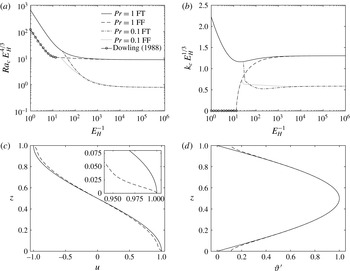
Linear stability of the Navier–Stokes equations for fixed temperature (FT) and fixed flux (FF) thermal boundary conditions. (a) Asymptotically scaled critical Rayleigh number and (b) critical wavenumber as a function of the inverse Ekman number for both steady (
 $Pr=1$
) and oscillatory (
 $Pr=0.1$
) convection. (c) Horizontal velocity and (d) temperature eigenfunctions for
 $Pr=1$
and
 $E_{H}=10^{-4}$
; the inset figure in (c) shows a magnified view of the Ekman layer along the bottom boundary. In (a) and (b) the solid line with open circles shows values calculated from the explicit formula of Dowling (Reference Dowling1988).

Figure 1 shows results from the linear stability calculations. Results are given for both steady (
 $Pr=1$
) and oscillatory (
 $Pr=0.1$
) convection; we note that oscillatory convection does not exist for
 $Pr\geqslant 1$
and becomes the primary instability for
 $Pr\lesssim 0.68$
(Chandrasekhar Reference Chandrasekhar1961). For
 $E_{H}\lesssim 10^{-5}$
, both the asymptotically scaled critical Rayleigh number
 $Ra_{c}E_{H}^{4/3}$
(figure 1
a) and the wavenumber
 $k_{c}E_{H}^{1/3}$
(figure 1
b) obtained from FT and FF boundary conditions are observed to converge to nearly equivalent values. For
 $E_{H}=10^{-6}$
, for instance, the differences in the critical parameters for the two cases are found to be
 $\ll 1\,\%$
. The solid line with open circles shows values calculated from the explicit formula of Dowling (Reference Dowling1988) for which the instability is characterized by
 $k_{c}=0$
.
Figure 1(c) shows the horizontal (
 $x$
) velocity eigenfunction for
 $E_{H}=10^{-4}$
, where Ekman layers can be seen at the top and bottom boundaries for the FF (dashed curve) case; a magnified view of the bottom Ekman layer is shown in the inset figure. The temperature perturbation eigenfunctions plotted in figure 1(d) show that both the FT and FF cases have identical structure in the fluid interior, whereas the two profiles differ significantly near the top and bottom boundaries. In the following section we present the asymptotic reduction of the Navier–Stokes equations to better understand and quantify this behaviour.
3. Asymptotics
To proceed with the asymptotic development, we follow the work of Sprague et al. (Reference Sprague, Julien, Knobloch and Werne2006) and write the governing equations using a generic non-dimensionalization such that
 $$\begin{eqnarray}\displaystyle & \displaystyle D_{t}\boldsymbol{u}+\frac{1}{Ro}\widehat{\boldsymbol{z}}\times \boldsymbol{u}=-Eu\boldsymbol{{\rm\nabla}}p+{\it\Gamma}{\it\theta}\widehat{\boldsymbol{z}}+\frac{1}{Re}{\rm\nabla}^{2}\boldsymbol{u}, & \displaystyle\end{eqnarray}$$
 $$\begin{eqnarray}\displaystyle & \displaystyle \boldsymbol{{\rm\nabla}}\boldsymbol{\cdot }\boldsymbol{u}=0, & \displaystyle\end{eqnarray}$$
 $$\begin{eqnarray}\displaystyle & \displaystyle D_{t}{\it\vartheta}=\frac{1}{Pr\,Re}{\rm\nabla}^{2}{\it\vartheta}, & \displaystyle\end{eqnarray}$$
 $D_{t}(\cdot )=\partial _{t}(\cdot )+\boldsymbol{u}\boldsymbol{\cdot }\boldsymbol{{\rm\nabla}}(\cdot )$
and the velocity, pressure and temperature are denoted by
 $\boldsymbol{u}$
,
 $p$
and
 ${\it\vartheta}$
respectively. The above system has been non-dimensionalized utilizing the velocity scale
 $U$
, length
 $L$
, time
 $L/U$
, pressure
 $P$
and temperature
 $\widetilde{T}$
. For the FT and FF cases the temperature scale becomes
 ${\rm\Delta}T$
and
 $Nu{\rm\Delta}T$
respectively. The Rossby, Euler, buoyancy and Reynolds numbers are defined by
 $$\begin{eqnarray}Ro=\frac{U}{2{\it\Omega}L},\quad Eu=\frac{P}{{\it\rho}_{0}U^{2}},\quad {\it\Gamma}=\frac{g{\it\alpha}\widetilde{T}L}{U^{2}},\quad Re=\frac{UL}{{\it\nu}}.\end{eqnarray}$$
In the present work we are interested in the
 ${\it\epsilon}\equiv Ro\rightarrow 0$
limit. In the fluid interior we employ multiple scales in the axial space direction and time such that
 $$\begin{eqnarray}\partial _{z}\rightarrow \partial _{z}+{\it\epsilon}\partial _{Z},\quad \partial _{t}\rightarrow \partial _{t}+{\it\epsilon}^{2}\partial _{{\it\tau}},\end{eqnarray}$$
where
 $Z={\it\epsilon}z$
is the large-scale vertical coordinate and
 ${\it\tau}={\it\epsilon}^{2}t$
is the ‘slow’ time scale. It has been shown that the following distinguished limits can be taken to reduce the governing equations to accurately model quasi-geostrophic convection (e.g. Sprague et al.
Reference Sprague, Julien, Knobloch and Werne2006):
 $$\begin{eqnarray}Eu=\frac{1}{{\it\epsilon}^{2}},\quad {\it\Gamma}=\frac{\widetilde{{\it\Gamma}}}{{\it\epsilon}},\quad Re=O(1),\quad Pr=O(1),\end{eqnarray}$$
where
 $\widetilde{{\it\Gamma}}=O(1)$
. On scaling the velocity viscously such that
 $U={\it\nu}/L$
we have
 $$\begin{eqnarray}{\it\epsilon}=E_{H}^{1/3},\quad \widetilde{{\it\Gamma}}=\frac{E_{H}^{4/3}Ra}{Pr},\quad Re=1,\end{eqnarray}$$
where we note that
 $L$
is the characteristic horizontal scale of convection and behaves as
 $L=HE_{H}^{1/3}$
in the limit of rapid rotation (Chandrasekhar Reference Chandrasekhar1961). Notably, this
 $L$
scaling can be derived from the linear axial vorticity equation by assuming a balance between axial vortex stretching and horizontal viscous diffusion. In dimensional terms, this becomes
 $2{\it\Omega}\partial _{z}w\approx {\it\nu}{\rm\nabla}^{2}{\it\zeta}$
, or
 $2{\it\Omega}U/H\sim {\it\nu}U/L^{3}$
, where
 ${\it\zeta}=\widehat{\boldsymbol{z}}\boldsymbol{\cdot }\boldsymbol{{\rm\nabla}}\times \boldsymbol{u}$
is the vertical vorticity; rearranging then yields
 $L\sim HE_{H}^{1/3}$
. We recall that the notation for the Rayleigh number is generic in the sense that
 $Ra$
denotes either
 $Ra_{FT}$
or
 $Ra_{FF}$
. Hereafter, we define the asymptotically reduced Rayleigh number as
 $\widetilde{Ra}\equiv E_{H}^{4/3}Ra=O(1)$
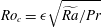
. The convective Rossby number then becomes
 $Ro_{c}={\it\epsilon}\sqrt{\widetilde{Ra}/Pr}$
, and is therefore assumed to be small in the present work.
We utilize a composite asymptotic expansion approach (e.g. Nayfeh Reference Nayfeh2008) and, following Heard & Veronis (Reference Heard and Veronis1971), decompose each variable into interior (i), middle (m) and Ekman layer (e) components. For instance, the dependent variable
 $f$
can be written as
 $$\begin{eqnarray}f=f^{(i)}(\boldsymbol{x},Z,t,{\it\tau})+f^{(m)}(x,y,{\it\xi},t)+f^{(e)}(x,y,{\it\eta},t),\end{eqnarray}$$
where
 ${\it\xi}=z$
and
 ${\it\eta}={\it\epsilon}^{-1/2}z$
are boundary layer variables. The above representation ensures that each dependent variable is uniformly valid throughout the domain. The boundary layer variables consist of a sum of contributions from the top and bottom boundary layers; for brevity, we focus on the bottom boundary layers. In the present work we make use of the following limits and notation:
 $$\begin{eqnarray}\displaystyle & \displaystyle \lim _{{\it\xi}\rightarrow \infty }(f^{(m)})=(f^{(m)})^{(i)}=\lim _{{\it\eta}\rightarrow \infty }(f^{(e)})=(f^{(e)})^{(m)}=(f^{(e)})^{(i)}=0, & \displaystyle\end{eqnarray}$$
 $$\begin{eqnarray}\displaystyle & \displaystyle \lim _{{\it\xi}\rightarrow 0}(f^{(i)})=(f^{(i)})^{(m)}=\lim _{{\it\eta}\rightarrow 0}(f^{(i)})=(f^{(i)})^{(e)}=f^{(i)}(Z=0)=f^{(i)}(0). & \displaystyle\end{eqnarray}$$
 $$\begin{eqnarray}f^{(i)}(\boldsymbol{x},Z,t)=f_{0}^{(i)}(\boldsymbol{x},Z,t,{\it\tau})+{\it\epsilon}^{1/2}f_{1/2}^{(i)}(\boldsymbol{x},Z,t,{\it\tau})+{\it\epsilon}f_{1}^{(i)}(\boldsymbol{x},Z,t,{\it\tau})+O({\it\epsilon}^{3/2}).\end{eqnarray}$$
Each dependent variable is further decomposed into mean and fluctuating components such that
 $$\begin{eqnarray}f^{(i)}(\boldsymbol{x},Z,t,{\it\tau})=\overline{f}^{(i)}(Z,{\it\tau})+f^{\prime (i)}(\boldsymbol{x},Z,t,{\it\tau}),\end{eqnarray}$$
where the horizontal averaging operator is defined by
 $$\begin{eqnarray}\overline{f}(Z,{\it\tau})=\lim _{[{\it\tau}],[A]\rightarrow \infty }\frac{1}{[{\it\tau}][A]}\int _{[{\it\tau}],[A]}f\,\text{d}x\,\text{d}y,\quad \text{and}\quad \overline{f^{\prime }}\equiv 0,\end{eqnarray}$$
where
 $A$
is the small-scale horizontal area.
3.1. The interior equations
By substituting decompositions for each variable of the form (3.8) into the governing equations and utilizing the limits (3.9)–(3.10), equations for each region can be derived; expansions of the form (3.11) are then utilized to determine the asymptotic behaviour of each fluid region. Because the derivation of the interior equations has been given many times previously, we present only the salient features and direct the reader to previous work (e.g. Sprague et al. Reference Sprague, Julien, Knobloch and Werne2006) for details on their derivation. The main point is that the interior convection is geostrophically balanced and horizontally divergence-free to leading order,
 $$\begin{eqnarray}\widehat{\boldsymbol{z}}\times \boldsymbol{u}_{0}^{(i)}=-{\rm\nabla}_{\bot }p_{1}^{(i)},\quad {\rm\nabla}_{\bot }\boldsymbol{\cdot }\,\boldsymbol{u}_{0,\bot }^{(i)}=0,\end{eqnarray}$$
where
 ${\rm\nabla}_{\bot }=(\partial _{x},\partial _{y},0)$
. The above relations allow us to represent the geostrophic velocity via the geostrophic streamfunction
 ${\it\psi}_{0}^{(i)}\equiv p_{1}^{\prime (i)}$
such that
 $\boldsymbol{u}_{0,\bot }^{(i)}=-\boldsymbol{{\rm\nabla}}\times {\it\psi}_{0}^{(i)}\widehat{\boldsymbol{z}}$
. The vertical vorticity is then
 ${\it\zeta}_{0}^{(i)}={\rm\nabla}_{\bot }^{2}{\it\psi}_{0}^{(i)}$
. The interior vertical vorticity, vertical momentum, fluctuating heat and mean heat equations then become
 $$\begin{eqnarray}\displaystyle & \displaystyle D_{t}^{\bot }{\it\zeta}_{0}^{(i)}-\partial _{Z}w_{0}^{\prime (i)}={\rm\nabla}_{\bot }^{2}{\it\zeta}_{0}^{(i)}, & \displaystyle\end{eqnarray}$$
 $$\begin{eqnarray}\displaystyle & \displaystyle D_{t}^{\bot }w_{0}^{\prime (i)}+\partial _{Z}{\it\psi}_{0}^{(i)}=\frac{\widetilde{Ra}}{Pr}{\it\vartheta}_{1}^{\prime (i)}+{\rm\nabla}_{\bot }^{2}w_{0}^{\prime (i)}, & \displaystyle\end{eqnarray}$$
 $$\begin{eqnarray}\displaystyle & \displaystyle D_{t}^{\bot }{\it\vartheta}_{1}^{\prime (i)}+w_{0}^{\prime (i)}\partial _{Z}\overline{{\it\vartheta}}_{0}^{(i)}=\frac{1}{Pr}{\rm\nabla}_{\bot }^{2}{\it\vartheta}_{1}^{\prime (i)}, & \displaystyle\end{eqnarray}$$
 $$\begin{eqnarray}\displaystyle & \displaystyle \partial _{{\it\tau}}\overline{{\it\vartheta}}_{0}^{(i)}+\partial _{Z}\overline{(w_{0}^{\prime (i)}{\it\vartheta}_{1}^{\prime (i)})}=\frac{1}{Pr}\partial _{Z}^{2}\overline{{\it\vartheta}}_{0}^{(i)}, & \displaystyle\end{eqnarray}$$
 $D_{t}^{\bot }(\cdot )=\partial _{t}(\cdot )+\boldsymbol{u}\boldsymbol{\cdot }{\rm\nabla}_{\bot }(\cdot )$
. The mean interior velocity field
 $\overline{\boldsymbol{u}}_{0}^{(i)}$
is zero and the mean momentum equation reduces to hydrostatic balance in the vertical,
 $\partial _{Z}\overline{p}_{0}^{(i)}=(\widetilde{Ra}/Pr)\overline{{\it\vartheta}}_{0}^{(i)}$
.
The interior system is fourth order with respect to the large-scale vertical coordinate
 $Z$
. Two boundary conditions are supplied by impenetrability such that
 $w_{0}^{\prime (i)}(0)=w_{0}^{\prime (i)}(1)=0$
. Although no
 $Z$
derivatives with respect to
 ${\it\vartheta}_{1}^{\prime (i)}$
are present in (3.17), evaluation of this equation at the boundaries shows that the FT conditions
 ${\it\vartheta}_{1}^{\prime (i)}(0)={\it\vartheta}_{1}^{\prime (i)}(1)=0$
are satisfied implicitly for the fluctuating temperature. Evaluation of (3.16) at either the top or bottom boundary with the use of impenetrability shows that stress-free boundary conditions are implicitly satisfied as well since
 $\partial _{Z}{\it\psi}_{0}^{(i)}(0)=\partial _{Z}{\it\psi}_{0}^{(i)}(1)=0$
.
For the case of FT thermal boundary conditions, we have
 $$\begin{eqnarray}\overline{{\it\vartheta}}_{0}^{(i)}(0)=1\quad \text{and}\quad \overline{{\it\vartheta}}_{0}^{(i)}(1)=0\quad (\text{FT}).\end{eqnarray}$$
Thus, for the FT case the boundary layer corrections are identically zero and the above system is complete. Numerous investigations have used the above system of equations to investigate rapidly rotating convection in the presence of stress-free mechanical boundary conditions and have shown excellent agreement with direct numerical simulations (DNS) of the Navier–Stokes equations (Stellmach et al. Reference Stellmach, Lischper, Julien, Vasil, Cheng, Ribeiro, King and Aurnou2014). In the presence of no-slip boundaries, order-one deviations in heat transfer are observed between simulations of the reduced equation set and DNS and laboratory experiments; these differences are thought to be the result of enhanced heat transfer due to Ekman pumping (Stellmach et al. Reference Stellmach, Lischper, Julien, Vasil, Cheng, Ribeiro, King and Aurnou2014; Aurnou et al. Reference Aurnou, Calkins, Cheng, Julien, King, Nieves, Soderlund and Stellmach2015).
For the FF case the mean temperature boundary conditions become
 $$\begin{eqnarray}\partial _{Z}\overline{{\it\vartheta}}_{0}^{(i)}(0)=-1\quad \text{and}\quad \partial _{Z}\overline{{\it\vartheta}}_{0}^{(i)}(1)=-1\quad (\text{FF}).\end{eqnarray}$$
We further require
 $\partial _{Z}{\it\vartheta}_{1}^{\prime (i)}(0)=\partial _{Z}{\it\vartheta}_{1}^{\prime (i)}(1)=0$
; boundary layer corrections are therefore required since these conditions are not satisfied by (3.17). In the following two subsections we determine the magnitude of these boundary layer corrections.
3.2. The middle layer equations
The first non-trivial fluctuating middle layer momentum equation occurs at
 $O({\it\epsilon})$
to yield the thermal wind balance
 $$\begin{eqnarray}\widehat{\boldsymbol{z}}\times \boldsymbol{u}_{2}^{\prime (m)}=-\boldsymbol{{\rm\nabla}}p_{3}^{\prime (m)}+\frac{\widetilde{Ra}}{Pr}{\it\vartheta}_{2}^{\prime (m)}\widehat{\boldsymbol{z}},\end{eqnarray}$$
such that
 ${\rm\nabla}_{\bot }\boldsymbol{\cdot }\,\boldsymbol{u}_{2}^{\prime (m)}=0$
and
 $w_{2}^{\prime (m)}\equiv 0$
. The mean velocity field
 $\overline{\boldsymbol{u}}_{2}^{(m)}\equiv 0$
.
The leading-order temperature equation for the middle layer is
 $$\begin{eqnarray}\partial _{t}{\it\vartheta}_{2}^{\prime (m)}+\boldsymbol{u}_{0}^{\prime (i)}(0)\boldsymbol{\cdot }{\rm\nabla}_{\bot }{\it\vartheta}_{2}^{\prime (m)}=\frac{1}{Pr}{\rm\nabla}^{2}{\it\vartheta}_{2}^{\prime (m)},\end{eqnarray}$$
with corresponding boundary conditions
 $$\begin{eqnarray}\partial _{Z}{\it\vartheta}_{1}^{\prime (i)}(0)+\partial _{{\it\xi}}{\it\vartheta}_{2}^{\prime (m)}(0)=0,\quad {\it\vartheta}_{2}^{\prime (m)}({\it\xi}\rightarrow \infty )\rightarrow 0.\end{eqnarray}$$
We find the first non-trivial mean temperature to be of magnitude
 $O({\it\epsilon}^{5})$
(i.e.
 $\overline{{\it\vartheta}}^{(m)}={\it\epsilon}^{5}\overline{{\it\vartheta}}_{5}^{(m)}\neq 0$
) and therefore omit any further consideration of this correction.
The first three orders of the stress-free mechanical boundary conditions along the bottom boundary become
 $$\begin{eqnarray}\partial _{Z}\boldsymbol{u}_{0,\bot }^{\prime (i)}(0)=0,\quad \partial _{Z}\boldsymbol{u}_{1/2,\bot }^{\prime (i)}(0)=0,\quad \partial _{Z}\boldsymbol{u}_{1,\bot }^{\prime (i)}(0)+\partial _{{\it\xi}}\boldsymbol{u}_{2,\bot }^{\prime (m)}(0)+\partial _{{\it\eta}}\widetilde{\boldsymbol{u}}_{0}^{\prime (e)}(0)=0.\end{eqnarray}$$
Thus, the first two orders of the interior velocity satisfy stress-free conditions on their own and therefore need no boundary layer correction. Here, we have rescaled the Ekman layer velocity according to
 $\boldsymbol{u}_{5/2}^{\prime (e)}={\it\epsilon}^{5/2}\widetilde{\boldsymbol{u}}_{0}^{\prime (e)}$
; this rescaling is simply highlighting the fact that the Ekman layer velocities are significantly weaker than those in the interior.
3.3. The Ekman layer equations
The Ekman layer equations have been studied in great detail in previous work (e.g. Greenspan Reference Greenspan1968), so we simply state the leading-order continuity and momentum equations as
 $$\begin{eqnarray}{\rm\nabla}_{\bot }\boldsymbol{\cdot }\,\widetilde{\boldsymbol{u}}_{0}^{\prime (e)}+\partial _{{\it\eta}}\widetilde{w}_{1/2}^{\prime (e)}=0,\quad \widehat{\boldsymbol{z}}\times \widetilde{\boldsymbol{u}}_{0}^{\prime (e)}=\partial _{{\it\eta}}^{2}\widetilde{\boldsymbol{u}}_{0}^{\prime (e)},\end{eqnarray}$$
where
 $w_{3}^{\prime (e)}={\it\epsilon}^{3}\widetilde{w}_{1/2}^{\prime (e)}$
. All of the mean Ekman layer variables can be shown to be zero. A key component in the present analysis that differs from previous work is the middle thermal wind layer that enters the Ekman layer solution via the stress-free boundary conditions (3.24a−c
). On utilizing the thermal wind relations for the middle layer that follow from equation (3.21),
 $$\begin{eqnarray}\partial _{{\it\xi}}u_{2}^{\prime (m)}=-\frac{\widetilde{Ra}}{Pr}\partial _{y}{\it\vartheta}_{2}^{\prime (m)},\quad \partial _{{\it\xi}}v_{2}^{\prime (m)}=\frac{\widetilde{Ra}}{Pr}\partial _{x}{\it\vartheta}_{2}^{\prime (m)},\end{eqnarray}$$
the stress-free boundary conditions along the bottom boundary can be written as
 $$\begin{eqnarray}\partial _{Z}\boldsymbol{u}_{1,\bot }^{\prime (i)}(0)+\frac{\widetilde{Ra}}{Pr}{\rm\nabla}^{\bot }{\it\vartheta}_{2}^{\prime (m)}(0)+\partial _{{\it\eta}}\widetilde{\boldsymbol{u}}_{0}^{\prime (e)}(0)=0,\end{eqnarray}$$
where
 ${\rm\nabla}^{\bot }=(-\partial _{y},\partial _{x},0)$
. Solving the Ekman layer momentum equations for the horizontal components of the velocity field with the additional requirement that
 $(\widetilde{u}_{0}^{\prime (e)},\widetilde{v}_{0}^{\prime (e)})\rightarrow 0$
as
 ${\it\xi}\rightarrow \infty$
, the continuity equation is then used to find the Ekman pumping velocity
 $$\begin{eqnarray}\widetilde{w}_{1/2}^{\prime (e)}=\left[\partial _{Z}{\it\zeta}_{1}^{(i)}(0)+\frac{\widetilde{Ra}}{Pr}{\rm\nabla}_{\bot }^{2}{\it\vartheta}_{2}^{\prime (m)}(0)\right]\text{e}^{-{\it\eta}/\sqrt{2}}\cos \left(\frac{{\it\eta}}{\sqrt{2}}\right).\end{eqnarray}$$
Thus, vertical velocities of magnitude
 $O({\it\epsilon}^{3})$
are induced by FF thermal boundary conditions and result from both finite viscous stresses within the fluid interior and horizontal variations of the temperature within the middle layer. This finding is closely analogous to the Ekman pumping effect first reported by Hide (Reference Hide1964) for shallow layer quasi-geostrophic flow in the presence of lateral temperature variations along a free surface. Evaluating (3.28) at
 ${\it\eta}=0$
provides a parameterized boundary condition for the effects of Ekman pumping.
The small magnitude of the Ekman pumping velocity (3.28) results in very weak
 $O({\it\epsilon}^{5})$
temperature fluctuations within the Ekman layer. Because of this, the dominant correction of the FF thermal boundary conditions occurs within the middle layer and we do not consider the Ekman layer temperature any further.
3.4. Synthesis
The thermal boundary layer correction given by (3.23) is passive in the sense that
 ${\it\vartheta}_{2}^{\prime (m)}$
can be calculated a posteriori with knowledge of
 ${\it\vartheta}_{1}^{\prime (i)}$
. Thus, the leading-order interior dynamics is insensitive to the thermal boundary conditions. The Ekman layer analysis shows that the first six orders of the interior vertical velocity satisfy the impenetrable mechanical boundary conditions
 $w_{i}^{\prime (i)}(0)=0$
, for
 $i=0,\ldots ,5/2$
. At
 $O({\it\epsilon}^{3})$
we have the Ekman pumping boundary conditions
 $$\begin{eqnarray}w_{3}^{\prime (i)}(0)=-w_{3}^{\prime (m)}(0)-\partial _{Z}{\it\zeta}_{1}^{(i)}(0)-\frac{\widetilde{Ra}}{Pr}{\rm\nabla}_{\bot }^{2}{\it\vartheta}_{2}^{\prime (m)}(0),\end{eqnarray}$$
where we have used the Ekman pumping relation (3.28) evaluated at
 ${\it\eta}=0$
. From the standpoint of linear theory, the first correction to the critical Rayleigh number will therefore occur at
 $O({\it\epsilon}^{3})$
; this explains the linear behaviour previously discussed in § 2. Although the above velocity correction is asymptotically weak, we note that it may be possible to identify this additional circulation in DNS studies by employing the method outlined by Kunnen, Clercx & Geurts (Reference Kunnen, Clercx and Geurts2013).
4. Discussion
In light of the boundary layer analysis, we conclude that the leading-order quasi-geostrophic dynamics is described by equations (3.15)–(3.18) for both FT and FF thermal boundary conditions. Indeed, inspection of the system shows that it is invariant under the following rescaling of the Rayleigh numbers and temperature variables:
 $$\begin{eqnarray}\widetilde{Ra}_{FT}=\frac{\widetilde{Ra}_{FF}}{Nu},\quad {\it\vartheta}_{1,FT}^{\prime (i)}=Nu\,{\it\vartheta}_{1,FF}^{\prime (i)},\quad \overline{{\it\vartheta}}_{0,FT}^{(i)}=Nu\,\overline{{\it\vartheta}}_{0,FF}^{(i)}.\end{eqnarray}$$
Integration of the time-averaged mean heat equation with respect to
 $Z$
yields
 $$\begin{eqnarray}\displaystyle & \displaystyle Pr\overline{(w_{0}^{\prime (i)}{\it\vartheta}_{1,FT}^{\prime (i)})}=\partial _{Z}\overline{{\it\vartheta}}_{0,FT}^{(i)}+Nu\quad (\text{FT}), & \displaystyle\end{eqnarray}$$
 $$\begin{eqnarray}\displaystyle & \displaystyle Pr\overline{(w_{0}^{\prime (i)}{\it\vartheta}_{1,FF}^{\prime (i)})}=\partial _{Z}\overline{{\it\vartheta}}_{0,FF}^{(i)}+1\quad (\text{FF}), & \displaystyle\end{eqnarray}$$
 $Z=0$
in the above relations. Taking either (4.2) or (4.3) and utilizing (4.1a−c
) shows that the mean interior temperature gradient is described by identical equations for the two cases.
The above results indicate that the findings of previous work on low-Rossby-number convection employing FT thermal boundary conditions can be accurately applied to the case of FF thermal boundary conditions by use of the rescalings given by (4.1a−c
). Julien et al. (Reference Julien, Rubio, Grooms and Knobloch2012b
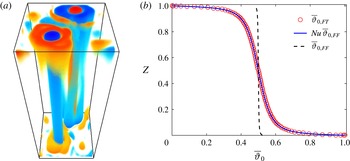
) identified four flow regimes that occur in rapidly rotating convection as a function of the Prandtl and (FT) Rayleigh numbers. The so-called ‘convective Taylor column’ (CTC) regime is distinguished by coherent vertically aligned convective structures that span the depth of the fluid. Figure 2(a) shows a volumetric rendering of the temperature perturbation for
 $Pr=7$
and
 $\widetilde{Ra}_{FT}=46.74$
, or
 $\widetilde{Ra}_{FF}=1000$
and
 $Nu=21.39$
; this case was computed explicitly with FF thermal boundary conditions. The CTC regime occurs over the FT Rayleigh number range of
 $20\lesssim \widetilde{Ra}_{FT}\lesssim 55$
, corresponding to an FF Rayleigh number range of
 $82\lesssim \widetilde{Ra}_{FF}\lesssim 1656$
(e.g. see Nieves, Rubio & Julien Reference Nieves, Rubio and Julien2014). Figure 2(b) shows mean temperature profiles obtained utilizing the FT and FF thermal boundary conditions, along with the remapped FF mean temperature profile. The Nusselt number
 $Nu=21.39$
corresponds to a mean temperature difference of
 $0.0468$
between the top and bottom boundaries for the FF case. Given that the mapping defined by (4.1a−c
) is independent of the Prandtl number, we note that the rescaling shown in figure 2(b) can be carried out for any Prandtl number.
Of particular interest in convection studies is the dependence of the heat transfer scaling on the strength of the thermal forcing input via Nusselt–Rayleigh number scalings of the form
 $Nu\sim \widetilde{Ra}_{FT}^{{\it\alpha}}$
. With the rescaling given in (4.1a−c
) the FF equivalent of this relation becomes
 $Nu\sim \widetilde{Ra}_{FF}^{{\it\beta}}$
, where
 ${\it\beta}={\it\alpha}/({\it\alpha}+1)$
. For the CTC regime the exponent is
 ${\it\alpha}\approx 2.1$
(Julien et al.
Reference Julien, Rubio, Grooms and Knobloch2012b
), yielding
 ${\it\beta}\approx 0.68$
. Additionally, the final regime of geostrophic turbulence achieves a dissipation-free scaling law with
 ${\it\alpha}=3/2$
such that
 ${\it\beta}=3/5$
(Julien et al.
Reference Julien, Knobloch, Rubio and Vasil2012a
). Similarly, the dependence of all other variables of interest on the Rayleigh number (e.g. mean temperature gradient, vorticity, etc.) can also be remapped to the case of FF thermal boundary conditions.
(a) An example volumetric rendering of the temperature perturbation from a simulation of the quasi-geostrophic convection equations showing the ‘convective Taylor column’ (CTC) regime. (b) Mean temperature profiles obtained with both FT (solid blue) and FF (dashed black) boundary conditions, and the rescaled FF temperature profile (red open circles). The parameters are
 $\mathit{Pr}=7$
,
 $\widetilde{Ra}_{FT}=46.74$
,
 $\widetilde{Ra}_{FF}=1000$
and
 $Nu=21.39$
.

5. Conclusion
In this work we have shown that the leading-order dynamics of rapidly rotating convection in a plane layer geometry are equivalent for both FT and FF thermal boundary conditions. Fixed flux thermal boundary conditions give rise to a double boundary layer structure in the limit of rapid rotation that induces a vertical mass flux, or Ekman pumping, that is given explicitly by (3.28). The Ekman pumping velocity is asymptotically weak, however, and we conclude that all previous work employing FT thermal boundary conditions also accurately describes FF thermal boundary conditions as long as the Rossby number remains small. Practically speaking, the influence of rotation can be expected to be strong when
 $Ro\lesssim 0.1$
(e.g. Vorobieff & Ecke Reference Vorobieff and Ecke2002; Horn & Shishkina Reference Horn and Shishkina2015). Our findings imply that the reduced quasi-geostrophic model defined by (3.15)–(3.18) applies to both FT and FF thermal boundary conditions within the regime of asymptotic validity, i.e.
 $Ro\sim E_{H}^{1/3}\ll 1$
,
 $E_{H}\ll Pr$
and
 $\widetilde{Ra}\lesssim \mathit{O}(E_{H}^{-1/3})$
(Julien et al.
Reference Julien, Knobloch, Rubio and Vasil2012a
). For
 $Pr=O(E_{H})$
, rapid oscillations occur such that the inertia can be large enough to balance the Coriolis and pressure gradient forces (Zhang & Roberts Reference Zhang and Roberts1997), whereas the bound on
 $\widetilde{Ra}$
further ensures that the Rossby number remains small.
The influence of both thermal and mechanical boundary conditions on non-rotating convection has received significant attention (e.g. Johnston & Doering Reference Johnston and Doering2009; van der Poel et al. Reference van der Poel, Ostilla-Mónico, Verzicco and Lohse2014). For the case of rotating convection, plane layer investigations have shown that both no-slip and stress-free mechanical boundary conditions yield similar convective dynamics (King et al. Reference King, Stellmach, Noir, Hansen and Aurnou2009; Schmitz & Tilgner Reference Schmitz and Tilgner2010), though the presence of Ekman pumping for no-slip boundary conditions is now known to significantly enhance heat transfer in comparison to stress-free simulations (Kunnen, Clercx & Geurts Reference Kunnen, Clercx and Geurts2006; Stellmach et al. Reference Stellmach, Lischper, Julien, Vasil, Cheng, Ribeiro, King and Aurnou2014). To date, studies investigating the role of thermal boundary conditions on nonlinear rotating convection have been focused solely on spherical geometries. Zhang & Gubbins (Reference Zhang and Gubbins1993) showed that convection cells in a rotating spherical shell can resonate with inhomogeneous (spatially varying) temperature boundary conditions. A subsequent investigation by Davies, Gubbins & Jimack (Reference Davies, Gubbins and Jimack2009) has shown that resonance is dependent upon both the rotation rate and the spatial scale of the thermal anomaly along the outer boundary, with resonance vanishing when the scale of the temperature variation is comparable to the most unstable wavelength and the rotation rate of the system is large. Our asymptotic analysis complements these previous numerical findings and rigorously shows that any horizontal thermal variation along the boundaries that varies on the scale of the convection, as allowed for with FF thermal boundary conditions, has no leading-order influence on the interior convection. However, we note that resonance can occur when the spatial scale of the thermal anomaly is comparable to the vertical scale of convection (Davies et al. Reference Davies, Gubbins and Jimack2009); this is the mechanism likely to cause significant changes in the magnetic and velocity fields observed in spherical dynamo simulations with FF boundary conditions (Sakuraba & Roberts Reference Sakuraba and Roberts2009, Reference Sakuraba, Roberts, Petrovskỳ, Ivers, Harinarayana and Herrero-Bervera2011).
Acknowledgements
This work was supported by the National Science Foundation under grants EAR no. 1320991 (M.A.C. and K.J.), EAR CSEDI no. 1067944 (K.J. and P.M.) and DMS EXTREEMS no. 1407340 (D.D.).