Introduction
The playing of videogames is a rapidly growing leisure activity worldwide. Since the advent of the massively multiplayer online role-playing games (MMORPGs) in the early 2000s, games like World of Warcraft have allowed players to engage online with one another via online gaming platforms (GamesIndustry International 2004). More recently, the gaming landscape has been dominated by newer gaming platforms such as multiplayer online battle arena (MOBA) games and online multiplayer battle royale games (Wepc 2019). MOBA games (e.g. League of Legends) consist of players forming teams to complete against each other in combat situations (Meng et al. Reference Meng, Williams and Shen2015). Online Multiplayer Battle Royale games (e.g. Player Unknown’s Battlegrounds [PUBG], Fortnite) pit individuals or teams against each other in a ‘last-man-standing’ combat format (Mamun & Griffiths Reference Mamun and Griffiths2019). These games are immensely popular, with Fortnite reaching a peak of 3.4 million players worldwide concurrently online in August 2018 (Chalk Reference Chalk2018). In Ireland, a recent survey conducted by a telecommunication company reported that 36% of the Irish adult population currently engage in online gaming (O’Brien Reference O’Brien2019).
The structural characteristics of these genres make them ideal candidates for use in esports. Esports are ‘competitive (pro and amateur) video gaming that is often coordinated by different leagues, ladders, and tournaments, and where players customarily belong to teams or other “sporting” organisations who are sponsored by various business organisations’ (Hamari & Sjöblom Reference Hamari and Sjöblom2017: 211). Esports have garnered significant Irish media interest in recent years, from Ireland hosting its first esports event in May 2018 (Cocking Reference Cocking2018) to an Irish teenager winning $50,000 for his high finishing position in the Fortnite World Cup (Pollak & Gallagher Reference Pollak and Gallagher2019). With these new popular platforms for online gaming, there has been an increase in gaming revenue. The videogame market in 2017 generated over $78 billion (US) (Wepc 2019) and this figure is predicted to rise to as much as $300 billion (US) by the year 2025 (Lanier Reference Lanier2019).
With the increased popularity and usage of gaming, there is an increased risk of the development of gaming disorder among a minority of individuals (Mihara & Higuchi Reference Mihara and Higuchi2017). Gaming disorder was recently introduced into the International Classification of Diseases and Related Health Problems (ICD-11) under ‘Disorders due to substance misuse or addictive behaviours’ (World Health Organization 2018). Gaming disorder is classified as persistent or recurrent online or offline gaming behaviours that display impaired control over gaming, increased priority given to gaming over other pursuits, and continuation of gaming despite harmful consequences (World Health Organization 2018). It is important to state that, for the majority of individuals, gaming and online gaming are a pleasurable, recreational pursuit that can have positive social and emotional benefits (Columb et al. Reference Columb, Griffiths and O’Gara2019). However, for the individuals affected by gaming disorder, it can have personal, social, and emotional consequences (Columb et al. Reference Columb, Griffiths and O’Gara2019).
Gaming disorder has an estimated prevalence worldwide of up to 4.7% (Feng et al. Reference Feng, Ramo, Chan and Bourgeois2017) with higher prevalence in males compared to females (Mihara & Higuchi Reference Mihara and Higuchi2017). In Ireland, there are no data available on the prevalence of gaming disorder or the characteristics and behaviours of individuals engaging in playing videogames. In addition, there are very few treatment facilities available for gaming disorder in Ireland. This raises concerns because young patients are already presenting to psychiatrists in Ireland seeking treatment for gaming disorder as stated in an interview with Dr Gerry McCarney, a Consultant Child and Adolescent Psychiatrist working in Ireland (Kelleher Reference Kelleher2019). Given the lack of data in Ireland in relation to gaming and gaming disorder, the aim of this study was to examine the gaming characteristics of individuals engaging in online gaming in Ireland and to ascertain whether features of gaming disorder are present in this population.
Methods
Participants
Between November 2018 and April 2019, 166 participants engaged in an online survey focusing on gaming characteristics and gaming addiction. The survey questionnaire was posted on numerous Irish online gaming forums (Boards.ie Gaming [General] forum, League of Legends Ireland forum, and PC Gaming Ireland forum), as well as an Irish online gaming community (Irish Gamers Community). A short explanation of the study was posted along with a link to the survey. An information sheet detailing the outline of the study, the reasons behind the study, how the participant’s data would be used, the risks and benefits of the study as well as the relevant General Data Protection Regulation (GDPR) information was provided at the beginning of the survey. A consent form followed this information sheet confirming their understanding of the information sheet, their voluntary agreement to participate in the study, their understanding of how their data would be used, and their opportunity to ask questions prior to completing the questionnaire. Ethical approval was obtained from the Human Research Ethics Committee of University College Dublin.
Survey design
The survey comprised 21 questions with three demographic questions and 18 questions related to gaming and gaming disorder. Demographic questions consisted of age, gender, and nationality. Gaming questions enquired about age of onset of gaming and the hours spent gaming (on weekends and weekdays). Participants were asked to select the games they regularly played from a list of 27 popular online games. The type of device used for gaming (console gaming, mobile gaming, personal computer [PC] gaming) and frequency of use of these devices were enquired about on an eight-point Likert scale (‘I do not use this type of device’ to ‘every day’).
Mobile gaming questions were included in the survey including age of onset of mobile gaming and the hours spent mobile gaming (on weekends and weekdays). The frequency of play of the most popular mobile games was assessed using an eight-point Likert scale (no play to every day). The mobile games assessed were Candy Crush Saga, Fortnite, Pokemon Go!, Toon Blast, Candy Crush Soda Saga, Clash of Clans, ROBLOX, Guns of Glory, Dragon Ball Z and Dokkan Battle, based on the most popular games available on mobile devices.
The survey included two psychometric scales related to gaming and gaming disorder – the nine-item Internet Gaming Disorder Scale – Short Form (IGDS9-SF) and the Motives for Online Gaming Questionnaire (MOGQ). The IGDS9-SF is a brief, reliable, and valid scale (Pontes & Griffiths Reference Pontes and Griffiths2015) comprising nine questions responded to on a five-point Likert scale from 1 (‘never’) to 5 (‘very often’) based on the criteria for Internet Gaming Disorder outlined in the Diagnostic and Statistical Manual of Mental Disorders (DSM-5; American Psychiatric Association 2013). Scores can range from 9 to 45. Endorsing five or more items out of nine in the most severe range (i.e. 5) indicates gaming disorder. The Motives for Online Gaming Questionnaire is a 27-item scale assessing seven main motives for online gaming (social, escape, competition, coping, skill development, fantasy, and recreation) (Demetrovics et al. Reference Demetrovics, Urbán, Nagygyörgy, Farkas, Zilahy, Mervó, Reindl, Ágoston, Kertész and Harmath2011). Questions are responded to on a five-point Likert scale from 1 (‘almost never’) to 5 (‘almost always/always’) with a minimum score of 4 for each factor (3 for Recreation) and a maximum of 20 for each factor (15 for Recreation).
Additionally, there were questions related to the use of microtransactions in gaming, watching/participating in esports, and gambling on esports. Questions concerning microtransactions (in-game purchases that unlock specific features or give players special abilities, characters, or content) focused on the participants use of microtransactions, the type of microtransaction used [in-game currencies, random chance purchases/loot boxes, in-game advantages, expiration (purchases to continue playing when time-limit)], and the estimated amount of money spent on microtransactions over the past year. Esports questions enquired about participants’ engagement in esports, gambling on esports events (if any), and the amount of money spent gambling on esports.
Data analysis
Descriptive statistics were performed on all 18 questions in relation to gaming included in the survey. Variables included age at which the participant commenced online videogames, hours spent playing online on weekdays/weekends, type of game played, type of device used, and frequency of use and mobile gaming. Based on the IGDS9-SF score, endorsing five or more items out of the nine items in the most severe range (scoring five points on each item) indicates gaming disorder. The proposed scoring of scoring of 36 or more out of 45 on the overall scale also indicated disordered gaming (Pontes & Griffiths Reference Pontes and Griffiths2015). Responses from the MOGQ questionnaire were ranked based on the highest scoring for each of the seven main motives for online gaming.
Results
Participants
A total of 166 participants completed the online survey between November 2018 and April 2019. Of these 166 participants, males accounted for 154 participants (92.8%), females accounted for 10 participants (6.0%), and ‘other’ accounted for two participants (1.2%). The average age of the population was 30.1 years (sd = 8.1 years). Male participants had an average age of 30.5 years (sd = 8.2 years), female participants had an average age of 24.5 years (sd = 4.6 years), and participants listed as ‘other’ had an average age of 28 years (sd = 11.3 years). In relation to nationality, Irish accounted for 148 (89.2%) of the study population with other nationalities comprising UK (4.8%) and Lithuanian (1.2%), with the remaining 4.8% being Latvian, Polish, Swedish, Portuguese, Hungarian, South African, and Croatian. Although country of residence was not enquired about, two participants stated that they have lived in Ireland since childhood.
Gaming behaviours
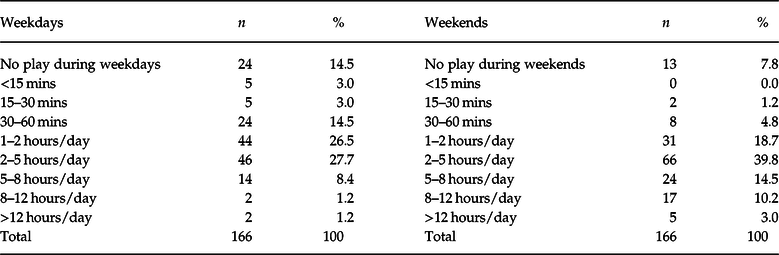
The average age at which participants began to play videogames was 14.1 years (sd = 6.8). In relation to hours spent online gaming during the weekdays, the full results are listed in Table 2. The most frequent time spent gaming was between 2 and 5 hours/day on both weekdays and weekends, with 28.0% participants playing between 2 and 5 hours/day on weekdays and 40.2% participants playing between 2 and 5 hours/day on weekends. The time periods of 1–2 hours/day and 2–5 hours/day combined accounted for the majority of time spent playing online, with 54.2% on weekdays and 58.5% on weekends. A total of 14.5% stated that they did not play videogames online on weekdays, and 7.8% stated that they did not play videogames online on weekends.
Hours spent online gaming

Microtransactions used by Irish gamers

Money spent on microtransactions during gaming

Motives for online gaming

Games played online
Out of 27 games listed, the 10 most popular game played online by our participants were Battlefield (27.1%) followed by PlayerUnknown’s Battlegrounds (25.9%), League of Legends (24.1%), Grand Theft Auto V (24.1%), Call of Duty (21.1%), Overwatch (20.5%), Fortnite: Battle Royale (19.9%), Rocket League (16.9%), Destiny 2 (16.3%) and Counter-Strike: Global Offensive (13.3%). The most popular genre of game in the top 10 were first-person shooter (FPS) games (Battlefield, Call of Duty, Destiny 2, Counter-Strike: Global Offensive, Overwatch) with 50% of the top 10 games within in this genre. The next most common genre in the top 10 games listed was Online Multiplayer Battle Royale (PlayerUnknown’s Battlegrounds, Fortnite: Battle Royale) followed by MOBA (League of Legends), action-adventure videogame (GTA V), and vehicular soccer videogame (Rocket League) (Table 1).
Devices used for online gaming
The most commonly used devices for online gaming were PC gaming and console gaming (e.g. Xbox, PlayStation) with 69.9% and 69.9% respectively using these devices to game online. While both these devices had an equal number of participants using them, PC gaming was used on a more frequent basis compared to console gaming. A total of 50.9% participants engaged in online gaming daily via PC compared to 19.0% participants engaging in online gaming via console gaming. Only 12.9% participants using PC gaming played less than once per week compared to console gaming (44.0%). A combination of PC and console gaming was used by 42.2% participants. Only 9.0% used both devices on a regular basis (greater than 2–4 times per week).
Mobile gaming
A total of 43.4% participants stated that they played mobile games. The most popular game played by our participants was Pokemon Go!, with 43.1% of participants using mobile gaming, followed by Fortnite (34.7%), Candy Crush Saga (27.8%), Clash of Clans (20.8%), ROBLOX (20.8%), Toon Blast (19.4%), Candy Crush Soda Saga (18.1%), Guns of Glory (18.1%) and Dragon Bal Z Dokkan (16.7%). Of all the mobile games surveyed, only three were played every day – Pokemon Go (n = 6), Candy Crush Saga (n = 2) and Toon Blast (n = 1). All 72 participants answered the question in relation to their age commencing mobile gaming, with an average age of 20.8 years (sd = 8.2 years)
Microtransactions
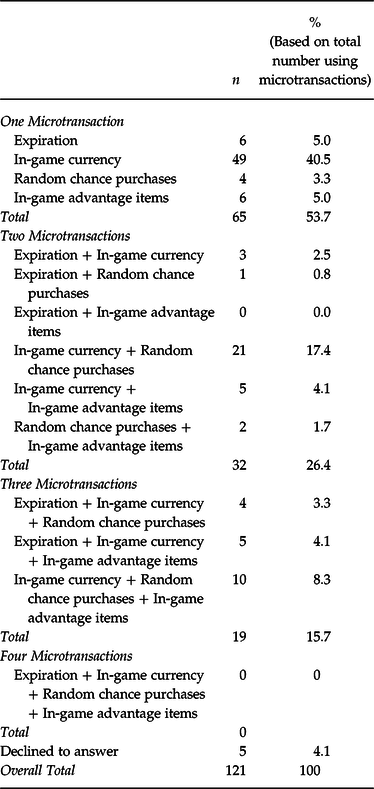
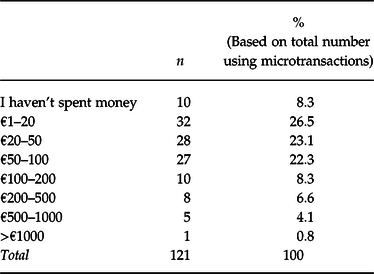
In total, 72.9% participants stated that they had made microtransactions while gaming. Of the participants that had made microtransactions, 83.6% had used in-game currencies, 36.2% had used random chance purchases, 25.9% had used in-game advantage items, and 16.3% had used expiration microtransactions. Over half (53.7%) made only one type of microtransaction, 26.4% had made two types of microtransaction, 15.7% had made three different types of microtransaction, and no participants had made all four types of microtransactions. Five participants declined to answer (4.1%). The most common combination of microtransactions used was in-game currencies and random chance purchases (17.4%). Of the money spent on microtransactions, the most frequent amount spent was €1–€20 per year (26.5%), followed by €20–€50 (23.1%), €50–€100 (22.3%), €100–€200 (8.3%), €200–€500 (6.6%), €500–€1000 (4.1%), and >€1000 (0.8%) (Tables 2 and 3).
Motives for online gaming
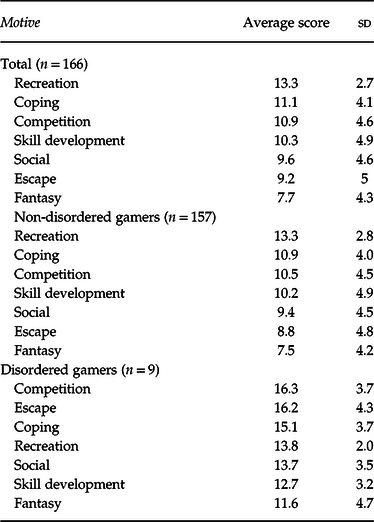
Each motivation was ranked based on the total score from each of the questions related to one of the seven motives for online gaming. Each question was scored between one and five based on the Likert scale ranging from ‘almost never’ to ‘almost always/always’. The main motivation for online gaming was recreation (13.3, sd = 2.7). This was followed by coping (11.1, sd = 4.1), competition (10.9, sd = 4.6), skill development (10.3, sd = 4.9), social (9.6, sd = 4.6), escape (9.2, sd = 5), and fantasy (7.7, sd = 4.3). The main motivations for online gaming for non-disordered gamers (94.6%) were recreation (13.3, sd = 2.8), coping (10.9, sd = 4.0), competition (10.5, sd = 4.5), skill development (10.2, sd = 4.9), social (9.4, sd = 4.5), escape (8.8, sd = 4.8), and fantasy (7.5, sd = 4.2). The main motivations for online gaming for disordered gamers (5.4%) were competition (16.3, sd = 3.7), escape (16.2, sd= 4.3), coping (15.1, sd = 3.7), recreation (13.8, sd = 2.0), social (13.7, sd = 3.5), skill development (12.7, sd = 3.2), and fantasy (11.6, sd = 4.7) (Table 4).
Esport gaming
Half of the total participants (50%) stated that they had participated in or watched esports. However, only 11.4% stated that they had gambled on an esport event. Of the 19 participants that engaged in gambling on esports events, 17 participants (89.5%) gambled less than once per month on esports, with one participant gambling once per month, and one participant gambling 2–3 times per month. In relation to the amount of money spent on gambling on esports in the past year, eight participants spent between €1 and €20 per year, five spent between €20 and €50, 2 (10.5%) spent between €50 and €100, one (5.3%) spent between €100 and €200, and one (5.3%) spent between €200 and €500. Two participants declined to answer how much they had spent on esports.
Disordered gamers
Based on the criteria listed for disordered gaming (see Methods), four participants (2.4%) met the IGDS9-SF criteria for disordered gaming. By using the proposed scale cut-off of 36 points or greater meant that nine participants (5.4%) were classified as having gaming disorder. However, it must be reiterated that this is a suggested cut-off point for diagnosis of gaming disorder and is for research purposes only, and that the current IGDS-SF9 criteria are used worldwide. Of the nine participants identified as disordered gamers and gamers with high IGDS-SF9 scores, eight were male. A total of 12.7% participants had scores between 27 and 36, 48.8% had scores between 18 and 27, and 33.1% had scores between 9 and 18 (the lowest score achievable on the scale is 9). The average age by disordered gamers commencing the playing of videogames was 12 years (sd = 5.4 years). Hours spent gaming on weekdays were 2–5 hours/day (n = 4), 1–2 hours/day (n = 2), 5–8 hours/day (n = 2), and >12 hours/day (n = 1). The hours spent gaming at the weekend were most frequently 8–12 hours/day (n = 3) and >12 hours/day (n = 3), followed by 30–60 mins/day (n = 1), 2–5 hours/day (n = 1), and 5–8 hours/day (n = 1). PCs was the most used device for online gaming, with eight disordered gamers using PCs either most days (4–6 times a week) or every day. In comparison, two disordered gamers stated they use consoles to the same frequency. The most commonly made microtransactions in the disordered gamer group were in-game currencies (n = 7), random chance purchases (n = 3), in-game advantage items (n = 2), and expiration (n = 2). The most frequent amount of money spent on microtransactions was €200–€500 (n = 4) followed by €20–€50 (n = 2), €50–€100 (n = 2), and €1–€20 (n = 1). Eight disordered gamers watched and/or participated in esports but only four of them had gambled on esports, all with a frequency of less than once per month.
Discussion
The aim of this study was to examine the gaming characteristics of individuals engaging in online gaming in Ireland and to ascertain whether features of gaming disorder are present in this population. The majority of the participants were male (92.8%), which is consistent with males using videogames more regularly than females (Mentzoni et al. Reference Mentzoni, Brunborg, Molde, Myrseth, Skouverøe, Hetland and Pallesen2011). The percentage of male respondents in this survey was only slightly higher than other studies utilising an online recruitment strategy, with males accounting for 77% (Hussain et al. Reference Hussain, Griffiths and Baguley2012) and 85% (Pontes et al. Reference Pontes, Kiraly, Demetrovics and Griffiths2014) of the researched population. The average age of the participants surveyed was 30.1 years (sd = 8.1), in line with other studies investigating adult populations in gaming disorder (Griffiths et al. Reference Griffiths, Davies and Chappell2004b).
This survey identified four participants as endorsing the IGDS9-SF criteria for gaming disorder (2.4%). The worldwide prevalence of gaming disorder is estimated at being up to 4.7% (Feng et al. Reference Feng, Ramo, Chan and Bourgeois2017) and the present study looked at two different cut-off points using the same scale to meet criteria for gaming disorder. Four participants (2.4%) met the standard cut-off point of endorsing five or more out of nine items in the most severe range on the IGDS9-SF and nine participants scored greater than 36 out of 45 on the IGDS9-SF scale (5.4%). Based on this study, the prevalence of gaming disorder among regular gamers using IGDS9-SF criteria in Ireland is 2.4%. Using research-based cut-off criteria (scoring 36 or more out of 45), the prevalence rate increased to 5.4% of participants with possible gaming disorder.
The average age in which participants began online gaming was 14.1 years old and the average age in which our disordered gamers began to engage in online gaming was 12 years old. This appears to confirm previous studies which note that younger age of onset in online gaming has been associated with an increased risk of developing gaming disorder (Lopez-Fernandez et al. Reference Lopez-Fernandez, Honrubia-Serrano, Baguley and Griffiths2014) as well as years spent online gaming (Gentile Reference Gentile2009).
The average time spent gaming during the weekdays and the weekends was 2–5 hours/day, with the majority of participants engaging between 1 and 5 hours/day on both weekdays and weekends. This is in line with other studies documenting average gaming time at 2.49 hours/day (Grüsser et al. Reference Grüsser, Thalemann and Griffiths2006) and 25 hours/week (Griffiths et al. Reference Griffiths, Davies and Chappell2004a). Disordered levels of gameplay have been difficult to quantify as it has been previously shown that even playing over 80 hours/week can occur without necessarily meeting gaming disorder criteria (Griffiths Reference Griffiths2010). However, hours spent online gaming has been shown in multiple studies to be a risk factor for developing gaming disorder (Mihara & Higuchi Reference Mihara and Higuchi2017) and individuals with gaming disorder have been shown to spend more time gaming online than their non-disordered counterparts (Gentile Reference Gentile2009). Among the disordered gaming cohort in the present study, the most frequent time spent gaming during the weekdays was 2–5 hours/day (n = 4) and the shortest time played during the weekdays in this group was 1–2 hours/day (n = 2). In contrast, 21.7% of participants in the non-disordered group played for shorter periods of time (<1 hour/day) compared to none of the disordered gaming group during the weekdays. Increased hours of gameplay during weekdays was listed as a risk factor for the development of gaming disorder (Mihara & Higuchi Reference Mihara and Higuchi2017) and this was seen in this study’s disordered gaming group. Weekend play among the disordered gaming group was higher compared to the non-disordered gaming group, with six participants (67%) gaming over 8 hours/day on the weekends, compared to 16 participants in the non-disordered gaming group (10%). As mentioned previously, increased frequency of gaming is a risk factor for developing gaming disorder (Mihara & Higuchi Reference Mihara and Higuchi2017) and this is seen in weekend play among the disordered gamers.
FPS games were the most frequently played game among participants with this genre comprising 50% of the top 10 games played. FPS and Action-Adventure games (also included in the top 10 games in this survey) have been associated with increased risk of problematic videogame use (Elliott et al. Reference Elliott, Golub, Ream and Dunlap2012). MOBA games, also included in the top 10 games in this study, have also shown a relationship between increased impulsivity and problematic use of these types of game (Nuyens et al. Reference Nuyens, Deleuze, Maurage, Griffiths, Kuss and Billieux2016). PC gaming was the platform most frequently used for regular online gaming in our survey, consistent with previous studies in this area (Király et al. Reference Király, Sleczka, Pontes, Urbán, Griffiths and Demetrovics2017).
Mobile gaming was utilised by only 43.4% of participants and only nine participants (5.4%) had used mobile gaming on a daily basis. The most common game played was Pokemon Go! which has been shown to be used as a maladaptive coping strategy in a small number of individuals by using the augmented reality provided by the game to escape their own reality (Das et al. Reference Das, Zhu, Mclaughlin, Bilgrami and Milanaik2017). However, given the relative infrequency of the use of mobile gaming, mobile gaming addiction was not a major issue for this study group. This finding concurs with previous cross-cultural research showing that gaming addiction among mobile users does not appear to be problematic (Lopez-Fernandez et al. Reference Lopez-Fernandez, Männikkö, Kääriäinen, Griffiths and Kuss2018).
Making in-game microtransactions was common among the participants (72.9%). In-game currencies were the most common microtransactions made (83.6%) and in-game currency combined with random chance purchases (17.4%) was the most commonly used combination. In-game currencies have been shown to increase spending by using a different medium instead of traditional money (Duverge Reference Duverge2016) and can encourage players to spend money to purchase currency (‘pay-to-skip’) instead of the hours of gameplay required to achieve the same amount of in-game currency (‘grinding’) (Columb et al. Reference Columb, Griffiths and O’Gara2019). Random chance purchases or ‘loot boxes’ have also shown characteristics akin to slot machine gambling and have been described as ‘virtual games of chance’ (Griffiths Reference Griffiths2018). The potential addictive properties and frequent use in this group could increase risk of addictive use and monetary spending as a result. However, in this study, the majority of participants (71.9%) making microtransactions spent less than €100 a year on microtransactions. Among the disordered gamers, the most common (and largest) amount spent on microtransactions was €200–€500 (n = 4) compared to six participants in the non-disordered gaming group spending more than €500 per year. Based on the findings, the present study did not show any relationship between money spent on microtransactions and disordered gaming. Given that some disordered gamers can spend too much money on microtransactions and/or ‘chase losses’ by making microtransaction payments to improve gameplay performance (King & Delfabbro Reference King and Delfabbro2018), future Irish studies including larger numbers of disordered gamers may show increased spend compared to their non-disordered counterparts.
Esports participation and/or viewing was also assessed, given its rise in popularity in recent times. There has been research to show a large gambling element associated with esports (Bányai et al. Reference Bányai, Griffiths, Király and Demetrovics2019) and gambling on esports is estimated to reach $10 billion (US) by 2020 (Griffiths Reference Griffiths2017). In the present study, only 11.4% of the participants watching esports gambled on esports, and the majority of these participants gambled less than once per month on esports (89.5%). This implies that esport watching and betting on esports were not concerns for the participants in this study.
Of the seven main motives for online gaming, recreation was the most common motive seen among non-disordered gamers and concurs with previous studies in relation to non-disordered gamers (Kim et al. Reference Kim, Hwang, Choi, Kim, Demetrovics, Király, Nagygyörgy, Griffiths, Hyun and Youn2016). Among disordered gamers, the most common motive for online gaming was competition, followed by escape and coping. These motives were also the top three motives listed by disordered gamers in other studies (Kim et al. Reference Kim, Hwang, Choi, Kim, Demetrovics, Király, Nagygyörgy, Griffiths, Hyun and Youn2016). Using gaming as a means of coping and escape can ease psychiatric distress and lead to the development and the continuation of the problem behaviour (Király et al. Reference Király, Urbán, Griffiths, Ágoston, Nagygyörgy, Kökönyei and Demetrovics2015). The use of gaming as a means of modifying psychiatric distress rather than using gaming as a pleasurable pursuit may be an important factor in screening individuals for possible gaming disorder in the future.
There are some limitations to this study. The main limitation is the relatively small total number of disordered gamers identified by this study (and the small sample size more generally). This likely reflects that online gamers in Ireland are using global forums such as Reddit and that individuals using forums would be regular online gamers compared to the casual online gaming player. Country of current residence was not enquired about in the present study. Despite the fact that participants were solely recruited through Irish gaming forums and communities, this may not mean that the participants were necessarily currently living in Ireland. Given the low overall total number of disordered gamers, it is difficult to make any statistical comparisons between disordered and non-disordered gamers. Further large population-based studies are required to achieve a more accurate measure of the prevalence and behaviours of gaming disordered individuals in an Irish population. This study also used self-report measures to identify gaming disorder as opposed to a clinician-based diagnosis, which may lead to greater inaccuracy in the identification of gaming disordered individuals. Finally, the participants in this study were self-selected, leading to possible selection bias in this population.
Given the increasing popularity of online gaming and likely future increase in presentations of problematic gaming, clinicians should be aware of practical steps and advice concerning managing problematic gaming and gaming disorder. For most individuals, engaging in online gaming is a harmless pastime and can have positive prosocial and educational benefits (Columb et al. Reference Columb, Griffiths and O’Gara2019). When addressing possible gaming disorder, ensuring that gaming is used as a social event (rather than playing solo) and that the gamer has other pursuits and hobbies outside of gaming can be important (Griffiths & Meredith Reference Griffiths and Meredith2009). Online support forums concerned with excessive and problematic gaming can offer practical advice and experiential accounts for gamers (Griffiths & Meredith Reference Griffiths and Meredith2009). Cognitive behavioural therapy offers the most promising avenue of treatment for gaming disorder, with the aim of increasing prosocial skills and the use of real life activities to reduce the amount of time spent gaming (Griffiths & Meredith Reference Griffiths and Meredith2009).
In conclusion, this is the first ever study examining gaming disorder and gaming characteristics in Ireland. The results of this study show that gamers in Ireland display many of the characteristics of gaming and gaming disorder globally. The prevalence of disordered gaming in this population from this study highlights the need for increased screening for gaming disorder. At-risk individuals may be displaying some of the risk factors and characteristics listed in this study, including gaming as a means of coping or escape. Finally, further studies are required to ascertain the extent of gaming disorder in Ireland with an emphasis on early detection of these individuals and providing pathways for further treatment of this cohort.
Conflicts of interest
DC, MDG, and CO have no conflicts of interest to disclose.
Ethical standards
The authors assert that all procedures contributing to this work comply with the ethical standards of the relevant national and institutional committee on human experimentation with the Helsinki Declaration of 1975, as revised in 2008. The study protocol was approved by the ethics committee of University College Dublin.
Financial support
This research received no specific grant from any funding agency, commercial or not-for-profit sectors.