INTRODUCTION
The decapod Hippolyte prideauxiana (Leach, Reference Leach1817) is a cryptic commensal of the crinoids Antedon bifida (Pennant, Reference Pennant1777) and Antedon mediterranea (Lamarck, Reference Lamarck1816), giving rise to its common name ‘the feather star shrimp’. Globally it is one of three Hippolyte species that are known to live commensally on a feather star (d'Udekem d' Acoz, Reference d'Udekem d'Acoz2007). The known range of H. prideauxiana extends from the Canary Islands to Scotland, including the Mediterranean (d'Udekem d' Acoz, Reference d'Udekem d'Acoz1999, Reference d'Udekem d'Acoz2007). Records for the UK and Ireland are limited; with records from the east coast of Ireland (two specimens—Leonard & Jeal, Reference Leonard and Jeal1984), west coast of Ireland (one specimen—O'Ceidigh & McGrath, Reference O'Ceidigh and McGrath1978) and south-west England from 1877 (in O'Ceidigh & McGrath, Reference O'Ceidigh and McGrath1978). In Scotland this species was first observed in 1997, when it was observed in Loch Fyne (Faasse, Reference Faasse1999). Since then it has also been recorded in Loch Carron in 1998 (MacRae, 1998), and in Loch Fyne in 2003, Sound of Kerrara in 2003 and in Loch Creran 2005 (Jason Gregory, personal communication).
In this paper two new specimens are documented from the north isles of Scotland, extending the known geographical distribution of this species.
MATERIALS AND METHODS
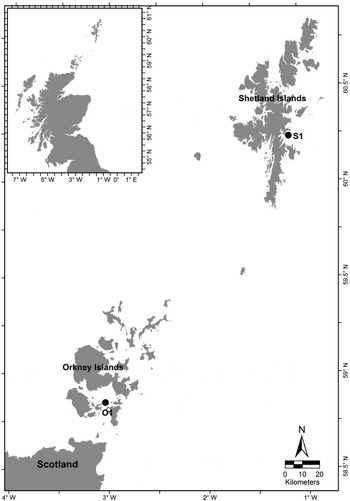
In June 2010 and November 2013 SCUBA surveys were conducted in the Orkney Islands (Scapa Flow) and in the Shetland Islands (North Isle of Gletness), Scotland (Figure 1) as part of the ‘Seasearch’ marine recording programme. Surveys were undertaken using SCUBA from a maximum depth of 30 m to the surface, with the diversity and abundances of benthic and pelagic organisms recorded. Each survey lasted a minimum of 60 minutes. Species and abundance estimates were recorded in situ, with photographic records made of specimens using a Nikon D70 and D600, Nikkor 60 mm and Nikkor 105 mm macro lenses with Ikelite housings and Inon Z240 flash units.
Sampling locations: Orkney Islands (O1—Scapa Flow) and Shetland Islands (S1—North Isle of Gletness) Scotland.

RESULTS
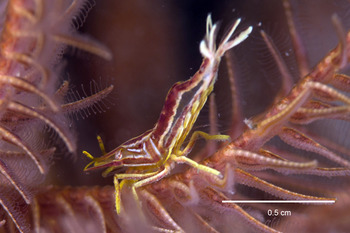
Single live specimens of Hippolyte prideauxiana were observed at two survey locations. One specimen from the Orkney Islands was observed at 20 m on the wreck of the SMS ‘Dresden’, Scapa Flow (58°50′N 03°03′W) on the uppermost vertical area of the wreck. The specimen was found on the feather star Antedon bifida. The specimen was 10 mm in length and is considered to be a male or immature female, based on coloration (Figure 2). Males and immature females have a broad longitudinal dorsal red stripe, a longitudinal yellow line running through this stripe, an interrupted ventrolateral red line and two transverse red and yellow stripes on each side of the carapace (d'Udekem d' Acoz, Reference d'Udekem d'Acoz1996).
Hippolyte prideauxiana male or immature female on the SMS 'Dresden', Orkney Islands.

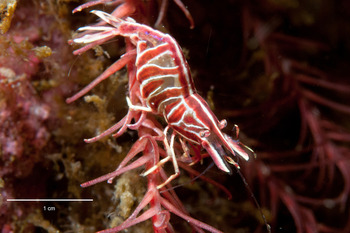
One specimen was observed from the Shetland Islands at the North Isle of Gletness (60°15′N 01°09′W) 10 m below sea level on the feather star Antedon bifida on a vertical wall. The specimen was 20 mm in length and is considered to be a mature female based on size and coloration. Mature females have a similar colour pattern to males and immature females but without a ventrolateral red line and with transverse red and yellow stripes on the whole body (d'Udekem d' Acoz, Reference d'Udekem d'Acoz1996) (Figure 3).
Hippolyte prideauxiana mature female on the North Isle of Gletness, Shetland Islands.

During the survey feather stars were searched but only one specimen of H. prideauxiana was noted at each survey location.
DISCUSSION
There are few records of Hippolyte prideauxiana in Scotland and the present observations widen the known range of this species by 400 km from Loch Carron on the west coast of Scotland to the Shetland Islands. All observations of this species in Scotland have been made using SCUBA, with the specimens observed commensal to the feather star Antedon bifida. Recent records from the Adriatic Sea have also been made using SCUBA (Kirinčić, Reference Kirinčić2006). The use of SCUBA allows the investigation of microhabitats of the infra-littoral zone, which is useful for recording genera which are rarely observed with traditional surface-operated gears and/or unlikely to be found in trawl surveys (Kirinčić, Reference Kirinčić2006). These observations highlight this benefit of SCUBA as a survey method, as well as the benefits of ‘citizen science’ survey programmes such as ‘Seasearch’ which operates throughout the UK.
There are a number of potential explanations for the geographical range expansion observed in this study; the expansion could be linked to increased seawater temperatures due to climate change or these new observations could be due to increased survey effort and/or increased awareness of this cryptic species.
From 1980 to 2005 sea temperatures around Scotland are estimated to have risen between 0.2 and 0.6°C per decade, with the warming trend appearing to be strongest on the west coast of Scotland (Fisheries Research Services, Reference Hughes2007). Whilst a number of studies have suggested this has affected the relative abundance of a number of benthic species in the UK (e.g. Burrows et al., Reference Burrows, Moore and James2002; Mieszkowska et al., Reference Mieszkowska, Leaper, Moore, Kendall, Burrows, Lear, Poloczanska, Hiscock, Moschella, Thompson, Herbert, Laffoley, Baxter, Southward and Hawkins2006), evidence for northward range expansions of southerly species or range reduction of northerly species is currently limited. A study of commonly found and monitored rocky shore species only found evidence of range expansions of two species in Scotland, Phorcus lineatus (Da Costa, Reference Da Costa1778) and Chthamalus montagui (Southward, Reference Southward1976): with a range increase of 55 km and 140 km respectively (Mieszkowska et al., Reference Mieszkowska, Leaper, Moore, Kendall, Burrows, Lear, Poloczanska, Hiscock, Moschella, Thompson, Herbert, Laffoley, Baxter, Southward and Hawkins2006). It therefore seems unlikely that a range expansion of the scale observed in this study is primarily driven by climate change.
The cryptic nature and small size of this species means that it is likely to be overlooked, females reaching 21.7 mm and males 10.4 mm (Murray, Reference Murray1980). The specimens observed in this study are consistent with this size range. Since 2010 there has been an increase in the number of ‘Seasearch’ surveys undertaken by trained ‘surveyors’ in the north of Scotland, with co-ordinated surveying of Scapa Flow initiated in 2012. It therefore seems likely that these new records are primarily the result of an increased survey effort.
ACKNOWLEDGEMENTS
I thank Bob Anderson of the MV ‘Halton’, Dr Joanne Porter and Jenni Kakkonen for organizing the 2013 survey in Scapa Flow, Orkney. The Orkney Islands survey was undertaken as part of the Seasearch diver programme and was partly funded by Scottish Natural Heritage via Seasearch Scotland. I acknowledge the SCUBA survey members who participated in the recording of the benthic and pelagic species during these surveys: Dr Richard Shucksmith, Dr Joanne Porter, Ivan Houston, Amy Houston and Robert Beharie. Also I thank the two anonymous referees for their comments which have helped to improve the paper.