Introduction
Corticosteroids are a mainstay of medical management for many upper airway diseases.Reference de Benedictis and Bush1–Reference Trangsrud, Whitaker and Small3 Topical corticosteroids are particularly useful for their ability to deliver local therapeutic relief of inflammation.Reference Arnaldi, Angeli, Atkinson, Bertagna, Cavagnini and Chrousos4 We describe an important interaction between ritonavir, a protease inhibitor used in human immunodeficiency virus (HIV) anti-retroviral therapy, and fluticasone nasal spray, a commonly utilised intranasal corticosteroid with low systemic bioavailability.
The interaction between fluticasone (inhaled and intranasal forms) and ritonavir has previously been described,Reference Saberi, Phengrasamy and Nguyen5–Reference Figueiredo, Serrado, Khmelinskii and do Vale12 but it remains a poorly recognised entity amongst clinicians, particularly in the field of otolaryngology – a field where an admittedly high proportion of intranasal steroids are administrated. We present the first case of avascular necrosis of the shoulder and Cushing's syndrome resultant from drug interaction between intranasal fluticasone spray and ritonavir.
Case report
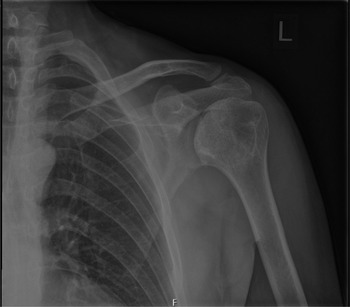
A 51-year-old man with HIV in complete remission (undetectable viral load) presented to the ENT department with a 1-year history of bilateral, temporal headaches. Two years prior to his consultation, he was started on fluticasone intranasal corticosteroid spray for his presumed chronic rhinosinusitis. In the months following initiation of this therapy, he developed lethargy, weight gain, a plethoric face and abdominal striae. He was reviewed by the infectious disease team and his symptoms were found to be consistent with drug-induced Cushing's syndrome. It was presumed that an interaction between ritonavir and fluticasone had potentiated the effect of the corticosteroid. He unfortunately developed avascular necrosis of his shoulder, which was felt to be precipitated by his hypercortisolism (Figure 1).
X-ray imaging of the patient illustrates subarticular collapse of the humeral head suggestive of avascular necrosis. L = left

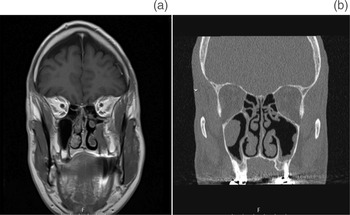
He was referred on to the ENT service for investigation of a sinonasal aetiology for his headaches. He was noted to have an incidental finding of left silent sinus syndrome, a syndrome characterised by unilateral enophthalmos and hypoglobus due to a downward bowing of the orbital floor and atelectasis of the maxillary antrum (Figure 2a).Reference Soparkar, Patrinely, Cuaycong, Dailey, Kersten and Rubin13
(a) Pre-operative coronal magnetic resonance imaging scan of the patient depicting left silent sinus syndrome. (b) Post-operative coronal computed tomography scan of the sinuses revealing re-expanded left maxillary sinus. F = feet

He underwent endoscopic sinus surgery for the silent sinus syndrome, from which he recovered well with improvement in his headaches (Figure 2b). He subsequently underwent shoulder replacement surgery for his avascular necrosis. He remains stable on intranasal beclomethasone and efavirenz, an alternative anti-retroviral medication for ongoing allergic rhinitis, with no further adverse effects.
Discussion
To our knowledge, this is the first case report describing an interaction between intranasal fluticasone propionate and ritonavir causing avascular necrosis of the shoulder and Cushing's syndrome.
Within the field of ENT, intranasal corticosteroids are prescribed for long-term use in the treatment of inflammatory conditions such as allergic rhinitis, non-allergic rhinitis and chronic rhinosinusitis, relieving symptoms of nasal congestion, nasal obstruction and rhinorrhoea.Reference Mygind, Nielsen, Hoffmann, Shukla, Blumberga and Dahl14 Intranasal corticosteroids bind to glucocorticoid receptors in the nasal epithelial cells, inhibiting cytokine synthesis, leukocyte chemotaxis and vascular permeability.Reference Mygind, Nielsen, Hoffmann, Shukla, Blumberga and Dahl14 It is widely accepted that the intranasal administration of corticosteroids represents a low-risk route of administration with regard to systemic absorption.Reference Sastre and Mosges15
Fluticasone is a second-generation intranasal corticosteroid, and therefore has minimal systemic bioavailability compared to oral or first-generation intranasal corticosteroids. Over 99 per cent of fluticasone is deposited within the nose; the remaining is ingested and subject to first-pass hepatic metabolism by cytochrome P450, family 3, subfamily A (CYP3A).Reference Derendorf, Hochhaus, Meibohm, Mollmann and Barth16 The topical application and reduced systemic bioavailability of fluticasone limits the side-effect profile to local adverse effects, including epistaxis, pharyngitis, nasal burning and dryness, and largely eliminates the incidence of severe adverse events observed in systemically administered corticosteroids.Reference Sastre and Mosges15
Systemic corticosteroid absorption, particularly in large or prolonged quantities, carries a high side-effect profile, including skin thinning, leukocytosis, hypertension, decreased sex hormone production, the inhibition of linear growth, and adrenal gland suppression due to alterations in the hypothalamic–pituitary–adrenal axis.Reference Stanbury and Graham17 Cushing's syndrome, a constellation of symptoms that develop as a result of elevated cortisol, is a widely known pathological manifestation of prolonged administration or large doses of corticosteroids. Patients may develop weight gain with central obesity, facial rounding and plethora, facial hirsutism, proximal muscle weakness, hypercoagulability, metabolic syndrome, osteoporosis, and mood disturbances.Reference Arnaldi, Angeli, Atkinson, Bertagna, Cavagnini and Chrousos4
Avascular necrosis of bone is a complication occurring in 9–40 per cent of patients receiving glucocorticoid therapy. It occurs most commonly in the femur, although it has also been observed in the shoulder or vertebrae.Reference Weinstein18 Studies of the dosage and duration of steroid treatment needed to induce avascular necrosis are conflicting, with cases observed following a spectrum of doses, from long-term treatment with high-dose glucocorticoids, short-term treatment with methylprednisolone intravenous pulse therapy, to a single methylprednisolone intra-articular injection.Reference Weinstein18–Reference Yamamoto, Schneider, Iwamoto and Bullough23 The underlying mechanism of steroid-induced avascular necrosis is unclear, but it has been postulated to be a downstream effect of: increased marrow fat that results in increased intra-osseous pressure, decreased bone perfusion, fat emboli, and hypercoagulability reducing blood flow to the head, or the accumulation of fatigue fractures, most commonly at the femoral head.Reference Drescher, Schlieper, Floege and Eitner20,Reference Jia, O'Brien, Stewart, Manolagas and Weinstein24–Reference Mankin29
The symptoms of hypercortisolism in the patient presented in this report suggest higher bioavailability of fluticasone than routinely detected in topical use. Ritonavir is a protease inhibitor known to be metabolised by CYP3A, along with other commonly prescribed corticosteroids including fluticasone.Reference Hsu, Granneman and Bertz30 Ritonavir has been found to displace drugs metabolised by CYP3A, leading to increased bioavailability and potentiation of the adverse effect of systemically available corticosteroids.Reference Saberi, Phengrasamy and Nguyen5,Reference Hsu, Granneman and Bertz30 Although it is important to note that ritonavir use alone has been associated with avascular necrosis of bone,Reference Bayard, Ledergerber, Flepp, Lecompte, Moulin and Hoffmann31 patients demonstrating multiple features of hypercortisolism, as observed in this patient with Cushing's syndrome and avascular necrosis of the shoulder while on ritonavir and a corticosteroid, should prompt consideration for an interaction between the medications.
The more than 60 cases of inhaled or intranasal corticosteroid interactions with ritonavir reported in the literature to date would suggest that greater awareness of the hazards of this prescribing decision is needed to prevent morbidity.Reference Saberi, Phengrasamy and Nguyen5–Reference Wood, Lacy, Johnston, Weigle and Dhanireddy10,Reference Figueiredo, Serrado, Khmelinskii and do Vale12 Two case reports have previously described interactions between intranasal fluticasone and ritonavir, in which one patient developed Cushing's syndrome and the other developed both Cushing's syndrome and adrenal insufficiency.Reference Hillebrand-Haverkort, Prummel and ten Veen32,Reference Chen, Kearney, Robinson, Daley-Yates, Waldron and Churchill33 In these two patients, symptoms resolved once fluticasone was discontinued or a new protease inhibitor was initiated that did not interact with CYP3A4, respectively. In other published reports, four patients received both inhaled and intranasal fluticasone; all of these patients developed Cushing's syndrome symptoms.Reference Saberi, Phengrasamy and Nguyen5,Reference Azevedo, Pego, Souto Moura and Germano9,Reference Wood, Lacy, Johnston, Weigle and Dhanireddy10 Two patients developed secondary adrenal insufficiency, one developed osteoporosis, and one patient developed osteonecrosis of both hips in addition to vertebral and femoral fractures leading to total hip replacement surgery. These severe outcomes were presumed to be a result of the additive effect of inhaled and intranasal corticosteroids, coupled with the interaction with ritonavir. In all of these cases, fluticasone was tapered and patients were started on alternative corticosteroids.
• Intranasally administered corticosteroids represent a low-risk route of administration but carry an under-estimated risk of adverse events in the setting of drug potentiators
• A unique case is presented of Cushing's syndrome and avascular shoulder necrosis in a human immunodeficiency virus (HIV) patient treated with ritonavir and intranasal fluticasone
• Co-administration of strong CYP3A inhibitors with corticosteroids is not recommended unless the potential treatment benefit outweighs the risk of systemic corticosteroid effects
• Intranasal beclomethasone should be considered in rhinitis or rhinosinusitis management in HIV patients receiving anti-retroviral medications
Patients with HIV receiving a combination of anti-retroviral therapy that includes ritonavir, who require treatment for chronic rhinosinusitis, should be started on intranasal beclomethasone dipropionate. Physicians are generally encouraged to consider fluticasone nasal preparations in preference to beclomethasone because of its low systemic bioavailability, reported at 0.5 per cent, in comparison to beclomethasone dipropionate which has bioavailability said to be over 40 per cent.Reference Daley-Yates and Baker34–Reference Daley-Yates, Price, Sisson, Pereira and Dallow36 It may therefore be assumed that fluticasone has a lower risk of drug interaction and would be a safer choice in patients on multiple medications. However, beclomethasone dipropionate does not interact with ritonavir in a clinically significant manner because of primary metabolism by esterase enzymes rather than CYP3A, making it a viable alternative for medical therapy in chronic rhinosinusitis patients.Reference Daley-Yates, Price, Sisson, Pereira and Dallow36,Reference Boyd, Hadigan, McManus, Chairez, Nieman and Pau37 Wider education is required to encourage the appropriate use of beclomethasone in selected cases, such as patients on ritonavir.
Conclusion
The choice of an individual drug for a particular patient is one of the most important decisions a clinician makes on a daily basis. Consideration for the compatibility of a medication with other treatments that a patient is receiving is essential for good practice in prescribing-related decision making. Even in routes deemed as low-risk, the co-administration of strong inhibitors of CYP3A with corticosteroids is not recommended, unless the potential benefit of treatment outweighs the risk of systemic corticosteroid effects.
This case demonstrates the severe side effects, including drug-induced Cushing's syndrome and avascular necrosis of the shoulder, which can occur due to potentiation of systemic effects of corticosteroids by the anti-retroviral agent, ritonavir. Dose reduction of the glucocorticoid, with close monitoring of local and systemic side effects, is recommended when co-administration is considered, or the use of an alternative glucocorticoid, such as beclomethasone, which is not a substrate for CYP3A.
Competing interests
None declared