In 1967 the prominent psychologist Abraham Maslow set out a new vision for music-making in the United States. As he told the crowd of musicians, educators, and luminaries gathered for the Tanglewood symposium on “Music in American Society,” Maslow founded his program on a revised understanding of Freudian psychology. Freud's “one big mistake, which we are correcting now,” Maslow explained, “is that he thought of the unconscious merely as undesirable evil.”Footnote 1 Now, Maslow and other psychologists understood that in fact, “unconsciousness carries in it also the roots of creativeness, of joy, of happiness, of goodness.” According to Maslow, this higher unconscious carried the roots of music-making, too. And this, he suggested, was very good news.
For Maslow argued that if musicians or anyone else learned to tap into their higher unconscious, they opened themselves up to the potentially life-altering psychological events Maslow called “peak experiences.” In his Tanglewood address, Maslow likened the peak experience to a state of “transcendent ecstasy,” “a great and mystical experience, a religious experience if you wish—an illumination, a revelation, an insight.”Footnote 2 Peak experiences revealed latent energies and hidden capacities, and confirmed one's sense of individuality and identity. In Maslow's view, these psychological peaks lead the seeker to their highest calling, what Maslow called “self-actualization”: the full realization of one's potential as a human being.Footnote 3
As the term suggested, the quintessential peak experience—for Maslow, anyway—was orgasm.Footnote 4 But as Maslow was pleased to announce, there was more than one way to peak. “I want to report that the two easiest ways of getting peak experiences (in terms of simple statistics in empirical reports) are through music and through sex.”Footnote 5 This was so because like sex, music-making was both primal and physical. “The rhythmic experience . . . the good dancing of a rumba, or the kinds of things that the kids can do with drums,” Maslow mused to the Tanglewood crowd, “I don't know whether you want to call that music, dancing, rhythm, athletics, or something else. The love for the body, awareness of the body, and a reverence for the body—that kind of thing that gets mixed in there—these are clearly good paths to peak experiences.”Footnote 6 Maslow imagined that in their love for the music-making body (or was it their love-making musical body?), musicians could actualize their most fulfilled, creative, fully human self.
As Maslow's images of Afro-Cuban gyrations and drum-happy children implied, his prescription for musical self-actualization came with a heavy dose of primitivist, erotic fantasy. But unlike in our own times, many in the late 1960s saw such exoticism as more feature than bug.Footnote 7 At the height of the sexual revolution, Maslow's message to the musicians of U.S. society was this: conquer your all-too-Freudian fears of the carnal body and make music a medium of peak experience and self-actualization.
Many musicians would heed Maslow's call, but few composers embodied Maslow's post-Freudian program more than John Coolidge Adams did in the late 1970s. Admittedly, next to slightly older and more overtly countercultural minimalist figures like Terry Riley, La Monte Young, or Steve Reich, Adams has always seemed something of a square. Adams has even been described, if playfully, as a “reactionary” postminimalist who garnered box-office success by wedding elements of minimalist style with “traditional notions of craft and compositional voice.”Footnote 8 According to this perspective, the more Adams brought minimalism into mainstream concert life, the more the genre lost its countercultural edge.
I will argue otherwise. When Adams “broke the bonds” of minimalist orthodoxy in the late 1970s, he joined the ranks of U.S. musicians busily remaking concert music in the image of Maslow.Footnote 9 To make this case, I will show how post-Freudian concepts shaped some of Adams's formative musical experiences in the San Francisco Bay Area, where ideas like Maslow's enjoyed wide popularity. I will further demonstrate how these same ideas inspired the development of Adams's idiosyncratic postminimalist idiom. First, I will examine Adams's first experience conducting a minimalist work in 1977 and his influential collaboration with Charlemagne Palestine (born Chaim Moshe Tzadik Palestine, also known as Charles Martin Palestine) later that same year. Next, I will detail the genesis, aesthetics, and cultural politics of one of Adams's earliest and most significant pulse-based works, the ecstatic 1978 string septet Shaker Loops. In this work, I will argue, Adams embraced Maslow's post-Freudian vision for “music in American society.” When he did this, Adams became a de facto leader of a broader Maslowian musical culture whose reach would extend far beyond Adams's own musical activities.
Eventually, Adams would credit the experience of composing Shaker Loops with liberating him from the ideological grip of musical modernism. Scholars often associate the postmodern in music with stylistic eclecticism and pastiche (especially in Adams's case), and Adams may well have identified with such a view.Footnote 10 But for Adams, at least, to make music “after” modernism was also to make music a medium of peak experience and self-actualization. Still, we should not think that Maslow's vision delivered Adams from all of modernism's sins. As he strove to make U.S. musical culture postmodern, Adams, like Maslow before him, founded his platform on tropes of primitivism, eroticism, and exoticism characteristic of earlier modernist music. In the end, both Adams and Maslow were perhaps as uncritical of their own sexual and cultural politics as they were sincere in their humanistic aims. The fact that musicologists have largely ignored how Adams participated in Maslow's countercultural project says a lot about the modern-day legacy of the self-actualization culture Adams helped to build.
Me and My Music
Born in 1947, Adams arrived in the San Francisco Bay Area in 1972, undergraduate and master's degrees from Harvard in hand. Like so many other white, well-educated, born-and-bred New Englanders of his generation, Adams had decided to trek west. Unlike many others of his generation, Adams managed to find steady, gainful employment there—as a teacher and leader of the New Music Ensemble, a student contemporary music group, at the San Francisco Conservatory.Footnote 11 Though Maslow had died in 1970, Adams arrived in the Bay Area just in time to see many San Franciscans experiment with putting ideas like Maslow's into practice. Inspired, perhaps, by his countercultural environs, eventually Adams would make his own musical contribution to the Bay Area's growing culture of peak experience and self-actualization.
For those seeking peak experience, Adams's San Francisco was a mecca. To take just one example, in 1973 Maslow acolyte and social reformer Michael Murphy founded the Esalen Sports Center there (an offshoot of the famous Esalen Institute in Big Sur) which he dedicated to exploring how athletics could and often did induce mystical, even ecstatic experiences in participants.Footnote 12 The Center boasted an impressive lineup of peak experience-oriented programming, including workshops like “The Inner Game of Tennis” and “Inside Running.”Footnote 13 The Center also maintained a remarkable roster of prominent U.S. athletes ready to lend credence to the Center's Maslowian cause.Footnote 14 With the backing of figures like former San Francisco 49ers quarterback John Brodie, the Center prompted the New York Times to declare a “revolution” in U.S. sports culture.Footnote 15
The San Francisco Sports Center only confirmed what many around the country already knew: that the Bay Area had grown into the nation's top distributor of a new, Maslowian view of the body that idealized physical activity as a source of unforeseen energies, mystical insights, and personal satisfaction. As sociologist Sam Binkley has shown, Bay Area seekers not only developed numerous methods and programs for bodily exploration and self-discovery, but a robust print media consumer culture through which to market them.Footnote 16 In the numerous guides and directories they published, San Franciscans promoted various forms of psychosomatic practice, from jogging and yoga to massage and meditation. In texts like the 1973 book Our Bodies, Ourselves, they taught female readers that in “learning to understand, accept, and be responsible for our physical selves, we are freed . . . to use our untapped energies.”Footnote 17 And through numerous self-help books, they reimagined sex, in Binkley's words, as “an autonomous object of manipulation and creative play, a pleasurable end in itself, but also a technique of self-realization and mutual exploration.”Footnote 18 All this Binkley has dubbed a culture of “getting loose.” When San Franciscans looked to loosen up, they were seeking “a more authentic, innocent, and original source of the self, and . . . a way of living that was more primary and immediate but also more active and creative.”Footnote 19 They were seeking, in other words, exactly what Maslow had envisioned for musicians.
Soon enough, concert musicians in the Bay Area and beyond joined in, and it is likely Adams knew their work. In the early 1970s, for example, experimental composer Pauline Oliveros (recently relocated from San Francisco to San Diego) adapted tai chi as taught by the Esalen workshop leader Al Huang to develop her Sonic Meditations, works designed to help participants loosen up their deeper, more authentic musical selves.Footnote 20 Adams probably knew about Oliveros's meditational method, if not through her reputation in the Bay Area, then through Betty Wong, an Oliveros student Adams featured on one of his new music concerts at the San Francisco Conservatory in 1973.Footnote 21 In 1977, the Esalen teacher Judith Aston gave a workshop at the San Francisco Conservatory in “Aston Patterning,” Aston's psychosomatic self-awareness technique developed from Rolfing, the famous Esalen massage practice. At least eight of the fourteen students who participated in Aston's workshops also performed with the New Music Ensemble under Adams in 1977 and 1978.Footnote 22 Beyond San Francisco, around the same time the prominent soprano Jan DeGaetani developed a related technique for relieving bodily tension and increasing expressive immediacy, based in part on the bodywork practice of dancer Elaine Summers, a onetime student of Esalen-regular Charlotte Selver.Footnote 23 By the late 1960s, even the reformed serialist George Rochberg was touting erotic energies and paranormal consciousness as the most authentic tools of musical expression.Footnote 24 Across the United States but in Adams's Bay Area especially, the seeds Maslow planted had blossomed into a musical culture of peak experience and self-actualization.
This post-Freudian spring had been long in coming.Footnote 25 In the 1950s, the philosopher and cultural critic Herbert Marcuse had envisioned a society enriched by liberated bodily energies.Footnote 26 If Marcuse remained best known among intellectuals and left-wing activists, his like-minded contemporary, the eccentric philosopher, former Freud student, and inventor Wilhelm Reich actually achieved a measure of popular appeal touting his “Orgone Energy Accumulator,” a domestic appliance designed to enhance erotic energies and cure neuroses.Footnote 27 (Reich died imprisoned in 1957, but his machine remained popular enough to be parodied in Woody Allen's iconic 1973 film Sleeper as the “Orgasmatron.”) By the late 1960s, Marcuse and Reich had been dubbed leaders of the “Freudian Left”—a radical school of post-Freudians who, like Maslow, adopted “explicitly religious or poetic languages in order to embrace and celebrate the id as a mystical force of orgasmic bliss, social revolution, and . . . even bodily transfiguration.”Footnote 28
While some celebrated its emergence, many critics bemoaned and maligned the Freudian Left and the culture of peak experience it helped to spawn. “The beat . . . goes . . . Me. . . Me. . . Me. . . Me. . .”Footnote 29 Thus it was with a disconcerting musical metaphor that the journalist provocateur Tom Wolfe concluded his infamous 1976 New York magazine article, “The Me Decade and the Third Great Awakening,” one of the most influential indictments of the self-actualization culture and its apparent narcissism. In that essay, Wolfe described a group therapy session that quickly morphs into an apparent collective peak experience—a frenzy of “release and liberation” complete with a chorus of titillating moans and groans.Footnote 30 But far from a true religious experience, as Wolfe explains, the sham peak experience was actually instigated by nothing less vulgar or banal than one participant's personal preoccupation: “me and my hemorrhoids.”Footnote 31 Numerous like-minded critics joined Wolfe to lament a generation of misguided young people who wrongly imagined that self-discovery, as Christopher Lasch put it in 1979, required “the overthrow of inhibition and the immediate gratification of every impulse.”Footnote 32 Where some saw self-actualization, in other words, others saw only self-gratification. But as Wolfe and Lasch begrudgingly recognized, there was no denying that peak experience had become a national pastime. By the end of the Me Decade, John Adams was ready to play.
Techniques of Ecstasy
When he arrived in San Francisco, Adams was still in his mid-twenties and had yet to develop his now-familiar, pulsing compositional idiom.Footnote 33 Adams began to find himself, so to speak, only after two firsthand experiences with pulse-based minimalism—a 1977 performance of Steve Reich's Reference Reich1973 Music for Mallet Instruments, Voices, and Organ with the student-musicians of the San Francisco Conservatory New Music Ensemble, and second, later that same year, a collaboration between the ensemble and the composer and performer Charlemagne Palestine. Scholars have only recently begun to explore the variety of minimalist experience in the 1970s, but even a glance at the historical record suggests how diverse listeners’ and musicians’ understanding of the genre could be.Footnote 34 Around 1977, Adams and the New Music Ensemble appear to have begun to forge a Bay Area minimalist hermeneutic of their own. Together, they would develop a minimalist practice for the me generation.
A program note Adams and the ensemble provided for their performance of Reich's Music for Mallet Instruments foregrounded themes familiar from the Bay Area's loosened culture, and suggests that Adams and the ensemble had begun to interpret Reich's music as a pathway to peak experience.Footnote 35 Calling to mind Maslow's primal images of rumbas, naïve child drummers, and extraordinary states of consciousness, the note described Reich's work as an “eminently performable,” “primitive” rite that produced an occult “energy state” in performers and listeners alike. In a further echo of Maslow, the note likened that primitive, out-of-the-ordinary “energy state” to “a feeling of ecstasy,” and emphasized that this peak-like state arose from the act of music-making itself. “Running as they do on human rather than mechanical or electrical energy,” the note argued, Reich's modular works were “capable of doing what mere hardware cannot: they can take the listener out of his normal state; they can (and sometimes do) produce in the listener a feeling of ecstasy.” In true Maslowian form, the note described Reich's work as an archaic ritual that unleashed primal energies in the act of performance and launched participants into ecstasy.
Of course, Adams and the New Music Ensemble were hardly the first musicians to describe minimalist music as a “technique of ecstasy,” to borrow a phrase from the historian of religion and countercultural guru Mircea Eliade.Footnote 36 In fact, they had been preceded in this by Steve Reich himself. As Kerry O'Brien has discussed, Reich frequently compared his music to yoga in the 1970s, describing both as practices of self-discipline, and yes, “ecstasy.”Footnote 37 But the New Music Ensemble program note suggests that Adams and the Ensemble imagined Reich's music in a different vein. Reich and the New Music Ensemble, I would suggest, diverged along lines familiar to scholars of South Asian religion and its popularization in the postwar United States. Historian of religion Jeffrey Kripal has borrowed the language of Tantric philosophy to explain how sixties and seventies counterculturists cultivated both more ascetic, “right-handed” meditation traditions as well as more overtly carnal, “left-handed” practices like Tantric sex and Kundalini yoga. As Kripal explains, “Whereas left-handed Tantric traditions . . . are those that insist on the actual performance of transgressive acts and sexual rituals . . . right-handed Tantric traditions are those that have sublimated these same acts and rituals into internal contemplative exercises . . . that still bear the stamp of the original erotic union but are now quite removed from any literal act or ‘polluting’ sexual fluid.”Footnote 38
Applying the left-hand, right-hand metaphor to seventies minimalism, we might say that while Reich practiced a more contemplative, “right-handed” minimalism of self-sublimation, Adams and the New Music Ensemble seem to have adopted a looser, more “left-handed” approach. To be sure, we can only draw a loose analogy between Reich, Adams, and these divergent Tantric traditions—both Adams and Reich, after all, insisted on the actual performance of minimalist music in their quest for ecstasy. And yet Reich did seem to prefer to sublimate the act of performance into a “purer” act of contemplation. Not only did Reich claim to discipline his “individual thoughts and feelings” in performance, “subjugating myself to the music,” as he put it, but he also frequently insisted that the real source of pleasure in his music was the interlocking patterns of sound his music generated, patterns that could be contemplated like a mandala or other meditation object.Footnote 39 As he put it in 1968, Reich wanted to produce works that sounded like “a process happening so slowly and gradually that listening to it resembles watching a minute hand on a watch.”Footnote 40 The New Music Ensemble program note acknowledged Reich's position, but attributed the music's ecstasies to the “human . . . energy” exerted in performance. In so doing, the note seems to have given Reich's right-handed, contemplative music a more left-handed spin. Later that year, Adams's career would veer yet more sharply to the “left” of Reich, when he and the New Music Ensemble encountered the left-handed minimalist par excellence, Charlemagne Palestine.
A Little Bit like a Bordello
Adams would frequently cite his performance of Music for Mallet Instruments in 1977 as a turning point in his career, and it was—though he would continue to dabble in other genres, he would rise to fame by composing pulsing, repetitive music reminiscent of Reich's.Footnote 41 But the performance was significant for another reason, for evidence also suggests that when Adams composed his first pulsing, process-based works, he did so with the flow of the New Music Ensemble's left-handed energies in mind. After the Reich performance, Adams composed two pulsing piano solos, Phrygian Gates and its companion piece China Gates. As K. Robert Schwarz has argued, these works could rightly be described as “process” music akin to Reich's.Footnote 42 And yet when Adams used the term “gate” in the title of these works, he placed energy flow at their conceptual core. As Adams explained later, a “gate” was a piece of hardware, often used in electronic music composition, “that passes a certain amount of current on a given command.”Footnote 43
In his next, more ambitious work, the string septet Shaker Loops, Adams would again make energy flow a theme, but this time, the work's title and dramatic design would make clear that the energies Adams had in mind were explicitly carnal. To get there, it would take one more direct experience with minimalism, this time with a musician after Maslow's own heart, the composer and performer Charlemagne Palestine. Following Palestine's example, Adams would develop his energy-based minimalist aesthetic into a full-fledged post-Freudian compositional practice.
If ever there was a composer of the me generation, it was Palestine. In the late sixties and early seventies, Palestine led composition classes at the California Institute of the Arts that mirrored faddish inward-facing group therapies like those Wolfe mercilessly mocked in his 1976 “Me Decade” essay. With his students gathered in a dark room, Palestine would instruct them “to search out with your body and your voice any way you want to try to articulate deep inside what seems most at the root of your sentiments and externalize them.”Footnote 44 Palestine would sit in a corner doing the same, “making this kind of a ‘AHHHG,’ sort of searching inside for my demons in a way,” as he told an interviewer in the mid-1970s. Compare this to how Wolfe described the woman obsessed with “me and my hemorrhoids”: “To let the feeling gush forth . . . she starts moaning . . . AAAAAAAAARRRRRRRGGGGGGGHHHHHHH!”Footnote 45 Outside the classroom, Palestine imagined his performances, too, as a quasi-mystical process of self-exploration. “What I'm gonna try to bring to music now is a looking inside,” he explained, “so every concert I do is always more than just a piece. It means that everybody who's in it is going through some kind of reevaluation in some sense. Do you know what I mean?”Footnote 46 Like Maslow, Palestine well understood the implicit connections between musical self-discovery and the carnal body. “It was a little bit like a bordello,” he said of his classes in 1976—“a-u-r-a-l intercourse.”Footnote 47 In the same interview, he even claimed that his self-exploratory performance practice had emerged spontaneously from euphoric improvisations at the piano in a dark room after sex.Footnote 48 Maslow had little taste for new music, but he would have had to admit that Palestine had seemed to make music a medium of self-actualization.
As we would expect, Palestine's peaking performances were intensely physical affairs. In the 1970s he was renowned for improvising “minimal” pieces on a Bösendorfer piano—often pounding out only a handful of chords in a sitting—and for marathon solo vocal theatrics. “Palestine knelt quietly on the floor for a while, just rocking and breathing,” critic Tom Johnson wrote of a 1974 New York performance, “and then gradually picking up steam both physically and vocally. When the performance climaxed, about twenty minutes later, he was reiterating loud tones and throwing himself vigorously onto his hands.”Footnote 49 The dramatic potential of Palestine's orgasmic performances intrigued Johnson. “I suspect they could lead to some extraordinary form of full-blown music theater,” he wrote, “especially if Palestine ever figures out how to present such things with a group of people instead of as solos.” Three years later, Palestine would do just that—in San Francisco, at the invitation of John Adams.
Adams commissioned Palestine to compose and lead a new work for the New Music Ensemble for a December 1977 concert.Footnote 50 Palestine answered with a piece for twelve strings he called Birth of a Sonority. Palestine assigned each member of the Ensemble a “sonority” to play in rehearsal (there was no score). Then, in performance, Palestine proceeded to coax those sonorities from the players with wild gesticulations. The result was a form of conducted improvisation similar to the group improvisation practices composers like John Zorn and Lawrence “Butch” Morris were exploring around the same time.Footnote 51 “It sets up a physical rapport with the players,” Palestine said of Birth of a Sonority in a 1980 interview, “so that at any moment, a conductor can get a sense of intensity or sense of motion on the pitches from the player without any middle notation in a way—it's a totally physical kind of interaction.”Footnote 52
Such aggressively intimate music-making may have been more than his musicians bargained for. By Adams's account, Palestine subjected the New Music Ensemble to the kind of red-blooded musical treatment Palestine was used to inflicting on his Bösendorfer. But Adams found Palestine's unrestrained carnality inspiring. In fact, Adams would later suggest that when Palestine gave his totally physical performance with the New Music Ensemble, the spectacle liberated Adams to seek a totally physical musical aesthetic of his own—an aesthetic he would first realize in a 1978 string septet, Shaker Loops. As Adams remembered of Palestine and Birth of a Sonority in the early 1980s,
He did a fifteen- or twenty-minute piece based essentially on the format of his piano pieces . . . . He stood in front of this group . . . who had no notation or anything. . . . They knew what intervals to play . . . and he conducted them and got very passionately involved physically. . . . I realized in watching him that he was attempting to do something that I very much wanted to do, only I took a much different tack and it resulted in Shaker Loops, which is a very physical and very muscular piece. I always have to acknowledge that debt to Charlemagne, that he sort of liberated a certain physical relationship to my own music that may have taken me longer to do had I not experienced that with him.Footnote 53
The liberation Adams found in the Palestine performance changed his career. Freed—or perhaps better, “loosened”—Adams composed Shaker Loops, which quickly became his most popular work and eventually attracted the attention of director Peter Sellars, with whom Adams would skyrocket to international fame collaborating on works like Nixon in China and The Death of Klinghoffer.Footnote 54
To the extent that Palestine helped Adams find his compositional voice and subsequent success, we might say superficially that Palestine paved the way for Adams's self-actualization as a composer. But as Adams's account of his physical liberation suggests, Palestine's performance set Adams on the path to self-actualization in a specifically Maslowian sense. Today, few remember that Palestine influenced Adams at all—Adams himself seems to have largely disavowed him.Footnote 55 But a more forthcoming Adams knew that Palestine had shown him how to get loose. Soon, with a little inspiration from the Shakers, Adams would be ready to give composing his own brand of totally physical minimalism a whirl.
Shake!
When Adams composed Shaker Loops in 1978, he finally made his own original contribution to the music of the Me Decade. Today we might be tempted to hear Shaker Loops’ effusively tonal, neoromantic idiom as a political statement about the demise of musical modernism, but the work had other, perhaps more significant ideological resonances. As Schwarz observed in the late 1980s, the piece entailed a “loosening of musical process” in comparison to the rigid procedures of Steve Reich, but that “loosening” was more than merely stylistic.Footnote 56 Bay Area seekers would likely have recognized Shaker Loops as a celebration of their loosened lifestyle. At a time when critics like Wolfe and Lasch made notions of peak experience and self-actualization more controversial than ever, Shaker Loops implied Adams's allegiance to Maslow.
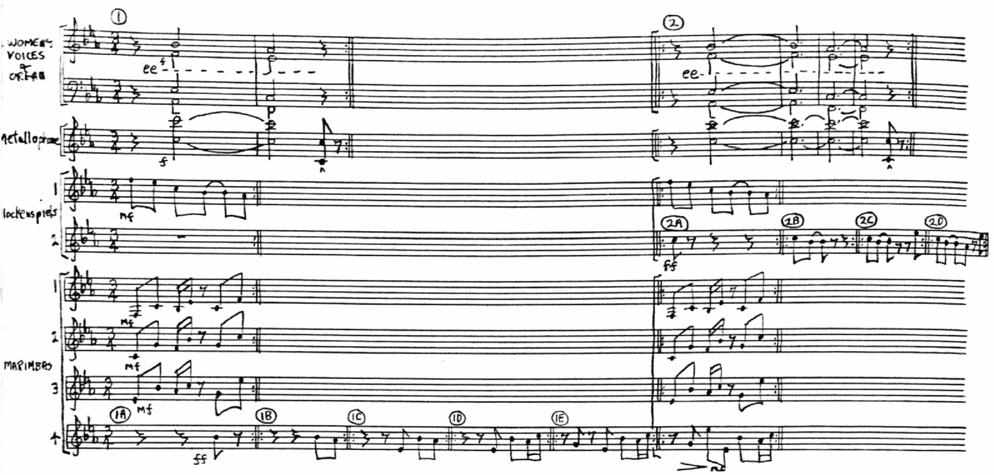
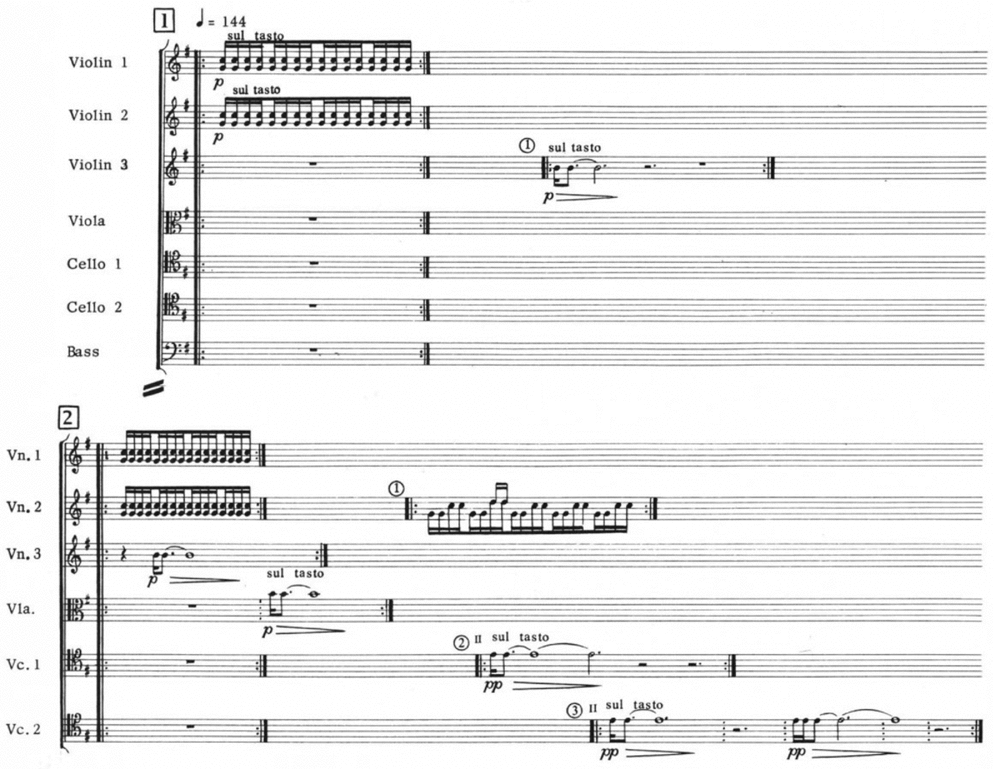
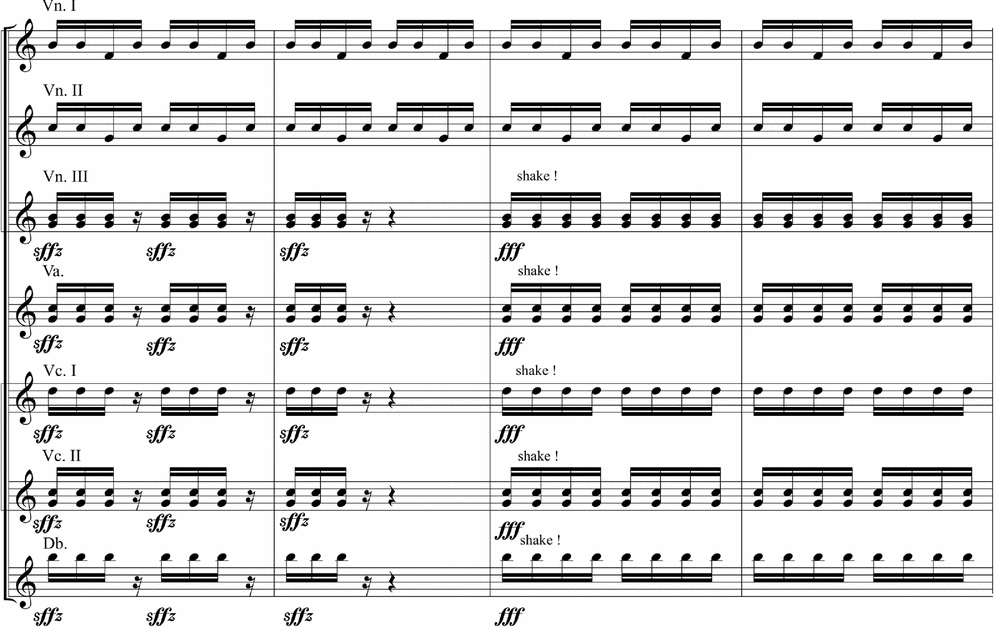
There can be little doubt that Adams took Palestine's example to heart when he composed Shaker Loops. Faced with the task of translating Palestine's unnotated, totally physical musicality onto paper, Adams wed the Dionysian physicality of Palestine's Birth of a Sonority with the Apollonian notational system of Reich's Music for Mallet Instruments. From a structural perspective, Adams borrowed most heavily from Reich (Figures 1 and 2). Adams constructed Shaker Loops from a series of musical modules and submodules consisting of short musical fragments set to be repeated indefinitely until the ensemble leader signaled the group to move on.
Reich, Music for Mallet Instruments, Voices, and Organ, modules 1–2, composer's self-published manuscript.

Adams, Shaker Loops, part 1, “Shaking and Trembling,” modules 1–2, published score. (John Adams. Shaker Loops, Version for String Septet. New York: Associated Music Publishers, 1983)

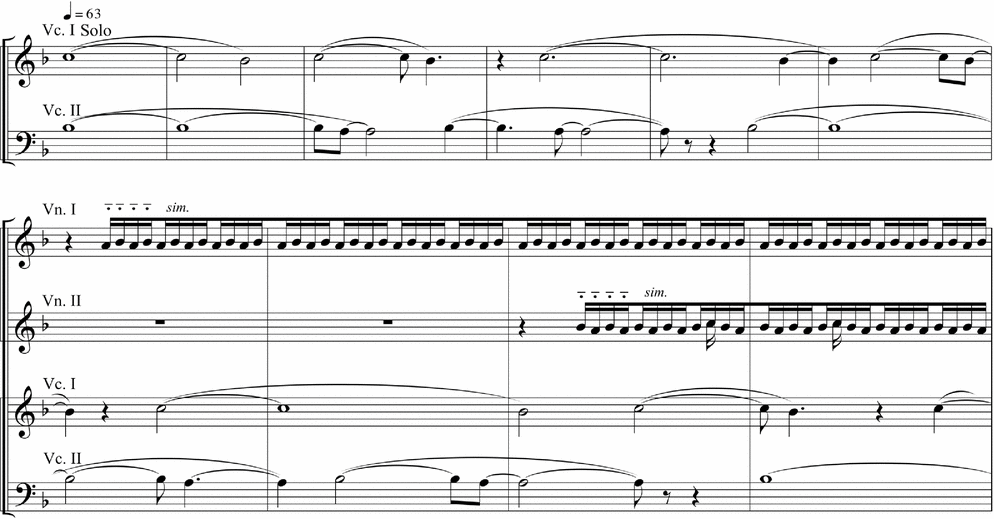
But as if in imitation of the “passionately involved” physicality of Birth of a Sonority, Adams filled his modules not with texturally uniform, interlocking rhythmic motives but with blocks of conspicuously varied, gestural figures. This difference accounts for the two works’ radically opposed sonic effects. Reich composed the modules of Music for Mallet Instruments with strict metrical regularity, so that the transition from one module to another feels pronounced, even jarring—an effect Reich famously christened “perceptible process.”Footnote 57 Adams's processes, by contrast, are anything but perceptible. Adams seems to have composed his loops to suppress, rather than reinforce, the sense of a prevailing meter, producing an affect of Palestinesque, unrestrained engagement in the physical task of playing the loop. Not only did Adams fill his modules with asymmetrical loops, but he designed a prevailing loop—the “shaking” sixteenth-note rhythmic figure in the first and second violins—that feeds into itself without break; it is simply a string of continuous, undifferentiated pulses. As more soloistic loops rise out of the texture with seeming spontaneity (the third violin in Figure 2, module 1, for instance), we can almost see Palestine aggressively beckoning players to “birth” their sonorities. Later, Adams resorts to a different strategy for subverting meter: rather than using tightly compacted loops of continuous pulses, he slows the pulse to create modules of overlapping long-held tones. Elsewhere in the piece, longer, lyrical loops are set against both long-tone loops and the meterless “shaking” motif from the opening movement (Example 1). The result of all this is a modularly organized work whose constituent “loops” hardly seem like “loops” at all. Instead, Shaker Loops sounds like irrepressible, loosened bodies surging toward climax, the deific vision, the peak experience.
Divinely inspired lyrical “verses” and shaking loops in Adams, Shaker Loops, part 3, “Loops and Verses [in the Presence of the Lord],” mm. 3–12 (some parts omitted). (John Adams. Shaker Loops. Version for String Septet. New York: Associated Music Publishers, 1983)

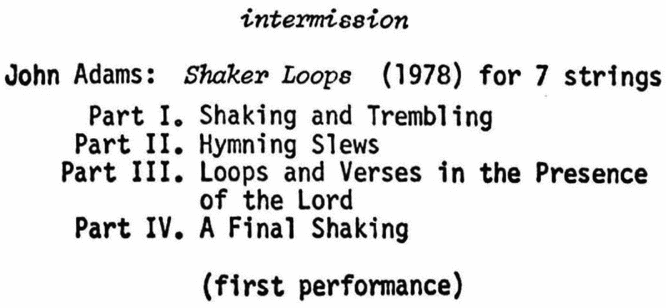
In this way, Shaker Loops depicted the nineteenth-century Shaker sect in the image of the loosened 1970s. As a note supplied for the premiere indicated, Shaker Loops referred specifically to the “rhythmic shaking” the Shakers used “to induce visionary mental states” or “Ecstatick Fits.”Footnote 58 As that original program note also made clear, Adams's Shakers got what they danced for: the third movement, later published simply as “Loops and Verses,” was first entitled “Loops and Verses in the Presence of the Lord” (Figure 3). In this, Shaker Loops presented a depiction of its eponymous community that would have been uncontroversial in any decade. But the work took one more interpretive leap—one that marked it as a product of the seventies and its composer as a devotee of peak experience.
Original movement titles of Shaker Loops, as printed in the program for the premiere performance. New Music Ensemble concert program, John Adams, director, December 15, 1978, San Francisco Conservatory of Music Archives.

Adams speculated that the Shakers’ spiritual exercises were overtly carnal, and did not shy away from celebrating that eroticism. “You know the Shakers were celibate,” Adams told a group of students at the University of Southern California in 1985.Footnote 59
And each Saturday night, or I don't know how many times a week . . . they would do this divine dance that would bring them to a frenzy. And I'm sure . . . the effect of this had to be as much of an erotic experience as it was a religious one. And I tried to imagine while writing this piece, the piece was very much inspired by the idea of these people and this dance in which [Adams performs an emphatic up-and-down hand gesture] they got into a, they got locked into a kind of loop, which went faster and faster until they reached a visionary state. So, there is a kind of a religious, but clearly erotic overtone of this piece.Footnote 60
Exactly where Adams got his ideas about the Shakers’ supposedly sublimated sex lives is unclear. Perhaps he was inspired by Wolfe's “Me Decade” screed, which stopped short of calling the Shakers a sex cult but did describe them as the United States’ original practitioners of “release and liberation.”Footnote 61
Or perhaps Adams sensed what some critics were beginning to suspect about pulse-based minimalism: that the genre was really an erotic dance music akin to its more expressly carnal cousin, disco. As Robert Fink has pointed out, in the early 1980s one critic even called minimalism the “higher disco.”Footnote 62 We cannot say whether Adams had disco in mind when he composed Shaker Loops, but he suggested as much when he speculated that the Shakers would gather “each Saturday night,” quickly adding, as if catching himself, “or I don't know how many times a week.” From this, it is hard not to think that images of the 1977 film Saturday Night Fever, or perhaps the 1976 essay on which it was based, “Tribal Rites of the New Saturday Night,” may have been gyrating in Adams's erotic musical imagination when he composed Shaker Loops. But whether it was a conservative op-ed piece, a loosened Bay Area sex manual, or his own imagination that inspired him to eroticize Shaker ritual, when Adams staged the seventies spiritual zeitgeist in Shaker Loops, he cast his lot with the me generation.
Indeed, the work's contemporary relevance, and its political point, would have been hard to miss. By the late 1970s, the Shakers had become a political football.Footnote 63 And as Wolfe's essay suggested, the Shakers also evoked more recent sexual and religious practices. This was the era of the so-called “Jesus Movement,” when Charismatic Christians (pejoratively labeled “holy rollers”) brought paranormal and even erotic experiences of the Holy Spirit into the mainstream.Footnote 64 In the mid-1970s one such group, known as the “Children of God,” notoriously added free love to its ecstatic evangelization program.Footnote 65 Wolfe could have been describing these unchurched youths as much as Maslow's psychology or Adams's music when he opined that “sex had now become a religion . . . in which the orgasm had become a form of spiritual ecstasy.”Footnote 66 But Adams didn't seem to be complaining. If anything, he seemed to be celebrating a vision of his national past that resonated with his loosened, Maslowian present.
For Shaker Loops went beyond merely depicting acknowledged forerunners of the me generation to actually represent the work's performers, including Adams himself, as participants in a post-Freudian peak experience. According to the original program note, the term “shaker” in the title referred not only to the religious group but also to the fact that “the primary means of playing here is by shaking the bow across the strings.”Footnote 67 With its punning title, Shaker Loops represented the players’ rapid bow strokes as the equivalent of the Shakers’ rhythmic dance, thereby staging the act of music-making as a medium of peak experience. At one climactic moment, Adams even added the instruction “shake!” to a set of running sixteenth-note loops already marked triple forte (Example 2). The piece also called for the musicians to perform an impressive catalogue of other string techniques—sul tasto, flautando, spiccato, pizzicato, at the point, tremolo and quasi-tremolo, “brush stroke,” “off the string,” the placing and removing of mutes—as well as less-specialized but no less characteristic gestures like trills and glissandi. In Shaker Loops, Adams had forged a fusion not only of “music, dancing, rhythm, athletics”—to recall Maslow's list of “good paths to peak experiences”—but of musicianship.
And for the premiere, at least, which Adams conducted, Adams provided a part for himself, too. “The conductor watches over the progressions through the loops and signals the movement from one to another,” the program note explained. Adams gave himself a role not unlike the “dance master” in contemporary accounts of the Whirling Dervishes of Turkey's Mevlevi Sufi order, a group often compared to the Shakers at the time and well known in the United States from touring performances.Footnote 68 (Indeed, by the late 1970s one could even attend a workshop in Dervish dance held, appropriately enough, on the grounds of a former Shaker colony in New Lebanon, New York.Footnote 69) As one writer described the Dervish dance in 1975, “All the dervishes unfold and whirl as the musicians play and the chorus chants. . . . The energy from above enters . . . [and] passes through the body . . . . As they turn the dance master slowly walks among them gesturing with his eyes or position to correct their speed or posture.”Footnote 70 As Wolfe and others bemoaned the revival of Shaker-like practices in their own day, Adams wrote himself and his musicians into a Shaker-inspired ritual of musical peak experience.
Adams, Shaker Loops, part 1, “Shaking and Trembling,” module 20, mm. 7–10. (John Adams. Shaker Loops. Version for String Septet. New York: Associated Music Publishers, 1983)

The Self-Actualization of John Adams
Shaker Loops transformed its players into a band of seventies seekers, but on another level, it also transformed its composer. Across the 1980s, Adams repeatedly described his own creativity as a physical, sensual, and mystical process, suggesting that by this time Adams had come to identify with the model of Maslowian musical creativity he had witnessed in the work of Palestine and gone on to depict in Shaker Loops. As previously mentioned, Adams credited Palestine with helping him find his creative voice. Eventually, Adams would turn to the same post-Freudian imagery to explain how he had liberated himself from the clutches of musical modernism.
By the mid-1980s, Adams was describing himself as a Maslowian composer for whom music-making was inherently physical. “I'm not the kind of composer that takes a sheet of manuscript paper and a pencil and goes off into another room with no other apparatus and creates music,” Adams told an interviewer in 1986.Footnote 71 “For me, creativity is very much like being an athlete. . . . It's a very physical activity for me. . . . I'm of a breed of composer for whom the physical touch of the sound is paramount to the creative act.” Phrases like “very much like . . . an athlete,” “very physical activity,” and “physical touch of sound” all evoked the muscular demands of Birth of a Sonority and Shaker Loops. In the image of Maslow and Palestine before him, Adams was a composer in touch with his body.
When Adams elaborated on this point, he suggested that the physicality he had in mind was expressly carnal. Referring to a line of text from Harmonium, Adams's Reference Adams1981 follow-up to Shaker Loops for chorus and orchestra, Adams told the interviewer, “Then there's this wonderful image of throwing away the compass, ‘Done with the compass’. . . . And in a sense, my odyssey as a composer has had to do with throwing away the compass, throwing away the chart, and saying I believe that my intuitive sense is far more powerful than any rational, intellectual processes.” Here, Adams suggested he would not be beholden to charts and graphs any more than he would be to pen and paper, the tools of the rational, intellectual composer.
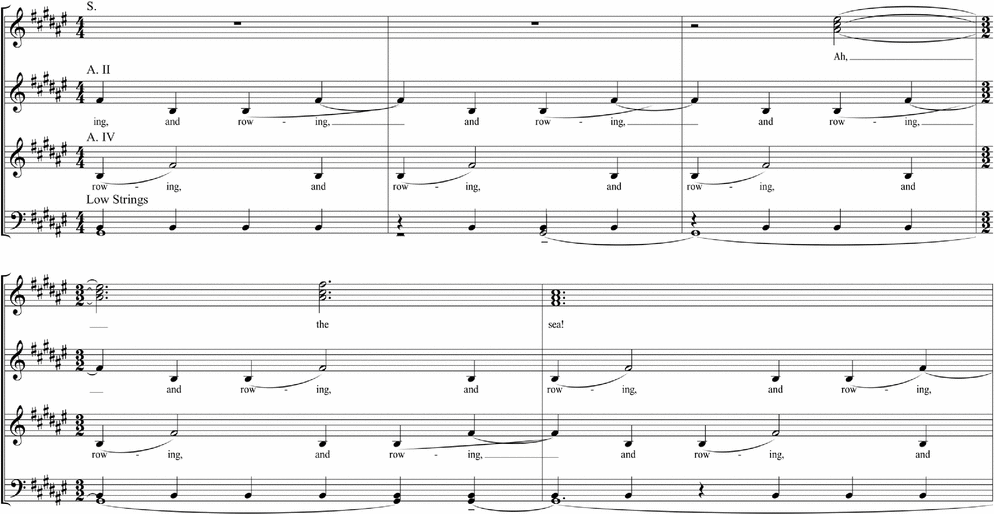
What Adams did not say directly, but the music of Harmonium makes clear, is that “throwing away the compass” meant embracing the very kind of erotic, physical energy that fueled Birth of a Sonority and Shaker Loops. Adams had quoted lines from Harmonium’s finale, a seething setting of Emily Dickinson's erotic fantasia “Wild Nights.” The poem seeps with post-Freudian imagery: of the ocean (an archetypical symbol of the unconscious) and “rowing in Eden” (Dickinson's metaphor for erotic paradise). “Done with the Compass - / Done with the Chart!” the chorus exclaims. “Rowing in Eden - / Ah - the sea! / Might I but moor - tonight - / In thee!” Adams set the erotic line “rowing in Eden” as a loop reminiscent of the “shaking” motif from Shaker Loops (Example 3). In another echo of that earlier work, Adams even wrote the “rowing” loop to continue pulsing along in the lower voices as the sopranos above sing the rest of Dickinson's evocation of sexual union and mystical wholeness. Here, the sopranos’ ecstatic “verse” seems to arise out of the erotic energy of the “rowing” motif below, just as the cellos’ “verses in the presence of the Lord” seem to be sparked by the “shaking” motif in the violins in Example 1. When Adams claimed that the act of throwing away the chart defined him as a musician, he also defined himself by Harmonium’s erotic physicality. In sum, the story of Adams's musicianly “odyssey,” as he had come to describe it, was this: he had to throw away the chart and learn to row in Eden, or, quite simply, “shake!” Maslow could hardly have put it better himself.
Carnal “rowing” induces a visionary verse on the sea. Adams, Harmonium, mvt. III, “Wild Nights,” mm. 289–93 (some parts omitted). (John Adams. Harmonium. New York: Associated Music Publishers, 1981)

Adams even claimed that it was only by loosening himself out of a compositional approach based on charts and graphs that he had been able to compose Shaker Loops at all. In 1983, Adams explained that the piece had begun as a string quartet called Wavemaker, an elaborate working-out of Adams's fascination with the mathematics of wave-form curves. “And by an enormous effort and real self-discipline and doggedness,” he told an interviewer, “I took that piece and I rewrote it. . . . I completely freed myself from all this ideology and these numbers, and these wave-forms that I had drawn on graph paper and hence used to make my compositional decisions with. And the piece became what it is now, a modular piece, very much free of any kind of methodology or ideology, and I think by far one of my best pieces.”Footnote 72 As successful a work as Shaker Loops may have been, it was hardly as free of ideology as Adams claimed. Adams had so internalized post-Freudian discourse that it no longer registered as an ideology to him, which only underscores how fundamentally such ideas had shaped him. Adams's self-actualization was complete.
For Adams, his personal conversion to a Maslowian musicianly identity had wider ramifications. “I think we're witnessing the death of modernism, and I couldn't be happier,” Adams declared in the 1986 interview where he had outlined his athletic, physically liberated approach to composition.Footnote 73 “There is a departure from the rigorous, purist attitude towards creativity that really typifies the great masterpieces of modernism, and also I think the fascination with procedure and technique and with materials. All of this I think has given way to more of a concern with communication and with investing a kind of new humanism into the creative act.” That “new humanism,” it seems, encapsulated all that Adams had learned from Palestine and the experience of composing Shaker Loops: that the physical act of music-making could liberate musicians’ carnal creative energies, free them from the rational procedures, charts, and graphs of the modernists, and lead them to discover their authentic, totally physical artistic selves.
Today scholars often associate musical postmodernism with stylistic eclecticism, pastiche, and nonteleological views of history, attributes which Adams certainly embodied. But for Adams the opposition between the postmodern and the modern was also intertwined with the opposition between a post-Freudian musical ethos and the apparent rigors of modernist composition. Palestine taught Adams to shake off such rigors in order to release in himself a totally physical musical flow. In this, Adams differed little from many of his countercultural Bay Area contemporaries. As Binkley has argued, for them “to be loose was to be modern, and to be modern was to tell oneself a story of self-loosening, of a mediated and supervised relaxation of self-control and an acquired talent for the immersion of oneself in bodily sensations, impulses, and the inevitable flows of daily events.”Footnote 74 For Adams, the only difference was that in his view, to be loose was to be postmodern. “What sets me apart from Reich and Glass is that I am not a modernist,” Adams told another interviewer in 1986.Footnote 75 And indeed, by then Adams had long abandoned the right-handed self-discipline of Reich, which Adams now dismissed as morbidly modernist, for more left-handed, “postmodern” ecstasies.
Musicologists have long since learned to preface any discussion of postmodernism by acknowledging that the term defies simple definitions.Footnote 76 Still, that has not stopped historians from chasing the “essential postmodernist project.”Footnote 77 But talk of essential postmodernist goals tends to obscure the fact that what it meant to be “postmodern” has always been a matter of debate, and Adams's example reveals that in the 1980s, that debate focused, in part, on the legitimacy of the culture of self-actualization itself. While Adams gleefully replaced modernism with his “new humanism” of self-actualization, meanwhile the celebrated social critic and theorist of postmodernism Jürgen Habermas argued that the contemporary vogue for “self-realization” constituted a “problem” that an authentic postmodern culture must fend off, not embrace.Footnote 78 Adams and Habermas represent diverging but crucial examples of what might be called “actually existing postmodernism,” to adapt a phrase from Benjamin Piekut's work on experimentalism.Footnote 79 Ultimately, we should understand Adams's postmodernism of self-actualization as but one, heretofore marginalized voice in an ongoing contemporary debate over what life after the “modern” should be, and in particular, what kind of bodily energies it should privilege.
Pardoning John Adams
To hear him tell it, Adams expected a hero's welcome for dealing modernism its death blow. No doubt, he has since garnered his share of acclaim, and he now ranks among the most-performed living composers in the United States.Footnote 80 Still, Adams's liberation came at a cost. For one thing, though Adams claimed to displace modernism with a new humanism, his aesthetic still relied on the long-standing primitivist trope that glorified non-modern peoples for the deeper connection they supposedly maintained to their bodies. This much was evident from the evocation of unnamed primitives in the Music for Mallet Instruments program note as much as from Adams's treatment of the Shakers in Shaker Loops. Predictably, Adams also imagined the supposedly archaic techniques of these primitive Others to be freely available for appropriation as much as admiration. As Ralph Locke has argued of Steve Reich, Adams lived out “a not unfamiliar case of searching for an expanding of the self in the Other.”Footnote 81
But if the slightly older Reich and others of his generation had had to travel abroad to discover their primitive Others, Adams needed only to look around to see that there was archaic, ecstatic treasure buried in his own backyard (as he noted in 1983, he had in fact grown up not far from a former Shaker colony).Footnote 82 Malsow had encouraged musicians to make their own familiar musical practices into pathways to self-actualization, and this was precisely what Adams did when in Shaker Loops he imagined the U.S. national past and his own musical scene as a culture of transformative peak experience. In the 1970s, it may well have seemed that thinkers like Maslow, places like the Esalen Sports Center, films like Saturday Night Fever, and musicians like Palestine and Adams actually did succeed in remaking the United States into a post-Freudian, postmodern utopia of self-actualization.
The catch, of course, was that not all felt welcome in this Maslowian United States. Today, Adams has earned a reputation among critics as an Americanist composer following in the footsteps of Aaron Copland, an image Adams himself has carefully cultivated.Footnote 83 Not only has he written works with titles like My Father Knew Charles Ives and American Standard, but he even subtitled his 2008 autobiography Composing an American Life. But it was a very particular “America” that Adams composed, at least in the years around 1980: a nation in which a graduate of an elite East Coast university could relocate to San Francisco to pass the long 1970s experimenting with meditation, “holing up and reading Zen stories” (as Adams wrote years later), imbibing Norman O. Brown's erotic countercultural philosophy, and envisioning Western art music as a medium of peak experience.Footnote 84 This America, despite the esteem with which it regarded the thought and practice of its Others, still followed colonial patterns of encounter and consumption. And despite its professed humanism, this America remained exclusive, offering what some perceived to be so much “jive shit for rich white folk,” as one graffiti artist once labeled the Esalen Institute.Footnote 85
Evidently, Adams's was not everyone's “American life.” Wolfe, for his part, would probably have heard in Adams's “new humanism” nothing but “Me. . . Me. . . Me. . . Me. . .”Footnote 86 Other critics did not leave us guessing. In a 1989 talk, musicologist Richard Taruskin described Adams's attempt at “rehumanizing” contemporary musical culture as an indulgent and politically irresponsible appeal to the “autonomic nervous system,” the system of unconscious functions of the body from sexual arousal to fight or flight responses.Footnote 87 “Do we have no other choice than a choice of dehumanization?” Taruskin wrote of Adams's notorious 1982 Grand Pianola Music, which in addition to an infamous Beethoven pastiche, also made ample use of the libidinous idiom Adams first invented for Shaker Loops. “On the one hand there is music, increasingly under attack, that makes its appeal exclusively to the cerebral cortex. On the other hand there is a music, increasingly successful, that speaks, if I may put it so, directly to the medulla and the ganglia.” Taruskin echoed other critics’ takes on Adams's carnal music. “The pulse, that's the main thing. It hums, it thrums, surging, tidal, as blind, libidinous, and basic as a heartbeat,” Laurence Shames wrote of Harmonium in 1984.Footnote 88 “The music is gut, vast, viscous; you can float on it or smother, depending on your mood. A single chord becomes an ocean here. . . . And always there is that pulse, galvanic, relentless, almost shockingly intimate.” For Taruskin, Adams's flowing, oceanic music smothered the ego rather than buoyed it up—and there was nothing “fully human” about that.
We might also want to question Adams's sexual politics. When Adams said in 1983 that his music featured a “more physiological, physical, visceral thrust,” it was not difficult to guess what physiology he had in mind. In light of this, Adams's musical language could possibly be heard not simply as erotic but as specifically phallic. And we might speculate that such an interpretation may have resonated with some feminists in the 1970s, who sometimes joined more conservative critics in questioning the post-Freudian movement's professed universality. For instance, though Betty Friedan had drawn on Maslow's notion of self-actualization to argue for women's empowerment in the 1960s, she later reacted harshly against the “mountain macho man” ethos she perceived among purveyors of self-actualization culture at the Esalen Institute.Footnote 89
To be clear, no one is accusing Adams of such behavior. But when we take Adams's commentary into account, we could potentially hear a work like Shaker Loops to reflect, if not necessarily condone, the same phallicist social order that offended feminists like Friedan. If we consider Susan McClary's critiques of the “thrust” of certain nineteenth-century symphonies, moments like the explosive, “shaking” climax in the first movement of Shaker Loops start to sound “neoromantic” in more ways than one.Footnote 90 Indeed, the fact that there are true climaxes in Adams's early postminimalist works at all, in place of the “nonteleological space of pleasure” Fink and McClary herself have identified in other minimalist music, makes it all the easier to hear Adams's idiosyncratic post-Freudian aesthetic as phallocentric.Footnote 91 I do not wish to suggest that no women experienced carnal self-actualization along the lines Adams proposed, nor do I want to essentialize Adams's music as inherently male; but I do want to argue that such debates may well have occupied Adams's contemporaries, and that they should occupy us as we assess Adams's legacy.
For questions like these have been largely absent from critical discourse on Adams's work. One explanation is that the cultural history of minimalism is only beginning to be written.Footnote 92 But another might be the fact that the fight waged by reformers like Maslow and Adams to make America post-Freudian was in many ways successful. Indeed, Maslowian ideas are so ubiquitous today that like Adams, we might mistake its ideology for the world as it is. Books like Esalen guru Timothy Gallwey's The Inner Game of Tennis are bestsellers. Meanwhile, corporate mainstays like Nike and newer arrivals like Soul Cycle thrive on post-Freudian slogans like “just do it” and “change your body, find your SOUL.” Whereas in the 1970s, Richard Nixon tried to shut down countercultural havens like Esalen through covert media sabotage, in our own day schoolchildren do yoga on the White House lawn.Footnote 93 In the musical realm, techniques like double bassist Barry Green's “inner game of music” (a spin-off of Gallwey's “inner game of tennis”) and soprano Irene Gubrud's “Meditation for Peak Performance,” not to mention courses in Alexander Technique and other body awareness disciplines, have been part of major U.S. art music training institutions since the late 1980s.Footnote 94 If these examples do not speak directly of sex and self-actualization, they do link physical expenditure and self-fulfillment in a way Malsow and other post-Freudian advocates would have applauded. By confronting the more far-out, primitivist, and perhaps phallic origins of these now commonplace discourses and practices, we can better grapple with the political and ethical stakes of their continued popularity.
“Pardon my California years,” Adams entreated journalist David Sterritt in 1987. As Sterritt slyly related, Adams had just described composition as “a matter of ‘modulating the energy’ . . . smiling at the trendy overtones of his words.”Footnote 95 Trendy indeed: the phrase “modulating the energy” might have reminded Sterritt of any number of then-fashionable techniques of self-exploration and well-being spawned by the late counterculture.Footnote 96 Adams was clearly embarrassed by the admission, perhaps rightly recognizing in the run-up to the premiere of his blockbuster opera Nixon in China that New Age catchphrases were not likely to win him many fans among the opera-going set. We may no longer find Adams's energy-modulating aesthetic so embarrassing. But even if we are ready to forgive Adams his California years, we should not forget them if we want to understand our late, late countercultural present.