1. Introduction
In previous galactic dynamo simulations, the mean-field equations have been solved for the magnetic field, but the equations for the mass flow have been neglected. This is not important for solutions in the galactic disc, because there the mass flows are very slow. However it is important in the halo, in which the magnetic flux is diffused upward across the halo to entirely escape from the galaxy. This escape is necessary for our galaxy because the total flux must be conserved and the flux in any dynamo origin theory must start from a very small value and grow to its present value. In our galaxy the present flux is observed to be non-zero (Kulsrud Reference Kulsrud1999; Kulsrud & Zweibel Reference Kulsrud and Zweibel2008).
However during the amplification, the mass which is tied to the flux by flux-freezing must also diffuse out of the galaxy with the magnetic flux. This mass is acted on by the gravitational field of the galaxy. This gravitational field can pull the mass and flux tied to it back into the galactic disc as fast as the halo turbulence is diffusing the flux upward. Indeed, a simple estimate shows that for the generally accepted value of the diffusion coefficient (of the order of
 $10^{28}~\text{cm}^{2}~\text{s}^{-1}$
) the gravitational force dominates over the diffusion and the dynamo is strongly inhibited. This estimate comes from an elementary one-dimensional problem that includes diffusion, flux-freezing and gravity.
To get around this difficulty, a new idea is presented in this paper for a process that dissipates the flux by the amount required by any dynamo origin theory. This process does not require the removal of mass from the galaxy, as is required by previous origin theories when flux-freezing is included. It involves galactic superbubbles which break out of the disc. It is known that when a superbubble shell breaks out of the galaxy its shell breaks up into many fragments, and from each of these fragments, a new instability, the spike instability, can develop. This instability accelerates a small mass, and the small piece of the flux swept up by it, to faster than the galactic escape velocity, allowing these pieces to ballistically escape from the galaxy. As a consequence, the part of the flux line attached to it but remaining in the disc is effectively cut into short pieces of finite length. These pieces, although connected to each other through the expelled pieces, are not inhibited from rotating freely and in this way, the flux of these lines is dissipated. Although very little mass is actually removed from the galaxy, and the rest of the mass on the line remains in the disc, its flux no longer counts in the balance of flux in the dynamo theory. It turns out that this in situ dissipation is equivalent to that resulting from flux expulsion, but is not subject to the gravitational difficulty arising from the flux-freezing constraint.
This paper elaborates on how this second process can enable the alpha–omega dynamo to function without the difficulties involved in flux and mass escape.
In the next section, an attempt is made to quantify the difficulties encountered when flux-freezing and the effect of gravity on the related mass are included in the dynamo simulations. These are semi-quantified by a simple one-dimensional model, and shown to be potentially serious.
In the third section, I present the proposed new solution, and introduce the spike instability and the relevant properties of the superbubbles. In §§ 4 and 5, I describe the superbubble phenomena and its properties which underlie the process. In § 6, I derive the linear and nonlinear properties of the spike instability. In § 7, I give an estimate for the number of spikes, the rate at which any relevant line is cut per unit time and the mean length of the cuts. In § 8 I calculate the rate of rotation of the relevant cut lines of force, which depends on the latter’s length, and the time for their flux to be dissipated by this rotation. This time is the important time which sets a limit on the speed of the dynamo if no line escape is possible. The number of lines whose lengths suffer the spike instability is also estimated.
The tentative conclusion from this is: in approximately a billion years, enough cuts are produced that every line in the outer quarters of the disc loses its mean flux. This implies that the dynamo can grow the galactic field without the need for actual flux escape. However, the rate of dynamo growth is somewhat slower than at first thought.
2. The inhibition of previous galactic dynamos by flux freezing
Our galaxy has a strong large-scale magnetic field and its origin is of considerable astrophysical interest. Where does it come from? It is generally agreed that the galaxy started off with a very weak seed field, perhaps as weak as
 $10^{-16}~\text{G}$
, produced by cosmological processes (Kulsrud et al.
Reference Kulsrud, Cen, Ostriker and Ryu1997; Moss & Sokoloff Reference Moss and Sokoloff2013). This field is believed to be increased exponentially by a galactic dynamo. The problem is complicated for our galaxy, which is known to have non-zero flux from measurements which indicate that the field does not change sign across the galactic midplane. This implies that some flux must leave the galaxy.
A large number of important papers have been written on this galactic dynamo. Examples of these include the following references: Parker (Reference Parker1971), Baryshnikova et al. (Reference Baryshnikova, Shukurov, Ruzmaikin and Sokoloff1987), Ruzmaikin, Shukurov & Sokoloff (Reference Ruzmaikin, Shukurov and Sokoloff1988), Donner & Brandenburg (Reference Donner and Brandenburg1990), Brandenburg et al. (Reference Brandenburg, Donner, Moss, Shukurov, Sokoloff and Tuominen1992, Reference Brandenburg, Donner, Moss, Shukurov, Sokoloff and Tuominen1993), Moss & Brandenburg (Reference Moss and Brandenburg1992), Moss et al. (Reference Moss, Brandenburg, Donner and Thomsson1993), Poezd, Shukurov & Sokoloff (Reference Poezd, Shukurov and Sokoloff1993), Beck et al. (Reference Beck, Brandenburg, Moss, Shukurov and Sokoloff1996) and Dobler et al. (Reference Dobler, Poezd and Shukurov1996). In these papers, the structure of the galaxy is taken to be a thin disc with thickness
 $2H\approx 400{-}1000~\text{pc}$
. This disc is embedded in a large sphere of radius 4–10 kpc. The region of the galaxy outside of the disc is called the halo.
In these papers the mean-field dynamo equations (Steenbeck et al. Reference Steenbeck, Krause and Rädler1966) are successfully solved throughout the sphere with solutions that grow exponentially in a growth time of a few hundred million years.
These equations are
 $$\begin{eqnarray}\displaystyle \left.\begin{array}{@{}c@{}}\displaystyle \frac{\partial B_{r}}{\partial t}=-\frac{\partial ({\it\alpha}B_{{\it\theta}})}{\partial z}+\frac{\partial }{\partial z}\left({\it\beta}\frac{\partial B_{r}}{\partial z}\right)\\ \displaystyle \frac{\partial B_{{\it\theta}}}{\partial t}=r\frac{\partial {\it\Omega}}{\partial r}B_{r}+\frac{\partial }{\partial z}\left({\it\beta}\frac{\partial B_{{\it\theta}}}{\partial z}\right).\end{array}\right\} & & \displaystyle\end{eqnarray}$$
In these equations,
 ${\it\alpha}$
, which produces the famous alpha effect, turns toroidal flux into poloidal flux.
 ${\it\Omega}(r)$
is the differential rotation of the galaxy, which turns poloidal flux into toroidal flux.
 ${\it\beta}$
is the coefficient of turbulent magnetic diffusion which mixes up the magnetic fields. To allow growth of the galactic field, which starts with zero flux early on and at present has non-zero flux, conditions must be satisfied on the surface of the halo that allow the escape of flux into the intergalactic medium.
These integrations are mathematically correct, but they ignore two important physical effects which throws some doubt on the physical reality of their results.
These two effects are:
-
(1) Flux freezing in detail. The mean field equations given in (2.1) do preserve flux freezing on the large scale, but they do not take into account that, even on small scales, any mass tied to a given flux tube must remain tied to this flux tube as it moves. By ignoring this property the solutions have been able to avoid the dynamics of the mass flow and are solved without regard to the mass dynamics, which would follow from flux-freezing.
-
(2) The gravitational field. Once mass flow is ignored there is no need to take into account the gravitational field of the galaxy. However, it has a strong effect on any mass flow tied to the flux flow. In any simulation in which the mass is tied to the flux, the gravitational field plays an important role.
In order to understand the importance of these effects clearly, I consider only the earliest phases of the galactic dynamo. This is the phase, when the Lorentz forces are too weak to be macroscopically important, but strong enough to enforce flux freezing.
I show by a simplified model that when these two effects are included in the simulation, the gravitational field will strongly affect the flow of the flux out of the halo. To this purpose, I ignore all dynamo terms except the
 ${\it\beta}$
terms, and I assume that
 ${\it\beta}$
is constant.
The flow of the flux is treated most simply by considering what happens to a bundle of flux which leaves the disc at time
 $t=0$
. I assume one space dimension,
 $z$
, in the vertical direction normal to the disc. Let
 $f$
be the intensity of the bundle and let us describe it by a collection of particles diffusing with diffusion coefficient
 ${\it\beta}$
, and under the influence of a downward gravitational field
 $g$
. It is physically reasonable to assume that the diffusion will occur in an downward accelerating frame with a diffusion coefficient whose value is independent of the acceleration. The frame is accelerating downward at a constant value
 $g$
.
Then, as shown in appendix A,
 ${\it\Phi}(t)$
, the fraction of this bundle of particles that is beyond the radius of the galaxy,
 $R$
at time
 $t$
is,
 $$\begin{eqnarray}{\it\Phi}(t)=\text{Erfc}[(R+gt^{2}/2)/\sqrt{4{\it\beta}t}],\end{eqnarray}$$
where Erfc is the compliment of the error function.
If
 $g=0$
, the simplified model corresponds to the previous simulations and the fraction escaping is simply
 $$\begin{eqnarray}{\it\Phi}(t)=\text{Erfc}[R/\sqrt{4{\it\beta}t}].\end{eqnarray}$$
As
 $t$
increases, the argument of the complimentary error functions decreases, and
 ${\it\Phi}$
increases. Finally, when
 $t\gg t_{c}$
where
 $$\begin{eqnarray}t_{c}=\frac{R^{2}}{4{\it\beta}}=8\times 10^{7}R_{10}/{\it\beta}_{28}~\text{years}\end{eqnarray}$$
the argument of Erfc is much less than unity, and the bulk of the flux is beyond
 $R$
.
 $R_{10}$
is the radius of the halo in units of 10 kpc and
 ${\it\beta}_{28}$
is
 ${\it\beta}$
in units of
 $10^{28}~\text{cm}^{2}~\text{s}^{-1}$
. These values are consistent with the dynamo times attained in the dynamo models, which shows that the example gives roughly the correct results.
If we include the galactic gravitational field,
 $g\sim 10^{-8}~\text{cm}~\text{s}^{-2}$
, then the fraction of lost particles (or flux) is given by the full (2.2). In this case, as
 $t$
increases, the argument of Erfc at first decreases till it reaches a minimum value at
 $t=t_{g}$
, where
 $$\begin{eqnarray}t_{g}=\sqrt{\frac{2R}{3g}}\end{eqnarray}$$
and then increases.
That is, the lost flux in our model increases to
 ${\it\Phi}(t_{g})$
, and then seems to decrease. In our model this corresponds to particles that have crossed
 $R$
and then fallen back inside
 $z=R$
. Presumably, conditions beyond
 $z=R$
are different. For example,
 $g$
may weaker and other factors may enter which are not included in the model. Therefore, assuming any flux that has passed beyond the halo boundary escapes, the largest fraction of the flux that can escape is
 $$\begin{eqnarray}{\it\Phi}_{g}(t_{g})=\text{Erfc}\!\left[\frac{(2R/3)^{3/4}g^{1/4}}{{\it\beta}^{1/2}}\right].\end{eqnarray}$$
 $t_{g}$
is essentially the free-fall time from radius
 $R$
. Numerically, we have the following table.
For
 $R=10~\text{kpc}$
and
 ${\it\beta}=10^{28}~\text{cm}^{2}~\text{s}^{-1}$
,
 ${\it\Phi}=10^{-13.9}$
.
For
 $R=5~\text{kpc}$
and
 ${\it\beta}=10^{28}~\text{cm}^{2}~\text{s}^{-1}$
,
 ${\it\Phi}=10^{-5.33}$
.
For
 $R=10~\text{kpc}$
and
 ${\it\beta}=10^{29}~\text{cm}^{2}~\text{s}^{-1}$
,
 ${\it\Phi}=0.016$
.
For
 $R=5~\text{kpc}$
and
 ${\it\beta}=10^{29}~\text{cm}^{2}~\text{s}^{-1}$
,
 ${\it\Phi}=0.191$
.
Thus, we see that if
 ${\it\beta}$
is of order
 $10^{28}~\text{cm}^{2}~\text{s}^{-1}$
(Kulkarni & Fich Reference Kulkarni1985; Dickey & Lockman Reference Dickey and Lockman1990; Poezd et al.
Reference Poezd, Shukurov and Sokoloff1993) the fraction of the flux that escapes is extremely small, and nearly all of the flux escaping from the disc is reflected back by the halo. That is to say, the disc boundary conditions are essentially closed conditions, significantly modifying the standard dynamo solution.
This simple approximate model implies that at the very least the standard simulations should be repeated with mass attached to the flux, by flux freezing, and a gravitational field included. This should be the case even when one has a larger diffusion coefficient.
If the diffusion coefficient were large enough, (i.e.
 $10^{29}~\text{cm}^{2}~\text{s}^{-1}$
) to produce the escape of the flux in the presence of flux freezing and gravity, a considerable amount of energy would be involved. In fact, if a sufficient amount of flux escapes to allow the dynamo to double the magnetic flux in the disc, at least half of the disc would be lifted out of the galaxy. This would take approximately
 $10^{55}$
ergs for an annulus with width a kpc. If the removal occurs over a time of a billion years, the amount of power that must be supplied is of order
 $10^{39}~\text{ergs}~\text{s}^{-1}$
. This is an interesting number. The power needed to resupply the loss of cosmic rays is a little larger. Approximately
 $t$
times
 $5\times 10^{40}~\text{ergs}~\text{s}^{-1}$
and infalling mass has been invoked to supply this energy.
Clearly, the above argument rests heavily on the property of flux freezing. To see that flux freezing is valid in this case, consider the magnetic diffusion equation, in a static medium, with non-turbulent resistivity,
 $$\begin{eqnarray}\frac{\partial {\it\delta}B}{\partial t}=\frac{{\it\eta}}{4{\rm\pi}}{\rm\nabla}^{2}B,\end{eqnarray}$$
where according to Spitzer (Reference Spitzer1962)
 ${\it\eta}/4{\rm\pi}=10^{7}/T_{e}^{3/2}~\text{cm}^{2}~\text{s}^{-1}$
where
 $T_{e}$
is the electron temperature in electron volts. Let
 $B$
have a scale length of
 $\ell$
and estimate
 ${\rm\nabla}^{2}B\sim B/\ell ^{2}$
. Then with
 $T_{e}=1~\text{eV}$
(a typical astrophysical temperature),
 $$\begin{eqnarray}\frac{{\it\delta}B}{B}\sim \frac{10^{7}t}{\ell ^{2}}\sim \frac{3\times 10^{23}}{\ell ^{2}}=3\times 10^{-14},\end{eqnarray}$$
if
 $t=10^{9}~\text{yr}$
and
 $\ell \sim 1~\text{pc}$
. If the plasma is moving, then this change in
 $B$
represents the slippage of magnetic flux relative to the plasma. For the galactic dynamo these are appropriate values for
 $t$
and
 $\ell$
as the flux leaves the disc, and this very small slippage justifies the flux-freezing assumption. In any event, if
 ${\it\beta}$
is not sufficiently large, then either the standard galactic dynamo needs to be revisited or flux freezing must be invalid.
In light of this, it would seem prudent to look for a different way to remove the flux, and it is the purpose of this paper to suggest such an alternative.
3. Alternative suggestions for a solution to the problem
Clearly, if the halo diffusion coefficient is not large enough, something more is needed to make the galactic dynamo viable. Parker (see figure 3 in Parker (Reference Parker1992)) has suggested that it is not necessary for entire lines to be bodily moved out of the halo, but only partial loops of the lines. The mass on the loops themselves could be greatly reduced by mass sliding down the field lines, and the loops lifted upward by buoyancy or cosmic ray pressure. Parker then suggests that these loops would be cut loose by magnetic reconnection and lifted out of the galaxy by buoyancy and cosmic ray forces. However, Parker’s lifting mechanism is not available in the early, very weak field, phase of the galactic disc. It is also true that in Parker’s model, most of each flux line would be left behind and so the disc flux would appear to be unchanged. However, in § 9, I show that, even without reconnection. such pieces of the field lines could be dissipated by horizontal turbulent diffusion.
Other plausible approaches to the flux removal problem are the use of supernovae or superbubbles to lift portions of the field lines out of the galaxy. In these approaches, the main flux is also left behind in the disc, although these remnants of the field lines might also be dissipated, as in § 9. However, neither cosmic rays, supernovae or superbubbles have the capacity to directly lift even pieces of enough lines out of the galaxy. Most type II supernovae are too embedded in the disc to move through the interstellar medium and leave the disc. Only the very few type II supernova that explode high above the disc could throw material out of the halo, and there are not enough of these. The largest superbubbles potentially have enough power, but once their shells leave the disc, they become unstable and break up into fragments which fall back into the disc (Mac Low, McCray & Norman Reference Mac Low, McCray and Norman1989; Rafikov & Kulsrud Reference Rafikov and Kulsrud2000).
This is true of our galaxy, but not necessarily true of others. In fact, in starburst galaxies, the sources of activities are much stronger and strong plasma outflows are observed. But our galaxy is not forming stars at the rates of these galaxies, and there is no evidence that it ever did. Smaller galaxies however have weaker gravitational fields that could allow outflows.
Thus, the possible solutions to the flux problem in our early galaxy face two difficulties: (i) the existence of enough sources sufficiently powerful to expel mass from the halo and (ii) the removal of the net flux of any piece of a line left behind.
In this paper I suggest a different approach to the problem. First, I propose that fragments of a superbubble shell which breaks out of the disc are unstable to the formation of spike-like structures that can drive small lumps of mass upwards. The mass in these spikes act like the mass in Parker’s loops in that mass can slide down their sides, reducing the mass on their tops. The mass remaining on their tops can then be accelerated to the galactic escape velocity and escape ballistically out of the galaxy. This mass will carry a small portion of the lines of force out of the halo. This will resolve the first difficulty.
Second, it is true that the line removal leaves the rest of the line in the disc, but this remainder is effectively cut into separate pieces, Kulsrud (Reference Kulsrud2010). These pieces will be rotated by the turbulent motions in the disc. These pieces are still connected to each other through the pieces of flux expelled by the spikes. However, it is easily seen that the flux in the disc is thus reduced, the residual part of the flux being carried away by the tiny pieces of expelled flux. Thus, surprisingly, the flux will be reduced by the cuts due to the spikes without the bulk of the flux lines or the mass being removed from the disc.
If there were no spikes, the lines of force could in principle still be considered to be divided into pieces, much as they are with the spikes. Because the magnetic field is very weak the pieces could still rotate randomly. But in this case, these pieces are connected to each other through flux lines still in the disc, so that no flux is lost.
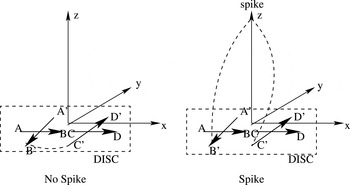
The two cases are illustrated in figure 1. On the left we have a line of force AD in the
 $(x,y)$
-plane. Imagine it divided into two parts, AB and CD. Let the two parts be rotated, as in the figure, to
 $\text{A}^{\prime }\text{B}^{\prime }$
and
 $\text{C}^{\prime }\text{D}^{\prime }$
. These two parts have no flux in the disc in either the
 $x$
direction or the
 $y$
direction. However, they were connected by a short line BC which by flux freezing goes to
 $\text{B}^{\prime }\text{C}^{\prime }$
, so that the combined line
 $\text{A}^{\prime }\text{B}^{\prime }\text{C}^{\prime }\text{D}^{\prime }$
has the same flux in the disc as the original line.
Now, consider the same situation and the same line segments, except
 $\text{B}^{\prime }\text{C}^{\prime }$
has been replaced by a line that stretches out of the disc to the spike and back. This segment has very little flux in the disc and the remaining lines have no flux. As far as the disc is concerned, the line has been cut into two parts whose disc fluxes can cancel.
It should be noted that if the line
 $\text{B}^{\prime }\text{C}^{\prime }$
reconnected with itself, then the matter along it would naturally drop back into the disc and draw the line
 $\text{B}^{\prime }\text{C}^{\prime }$
with it. Thus, reconnection would destroy the model. But it seems highly unlikely that flux freezing on this scale would allow reconnection.
The line breaking with and without the spike.

As the cut pieces rotate and decrease the disc flux, the magnetic line in the expelled parts will twist in the opposite direction, consistent with flux and helicity conservation. However, the helicity in the disc, under any plausible definition of local helicity, will change, as required for any dynamo that is growing the field.
In the remainder of this paper I show that during a billion years, there are enough spikes produced by superbubbles to cut enough lines to reduce the flux by a finite value in the top and bottom parts of the disc. This will resolve the second difficulty.
4. Superbubbles
Superbubbles were first discovered by Heiles in 1974 Heiles (Reference Heiles1974). He found them by surveying the galactic disc in narrow,
 $10~\text{km}~\text{s}^{-1}$
, width Doppler-shifted velocity bands of the 21 cm line. He found that in each band, the intensities were located in definite stripes. Combining these stripes in velocity and space, he interpreted them as gigantic expanding bubbles. These bubbles were similar to those produced by stellar winds (Weaver et al.
Reference Weaver, McCray, Castor, Shapiro and Moore1977) but on a much greater scale.
It was soon realized that superbubbles must be produced by multiple sequential supernovae originating in a forming galactic cluster of stars. The O and B stars in the cluster explode as supernovae almost as soon as they form so that their energy, instead of going into the kinetic energy of their remnants, goes into a bubble of high-pressure low-density plasma. This plasma pushes all the surrounding mass into a massive shell. An example of a large superbubble is the North Polar Spur. It has an enormous diameter of more than
 $80^{\circ }$
, stretching across the whole sky. After a period of time, it was appreciated that nearly every superbubble could be identified with a young galactic cluster, and conversely, every galactic cluster was generating a superbubble, (Elmegreen & Clemens Reference Elmegreen and Clemens1985).
In these superbubbles the supernovae explode as frequently as once or twice every million years. The rate of explosions multiplied by the supernova energy per explosion gives the luminosity,
 $L$
, of the superbubble, which ranges from
 $10^{36}$
to
 $10^{39}~\text{ergs}~\text{s}^{-1}$
. A superbubble lasts as long as O and B stars in its cluster are forming. Generally, this lifetime is 25–50 million years. The average number of supernova in a cluster lies between 6 and several thousand. The luminosity of the superbubble
 $L$
is emitted continuously and can be estimated as
 $L\sim SE_{sn}$
, where
 $S$
is the supernova rate and
 $E_{sn}$
is the energy of a supernova.
It is found that the shells of superbubbles with
 $L>10^{37}~\text{ergs}~\text{s}^{-1}$
expand long enough to break out of the disc. Prior to breakout, these superbubble decelerate, as more and more mass is added into their shells. However, for the stronger ones, after they break out of the disc, there is no further surrounding mass to add, and the pressure of the bubble then accelerates the shell. This situation is unstable to the Rayleigh–Taylor instability because the low-density plasma of the superbubble accelerates the high-density shell. As a consequence, the part of the superbubble extending out of the disc fragments into many pieces. This is observed in the numerical simulations of Mac Low et al. (Reference Mac Low, McCray and Norman1989). After the break up, the fragments continue to rise, but eventually their mass is brought to a stop by the galactic gravitational field, at heights of one or two kiloparsecs.
This does not directly help the dynamo because when the superbubble mass falls back into the disc it drags the flux back, thus expelling no net flux. However, as shown in § 7, a spike instability develops on any fragments that manage to hold on to the superbubble pressure for a long enough time. This spike will manage to throw mass out of the halo even if the fragment falls back into the disc.
In fact, the mass at the very top of the spike achieves velocities greater than the galactic escape velocity. The mass at the top of the spike will thus drag the flux lines that are still embedded in it out of the galaxy. Each of the very short segments of these lines will ‘cut’ the rest of the line that remains in the disc.
The part of the shell above the midplane of the disc will contain all the flux in the top half of the disc and within a sphere of radius
 $H$
. The spikes are unstable only on the top of half of the fragments and contain flux and mass from one quarter of the disc. A similar scenario occurs in the part of the shell below the midplane.
The remainder of this paper is devoted to finding the number of cuts in a given period of time. We first estimate the number of fragments into which the superbubble shell breaks. We assume that
 $f$
of these fragments will have a spike. Then, after investigating the nature of the spikes, we calculate the number of lines of force it ejects from the galaxy, i.e. the number of cuts it makes.
Next, we find the total number of spikes and cuts above the midplane due to a single superbubble Then, making use of the rate of production of superbubbles per unit area and time, we calculate the number of cuts made per square kiloparsec per million years.
By considering an annulus through the solar circle, we determine both the number of lines and the number of cuts in this annulus in
 $t_{6}$
million years. The ratio of these two numbers is the number of cuts per line in this time.
From this number we obtain the average length of the cut lines at any time. From diffusion theory, with the diffusion coefficient
 ${\it\beta}_{d}$
obtained from dynamo theory, we calculate the rate of spreading of
 ${\it\theta}_{d}$
the angles of the cut lines relative to their initial directions. The time it takes for this average angle to become larger than
 ${\rm\pi}/2$
is the dissipation time of the flux. By comparison with the standard value for the dynamo growth time, we can test whether the dissipation time is shorter or longer than the dynamo time of the models.
The theoretical and observational properties of superbubbles can be found in the following references. (Heiles Reference Heiles1974, Reference Heiles1976, Reference Heiles1979, Reference Heiles1980, Reference Heiles1984, Reference Heiles1987, Reference Heiles1990; Weaver et al. Reference Weaver, McCray, Castor, Shapiro and Moore1977; Elmegreen & Clemens Reference Elmegreen and Clemens1985; McCray & Kafatos Reference McCray and Kafatos1987; Mac Low & McCray Reference Mac Low and McCray1988; Kennicut, Edgar & Hodge Reference Kennicut, Edgar and Hodge1989; Mac Low et al. Reference Mac Low, McCray and Norman1989; Tenorio-Tagle et al. Reference Tenorio-Tagle, Silich, Kunth and Terlevich1999; Rafikov & Kulsrud Reference Rafikov and Kulsrud2000).
5. Superbubble properties
For simplicity we assume that the galactic disc is a slab of uniform density,
 $n_{0}=1.0~\text{cm}^{-3}$
and has a half-thickness of
 $H=200~\text{pc}$
, (Ferrière Reference Ferrière1998). This slab contains the same interstellar mass as the galaxy. We assume that all superbubble explosions are centred on the disc midplane. Henceforth, we consider the parts of the shell and its fragments only in the upper half of the disc.
For this case, the radius,
 $R$
, of a single superbubble before it breaks out of the disc, evolves as
 $$\begin{eqnarray}\displaystyle R=267L_{38}^{1/5}t_{7}^{3/5}~\text{pc}, & & \displaystyle\end{eqnarray}$$
where
 $L$
, the luminosity of the superbubble, is
 $10^{38}L_{38}~\text{ergs}~\text{s}^{-1}$
and
 $t=t_{7}10^{7}~\text{years}$
. (Weaver et al.
Reference Weaver, McCray, Castor, Shapiro and Moore1977; Mac Low & McCray Reference Mac Low and McCray1988; Rafikov & Kulsrud Reference Rafikov and Kulsrud2000).
Differentiating this with respect to
 $t$
we find the velocity of expansion
 $$\begin{eqnarray}\displaystyle v=15.7L_{38}^{1/5}t_{7}^{-2/5}~\text{km}~\text{s}^{-1}. & & \displaystyle\end{eqnarray}$$
From these results we can determine the luminosity
 $L_{1}$
at which a superbubble is just able to break out of the disc. We use the fact that the superbubble stops expanding horizontally when its velocity drops to the interstellar velocity of
 $10~\text{km}~\text{s}^{-1}$
, and we set its horizontal radius equal to
 $H$
at this time Ferrière (Reference Ferrière1993). (Under the uniform density approximation for the disc, the superbubble will expand spherically up to breakout. Afterwards, it will expand only in the vertical direction.)
We find that
 $$\begin{eqnarray}\displaystyle L_{1}=1.46\times 10^{37}~\text{ergs}~\text{s}^{-1}, & & \displaystyle\end{eqnarray}$$
and the breakout time for a superbubble with
 $L>L_{1}$
is
 $$\begin{eqnarray}\displaystyle t_{br}=11.7\left(\frac{L}{L_{1}}\right)^{-1/3}~\text{Myr}, & & \displaystyle\end{eqnarray}$$
where Myr denotes
 $10^{6}~\text{years}$
.
The rate of production of superbubbles is
 $$\begin{eqnarray}\text{d}{\it\sigma}=0.10\left(\frac{L}{L_{1}}\right)^{-2.3}\frac{\text{d}L}{L_{1}}~\text{kpc}^{-2}~\text{Myr}^{-1},\end{eqnarray}$$
where we have normalized the rate to the
 $L_{1}$
luminosity. (Elmegreen & Clemens Reference Elmegreen and Clemens1985; Kennicut et al.
Reference Kennicut, Edgar and Hodge1989; Ferrière Reference Ferrière1993).
We are only interested in superbubbles with luminosities great enough to break out of the disc, i.e.
 $L>L_{1}$
. The shells of these superbubbles will fragment due to the Rayleigh–Taylor instability when
 $R>H$
and they leave the disc. The growth rate of the instabilities with horizontal wavenumber
 $k$
has a maximum of
 ${\it\gamma}=\sqrt{kg/2}$
at
 $kD=1$
, where
 $D$
is the thickness of the shell. (
 $g\sim 10^{-8}$
is the vertical gravitational field produced by the stars in the disc (Ferrière Reference Ferrière1998).)
We can obtain the thickness of the shell at breakout by comparing the pressure
 $p$
in the hot core of the superbubble with the pressure
 $n_{s}{\it\kappa}_{B}T$
in the shell. The core pressure can be obtained from the energy deposited by the exploding supernovae into the core plasma during the time of the breakout,
 $(5/11)Lt_{br}$
. (The factor of
 $5/11$
takes into account the work done by the core pressure in accelerating the shell.) Dividing this energy by the spherical volume of radius
 $H$
gives
 $3/2$
times the core pressure. The result of the calculation is
 $$\begin{eqnarray}\displaystyle n_{s}=40.0(\ell ^{2/3}{\it\theta}^{-1})~\text{cm}^{-3}, & & \displaystyle\end{eqnarray}$$
where
 $$\begin{eqnarray}\ell \equiv \left(\frac{L}{L_{1}}\right).\end{eqnarray}$$
The temperature is not known, but it is believed to lie between
 $100^{\circ }$
and
 $1000^{\circ }$
, so we normalize it to 300 K and set
 $T=300{\it\theta}$
. The shell sweeps up all the interstellar matter in the sphere above the midplane, so
 $$\begin{eqnarray}D=\frac{n_{0}H}{3n_{s}}=1.66(\ell ^{-2/3}{\it\theta})~\text{pc}.\end{eqnarray}$$
The superbubble shell will break into fragments with radii of a scale of order
 ${\it\lambda}_{0}=2{\rm\pi}/k=2{\rm\pi}D$
, with
 $k=1/D$
the wavenumber at maximum growth rate, so
 $$\begin{eqnarray}\displaystyle {\it\lambda}_{0}=10.4(\ell ^{-2/3}{\it\theta})~\text{pc}. & & \displaystyle\end{eqnarray}$$
Mac Low et al. (Reference Mac Low, McCray and Norman1989) have simulated the explosion of a superbubble with
 $L\sim L_{38}$
, and have displayed the fragmentation at the time of breakout. For this luminosity,
 ${\it\lambda}_{0}=6~\text{pc}$
. A crude inspection of their figure 2(c) shows that the radii of their fragments at breakout is between 12 and 15 pc. We use this to set the radii of the fragments to
 $2{\it\xi}{\it\lambda}_{0}$
, where
 ${\it\xi}$
is of order one.
The number of fragments per superbubble is thus
 $$\begin{eqnarray}N_{f}=\left(\frac{H}{2{\it\xi}{\it\lambda}_{0}}\right)^{2}=91.7(\ell ^{4/3}{\it\theta}^{-2}{\it\xi}^{-2}).\end{eqnarray}$$
Each fragment will have a spike with probability
 $f$
.
6. The spike instability
Assume a thin disc at the top of a fragment of the superbubble shell with surface density
 ${\it\sigma}_{0}$
. Ignoring the inertial forces, the gravitational force on a unit area of the shell is
 ${\it\sigma}_{0}g$
.
 $g=10^{-8}~\text{cm}~\text{s}^{-2}$
, the real galactic gravitational field.
Assume that the spike perturbation is azimuthally symmetric about some vertical axis. We derive the Lagrangian equations for it, with radial and vertical Lagrangian displacements
 $R(r_{0},t)$
and
 $Z(r_{0},t)$
, where
 $r_{0}$
is the Lagrangian radial independent variable.
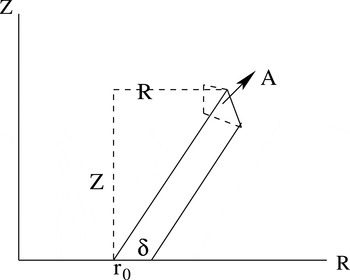
In the perturbation, consider a thin zonal disc generated by the rotation of a line initially extending from
 $r_{0}$
to
 $r_{0}+{\it\delta}$
. After a time
 $t$
, these two end points are displaced to
 $[r_{0}+R(r_{0},t),Z(r_{0},t)]$
and
 $[r_{0}+{\it\delta}+R(r_{0},t)+{\it\delta}R^{\prime }(r_{0},t),Z(r_{0},t)+{\it\delta}Z^{\prime }(r_{0},t)]$
, where the prime denotes a derivative with respect to
 $r_{0}$
.
The area for the spike instability.

If we rotate this displaced line by a small angle
 ${\it\epsilon}$
about the cylindrical axis, we will obtain a small vectorial area
 $\boldsymbol{A}$
whose coordinates are
 $$\begin{eqnarray}\displaystyle \left.\begin{array}{@{}c@{}}\displaystyle A_{r}=-{\it\epsilon}{\it\delta}(r_{0}+R)Z^{\prime }\\ \displaystyle A_{z}={\it\epsilon}{\it\delta}(r_{0}+R)(1+R^{\prime }).\end{array}\right\} & & \displaystyle\end{eqnarray}$$
See figure 2.
Now
 $m$
, the mass of this area, is constant under the Lagrangian displacement and equals
 ${\it\delta}{\it\epsilon}r_{0}{\it\sigma}_{0}$
. The pressure force has the components
 $pA_{r}$
and
 $pA_{z}$
, with
 $p={\it\sigma}_{0}g$
also a constant. The gravitational force has the components
 $[0,-mg]$
.
Therefore, the (nonlinear) Lagrangian equations of motions are
 $$\begin{eqnarray}\displaystyle \left.\begin{array}{@{}c@{}}\displaystyle \frac{\partial ^{2}R}{\partial t^{2}}=-\frac{g}{r_{0}}(r_{0}+R)Z^{\prime }\\ \displaystyle \frac{\partial ^{2}Z}{\partial t^{2}}=\frac{g}{r_{0}}(r_{0}+R)(1+R^{\prime })-g.\end{array}\right\} & & \displaystyle\end{eqnarray}$$
Take
 $R$
and
 $Z$
proportional to
 $\text{e}^{{\it\gamma}t}$
. Then the linear equations are
 $$\begin{eqnarray}\displaystyle \left.\begin{array}{@{}c@{}}\displaystyle {\it\gamma}^{2}R=-gZ^{\prime }\\ \displaystyle {\it\gamma}^{2}Z=g\left(\frac{R}{r_{0}}+R^{\prime }\right).\end{array}\right\} & & \displaystyle\end{eqnarray}$$
Setting
 ${\it\gamma}^{2}=kg$
, where
 $k$
gives the initial spatial dependence of the mode, we find that the linear solution is
 $$\begin{eqnarray}\displaystyle \left.\begin{array}{@{}c@{}}\displaystyle Z=a\text{e}^{{\it\gamma}t}\text{J}_{0}(kr_{0})\\ \displaystyle R=a\text{e}^{{\it\gamma}t}\text{J}_{1}(kr_{0}),\end{array}\right\} & & \displaystyle\end{eqnarray}$$
where
 $\text{J}_{0}$
, and
 $\text{J}_{1}$
are Bessel functions.
When the finite thickness of the shell
 $D$
is taken into account, the growth rate is given by
 ${\it\gamma}^{2}=kg/(1+k^{2}D^{2})$
, so that the maximum growth rate occurs when
 $kD=1$
, and is
 ${\it\gamma}=\sqrt{g/2D}$
. Using (5.8) for
 $D$
we find the linear growth time of the spike is
 ${\it\gamma}^{-1}=1.0\ell ^{1/3}{\it\theta}^{1/2}$
million years.
We require the nonlinear development of the solution to study the escape of mass from the galaxy.
The nonlinear limit of our equations are
 $$\begin{eqnarray}\displaystyle \left.\begin{array}{@{}c@{}}\displaystyle \frac{\partial ^{2}R}{\partial t^{2}}=-\frac{g}{r_{0}}RZ^{\prime }\\ \displaystyle \frac{\partial ^{2}Z}{\partial t^{2}}=\frac{g}{r_{0}}RR^{\prime }.\end{array}\right\} & & \displaystyle\end{eqnarray}$$
To solve these equations, set
 $$\begin{eqnarray}\displaystyle \left.\begin{array}{@{}c@{}}\displaystyle R=\frac{{\it\eta}(r_{0})}{(t_{0}-t)^{2}}\\ \displaystyle Z=\frac{{\it\nu}(r_{0})}{(t_{0}-t)^{2}}.\end{array}\right\} & & \displaystyle\end{eqnarray}$$
Then the nonlinear equations become
 $$\begin{eqnarray}\displaystyle \left.\begin{array}{@{}c@{}}\displaystyle 6{\it\eta}=-\frac{g}{r_{0}}{\it\eta}{\it\nu}^{\prime }\\ \displaystyle 6{\it\nu}=\frac{g}{r_{0}}{\it\eta}{\it\eta}^{\prime }.\end{array}\right\} & & \displaystyle\end{eqnarray}$$
Canceling
 ${\it\eta}$
in the first equation, we find
 $$\begin{eqnarray}\displaystyle {\it\nu}=C-3\frac{r_{0}^{2}}{g}, & & \displaystyle\end{eqnarray}$$
where
 $C$
is a constant to be determined. The second equation gives
 $$\begin{eqnarray}\displaystyle {\it\eta}^{2}=\frac{6C}{g}r_{0}^{2}-\frac{9}{g^{2}}r_{0}^{4}\approx \frac{6C}{g}r_{0}^{2}. & & \displaystyle\end{eqnarray}$$
The linear and nonlinear solutions do not overlap. To a sufficient approximation, we can compare the two solutions for
 $Z$
at
 $t=0$
, to obtain rough values for
 $C$
and
 $t_{0}$
.
 $$\begin{eqnarray}\frac{C-3r_{0}^{2}/g}{t_{0}^{2}}\approx a(1-k^{2}r_{0}^{2}/4).\end{eqnarray}$$
From this we find that
 $$\begin{eqnarray}\displaystyle \left.\begin{array}{@{}c@{}}\displaystyle t_{0}^{2}=\frac{12}{k^{2}ga}\\ \displaystyle C=at_{0}^{2}=\frac{12}{k^{2}g}=\frac{12D^{2}}{g}.\end{array}\right\} & & \displaystyle\end{eqnarray}$$
Since
 $kD=1$
, the initial radius of the spike is
 ${\sim}\sqrt{2}D$
and
 $$\begin{eqnarray}C=3.14\times 10^{46}(\ell ^{-4/3}{\it\theta}^{2})~\text{cm}^{2}~\text{s}.\end{eqnarray}$$
Note that
 $C$
does not involve the initial amplitude
 $a$
.
As
 $t$
approaches
 $t_{0}$
, both
 $Z$
and
 $R$
diverge. Before this happens, the velocity reaches the escape velocity and the top of the spike moves ballistically out of the galaxy. Setting the upward velocity
 $\partial Z/\partial t$
at
 $r_{0}=0$
and
 $t=t_{esc}$
, equal to
 $v_{esc}=400~\text{km}~\text{s}^{-1}$
, (Binney & Tremaine Reference Binney and Tremaine1987) we have
 $$\begin{eqnarray}\displaystyle \frac{\partial Z}{\partial t}=\frac{24}{k^{2}g({\rm\Delta}t)^{3}}=v_{esc}, & & \displaystyle\end{eqnarray}$$
so since
 $k=1/D$
we have
 $$\begin{eqnarray}{\rm\Delta}t=t_{0}-t_{esc}=0.37(\ell ^{-4/9}{\it\theta}^{2/3})~\text{Myr}.\end{eqnarray}$$
The height,
 $h_{esc}$
, at which this happens is
 $$\begin{eqnarray}h_{esc}=\frac{C}{({\rm\Delta}t)^{2}}=75(\ell ^{-4/9}{\it\theta}^{2/3})~\text{pc}.\end{eqnarray}$$
At the same time, the plasma at the top has spread out, and thus the magnetic field originally trapped on the top will also have spread out. Its strength is weakened by a power of
 $$\begin{eqnarray}\displaystyle {\it\rho}=\frac{R}{r_{0}} & = & \displaystyle \sqrt{\frac{6C}{g}}\frac{1}{({\rm\Delta}t)^{2}}\nonumber\\ \displaystyle & = & \displaystyle 32.2(\ell ^{2/9}{\it\theta}^{-1/3})\end{eqnarray}$$
at time
 $t_{esc}$
.
7. The rate of cuts
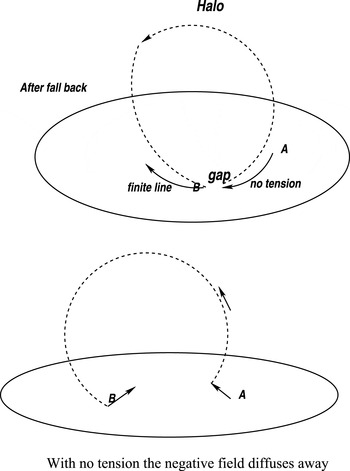
As a result of a single spike, a line has been cut. See figure 3.
The model for line cutting.

We will first estimate the number of cuts made by a single spike, then the number of cuts per superbubble, followed by the rate of cuts in a cubic kiloparsec.
How many cuts does a single spike make? From the previous section we see that the top of the spike will be accelerated to the escape velocity and leave the galaxy, dragging its embedded flux with it. These lines will still be connected to the disc and each removed line will produce a cut in a disc line.
Let us take the initial horizontal diameter of the spike to be
 $d=2D$
.
Now, the lines in a spike will be those that come from the top half of its fragment, which in turn come from the top half of that part of the initial galactic field above the galactic midplane. In general, we do not know the vertical profile of the structure of the disc field (which is determined by the dynamo theory), although it must have the same profile as the initial flux in the spike. Let the initial flux in the spike be
 ${\it\chi}B_{0}(2DH/2)$
, where the profile factor
 ${\it\chi}$
would be one if the field were uniform.
Thus, the initial number of lines in the spike is
 $$\begin{eqnarray}{\it\phi}^{\prime }={\it\chi}B_{0}DH.\end{eqnarray}$$
As the spike grows, the mass on the top slides downward along its sides, and at the escape time, the surface density is reduced by a factor of
 ${\it\rho}^{2}$
where
 ${\it\rho}$
is given by (6.16).
Although the surface density decreases by
 ${\it\rho}^{2}$
, the number of field lines decreases only by one power of
 ${\it\rho}$
. This is because in one direction, the mass flows along the field lines. The lines are only removed from the top by motions in a transverse direction to the field. Remember we are dealing with extremely weak fields, so the velocities are axisymmetric and the fields have no effect on them.
From (6.16) we see that in the planer single-spike solution, the spike will expand by approximately thirty times. It is unlikely that the solution is valid to such a large distance, but the thinning out of the flux and density about the origin are locally correct. Since I am uncertain what terminates the nonlinear solution in the horizontal direction, I assume that the flux is ejected from the galaxy at least to a distance
 ${\it\tau}D$
from the origin, where
 ${\it\tau}$
is a factor greater than one.
Thus, the flux which is removed from the galaxy by a single spike and the number of resulting cuts in different lines is
 $$\begin{eqnarray}{\it\phi}_{spike}={\it\chi}\frac{{\it\tau}DHB}{{\it\rho}}={\it\chi}{\it\tau}\frac{D}{H}\frac{H^{2}B}{{\it\rho}}={\it\chi}2.57\times 10^{-4}(\ell ^{-8/9}{\it\theta}^{4/3}{\it\tau})~\text{G}~\text{cm}^{2}.\end{eqnarray}$$
Next, the number of cuts per superbubble is the number of cuts per spike times the number of fragments times the probability
 $f$
that each fragment will have a spike. Thus,
 $$\begin{eqnarray}{\it\phi}_{sb}=fN_{f}{\it\phi}_{spike}=0.0236\times {\it\chi}H^{2}B(\ell ^{4/9}{\it\theta}^{-2/3}f{\it\tau}{\it\xi}^{-2}).\end{eqnarray}$$
Now, using (5.5) the number of cuts per unit area summed over all
 $L$
, is
 $$\begin{eqnarray}\displaystyle {\it\phi}_{kpc} & = & \displaystyle \int {\it\phi}_{sb}\,\text{d}{\it\sigma}\nonumber\\ \displaystyle & = & \displaystyle 0.00236{\it\chi}H^{2}B({\it\theta}^{-2/3}f{\it\tau}{\it\xi}^{-2})\int _{1}^{\infty }\ell ^{4/9-2.3}\,\text{d}\ell \nonumber\\ \displaystyle & = & \displaystyle 0.00276{\it\chi}H^{2}B({\it\theta}^{-2/3}f{\it\tau}{\it\xi}^{-2})~\text{kpc}^{-2}~\text{Myr}^{-1}.\end{eqnarray}$$
To find the number of cuts per unit time of any individual line in the upper quarter of the disc, we consider an annulus of radius
 $8.5~\text{kpc}$
, thickness
 $H$
and width
 ${\rm\Delta}R$
. The rate of cuts in this annulus is
 $$\begin{eqnarray}\displaystyle {\it\phi}_{ann} & = & \displaystyle 2{\rm\pi}R_{S}{\rm\Delta}R{\it\phi}_{kpc}\nonumber\\ \displaystyle & = & \displaystyle 2.76\times 10^{-3}{\it\chi}H^{2}B(2{\rm\pi}R_{S}{\rm\Delta}R)({\it\theta}^{-2/3}{\it\tau}f{\it\xi}^{-2})~\text{Myr}^{-1}.\end{eqnarray}$$
The initial number of lines in the top quarter of the disc and in this annulus is
 $$\begin{eqnarray}\displaystyle {\it\Psi}=0.5{\it\chi}BH{\rm\Delta}R~\text{G}~\text{cm}^{2}. & & \displaystyle\end{eqnarray}$$
Clearly,
 $N_{cuts}$
, the total of cuts which any line in the annulus suffers in
 $t_{6}~\text{Myr}$
is
 $$\begin{eqnarray}\displaystyle N_{cuts}=\frac{{\it\phi}_{ann}}{{\it\Psi}}=1.10\times 10^{-3}(2{\rm\pi}R_{S})t_{6}({\it\theta}^{-2/3}{\it\tau}f{\it\xi}^{-2}). & & \displaystyle\end{eqnarray}$$
The profile factor,
 ${\it\chi}$
has dropped out of this ratio.
The average length of every line segment after
 $t_{6}~\text{Myr}$
is
 $$\begin{eqnarray}\displaystyle {\mathcal{L}}= & = & \displaystyle \frac{2{\rm\pi}R_{S}}{N_{cuts}}\nonumber\\ \displaystyle & = & \displaystyle \frac{909}{t_{6}}({\it\theta}^{2/3}f^{-1}{\it\tau}^{-1}{\it\xi}^{2})~\text{kpc}.\end{eqnarray}$$
8. The dissipation time for the flux
We now consider how fast the cut lines can rotate in order to remove their net flux. This rotation occurs in the disc and is produced by turbulent diffusion there. The disc diffusion coefficient is included in all previous work. It has usually been estimated from the observed properties of interstellar turbulence, but the magnitude of this turbulence is uncertain. Ferrière has carried out a more deductive calculation of its production by the fluid motions resulting from supernova and superbubble explosions (Ferrière Reference Ferrière1993). Characterizing the effective turbulence by the disc diffusion coefficient
 ${\it\beta}_{d}$
, she finds
 ${\it\beta}_{d}\approx 5\times 10^{25}~\text{cm}^{2}~\text{s}^{-1}$
. This diffusion coefficient is much smaller than the halo coefficient discussed in § 3, and is the same as the
 ${\it\beta}$
in the dynamo equations (2.1).
Consider any given cut portion of a line aligned along any axis. Each end will be displaced by the interstellar turbulence by a perpendicular amount whose standard deviation is
 $2{\it\beta}t$
. Therefore, the line will be rotated from its initial direction by an angle
 ${\it\theta}_{d}$
whose standard deviation is
 $$\begin{eqnarray}\langle ({\it\theta}_{d})^{2}\rangle =\int _{0}^{t}\frac{8{\it\beta}\,\text{d}t}{{\mathcal{L}}^{2}}=0.44t_{9}^{3}({\it\theta}^{-4/3}f^{2}{\it\tau}^{2}{\it\xi}^{-4}),\end{eqnarray}$$
where
 $t_{9}$
is the time in
 $10^{9}$
years.
The dissipation time,
 $t_{d}$
, is found by setting
 $\langle {\it\theta}_{d}^{2}\rangle =({\rm\pi}/2)^{2}$
. This is the time when all the relevant flux is diffused to zero.
 $$\begin{eqnarray}t_{d}=1.66\times 10^{9}({\it\theta}^{4/9}f^{-2/3}{\it\tau}^{-2/3}{\it\xi}^{4/3})~\text{years}.\end{eqnarray}$$
This estimate for
 $t_{d}$
shows that the time to dissipate the flux is of order of a billion years. In deriving it, I make use of certain assumptions that are quantified by the parameters:
-
(i)
 $f$
, the probability that a fragment will have a spike instability equal to the probability that the fragments holds their superbubble pressure for a time
$t_{esc}$
, (see (6.14)).
-
(ii)
${\it\xi}$
, the size of the fragments normalized to
$4{\rm\pi}D$
. -
(iii)
${\it\theta}$
, the shell temperature normalized to 300 K. -
(iv)
${\it\tau}$
, the radius of the top of the spike at the escape time, normalized to
$2D$
.


These parameters are included in (8.2). Their values are uncertain. In particular, if the spike instability did not occur at all (because all the fragments lose their superbubble pressure too rapidly), then
 $f$
would be zero, (8.2)
 $t_{d}$
would be infinite and the spike hypothesis of this paper would not work.
For comparison, let us take an estimate of the dynamo time
 $t_{dy}$
equal to the growth time, from one of the referenced papers in § 2, (Brandenburg et al.
Reference Brandenburg, Donner, Moss, Shukurov, Sokoloff and Tuominen1992).
 $$\begin{eqnarray}t_{dy}=\frac{R_{0}^{2}}{11{\it\beta}}\sim 3\times 10^{8}~\text{years}\end{eqnarray}$$
a time considerably shorter than a billion years. Thus, if the Brandenburg et al. galactic dynamo is inhibited by flux freezing and the galactic gravitational field, it still can work using this new process but with a longer growth time given by
 $t_{d}$
.
Although we cannot determine the values of the parameters, we can note the following. First,
 $f$
is the most uncertain parameter since the analytic details of the fragmentation are not known.
 $f$
must be less than one, but is probably bigger than one third. The parameter
 ${\it\tau}$
is definitely larger than one but less than
 $4{\rm\pi}{\it\xi}$
since
 $4{\rm\pi}{\it\xi}D$
is the radius of the fragment. It is probably considerably larger than one. One might assume that the factors
 $f$
and
 ${\it\tau}$
cancel.
 ${\it\xi}$
, which has been determined by comparison with the simulation of Mac Low et al. (Reference Mac Low, McCray and Norman1989), is probably not far from one. Thus, it is reasonable to believe that
 $t_{d}$
is directly proportional to
 ${\it\theta}$
.
 ${\it\theta}$
can easily be as small as
 $1/3$
if the shell temperature is 100 K, or as large as three if the temperature is 1000 K, so this probably gives a plausible range for
 $t_{d}$
. Thus, one might have either
 $t_{d}$
comparable to
 $t_{dy}$
, in which case the previous values for the dynamo time are believable, or it may be much larger and the dynamo would be correspondingly slower. Detailed numerical simulations are probably necessary to decide which is the case.
How does one analytically combine our result for
 $t_{d}$
with the alpha–omega differential equation (2.1)? The simplest way is to modify these equations by adding terms
 $-B_{r}/t_{d}$
and
 $-B_{{\it\theta}}/{\it\tau}_{d}$
to the right-hand sides of the two equations when
 $0.5H<|z|<H$
. In addition, one must include the mass flow expressed in terms of the flux flow from the flux-freezing condition, and the gravitational field. It should be acceptable to use vacuum boundary conditions on the edge of the halo. This leads to a modification of the standard approach and should be more realistic.
The broken pieces of flux from one growth phase will not interfere with the next growth phase because the strength of their fields are relatively small. This only holds during amplification. When the stronger field is approached, the spike instability saturates and one can no longer neglect the residual field in the disc, even after it is dissipated. This will probably saturate the dynamo as well since
 $t_{d}$
would be much longer, and the boundaries would become completely closed. Assuming saturation at the present epoch, these loose finite pieces could be responsible for the random fields measured by Rand & Kulkarni (Reference Rand and Kulkarni1989).
We can calculate the length of the cut lines averaged over a decay time. This is given by averaging (7.8) over
 $t_{d}$
, and is equal to the length at
 $t_{d}$
multiplied by a logarithmic factor which is two or three. This length, of only a few kpc, is about the bulk distance cosmic rays can propagate during their lifetime. These cut lines remaining after saturation suggest a natural method for cosmic rays to escape from the disc.
9. Summary and conclusions
I have shown by a simple example that, when flux freezing and the gravitational field are present, the rate of expulsion of flux in previous galactic dynamo theories can be strongly inhibited by the mass on the outflowing flux falling back from the halo into the disc. A crude estimate of this inhibition is given by (2.2) which indicates that if the halo diffusion coefficient is much less than
 $10^{29}~\text{cm}^{2}~\text{s}^{-1}$
, the outflow will be completely inhibited.
However, in this case, the dynamo may be saved by another process based on a spike instability arising from the fragmentation of those superbubbles that succeed in breaking out of the disc. This instability can expel a very short length of a line of force, cutting the rest of the line in two. If a line is cut into short enough pieces, these pieces can rotate horizontally in the disc, dissipating their net flux and removing it from playing any role in the dynamo. This turns out to be equivalent to expelling the line as far as the dynamo is concerned. An estimate of how many cuts occur shows that the relevant amount of flux can be removed in a time of the order of a billion years. Thus, the dynamo can still operate, but on this longer time scale, to grow the galactic magnetic field. The two processes, the alpha–omega dynamo and the flux annihilation by cutting fields, can be combined into a systematic theory. One merely has to add terms giving the annihilation rate to the dynamo equations, and assume boundary conditions compatible with the inhibition of the flux expulsion.
The method of dissipating flux without removing mass may apply to other dynamos, such as the solar dynamo, in which the flux is confined by flux freezing and one does not want to remove an appreciable fraction of the mass of an object to produce its dynamo.
Although no direct observational evidence is produced for this model, it may have indirect consequences of importance such as providing an explanation for why the observed random magnetic fields are larger than the mean field. Also, the cut fields may provide an escape route for cosmic rays.
Acknowledgements
I should like to acknowledge my referees whose criticism has led to a great improvement of this paper and my understanding of the physics underlying it. This work was partially supported by the US Department of Energy Grants DE-AC02-09CH11466.
Appendix A. The diffusion of flux in the presence of a gravitational field
To address the problem of the motion of flux through the halo, I consider a one-dimensional diffusion problem of particles in a downward gravitational field of strength
 $g$
with diffusion coefficient
 ${\it\beta}$
.
The one-dimensional Fokker–Planck equation in
 $z$
is
 $$\begin{eqnarray}\frac{\partial f(z,t)}{\partial t}=\frac{\partial ^{2}}{\partial z^{2}}\left[\frac{\langle ({\rm\Delta}z)^{2}\rangle }{2}f\right]-\frac{\partial }{\partial x}[(\langle {\rm\Delta}z\rangle )f].\end{eqnarray}$$
Let us start the problem at time
 $t=0$
, with
 $f(z,0)={\it\delta}(z)$
. Define
 $(\langle ({\rm\Delta}z)^{2}/2\rangle )={\it\beta}$
. Then, with
 $\langle {\rm\Delta}z\rangle =-gt$
, the Fokker–Planck equation becomes,
 $$\begin{eqnarray}\frac{\partial f(z,t)}{\partial t}={\it\beta}\frac{\partial ^{2}f}{\partial z^{2}}+gt\frac{\partial f}{\partial t}.\end{eqnarray}$$
Next transform this equation by setting
 $z$
to
 $z^{\prime }=z+gt^{2}/2$
which gives
 $$\begin{eqnarray}\frac{\partial f(z^{\prime },t)}{\partial t}={\it\beta}\frac{\partial ^{2}f}{\partial z^{\prime 2}}\end{eqnarray}$$
whose solution is
 $$\begin{eqnarray}\displaystyle f(z^{\prime },z) & = & \displaystyle \frac{1}{\sqrt{4{\rm\pi}{\it\beta}t}}\exp -\frac{z^{\prime 2}}{4{\it\beta}t}\nonumber\\ \displaystyle & = & \displaystyle \frac{1}{\sqrt{4{\rm\pi}{\it\beta}t}}\exp -\frac{(z+gt^{2}/2)^{2}}{4{\it\beta}t}.\end{eqnarray}$$
Now, at any time
 $t$
, the number of particles with
 $z>R$
is
 $$\begin{eqnarray}\displaystyle {\it\Phi}(t) & = & \displaystyle \int _{R}^{\infty }f(z,t)\,\text{d}z\nonumber\\ \displaystyle & = & \displaystyle \frac{1}{\sqrt{4{\it\beta}t}}\int _{R}^{\infty }\exp -\frac{(z+gt^{2}/2)^{2}}{4{\it\beta}t}\,\text{d}z\nonumber\\ \displaystyle & = & \displaystyle \frac{1}{\sqrt{{\rm\pi}}}\int _{(R+gt^{2}/2)/\sqrt{(4{\it\beta}t)}}^{\infty }\text{e}^{-u^{2}}\,\text{d}u.\end{eqnarray}$$
Alternatively,
 $$\begin{eqnarray}{\it\Phi}(t)=\text{Erfc}[(R+gt^{2}/2)/\sqrt{4{\it\beta}t}],\end{eqnarray}$$
where Erfc is the compliment of the error function. This is (2.2).