I. INTRODUCTION
The increasing demand for energy all around the world and the high level of pollution generated by fossil fuel combustion, the conventional way of energy supply, require new environmental-friendly energy conversion systems with high efficiency. To this aim, fuel cells, which directly convert chemical energy into electricity, provide a promising alternative option. Reference Stambouli and Traversa1 Moreover, fuel cells are versatile and can generate electricity from several W to MW range, since their efficiency does not depend on their size, meeting the demand from portable to stationary applications. Reference Stambouli and Traversa1
Solid oxide fuel cells (SOFCs), regarded as one of the most promising fuel cell types, Reference Wachsman, Marlowe and Lee2 have additional advantages over the other types of fuel cells, including fuel flexibility, all solid components, use of nonprecious catalysts, etc. Reference Stambouli and Traversa3 However, the conventional SOFC technology uses oxygen-ion conductor electrolytes, such as yttria-stabilized zirconia (YSZ), and thus needs operation temperatures up to 1000 °C due to the YSZ ionic conductivity. Reference Han, Tang, Yin and Peng4,Reference Chen, Lu, Chen, Ai, Huang, Du and Su5 However, working at such a high temperature causes many problems, including the reduction of cell life time, interfacial diffusions, sealing problems, etc. Reference Minh6 Therefore, the reduction of the SOFC working temperature is the current trend in SOFC development. Reference Wachsman and Lee7
One strategy to reduce the working temperature for SOFCs is decreasing the YSZ electrolyte thickness, Reference deSouza, Visco and DeJonghe8 which in turn results in reducing the ohmic resistance of the cell and in improving the cell performance at lower temperatures. Reference Dong, Liu, Xie, Sheng, Wang, Peng, Liu and Meng9 However, an operating temperature of 700 °C is needed when the thickness of the YSZ electrolyte is reduced at 15 μm. Reference Steele and Heinzel10 The development of alternative electrolyte materials with high ionic conductivity at intermediate temperatures is needed to further reduce the SOFC working temperature in the 500–700 °C temperature range, Reference Ishihara, Matsuda and Takita11,Reference Esposito and Traversa12 and the fabrication of films of these electrolytes can further boost the SOFC performance. Reference Ahn, Pergolesi, Camaratta, Yoon, Lee, Lee, Jung, Traversa and Wachsman13,Reference Bozza, Polini and Traversa14
Since the discovery of Iwahara et al. Reference Iwahara, Esaka, Uchida and Maeda15–Reference Iwahara, Uchida and Morimoto17 that some ABO3 perovskite-type oxides showed proton conductivity at intermediate temperatures, proton-conducting oxides have become promising electrolyte candidates for intermediate temperature SOFCs, Reference Fabbri, Pergolesi and Traversa18 since they possess lower activation energy compared with that of YSZ in the intermediate temperature range. An additional advantage is the water formation at the cathode side during fuel cell operation, which avoids fuel dilution at the anode side.
Although there are some alternative materials reported in the literature to show proton conductivity, Reference Omata and Otsuka-Yao-Matsuo19–Reference Kawasaki, Okada, Ito, Matsumoto and Ishihara21 in the past three decades, most of the researches on proton-conducting oxides are still focused on the BaCeO3–BaZrO3 compositions, due to their superior proton conductivity. Reference Kreuer22–Reference Fabbri, Bi, Pergolesi and Traversa24 The properties of doped (being Y the preferred dopant) BaCeO3 and BaZrO3 significantly differ when in form of sintered ceramic bodies: Y-doped BaCeO3 (BCY) pellets show good ionic conductivity but very weak chemical stability, whereas the total conductivity of Y-doped BaZrO3 (BZY) pellets is one order of magnitude smaller than that of BCY pellets, but with an excellent chemical stability. Reference Iwahara, Yajima, Hibino, Ozaki and Suzuki25–Reference Fabbri, Pergolesi, D'Epifanio, Di Bartolomeo, Balestrino, Licoccia and Traversa30 For this reason, most of the early work on proton-conducting SOFCs was performed using BaCeO3-based materials as electrolytes. Reference Peng, Wu, Yang and Mao31–Reference Fabbri, Licoccia, Traversa and Wachsman37 However, the poor chemical stability of BaCeO3 in CO2 and H2O atmospheres makes its practical applications difficult: the amount of CO2 and H2O produced during the fuel cell operation can deteriorate the BaCeO3 electrolyte when the cell operates with hydrogen and hydrocarbon fuels, and/or with internal reforming. Doping was used to enhance the chemical stability of BaCeO3, though showing only a partial improvement of BaCeO3 stability. Reference Bi, Zhang, Fang, Tao, Peng and Liu38,Reference Xie, Yan and Liu39 Furthermore, the improved chemical stability with doping is usually at the cost of reducing BaCeO3 proton conductivity. Reference Xie, Yan, Chen, Dong, Wang, Liu and Meng40 The trade-off relation between chemical stability and conductivity made the studies on fuel cells based on BaCeO3 electrolyte either pursue high fuel cell performance Reference Hibino, Hashimoto, Suzuki and Sano41 or pursue a better chemical stability but decreasing the cell performance. Reference Bi, Fang, Tao, Zhang, Peng and Liu42
In contrast, BaZrO3 has been proven to be chemically stable at fuel cell working temperatures, and it also shows acceptable conductivity, Reference Babilo, Uda and Haile43 which would be more appropriate for practical applications in SOFCs. However, a large volume of highly resistive grain boundaries, due to its poor sinterability, significantly decreases BZY total conductivity. Reference Serra and Meulenberg44 Nonetheless, it has been reported that the bulk conductivity of BZY is even larger than that of BCY, Reference Pergolesi, Fabbri, D'Epifanio, Di Bartolomeo, Tebano, Sanna, Licoccia, Balestrino and Traversa45 and this has recently stimulated again attention to doped BaZrO3 by the proton-conducting oxide community, aimed at fabricating SOFCs with a chemically stable electrolyte for practical applications. Reference Yamazaki, Hernandez-Sanchez and Haile46 Therefore, numerous synthesis and doping strategies have been developed to improve the total conductivity with the enhancement of grain growth and the reduction of the total volume of the highly resistive grain boundaries for BaZrO3-based materials, which will be reviewed in the present work. Here, we summarize the different synthesis methods proposed for the preparation of BaZrO3-based materials, showing that nanosized powders can promote the sinterability and electrochemical performance of BaZrO3. Advantages and drawbacks of the doping strategies for the synthesis of modified BaZrO3 nanomaterials are also discussed, together with their influence on SOFC performance.
II. DIFFERENT SYNTHESIS METHODS FOR BaZrO3-BASED MATERIALS
A. Solid state reaction
For BaZrO3, trivalent dopants are essential to create oxygen vacancies according to the equation,
 ${\rm{Y}}_{\rm{2}} {\rm{O}}_{\rm{3}} \to 2{\rm{Y}}_{{\rm{Zr}}}^\prime + 3{\rm{O}}_{\rm{0}}^x + {\rm{V}}_{\rm{0}}^{\cdot \cdot}$
, so that doped BaZrO3 can show proton conductivity in a wet atmosphere according to the following equation,
 ${\rm{H}}_{\rm{2}} {\rm{O}} + {\rm{V}}_{\rm{0}}^{\cdot \cdot} + {\rm{O}}_{\rm{0}}^x \Leftrightarrow 2{\rm{OH}}^\cdot$
. Among the different elements that can be chosen as acceptor dopant,
Reference Imashuku, Uda, Nose, Taniguchi, Ito and Awakura47
yttrium is the mostly used for BaZrO3 since Y-doped BaZrO3 (BZY) shows the largest conductivity.
Reference Stokes and Islam48
Therefore, most of the studies are focused on the synthesis and application of BZY. For the preparation of BZY materials, the solid state reaction method is the most used synthesis route, where metal oxides or metal carbonates are the starting materials, followed by several steps of grinding and high temperature calcination processes.
Reference Iguchi, Yamada, Sata, Tsurui and Yugami49,Reference Dong, Stone and Lakes50
For the preparation of BaZr0.9Y0.1O3−δ, typically BaCO3, ZrO2, and Y2O3 are used as the starting materials, and stoichiometric amounts are mixed in a ball mill with ethanol for 10 h. The dried powder is annealed at a high temperature (such as 1400 °C) to obtain a single BaZr0.9Y0.1O3−δ perovskite phase.
Reference Fabbri, D'Epifanio, Di Bartolomeo, Licoccia and Traversa29
The solid-state reaction method enables the preparation of BZY powders with a relatively simple procedure that only involves powder grinding and annealing steps. Reference Bohn and Schober51 However, this method has several drawbacks, including the requirement of elevated annealing temperatures, the powders produced are coarse with a wide particle size distribution, strongly agglomerated, with inhomogeneous chemical composition, etc. The very high annealing temperatures needed for the BZY preparation by solid-state reaction result in powders with large particle size, which in turn require very high sintering temperatures. As mentioned above, the main problem of BZY is the difficult sintering that makes the fabrication of dense electrolyte membranes having large grain size difficult. For BZY powders prepared by a solid state reaction, a sintering temperature as high as 1800 °C is required to densify the pellets, Reference Fabbri, D'Epifanio, Di Bartolomeo, Licoccia and Traversa29 and temperatures as high as 2200 °C are needed to make the BZY grains grow for reducing the grain boundary density. Reference Duval, Holtappels, Vogt, Pomjakushina, Conder, Stimming and Graule52 Duval et al. Reference Duval, Holtappels, Vogt, Pomjakushina, Conder, Stimming and Graule52 found that the grain boundary conductivity of BZY pellets sintered at 2200 °C can increase up to two orders of magnitude compared with that of BZY samples sintered at 1720 °C, while the bulk conductivity did not change, revealing that the high sintering temperature help BZY grain growth and improve its conductivity accordingly. In fact, extremely high sintering temperatures can lead to several problems. First, the high sintering temperature with a long soaking time can lead to Ba evaporation, resulting in lower conductivity values. Reference Tomita, Tsunekawa, Hibino, Teranishi, Tachi and Sano53,Reference Yamazaki, Hernandez-Sanchez and Haile54 Iguchi et al. Reference Iguchi, Yamada, Sata, Tsurui and Yugami49 prepared BZY samples with different average grain sizes. Although the BZY sample sintered at 1800 °C for 200 h showed a larger average grain size (∼1.61 μm) than that of the BZY sample sintered at 1800 °C for 20 h (∼0.67 μm), both the bulk and grain boundary conductivities did not increase for the BZY sample sintered for 200 h. This evident change in bulk conductivity suggests that the material composition might be changed from its nominal composition, due to Ba loss during the prolonged high temperature sintering process. Second, the high sintering temperature is also problematic when the BZY electrolyte is co-fired with electrode materials. Reference Tolchard and Grande55 For SOFC applications, the electrolyte film usually needs to be supported on an electrode substrate to reduce its ohmic resistance and improve the cell performance. Reference Zhang, Jiang, Wang and Zhang56 In this fuel cell configuration, the electrolyte/electrode bilayer or trilayer has to be fired together to get a dense electrolyte membrane, but still preserving the electrodes porous. Reference Bozza, Polini and Traversa57 The high sintering temperatures required by BZY powders prepared by solid state reaction lead either to porosity loss in the electrodes Reference Fehringer, Janes, Wildersohn and Clasen58 or to severe electrode/electrolyte interfacial reactions during the co-firing process, Reference Asamoto, Shirai, Yamaura and Yahiro59 which are fatal to fuel cell performance. Therefore, wet chemical routes for the fabrication of fine BZY nanopowders are proposed to promote grain growth and conductivity through an improved sintering behavior.
B. Wet chemical routes
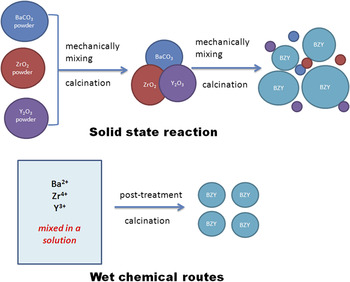
Figure 1 shows a scheme that compares the wet chemical route synthesis with the solid-state reaction method. As stated above, solid state reaction involves several cycles of ball milling and high temperature annealing to complete diffusion, usually resulting in large average particle size and a wide particle size distribution. Furthermore, the incomplete reaction, the possible introduction of impurities, or the loss of certain amounts of starting materials during the repeated milling and annealing process would affect composition and thus the electrical properties of the prepared BZY samples. In contrast, a wet chemical route involves the mixture of metal precursors in a solvent, which usually provides mixing of each element at the molecular level, and reduces the diffusion path up to the nanometric scale for the resulting materials. Reference Kakihana60 Therefore, the nanostructured oxide powders can be synthesized at lower temperatures, avoiding the problems occurring for the solid-state reaction method and yielding a better performance.
Schematic diagram comparing BZY powders synthesized by solid-state reaction and wet chemical routes.

Sol–gel, which is one of the major wet chemical methods, has been applied to synthesize BaZrO3-based nanostructured powders in mild conditions using heterometallic alkoxides as the starting materials. Reference Veith, Mathur, Lecerf, Huch, Decker, Beck, Eiser and Haberkorn61 The limit of the sol–gel method is that it only can be used for producing small amounts as its powder yield is lower than that of the solid-state reaction. Sin et al. Reference Sin, El Montaser, Odier and Weiss62 have modified the sol–gel method by using an alternative gelification route with acrylamide polymerization to overcome the low powder yield. This method has been demonstrated to be an inexpensive and easily scalable route to prepare BaZrO3 nanostructured powders, which could be sintered at 1450 °C, a temperature significantly lower than that needed for sintering the BaZrO3 powders prepared by solid state reaction. Similar results were reported by Magrez and Schober, Reference Magrez and Schober63 showing that Y-doped BaZrO3 powders prepared by a sol–gel method were sintered at 1500 °C for 10 h achieving 95% of the theoretical density. Taglieri et al. Reference Taglieri, Tersigni, Villa and Mondelli64 reported that BaZrO3 powders prepared by sol–gel using citrates as precursors showed a much larger shrinkage during sintering than that of the BaZrO3 solid state reaction powders. These studies reveal that the nanostructured BaZrO3 powders produced by the sol–gel method can effectively promote densification and reduce the high sintering temperatures required for preparing BaZrO3 pellets from solid-state reaction derived powders.
Rabuffetti et al. Reference Rabuffetti, Lee and Brutchey65 proposed a vapor diffusion sol–gel synthesis to prepare doped-BaZrO3 nanostructured materials. Single-phase BaZrO3 materials were obtained after firing at 600 °C for 15 min. With this low annealing temperature, the as-prepared BaZrO3 powders showed a particle size of around 16 nm, even smaller than the size of the BaZrO3 particles prepared by the conventional sol–gel method. Though these powders look very promising for SOFC applications, the authors did not investigate the sintering and the electrical performance, since their focus was in investigating the luminescence properties of the prepared materials.
D’Epifanio et al. Reference D'Epifanio, Fabbri, Di Bartolomeo, Licoccia and Traversa66 successfully prepared BaZr0.8Y0.2O3−δ (BZY20) nanostructured powders using a modified sol–gel route by investigating the role of different solvents and the ratio between chelating agent and the total amount of cations. BZY20 pellets could be sintered at 1600 °C with a suitable density for fuel cell tests. With wet H2 as the fuel and air as the oxidant, the BZY fuel cell showed a peak power density of 7 mW/cm2 at 600 °C. Considering the large thickness of the BZY20 electrolyte (∼0.6 mm), it is reasonable to assume that the reduction of the electrolyte thickness can further improve the fuel cell performance. This work was the first, reporting a power output, though small, from a BZY electrolyte, demonstrating the great potential of the BZY nanostructured powders in SOFC applications.
The modified sol–gel route was also used to prepare powders in the BaZr1−x Y x O3−δ series, where the Y content was increased from 0.2 up to x = 0.6, Reference Fabbri, Pergolesi, Licoccia and Traversa67 which was not considered possible in earlier studies. Reference Iguchi, Tsurui, Sata, Nagao and Yugami68 This was achieved with a careful control of the synthesis conditions that led to the fabrication of chemically stable BZYx pellets with 0.2 ≤ x ≤ 0.5 compositions, whereas the BZY60 powder was not stable when sintered. The aim of this study was to check whether the increase in defect concentration would lead to increased proton conductivity. A larger proton concentration was observed with increasing Y content, but this did not result in larger proton conductivity. Both bulk and grain boundary conductivities decreased with increasing the Y content for BZYx-sintered pellets. Reference Fabbri, Pergolesi, Licoccia and Traversa67
Fabbri et al. Reference Fabbri, D'Epifanio, Di Bartolomeo, Licoccia and Traversa29 investigated the electrochemical performance of pellets prepared using the BZY powders prepared by the sol–gel method, finding a proton conductivity of 5.68 × 10⁻³ S/cm at 700 °C in wet H2. This conductivity was significantly larger than that of the BZY pellets prepared by a solid state reaction powder, which was about 1.8 × 10⁻³ S/cm at 700 °C, Reference Iwahara, Yajima, Hibino, Ozaki and Suzuki25 even though the sintering temperature for sol–gel BZY pellets was 200 °C lower than that for the solid state reaction BZY pellets. This finding indicates that the nano-sized BZY powders prepared by the sol–gel method not only help BZY densification, but promote also its grain growth to reduce the grain boundary resistance. It is reasonable to assume that the sol–gel BZY conductivity could be further enhanced if the grain size can be larger. The advantage is that the conductivity could be enhanced with a sintering procedure at a reasonably low temperature that avoids all the deleterious effects on practical applications of high temperature sintering.
Yamazaki et al. Reference Yamazaki, Hernandez-Sanchez and Haile46 proposed a reactive sintering method to prepare highly conductive BZY samples. The nanopowders usually need to be fired at 1100 °C to obtain a BZY single phase. In the discussed work, the sol–gel BZY precursor was only fired at 850 °C, thus leaving unreacted BaCO3 in the BZY powder. Then reactive sintering occurred during the later sintering stages, resulting in large grained polycrystalline BZY-sintered bodies with a total conductivity reaching about 10−2 S/cm at 450 °C.
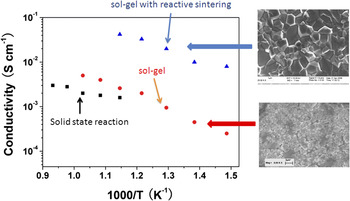
Figure 2 summarizes the results, described above, on the conductivity of BZY samples prepared by different routes. Reference Iwahara, Yajima, Hibino, Ozaki and Suzuki25,Reference Fabbri, D'Epifanio, Di Bartolomeo, Licoccia and Traversa29,Reference Yamazaki, Hernandez-Sanchez and Haile46 The BZY sample prepared by the solid-state reaction shows the lowest conductivity, though it was sintered at 1800 °C, revealing the presence of a large volume of grain boundaries. With the sol–gel method, the sintering temperature decreased to 1600 °C and the conductivity was improved, indicating that the nanometric BZY powders synthesized by the sol–gel method are quite helpful to improve the BZY grain growth. The grain size can be further increased up to above 1 μm by using the reactive sintering for the sol–gel BZY nanostructured powders, resulting in a much improved total proton conductivity.
Comparison of pellet conductivities of BZY synthesized by different methods: solid-state reaction, Reference Iwahara, Yajima, Hibino, Ozaki and Suzuki25 sol–gel, Reference Fabbri, D'Epifanio, Di Bartolomeo, Licoccia and Traversa29 and sol–gel with reactive sintering. Reference Yamazaki, Hernandez-Sanchez and Haile46 The inset pictures are scanning electron microscopy (SEM) micrographs showing the morphology of the corresponding tested BZY pellets. Reproduced with permission from Ref. Reference Fabbri, D'Epifanio, Di Bartolomeo, Licoccia and Traversa29, Copyright 2008, Elsevier. Reproduced with permission from Ref. Reference Yamazaki, Hernandez-Sanchez and Haile46, Copyright 2009, American Chemical Society.

Besides the sol–gel method, the combustion method is another widely used method for synthesizing BaZrO3-based materials. Compared with the relatively mild reactions of the sol–gel method, the combustion method undergoes an ignition of the precursor mixture, sometimes with an observable flame. Reference Deganello, Marcì and Deganello69 In the combustion method, metal nitrates together with a complexing agent and fuels are dissolved in a water solution, which is heated on a hot plate. After the evaporation of water, ignition occurs after reaching a critical temperature, resulting in a white BaZrO3 precursor that is subsequently fired at different temperatures (around 1000 °C) to obtain a single perovskite phase. Reference Sun, Fabbri, Bi and Traversa70
Magrez and Schober Reference Magrez and Schober63 used urea as the fuel to prepare BZY20 powder by a combustion method, obtaining a single phase after firing at 1250 °C for 10 h. When citric acid was used as both the complexing agent and the fuel in the combustion process, BZY20 single-phase nano-crystalline powders were successfully synthesized by firing at only 1000 °C for 6 h, Reference Sun, Fabbri, Bi and Traversa70 implying that the complexing agent and the fuel play a central role in the synthesis. Reference Deganello, Liotta, Marcì, Fabbri and Traversa71
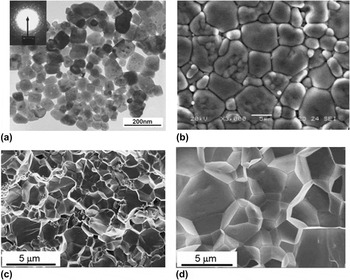
Kumar et al. Reference Kumar, Vijayakumar, George, Solomon, Jose, Thomas and Koshy72 synthesized BaZrO3 nanopowders by a single-step combustion method using citric acid as the complexing agent and ammonia as the fuel. No further heating step was necessary for the BaZrO3 precursor in this study since the single phase BaZrO3 was directly obtained after the combustion. Figure 3(a) shows the transmission electron microscopy (TEM) micrograph of the synthesized BaZrO3 powder with submicrometer aggregates of 30–50 nm crystallites. Reference Kumar, Vijayakumar, George, Solomon, Jose, Thomas and Koshy72 This fine BaZrO3 powder was sintered at 1650 °C for 2 h with a final grain size of around 5 μm [Fig. 3(b)]. Reference Kumar, Vijayakumar, George, Solomon, Jose, Thomas and Koshy72 The grain size of the BaZrO3-sintered pellets prepared from powders by this combustion method was much larger than that of the solid-state reaction BaZrO3 material after sintering at 1720 °C [∼2 μm, Fig. 3(c)] Reference Duval, Holtappels, Vogt, Pomjakushina, Conder, Stimming and Graule52 and almost equal to the grain size of the sample sintered at 2200 °C [∼5 μm, Fig. 3(d)]. Reference Duval, Holtappels, Vogt, Pomjakushina, Conder, Stimming and Graule52 Sinterability and grain growth was significantly improved for the BaZrO3 powders prepared by the single-step combustion method, and large grain size was achieved without using extreme conditions for sintering, with the possibility of reducing the grain boundary resistance, which has a great potential for SOFC applications.
(a) TEM micrograph of BaZrO3 nanopowders synthesized by a one-step combustion method Reference Kumar, Vijayakumar, George, Solomon, Jose, Thomas and Koshy72 ; (b) SEM micrograph of the BaZrO3 pellet obtained from the said BaZrO3 nanopowders after sintering at 1650 °C Reference Kumar, Vijayakumar, George, Solomon, Jose, Thomas and Koshy72 ; (c) SEM micrograph of BaZrO3-based pellet obtained from the powder prepared by solid-state reaction after sintering at 1720 °C Reference Duval, Holtappels, Vogt, Pomjakushina, Conder, Stimming and Graule52 ; (d) SEM micrograph of BaZrO3-based pellet obtained from the powder prepared by solid-state reaction after sintering at 2200 °C. Reference Duval, Holtappels, Vogt, Pomjakushina, Conder, Stimming and Graule52 Reproduced with permission from Ref. Reference Duval, Holtappels, Vogt, Pomjakushina, Conder, Stimming and Graule52, Copyright 2007, Elsevier. Reproduced with permission from Ref. Reference Kumar, Vijayakumar, George, Solomon, Jose, Thomas and Koshy72, Copyright 2008, Elsevier.

Boschini et al. Reference Boschini, Rulmont, Cloots and Vertruyen73 developed a precipitation method in aqueous solution to synthesize well-crystallized BaZrO3 with a single perovskite phase at relatively low temperatures. Single-phase BaZrO3 powders with small particle size (∼150 nm) could be obtained at around 80 °C, without high temperature annealing treatments. These powders after sintering at 1650 °C achieved a relative density as high as 98.4% of theoretical density, with a large grain size of around 5 μm. Another low temperature synthesis route based on an all-alkoxide sol–gel method was reported by Cervera et al. Reference Cervera, Oyama and Yamaguchi74 for preparing BZY powders. In their study, nanocrystalline BZY powders were successfully prepared at 130 °C with a particle size smaller than 50 nm.
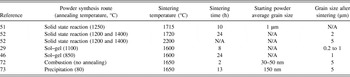
Table I summarizes the characteristics of BaZrO3-based materials prepared by different methods as reported in the literature. One can observe that the BaZrO3 powders prepared by a solid-state reaction usually have a large average grain size and require high annealing temperatures (1200–1400 °C), leading to even higher sintering temperatures. In contrast, the BaZrO3 powders prepared by wet chemical routes can be synthesized at temperatures that can be significantly lower (even 80 °C), keeping the particle size at the nanometric range, which then lead to a considerable grain growth, up to 5 μm, even at sintering temperatures 550 °C lower than those needed for the BaZrO3 powders prepared by solid-state reaction. It is also interesting to note that the grain growth from the powders having 30–50 nm particle size seems better than that from the powders having particle size at around 150 nm, considering that the sintering time for achieving the same grain size is shorter. These findings indicate that systematic and quantitative studies on the correlation between starting BaZrO3 powder size and grain growth, now lacking, would be very interesting to elucidate the synthesis strategies for BaZrO3-based materials.
Characteristics of BaZrO3-based materials synthesized by different methods reported in the literature. N/A means the information is not provided in the literature.

Contradictory results have been reported for the synthesis of BaZrO3-based materials using spray pyrolysis Reference Stuart, Unno, Ayres-Rocha, Djurado and Skinner75–Reference Duval, Holtappels, Vogt, Stimming and Graule77 and spray drying methods. Reference Duval, Holtappels, Vogt, Stimming and Graule77,Reference Robertz, Boschini, Rulmont, Cloots, Vandriessche, Hoste and Lecomte-Beckers78 On one side, Stuart et al. Reference Stuart, Unno, Ayres-Rocha, Djurado and Skinner75 demonstrated that the spray pyrolysis method was effective to prepare fine BZY powders and highly dense BZY pellets could be obtained after sintering at 1500 °C. On the other side, Duval et al. Reference Duval, Holtappels, Vogt, Stimming and Graule77 reported somewhat deceiving results using spray pyrolysis to produce BZY powders: these BZY powders could not be reasonably densified even after sintering at 1720 °C, with resulting low proton conductivity. These contradicting results clearly demonstrate that in these synthesis routes, the control of the preparation parameters is critical for the final quality of the BZY powders, and further studies are needed to make clear the appeal of this synthesis technique.
C. Doping strategies for improving the performance of BaZrO3-based powders
The development of synthesis methods to prepare BaZrO3-based nanostructured powders with enhanced sinterability to promote grain growth has clear limits, and more effective methods for promoting the sinterability and the electrical properties of BaZrO3-based materials need to be considered. The use of sintering aids and doping strategies showed promising results.
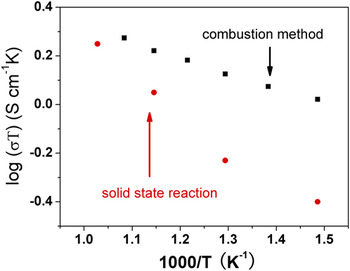
Given the difficulties in sintering BaZrO3-based materials, the use of sintering aids was an obvious choice to improve the BaZrO3 sinterability. Babilo and Haile Reference Babilo and Haile79 screened a number of transition metal oxides as sintering aids for BZY powders prepared by a combustion method. ZnO was found to promote the BZY sinterability without introducing electronic conductivity. The Zn-modified BZY samples showed significantly larger shrinkage than that of the Zn-free samples; after sintering at 1300 °C, the density of Zn-modified BZY samples was 95% of the theoretical density, whereas the density of Zn-free samples was about 60%. Though, the bulk conductivity of the Zn-modified BZY samples was lower than that of the Zn-free counterparts, which was probably due to the strong proton trapping at sites. Moreover, Zn was also found to accumulate at grain boundaries, which resulted in a degradation of proton conductivity for the ZnO-modified BZY samples. Similar results were found by Tao and Irvine Reference Tao and Irvine80,Reference Tao and Irvine81 : the ZnO sintering aid can reduce to 1325 °C the sintering temperature for BZY prepared by solid-state reaction, a slightly higher temperature than that found by Babilo and Haile for the same sintering aid. This confirms the benefits of using BZY nanostructured powders prepared by wet chemical routes even in the presence of sintering aids, and also the BZY proton conductivity was improved. Fig. 4 shows the comparison of the bulk conductivity for the ZnO modified BZY samples, prepared by solid-state reaction Reference Tao and Irvine81 and by a combustion method. Reference Peng, Melnik, Luo, Sanger and Chuang82 We can see that the bulk conductivity, which in principle is determined by the material properties, differs significantly depending on the ZnO-modified BZY preparation routes, with the sample prepared by a combustion method having significantly larger bulk conductivity.
Comparison of the conductivity of ZnO-modified BZY pellets at different temperatures. The ZnO-modified BZY powders were synthesized by a solid-state reaction Reference Tao and Irvine81 and a combustion method. Reference Peng, Melnik, Luo, Sanger and Chuang82

Besides ZnO, other transition metal oxides, such as NiO and CuO, have been proposed as effective sintering aids for BZY. Reference Tong, Clark, Hoban and O'Hayre83,Reference Gao and Guo84 However, despite promoting good densification, these sintering aids degrade the BZY conductivity. Moreover, the stability of transition metal oxides under reducing environment is questionable and needs to be further explored. Although the NiO-modified BZY prepared by a reactive sintering showed good conductivity values, Reference Tong, Clark, Hoban and O'Hayre83 the possibility of introducing electronic conductivity Reference Babilo and Haile79 and of forming secondary phases Reference Tong, Clark, Bernau, Sanders and O'Hayre85 suggests detailed investigations of the use of NiO as sintering aid, especially under fuel cell testing conditions. Other metal oxides, such as TiO2, MgO, Al2O3, and Bi2O3, were also added to BZY, but samples containing these additives showed a lower conductivity than that of the additive-free samples. Reference Duval, Holtappels, Stimming and Graule86
Overall, the addition of the sintering aids was more or less detrimental to the electrical properties of the BZY samples despite the sinterability improvement. This can be attributable to the nature of the sintering aids used. It would be desirable that the development of a sintering aid may improve the sinterability of BZY without influencing its electrical properties, which can be identified in the element that will evaporate during sintering. Sun et al. Reference Sun, Fabbri, Bi and Traversa70 proposed LiNO3 as a sintering aid for BZY. BZY nanostructured powders were synthesized by a combustion method with the addition of 1 mol% of LiNO3. The sinterability of BZY was much enhanced upon Li addition due to the formation of a Li–Y–O low melting point glass phase that improved sinterability through a liquid-phase-assisted sintering mechanism. However, different from other sintering aids that remained in the final BZY samples, Li disappeared due to the full evaporation of Li during sintering, and “clean” grain boundaries were observed with TEM. As a result, the sintered BZY samples maintained high conductivity in both bulk and grain boundaries, making this material show higher conductivity than that of the sintering aids (such as ZnO and CuO)-modified BZY. Similar results were also obtained by Tsai et al. Reference Tsai, Kopczyk, Smith and Schmidt87 They found that the sinterability of combustion-prepared BZY powders could be improved with the addition of 7 wt% of LiF, which subsequently evaporated during the sintering process, resulting in a good conductivity for the BZY pellet. Li promoted BZY densification, but the grain size of the sintered BZY pellets remained small reaching only 100–300 nm even after sintering at 1600 °C. The small grain size hinders the improvement of BZY conductivity. CaO addition to the stoichiometric BZY led to an easier densification for BZY, as well as to a large average grain size of 550 nm, which resulted in a final high conductivity. Reference Sun, Fabbri, Bi and Traversa88 The main mechanism for the sintering improvement in CaO-modified samples was probably due to the surface modification of BZY with Ca ion, which locally raised the BaO/ZrO2 ratio from 1.25 to 4.45 and led to the formation of a liquid phase at low temperatures. Furthermore, the high open circuit voltage value (∼1.02 V at 600 °C) of the fuel cell made with a CaO-modified BZY electrolyte suggested that the CaO addition did not create electronic conductivity in the BZY material.
Yttrium is regarded as the most suitable dopant for BaZrO3 to obtain the highest proton conductivity. Doping strategies have been developed as another effective method to improve the BaZrO3 sinterability. Ito et al. Reference Ito, Matsumoto, Kawasaki, Okada and Ishihara89 reported that the introduction of a second dopant (such as Ga or In) into BZY significantly improved the sinterability. Y was completely substituted with In, and the In-doped BaZrO3 showed a much better sinterability than the Y-doped samples. Reference Bi, Fabbri, Sun and Traversa90 However, similar to the effect of sintering aids, the improved sinterability was at the expenses of lowering the electrical performance. A way to solve this problem was provided by an ionic diffusion strategy where during sintering, the In-doped BaZrO3 electrolyte densified with the substitution of In with Y coming from the anodic substrate, taking advantage of the high sinterability of the In-doped BaZrO3 but getting rid of the deleterious influence of In on the conductivity, improving the fuel cell performance accordingly. Reference Bi, Fabbri, Sun and Traversa91
The sinterability and electrical performance of the BaZrO3-based materials seems to be a trade-off relation with the addition of co-doping elements. However, a recent study indicated that the introduction of Pr as a second dopant in BZY did not impair its electrical performance. Fabbri et al. Reference Fabbri, Bi, Tanaka, Pergolesi and Traversa92 synthesized BaZr0.7Pr0.1Y0.2O3−δ (BZPY10) nanostructured powders by a combustion method with the introduction of 10 mol% Pr into BZY, which dramatically improved the sinterability for BZY material. BZPY10 sintered at 1600 °C was almost fully dense (98.6% of theoretical density) with a large grain size of 1.7 μm. BZPY10 showed only proton conductivity in humid air at 600 °C, measured at 10−2 S/cm, a value that is considered suitable for practical applications. Furthermore, the BZPY10 pellets maintained an excellent chemical stability in both CO2 and H2O environments. The good sinterability and excellent chemical stability made BZPY10 easy to be processed, while its high conductivity promoted the performance of the BZPY10-based fuel cell reaching 108 mW/cm2 at 650 °C. Reference Fabbri, Bi, Tanaka, Pergolesi and Traversa92
D. Nanostructured BaZrO3-based composite materials for electrodes
For the development of proton-conducting SOFCs, it is not sufficient to have a suitable electrolyte with high proton conductivity, but also appropriate electrode materials need to be identified for good performance at intermediate temperatures. Reference Fabbri, Pergolesi and Traversa93 Early research works simply applied materials used as cathodes for oxygen-ion conducting electrolytes to proton conducting electrolytes, with unsatisfactory performance, and only recently rationale work has been performed to address the specific cathodic reactions involving protons and water in a proton conducting electrolyte. Reference Fabbri, Oh, Licoccia, Traversa and Wachsman94
Magrasò et al. Reference Magrasò, Frontera, Gunnaes, Tarancon, Marrero-Lopez, Norby and Haugsrud95,Reference Magrasò, Kjolseth, Haugsrud and Norby96 studied Gd and Pr co-doped BaZrO3 materials (BaZr1−x Pr x Gd0.1O3−δ, x = 0.3, 0.6, 0.9), showing that high concentrations of Pr enhanced both sinterability and electron hole conductivity. Fabbri et al. Reference Fabbri, Markus, Bi, Pergolesi and Traversa97 systematically investigated the influence on the electrical properties of different doping levels of Pr (from 10 to 40 mol%) into BZY. While BZPY10 showed only proton conductivity below 600 °C, when the Pr doping level increased above 10 mol%, electron hole conductivity contribution was observed and the ionic transport number in wet air atmosphere decreased with increasing the Pr amount. The electron hole conduction became dominant when the doping level of Pr reached to 40 mol%. The 30 mol% Pr doped sample (BaZr0.5Pr0.3Y0.2O3−δ, BZPY30) showed a mixed electronic–protonic conduction suitable for cathode application in proton-conducting SOFCs.
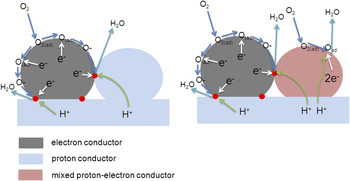
Figure 5 shows the advantages of using a properly tailored mixed electronic–protonic conductor in SOFC cathodes. A composite cathode consisting of a mixture of an electron-conducting phase and a proton-conducting phase allows the electrochemical reactions to occur at the triple phase boundary (TPB), restricting the active sites at the connections between the electron conducting and the proton conducting phases. In contrast, the reaction sites can be extended to a larger area with the application of an electron-conducting phase and a proton–electron conducting phase composite cathode. However, this approach does not consider the oxygen reduction reaction steps occurring at the cathode: a further enhancement of the cathode active sites can be obtained by substituting in the composite the electronic conductor with a mixed oxygen-ion/electronic conductor, which allows extending to the whole cathode bulk the active sites. Reference Fabbri, Bi, Pergolesi and Traversa98
Schematic diagram of the reactions occurring at composite cathodes made of a mixture of proton conductor and electron conductor and a mixture of mixed proton–electron conductor and electron conductor. The red area (including the light-red area) represents the active site for electrochemical reactions.

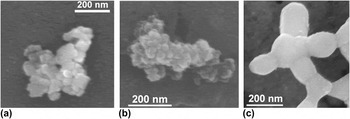
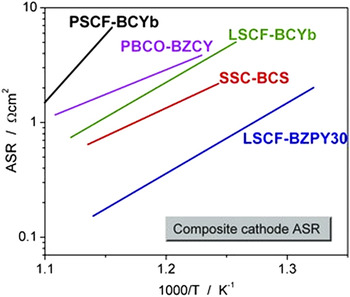
Based on these ideas, Fabbri et al. Reference Fabbri, Bi, Pergolesi and Traversa98 synthesized BZPY10 and BZPY30 powders by a combustion method, obtaining an average grain size of about 60 nm (Fig. 6), and studied composite cathodes coupling these materials with La0.6Sr0.4Co0.2Fe0.8O3−δ (LSCF), a well-known mixed oxygen-ion/electronic conductor. The BZPY30-LSCF composite cathode showed a superior electrochemical performance with an area specific resistance (ASR) of 0.157 Ω cm2 at 600 °C in wet air. Figure 7 shows the comparison of the ASR value of BZPY30-LSCF composite cathode with other composite cathode materials for proton-conducing SOFCs reported in the literature. In the whole temperature range, the BZPY30-LSCF composite cathode shows a much lower ASR value than that of the other composite cathodes. Reference Wu, Peng and Xia33,Reference Fabbri, Licoccia, Traversa and Wachsman37,Reference Vert, Solis and Serra99,Reference Zhao, Wang, Brinkman and Chen100 The good performance of the BZPY30-LSCF composite cathode is mainly due to two reasons. First, the BZPY30 and LSCF nanostructured powders prepared by the combustion method allowed obtaining small particles and large surface area in the composite cathode, providing more active sites for electrochemical reactions. Second, the proper tailoring of the cathode conductivity provides pathways for both proton and electron and allows the oxygen reaction with proton directly at the BZPY30 surface. The extended active sites in BZPY30-LSCF cathode can facilitate the cathodic electrochemical reactions, reducing thus its ASR. This high activity was reflected in fuel cell testing, where using the BZPY30-LSCF composite nanomaterial cathode allowed reaching 128 mW/cm2 at 650 °C, which was one of the largest power output reported for BaZrO3-based fuel cells.
SEM micrographs of (a) BZY10, (b) BZPY30, and (c) LSCF powders synthesized by a combustion method. Reference Fabbri, Bi, Pergolesi and Traversa98 Reproduced with permission from The Royal Society of Chemistry. Copyright 2011, The Royal Society of Chemistry.

Comparison of ASR of LSCF-BZPY30 cathode with other composite cathodes for proton-conducting SOFCs, including Pr0.58Sr0.4Fe0.8Co0.2O3−δ-BaCe0.9Yb0.1O3−δ (PSFC-BCYb), Reference Vert, Solis and Serra99 PrBaCo2O5+x-BaCe0.7Zr0.1Y0.2O3−δ (PBCO-BCZY), Reference Zhao, Wang, Brinkman and Chen100 La0.6Sr0.4Co0.2Fe0.8O3−δ-BaCe0.9Yb0.1O3−δ (LSCF-BCYb), Reference Fabbri, Licoccia, Traversa and Wachsman37 and Sm0.5Sr0.5CoO3−δ-BaCe0.8Sm0.2O3−δ (SSC-BCS). Reference Wu, Peng and Xia33 Reproduced with permission from Ref. Reference Fabbri, Bi, Pergolesi and Traversa24. Copyright 2012, Wiley-VCH Verlag GmbH&Co. KGaA, Weinheim.

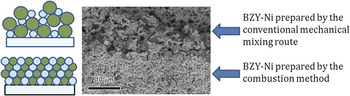
Nanostructured BaZrO3-based composite powders are also paramount for the development of anode materials for protonic SOFCs. When hydrogen is used as a fuel, the typical anode material for SOFCs is made of a cermet containing Ni and the corresponding electrolyte material. Reference Chevallier, Zunic, Esposito, Di Bartolomeo and Traversa101–Reference Bi, Fabbri and Traversa103 The conventional preparation method for the composite anodes is by mechanically mixing NiO and BZY powders with ball milling, with subsequent reduction of NiO to Ni in operating conditions. However, this method may result in an inhomogeneous distribution of the two phases, and the use of coarse starting powders could also reduce the TPB sites for electrochemical reactions. Bi et al. Reference Bi, Fabbri, Sun and Traversa104 demonstrated that the TPB length at the anode can be increased with BZY–NiO composite nanostructured powders, which were successfully synthesized by a combustion method. Although NiO was simultaneously produced with BZY in one batch combustion process, no impurity phases were observed. Figure 8 shows the morphologies of BZY–Ni anodes conventionally prepared by mechanical mixing and by the combustion method. A homogenous distribution of BZY and Ni particles with small size can be observed in the combustion anode, with respect to the coarse powder and inhomogeneous distribution of BZY and Ni particles in the anode prepared by the mechanical mixing route. This extends the TPB sites for electrochemical reactions and thus reduce its polarization resistance, demonstrated in the electrochemical studies. Reference Bi, Fabbri, Sun and Traversa104
SEM micrographs for BZY–Ni anodes prepared by different routes, Reference Bi, Fabbri, Sun and Traversa104 with a schematic diagram of the particle distribution. Reproduced with permission from Ref. Reference Bi, Fabbri, Sun and Traversa104. Copyright 2011, The Electrochemical Society.

E. Performance of SOFCs using BaZrO3-based electrolytes
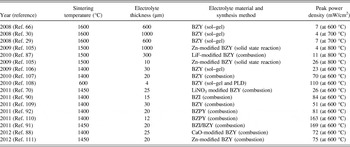
Table II summarizes literature data on the fuel cell performance of SOFCs (peak power density) with chemically stable BaZrO3-based electrolytes. Initial reports for BaZrO3-based fuel cells adopted an electrolyte-supported configuration. Although the sintering temperatures were lowered to around 1600 °C with the assistance of sintering aids Reference Bi, Fabbri, Sun and Traversa104 or fine powders prepared by wet chemical routes, Reference D'Epifanio, Fabbri, Di Bartolomeo, Licoccia and Traversa66 using a thick electrolyte layer led to large ohmic resistance for the cells. The large electrolyte resistance inevitably decreased the cell performance and resulted in a power output of only a few mW/cm2 at testing temperatures. Therefore, efforts were made to reduce the electrolyte thickness for improving the fuel cell performance. Guo et al. Reference Guo, Lin, Ran and Shao106 synthesized BZY20 powders with a sol–gel method and successfully fabricated an anode supported fuel cell with a 30 μm thick BZY20 electrolyte film after co-sintering the anode/electrolyte bilayer, showing a peak power density of 23 mW/cm2 at 600 °C. Peng et al. Reference Peng, Melnik, Li, Luo, Sanger and Chuang105 fabricated a cathode supported fuel cell using ZnO-modified BaZr0.85Y0.15O3−δ as the electrolyte film (15 μm), obtaining a peak power density of 26 mW/cm2 at 800 °C. The reduced electrolyte thickness indeed improved the cell performance, but the fuel cell performance was still not satisfactory for practical applications and much lower than that of the BaCeO3-based fuel cells, for which peak power density of a few hundred mW/cm2 can be achieved at 600 °C. Therefore, a further reduction in the electrolyte thickness or development of new strategies to promote BZY grain growth were used to further reduce the ohmic resistance of the electrolyte and enhance the fuel cell performance.
Summary of the performance of BaZrO3-based fuel cells reported in the literature. BZY: Y doped BaZrO3; BZI: In-doped BaZrO3; BZPY: Pr and Y co-doped BaZrO3.

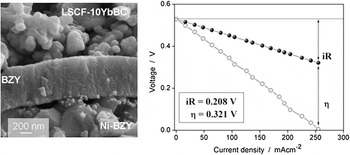
Pergolesi et al. Reference Pergolesi, Fabbri and Traversa108 used pulsed laser deposition (PLD) to fabricate a 4-μm-thick BZY20 electrolyte film on BZY20–NiO anode substrate. The thin electrolyte film made the cell less resistive and led to a higher fuel cell performance (∼110 mW/cm2 at 600 °C). PLD allowed also depositing BZY electrolyte film with a thickness of 650 nm, Reference Fabbri, D'Epifanio, Sanna, Di Bartolomeo, Balestrino, Licoccia and Traversa112 which were tested in a single chamber configuration. The results showed that the cell performance was mostly limited by the electrode polarization resistance rather than the BZY20 electrolyte ohmic resistance, as shown in Fig. 9. These results suggest that PLD is a promising technique to fabricate fuel cells with thin electrolyte films, avoiding the problems of the conventional ceramic sintering processing, which can improve the overall fuel cell performance by reducing the electrolyte ohmic resistance.
SEM cross-sectional micrograph of a fuel cell with a thin film BZY electrolyte 650-nm thick prepared by PLD, with the ohmic loss (iR) and polarization loss (η) of the cell at testing temperature. Reference Fabbri, D'Epifanio, Sanna, Di Bartolomeo, Balestrino, Licoccia and Traversa112 Reproduced with permission from The Royal Society of Chemistry. Copyright 2010, The Royal Society of Chemistry.

Although LiNO3 has been proved to be an effective sintering aid for BZY20 densification without altering its composition, the fuel cell based on Li-modified BZY20 film electrolyte only showed a moderate fuel cell performance despite the quite dense electrolyte film, reaching 53 mW/cm2 at 700 °C. Reference Sun, Fabbri, Bi and Traversa70 The performance was hindered by the poor BZY20 grain growth, most likely. A better grain growth was obtained with the addition of CaO to BZY20 electrolyte, leading to a larger power density output of 141 mW/cm2 at 700 °C. Reference Sun, Fabbri, Bi and Traversa88 These findings imply that both grain growth and densification of BZY electrolyte films are critical for improving the overall fuel cell performance.
To promote the grain growth of the BZY20 electrolyte film and to avoid the negative influence of sintering aids, a BZY20 film fuel cell was fabricated on a BaCeO3-based anode substrate. Reference Sun, Yan, Shi, Zhu and Liu107 The BZY20 electrolyte was dense after co-sintering at 1400 °C the electrolyte film/anode substrate bi-layer. The densification of the electrolyte film was achieved with the promotion from the more sinteractive BaCeO3–NiO anode substrate. This interesting approach was tested also with chemically stable BZY20–NiO anodes. The nanosized BZY20–NiO anode powders synthesized by a combustion method showed good sinterability, in addition to good electrochemical performance, Reference Bi, Fabbri, Sun and Traversa104 promoting densification and conductivity of the deposited BZY20 electrolyte films with large grain size. Reference Bi, Fabbri, Sun and Traversa109 BZY20 films deposited on this sinteractive anode were dense after sintering at 1300 °C and a high film conductivity up to 5.4 × 10⁻³ S/cm at 700 °C with an average grain size of 1 μm was also obtained, resulting in a high fuel cell performance (∼172 mW/cm2 at 700 °C). Reference Bi, Fabbri, Sun and Traversa109
The electrolyte, anode, and cathode materials that showed better performance were assembled together in a prototype fuel cell to find the state-of-the-art performance, Reference Fabbri, Bi, Rupp, Pergolesi and Traversa110 to rationalize the previous scattered results. The cells made of BZPY10 electrolyte, Reference Fabbri, Bi, Tanaka, Pergolesi and Traversa92 nanosized BZY20–NiO anode powder, Reference Bi, Fabbri, Sun and Traversa109 and nanosized BZPY30–LSCF composite cathode Reference Fabbri, Bi, Pergolesi and Traversa98 exhibited a significantly improved fuel cell performance, reaching a peak power density of 163 mW/cm2 at 600 °C. Reference Fabbri, Bi, Rupp, Pergolesi and Traversa110 This value is one of the largest power density output reported for BaZrO3-based fuel cells, and it is almost equal to the performance of the cell fabricated by an ionic diffusion strategy. Reference Bi, Fabbri, Sun and Traversa91 This achieved fuel cell performance is comparable with that of BaCeO3-based fuel cells, Reference Iwahara, Uchida and Morimoto17,Reference Fehringer, Janes, Wildersohn and Clasen58,Reference Zunic, Chevallier, Di Bartolomeo, D'Epifanio, Licoccia and Traversa102,Reference Tao, Bi, Yan, Sun, Zhu, Peng and Liu113 but obtained for a chemically stable electrolyte, which is essential for practical applications.
It is also worth mentioning that the fuel cell performance reported for BaZrO3-based fuel cells was mostly for cells fabricated using BaZrO3-based nanostructured powders prepared by wet chemical routes, implying that the use of fine powders is critical for fabrication of fuel cells based on BaZrO3 film electrolytes. High sintering temperatures need to be avoided for film electrolyte-based fuel cells, to limit interfacial reactions during co-sintering of electrolyte and supporting electrode and to keep enough electrode porosity after sintering. Table II shows that most of the BaZrO3 film electrolytes were sintered at 1400 or 1450 °C, which is significantly lower than the sintering temperatures needed for electrolyte supported cells (around 1600 °C). The starting BaZrO3 powders need to be synthesized by wet chemical routes to achieve this result. In fact, Table II also shows that the BaZrO3 starting materials for film electrolyte fabrication are mostly synthesized by a wet chemical route (either by a sol–gel route or by a combustion method), except for the Zn-modified BZY that was synthesized by solid-state reaction. In the last case, the needed sintering temperature was 1500 °C. The synthesis strategy for the starting BaZrO3 powders plays an important role for the final fuel cell performance.
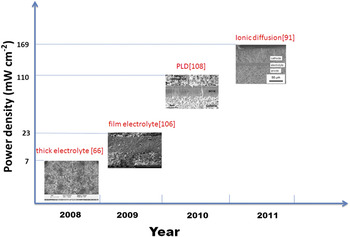
Figure 10 shows the increasing performance of BZY-based fuel cells with the years. From the first report in 2008 on a fuel cell using a BZY electrolyte-supported configuration, which only achieved 7 mW/cm2 at 600 °C, to the cell reaching 169 mW/cm2 at 600 °C in 2011, the BZY cell performance increased noticeably in the past few years due to great research efforts by different groups. It is expected that the performance of BZY fuel cells could be further enhanced by tailoring the electrolyte/electrode composites and optimizing their microstructure. Coupled with its excellent chemical stability, the much improved fuel cell performance makes BaZrO3 materials promising electrolyte candidates for the next generation of intermediate temperature SOFCs. Reference Fabbri, Bi, Pergolesi and Traversa24
The increase in performance for BaZrO3-based fuel cells with the years. Reproduced with permission from Ref. Reference D'Epifanio, Fabbri, Di Bartolomeo, Licoccia and Traversa66, Copyright 2008, Wiley-VCH Verlag GmbH&Co. KGaA , Weinheim. Reproduced with permission from Ref. Reference Guo, Lin, Ran and Shao106, Copyright 2009, Elsevier. Reproduced with permission from Ref. Reference Pergolesi, Fabbri and Traversa108, Copyright 2010, Elsevier. Ref. Reference Bi, Fabbri, Sun and Traversa91—Reproduced with permission from The Royal Society of Chemistry, Copyright 2011, The Royal Society of Chemistry.

III. SUMMARY
Doped BaZrO3 materials have been regarded as promising electrolyte candidates for intermediate temperature SOFCs due to their high bulk conductivity and excellent chemical stability. However, the large grain boundary resistance and poor sinterability for many years represented significant challenges for doped-BaZrO3 applications in fuel cells. Different synthesis strategies aimed to prepare BaZrO3 nanostructured powders were developed to overcome its refractory nature. To start with, nanostructured powders showed a great promotion of the sinterability and electrochemical properties for BaZrO3-based materials. The modification of doped BaZrO3 with sintering aids or codopant elements was often effective in improving the sinterability, but hindering the electrochemical performance, with the noteworthy exception of the Pr and Y co-doped BaZrO3, show high sinterability, chemical stability, and proton conductivity as high as 10−2 S/cm at 600 °C. Although the fuel cell performance of Y-doped BaZrO3 electrolytes at the beginning only reached a few mW/cm2 at intermediate temperatures, the cell performance was improved with the combination of highly conductive electrolyte and nanosized electrodes, or with novel fabrication techniques, reaching up to about a couple of hundred mW/cm2 at intermediate temperatures. This fuel cell performance is comparable with that of fuel cells based on BaCeO3 electrolyte, which is the most used electrolyte material for proton-conducting SOFCs at present. The high chemical stability of BaZrO3 offers a great advantage over BaCeO3-based fuel cells in practical applications.