1. Introduction
Zircons are the most durable known minerals, and the oldest radiometrically dated detrital zircon crystals are much older than the earliest-known rocks in which they are found (Wilde et al. Reference Wilde, Valley, Peck and Graham2001). One of the few ways of knowing where some old continents were located during the Precambrian Eon is through analysis of zircon distribution since their original formation. Detrital zircon age spectra are useful as ‘genetic fingerprints’ of basement units and the clastic sediments those basements shed into adjacent basins. However, after collisional reunification, detrital zircon age spectra only record closely related basement provinces and their uniform detritus; they are notoriously blind to the possibility of intervening oceanic realms which have either been completely subducted or, in the case of obduction, make no detectable contribution to detrital zircon populations.
When interpreting more recent events, it can be seen that the distribution of old detrital zircon crystals within the various continents and terranes still reflect their original pre-break-up positions rather than their destinations from later movements. A good example is the formation of the Indian Ocean since the break-up of Pangea (e.g. Torsvik et al. Reference Torsvik, Amundsen, Hartz, Corfu, Kusznir, Gaina, Doubrovine, Steinberger, Ashwal and Jamtveit2013). In a comparable way, recent summaries on Variscan geology (e.g. Ballèvre et al. Reference Ballèvre, Martínez Catalán, López-Carmona, Schulmann, Martínez, Lardeaux, Janoušek and Oggiano2014; Franke et al. Reference Franke, Cocks and Torsvik2017) clearly reveal an orogenic collage, suggesting a complex pre-orogenic palaeogeography comparable to that of the Indian Ocean.
In the ongoing debate on the Palaeozoic evolution of the north Gondwana margin, Franke et al. (Reference Franke, Cocks and Torsvik2017) summarized evidence for the existence of Armorican microcontinents that, during early Palaeozoic time, were separate from the Gondwana mainland, and refuted one-ocean models for the later Palaeozoic Variscides. In contrast however, Stephan et al. (Reference Stephan, Kroner and Romer2018) argue for a different model based largely on the distribution of old detrital zircon crystals in the Variscan area: comparable conclusions were reached in a paper by Žák & Sláma (Reference Žák and Sláma2017) who wrote on the early Palaeozoic detrital zircon record in central Bohemia. However, we reiterate the point here that zircon spectra are unable to detect the separation and drift history of ‘suspect’ microcontinents, but only reveal the original derivation of their age clusters. The variance between these views form the topic of this paper.
2. Significance of detrital zircon ages
The problem in using the distributions of detrital zircon ages is exemplified by the case of the Indian Ocean today, where the microcontinents of Madagascar, Seychelles, Mauritia, Sri Lanka and India have drifted off from the African mainland (Torsvik et al. Reference Torsvik, Amundsen, Hartz, Corfu, Kusznir, Gaina, Doubrovine, Steinberger, Ashwal and Jamtveit2013; Torsvik & Cocks Reference Torsvik and Cocks2017; Ashwal et al. Reference Ashwal, Wiedenbeck and Torsvik2017). The ‘African’ basement for all those microcontinents (except Mauritia) has remained unchanged and areas elevated above sea level are still shedding ‘African’ detritus into the intervening oceans. If and when those microcontinents should ever be reunited with one another and with their original continent of Gondwana, the zircon age signatures of basement blocks and clastic sediments derived from them can be expected to be very similar or even identical. Contrary to the logic of Stephan et al. (Reference Stephan, Kroner and Romer2018) and Žák & Sláma (Reference Žák and Sláma2017), such observations of detrital zircon distribution should therefore not be misinterpreted for the Variscan Orogeny to preclude the existence, before collision, of separating oceans, as set out below.
Another example of ‘unusual’ detrital zircon transport, not developed further here, is the evidence documented by Porębski et al. (Reference Porębski, Anczkiewicz, Paszkowski, Skompski, Kędzior, Mazur, Szczepański, Buniak and Mikołajewski2019) who discovered many detrital zircons of Gondwanan cratonic origin deposited during the latest Ordovician Hirnantian glacial episode within diamictites, whose zircons had been carried by icebergs into the then-subtropical continent of Baltica, which was then over 30° of latitude further north at that time than the closest part of the Gondwanan craton (Torsvik & Cocks Reference Torsvik and Cocks2017).
3. Ophiolites, deep-water basins and high-pressure and/or ultra-high-pressure rocks within peri-Gondwana
The early Palaeozoic evolution of Peri-Gondwana strongly resembles that of the Indian Ocean: in both areas, we are dealing with separate pieces and detrital crumbs derived from one and the same continental cake. With the exception of Avalonia (which was only marginally involved in the main Variscan Orogen), the distribution of Precambrian and lower Palaeozoic zircons are merely trivially important to the problem of where to place the peri-Gondwanan terranes in relation both to each other and to Gondwana itself before the main Variscan events commenced in the Devonian Period.
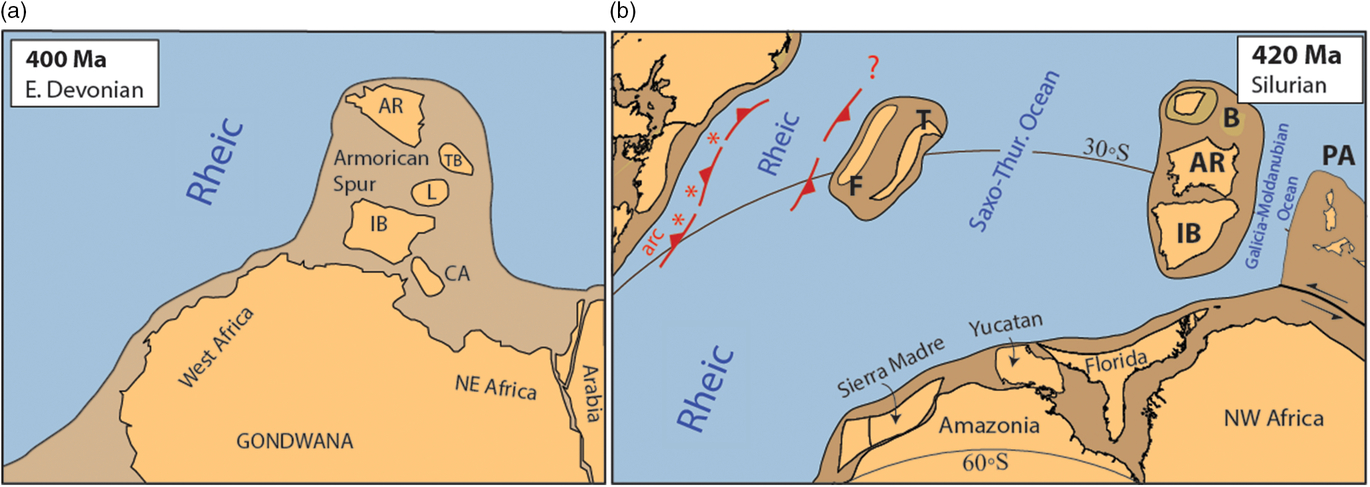
The publications by Kroner et al. (Reference Kroner, Hahn, Romer and Linnemann2007), Kroner & Romer (Reference Kroner and Romer2013) and Stephan et al. (2018, Reference Stephan, Kroner, Romer and Rösel2019) have compiled the available U–Pb laser inductively coupled plasma mass spectrometry ages of detrital zircons from various parts of the European Variscides, America, northern Africa and the Middle East (late Neoproterozoic – Early Devonian). They have convincingly demonstrated that those age spectra form very uniform groupings, but from that they concluded that all the sampled areas were part of a broad, contiguous shelf fringing the north of the Gondwana craton during early Palaeozoic time before the start of the main Variscan Orogeny. Their conclusions imply that the Gondwana-derived Armorican microcontinents did not exist as separate early Palaeozoic entitities. However, those conclusions are untenable; first, the method applied is not relevant to the issue; second, the drift stage of Armorican microcontinents post-dates the time range of nearly all of the zircon data summarized by the authors; and third, there is ample geological evidence of Palaeozoic narrow oceans within the north Gondwanan margin (see paragraph after next, beginning ‘Unless cited otherwise’). Figure 1 demonstrates the very different late Silurian and Early Devonian palaeogeographies published by Kroner & Romer (Reference Kroner and Romer2013), which was endorsed by Stephan et al. (Reference Stephan, Kroner and Romer2018, fig. 1), and by Franke et al. (Reference Franke, Cocks and Torsvik2017, fig. 10).
Fig. 1.Differing late Silurian and Early Devonian (400 Ma) NW Gondwana and southern Europe palaeogeographies: (a) redrawn from Kroner & Romer (Reference Kroner and Romer2013), repeated in Stephan et al. (Reference Stephan, Kroner and Romer2018, fig. 1); light brown, Peri-Gondwana shelf; AR – Armorican Massif; CA – Carpathians; IB – Iberia; L – Lausitz; TB – Teplá-Barrandian; and (b) Franke et al. (Reference Franke, Cocks and Torsvik2017, fig. 10); brown rims around microcontinents account for tectonic shortening; F – Franconia; T – Thuringia; B – Bohemia; AR – Armorica; IB – Iberia; PA – Palaeo-Adria. Note that the southern parts of AR and IB probably correlate with F and T.
However, we do not know the extent of possible old emergent areas in, for instance, the Galicia-Moldanubian or Saxo-Thuringian oceans, because most if not all of these ‘drifted’ terranes have Cambro-Ordovician and younger Palaeozoic covers. Here again, the present-day Indian Ocean offers an explanation, for which Müller et al. (Reference Müller, Gaina, Roest and Hansen2001) proposed a ’recipe for microcontinent formation’. Those authors suggested that, after the separation of India from Madagascar, the mid-ocean ridge jumped into the extended, mechanically weak, western margin of India, from which it cut off a ribbon of extended continental crust. That ribbon, now represented by the Seychelles, the Mascarene Plateau and the continental crust under the hotspot basalts of Réunion, seldom rises above sea level for simple isostatic reasons. In a comparable manner, separation of the Armorican Terrane Assemblage from the Gondwana mainland might have started with the formation of the Galicia-Moldanubian Ocean, after which the mid-ocean ridge jumped to the north of Bohemia, giving birth to the Saxo-Thuringian Ocean. That analogy could explain the Palaeozoic sedimentary cover widespread on the Cadomian basement of Bohemia and the Armorican Massif, providing a good indication of oceanic domains within Peri-Gondwana.
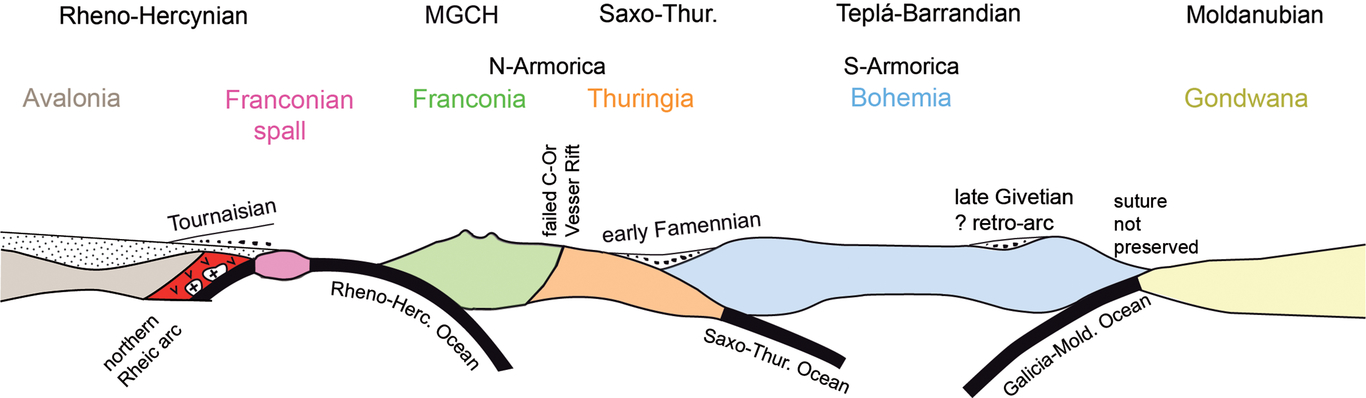
Unless cited otherwise, the data presented below are from the summary by Franke et al. (Reference Franke, Cocks and Torsvik2017). The disputed Peri-Gondwanan palaeogeography (Fig. 2) comprises, from north to south: (1) Avalonia; (2) a North Armorican spall, separated from the North Armorican mainland during the formation of (3) the Rheno-Hercynian Ocean; (4) North Armorica, consisting of Franconia and Thuringia, subdivided by the failed Cambro-Ordovician Vesser Rift; (5) the Saxo-Thuringian Ocean; (6) South Armorica (Bohemia); and (7) the Galicia-Moldanubian Ocean, which was bordered to the south by (8) the Gondwana mainland.
Fig. 2.Diagrammatic palaeogeographical transect across the mid-European Variscides (left-hand side is north). Onlap of flysch wedges on continental crust constrains collision (Givetian – Late Tournaisian, 385–345 Ma). Continental units colour-coded. Stippled cover of Avalonia: Early Devonian, Baltoscandia-derived shelf sediments. Black, uppermost line: Variscan tectonic units. MGCH, Mid-German Crystalline High. Note that the present-day boundary between the Teplá-Barrandian and Moldanubian units is a subvertical fault. Modified after Franke (Reference Franke, Franke, Haak, Oncken and Tanner2000).
Stephan et al. (Reference Stephan, Kroner and Romer2018) stated that the detrital zircon age records of Peri-Gondwana remained uniform throughout early Palaeozoic time. However, the vast majority of zircon ages reported in their paper come from Neoproterozoic–Ordovician clastic sediments, and the two Silurian samples from the Saxo-Thuringian belt do not provide a base for comparison with time-equivalent rocks in NW Iberia. Uniform zircon spectra in the early Palaeozoic Era are irrelevant to the issue, because the (meta-) ophiolites within peri-Gondwana have been dated as Silurian in the Moldanubian Zone and Emsian in the Saxo-Thuringian and Rheno-Hercynian zones; they therefore post-date most of the sediments with their deceptively homogeneous zircon ages. That further invalidates the palaeogeography based on zircon data. In addition, Stephan et al. (Reference Stephan, Kroner and Romer2018) failed to evaluate the Rheno-Hercynian clastic record for the Devonian and Early Carboniferous periods, which is characterized by Baltoscandia-derived sandstones and Armorica-derived flysch greywackes (Huckriede et al. Reference Huckriede, Wemmer and Ahrendt2004; Eckelmann et al. Reference Eckelmann, Nesbor, Königshof, Linnemann, Hofmann, Lange and Sagawe2014; Franke & Dulce Reference Franke and Dulce2017). Because the Rheic Ocean was already closed in Early Devonian time (see the critical discussion of Eckelmann et al. Reference Eckelmann, Nesbor, Königshof, Linnemann, Hofmann, Lange and Sagawe2014 in Franke et al. Reference Franke, Cocks and Torsvik2017), those findings clearly document the existence of the Rheno-Hercynian successor ocean which had attained a width of about 1000 km (Franke et al. Reference Franke, Huckriede, O´Sullivan and Wemmer2019).
Stephan et al. (Reference Stephan, Kroner and Romer2018) also ignored that, in addition to meta-ophiolites, there is further robust evidence for narrow oceans within the Peri-Gondwanan realm. For example, the weakly metamorphosed parts of the Rheno-Hercynian and Saxo-Thuringian belts have preserved within them condensed radiolarian cherts and shales devoid of carbonate, which (in the Saxo-Thuringian) form a separate tectonic unit or (in the Rheno-Hercynian allochthon) alternate with or overlie mid-ocean-ridge-type metabasalts. Those sediments occur from the Early Devonian Period onwards and indicate deposition onto oceanic or strongly extended continental crust. In addition, subduction and/or collision processes in the Rheno-Hercynian, Saxo-Thuringian and Galicia-Moldanubian zones of the Variscides are recorded by synorogenic turbidite wedges and pressure-dominated metamorphic rocks developed at the active margins, with ultra-high-pressure rocks in the latter two zones. Those observations must negate the concept of one coherent north Gondwanan shelf. The faunal and floral distribution papers quoted by Stephan et al. (Reference Stephan, Kroner and Romer2018) are somewhat irrelevant to this discussion, since they mostly record the various pelagic organisms such as chitinozoa, whose distributions are and were largely latitude- rather than terrane-specific. The fact that the benthic faunas from the southern Variscan terranes were all sectors of the high-latitude lower Palaeozoic Mediterranean Province (Fortey & Cocks Reference Fortey and Cocks2003) is also irrelevant to the detailed placement of those terranes in the late Palaeozoic Era.
We agree that evidence for true oceanic separation in the Galicia-Moldanubian basin is the weakest of all the Variscan sub-orogens, but there is a Silurian plagiogranite in the Gföhl Moldanubian in Austria which supports it (Finger & Quadt Reference Finger and Quadt1995). Unfortunately, ubiquitous high-grade metamorphism and accompanying deformation have not allowed preservation of condensed pelagic sediments in the Galicia-Moldanubian basin, in contrast to their survival in the other Variscan belts. However, we should also remember here that typical oceanic lithosphere is usually completely subducted, and that there is no unequivocal evidence of any Rheic ophiolite complex in Europe. The Galicia-Moldanubian basin was probably narrow, and may even have lacked a mid-ocean ridge, but its existence does not accord with the idea of a continuous northern Gondwanan shelf. Strong extension of continental crust would have created a sizeable marine basin which would, during its Silurian–Devonian period, have effectively hindered siliciclastic transport from West Africa to Bohemia (as inferred by Stephan et al. Reference Stephan, Kroner and Romer2018). The same applies to other areas of thinned continental crust separating Cadomian blocks whose existence was conceded by Kroner et al. (Reference Kroner, Hahn, Romer and Linnemann2007).
4. Plate kinematics revealed by lower Palaeozoic clastic sediment volume
The separation of Armorican microcontinents from Gondwana mainland can also be deduced from the amount of sediment discharged into the peri-Gondwanan basins. It has long been agreed that Cambrian and Early Ordovician clastic shelf sediments of several kilometers thickness cannot be derived from Armorican islands, but require a continental drainage system. That is self-evident for the Palaeozoic deposits on the southern flank of the Variscides exposed in central and northern Iberia or in South France (Feist et al. Reference Feist, Echtler, Galtier, Mouthier and Keppie1994; Gutíerrez Marco et al. Reference Gutíerrez Marco, Robardet, Rábano, Sarmiento, San José Lancha, Araújo, Pieren Pidal, Gibbons and Moreno2002; Liñan et al. Reference Liñan, Gozalo, Palacios, Gámez Vintaned, Ugidos, Mayoral, Gibbons and Moreno2002), which were undoubtedly deposited within the northern margin of Gondwana. In those areas, sedimentation rates remained high up to the Dapingian Stage. Younger sandstone bodies are much thinner. They occur in the Upper Ordovician and lowest Devonian strata of southern France and in northeastern Iberia (including parts of the Pyrenees), where they extend into the Upper Devonian strata (García-Alcalde et al. Reference García-Alcalde, Carls, Pardo Alonso, Sanz López, Soto, Truyols-Massoni, Valenzuela-Rios, Gibbons and Moreno2002). Dwindling discharge from the Gondwanan margin suggests transition from rift to drift in the Galicia-Moldanubian Ocean adjacent to the north.
Thicker Sandbian and later clastic sediments exist on the Cadomian basement of Bohemia (Žák & Sláma, Reference Žák and Sláma2017). Cadomian detrital white mica ages (612–585 Ma) occur in Middle–Upper Ordovician (Darriwilian–Hirnantian) sandstones, and Givetian sandstones have yielded micas dated at 487 Ma (Neuroth Reference Neuroth1997). Stratigraphical breaks and transgressive contacts of lower Cambrian and basal Ordovician clastic sediments on older rocks (including Cadomian basement) suggest that those mica fractions were derived from the basement of Bohemia (instead of a remote north Gondwanan source).
In the Saxo-Thuringian belt on the northern flank of the orogen (Fig. 2), Upper Ordovician clastic inserts within a predominantly shaley sequence are again especially thin, virtually absent from the Silurian deposits, and local and very subordinate in the Lower and Upper Devonian strata. Upper Ordovician as well as Lower and Upper Devonian sandstones from the northern, parautochthonous ‘Thuringian Facies’ of the Saxo-Thuringian basin contain upper Neoproterozoic (‘Cadomian’) detrital white mica fractions (Ahrendt et al. Reference Ahrendt, Büttner, Tischler and Wemmer2001; Huckriede et al. Reference Huckriede, Ahrendt and Wemmer2002). That palaeogeographical context (Falk et al. Reference Falk, Franke, Kurze and Keppie1995) firmly indicates derivation from a more northerly Armorican source, presumably Franconia (Franke et al. Reference Franke, Cocks and Torsvik2017).
During synorogenic clastic sedimentation (Frasnian–Stephanian) in the Rheno-Hercynian belt, Franconia included the southern, active basin margin and delivered Neoproterozoic, Ordovician and Silurian – Lower Devonian magmatic zircons, together with the detritus of granitoids relating to the closure of the Rheno-Hercynian basin (Franke & Dulce Reference Franke and Dulce2017; Franke et al. Reference Franke, Huckriede, O´Sullivan and Wemmer2019). Upper Devonian flysch greywackes also contain Cadomian detrital white mica fractions (Huckriede et al. Reference Huckriede, Wemmer and Ahrendt2004). Those findings indicate that Neoproterozoic basement with various Palaeozoic intrusions was available for erosion also in the northernmost part of Peri-Gondwana.
The relatively small volume of Upper Ordovician and younger clastic sediments with Gondwana-derived detrital zircons was probably provided from the basement of Armorican microcontinents or recycling of their Cambrian – Lower Ordovician cover. Recycling is directly evident from the glacio-marine debris-flow deposits of the uppermost Ordovician, which usually contain only clasts of older sedimentary rocks (e.g. Falk et al. Reference Falk, Franke, Kurze and Keppie1995).
Taken altogether, the paucity of siliciclastic sediments in and around the disputed Armorican microcontinents from the Middle Ordovician System onwards is best explained by the previous separation of those microcontinents from mainland Gondwana and a local derivation of those clastic sediments (as opposed to direct input from the main northern Gondwana craton). There are complete Wilson Cycles for the Rheno-Hercynian and Saxo-Thuringian oceans, and a near-complete Wilson Cycle for the Galicia-Moldanubian Ocean, even though the exact amount of separation is unknown.
5. Conclusions
The evolution of the Indian Ocean over the past 200 Ma provides an instructive parallel for understanding the Palaeozoic geography of North Africa and southern Europe. The simple palaeogeography for the peri-Gondwanan area before the main Variscan Orogeny envisaged by Stephan et al. (2018, Reference Stephan, Kroner, Romer and Rösel2019) is incorrect, even though they presented a very professional synthesis of zircon data from all of the North African and southern European peri-Gondwanan areas. However, the age spectra of detrital zircons, if interpreted critically, can only reveal their original derivation, but not their subsequent plate-tectonic and sedimentary pathways. Palaeogeographical reconstructions therefore require a holistic combination of results from many different disciplines of the Earth Sciences. The Stephan et al. (Reference Stephan, Kroner and Romer2018) compilation of zircon data cannot support the idea of one huge NW-Africa-derived drainage system as a source for clastic deposits in a contiguous north Gondwanan shelf, since narrow Variscan oceans or marine basins on thinned continental crust must have blocked sediment transport, including detrital zircons. That does not deny the erosion of basement rocks in Armorican Assemblage microcontinents that have a basement similar to that of their original mother continent of Gondwana, and also the recycling of Cambrian–Ordovician clastic sediments deposited on Armorican microcontinents prior to their separation from mainland Gondwana after the Ordovician Period.
However, one of the chief remaining problems in the understanding of peri-Gondwanan palaeogeography is the former relative positions of the various Lower Palaeozoic ‘zones’ that together make up the substantial area of Iberia since the close of the Variscan (apart from today’s SW corner, which was part of Avalonia). In our maps in Franke et al. (Reference Franke, Cocks and Torsvik2017, fig. 10), we merely showed Iberia as a unified microcontinent during the Early Ordovician Period, which is certainly unrealistic (although we attempted to unravel more of its history in Franke et al. Reference Franke, Cocks and Torsvik2017, fig. 1). Nevertheless, its progressively changing geographies are still unknown in detail.





 You have
Access
1. Introduction
Zircons are the most durable known minerals, and the oldest radiometrically dated detrital zircon crystals are much older than the earliest-known rocks in which they are found (Wilde et al. Reference Wilde, Valley, Peck and Graham2001). One of the few ways of knowing where some old continents were located during the Precambrian Eon is through analysis of zircon distribution since their original formation. Detrital zircon age spectra are useful as ‘genetic fingerprints’ of basement units and the clastic sediments those basements shed into adjacent basins. However, after collisional reunification, detrital zircon age spectra only record closely related basement provinces and their uniform detritus; they are notoriously blind to the possibility of intervening oceanic realms which have either been completely subducted or, in the case of obduction, make no detectable contribution to detrital zircon populations.
When interpreting more recent events, it can be seen that the distribution of old detrital zircon crystals within the various continents and terranes still reflect their original pre-break-up positions rather than their destinations from later movements. A good example is the formation of the Indian Ocean since the break-up of Pangea (e.g. Torsvik et al. Reference Torsvik, Amundsen, Hartz, Corfu, Kusznir, Gaina, Doubrovine, Steinberger, Ashwal and Jamtveit2013). In a comparable way, recent summaries on Variscan geology (e.g. Ballèvre et al. Reference Ballèvre, Martínez Catalán, López-Carmona, Schulmann, Martínez, Lardeaux, Janoušek and Oggiano2014; Franke et al. Reference Franke, Cocks and Torsvik2017) clearly reveal an orogenic collage, suggesting a complex pre-orogenic palaeogeography comparable to that of the Indian Ocean.
In the ongoing debate on the Palaeozoic evolution of the north Gondwana margin, Franke et al. (Reference Franke, Cocks and Torsvik2017) summarized evidence for the existence of Armorican microcontinents that, during early Palaeozoic time, were separate from the Gondwana mainland, and refuted one-ocean models for the later Palaeozoic Variscides. In contrast however, Stephan et al. (Reference Stephan, Kroner and Romer2018) argue for a different model based largely on the distribution of old detrital zircon crystals in the Variscan area: comparable conclusions were reached in a paper by Žák & Sláma (Reference Žák and Sláma2017) who wrote on the early Palaeozoic detrital zircon record in central Bohemia. However, we reiterate the point here that zircon spectra are unable to detect the separation and drift history of ‘suspect’ microcontinents, but only reveal the original derivation of their age clusters. The variance between these views form the topic of this paper.
2. Significance of detrital zircon ages
The problem in using the distributions of detrital zircon ages is exemplified by the case of the Indian Ocean today, where the microcontinents of Madagascar, Seychelles, Mauritia, Sri Lanka and India have drifted off from the African mainland (Torsvik et al. Reference Torsvik, Amundsen, Hartz, Corfu, Kusznir, Gaina, Doubrovine, Steinberger, Ashwal and Jamtveit2013; Torsvik & Cocks Reference Torsvik and Cocks2017; Ashwal et al. Reference Ashwal, Wiedenbeck and Torsvik2017). The ‘African’ basement for all those microcontinents (except Mauritia) has remained unchanged and areas elevated above sea level are still shedding ‘African’ detritus into the intervening oceans. If and when those microcontinents should ever be reunited with one another and with their original continent of Gondwana, the zircon age signatures of basement blocks and clastic sediments derived from them can be expected to be very similar or even identical. Contrary to the logic of Stephan et al. (Reference Stephan, Kroner and Romer2018) and Žák & Sláma (Reference Žák and Sláma2017), such observations of detrital zircon distribution should therefore not be misinterpreted for the Variscan Orogeny to preclude the existence, before collision, of separating oceans, as set out below.
Another example of ‘unusual’ detrital zircon transport, not developed further here, is the evidence documented by Porębski et al. (Reference Porębski, Anczkiewicz, Paszkowski, Skompski, Kędzior, Mazur, Szczepański, Buniak and Mikołajewski2019) who discovered many detrital zircons of Gondwanan cratonic origin deposited during the latest Ordovician Hirnantian glacial episode within diamictites, whose zircons had been carried by icebergs into the then-subtropical continent of Baltica, which was then over 30° of latitude further north at that time than the closest part of the Gondwanan craton (Torsvik & Cocks Reference Torsvik and Cocks2017).
3. Ophiolites, deep-water basins and high-pressure and/or ultra-high-pressure rocks within peri-Gondwana
The early Palaeozoic evolution of Peri-Gondwana strongly resembles that of the Indian Ocean: in both areas, we are dealing with separate pieces and detrital crumbs derived from one and the same continental cake. With the exception of Avalonia (which was only marginally involved in the main Variscan Orogen), the distribution of Precambrian and lower Palaeozoic zircons are merely trivially important to the problem of where to place the peri-Gondwanan terranes in relation both to each other and to Gondwana itself before the main Variscan events commenced in the Devonian Period.
The publications by Kroner et al. (Reference Kroner, Hahn, Romer and Linnemann2007), Kroner & Romer (Reference Kroner and Romer2013) and Stephan et al. (2018, Reference Stephan, Kroner, Romer and Rösel2019) have compiled the available U–Pb laser inductively coupled plasma mass spectrometry ages of detrital zircons from various parts of the European Variscides, America, northern Africa and the Middle East (late Neoproterozoic – Early Devonian). They have convincingly demonstrated that those age spectra form very uniform groupings, but from that they concluded that all the sampled areas were part of a broad, contiguous shelf fringing the north of the Gondwana craton during early Palaeozoic time before the start of the main Variscan Orogeny. Their conclusions imply that the Gondwana-derived Armorican microcontinents did not exist as separate early Palaeozoic entitities. However, those conclusions are untenable; first, the method applied is not relevant to the issue; second, the drift stage of Armorican microcontinents post-dates the time range of nearly all of the zircon data summarized by the authors; and third, there is ample geological evidence of Palaeozoic narrow oceans within the north Gondwanan margin (see paragraph after next, beginning ‘Unless cited otherwise’). Figure 1 demonstrates the very different late Silurian and Early Devonian palaeogeographies published by Kroner & Romer (Reference Kroner and Romer2013), which was endorsed by Stephan et al. (Reference Stephan, Kroner and Romer2018, fig. 1), and by Franke et al. (Reference Franke, Cocks and Torsvik2017, fig. 10).
Differing late Silurian and Early Devonian (400 Ma) NW Gondwana and southern Europe palaeogeographies: (a) redrawn from Kroner & Romer (Reference Kroner and Romer2013), repeated in Stephan et al. (Reference Stephan, Kroner and Romer2018, fig. 1); light brown, Peri-Gondwana shelf; AR – Armorican Massif; CA – Carpathians; IB – Iberia; L – Lausitz; TB – Teplá-Barrandian; and (b) Franke et al. (Reference Franke, Cocks and Torsvik2017, fig. 10); brown rims around microcontinents account for tectonic shortening; F – Franconia; T – Thuringia; B – Bohemia; AR – Armorica; IB – Iberia; PA – Palaeo-Adria. Note that the southern parts of AR and IB probably correlate with F and T.
However, we do not know the extent of possible old emergent areas in, for instance, the Galicia-Moldanubian or Saxo-Thuringian oceans, because most if not all of these ‘drifted’ terranes have Cambro-Ordovician and younger Palaeozoic covers. Here again, the present-day Indian Ocean offers an explanation, for which Müller et al. (Reference Müller, Gaina, Roest and Hansen2001) proposed a ’recipe for microcontinent formation’. Those authors suggested that, after the separation of India from Madagascar, the mid-ocean ridge jumped into the extended, mechanically weak, western margin of India, from which it cut off a ribbon of extended continental crust. That ribbon, now represented by the Seychelles, the Mascarene Plateau and the continental crust under the hotspot basalts of Réunion, seldom rises above sea level for simple isostatic reasons. In a comparable manner, separation of the Armorican Terrane Assemblage from the Gondwana mainland might have started with the formation of the Galicia-Moldanubian Ocean, after which the mid-ocean ridge jumped to the north of Bohemia, giving birth to the Saxo-Thuringian Ocean. That analogy could explain the Palaeozoic sedimentary cover widespread on the Cadomian basement of Bohemia and the Armorican Massif, providing a good indication of oceanic domains within Peri-Gondwana.
Unless cited otherwise, the data presented below are from the summary by Franke et al. (Reference Franke, Cocks and Torsvik2017). The disputed Peri-Gondwanan palaeogeography (Fig. 2) comprises, from north to south: (1) Avalonia; (2) a North Armorican spall, separated from the North Armorican mainland during the formation of (3) the Rheno-Hercynian Ocean; (4) North Armorica, consisting of Franconia and Thuringia, subdivided by the failed Cambro-Ordovician Vesser Rift; (5) the Saxo-Thuringian Ocean; (6) South Armorica (Bohemia); and (7) the Galicia-Moldanubian Ocean, which was bordered to the south by (8) the Gondwana mainland.
Diagrammatic palaeogeographical transect across the mid-European Variscides (left-hand side is north). Onlap of flysch wedges on continental crust constrains collision (Givetian – Late Tournaisian, 385–345 Ma). Continental units colour-coded. Stippled cover of Avalonia: Early Devonian, Baltoscandia-derived shelf sediments. Black, uppermost line: Variscan tectonic units. MGCH, Mid-German Crystalline High. Note that the present-day boundary between the Teplá-Barrandian and Moldanubian units is a subvertical fault. Modified after Franke (Reference Franke, Franke, Haak, Oncken and Tanner2000).
Stephan et al. (Reference Stephan, Kroner and Romer2018) stated that the detrital zircon age records of Peri-Gondwana remained uniform throughout early Palaeozoic time. However, the vast majority of zircon ages reported in their paper come from Neoproterozoic–Ordovician clastic sediments, and the two Silurian samples from the Saxo-Thuringian belt do not provide a base for comparison with time-equivalent rocks in NW Iberia. Uniform zircon spectra in the early Palaeozoic Era are irrelevant to the issue, because the (meta-) ophiolites within peri-Gondwana have been dated as Silurian in the Moldanubian Zone and Emsian in the Saxo-Thuringian and Rheno-Hercynian zones; they therefore post-date most of the sediments with their deceptively homogeneous zircon ages. That further invalidates the palaeogeography based on zircon data. In addition, Stephan et al. (Reference Stephan, Kroner and Romer2018) failed to evaluate the Rheno-Hercynian clastic record for the Devonian and Early Carboniferous periods, which is characterized by Baltoscandia-derived sandstones and Armorica-derived flysch greywackes (Huckriede et al. Reference Huckriede, Wemmer and Ahrendt2004; Eckelmann et al. Reference Eckelmann, Nesbor, Königshof, Linnemann, Hofmann, Lange and Sagawe2014; Franke & Dulce Reference Franke and Dulce2017). Because the Rheic Ocean was already closed in Early Devonian time (see the critical discussion of Eckelmann et al. Reference Eckelmann, Nesbor, Königshof, Linnemann, Hofmann, Lange and Sagawe2014 in Franke et al. Reference Franke, Cocks and Torsvik2017), those findings clearly document the existence of the Rheno-Hercynian successor ocean which had attained a width of about 1000 km (Franke et al. Reference Franke, Huckriede, O´Sullivan and Wemmer2019).
Stephan et al. (Reference Stephan, Kroner and Romer2018) also ignored that, in addition to meta-ophiolites, there is further robust evidence for narrow oceans within the Peri-Gondwanan realm. For example, the weakly metamorphosed parts of the Rheno-Hercynian and Saxo-Thuringian belts have preserved within them condensed radiolarian cherts and shales devoid of carbonate, which (in the Saxo-Thuringian) form a separate tectonic unit or (in the Rheno-Hercynian allochthon) alternate with or overlie mid-ocean-ridge-type metabasalts. Those sediments occur from the Early Devonian Period onwards and indicate deposition onto oceanic or strongly extended continental crust. In addition, subduction and/or collision processes in the Rheno-Hercynian, Saxo-Thuringian and Galicia-Moldanubian zones of the Variscides are recorded by synorogenic turbidite wedges and pressure-dominated metamorphic rocks developed at the active margins, with ultra-high-pressure rocks in the latter two zones. Those observations must negate the concept of one coherent north Gondwanan shelf. The faunal and floral distribution papers quoted by Stephan et al. (Reference Stephan, Kroner and Romer2018) are somewhat irrelevant to this discussion, since they mostly record the various pelagic organisms such as chitinozoa, whose distributions are and were largely latitude- rather than terrane-specific. The fact that the benthic faunas from the southern Variscan terranes were all sectors of the high-latitude lower Palaeozoic Mediterranean Province (Fortey & Cocks Reference Fortey and Cocks2003) is also irrelevant to the detailed placement of those terranes in the late Palaeozoic Era.
We agree that evidence for true oceanic separation in the Galicia-Moldanubian basin is the weakest of all the Variscan sub-orogens, but there is a Silurian plagiogranite in the Gföhl Moldanubian in Austria which supports it (Finger & Quadt Reference Finger and Quadt1995). Unfortunately, ubiquitous high-grade metamorphism and accompanying deformation have not allowed preservation of condensed pelagic sediments in the Galicia-Moldanubian basin, in contrast to their survival in the other Variscan belts. However, we should also remember here that typical oceanic lithosphere is usually completely subducted, and that there is no unequivocal evidence of any Rheic ophiolite complex in Europe. The Galicia-Moldanubian basin was probably narrow, and may even have lacked a mid-ocean ridge, but its existence does not accord with the idea of a continuous northern Gondwanan shelf. Strong extension of continental crust would have created a sizeable marine basin which would, during its Silurian–Devonian period, have effectively hindered siliciclastic transport from West Africa to Bohemia (as inferred by Stephan et al. Reference Stephan, Kroner and Romer2018). The same applies to other areas of thinned continental crust separating Cadomian blocks whose existence was conceded by Kroner et al. (Reference Kroner, Hahn, Romer and Linnemann2007).
4. Plate kinematics revealed by lower Palaeozoic clastic sediment volume
The separation of Armorican microcontinents from Gondwana mainland can also be deduced from the amount of sediment discharged into the peri-Gondwanan basins. It has long been agreed that Cambrian and Early Ordovician clastic shelf sediments of several kilometers thickness cannot be derived from Armorican islands, but require a continental drainage system. That is self-evident for the Palaeozoic deposits on the southern flank of the Variscides exposed in central and northern Iberia or in South France (Feist et al. Reference Feist, Echtler, Galtier, Mouthier and Keppie1994; Gutíerrez Marco et al. Reference Gutíerrez Marco, Robardet, Rábano, Sarmiento, San José Lancha, Araújo, Pieren Pidal, Gibbons and Moreno2002; Liñan et al. Reference Liñan, Gozalo, Palacios, Gámez Vintaned, Ugidos, Mayoral, Gibbons and Moreno2002), which were undoubtedly deposited within the northern margin of Gondwana. In those areas, sedimentation rates remained high up to the Dapingian Stage. Younger sandstone bodies are much thinner. They occur in the Upper Ordovician and lowest Devonian strata of southern France and in northeastern Iberia (including parts of the Pyrenees), where they extend into the Upper Devonian strata (García-Alcalde et al. Reference García-Alcalde, Carls, Pardo Alonso, Sanz López, Soto, Truyols-Massoni, Valenzuela-Rios, Gibbons and Moreno2002). Dwindling discharge from the Gondwanan margin suggests transition from rift to drift in the Galicia-Moldanubian Ocean adjacent to the north.
Thicker Sandbian and later clastic sediments exist on the Cadomian basement of Bohemia (Žák & Sláma, Reference Žák and Sláma2017). Cadomian detrital white mica ages (612–585 Ma) occur in Middle–Upper Ordovician (Darriwilian–Hirnantian) sandstones, and Givetian sandstones have yielded micas dated at 487 Ma (Neuroth Reference Neuroth1997). Stratigraphical breaks and transgressive contacts of lower Cambrian and basal Ordovician clastic sediments on older rocks (including Cadomian basement) suggest that those mica fractions were derived from the basement of Bohemia (instead of a remote north Gondwanan source).
In the Saxo-Thuringian belt on the northern flank of the orogen (Fig. 2), Upper Ordovician clastic inserts within a predominantly shaley sequence are again especially thin, virtually absent from the Silurian deposits, and local and very subordinate in the Lower and Upper Devonian strata. Upper Ordovician as well as Lower and Upper Devonian sandstones from the northern, parautochthonous ‘Thuringian Facies’ of the Saxo-Thuringian basin contain upper Neoproterozoic (‘Cadomian’) detrital white mica fractions (Ahrendt et al. Reference Ahrendt, Büttner, Tischler and Wemmer2001; Huckriede et al. Reference Huckriede, Ahrendt and Wemmer2002). That palaeogeographical context (Falk et al. Reference Falk, Franke, Kurze and Keppie1995) firmly indicates derivation from a more northerly Armorican source, presumably Franconia (Franke et al. Reference Franke, Cocks and Torsvik2017).
During synorogenic clastic sedimentation (Frasnian–Stephanian) in the Rheno-Hercynian belt, Franconia included the southern, active basin margin and delivered Neoproterozoic, Ordovician and Silurian – Lower Devonian magmatic zircons, together with the detritus of granitoids relating to the closure of the Rheno-Hercynian basin (Franke & Dulce Reference Franke and Dulce2017; Franke et al. Reference Franke, Huckriede, O´Sullivan and Wemmer2019). Upper Devonian flysch greywackes also contain Cadomian detrital white mica fractions (Huckriede et al. Reference Huckriede, Wemmer and Ahrendt2004). Those findings indicate that Neoproterozoic basement with various Palaeozoic intrusions was available for erosion also in the northernmost part of Peri-Gondwana.
The relatively small volume of Upper Ordovician and younger clastic sediments with Gondwana-derived detrital zircons was probably provided from the basement of Armorican microcontinents or recycling of their Cambrian – Lower Ordovician cover. Recycling is directly evident from the glacio-marine debris-flow deposits of the uppermost Ordovician, which usually contain only clasts of older sedimentary rocks (e.g. Falk et al. Reference Falk, Franke, Kurze and Keppie1995).
Taken altogether, the paucity of siliciclastic sediments in and around the disputed Armorican microcontinents from the Middle Ordovician System onwards is best explained by the previous separation of those microcontinents from mainland Gondwana and a local derivation of those clastic sediments (as opposed to direct input from the main northern Gondwana craton). There are complete Wilson Cycles for the Rheno-Hercynian and Saxo-Thuringian oceans, and a near-complete Wilson Cycle for the Galicia-Moldanubian Ocean, even though the exact amount of separation is unknown.
5. Conclusions
The evolution of the Indian Ocean over the past 200 Ma provides an instructive parallel for understanding the Palaeozoic geography of North Africa and southern Europe. The simple palaeogeography for the peri-Gondwanan area before the main Variscan Orogeny envisaged by Stephan et al. (2018, Reference Stephan, Kroner, Romer and Rösel2019) is incorrect, even though they presented a very professional synthesis of zircon data from all of the North African and southern European peri-Gondwanan areas. However, the age spectra of detrital zircons, if interpreted critically, can only reveal their original derivation, but not their subsequent plate-tectonic and sedimentary pathways. Palaeogeographical reconstructions therefore require a holistic combination of results from many different disciplines of the Earth Sciences. The Stephan et al. (Reference Stephan, Kroner and Romer2018) compilation of zircon data cannot support the idea of one huge NW-Africa-derived drainage system as a source for clastic deposits in a contiguous north Gondwanan shelf, since narrow Variscan oceans or marine basins on thinned continental crust must have blocked sediment transport, including detrital zircons. That does not deny the erosion of basement rocks in Armorican Assemblage microcontinents that have a basement similar to that of their original mother continent of Gondwana, and also the recycling of Cambrian–Ordovician clastic sediments deposited on Armorican microcontinents prior to their separation from mainland Gondwana after the Ordovician Period.
However, one of the chief remaining problems in the understanding of peri-Gondwanan palaeogeography is the former relative positions of the various Lower Palaeozoic ‘zones’ that together make up the substantial area of Iberia since the close of the Variscan (apart from today’s SW corner, which was part of Avalonia). In our maps in Franke et al. (Reference Franke, Cocks and Torsvik2017, fig. 10), we merely showed Iberia as a unified microcontinent during the Early Ordovician Period, which is certainly unrealistic (although we attempted to unravel more of its history in Franke et al. Reference Franke, Cocks and Torsvik2017, fig. 1). Nevertheless, its progressively changing geographies are still unknown in detail.