1. Introduction
The State Insurance Regulatory Authority (SIRA) has published evidence-based practice (EBP) guidelines for clinicians who provide services within compensable schemes in New South Wales (NSW) which is a state in Australia. These guidelines were based on the Clinical Framework for the Delivery of Health Services developed by the Transport Accident Commission and WorkSafe Victoria and later adopted and adapted in other states of Australia. After SIRA became responsible for the regulatory functions of Workers Compensation (WC) and Compulsory Third Party (CTP) insurance schemes in 2015, the Clinical Framework for the Delivery of Health Services became the evidence-based guide designed to support psychologists delivering services to injured people within these compensation schemes. The use of EBP has been defined as “the conscientious, explicit and judicious use of current best evidence in making decisions about the care of the individual patient” (Sackett, Rosenberg, Gray, Haynes, & Richardson, Reference Sackett, Rosenberg, Gray, Haynes and Richardson1996, p. 71). Treatment guidelines are tools used to facilitate the adoption of EBP into routine clinical settings (Loisel & Anema, Reference Loisel and Anema2013). The Clinical framework implemented by SIRA is based on a set of EBP treatment guidelines that include: “i) measuring and demonstrating treatment effectiveness such as using standardised psychometric tests (e.g., the Depression Anxiety Stress Scale [DASS] and Symptom Checklist) at the initial assessment, regular review periods, and at treatment conclusion (Azocar et al., Reference Azocar, Cuffel, McCulloch, McCabe, Tani and Brodey2007; Transport Accident Commission & WorkSafe Victoria, 2012; WorkCover NSW, 2010); ii) adopting a biopsychosocial approach by using multidisciplinary biopsychosocial pain management interventions which includes using the Örebro Musculoskeletal Pain Questionnaire (ÖMPQ) to screen for psychosocial risk factors and identifying barriers to functioning in treatment planning; iii) empowering the injured person to manage their injury by using strategies which include education, self-management and addressing beliefs which adversely influence recovery; iv) implementing goals focused on optimising function, participation, and return to work through formulation of specific, measurable, achievable, relevant and timed (SMART) goals, and assessing progress towards these goals; and v) basing treatment on best available research evidence” such as using Cognitive Behavior Therapy as it has the strongest evidence of efficacy in the management of musculoskeletal injury with secondary psychological injury conditions (Richmond et al., Reference Richmond, Hall, Copsey, Hansen, Williamson, Hoxey-Thomas and Lamb2015; Schweikert et al., Reference Schweikert, Jacobi, Seitz, Cziske, Ehlert, Knab and Leidl2006; Transport Accident Commission & WorkSafe Victoria, 2012). These guidelines have a particular focus on the management of functional disability following a musculoskeletal injury (e.g., low back strain or whiplash). Overall, the guidelines are based on the biopsychosocial paradigm of pain (i.e., disability results from an interaction of physical, social, and psychological elements). Adherence with its five principles requires a coordinated approach by all stakeholders working within the compensation frameworks (Transport Accident Commission & WorkSafe Victoria, 2012; WorkCover NSW, 2010).
The biopsychosocial model has been recognized by the International Classification of Functioning, Disability and Health as being essential in the conceptualization and management of pain-related disability (Bruns & Disorbio, Reference Bruns and Disorbio2014; Kuijer et al., Reference Kuijer, Brouwer, Preuper, Groothoff, Geertzen and Dijkstra2006; Organization, 2001). Interventions within this framework are not just limited to symptom removal but are focused on full functional restoration within familial, household, and occupational roles (Schultz, Crook, Fraser, & Joy, Reference Schultz, Crook, Fraser and Joy2000). The biopsychosocial model emphasizes early intervention and identification of injured people at risk of developing prolonged disability and flows from the belief that protracted pain and disability makes treatment and recovery complicated (Schultz et al., Reference Schultz, Crook, Fraser and Joy2000). Within the biopsychosocial framework, treatment is outcome-focused, and the injured person is required to play an active role in the rehabilitation process. However, when relief of pain is not likely, rehabilitation is focused on helping clients to develop coping strategies and skills to deal with pain (Schultz et al., Reference Schultz, Crook, Fraser and Joy2000).
The role of psychologists within this intervention framework is significant, as the central focus is on the injured person experiencing the pain and includes appraisal of cognitive and behavioral factors leading to the maintenance and exacerbation of pain (Turk, Reference Turk, Gatchel and Schultz2014). In addition, a recently completed qualitative study of case-level files found that when psychologists’ adherence with the Clinical Framework was high in the treatment of musculoskeletal injuries (with a secondary psychological injury), lower claims costs and greater positive functional outcomes for injured people were observed (Haider, Dunstan, & Bhullar, Reference Haider, Dunstan and Bhullar2018). However, this study also found that psychologists’ use of these biopsychosocial intervention guidelines was suboptimal. Another qualitative study attempted to explore barriers affecting psychologists’ adherence by interviewing 20 psychologists working within CTP and WC frameworks and found that the actions of some key stakeholders (i.e., General Practitioners [GPs], insurers, and injured people) created difficulties in the psychologists’ application of the guidelines (Haider & Dunstan, Reference Haider and Dunstan2019; Haider, Dunstan & Bhullar, Reference Haider, Dunstan and Bhullar2018). The findings showed that implementing a biopsychosocial approach became difficult, with psychologists identifying untimely referrals by GPs, delays in approval for treatment by insurers, and poor engagement by injured people as affecting their practice (Haider & Dunstan, Reference Haider and Dunstan2019). The findings are consistent with existing literature, particularly in reference to GP involvement in WC cases. Research has found that GPs in the state of Victoria (Australia) are reluctant to treat compensable injuries because of time constraints, financial burden, and the clinical complexities involved in the injury management of compensable injuries (Brijnath et al., Reference Brijnath, Mazza, Kosny, Bunzli, Singh, Ruseckaite and Collie2016). A Victorian study investigating the management of claims for primary psychological injury found the process to be fraught with uncertainty around assessment, diagnosis, and referral (Brijnath et al., Reference Brijnath, Mazza, Singh, Kosny, Ruseckaite and Collie2014; Kilgour, Kosny, McKenzie, & Collie, Reference Kilgour, Kosny, McKenzie and Collie2015b). Similarly, within the NSW compensation schemes, GPs have been shown to lack decisive judgment and decision-making in the management of secondary psychological injuries such as the need to screen for yellow flags (i.e., psychosocial risk factors) at 4–6 weeks post-injury to capture “the golden hour” for effective psychosocial intervention (i.e., the subacute phase 4–12 weeks post-injury) (Heitz et al., Reference Heitz, Hilfiker, Bachmann, Joronen, Lorenz, Uebelhart and Brunner2009; Laisné, Lecomte, & Corbière, Reference Laisné, Lecomte and Corbière2012). Research has also found that GPs are unlikely to issue a medical certificate with alternate duties to injured patients with mental health conditions and are less likely to follow clinical practice guidelines developed in the management of these patients (Collie, Ruseckaite, Brijnath, Kosny, & Mazza, Reference Collie, Ruseckaite, Brijnath, Kosny and Mazza2013; Mazza & Russell, Reference Mazza and Russell2001; Ruseckaite et al., Reference Ruseckaite, Collie, Scheepers, Brijnath, Kosny and Mazza2016). Thus, the research findings alongside existing research indicate that some of the clinical limitations of the biopsychosocial approach influence the scope of its applicability within the compensation settings, namely, that it is both labor-intensive and time-consuming and requires a structure that can facilitate a team-based approach (Schultz et al., Reference Schultz, Crook, Fraser and Joy2000, p. 285). As the biopsychological model is a time-based intervention, the need to deliver targeted psychological treatment within the subacute stage (i.e., 4–12 weeks) of the musculoskeletal injury is required to prevent chronicity (Turk, Reference Turk, Gatchel and Schultz2014). This can become time-consuming, as within the NSW compensation schemes diagnostic validity must be established to be compensable, and psychopathology that follows a physical injury known as a “secondary psychological injury” is required to meet the DSM-5 diagnostic criteria for a mental disorder (i.e., anxiety, depression, or post-traumatic stress). Therefore, insurers’ focus on determining liability can take precedence over treatment and health outcomes within a functional restoration perspective (Kilgour, Kosny, McKenzie, & Collie, Reference Kilgour, Kosny, McKenzie and Collie2015a).
Existing literature suggests that therapists’ adoption and incorporation of EBP is impacted by contextual factors. Research evidence has shown that the adoption of EBP by psychologists is impacted by both the individual clinician, client, and organizational factors (Addis, Reference Addis2002; Waddell & Godderis, Reference Waddell and Godderis2005). Within the SIRA insurance framework, these contextual factors include actions and interactions between key stakeholders, that is, GP’s, compensation agents (i.e., case managers), and injured patients (Beidas & Kendall, Reference Beidas and Kendall2010). Effective behavior change which includes using EBP in ordinary clinical settings is only likely when the context within which the clinician works supports behavioral change (Beidas & Kendall, Reference Beidas and Kendall2010). Therefore, an understanding of the contextual barriers associated with the individual practitioner uptake of EBP is critical in reducing the gap between implementation and adoption (Beidas & Kendall, Reference Beidas and Kendall2010; Loisel & Anema, Reference Loisel and Anema2013).
Thus, within the NSW SIRA compensation schemes, an understanding and removal of the barriers created by stakeholders that impair psychologists’ adoption of biopsychosocial treatment guidelines has implications for lowering claims costs, improving patient outcomes, and bridging the gap between implementation and adoption (Beidas & Kendall, Reference Beidas and Kendall2010; Eakin, Reference Eakin2010; Loisel & Anema, Reference Loisel and Anema2013). This qualitative study aimed to explore these barriers including the delayed referral and approval of psychological treatment for musculoskeletal injuries from the standpoint of GPs and insurers and poor engagement in treatment from the standpoint of injured people.
1.2 Method
Study context
The NSW Workers Compensation scheme is a “no-fault” system (i.e., compensation benefits start after a claim is lodged and the injury is established as being work-related). The CTP scheme was traditionally a “fault-based” scheme (i.e., the injured party is required to establish negligence against the owner or driver of a vehicle); however, the NSW Government changed CTP to a hybrid, no-fault scheme in December 2017. Therefore, to obtain detailed data, a qualitative design was deemed appropriate due to the lack of availability of prior research in the area.
1.3 Participants
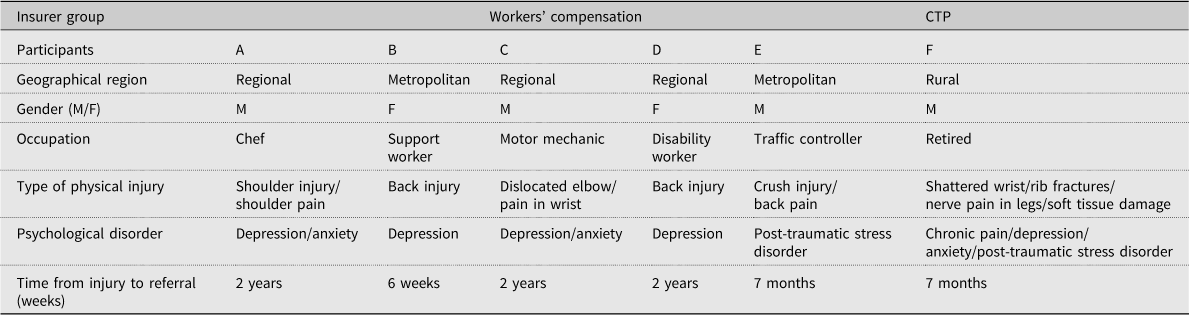
Data were collected between September 2016 and May 2017. Semi-structured individual interviews were conducted with 15 participants and two focus groups were conducted with 12 participants. Individual interviews were conducted with GPs working in private practice and participants included four males and two females with an average of 9 years’ experience and with practices across rural, regional, and metropolitan NSW. Two focus groups were conducted with WC and CTP insurers with six participants in each group. Participants in the WC group included six females (i.e., four case managers, one senior case manager, and one technical advisor) with an average of 6 years of experience. The CTP insurer group included four females and two males with an average of 3 years of experience (i.e., five injury management advisors and one rehabilitation manager). In addition, three individual interviews were conducted with CTP insurers (i.e., one personal injury consultant and two injury management advisors) whose schedule did not allow for focus group participation and included two females and one male with an average of 4 years of experience. Six injured people participated in individual interviews and a summary of their demographic details is presented in Table 1.
Demographic features of injured patient participants according to geographical location and injury suffered under insurance frameworks

All participants were required to sign an informed consent form prior to taking part in the interviews. The consent form assured participants anonymity through the allocation of pseudonyms during transcription and removal of any recognizable information (Douglas, Windsor, & Wollin, Reference Douglas, Windsor and Wollin2008). F2F focus groups ran for between 90 and 120 min and were conducted with insurers either on site or at a central city location. Sixty-minute individual interviews were held by telephone with GPs and injured people.
A convenience sampling strategy was used for all three stakeholder groups, and the selection criteria were developed a priori. All participants had to be >18 years, injured people were required to have an accepted claim for a musculoskeletal injury and a secondary psychological injury under WC or CTP, the insurers had to be SIRA scheme agents (for both WC and CTP) with experience in managing musculoskeletal injuries with secondary psychological injuries, and the GPs were required to have experience in treating injured people suffering from musculoskeletal injuries with secondary psychological injuries under WC and CTP.
1.4 Data collection
Data were collected through focus groups and individual interviews conducted by the first author using the same interview guide to ensure stability of the findings over time (see Appendix).
The questions were drafted by the first author and reviewed by the second author. They were informed by the Haider and Dunstan (Reference Haider and Dunstan2019) study of barriers affecting psychologists’ use of biopsychosocial treatment guidelines. The main purpose of the individual interviews was to enable participants to report their personal experiences and intentions that drove their behavior. Focus groups were utilized to facilitate the emergence of viewpoints from individuals (i.e., agreements and disagreements) that would otherwise be absent in an individual interview (Brijnath et al., Reference Brijnath, Mazza, Singh, Kosny, Ruseckaite and Collie2014; Kroll, Barbour, & Harris, Reference Kroll, Barbour and Harris2007). Combining individual interviews and focus group data allowed a rich and diverse dataset to be generated. Ethics approval was obtained from the University of New England prior to conducting the study (HE16-095).
1.5 Procedure
Study approval was granted by the University of New England Human Resources Ethics Committee (Approval numbers: HE16-095 and HE16-262), participants consented for the study. We contacted GPs via the NSW Primary Health Network newsletter that is distributed to all geographical regions of NSW (Department of Health, 2015). GPs who wanted to participate contacted the first author and those who met the inclusion criteria were interviewed (Brijnath et al., Reference Brijnath, Mazza, Singh, Kosny, Ruseckaite and Collie2014). The individual semi-structured interviews were conducted over the phone and during consultation hours and GPs were reimbursed $250 for their time. A heterogeneous group was formulated by taking geographical location, gender, and experience into consideration (Creswell & Creswell, Reference Creswell and Creswell2017).
We recruited insurers via existing professional relationships with the research team. Snowball techniques were used to identify additional insurers working within the WC and CTP insurance arena. Participants were paid $50 at the end of the focus groups and F2F individual interviews for their time and travel. Insurers ranged by work experience, insurance company, SIRA compensation scheme (i.e., WC and CTP), and role in handling claims (i.e., six case managers) to mid-level managers (i.e., a technical advisor and rehabilitation manager and seven injury management advisors).
Injured people were identified by the research teams’ existing professional relationships with psychologists and GPs. Participants were selected to ensure heterogeneity: injured people with musculoskeletal injuries and secondary psychological injuries under WC and CTP living in diverse geographical regions of NSW. Participants were paid $50 at the end of the individual telephone interviews for their time.
1.6 Data analysis
Both the focus group and individual interviews were digitally recorded, transcribed by a professional transcription service and initially reviewed by the first author for accuracy (Creswell & Creswell, Reference Creswell and Creswell2017). Transcripts were analyzed using a deductive approach to thematic analysis (Braun & Clarke, Reference Braun and Clarke2006). To manage data systematically, the interview transcripts were imported into QSR NVivo 11 (a qualitative data analysis software) for coding and analysis (Bazeley & Jackson, Reference Bazeley and Jackson2013). Analysis started after the first focus group and was carried out simultaneously as the data collection progressed (Tourangeau, Cummings, Cranley, Ferron, & Harvey, Reference Tourangeau, Cummings, Cranley, Ferron and Harvey2010). The data collection followed an iterative process until data saturation was reached (Creswell, Reference Creswell2014).
Coding used a prior template of predetermined codes (i.e., categories) derived from the interview questions and the findings of an earlier study that had qualitatively explored psychologists’ compliance with EBP within SIRA insurance frameworks (Haider & Dunstan, Reference Haider and Dunstan2019). The categories included were (1) barriers to timely referral by GPs of people with a musculoskeletal injury with secondary psychological injury, (2) barriers to insurers’ understanding and timely approval for the provision of psychological treatment, and (3) barriers to injured peoples’ engagement and participation in psychological interventions. The predetermined codes were entered as nodes in QSR NVivo 11 and the text was coded manually by matching the codes with sections of text selected as representative of the code. Segments from the transcript ranged from a line to several paragraphs and, in some cases, the same text segment was allocated to more than one code (Braun & Clarke, Reference Braun and Clarke2006). All interview responses were analyzed for barriers affecting accessing and engaging with psychological services from the standpoint of GPs, insurers, and injured people. The final themes were established by consensus among the authors. Reflexivity was recognized by the authors—the first author and second author both were psychologists who used their personal and professional experience of working within SIRA compensation schemes to review and analyze the data (Jootun, McGhee, & Marland, Reference Jootun, McGhee and Marland2009).
To improve the trustworthiness of the qualitative data collected, specific quality procedures were used. Rigor in data collection, analysis, and interpretation was established by using the criteria established by Lincoln & Guba (Reference Lincoln and Guba1985). Credibility was established by (i) conducting multiple focus groups and individual interviews to compare participant perspectives across diverse geographical locations (i.e., within regional, rural, and metropolitan NSW), insurance framework (i.e., CTP and WC) and compensation agents; (ii) truth value was established by using a detailed interview guide; (iii) confidence in the truth of the data was improved by advising participants that consensus was not the goal and by encouraging them to share their view points; and (iv) data triangulation in the analysis and interpretation was established (i.e., through the use of both face-to-face focus groups and individual and telephone interviews across various geographical regions with the three stakeholders) which enabled comparison of results with earlier studies (Haider & Dunstan, Reference Haider and Dunstan2019; Haider, Dunstan & Bhullar, Reference Haider, Dunstan and Bhullar2018) and was reflective of multiple realities.
Dependability was established through the (i) data being analyzed by the first author, followed by the second author, discrepancies between some themes were identified and, after rigorous discussion between the two researchers, consensus was reached, and decisions made regarding primary themes and (ii) stability of findings over time was established by using the same interview guide with focus groups and individual interview participants within each stakeholder group (i.e., the same interview script for focus groups and individual interviews conducted with various compensation agents, individual interviews conducted with GPs in different geographical regions and interviews carried out with patients injured under CTP and WC).
Transferability was established by using direct quotes in the presentation of findings and sample and setting was described for “potential appliers” to make “transferability” decisions (Lincoln & Guba, Reference Lincoln and Guba1985).
Conformability was established through a detailed audit trail of what was done by recording in NVivo Pro 11, whereas memos in NVivo Pro 11 were recorded and notes kept by researcher on processes and procedures undertaken to maintain the neutrality of the researcher.
The analysis of data was undertaken by using a systematic protocol to avoid making mistakes and overlooking critical factors (Krueger & Casey, Reference Krueger and Casey2015). As a result, reporting of each group (i.e., GP’s, insurers, and injured patient) used a sequential process so that the analysis strategy was clearly understood and documented by each member of the research team (Krueger & Casey, Reference Krueger and Casey2015).
2. Results
2.1 Stakeholder 1: GPs
The two main themes that emerged as reasons for the reported untimely referral by GPs were reticence to refer to a psychologist and a poor fit between the GPs’ practice and general clinical guidelines for the management of musculoskeletal injuries (Motor Accidents Authority, 2001; WorkCover SA, 2010).
2.1.1 Reticence to access psychological services
Some GPs reported being reticent to refer their patients to a psychologist because of the need to equate psychosocial disability with a “mental health disorder” and the stigma that might follow. As noted by one GP: “Harm can arise from the labelling and referral process” such that “the risks can outweigh the benefits.” GPs said they often prefer to address these presentations themselves. For example, GP 1 said: “I might work on elements of the mental health side without the patient never needing to accept that they’ve got a mental health label.”
GP 3 noted:
Most of the guys who are getting work injuries are usually male, 40–50 years of age. If I tell them you need to see a psychologist they’ll baulk at that and they’re not keen on seeing someone like that, they usually bottle up all their emotions and take it out at home. He might just say ‘Oh, give me a medicine, give me an antidepressant’.
Rural GPs noted that a dearth of male psychologists in regional areas can also contribute to actual or delayed referral of injured people who want “to see a male psychologist.”
2.1.2 Poor fit between GPs’ practice and treatment guidelines for the management of musculoskeletal injuries
Most GPs stated that they do not use “questionnaires” to screen for “yellow flags” (i.e., psychosocial risk factors for long-term disability) and were unfamiliar with the ÖMPQ, that is recommended in treatment guidelines for medical practitioners (Motor Accidents Authority, 2001; WorkCover SA, 2010) as an appropriate screening tool (Nicholas, Linton, Watson, Main, & Decade of the Flags Working Group, Reference Nicholas, Linton, Watson and Main2011). While conscious of the effect that psychosocial factors can have on injured peoples’ outcomes, GPs seemed unaware that these risk factors can and should be detected early, at approximately 4–6 weeks post-injury. They reported that they typically consider psychosocial issues much later such as when an injury is taking “double the time frame” to resolve. If referral is made to a psychologist, it is based on “intuition” or a “clear indication” that the “patient’s ways of thinking” are limiting their return to usual functioning (e.g., a lack of motivation to return to work).
GPs also reported that involvement by a psychologist can lengthen the duration of a claim and ultimately an injured person’s return to work or functioning. Further, there can be delays in insurer approval for psychology services, which “can take many weeks or months” and in the case of CTP patients, sometimes may not be approved at all. A few GPs stated that the main barrier to obtaining approval from insurers for psychological treatment of secondary psychological injuries is “getting the insurer to say it was related to the first injury.”
2.2 Stakeholder 2: Insurers
The WC and CTP insurer data revealed three main themes as reasons behind the delay in the timely approval of treatment for secondary psychological injuries. These themes included lack of trust in the validity of a secondary psychological injury claims and concerns about the implications of acceptance; a poor fit between psychologists’ practice and the expectations of the SIRA regulatory framework and lack of knowledge or skills to manage secondary psychological injury claims.
2.2.1 Lack of trust in the validity of a secondary psychological injury claim and concerns about the effect of acceptance
WC insurers noted that their primary focus is on the “physical side of the injury” and that it is: “Second nature for case managers to look at secondary psych as a separate thing and try and ignore it” (Insurer 4).
Their reticence to approve treatment is based on their belief that engagement in psychological treatment is likely to hold up, rather than expedite, the return to work. Insurer 12 noted: “In our mind, it’s like, oh, psychological treatments, or incapacity is going to delay return to work.”
Hence, insurers are reluctant to accept a claim for secondary psychological injury believing it will complicate the claims management process and increase costs.
CTP insurers acknowledged a historical reluctance and “significant stigma” associated with the acceptance of liability for psychological injury. Insurer 15 noted: “Insurers want to avoid kind of opening a can of worms around psych, so you look to do what you can to kind of play it down.”
Both WC and CTP insurers stated that they do not “intentionally delay” referral to a psychologist, they but need to be convinced that psychological intervention is required. Therefore, they need to receive “convincing information” to “understand the truthfulness relating to the claim.” Insurers seemed to intuitively recognize that there would be a psychological effect from injury but were uncomfortable calling it a “secondary psychological injury.” Unlike a physical injury, the absence of injury visibility made acceptance of secondary psychological injuries complex.
As we first said, first response, freak out about liability … almost every physical claim is going to have an element of secondary … small, or not, there will be a component of it. And that’s something that I think, we, as insurers, or scheme managers, you don’t like that, you don’t want to hear that. (Insurer 4)
Both CTP and WC insurers reported that their hesitation in accepting claims for secondary psychological injuries is often validated by the actions of some GPs who also appear reluctant to refer injured people to a psychologist:
Early identification through the GP is a key component’ in order ‘to get the referral started [but] I have had some GPs discourage the worker from going down the insurance path with secondary psych and try and get them assistance on the side outside the claim. (Insurer 1)
Lastly, CTP insurers reported that they believed when a solicitor became involved, the injured patient’s motivation regarding recovery and health outcomes became “driven by purely financial” reasons that further contribute to be an additional source of skepticism for them regarding the validity of claims that have a secondary psychological component.
2.2.2 A poor fit between psychologists’ practice and the expectations of the NSW SIRA regulatory framework
CTP insurers reported difficulties in approving some psychologists’ requests for treatment due to the psychologists’ lack of compliance with NSW SIRA treatment planning and reporting requirements. Specifically, psychologists’ failure to explain the evidence-based nature of the treatment they would be providing or a lack of understanding that, in making a CTP claim, the injured person has provided written consent to the exchange of information between the insurer and health service providers.
So, when after 20 sessions or so there’s no real progress, that’s when we would say well I haven’t really been able to determine how this is helping. We’re trying to make decisions based on objective and evidence-based information. The easiest way for us to do that is for the provider to give us that information [but psychologists are] more reluctant than other disciplines to do so (Insurer 8).
WC insurers reported a poor fit between the information they receive, their guidelines for approving treatment, and their capacity to approve referrals. WC insurers said that determining liability for a secondary psychological injury is challenging because they are required to “assess liability based on the diagnosis” and the diagnosis made by some GPs is sometimes “generic” and “not a specific DSM-5 diagnosis.” They explained that this issue increases the amount of clarification required by the GP and may require additional medico–legal investigation that can create delays (extending over weeks) in the commencement of psychological treatment for the injured person. Some WC insurer case managers noted that even if they do support a referral to a psychologist, a timely referral can be hindered by a lack of access to psychologists, particularly in rural areas where there can be a “six-month waiting list.”
2.2.3 Lack of knowledge or skills to manage secondary psychological injury claims
Insurers reported that they lack knowledge and understanding of the management of secondary psychological injuries and, in the absence of information guidelines, they can struggle to formulate an effective response. One WC insurer (Insurer 3) stated: ‘There’s no real guidelines from iCare or SIRA regarding how to deal with secondary injuries. The most that I ever remember doing, anything to do with secondary psych, is different to our perspective’.
CTP insurers stated that managing secondary psychological injuries is challenging for them due to the uncertainty around predicting treatment duration and recovery timeframes. Insurer 9, a CTP insurer, reported: “Psychological injuries are a bit of a scary territory for most claims analysts because they don’t understand the injuries for the most part or they understand it at kind of Google knowledge.”
2.3 Stakeholder 3: Injured people
Injured people who had received psychological treatment under WC and CTP reported it to be “invaluable” to their recovery and wished it had commenced much earlier. Issues affecting their engagement and participation in psychological intervention for secondary psychological injuries included a poor fit between the SIRA treatment guidelines for psychologists and their experiences with the insurers’ and some psychologists’ practice.
2.3.1 Poor fit between the treatment guidelines and injured people’s experience of insurers’ and psychologists’ practice
Injured people perceived the role of the insurer as adversarial and a barrier to recovery. For instance, most encountered significant delays in gaining approval for psychological intervention. Some worried that engagement in functional restoration activities would be subject to surveillance, while others feared that disclosures to the psychologist would be “reported back” to the insurer with unknown negative consequences such as denial of claim liability and subsequent discontinuation of treatment or wages. Consequently, these fears prevented some injured people from engaging in the activities required to achieve positive therapeutic outcomes.
I love gardening, it’s something that I’ve always loved doing. I had a friend of mine come up and set up a little garden at the back of my place and it’s done me the world of good but I’m so worried and I’ve told my psychologist this, that … I’m worried that I’m [under surveillance] by the insurer and if I, you know, show that I’m doing something with my right arm, they’re going to cancel my [claim] and it’s another pressure that … you know, there’s no need for it. (Injured Person 2)
One injured person described a delay in the approval process as follows:
Oh, mentally it just destroyed me. The wait, the unknowing. Knowing that it should be happening and [I] can’t figure out why it’s not happening. Stress levels were horrible. My lack of confidence in the whole system was non-existent. And it is very, very heartbreaking. (Injured Person 1)
The response of one injured person reflected a poor fit between a psychologist’s application of the SIRA procedures and the injured person’s expectations of treatment.
If they could say two hours to see the psychologist and we spent one hour doing the paperwork and then the next hour I could get something good out of it. (Injured Person 3)
With the psychology side of it I think I’m very happy with what I’ve received, I am just sorry it never happened way earlier. I’m sure it would have lifted my confidence and helped me through a lot earlier. That’s the only drawback that I can see with the whole procedure. (Injured Person 1)
3. Discussion
The aim of the current study was to explore barriers that included delayed referral and approval of psychological treatment for musculoskeletal injuries from the standpoint of GPs and insurers and poor engagement in treatment from the standpoint of injured people. The findings revealed that difficulties largely arise due to differences in how stakeholders conceptualize and manage illness and disability within the NSW compensation system.
Two key models are used to understand the presentation of human illness: the biomedical model and the biopsychosocial model (Dunstan & Covic, Reference Dunstan and Covic2006). The biomedical model purports that illness is caused by a specific recognizable physical pathology (Bernard & Krupat, Reference Bernard and Krupat1994) and that symptoms such as pain, disability, and psychological distress should be proportional to that pathology and remit when it is remedied (Waddell, Reference Waddell1992). In contrast, the biopsychosocial model (Engel, Reference Engel1977) assumes that illness, pain, and disability are the products of the interaction between psychological and physical elements that together sit against a background of social and environmental influences (Bernard & Krupat, Reference Bernard and Krupat1994). The treatment guidelines contained in the Clinical Framework are based on the biopsychosocial model (Transport Accident Commission & WorkSafe Victoria, 2012). The biopsychosocial model conceptualizes functional disability not as a “health problem,” but as “impairment, activity limitation, or participation restriction” shaped by interactions between health conditions and contextual factors (World Health Organization, 2017). When GPs and insurers are required to identify discrete diagnoses and the fulfillment of a diagnostic criterion, the biomedical model is being applied and this does not fit with a biopsychosocial approach. We discuss the impactions of this situation with reference to the findings of this study.
The issue of untimely referral by GPs was consistent with reports in the existing literature. The study findings also showed that GPs’ delay in referral for psychological treatment was due to a lack of systematic screening for psychopathology and a lack of familiarity in using appropriate psychometric tools for assessing yellow flags. Combined, these findings reveal that GPs are caught in a bind when they identify psychosocial factors that affect injured patients’ recovery (as understood in a biopsychosocial conceptualization), but (for good reason) do not consider it appropriate to “label” their patient as having a “mental disorder” (as required by the medical model familiar to them and applied by insurers).
Delays in timely approval of treatment by insurers were also found to stem from insurers viewing secondary psychological injuries through the lens of the biomedical model that formed the basis of their administration. This situation was found to be further complicated by deficits in insurers’ skills and knowledge of the management of secondary psychological injury and psychologists’ lack of compliance with treatment planning and reporting requirements. The insurers justified their actions by citing GPs’ behavior as the driver of their own behavior that, as mentioned above, was based on a desire to do “no harm” and was perceived as a potential outcome of applying the biomedical model. These findings are consistent with previous research that shows that insurers typically have insufficient education and skills to effectively address mental health claims and psychologists may have insufficient knowledge and skills to fully comply with recommended protocols and procedures (Brijnath et al., Reference Brijnath, Mazza, Singh, Kosny, Ruseckaite and Collie2014; Haider & Dunstan, Reference Haider and Dunstan2019; Haider, Dunstan & Bhullar, Reference Haider, Dunstan and Bhullar2018). In addition, insurers also viewed the management of musculoskeletal injuries, particularly those resulting from motor vehicle injuries, from the standpoint of the “insurance model” (i.e., the presence of secondary gains explains disability) with the knock-on effect of their inaction making it difficult for psychologists to adopt a biopsychosocial intervention framework (Schultz & Gatchel, Reference Schultz and Gatchel2006). Existing research has found some validity for this belief, as poor recovery for individuals seeking financial compensation is indicated (Murgatroyd, Casey, Cameron, & Harris, Reference Murgatroyd, Casey, Cameron and Harris2015). However, this in turn may result due to the stress associated with the claim process and the traits and situation of the individuals making the claim (Murgatroyd, Harris, Tran, & Cameron, Reference Murgatroyd, Harris, Tran and Cameron2016). Overall, the findings showed that delayed referral was due to insurers requiring valid diagnostic support to be convinced that psychological treatment was required, and the failure by GPs to effectively screen for yellow flags. As a result, when referral is delayed, it can be difficult for psychologists to achieve optimal outcomes with treatment-resistant client presentations, who may then require management not covered by the treatment guidelines. In addition, the role of both the workplace and the employer which was not investigated in the study can also significantly impact injury management within both the compensable and non-compensable contexts. Studies have found that successful implementation of guideline-based intervention is impacted by unforeseen organizational obstacles (i.e., policies, procedures, and individual approaches) (McCluskey, Burton, & Main, Reference McCluskey, Burton and Main2006). Nonetheless, the findings showed that insurers required valid diagnostic support to be convinced that psychological treatment was required and GPs’ failure in effectively screening for yellow flags (i.e., psychological aspects which includes beliefs, appraisals, and judgments) delayed referral. As a result of the delay in accessing psychological services, it can become difficult for psychologists to achieve optimal outcomes with treatment-resistant client presentations who may require management not covered by the treatment guidelines.
The findings of this study also highlighted how the claims management standpoint of insurers, driven by a biomedical model that requires psychological distress to be equated with a mental disorder, can be perceived as adversarial. Questioning of the legitimacy of the injured person’s psychosomatic symptoms can become a barrier to them accessing early intervention and active rehabilitation. These findings are consistent with other studies showing that interactions between insurers and injured people can create a sense of fear, anger, and insecurity; particularly, when covert surveillance is used to monitor the person’s participation in activities outside of their functional capacity (Kilgour et al., Reference Kilgour, Kosny, McKenzie and Collie2015a). The result is that some injured people withdraw from activities that could facilitate their recovery due to concerns about losing access to financial and treatment entitlements (Kilgour et al., Reference Kilgour, Kosny, McKenzie and Collie2015b). When injured people adopt this standpoint, psychologists’ use of biopsychosocial intervention guidelines becomes challenging. Furthermore, the coordinated approach among all stakeholders required by the biopsychosocial guidelines can be difficult to achieve in the context of “pathogenic” interactions between injured people and insurers (Kilgour et al., Reference Kilgour, Kosny, McKenzie and Collie2015b; Schultz & Gatchel, Reference Schultz and Gatchel2006, p. 455). Once again, the basis of this problem appears to lie in the “poor fit” between the expectations and behaviours of stakeholders created by the different theoretical models used in the compensation systems to understand illness and disability.
3.1 Strengths and limitations of this study
This study is the first study to investigate the barriers that affect key stakeholders accessing psychological services for musculoskeletal injuries within the NSW compensation schemes. The state of NSW was selected as previous research findings had indicated that psychologists’ compliance with EBP guidelines was variable and barriers to compliance were found to be influenced by stakeholders’ actions within this state’s compensation schemes (Haider & Dunstan, Reference Haider and Dunstan2019; Haider et al., Reference Haider, Dunstan and Bhullar2018). It is not known if similar findings would emerge in other jurisdictions since this is a qualitative study and results cannot be generalized. Additional limitations include the small size and the risk of selection bias. Moreover, the incentive offered to participants could have also influenced the results yielded. Nevertheless, because of the qualitative nature of the study a better understanding of the barriers impacting psychologist practice from the GP’s, insurers, and injured patient perspective was obtained. The findings can be used to generate hypotheses to further improve the adherence of EBP treatment guidelines and management of musculoskeletal injuries within the SIRA compensation schemes.
4. Conclusion
The treatment principles included in the Clinical Framework for the Delivery of Health Services promote a biopsychosocial approach to injury management that proposes early intervention and collaboration among all stakeholders. The findings of this study have revealed that the concurrent use of two different models of the conceptualisation of illness and disability, within the compensation schemes of NSW, reduces psychologists’ capacity to effectively treat injured people and leads to poor outcomes. Specifically, delays in referral and approval for treatment, which impair the timely application of a biopsychosocial approach, are driven by the application of the biomedical model and its need to establish a “diagnosis” for disability caused by psychosocial distress. A shared understanding of the standpoints of the NSW compensation systems’ stakeholders has emerged as a critical first step in grasping the effect each has on psychologists’ practice. An education program on the management of persisting disability following musculoskeletal injury within the NSW compensation scheme – one that focuses on functional restoration through early psychological intervention – is urgently warranted for insurers and GPs. Future research should explore ways in which employers, policy makers, key stakeholders, and researchers can collaborate to promote successful adoption of EBP treatment guidelines by psychologists, health practitioners, and administrators working within both the NSW WC and CTP compensation schemes.
Acknowledgements
None.
Financial support
This research received no specific grant from any funding agency, commercial, or not-for-profit sectors. The study was supported by State Insurance Regulatory Authority grant: SIRA reference number: MAA/438891/2015.
Conflicts of interest
None.
Declaration of interest
The authors have no conflicts of interest to declare.
Appendix
Barriers Impacting Insurer Approval of Treatment for Secondary Psychological Injuries (Questions Used by Facilitator)

Barriers Impacting Injured Patient Engagement With Psychological Treatment (Questions Used by Facilitator)

Barriers Impacting General Practitioner Timely Referral of Secondary Psychological Injuries to a Psychologist (Questions Used by Facilitator)