Introduction
Spousal care-giving is an increasingly common experience and emotionally a most demanding situation. If the care ends with the death of the spouse, specific characteristics of the care-giving situation may ameliorate or exacerbate the bereavement process. Stress research has characterised conjugal care-giving as a chronic stressor that is linked to increased care-giver burden and psychological distress (Beach et al. Reference Beach, Schulz, Lee and Jackson2000; Marks, Lambert and Choi Reference Marks, Lambert and Choi2002; Pearlin Reference Pearlin, Mullan, Semple and Skaff1990; Pearlin and Skaff Reference Pearlin and Skaff1996). Additionally, the loss of a spouse is a difficult life event and is associated with depression in widowhood (Carr and Utz Reference Carr and Utz2002). This paper contributes to the care-giving and widowhood research literatures (Bass and Bowman Reference Bass and Bowman1990; Bass, Bowman and Noelker Reference Bass, Bowman and Noelker1991; Burton, Haley and Small Reference Burton, Haley and Small2006; Selzer and Li Reference Selzer and Li2000), by focusing on the relationship between spousal care and bereavement adjustment. We emphasise how situational aspects of spousal care-giving relate to survivors' depressive symptoms six months into widowhood.
Studies of survivors find differences in adjustment during widowhood, depending upon whether they provided care, although the direction of those differences varies (Wells and Kendig Reference Wells and Kendig1997). Definitive explanations of the relationship between spousal care-giving and widowhood are elusive for two reasons. First, little sociological research has examined how specific dimensions of the care situation affect the surviving spouse's symptoms of depression, and secondly, methodological variations have produced inconsistent findings. To address this first limitation, we have drawn on Wheaton's (Reference Wheaton1990) model, which emphasises that the prior context of stressful life events influences individuals' experiences of those events. This model posits that the extent to which widowhood negatively influences psychological adjustment reflects chronic strains associated with the care-giving situation in which the death occurs. Researchers have conceptualised widowhood as a stressful life event, but if the care-giving situation is long-term, intimate or demanding, the end of care may actually signify ‘relief’ from a chronically-stressful role, and symptoms of distress may improve. In contrast to the ‘relief’ model, the ‘wear and tear’ model posits that demanding care-giving erodes care-givers' mental and physical resources and intensifies the negative impact of spousal loss. Although research findings support both perspectives, the balance of the evidence is for the relief model. This paper therefore asks, under what care-giving conditions is the relief model of adjustment to spousal bereavement supported?
As stated above, the second explanation for the inconsistent findings is methodological variation. Studies differ in their designs, sampling methods and outcomes (Schulz et al. Reference Schulz, Newsome, Fleissner, Decamp and Nieboer1997). Samples comprise variously: spouses and other family care-givers; women-only; dementia care-givers; and those who principally provide physical care. Beyond sampling, studies differ in their conceptualisations and outcome measures, with the latter ranging from depression and grief to drug use. To reconcile the measurement inconsistencies, this analysis focuses on a common outcome measure in both the care-giving and widowhood literature: depressive symptoms. We employ two waves of data from a prospective study of spousal bereavement to examine how care-giving stress, demands, and the type and duration of care impact upon survivors' depressive symptoms six months after the death of their spouse, controlling for pre-death depression. Analysing these data has enabled us to address differences in care-givers' and non-caregivers' changes in depressive symptoms over time. We examine only spousal care-givers to avoid conflating the outcomes for bereaved spouses with those of other bereaved care-givers. Although spousal loss is generally considered a negative event, investigating various aspects of the care-giving situation may help explain disparities in survivors' adjustment.
Spousal care-giving and adjustment in widowhood
Relief or wear and tear?
Previous research has suggested that spousal care-giving and widowhood are closely related life-transitions and that they should be examined as a process (Wells and Kendig Reference Wells and Kendig1997). While the few studies that have explicitly examined spousal care-giving and widowhood provide conflicting results, somewhat more evidence supports the position that care-giving is beneficial for survivors. In a review of 11 studies on care-giving and bereavement, Schulz et al. (Reference Schulz, Newsome, Fleissner, Decamp and Nieboer1997) concluded that most showed that care-giving is associated with better bereavement outcomes. Our own review of the research on care-giving and bereavement supports this conclusion. Schulz and colleagues also noted that contradictory findings arise from methodological variations in sampling, conceptualisation and outcome measurement.
Some studies support the relief model and find that care-giving has a beneficial effect on depression during widowhood. Comparing widows who were not spousal care-givers with those who were, Wells and Kendig (Reference Wells and Kendig1997) found that widowed care-givers were less likely to be depressed than non-caregivers. Similarly, Schulz, et al. (Reference Schulz, Newsome, Fleissner, Decamp and Nieboer2001) found no increases in depressive symptoms after the death of the spouse among strained spousal care-givers. The strained care-givers fared better than both non-caregivers and unstrained care-givers, who showed increases in depressive symptoms. Importantly, from the relief perspective, strained care-givers had improved health practices and no further increases in depression over time. Other research supports the relief model of adjustment for care-givers, although the focus is on the transition to care-giving and the samples differ considerably. For example, a study of wife and daughter care-givers found that, as widows, wives experienced greater social involvement and personal growth compared to continuing spousal care-givers (Selzer and Li Reference Selzer and Li2000). Other results showed that wives' wellbeing generally declined at the beginning of spousal care-giving and improved upon role exit. Qualitative narratives of widowhood also suggest that some women who provided intense conjugal care experienced relief after their partners' death (Bennett and Vidal-Hall Reference Bennett and Vidal-Hall2000). The results of a study of spouses and adult daughters who provided care for family members with dementia supports the relief model, since it was shown that levels of care-giving overload dropped following the death (Mullan Reference Mullan1992).
In contrast, the harmful effects of care-giving may combine with those of spousal loss to produce poorer outcomes in widowhood. In support of this ‘wear and tear’ perspective, a study that compared current and former spousal care-givers and non-caregivers found that former caregivers' depression did not improve to levels comparable to non-caregivers' for up to three years after the death (Robinson-Whelen et al. Reference Robinson-Whelen, Tada, MacCallum, McGuire and Kiecolt-Glaser2001). Similarly, a study of carers of spouses and parents with dementia found that bereaved and continuing care-givers were more depressed than non-caregivers (Bodnar and Kiecolt-Glaser Reference Bodnar and Kiecolt-Glaser1994). It is notable, however, that the sample was not restricted to spousal care-givers but included other family carers. Another study of adult children and spouses of hospice patients found that care-givers reported higher levels of depression prior to and immediately following the death compared to non-caregivers controls, although by seven months after the death no differences remained (Chentsova-Dutton et al. Reference Chentsova-Dutton, Schutcter, Hutchin, Strause, Burns, Dunn, Miller and Zisook2002). Other research supports the wear and tear hypothesis using other outcomes (Bass and Bowman Reference Bass and Bowman1990; Bass, Bowman and Noelker Reference Bass, Bowman and Noelker1991). For example, results from a study of social support and bereavement strain supported the wear and tear model since greater care-related strain predicted greater strain during bereavement (Bass and Bowman Reference Bass and Bowman1990). The results supported the wear and tear model since greater care-related strain predicted greater strain during bereavement.
The care-giving situation
Investigations of the care-giving situation vary and generally do not systematically account for care-giving characteristics. This is critical since conflicting results about spousal care-giving and bereavement may arise from variations in the context. Research inconsistently examines how care-giving stress, demand, duration and type, and social support, influence bereavement. Some studies have suggested that among widows, greater care-giver strain, difficulty and demand are associated with difficulties during bereavement (Bass and Bowman Reference Bass and Bowman1990). Wells and Kendig (Reference Wells and Kendig1997) examined the respondents' general sense of strain and found that married current and widowed former care-givers reported higher strain, although they did not examine the link between strain and depression. Others conceptualise and measure strain as the perceived difficulty of the care-giving situation, or care-givers' perception that their relative demands too much care (Bass and Bowman Reference Bass and Bowman1990; Bass, Bowman and Noelker Reference Bass, Bowman and Noelker1991). Studies of spousal care-giving and widowhood conceptualise and measure demand in different ways. Some indicate demand by the care recipient's degree of reliance on help with the activities of daily living (ADLs) (Mullan Reference Mullan1992), and others by the number of care-giving hours (Robinson-Whelen et al. Reference Robinson-Whelen, Tada, MacCallum, McGuire and Kiecolt-Glaser2001). ADLs may also indicate the type of care provided, although previous studies do not specify them as such.
Several studies have examined the impact of the duration of care-giving on adjustment. Mullan (Reference Mullan1992) measured duration in years but it was not a significant predictor of depression, mastery, overload or guilt. In contrast, Robinson-Whelen and colleagues (Reference Robinson-Whelen, Tada, MacCallum, McGuire and Kiecolt-Glaser2001) found a significant negative relationship between months spent providing care and positive affect among a sample of care-givers for spouses with Alzheimer's disease. For those providing care principally for physical impairments, a lengthy care-giving situation may be beneficial if it enables providers to engage in anticipatory grieving (Lopata Reference Lopata1986; Wells and Kendig Reference Wells and Kendig1997). Finally, some evidence shows that social support for care-givers influences adjustment in widowhood. Bass, Bowman, and Noelker (Reference Bass, Bowman and Noelker1991) examined social support and bereavement adjustment and found that care-giver support was a stronger predictor of positive bereavement outcomes than support provided after the death.
Care-giving and psychological outcomes
Studies of care-giving often use depressive symptoms to indicate distress (cf. Carr et al. Reference Carr, House, Kessler, Nesse, Sonnega and Wortman2000b). Much research focusing on the negative effects of care-giving on depression employs a role-strain perspective (e.g. Kramer and Lambert Reference Kramer and Lambert1999; Marks, Lambert and Choi Reference Marks, Lambert and Choi2002; Selzer and Li Reference Selzer and Li2000), with emphasis on care-giver burden and stress. This research tends to emphasise a ‘wear and tear’ model in which the care-giver's mental, emotional and physical resources are exhausted over time and result in greater depression (Hoyert and Seltzer Reference Hoyert and Seltzer1992; Skaff and Pearlin Reference Skaff and Pearlin1992). Conversely, a recent study suggested that spousal care-giving may have both positive and negative effects on depressive symptoms (Beach et al. Reference Beach, Schulz, Lee and Jackson2000).
The effects of care-giving on wellbeing also depend on social support. Studies demonstrate that care-givers' experience of stress depends upon their coping skills and social support (Pearlin and Skaff Reference Pearlin and Skaff1996). One study of care-giving wives found that social support from friends and family was associated with less strain and burden, and that emotional support from the spouse was associated with wives' lower levels of care-giving burden (Wright and Aquilino Reference Wright and Aquilino1998). The demand for care, measured as hours spent providing care, might also influence care-givers' stress. Higher demands may exacerbate care-givers' stress (Stoller and Pugliesi Reference Stoller and Pugliesi1989). Studies also measure demand as the number of ADLs or Instrumental ADLs for which assistance is required (Miller Reference Miller1990; Wright and Aquilino Reference Wright and Aquilino1998).
Less research has examined how the duration of care affects care-givers' distress. Spousal care-giving generally lasts for five to seven years (Azarnoff and Scharlach Reference Azarnoff and Scharlach1988), but studies also include people who have provided as little as one month of spousal care (Bowers Reference Bowers1999). In one study, the effect of the number of years of care-giving on wellbeing was contingent upon women's level of education, marital status and gender-role orientation (Moen, Robison and Dempster-McClain Reference Moen, Robison and Dempster-McClain1995). Other research on adult-children care-givers showed that wellbeing improved over time as they adjusted to the care-giving situation (Townsend et al. Reference Townsend, Noelker, Deimling and Bass1989).
Adjustment during widowhood
It is well established that widowhood has negative effects on psychological outcomes (Miech and Shanahan Reference Miech and Shanahan2000). Studies of widowhood examine multiple dimensions of adjustment including bereavement, loneliness, depression, grief, anxiety, stress, self-esteem levels, coping and adjustment. Some of the critical factors related to depression in widowhood include social support, health, survivor's financial situation, sudden versus anticipated death, gender and marital quality (Bennett Reference Bennett1997; Carr and Utz Reference Carr and Utz2002; Field and Sundin Reference Field and Sundin2001; Levesque, Cosette and Laurin Reference Levesque, Cosette and Laurin1995; Zisook and Shuchter Reference Zisook and Shuchter1991). Greater social support generally leads to higher wellbeing and life satisfaction (Dimond, Lund and Caserta Reference Dimond, Lund and Caserta1987), although there is evidence that this is not straightforward. In one study, social support did not moderate stress for widows (Pellman Reference Pellman1992), and another found a negative relationship between social support and adjustment among widowed women (Greene and Feld Reference Greene and Feld1989). The length of widowhood is also important; one study found that social support was related to less happiness for recent widows and greater happiness for longer-term widows (Greene and Feld Reference Greene and Feld1989).
Survivors' better physical health and greater financial resources may attenuate the negative effects of widowhood on adjustment. First, better physical health predicts better psychological adjustment in widowhood (Ozawa, Downs and Frigo Reference Ozawa, Downs and Frigo1984). Secondly, the deceased spouse's health prior to death may be important. The kind and duration of the spouse's illness before death explains some variation in survivors' psychological adjustment (Carr et al. Reference Carr, House, Kessler, Nesse, Sonnega and Wortman2000a; Norris and Murrell Reference Norris and Murrell1987). A longitudinal study of widows found evidence that those whose spouses were ill prior to the death were able to engage in anticipatory bereavement, such that widowhood itself did not significantly predict depression three years after the death (Carnelley, Wortman and Kessler Reference Carnelley, Wortman and Kessler1999). Higher income may help protect against depression (Arens Reference Arens1982; Carr et al. Reference Carr, House, Kessler, Nesse, Sonnega and Wortman2000a). Indeed, one analysis of data from the Changing Lives of Older Couples (CLOC) survey found that financial strain was related to grief, depression, and anxiety for widows and widowers (Utz Reference Utz2002). Financial insecurity or health problems may also force widows and widowers to move in with relatives or into institutional settings, both of which are disruptive.
Whether people have a chance to adjust before the death of their spouse may affect outcomes in widowhood. The kind and duration of the spouse's illness explains some of the variation in survivors' adjustment (Carr et al. Reference Carr, House, Kessler, Nesse, Sonnega and Wortman2000b; Norris and Murrell Reference Norris and Murrell1987). A longitudinal study of widows found evidence that those whose spouses were ill before the death were able to engage in anticipatory bereavement (Carnelley, Wortman and Kessler Reference Carnelley, Wortman and Kessler1999). Indeed, the inability to predict spousal deaths leads to higher emotional loneliness (Van Baarsen et al. Reference Van Baarsen, Smit, Snijders and Knipscheer1999). Other research using CLOC data has found that survivors who did not anticipate their spouse's death had more intrusive thoughts about their spouse in the short term. Survivors who anticipated their spouse's death also experienced negative bereavement such that those who spent more than six months anticipating the death had higher levels of anxiety during widowhood (Carr Reference Carr2003; Carr and Utz Reference Carr and Utz2002). Gender and marital quality are also related to adjustment in widowhood. Research has shown gender differences in experiences of spousal loss: men yearn for deceased spouses if their wives died after a prolonged illness, whereas wives yearn more if their spouse died suddenly (Carr and Utz Reference Carr and Utz2002). For both men and women, marital quality affects grief. Happier marriages lead to more grief, whereas troubled marriages are associated with lower levels of grief (Carr et al. Reference Carr, House, Kessler, Nesse, Sonnega and Wortman2000b).
Hypotheses
This study explored how spousal care-giving influences depressive symptoms six months into widowhood, and explicitly tested the relief model. We began by addressing whether in general the data support a relief model by comparing care-givers' and non-caregivers' depressive symptomatology six months into widowhood. Support of the relief model would show lower depression levels among care-givers than non-caregivers six months after spousal loss. Next, we addressed under what conditions former care-givers demonstrated relief at six months into widowhood. Thus, we posited negative relationships between more intensive care and depressive symptoms during bereavement. The four main hypotheses were:
H1: Among former care-givers, those who experienced greater care-giver stress will have lower depressive symptoms six months after the death than those with lower care-giver stress.
H2: Among former care-givers, having given personal care will predict lower depressive symptoms six months into widowhood compared to those who provided instrumental care.
H3: Among former care-givers, those who experienced greater demand (operationalised as hours per week) will have lower levels of depressive symptoms six months into widowhood than those who provided fewer hours.
H4: Having provided care for any duration of time will predict lower depression scores for care-givers than for non-caregivers. Further, in support of the relief model, longer durations of care-giving will be associated with greater relief; specifically, those who gave care for the longest durations will have the lowest depression scores, followed successively by those who cared for shorter durations and finally non-caregivers.
Methods
Data and sample
We used data from the Changing Lives of Older Couples (CLOC) study to examine how the spousal care-giving situation influences depressive symptomatology six months into widowhood. CLOC employed a two-stage area probability sample of 1,532 married men and women living in the Detroit Metropolitan Area. For inclusion in the study, respondents had to be members of a married couple with a husband aged at least 65 years. The research team conducted Time 1 face-to-face interviews in 1987 and 1988, and achieved a response rate of 65 per cent. After the death of a spouse, follow-up interviews were conducted with survivors at six (Time 2), 18 and 48 months after the loss through 1994 (Changing Lives of Older Couples Study 2003). For the follow-up interviews, 316 respondents were re-contacted, all of whom were widowed after the Time 1 survey. Of those, 250 (79%) participated in the Time 2 survey. The final analytic sample has 189 respondents, 72 of whom reported at the Time 2 survey having given care during the six months prior to their spouses' death.
The CLOC study is ideal for the present analysis since it provides longitudinal information for a substantial number of widows. An additional strength of the current analysis is that bereaved care-givers can be compared with bereaved people who did not perform care. Furthermore, among care-givers it is possible to examine the situational characteristics of the care. Data were drawn from the Time 1 interviews that were conducted while both spouses were alive, and information about care-giving came from the six-month follow-up interviews. To avoid confounding the effects of spousal care-giving and bereavement on depressive symptoms, the sample was restricted to people who were not spousal care-givers at Time 1. Therefore, the analytical sample includes only non-caregiving spouses at Time 1, who all experienced the transition to widowhood but only some of whom experienced the transition into and then out of the care-giving role. Those who reported care-giving at the Time 1 survey had already experienced the transition into care-giving, and therefore their starting point in terms of depressive symptoms is not comparable to those who had not yet experienced this transition. This strategy allows us to untangle the simultaneous effects of widowhood and care-giving on depressive symptoms from those of only bereavement.
Dependent variable
The dependent variable is a continuous measure of depressive symptomatology at Time 2. Depressive symptomatology is based on the respondent's score on an 11-item scale that is a subset of the Center for Epidemiological Studies–Depression (CES-D) 20-item scale, which was designed to measure symptoms of depression in the general population. Its purpose is not to diagnose depression but rather to assess the level of symptoms of depression with an emphasis on depressed mood (Radloff Reference Radloff1977). This subscale has been found to be both reliable and highly correlated with the original 20-item scale (Kohout et al. Reference Kohout, Berkman, Evans and Cornoni-Huntley1993). The 11-item version focuses on affective symptoms and is routinely employed in studies of widowhood (cf. Carnelley, Wortman and Kessler Reference Carnelley, Wortman and Kessler1999; Sonnega Reference Sonnega2002). For this sample, at Time 2 the scale had an alpha value of 0.84 and was considered a reliable measure of depressive symptomatology. For easier interpretation of the regression results, the CES-D scale has been standardised.
Independent variables
Beginning with characteristics of the spousal care-giving situation, at Time 2 the survivors were asked a series of questions regarding their care-giving responsibilities during the six months prior to the death of their spouses. In this study, care-givers were coded ‘1’ if they answered ‘yes’ to the following question, ‘Did you yourself have to provide physical care to your husband/wife in the six months before s/he died?’ Several measures were included to capture the characteristics of the spousal care-giving role (on all of these measures, non-caregivers were coded ‘0’). An indicator of care-giver stress was based on the following question, ‘During the six months before s/he died, how stressful was it for you to care for him/her or to arrange her/his care? Was it very stressful, quite stressful, somewhat stressful, not too stressful, or not at all stressful?’ The responses were reverse-coded so that higher values indicate greater perceived stress.
The survivors were asked what type of care they provided to their spouses and the responses coded into a master list. Personal care includes care with the standard ADLs and help with elimination, feeding and bathing. A dummy variable indicated if the survivors provided personal care (coded ‘1’) or other types of support (e.g. medical and transportation). A continuous variable indicates the total hours spent providing physical care per week. A dummy variable indicates the duration of care and was coded ‘1’ for six months or fewer, and ‘0’ for more than six months.
Turning to Time 1 characteristics, the principal independent variable in this analysis is the respondent's Time 1 CES-D 11 score, since it allows us to examine changes in depressive symptoms from before and after the spouse's death. The CES-D 11 scale at Time 1 was standardised and the distribution's alpha score was 0.78. Additionally, we controlled for several demographic variables. At Time 1 these were: age in years; race/ethnicity, dichotomised as non-Hispanic whites (coded ‘1’) and all other groups; household income, measured at the midpoints of 10 income categories that ranged from $25,000 to $80,000; and education measured in years. Women were coded ‘1’ and men ‘0’. An index of marital satisfaction at Time 1 was based on four questions such as, ‘Taking all things together, how satisfied are you with your marriage?’ Higher values indicate greater marital satisfaction. The index was standardised and has an alpha of 0.85. The Time 2 interviews occurred six months after the death of the spouse, not six months after the Time 1 interview. Thus, the interval between Time 1 and Time 2 interviews varied. The CLOC variables include an ‘interview gap’ measure, the number of months between the Time 1 and Time 2 interviews, and it was used as a control in the regression equations.
Finally in this itemisation of the measures, several described personal circumstances at Time 2. A dummy variable indicated if the respondent was employed at Time 2, and a self-reported health measure was based on responses to the question, ‘How would you rate your health at the present time?’ Would you say that it is ‘excellent’, ‘very good’, ‘good’, ‘fair’ or ‘poor’? ‘Fair’ and ‘poor’ answers were coded ‘1’ and others coded ‘0’. An index of chronic financial stress was based on the responses to three questions: ‘How satisfied are you with your present financial situation?’ ‘How difficult is it for you to meet the monthly payments on your bills?’ and, ‘In general, how do your finances usually work out at the end of the month?’ Higher values indicate greater financial stress. The measure was standardised and had an alpha of 0.78. We indicate social support using respondents' answers to two questions: ‘On the whole, how much do your friends and relatives make you feel loved and cared for?’ and “How much are your friends and relatives willing to listen when you feel like you need to talk about your worries or problems? Would you say ‘a great deal’, ‘quite a lot’, ‘some’, ‘a little’, or ‘not at all’?” Responses for each were combined into a scale where higher values indicate greater support (Pearson's correlation coefficient=0.57).
Analysis plan
The analysis began by obtaining descriptive statistics for the sample and making bivariate comparisons between care-givers and non-caregivers on relevant independent variables. Then three progressive ordinary least squares regressions of CES-D-11 scores at Time 2 were run with care-giving situation variables, other independent and control variables. For the regression analyses, the data were weighted to account for unequal probabilities of inclusion. Baseline Model 1 included demographic characteristics, marital satisfaction, the control for temporality, and Time 2 measures of employment, health, support and chronic financial stress. Model 2 tested whether having been a care-giver influenced depressive symptoms. Finally, Model 3 addressed Hypotheses 1 through 4 by adding indicators of the spousal care-giving situation. These are conditionally relevant variables (cf. Ross and Mirowsky Reference Ross and Mirowsky1992) and the effects apply only to care-givers. The coefficients in Model 3 for care-giver stress, personal care, hours spent care-giving, and duration of care-giving are therefore interpreted only for care-givers. In these hierarchical models, each successive model enabled the added influence of separate sets of variables on the dependent variable to be evaluated.
Results
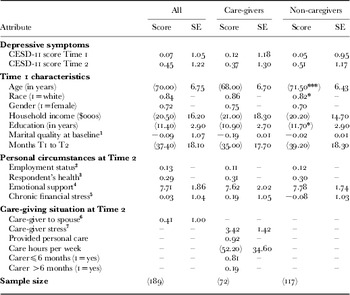
The descriptive statistics for all the variables are presented in Table 1. Not surprisingly, the majority of respondents were women. The average age of the respondents was 70 years, and 41 per cent reported providing care for their spouse. Care-givers and non-caregivers differed only in terms of their age, race and education. On average, care-givers provided care for their spouses for 52 hours per week, and most had provided care for fewer than six months. Almost all care-givers provided personal care rather than only instrumental care. Unexpectedly, at both times, there were no differences in CES-D scores between care-givers and non-caregivers, which importantly suggests that there was no bivariate relationship between care-giver status and depressive symptoms either before or after bereavement.
Characteristics of the sample by care-giver status at Time 2

Notes: All estimates are based on weighted samples. The significance tests denote differences between caregivers and non-caregivers. Units of the scores are indicated in the row labels, notes and text. Values on ‘real-world’ interval scales are in brackets. SE: standard error of the estimate of the mean. 1. Higher=greater satisfaction. 2. Paid work. 3. Fair/poor health=1. 4. Higher=greater support. 5. Higher=greater stress. 6. ‘1’=care-giver. 7. ‘1’ ‘not at all stressful’ to ‘5’ ‘very stressful’. Other baseline characteristics of the sample were: 12% were in full-time work; average work hours were 22.6 (standard deviation 11.7) hours; 92% were home-owners; 23% were care-givers to spouse; 60% had ‘fair’ or ‘poor’ health; and the Index of Financial Stress was 0.17 (sd 1.1).
Significance levels: * p<0.05, *** p<0.001.
The regression results
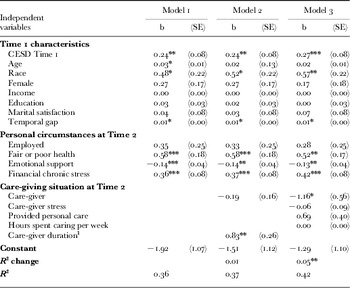
Table 2 presents the regression coefficients for the prediction of CES-D scores at Time 2. Model 1 shows that Time 1 depression scores and the temporality control were statistically significant. Furthermore, being white, older, in fair or poor health, there being a long gap between the Time 1 and Time 2 surveys, and greater chronic financial stress increased symptoms at Time 2, while emotional support decreased depressive symptoms. Model 2 addressed whether there was support for the relief model by including a variable for care-giver status. As spousal care-giving had no influence on depressive symptoms, the model provided no such support. Because previous research led us to expect that care-giving influenced adjustment to bereavement, it was suggested that it was not care-giving per se that mattered, but rather that the characteristics of the care situation were associated with care-givers' subsequent depressive symptoms.
Multiple regression coefficients of independent variables on widows' and widowers' standardised CESD-11 scores at six-months follow-up

Notes: 1. Fewer than six months coded ‘1’. SE: standard error.
Significance levels:* p⩽0.05, ** p⩽0.01, *** p⩽0.001.
We now turn to Model 3 that tested Hypotheses 1 through 4. Model 3 added indicators of the care-giving situation: care-giver stress, whether the respondent provided personal care, care-giving hours, and care-giving duration. The regression results suggest that one dimension of the care-giving situation is important: duration of care. The results do not support Hypotheses 1 through 3, because care-giver stress, personal care and hours spent caring were not significant predictors of depressive symptoms. They provide equivocal support for Hypothesis 4. Care-giving for longer than six months had a significant negative effect on depressive symptoms at Time 2, which means that it decreased depression scores relative to non-caregivers (the coefficient for the care-giver variable represents the effect of care-giving for those who cared for longer than six months, the omitted category of the duration dummy variable). This provides strong support for the contention that the relief model applies to those who have provided longer durations of care. Indeed, these care-givers had CES-D scores below the scores for both non-caregivers and those who provided care for no more than six months. Those who cared for longer than six months had depression scores 1.16 standard deviations below those of non-caregivers (p⩽0.05), and 0.83 standard deviations below those who provided no more than six months of care (p⩽0.01).
The difference between the short duration care-givers and non-caregivers was not significant (the results of a regression that omitted the short duration category are not shown). This is inconsistent with the relief model, which would predict relief even from short duration care-giving. Consistent with previous models, CES-D at Time 1, being white, in fair or poor health, there being a longer gap between Time 1 and Time 2 surveys, and greater chronic financial stress increased depressive symptoms at Time 2, while greater emotional support decreased depressive symptoms.
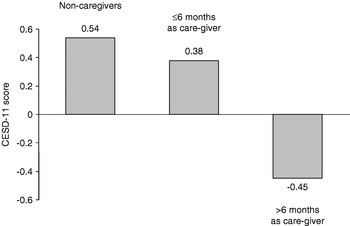
To illustrate fully the results for Hypothesis 4, Figure 1 presents the predicted mean CES-D scores at Time 2 for non-caregivers and both short and long duration care-givers. The predicted means were calculated from the Model 3 equation with all independent variables set to their means. The figure shows that those who gave spousal care for a longer period differed substantially and significantly from short-term carers and non-caregivers. In fact, the average CES-D score for non-caregivers was 1.5 standard deviations above the overall mean, and that for long duration carers about one-half of a standard deviation below the mean. Figure 1 shows the similar level of depressive symptoms for non-caregivers and for short-duration carers; as noted above, the slight differences were not significant.
Predicted mean standardised CESD-11 scores at Time 2.

Discussion
This study has extended previous research on the cessation of spousal care-giving by focusing on how facets of the care-giving situation influence adjustment six months into widowhood. The results suggest that analyses of spousal care-giving and survivors' adjustment should examine the care-giving situation, particularly its duration. We found some support for Wheaton's (Reference Wheaton1990) relief model, which suggests that the cessation of demanding spousal care-giving brings relief and improves psychological adjustment. With its emphasis on the context of stressful life events, the relief model proposes that although widowhood is a negative event, the death actually relieves spousal care-givers from chronically stressful care situations and has an ameliorative impact on psychological adjustment. This analysis of the care-giving situation has shown that providing care for longer durations was associated with lower depressive symptoms in bereavement than among short-duration carers and non-caregivers. Conversely, no associations were found between the adjustment to bereavement and short durations (six or fewer months) of care, care-giver stress, type of care, and hours spent care-giving.
The results are consistent with our expectation that long periods of care-giving predict lower levels of depressive symptoms in widowhood. It may be that long-term care-giving allows wives and husbands to adjust and ‘routinise’ care, which may then be perceived as less disruptive than a short period of care. Furthermore, this type of care-giving may provide time for couples to say goodbye and (or) begin the grieving process before the death. Once widowed, the positive effect of feeling useful and close to their spouse may carry over.
Again drawing on Wheaton's (Reference Wheaton1990) relief model, we expected that other care-giving characteristics would be important predictors of psychological adjustment in bereavement and therefore merited attention. Contrary to the relief thesis, the measure of care-giver stress was insignificant in the analysis. Furthermore, we were surprised to find that the type of care was not a significant predictor, probably because most care-givers in the sample provided personal care. Finally, the impact of hours spent care-giving over a week was insignificant. These findings clearly imply that to test the relief model rigorously, more refined measures of the care-giving situation are required. Most importantly, future research should include the duration of care as a measure of the care-giving situation. Our results suggest that Wheaton's model still has value.
Although it was found that spousal care-giving for long periods was associated with the survivor's lower depressive symptoms six months after the death of a spouse, at that time it is possible that widows are less depressed than earlier or later. Specifically, it has been shown that depression increases immediately following the death, declines several months into widowhood, and then increases again to pre-bereavement levels after about one year (Mullan Reference Mullan1992). This fluctuation makes it possible that our results might also vary by the duration of bereavement. Thus, the relationship between spousal care-giving and depressive symptomatology over an extended bereavement warrants further research (cf. Prokos and Keene Reference Prokos and Keene2005).
Strengths and limitations of the analysis
The longitudinal design of the CLOC dataset is one asset of this research. Using two waves of data permitted an examination of the changing nature of bereavement over time. Similarly, the inclusion of other pre-widowhood characteristics strengthened the analysis. Using randomly-sampled longitudinal data also addressed the selection issues that are commonly found in convenience samples of widows, widowers and care-givers. The analysis of course also has several limitations. The size of the sample limited the number and type of predictor variables. For example, we were unable to control for Alzheimer's care because so few respondents in this sample reported that their spouse had died from the disorder. Had the sample been larger, we could have controlled for this and other potentially important qualitative aspects of the care-giving situation, such as providing care for a spouse with cancer, whether the death was expected or sudden, and the provision of instrumental types of care-giving activities such as help with transport and housework. While this study has focused on depressive symptomatology, other studies have shown that other psychological states, including grief and anxiety, may be variable dimensions of psychological adjustment. Future research could employ CLOC data to investigate further how spousal care relates to other psychological manifestations of bereavement.
Two limitations associated with the omission of those who reported care-giving during the first wave of data collection should also be noted. The result was to exclude care-givers of the very longest duration from the study. This was necessary to assess the effects of the onset and the end of care-giving, but it is also possible that those who were the most exhausted (and possibly depressed) were omitted. Alternatively, those who fully adjusted to the role of care-giving may also have been omitted. Secondly, because all of the care-giver situation data came from the Wave 2 survey, it is possible that recall bias influenced the findings. Specifically, as part of the grieving process, widowed persons may have positively reconstructed the history and quality of their relationship with their spouse. Since the respondents had been removed from the care-giving situation for six months, it is possible that they reported fewer depressive symptoms than they would have reported had they answered the same questions when they were providing care.
On a practical level it is important not to misinterpret the conclusions. Clearly under certain circumstances spousal care-giving can have beneficial outcomes for surviving spouses. Nevertheless, spousal care-giving is stressful, taxing, problematic and complicated. A useful application of the findings would be to raise awareness among family, friends and practitioners who support widows and widowers that it is not only the loss of the spouse that influences survivors' adjustment to widowhood and affective states, but also the duration of the preceding care-giving. The supporters and advisors should recognise that survivors who provide care for short periods might take longer to recover and adjust to living without their spouses. Although we expect that the death is a negative life event, we must also allow for variation in survivors' responses to the end of care-giving, including relief.