INTRODUCTION
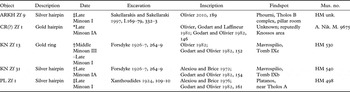
Minoan funerary contexts have produced a few items of jewellery bearing Linear A inscriptions (Table 1), objects that (sometimes along with their contexts) still remain little understood. The objects have been studied, to be sure (Alexiou and Brice Reference Alexiou and Brice1972, Reference Alexiou and Brice1976; Olivier, Godart and Laffineur Reference Olivier, Godart and Laffineur1981; Godart and Olivier Reference Godart and Olivier1982; Olivier Reference Olivier, Hadermann-Misguich and Raepsaet1982): they have been described and photographed, their inscriptions have been transliterated, and suggestions have been made as to how they may have been used; other questions, however, remain virtually unaddressed. Inscribed jewellery, for example, must have been accessible only to a very narrow segment of Minoan society; so to what sorts of individuals might these objects have belonged? Who might their intended audience have been? And what might these objects have meant to their wearers, and to the wearers' audience? As far as possible, interpretations should be informed by the objects' contexts: were the objects votive and never intended for use? Or were they personal items – abandoned, misplaced, or concealed and forgotten?
Concordance of inscribed Minoan jewellery.

Object codes are those assigned by Godart and Olivier (Reference Godart and Olivier1982). Dates are those given in Godart and Olivier Reference Godart and Olivier1982:
* : date generally accepted;
† : date based on style and provisionally accepted;
‡ : date provisionally proposed.
Unfortunately, a certain degree of bias against contextual studies and interpretations of jewellery and its meanings in ancient Aegean societies has persisted until recent years, despite the significance of jewellery as a category of personal adornment.Footnote 1 This bias is now being addressed, with many recent studies (e.g. those in Nosch and Laffineur Reference Nosch and Laffineur2012) providing important insights into the symbolic meanings of jewellery, and the ways in which such symbols were used to signify identity, ethnic boundaries and ritual practices, as well as the social and cultic arenas in which these symbols occurred. Clearly, metal jewellery – particularly gold and silver jewellery – had an intrinsic value, but it could serve also as a symbol of prestige or authority. To the viewer of the object, the overall effect of the rare, lustrous metal, together with its craftsmanship, its decoration, (perhaps) its inscription, and its use in adorning the body, would all have served to help define the identity of the individual wearing it.
Objects of beauty and rarity such as inscribed jewellery not only demonstrated access to limited resources, craftsmanship and esoteric knowledge, but also symbolised the growing status of Aegean and Cypriot elites. In this paper, we argue for the multivocal nature of inscribed Minoan jewellery – that these objects were highly personal artefacts; that their inscriptions were likewise of a personal (or at least a personalised) nature; and that these items were associated with identity construction, as well as with amuletic and ritual behaviour linked to gendered (and perhaps age-related) asymmetry.
THE OBJECTS AND THEIR CONTEXTS
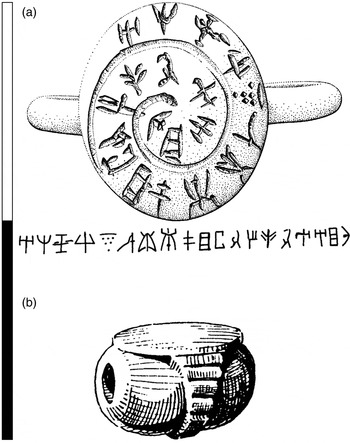
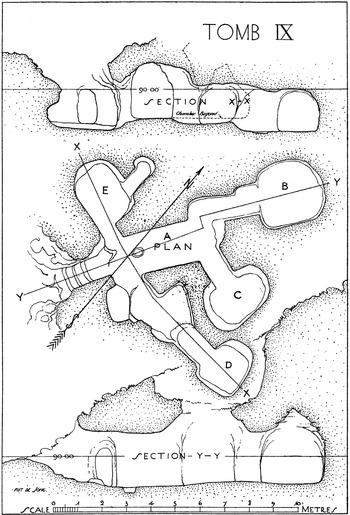
Gold ring KN Zf 13 Footnote 2 (Fig. 1a ), the only known Minoan ring with a Linear A inscription, was found in Tomb IXe at Mavrospilio (Fig. 2).Footnote 3 Co-finds include another gold ring with a plain bezel, as well as several gold beads, including one designed to appear as if the bead is encircled by a gold finger ring (Fig. 1b ).Footnote 4 A bronze knife was found nearby, as well as carnelian and faience beads, an empty larnax and Late Minoan I pottery. The inscribed ring is of cast gold, with a convex disk-shaped bezel; the complete and undamaged inscription of 19 signs is shallow and is designed to be read on the bezel itself rather than in an impression (as explained later in this article). The inscription spirals clockwise from the edge of the disk inward to its centre, in the same way as the inscription on the Phaistos disk.Footnote 5 In fact, the discovery of this ring in a secure context long after the Phaistos disk was found remains one of the best pieces of evidence for the authenticity of the latter object.Footnote 6
(a) Gold ring KN Zf 13. After Godart and Olivier Reference Godart and Olivier1982, 153; (b) gold bead Mavrospilio IX E.4. After Forsdyke Reference Forsdyke1926–7, 287 fig. 39.

Mavrospilio Tomb IX. After Forsdyke Reference Forsdyke1926–7, 265 fig. 19.

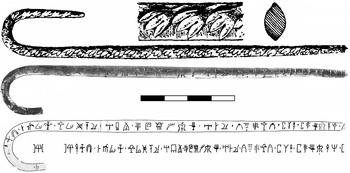
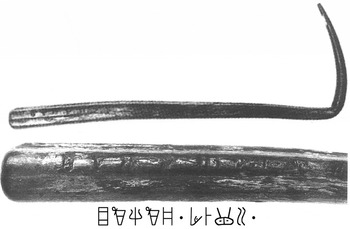
Silver hairpin KN Zf 31 (Fig. 3) was found in Mavrospilio Tomb IXb (Fig. 2); thus this pin and gold ring KN Zf 13 come from two chambers of the same tomb. The hairpin has been assigned to Late Minoan IA on stylistic grounds and also on the basis of associated pottery (Alexiou and Brice Reference Alexiou and Brice1972, 113, 116; Reference Alexiou and Brice1976, 19). The pin consists of a silver rod over 16 cm in length with an oval section and one hooked end (Forsdyke Reference Forsdyke1926–7, 267 fig. 38; Alexiou and Brice Reference Alexiou and Brice1972, 113–24, pls. I–II). It is embossed with crocus blossoms on one side and engraved with Linear A signs with a sharp tool on the other. The decorative motif and the purpose of the hairpin itself suggest that its intended owner was a mature female (Day Reference Day2011, 337–79). Though the beginning and end of the inscription are illegible, the remainder contains no fewer than 40 signs, making this one of the longest known inscriptions in Linear A. Co-finds such as steatite sealstones, amethyst and glass beads, a piece of gold foil and a vessel decorated in ivy leaves (Alexiou and Brice Reference Alexiou and Brice1972, 116) suggest an elite identity for the deceased.
Silver hairpin KN Zf 31. After Forsdyke Reference Forsdyke1926–7, 285 fig. 38, and Godart and Olivier Reference Godart and Olivier1982, 154–5.

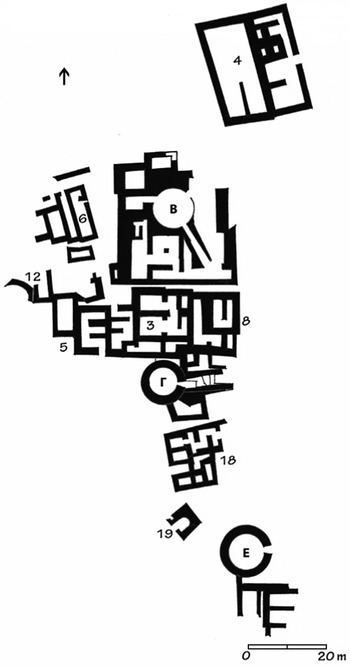
Silver hairpin ARKH Zf 9 (Fig. 4) comes from the pillar room of the Tholos B complex at Phourni (Fig. 5) near Archanes (Sakellarakis and Sakellaraki Reference Sakellarakis and Sakellaraki1997, I.169–79, 332–3, fig. 296; Olivier Reference Olivier2010, 189); like the Mavrospilio pin, it consists of a rod with a hooked end, though the hook on the Archanes pin is relatively straight rather than rounded. There was once a second storey above the pillar room that evidently served as a tomb, as human remains had fallen through into the pillar room, presumably along with the pin; thus the pin most likely originates from a burial. The pin might be dated on stylistic grounds to Late Minoan I by comparison to the Mavrospilio pin, though it could be older, as the pillar room contained a mixed Middle Minoan I – Late Minoan I context. Its inscription, which is complete and undamaged, contains nine signs in Linear A, making this the shortest of the inscriptions on Minoan jewellery.
Silver hairpin ARKH Zf 9. After Sakellarakis and Sakellaraki Reference Sakellarakis and Sakellaraki1997, I.333 fig. 296.

Phourni cemetery; the pillar room is immediately south of Tholos B. After McEnroe Reference McEnroe2010, 33 fig. 4.2.

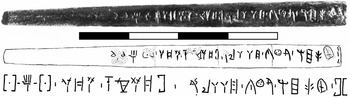
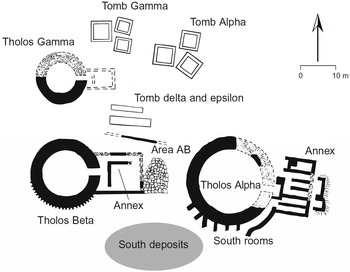
Silver hairpin PL Zf 1 (Fig. 6) comes from the vicinity of Tholos A at Platanos (Fig. 7) in the Mesara (Xanthoudides Reference Xanthoudides1924, 109–10; Alexiou and Brice Reference Alexiou and Brice1976, 20).Footnote 7 This pin has been dated to Late Minoan IA on stylistic grounds, and also by comparison to the Mavrospilio pin. The Platanos pin is formed of two joined pieces, has a lentoid section and measures 7 cm long and 0.5 cm wide at its widest point. The pin is slightly curved and does not end in a hook, although its length (less than half that of the Mavrospilio pin) suggests that it may have been broken and the end polished in antiquity, as is the case with other broken metal objects of Minoan origin (Alexiou and Brice Reference Alexiou and Brice1976, 19). That the Linear A inscription is truncated at the wider end also suggests that a section of the pin is missing. The surviving portion of the inscription contains 23 signs.
Silver hairpin PL Zf 1. After Godart and Olivier Reference Godart and Olivier1982, 161.

Platanos cemetery. After Legarra Herrero Reference Legarra Herrero and Murphy2011, 64 fig. 3.3.

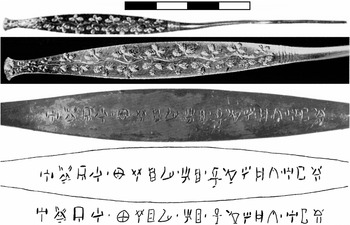
Cast-gold hairpin Cr(?) Zf 1 (Fig. 8) was acquired on the Western European antiquities market in 1980; its provenance before that is unknown. The dealer's claim that the pin came from the Knossos area is unsupportable but plausible, given the pin's composition and the concentration of high-status burials at Knossos (Olivier, Godart and Laffineur Reference Olivier, Godart and Laffineur1981, 3). The pin's authenticity has been questioned because it lacks use-wear, and because its decoration and inscription contain some irregularities and variations (Olivier, Godart and Laffineur Reference Olivier, Godart and Laffineur1981, 5);Footnote 8 but irregularities and variations are evident in other inscribed Minoan objects,Footnote 9 while the lack of use-wear could simply mean that this pin was made for a burial. The irregular composition of the gold, as well as the level of corrosion on the surface (due to significant copper content), both suggest authenticity (Olivier, Godart and Laffineur Reference Olivier, Godart and Laffineur1981, 23), and the scholarly consensus these days is that the object is probably genuine.
Gold hairpin CR(?) Zf 1. After Olivier, Godart and Laffineur Reference Olivier, Godart and Laffineur1981, 4 fig. 1, 6 fig. 2, and Godart and Olivier Reference Godart and Olivier1982, 146–7.

The pin, which is slightly bent, is approximately 11 cm long and is constructed of a thin rod with a circular cross section, expanding to form an upper lanceolate at one end. Both surfaces of the lanceolate are slightly convex. One surface contains an engraved design consisting of an undulating stem running longitudinally through the middle of the field, with alternating veined leaves in groups of three positioned to the left and right of the stem. The width of the design varies in proportion to the width of the available field; thus where the pin narrows, the leaves are reduced to points.Footnote 10 This vegetal pattern has been likened by Olivier, Godart and Laffineur (Reference Olivier, Godart and Laffineur1981, 8) to other typically Minoan naturalistic designs depicting species native to Crete,Footnote 11 and it is also a motif seen at the House of the Frescoes in Knossos (Evans Reference Evans1921–35, II.454 pl. XI top and bottom left, fig. 266a1 –a2).Footnote 12 The opposite surface of the lanceolate is engraved with 18 signs in Linear A; the inscription is complete and undamaged. Although this gold pin has no exact parallels, Minoan pins with similar stylised designs (such as a stem topped by a flower) are attested at MochlosFootnote 13 and Malia.Footnote 14
DISCUSSION
While there is consensus that the inscription on gold ring KN Zf 13 is in Linear A, no such consensus has been reached on the nature or purpose of this object. The ring has an inner diameter of 13 mm, which some have deemed too small for a finger ring. Forsdyke and Evans were both of the opinion that the ring functioned merely as a seal,Footnote 15 and that it was most likely inscribed with a personal name. Certainly, such small rings could have been suspended from bracelets, anklets or necklaces. Minoan adults or children could very well have worn such rings around the neck or wrist as amulets. That sealstones were sometimes worn on the wrist in the Aegean Bronze Age is suggested by their depiction on statuettes and in frescoes, such as the ‘Cup Bearer’ fresco at Knossos, and also by the occasional discovery of seals in the vicinity of the wrist in burials.Footnote 16 Evidence from burials also suggests that seals could be worn on the ankle,Footnote 17 while evidence that they were worn on necklaces comes from a multitude of sites on the mainland and on Crete.Footnote 18 Statuettes from Cyprus show that swivel-bezel rings were worn around the neck there, a fashion evidently borrowed from Egypt (Lagarce Reference Lagarce, Karageorghis, Clerc, Lagarce and Leclant1976, figs. 4, 6).
While the evidence for the use of sealstones and finger rings as jewellery is thus unequivocal, the Mavrospilio ring is (again) not likely to be a seal: an impression of the bezel would produce a sinistroverse inscription, whereas almost all known Linear A inscriptions are dextroverse.Footnote 19 Also, the shallow and narrow grooves of the inscription would have rendered impressions of this bezel indistinct and difficult to read; and as Olivier has observed (1982, 18), the ring itself is so delicate that using it as a seal would probably deform or even destroy it. Although no inscribed ring has yet been found in situ on or near the hand in an Aegean Bronze Age burial,Footnote 20 the findspots of inscribed rings in Cyprus indicate that they were worn as finger rings. An inscribed gold finger ring was found in Tomb 9 at Kition,Footnote 21 while an inscribed stirrup-shaped bezel ring comes from Late Cypriot II Hala Sultan Tekke (Boardman Reference Boardman1970, 7; Masson, O. Reference Masson1957, 20–2, fig. 15; Palaima Reference Palaima, Duhoux, Palaima and Bennet1989, fig. 8), and another from Late Cypriot III Kouklia-Evreti (Megaw Reference Megaw1953, 133 pl. IVb; Masson, O. Reference Masson1957, 20). This stirrup form of ring, usually with a cartouche-shaped bezel running parallel to the hoop,Footnote 22 is widespread throughout Cyprus (Boardman Reference Boardman1970),Footnote 23 the Levant,Footnote 24 and Egypt, where the form is thought to have originated.Footnote 25
We (along with others)Footnote 26 do not believe that the lack of iconographic evidence for engraved rings on Minoan fingers excludes the notion that the Mavrospilio ring – and indeed, small rings in generalFootnote 27 – could have been worn on the hand. Small rings might be worn by children, or on the little finger of an adolescent or small adult,Footnote 28 and rings are in fact the most common type of metal jewellery found in Aegean child-burials from the Middle Bronze Age onwards (Pomadère Reference Pomadère2012, 437–8). Evidence from Middle Helladic burials on the mainland (Pomadère Reference Pomadère2012, 436) and from Late Bronze Age to Early Iron Age burials in the LevantFootnote 29 indicates that in the Aegean and elsewhere in the eastern Mediterranean, children and infants were often buried with jewellery, demonstrating not only a degree of care for these individuals, but a perception of them as individuals. In situ finds from Argos, dated to Late Helladic I, include a six to seven year old child wearing a bronze ring on the right hand (Haas-Lebegyev Reference Haas-Lebegyev2012, 428). A gold ring with a small internal diameter dated to Middle Minoan II–III was found in Knossos-Ailias Tomb VII (Pini Reference Pini2010, no. 2), and another small ring was discovered within a possible child's burial in the Staikos plot at Thebes, dated to Late Helladic II–IIIA (Pini Reference Pini2010, no. 31).Footnote 30 Small finger rings also come from Ayia Irini in the Cyclades (Overbeck Reference Overbeck and Overbeck1989, 203). Rings with an inner diameter of less than 13 mm are plentiful in the sub-Mycenaean burials at Kerameikos, while gold jewellery is attested in child-burials at Lefkandi, where very small rings that could only have been worn by children were common.Footnote 31 As personal ornamentation (especially for children) frequently served an apotropaic function in cultures throughout the eastern Mediterranean,Footnote 32 jewellery in Aegean child-burials may have been meant to play a supernatural role in protecting vulnerable subadults from harm (Pomadère Reference Pomadère2012, 436).
The Mavrospilio ring may very well have served such an apotropaic function, regardless of its owner's age. One can compare its spiral inscription to the spiral inscriptions painted on the interiors of two conical cups from Knossos,Footnote 33 which in turn can be compared to Babylonian devil-traps – terracotta bowls whose interiors are inscribed with spiraliform magical texts (Budge Reference Budge1961, 284–90) that are meant to trap demons inside the bowl. Spirals have been compared to stylised snakes, such as the one found on the Egyptian board game Mehen (Whittaker Reference Whittaker2005, 31–6).
Naturally, the presence of an inscribed ring of precious metal in a burial also reflects the status of the ring's owner.Footnote 34 In this sense, we might compare the Mavrospilio ring to two gold stirrup-shaped bezel rings with Cypro-Minoan inscriptions (K-AD 734 and 795: Masson, E. Reference Masson and Karageorghis1985; Goring Reference Goring and Calinescu1996, 31–2, fig. 4) found in a rich Late Cypriot IIA2 burial assemblage near the intact skeleton of a young woman in Tomb 11 at Kalavassos-Ayios Dhimitrios (Goring Reference Goring and Peltenburg1989, 100–1, 103; Goring Reference Goring and Calinescu1996; South et al. in press).Footnote 35 Ferrara (Reference Ferrara2012, 67) sees these inscribed rings as evidence that literacy had become ‘a marker of the elite prestige paraphernalia’.Footnote 36 The wealth of Tomb 11, comparable in its period only to Tomb 2 at Enkomi, suggests not only that this female must have been of extraordinary status to have had access to such jewellery, but also that her elite status was being demonstrated through the use of writing as a legitimising element.
Importantly, the writing could have served this purpose regardless of whether the rings' owner could read it – and this is no less true of the Mavrospilio ring, and indeed of all inscribed Minoan jewellery: one cannot assume that the people who wore these objects could actually read the writing on them. Most likely they could not, as throughout the eastern Mediterranean at this time, knowledge of writing was esoteric knowledge that was carefully guarded by those who possessed it (Davis, B. Reference Davis2014, 133 n. 721). This same state of affairs meant that most people who saw these objects being worn would also not have been able to read the writing on them. However, both the wearer and nearby observers would have been aware of the presence of writing, which in itself would have signified an association with esoteric knowledge through the scribe who created it, thereby serving as a legitimising factor affirming the authority and status of the person wearing the inscribed object.Footnote 37 Thus writing becomes one of the many ways in which adornment could be actively involved in the social reproduction of status by people distinguishing themselves from others via the display of prestige items (Hayden Reference Hayden1998; Peregrine Reference Peregrine1991; Knapp Reference Knapp1986; Knapp Reference Knapp, Hellström and Alroth1996; Webb Reference Webb and Smith2002, 111).
The remaining four items of inscribed Minoan jewellery are all hairpins, which in the Aegean occur in a variety of forms. The contexts of hairpins, when known, are usually associated with female burials, while the pins themselves are often found near the skull or in pyxides (Hallager Reference Hallager2012, 354, n. 11, with references). They are generally made of high-status metals such as gold and silver, though examples are also attested in bronze, glass and ivory.Footnote 38 The four inscribed Minoan hairpins are no exception: three are of silver, while the fourth is of gold, and all but the (unprovenanced) gold specimen were found in funerary contexts, like the Mavrospilio gold ring. The fact that four (and probably all five) items of inscribed Minoan jewellery come from burial contexts does not necessarily mean that these items were made specifically for burials: most ancient objects of precious metal come from burials, simply because precious-metal items that remained in circulation were prone to eventual recycling. As an example, the Uluburun shipwreck contained a rich collection of scrap gold and silver derived from jewellery (Pulak Reference Pulak1998, 206). Furthermore, if the inscribed Minoan hairpins were made specifically for burials, then we should expect to find no trace of use-wear; yet the Platanos silver hairpin (Fig. 6) has clearly been broken in the middle of its inscription, and the broken end has been smoothed (Alexiou and Brice Reference Alexiou and Brice1976, 19). We have already noted that the lack of use-wear on unprovenanced gold hairpin CR(?) Zf 1 suggests that it was made specifically for a burial; but if the Platanos hairpin were made specifically for a burial and broken during the preparations for it, there would be little point in smoothing the broken end. Instead, the smoothing of the break suggests that this broken hairpin continued to be used by a living person. Of course, it is impossible to demonstrate that the deceased was the person who continued to use the hairpin after it was broken; but the evidence does suggest that not all inscribed Minoan hairpins were created specifically for burials.
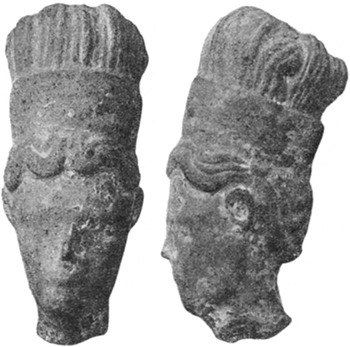
The use of hairpins in the Aegean extends from the early second millennium bc into the Late Bronze Age. Hook-shaped pins were regarded by Blinkenberg (an early authority on Aegean fibulae) and later by Higgins (whose expertise covered the spectrum of Aegean adornment) as the immediate predecessor of the violin-bow fibula – that is, they were thought to be used for fastening clothing (Blinkenberg Reference Blinkenberg1926, 40, fig. 5; Higgins Reference Higgins1980a, 85).Footnote 39 Many scholars, however, are of the opinion that these objects would have been useful in the elaborate Minoan hair arrangements seen in the Neopalatial period.Footnote 40 The Piskokephalo head (Fig. 9) exemplifies this type of raised coiffure (Platon Reference Platon1951, 134–5, pl. H1; Alexiou Reference Alexiou1975, 136 fig. 2; Zervos Reference Zervos1956, figs. 403, 406), one that would have benefitted from the use of pins, although whether these pins served a practical or merely ornamental function is still a topic of contention.Footnote 41
Terracotta head from Piskokephalo. After Holland Reference Holland1929, 189 fig. 6.

In any case, we also believe these objects to be hairpins rather than fasteners for clothing, as the crocus design moulded in high relief on pins such as the one from Mavrospilio would have made them impractical for inserting through fabric, as would the design of the twisted gold hook from Isopata (Evans Reference Evans1906, 151, fig. 129). Furthermore, Minoan garments were primarily of cut-and-sew construction rather than drapery, while outer garments were perhaps too sturdy to have been held in place by such delicate pins. By contrast, if these objects are hairpins, then the raised designs would have served a purpose by helping the pins grip the hair and remain in place. Countless US patents for hairpins using similar technologies exist today.Footnote 42
It has been suggested that the dots above the foreheads of the figures on the gold ring from Isopata (Fig. 10) may actually represent such hairpins in stylised form (Rehak Reference Rehak and Müller2000, 273). The crocus, closely associated with mature women in the Xeste 3 frescoes, appears on this ring as well (Day Reference Day2011, 361).Footnote 43
Gold ring from Isopata. After Platon and Pini Reference Platon and Pini1984, no. 51.

We might also mention the floral hairpins depicted on the gold ring from the Acropolis Tomb at Mycenae, which perhaps more clearly represent some type of hair adornment (Niemeier Reference Niemeier, Hägg and Nordquist1990, 167 fig. 1).Footnote 44 A gold and silver pin from Shaft Grave III, with its head in the form of a woman surrounded by a floral design, supports an association of these pins with women (Hood, S. Reference Hood1978, 200 fig. 199).
As the inscriptions on all four inscribed Minoan hairpins appear to follow no set formula, Rehak has suggested that these objects were ‘not dedicated according to some prescribed ritual but according to personal desire. Their words, therefore, are the closest we may ever get to actual words spoken or thought by Minoan women’ (Rehak Reference Rehak2009, 14).Footnote 45 In agreeing with his interpretation, we would only add that though the hairpins themselves may not have been dedicated according to a ‘prescribed ritual’, the content of their inscriptions may nevertheless be ritual (or at least ritualised) in nature, as the Linear A sequence ja-sa-sa-ra- on hairpin PL Zf 1 is a sequence that elsewhere occurs only on ritual objects.Footnote 46 Thus the inscriptions on at least some of the inscribed jewellery may contain personalised ritual dedications, rather than straightforward statements of origin (‘X made me’), ownership (‘I belong to X’) or interpersonal gift (‘X gives this to Y’).
Rehak has in fact contributed significantly to the literature on engraved hairpins, with particular reference to the Wounded Woman in the fresco at Xeste 3, Akrotiri (Rehak Reference Rehak2009).Footnote 47 The seated female in that fresco is distinguished by her unusual hairpins. She wears one over her forehead that imitates an olive twig with blue and yellow leaves.Footnote 48 Lacking is the usual forelock, and despite a hairpin shaped like a lilyFootnote 49 protruding from the loop of hair at the nape of her neck, a tress of her hair falls free. Rehak (Reference Rehak2009, 13) observes: ‘If the wound is a metaphor for the onset of menstruation, then we can regard the hairpins as pointing out the lack of her forelock, and emphasising the loosening of her hair. She is, therefore, a kore in the etymological sense, having had her hair cut in preparation for marriage.’Footnote 50 In this view, the Wounded Woman, costumed and bejewelled, appears to be the focus of an important event rather than a victim of misfortune. The differences in her hair, adornment and pose indicate that she may have left puberty behind and entered adulthood;Footnote 51 thus the presence of hairpins may be related to a rite of passage: from adolescence to womanhood.
Finally, one further potential meaning of inscribed Minoan jewellery is worth mentioning. By the beginning of the Neopalatial period, Minoan writing was shifting from a primarily bureaucratic role to one more closely associated with religion and palatial elites (Godart Reference Godart1979; Olivier Reference Olivier1986, 379; Schoep Reference Schoep1999, Reference Schoep2001).Footnote 52 From this point onwards, Linear A can be found on increasing numbers of prestige ritual objects, such as stone libation tables and metal double axes (Pope Reference Pope1956; Vermeule Reference Vermeule1959; Godart and Olivier Reference Godart and Olivier1982, 142–3). Inscriptions on many of these objects almost certainly identify the dedicant(s) by name,Footnote 53 thereby broadcasting to the deities (and to the few Minoans who were literate) the dedicants' status through their access both to expensive items and to the esoteric knowledge of scribes. This display of writing on prestige objects in ritual contexts thus may have been playing an important role in developing an association between the elite and the divine (Whittaker Reference Whittaker2005, 29).Footnote 54 The presence of writing on Minoan gold and silver jewelleryFootnote 55 together with features associated with ritualFootnote 56 suggests that these items may also have been expressing such an association, one linking power with religion.
CONCLUSIONS
The fact that inscribed Minoan jewellery is well suited to display indicates a degree of intentionality. The inscription of personal objects created a relationship between the objects and their wearers, enabling the wearers to construct their identities (Verduci Reference Verduci, Golani and Wygnańska2014) not just through what they wore, but how and where they wore it (Meskell and Joyce Reference Meskell and Joyce2003, 226). This relationship between object and wearer created a corresponding relationship between wearer and observer; thus these objects were actively involved in engineering the cognitive and behavioural responses to their own existence (Meskell Reference Meskell, Van Dyke and Alcock2003, 45).
As to the precise motives of the discourse intended by inscribed Minoan jewellery: the eventual decipherment of Linear A may (or may not) help to clarify these motives, but in the meantime, the currently available data do support four tentative conclusions. First: so far, inscribed Minoan jewellery seems to lie mostly outside the purview of men, in that all but one of the inscribed items are hairpins, which (as described earlier) are clearly associated with adult females; thus the inscriptions on these objects, to echo Rehak's earlier suggestion (2009, 14), may very well be the closest thing we have to the voices of Minoan women. By contrast, the Mavrospilio ring cannot be gendered. It may have belonged to a child or to an adult, and it may have been worn either as a finger ring or as an amulet around the wrist or neck; none of these possibilities can be eliminated. Second: these objects were almost certainly used to construct and broadcast the elite identity (and perhaps authority) of the people who wore them. Third: these objects may also have served as apotropaic amulets and/or symbols of rites of passage for their wearers, thus expressing certain rituals (unrelated to literacy) associated with the lives of the people who wore them (Helms Reference Helms1988, 261). Fourth: for the illiterate majority of Minoans, the inscriptions on these objects would have represented access to secret, even mystical knowledge, and to the power that comes from access to such knowledge; thus these objects may have played an active role in linking elite Minoan (and in the case of the hairpins, elite Minoan female) identity and authority to the divine.
ACKNOWLEDGEMENTS
This article is based on a paper given at the Third German–Israeli Foundation symposium (Negotiating Change – Cultural and Social Transformations in the Late 2nd Millennium bce East Mediterranean, 30 September – 1 October, 2013, Nauplio, Greece). The authors are grateful to Prof. Joseph Maran (University of Heidelberg) and Prof. Aren Maeir (Bar-Ilan University, Israel) for sponsoring the symposium and inviting us to participate; Assoc. Prof. Louise Hitchcock (University of Melbourne) and the Australian Research Council (Discovery Project 1093713) for helping to fund our participation; and Prof. John Younger (University of Kansas) for his generous offer to review and comment on the final draft.