INTRODUCTION
There is accumulating evidence that subjects with perinatal exposure to environmental events disturbing neurodevelopment are at increased risk of psychiatric disorders (Murray & Lewis, Reference Murray and Lewis1987; Cannon et al. Reference Cannon, Kendell, Susser, Jones, Murray, Jones, Susser, Van Os and Cannon2003; Verdoux, Reference Verdoux2004). Few studies have investigated the impact of prenatal exposure to synthetic hormones on psychiatric outcome. However, intra-uterine levels of oestrogens affect foetal brain development, particularly cerebral lateralization (Geschwind & Galaburda, Reference Geschwind and Galaburda1985). Synthetic oestrogens (or xeno-oestrogens) have a non-steroidal structure and do not bind to peripheral alpha-foetoprotein, a mechanism preventing entry into the foetal central nervous system; unlike endogenous oestrogens, they do not convert to oestrone, a metabolite of low oestrogenic activity (Schachter, Reference Schachter1994). Hence, high concentrations of active xeno-oestrogens reach the foetal brain with potential deleterious consequences on brain development (Slikker et al. Reference Slikker, Bailey, Newport, Lipe and Hill1982). Animal studies have shown that rodents prenatally exposed to xeno-oestrogens such as diethylstilboestrol (DES) or ethynyloestradiol present with a range of behavioural abnormalities (Porrini et al. Reference Porrini, Belloni, Della Seta, Farabollini, Giannelli and Dessi-Fulgheri2005). Human studies suggest that DES may impact on the neurodevelopmental lateralization process. An excess of left-handedness in women with prenatal exposure to DES has been reported by several studies (Schachter, Reference Schachter1994; Scheirs & Vingerhoets, Reference Scheirs and Vingerhoets1995; Smith & Hines, Reference Smith and Hines2000), although this finding was not supported by others (Titus-Ernstoff et al. Reference Titus-Ernstoff, Perez, Hatch, Troisi, Palmer, Hartge, Hyer, Kaufman, Adam, Strohsnitter, Noller, Pickett and Hoover2003); yet other studies found an excess of left-handedness in men with prenatal exposure to DES (Reinisch & Sanders, Reference Reinisch and Sanders1992; Titus-Ernstoff et al. Reference Titus-Ernstoff, Perez, Hatch, Troisi, Palmer, Hartge, Hyer, Kaufman, Adam, Strohsnitter, Noller, Pickett and Hoover2003).
Considering that abnormal lateralization may be implicated in the pathophysiology of psychiatric disorders (Crow et al. Reference Crow, Done and Sacker1996; Orr et al. Reference Orr, Cannon, Gilvarry, Jones and Murray1999), DES-induced neurodevelopmental disturbances may potentially mediate an increased risk of psychiatric disorders in exposed subjects. Contradictory findings have been reported by previous studies exploring this issue (Vessey et al. Reference Vessey, Fairweather, Norman-Smith and Buckley1983; Meyer-Bahlburg et al. Reference Meyer-Bahlburg, Ehrhardt, Feldman, Rosen, Veridiano and Zimmerman1985; Ehrhardt et al. Reference Ehrhardt, Feldman, Rosen, Meyer-Bahlburg, Gruen, Veridiano, Endicott and Cohen1987; Fried-Cassorla et al. Reference Fried-Cassorla, Scholl, Borow, Strassman and Bowers1987; Gustavson et al. Reference Gustavson, Gustavson, Noller, O'Brien, Melton, Pumariega, Kaufman and Colton1991; Pillard et al. Reference Pillard, Rosen, Meyer-Bahlburg, Weinrich, Feldman, Gruen and Ehrhardt1993; Titus-Ernstoff et al. Reference Titus-Ernstoff, Perez, Hatch, Troisi, Palmer, Hartge, Hyer, Kaufman, Adam, Strohsnitter, Noller, Pickett and Hoover2003).
Although DES is no longer prescribed, its impact on psychiatric outcome should be clarified, considering the numerous subjects prenatally exposed to DES up to the 1970s (around 8000 in UK, more than 150 000 in the Netherlands and in France and nearly 5 million in the USA; Palmlund et al. Reference Palmlund, Apfel, Buitendijk, Cabau and Forsberg1993). Furthermore, because of the persisting risk of prenatal exposure to environmental xeno-oestrogens (Newbold, Reference Newbold2004), DES studies are of value as a model of exposure to these substances. We investigated, in the French prospective cohort Etude Epidemiologique de femmes de la Mutuelle Générale de l'Education Nationale (E3N), whether psychiatric outcome differed between subjects prenatally exposed to DES and their unexposed siblings.
METHOD
Sample
Participants were mothers of a subgroup of the E3N cohort who completed questionnaires about their children for the present study. The E3N was initiated in 1990 to study risk factors for cancer in women (Clavel-Chapelon, Reference Clavel-Chapelon2002; Romieu et al. Reference Romieu, Avenel, Leynaert, Kauffmann and Clavel-Chapelon2003; Fournier et al. Reference Fournier, Berrino, Riboli, Avenel and Clavel-Chapelon2005; Tehard et al. Reference Tehard, Kaaks and Clavel-Chapelon2005). At baseline, the cohort included 97 995 women fulfilling the following inclusion criteria: (i) born between 1925 and 1950; (ii) covered by the national health insurance plan for French teachers (MGEN); and (iii) giving written informed consent to participate in the investigation. Information on a range of medical events is collected using postal questionnaires approximately every 24 months since 1990.
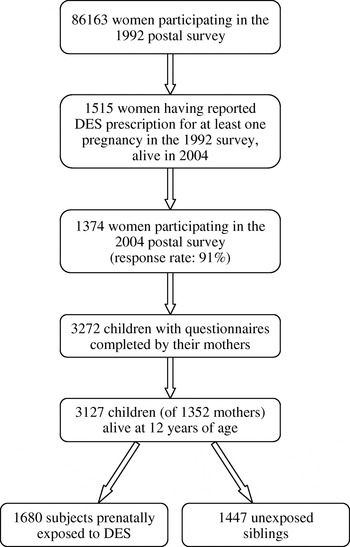
The process for subject selection included in the present study is presented in Fig. 1. Information on hormonal treatments during pregnancy was collected in the 1992 questionnaire sent to the whole cohort and completed by 87·9% of the women included at baseline. From this initial pool, we identified all women still alive who reported giving birth to at least one child exposed to DES in utero. They were sent a postal questionnaire in 2004. The cover letter mentioned only that the aim of the survey was to explore the impact of perinatal events on children's health. The hypothesis addressed in the present study and the fact that women had been selected on the basis of their prior answer to the DES item were not specified.
Selection of the subjects prenatally exposed to DES and their unexposed siblings.

Assessment of prenatal exposure to DES and other hormones
According to the information reported by the mother in the 1992 questionnaire, three variables were derived for each child: prenatal exposure to (i) DES; (ii) progestagen drugs; (iii) other hormones. To facilitate accurate recall, a leaflet with colour photographs of the hormonal treatments marketed in France accompanied the questionnaire. The presence or absence of hormonal treatment was recorded, without further information on motive for prescription, dose, duration or stage of pregnancy.
Assessment of child's outcome
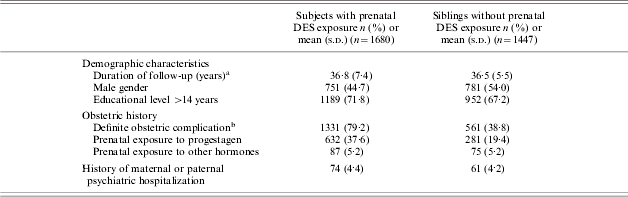
In 2004, the women were asked to complete a questionnaire for each biological child born alive (up to five). Information collected included (i) history of obstetric complications using questions (see Table 1) derived from the Lewis and Murray scale (this scale has been widely used to explore the association between obstetric complications and psychiatric outcome in studies based upon maternal recall; Lewis & Murray, Reference Lewis and Murray1987; Verdoux et al. Reference Verdoux, Geddes, Takei, Lawrie, Bovet, Eagles, Heun, McCreadie, McNeil, O'Callaghan, Stöber, Willinger, Wright and Murray1997); (ii) demographic characteristics, including cause of death; (iii) reproductive status: parity, history of miscarriage and of difficulties to conceive; if the answer was positive to the latter item, the mother was asked to specify if, to her knowledge, these difficulties were attributable to her child, to her partner, or of unknown origin; nulliparity and difficulties to conceive attributable to her child were categorized as ‘infertility strictly defined’, nulliparity and difficulties to conceive not attributable to the child or of unknown origin were categorized as ‘infertility broadly defined’; (iv) lifetime medical history of hospitalization or consultation with specialists, and age at first hospitalization: women were proposed a list of 15 possible reasons for hospitalization (including psychiatric hospitalization) and a similar list of speciality names (including consultation with a psychiatrist or a psychologist). We defined two categories of psychiatric outcome: (i) lifetime history of strictly defined serious psychiatric outcome if the mother reported that her son or daughter committed suicide or had been hospitalized in psychiatry; and (ii) lifetime history of broadly defined serious psychiatric outcome including the previous events or a history of consultation with a psychiatrist or a psychologist.
Characteristics of subjects prenatally exposed to DES and their unexposed siblings

DES, Diethylstilboestrol; s.d., standard deviation.
a Age of the children still alive in 2004, or age at the time of death.
b At least one definite obstetric complication according to the Lewis and Murray scale (Lewis & Murray, Reference Lewis and Murray1987): threatened abortion; antepartum bleeding; severe hypertension requiring hospitalization; caesarean for emergency delivery; breech presentation; premature birth >3 weeks; postmature birth >2 weeks; birthweight <2000 g; incubator used >4 weeks.
In addition, history of hospitalization in the first- and second-degree biological relatives of each child was collected. The above list of medical motives was used. In the present study only information on psychiatric hospitalization was used as a proxy measure of family history of psychiatric disorder. We applied a narrow definition of positive family history of psychiatric disorder, restricted to history of psychiatric hospitalization in the mother or in the biological father.
Statistical methods
We investigated the relationship between exposure to DES and psychiatric outcome overall and after stratification by gender. We also explored the relationship between DES exposure and reproductive status in daughters (history of miscarriage, nulliparity and infertility) to serve as a tool to validate maternal information, as the increased frequency of such events in DES-daughter has been largely documented elsewhere (Kaufman et al. Reference Kaufman, Adam, Hatch, Noller, Herbst, Palmer and Hoover2000). Finally, we performed a sensitivity analysis to check that removing non-significant variables or modifying correlation structure did not modify the other estimates (results available on request).
Characteristics of the exposed and unexposed children were compared statistically using the χ2 test. Multivariate analyses were performed to assess associations between each outcome of interest and exposure to DES, progestagen drugs or other hormones. The models were adjusted for follow-up duration (calculated as the age for children still alive in 2004 or the age at death), sex, educational level (dichotomized as above or below 14 years), history of obstetric complications and family history of psychiatric hospitalization. All variables except follow-up were treated as binary. Because of the large sample size, model selection was unnecessary, thereby limiting the risk of bias. Separate models were generated for strictly and broadly defined serious psychiatric outcomes. All variables included in the models were specified in the analysis plan blind to the data.
To take into account intra-family correlation, a hierarchical two-level logistic model was used (Watier et al. Reference Watier, Richardson and Hemon1997). The child's level was embedded in the family level, making it possible to estimate and to take into account correlation between siblings. An exchangeable correlation structure assuming common correlation among all siblings was used. The generalized estimating equations (GEE) approach provided estimates and 95% confidence intervals (CIs). Adjusted odds ratios (aORs) are reported. All tests were two-tailed. Statistical analyses were performed with SAS version 9.1 (SAS Institute Inc., Cary, NC, USA).
RESULTS
Characteristics of the sample
Numbers of respondents and children included in the study are given in Fig. 1. Few data were missing for most items of the questionnaire, limiting a posteriori loss of power; obstetrical complications variables had the highest frequency of missing data (around 10%) but sensitivity analyses with different imputation strategies led to the same results. The mean age of the mothers was 65 years (s.d.=5·8, range 54–80). Only children alive at 12 years of age and without history of psychiatric hospitalization before age 12 were considered, in order to exclude subjects with severe infancy or childhood psychiatric disorders such as mental retardation or pervasive development disorders, because inclusion of these subjects may have contributed to increase the heterogeneity of the spectrum of disorders considered in the psychiatric outcome. The mean duration of follow-up was 36 years (s.d.=6·4, range 12–57) and was 30 years and over for most (90%) children.
The characteristics of the subjects with prenatal DES exposure and of their unexposed siblings are given in Table 1. Irrespective of exposure status, most subjects had a high educational level. Nearly four out of five children prenatally exposed to DES had a history of definite obstetric complications, the most frequent being threatened abortion (69·7% of DES-exposed subjects; 21·4% of unexposed siblings) and antepartum bleeding (41·8% of DES-exposed subjects; 13·5% of unexposed siblings). Statistical tests indicate that both groups are not significantly different for all characteristics except for sex, progestagen exposure and obstetrical complications. These two latter differences were expected because DES was given to pregnant women with a history of prior complicated pregnancy and was often co-prescribed with progestagens.
Prenatal hormonal exposure and psychiatric outcome
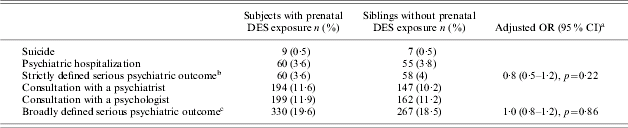
In the overall sample, subjects (n=16) who committed suicide had a median age of 27 years [interquartile range (IQR) 23–31, range 18–43]. The median age at first psychiatric hospitalization was 24 years (IQR 20–32, range 13–47). The comparison of psychiatric outcome according to prenatal DES exposure status is given in Table 2.
Psychiatric outcome of subjects prenatally exposed to DES and their unexposed siblings
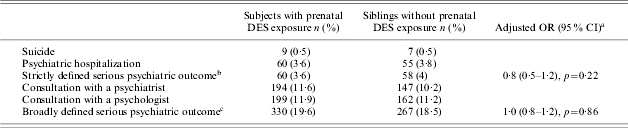
DES, Diethylstilboestrol; OR, odds ratio; CI, confidence interval.
a Adjusted for duration of follow-up, educational level, history of at least one definite obstetric complication according to the Lewis and Murray scale (Lewis & Murray, Reference Lewis and Murray1987) (see Table 1), prenatal exposure to progestagen drugs or other hormones, paternal or maternal history of psychiatric hospitalization.
b Suicide or psychiatric hospitalization.
c Suicide, psychiatric hospitalization or consultation with a psychiatrist or a psychologist.
Subjects prenatally exposed to DES were not at increased risk of presenting with a lifetime history of suicide or psychiatric hospitalization compared to their unexposed siblings. No association was found between prenatal DES exposure and serious psychiatric outcome broadly defined. Similar findings were obtained in analyses stratified by gender: the occurrence of strictly defined serious psychiatric outcome did not differ between women prenatally exposed to DES and their unexposed sisters (aOR 0·8, 95% CI 0·5–1·4, p=0·49) or between men exposed to DES and their unexposed brothers (aOR 0·80, 95% CI 0·37–1·67, p=0·56).
In the model adjusted for DES exposure and other potential confounding factors (see Table 1), no association was found between (i) prenatal exposure to progestagen drugs and serious psychiatric outcome (strictly defined: aOR 1·2, 95% CI 0·8–1·9, p=0·33; broadly defined: aOR 1, 95% CI 0·8–1·2, p=0·99); (ii) prenatal exposure to other hormones and serious psychiatric outcome (strictly defined: aOR 0·8, 95% CI 0·3–1·8, p=0·57; broadly defined: aOR 1·2, 95% CI 0·8–1·7, p=0·41).
Prenatal exposure to hormones and daughters' obstetrical outcome during adulthood
The frequency of nulliparity did not differ between daughters prenatally exposed to DES compared to their unexposed sisters [n=229 (27·1%) v. n=156 (26·6%), aOR 1·1, 95% CI 0·8–1·4, p=0·52]. A history of miscarriage was more frequently reported in daughters prenatally exposed to DES compared to their unexposed sisters [n=189 (22·3%) v. n=97 (16·5%), aOR 1·4, 95% CI 1·1–1·9, p=0·01]. Significant associations were found between prenatal DES exposure and infertility strictly defined [exposed daughters n=79 (9·4%) v. unexposed sisters n=16 (1·7%), aOR 3·4, 95% CI 2·0–6·0, p=0·0001] or infertility broadly defined [exposed daughters n=110 (13·1%) v. unexposed sisters n=42 (7·2%), aOR 2·1, 95% CI 1·4–3·1, p=0·0001]. No association was found between prenatal exposure to progestagen drugs and nulliparity (aOR 1·1, 95% CI 0·8–1·4, p=0·55), history of miscarriage (aOR 0·9, 95% CI 0·7–1·2, p=0·52), and infertility strictly (aOR 1·4, 95% CI 0·9–2·2, p=0·18) or broadly (aOR 1·2, 95% CI 0·8–1·7, p=0·36) defined. No association was found between prenatal exposure to other hormones and nulliparity (aOR 1·0, 95% CI 0·6–1·6, p=0·90), history of miscarriage (aOR 1·1, 95% CI 0·6–2·1, p=0·77), and infertility strictly (aOR 0·6, 95% CI 0·2–1·8, p=0·31) or broadly (aOR 1·1, 95% CI 0·5–2·3, p=0·84) defined.
DISCUSSION
Serious psychiatric outcome did not differ between subjects prenatally exposed to DES and their unexposed siblings. A history of miscarriage and of infertility was more frequent in women prenatally exposed to DES compared to their unexposed sisters.
Strengths and weaknesses
First, memory bias may limit the validity of maternal recall on pregnancy events, particularly medications prescribed during pregnancy. As we have little reason to suspect that this bias differed systematically according to offspring's psychiatric outcome, such a misclassification may have contributed to reduce the strength of the association. However, information on DES exposure was collected 14 years before the present survey, the mothers were not informed about the aim of this study, and their report of DES impact on their daughters' obstetric outcome at adulthood was in accordance with the documented genital consequences of DES (Kaufman et al. Reference Kaufman, Adam, Hatch, Noller, Herbst, Palmer and Hoover2000). Second, mothers may not be fully informed about the psychiatric outcome of their children, such as psychiatric consultation, but it is unlikely that they were not aware of events such as suicide or psychiatric hospitalization, or that they systematically under-reported psychiatric events for DES-exposed subjects compared to their unexposed siblings. However, we cannot exclude a non-systematic misclassification of broadly defined serious psychiatric outcome that may have attenuated the strengths of the associations. Third, mothers and children were not representative of the general population with regard to educational level, but is it unlikely that educational level modifies the neurodevelopmental impact of prenatal DES exposure. Fourth, no information was available on duration, dose and time of DES exposure during pregnancy, which may have attenuated the strength of the association if these characteristics modify the impact of DES exposure on psychiatric outcome. However, such information was no more available in prior studies reporting an association between DES exposure and increased risk of psychiatric disorders.
The major strengths of the study are the high response rate, the large sample size limiting the risk of type II error, and the fact that most offspring had passed beyond the age of peak incidence of major psychiatric disorders. In particular, for a prevalence of psychiatric disorders around 10% and an intra-family correlation between 0% and 50%, the study had a 80% power to detect a non-adjusted OR between 1·3 and 1·1 respectively.
Interpretation of findings
Studies have reported that the prevalence of psychiatric disorders, particularly depression or eating disorders, is increased in women or men prenatally exposed to DES (Vessey et al. Reference Vessey, Fairweather, Norman-Smith and Buckley1983; Meyer-Bahlburg et al. Reference Meyer-Bahlburg, Ehrhardt, Feldman, Rosen, Veridiano and Zimmerman1985; Gustavson et al. Reference Gustavson, Gustavson, Noller, O'Brien, Melton, Pumariega, Kaufman and Colton1991; Pillard et al. Reference Pillard, Rosen, Meyer-Bahlburg, Weinrich, Feldman, Gruen and Ehrhardt1993). Most of these studies were hampered by selection biases, the sampling procedure selecting, for example, women recruited in DES specialized centres or members of users' associations (Verdoux, Reference Verdoux2002). The only exception was the study by Vessey (Reference Vessey, Fairweather, Norman-Smith and Buckley1983) using data from a randomized controlled trial performed in the 1950s comparing DES to placebo in 1000 women. Information on the medical outcome of their 660 children was provided in 1977–1982 by their general practitioners (GPs) blind to the exposure status. Subjects prenatally exposed to DES were twice as likely to present with psychiatric disorders, mostly anxiety and depression, compared to their unexposed siblings. Other studies did not report such an association (Ehrhardt et al. Reference Ehrhardt, Feldman, Rosen, Meyer-Bahlburg, Gruen, Veridiano, Endicott and Cohen1987; Fried-Cassorla et al. Reference Fried-Cassorla, Scholl, Borow, Strassman and Bowers1987; Titus-Ernstoff et al. Reference Titus-Ernstoff, Perez, Hatch, Troisi, Palmer, Hartge, Hyer, Kaufman, Adam, Strohsnitter, Noller, Pickett and Hoover2003). The discrepancy between our findings and those of previous studies showing an excess of psychiatric disorders in subjects prenatally exposed to DES may be explained by the selection biases present in most prior studies. As psychiatric outcome was restricted in the present study to suicide or treatment by mental health professionals, we did not consider most common mental disorders treated at a primary care level, which may explain the difference between our findings and those reported in the study by Vessey et al. (Reference Vessey, Fairweather, Norman-Smith and Buckley1983).
Compared to prior studies carried out in selected populations or those that did not differentiate psychiatric outcome according to severity level or need for care, the major contribution of the present study is to provide strong evidence that prenatal exposure to DES is not associated with an increased risk of major psychiatric disorder requiring hospitalization or at least consultation with a mental health specialist. Our findings suggest that prenatal DES exposure is unlikely to have a major impact on the development of foetal brain structures implicated in the pathophysiology of serious psychiatric disorders. Nevertheless, this reassuring finding should not obscure the fact that DES-exposed subjects, particularly DES daughters, too often have to cope daily with the psychological distress induced by cancer or the consequences of genital malformations (infertility, foetal loss), and have to be provided with adequate psychological support.
ACKNOWLEDGEMENTS
We are grateful to the users' association Union Nationale des Amis et Familles de Malades Psychiques (UNAFAM) for supporting the study logistically. We thank the French League against Cancer, the European Community, the 3M Company, the Mutuelle Générale de l'Education Nationale, and the French Drugs Regulatory Agency (Agence Française de Sécurité Sanitaire des Produits de Santé) for supporting the E3N study financially. We thank LyAn Hoang for collecting the data and for managing the database and Ray Cooke for supervising the English of this manuscript. We acknowledge the reviewers of a prior version of the manuscript for their thoughtful comments.
DECLARATION OF INTEREST
None.