


Traditionally, discussions of liberal-egalitarian socioeconomic justice have been confined to domestic political communities.Footnote 1 Concerns about agents’ relative shares of wealth, opportunities, and economic and bargaining power used to arise within societies, not across them. This is no longer the case. In an increasingly globalized world, which is marked by poverty, destitution, and steep inequalities across societies and individuals, the question of whether liberal-egalitarian socioeconomic justice (also “socioeconomic justice” for brevity) should extend from the domestic context to the world at large has gained tremendous urgency, and sparked a lively debate among liberal political theorists.
Two main positions have emerged from this debate. The literature is divided between so-called statists, who think principles of egalitarian socioeconomic justice apply domestically but not internationally, and cosmopolitans, who seek to extend these principles to the world at large. Statists envisage a world of independent and just states, which observe rules of mutual respect and noninterference toward one another, and of justified intervention and assistance toward unjust or disadvantaged societies. Cosmopolitans envisage a world of integrated and highly interdependent communities, whose mutual relations are regulated by principles of socioeconomic justice placing limits on global inequalities.Footnote 2 The former think that, beyond state borders, we should only worry about absolute deprivation, whereas the latter believe that we should also worry about global relative deprivation.
This debate is not only of immediate practical relevance, but also of great theoretical interest. To adjudicate between these two positions, and offer a systematic answer to the question of global socioeconomic justice, we need to gain a clear understanding of what distinguishes principles of socioeconomic justice from other types of moral concern. Not every action or social phenomenon is an appropriate object of assessment from the perspective of socioeconomic justice. It might be morally objectionable for a student not to do his or her homework, but it is certainly not socioeconomically unjust. Socioeconomic justice only represents a subset of the realm of morality. This is why we need to ask: What is the function of principles of socioeconomic justice? Under what conditions, in the presence of what social phenomena, do they apply? Once we know what their function and conditions of application are, we can also establish whether they should apply globally, depending on whether the relevant conditions exist at the global level.
My aim in the present article is to answer this question by reviving, and further developing, a particular interpretation of liberal political morality. On this interpretation, which I call the “coercion view,” the function of principles of socioeconomic justice is to justify state coercion by making it compatible with each citizen's freedom. If the state coerces its citizens in accordance with these principles, so the argument goes, it grants them equal spheres of agency in which they can pursue their ends and goals, and the state's coercive power then counts as morally legitimate. Following this reasoning, principles of socioeconomic justice apply to the global realm only if the relevant forms of coercion exist globally. I argue that the coercion view allows us to develop a plausible and systematic liberal approach to global justice, accommodating both statist and cosmopolitan concerns.
In the first section, I outline and defend the particular liberal perspective from which I develop my argument. I show that a focus on freedom and coercion is central to liberal thinking in general, and implicitly underpins some important contemporary work in liberal political theory. Next, I consider what implications the coercion view is usually thought to have for global socioeconomic justice. I argue that the statist conclusions drawn by contemporary supporters of this view, such as Thomas Nagel (Reference Nagel2005) and Michael Blake (Reference Blake2001), are misguided. Instead of taking this as a sign that the coercion view needs to be abandoned, however, I suggest that it should be re-elaborated. In particular, the notion of coercion employed by contemporary liberals is too narrow to capture the constraints on freedom that need to be justified. In the third and fourth sections, I then develop a new, more general account of coercion, based on a distinction between “interactional” and “systemic” coercion. The former is coercion exercised by an agent (collective or individual), the latter coercion exercised through a system of rules supported by a large enough number of agents. On my revised version of the “coercion view,” what types of moral principles apply beyond borders depends on what forms of coercion exist in the international realm. In the final section, I show that this conceptual scheme allows us to recast the main positions in the global-justice debate, and provides a common conceptual core for talk of justice beyond borders. We can think of statist principles as justifying interactional coercion between states, and of cosmopolitan ones as justifying global systemic coercion. Because the world at large exhibits systemic as well as interactional coercion, I conclude that a plausible theory of global justice should include principles evaluating the justifiability (or lack thereof) of both.
This article's contributions are threefold. First, the article develops a new, more nuanced account of coercion, which does a better job at capturing what is normatively problematic about coercive acts, from a liberal perspective, than rival views in the literature. Second, by showing how considerations of socioeconomic justice, noninterference, and justified intervention all stem from a concern with the justification of coercion, the framework offered gives unified conceptual grounds on which to talk of justice at the international level. Third, although mainly conceptual, my argument has some substantive implications. In particular, it shows that there is merit to the concerns of both statists and cosmopolitans, thereby directing us toward a more conciliatory approach to global justice.Footnote 3 Finally, as is evident from this introduction, this article is situated within contemporary liberal political theory. Other approaches are certainly possible, but they are not the topic of the present article.
BACKGROUND: LIBERALISM, COERCION, AND JUSTICE
Like any complex political ideology, liberalism comprises a variety of views. What brings them together is (arguably) a shared concern with people's freedom, namely with their enjoyment of the necessary social conditions to lead autonomous lives, pursuing their chosen ends and goals. Because of this commitment to individual freedom, liberals tend to be suspicious of all forms of coercion. When an agent is coerced, his or her freedom is constrained: he or she does not act on his or her own will, but is a mere instrument of the will of another.
Although liberals regard coercion as prima facie morally problematic, they do not consider all forms of coercion morally unacceptable. Most importantly, unlike anarchists, liberals are not opposed to state coercion as such.Footnote 4 Even though state coercion may threaten freedom, it is also necessary for it. In a completely anarchical scenario, without stable coordination mechanisms, a system of law securing access to resources, and effective enforcement procedures ensuring compliance, leading an autonomous life is virtually impossible.Footnote 5
That said, liberals consider state coercion a sine qua non of an autonomous life and thereby legitimate only under strict conditions. Not all exercises of state coercion protect individual freedom. Despotic states can hardly be seen as providing their citizens with the necessary social conditions to lead autonomous lives. Similarly, hierarchical political communities, such as caste societies, protect the freedom of some—those at the top of the hierarchy—at the expense of others. Such exercises of state coercion are morally unacceptable from a liberal perspective. In particular, for liberals, state coercion is justified only insofar as it equally protects the freedom of all citizens. To meet this requirement and show equal respect for the freedom of all, a state must act according to principles of justice. On this view, then, the function of principles of justice is to place limits on legitimate state coercion.
In contemporary liberal political theory, principles of justice typically comprise two sets of guarantees: civil-political and socioeconomic (cf. Rawls Reference Rawls1999a). The first set includes rights to bodily integrity, voting, free speech, free movement, and freedom of religion and association; the second ensures that each citizen possesses the necessary resources and standing within society to pursue his or her ends and goals without being constantly dependent on others. Both sets of guarantees are necessary to lead autonomous lives. It is hard to pursue one's ends and goals without enjoying freedom of movement, speech, or religion, just as one cannot fulfill one's plans of life without suitable material resources. Absolute as well as relative deprivation places great constraints on freedom (see Cohen Reference Cohen and Miller1991; Waldron Reference Waldron1991). The former prevents individuals from satisfying their basic needs; the latter makes them vulnerable to domination by those who command more resources and have the power to shape others’ opportunities. In short, from this liberal perspective, the function of principles of justice in general, and of socioeconomic justice in particular, is to place limits on legitimate state coercion.
This account of the function of justice has important predecessors in the history of liberal political philosophy. The most prominent advocate of the view is probably Immanuel Kant ([Reference Kant1797] 1965), who defines principles of justice (Right) as those that can be legitimately enforced by law and whose purpose is to prevent individuals from violating one another's freedom.Footnote 6 Unlike other moral principles, principles of justice concern what we can be socially forced to do for the sake of freedom itself.Footnote 7 The link between justice and coercion is also present in contemporary liberalism. John Rawls's liberal-egalitarian account of justice may plausibly be interpreted as driven by a concern with the justification of coercive state power. As Rawls (Reference Rawls2001, 40–41) puts it, the question addressed by his theory is, ‘[I]n the light of what reasons and values—of what kind of conception of justice—can citizens legitimately exercise [. . .] coercive power over one another?”Footnote 8 This interpretation of the Rawlsian-liberal enterprise has been further defended by theorists such as Michael Blake (Reference Blake2001), Richard Miller (Reference Miller1998), and Thomas Nagel (Reference Nagel2005), who all see state coercion as the trigger of egalitarian socioeconomic justice.
Even though the coercion view can boast illustrious advocates, it is not the only contemporary liberal account of the function of socioeconomic justice. Another popular account, also traceable to Rawls, sees principles of socioeconomic justice as expressing an ideal of reciprocity among people involved in a joint scheme of cooperation (Sangiovanni Reference Sangiovanni2007), so that cooperation, rather than coercion, triggers demands for socioeconomic justice. Although this “cooperation view” has some merits, I set it aside here and concentrate on the coercion view, for two reasons.
First, a focus on the need to justify coercion is particularly in line with liberals’ commitment to equal respect for individual freedom. If the aim is to develop a liberal account of justice, the ideas of freedom and coercion seem to be closer to liberalism's central concerns than those of reciprocity and cooperation. A liberal view explaining the value of justice entirely in terms of the need to protect freedom has the advantage of being more parsimonious, and straightforwardly liberal, than one that also refers to additional values, such as reciprocity.
Second, if successful, the coercion view enables us to bring together two seemingly different domains of discussion of justice within the international realm. The literature on international justice is divided between discussions of justified intervention (and just war) on one hand, and discussions of global socioeconomic justice on the other. Yet it is unclear why these two discourses both belong to the conceptual domain of justice. (Nardin Reference Nardin2006). Theories of justified intervention obviously deal with the justified use of coercion across borders, but what about socioeconomic justice? If we can explain principles of global socioeconomic justice by appeal to the need to justify coercion, we are able to offer a unified and systematic account of the function of justice in its various ramifications, both domestically and internationally. Such parsimony and systematicity can clearly be seen as virtues in any account of justice.
JUSTICE, COERCION, AND THE INTERNATIONAL REALM
As already mentioned, cosmopolitans and statists give opposite answers to the question of whether principles of egalitarian socioeconomic justice apply at the global level: the former answer in the affirmative, the latter in the negative.Footnote 9 Existing advocates of the coercion view are firmly located in the statist camp.Footnote 10 Rawls (Reference Rawls1999b) famously denies the applicability of egalitarian socioeconomic justice to the global arena, and defends only international duties of mutual respect and noninterference between just societies, and of justified intervention and assistance toward unjust or poor ones. In his view, an ongoing concern with relative deprivation is out of place at the international level.Footnote 11 Similarly, Michael Blake (Reference Blake2001, 258) argues that “a concern with relative economic shares . . . is a plausible interpretation of liberal principles only when those principles are applied to individuals who share liability to the coercive network of state governance [emphasis added].” Finally, Thomas Nagel (Reference Nagel2005, 128) thinks that socioeconomic inequalities matter only domestically because “[w]hat is objectionable is that we should be fellow participants in a collective enterprise of coercively imposed legal and political institutions which generates such . . . inequalities.” For Nagel (Reference Nagel2005, 115), the possibility of liberal-egalitarian justice depends on the presence of “law backed up by a monopoly of force.” Because coercive state law does not exist globally, Nagel concludes that our international distributive obligations do not go beyond humanitarian assistance.
In summary, contemporary advocates of the coercion view claim that, because nothing like domestic state coercion exists globally, a concern with persons’ equal rights to freedom does not demand principles of egalitarian socioeconomic justice at the global level. To respect individuals’ equal rights to freedom, ideally, each state should be internally just or well ordered, and states should refrain from interfering in one another's affairs. To be sure, internationally, there is border coercion against foreigners, but advocates of the coercion view insist that border control involves a different type of coercion than domestic state coercion, and thus requires a different type of justification (Blake Reference Blake2001, 280 n. 30; Nagel Reference Nagel2005).Footnote 12 Through the coercive apparatus of their state, fellow citizens are made collectively responsible for one another's fate in a way that foreigners are not. Each society develops its own habits and culture and chooses the extent to which it pursues economic growth. In these circumstances, so proponents of the coercion view argue, ongoing egalitarian redistribution across societies would undermine those values of freedom and self-determination that liberals wish to protect (see Rawls Reference Rawls1999b, 117–18; Blake Reference Blake2001, 289–94). So long as societies are willing to assist one another in moments of need, thus making sure that none has to endure absolute deprivation, forms of international coercion such as border coercion are justified. This, they argue, strikes the right balance between self-determination and sensitivity to the needs (hence also the freedom) of others.
Is this a sensible view? Its plausibility depends on whether we can think of states as largely separate and self-sufficient entities. Today, the picture of a system of independent societies, free to pursue their own policies and goals, is unrealistic. In an increasingly globalized world, what happens in one community depends, to a significant extent, on what happens in other societies—because of externalities—and at the international level—because of rules set by international institutions.
Consider agricultural subsidies sustaining local farmers in Europe and the United States. These affect the opportunities, and livelihoods, of farmers and producers in developing countries (Pevnick Reference Pevnick2008, 407). Or consider international tax competition. To attract investments and capital, governments are “forced” to lower their tax rates, thereby undermining their ability to secure socioeconomic justice at home (Ronzoni Reference Ronzoni2009). Moreover, as Joseph Stiglitz (Reference Stiglitz and Weinstein2005, 231) points out, “with globalization comes [sic] new rules, often imposed by industrialized countries, that can strip countries of the economic tools they could previously use to manage economic crises.” Frequently cited examples are IMF conditions on loans and WTO trade regulations (see Moellendorf Reference Moellendorf2005). The more firmly countries have to conform to these rules, the more they lack the ability independently to regulate their own economies. Under these circumstances, we cannot assume that each state is uniquely responsible for securing domestic social justice. States’ ability to do so clearly depends on what happens beyond their borders.
The current level of international interdependence would seem to generate precisely those concerns about distributive shares, equal opportunities, and economic and bargaining power with which we are so familiar at the domestic level. A just world, in which each state can provide its citizens with the necessary conditions for leading autonomous lives, is one in which (i) interdependence is effectively regulated to avoid negative externalities and (ii) the rules adopted to regulate it are fairly designed, giving each country roughly equal opportunities and bargaining power. Only then can the freedom of all be guaranteed.
Even though this conclusion naturally follows from a liberal concern with the freedom of all, it is not available to proponents of the coercion view: in fact, none of them defend it. For them, global interdependence falls outside the scope of socioeconomic justice, presumably because its impact on freedom does not have an obvious state-like coercive nature. Externalities are unfortunate, in this picture, but not coercive. Europe and the United States are not threatening sanctions against farmers in developing countries; they are simply supporting their own agricultural industries. Societies’ decisions about tax policies in the presence of high capital mobility are not accompanied by commands backed by the threat of sanctions directed against foreigners. Even international institutions such as the WTO and the IMF are not coercive in the way the state is: instead of being imposed on their members (i.e., states), they are created, and voluntarily joined, by them (Nagel Reference Nagel2005).
One could therefore easily conclude that the coercion view fails on its own terms. Although it is animated by a concern with persons’ equal rights to freedom, it is unable to detect and place under justice-based assessment a vast number of constraints on freedom simply because they are not coercive in the way the state is (cf. Risse Reference Risse2006). Does this mean that the coercion view should be abandoned? I argue that, instead of being abandoned, it must be revised.
Contemporary accounts of the coercion view suffer from what might be called a fetishism of state coercion. They mistakenly consider state coercion as the sole trigger of the problem of justice, when in fact it is often part of its solution.Footnote 13 This mistake was not made by earlier liberal social-contract theorists. In their views, a group agent with the capacity to issue commands backed by the threat of sanctions was necessary to put an end to the “lawless” coercion occurring in the state of nature, which threatened to undermine individual freedom. As Kant said, “If you are so situated as to be unavoidably side by side with others, you ought to abandon the state of nature and enter, with all others, a juridical state of affairs, that is, a state of distributive legal justice” (Kant [Reference Kant1797] 1965, 71). The problem of justice, then, does not arise only in the presence of state coercion. The constraints on freedom that individuals place on one another under conditions of interaction and interdependence prior to the existence of the state also stand in need of justification. What is more, they can only be justified by creating justly governed state-like authorities (cf. Kant [Reference Kant1797] 1965; Young Reference Young2004, Reference Young2006; Ronzoni Reference Ronzoni2009). This is precisely why liberals, unlike anarchists, believe that state coercion is in principle justifiable, i.e., because it is necessary for persons’ freedom itself.
In light of this, if we want to offer a plausible account of the function and conditions of applicability of justice, we must turn to these more diffuse and less formal types of coercion.
TOWARD A NEW ACCOUNT OF COERCION
To describe these types of coercion, I start by defining the kind of coercion exercised by the state, which I call “narrow coercion,” and then generalize it.Footnote 14
Narrow Coercion. An agent A coerces another agent B if A intentionally forces B to do, or to refrain from doing, X through a command backed by the threat of sanctions.
On this account, the state plays the role of the coercer (A), its citizens (or foreigners) that of the coercees (B), and sanctions administered by public officials constitute the means through which the state intentionally restricts persons’ freedom. The state thus coerces individuals just as a gunman coerces his victims. The structure of coercion remains the same across the two cases; only its content changes. Whereas the gunman targets innocent bystanders, threatening, “Give me your money, or otherwise I'll kill you,” the state targets potential law-breakers, threatening, “Do not break the law, or otherwise I'll punish you.”Footnote 15
This definition of coercion is “narrow” in two respects: in its specification of how the coercer restricts the coercees’ freedom (through intentional commands backed by the threat of sanctions), and in its implicit understanding of who—i.e., what sort of entity—can play the role of the coercer (i.e., an agent, be it collective or individual). In what follows, I suggest that by relaxing each of these conditions, we obtain a more general account of coercion, which captures all the constraints on freedom that ought to be recognized, from a liberal perspective, as needing justification. I distinguish between interactional and systemic coercion, and argue that these two companion notions constitute the basis for a compelling outlook on the function and conditions of applicability of justice.Footnote 16
The account of coercion to be offered is not primarily intended to capture our ordinary intuitions about coercion, or our ordinary language use. Instead, its primary aim is to express the function, and conditions of applicability, of justice. I use the label “coercion” because my definitions stem from a generalization of what I have called the narrow (and familiar) account of coercion. On the view to be developed, we can think of “coercion” as encompassing a broad family of actions that place potentially problematic constraints on freedom. We can then qualify different types of coercion differently (e.g., as narrow, interactional, systemic) depending on the specific features of the actions in question.
This broader understanding of coercion seems legitimate because the notion of coercion is what philosophers call an “essentially contested concept” (Gallie Reference Gallie1956), namely a concept subject to ongoing controversy, for which we can identify a common core (e.g., the restriction of freedom), but for which there exist a variety of competing specifications. Some, for example, believe that only threats can be coercive, others that offers can also be coercive (e.g., O'Neill Reference O'Neill, Frey and Morris1991; Zimmerman Reference Zimmerman1981). Some argue that coercion can only occur when the will of the coercee is involved, i.e., when it is ultimately up to the coercee to decide whether to comply with the coercive command or not (e.g., Nozick Reference Nozick, Morgenbesser, Suppes and White1969), others that coercion also exists in the presence of sheer brute force, when the coercee has no choice (e.g., Lamond Reference Lamond2000). Some believe that bargaining between agents with unequal power involves coercion (e.g., McGregor Reference McGregor1988–89), others deny this, and so forth (see Anderson Reference Anderson and Zalta2006 for discussion of these different positions). Given the contested nature of the notion of coercion, new proposals or definition schemes cannot simply be dismissed by appeal to orthodoxy in usage. By suggesting that we think of coercion as including a family of potentially problematic freedom-restricting actions, my definition scheme is loyal to the complexity of the notion of coercion, and perhaps even helpful in solving such definitional controversies.
GENERALIZING COERCION I: INTERACTIONAL COERCION
As noted, coercive acts are often identified by how they undermine persons’ autonomy: through the intentional threat of sanctions. Although this is a common way of defining coercion (see, e.g., Anderson Reference Anderson and Zalta2006; Nozick Reference Nozick, Morgenbesser, Suppes and White1969; Wertheimer Reference Wertheimer1987), it is not the only one. An alternative account of coercion can be drawn from Kant's political philosophy, where coercion is understood, more broadly, as a hindrance to freedom (Kant [Reference Kant1797] 1965, 30). This alternative view of coercion is both independently plausible, and better suited as an account of what triggers concerns of justice than the narrow account.
Coercion is normatively significant because it involves problematic restrictions of freedom that require justification. There is no obvious reason, however,why restrictions of freedom perpetrated through explicit threats should be any more prima facie problematic than restrictions perpetrated via other means. The set of necessary social conditions for setting and pursuing ends for myself, i.e., my freedom, can be compromised not only when I am forced to perform certain actions on pain of sanctions, but also when I am robbed of my possessionsFootnote 17 or am subject to physical compulsion (cf. Ripstein Reference Ripstein2004, 8ff.). From a liberal perspective, there seems to be no reason why the first type of freedom restriction should call for any more justification than those others.
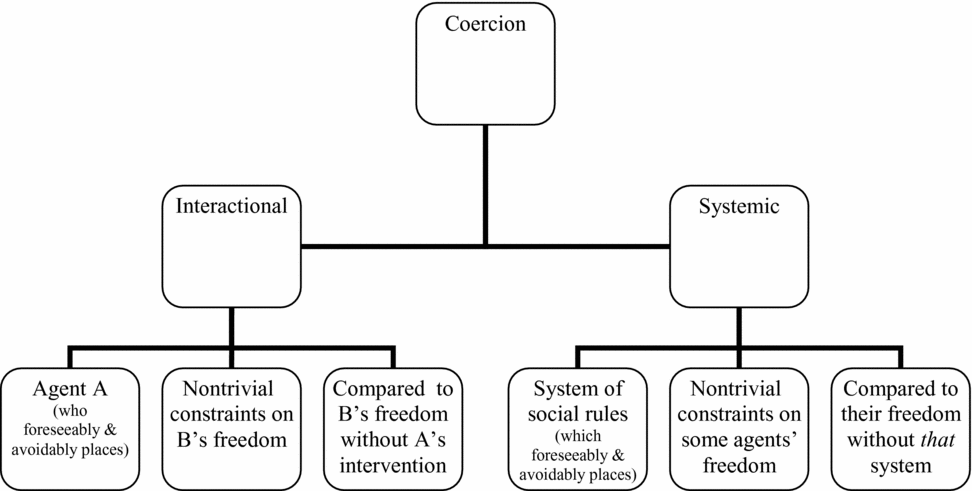
More generally, if coercive acts are those that call for special justification due to their freedom-restricting nature, then the notion of coercion should be to a large extent insensitive to how A restricts B's freedom. All that coercion requires is (i) a responsible agent and (ii) nontrivial constraints on someone else's freedom, (iii) compared to a suitable baseline. Given these three conditions, we can define coercion between two agents—what I call “interactional coercion”—as follows.
Interactional Coercion. An agent A coerces another agent B if A foreseeably and avoidably places nontrivial constraints on B's freedom, compared to B's freedom in the absence of A's intervention (other things being equal).
This definition of coercion generalizes the narrow definition of coercion outlined above. Although all occurrences of coercion under the earlier definition also count as occurrences of coercion under this newly developed one, the reverse is not the case. This is because, unlike narrow coercion, interactional coercion does not focus only on those restrictions of freedom that are intentionally brought about through the threat of sanctions. In the interactional account of coercion, the intentionality condition is replaced with the weaker condition of foreseeability (and avoidability). Although it is true that in order to intend something I must also foresee it, the opposite is not the case. Many actions may have many foreseeable consequences I do not intend. Similarly, threats of sanctions are only one possible source of constraints on freedom. To be sure, a gunman threatening to kill you unless you act as he commands restricts your freedom. But so does someone who physically forces you to do certain things (without threatening sanctions), or who prevents you from accessing certain material resources. For instance, if A threatens to injure B unless B hands over his or her wallet, A can be said to coerce B on both the narrow and the interactional account. However, if A secretly deprives B of valuable material resources in his or her possession, A can be said to coerce B only on the interactional account, and not on the narrow one.
To gain a clearer sense of what actions would count as coercive under the interactional account, we need to specify its component parts or parameters: “a responsible agent,” “nontrivial constraints on freedom,” and “a suitable baseline.” Let us consider each of them in turn.
A Responsible Agent. The first component of my definition—i.e., a responsible agent—is necessary for acts of coercion to stand as possible objects of moral appraisal, that is, as objects of justification. The sense of responsibility I am referring to here is often called “responsibility as attributability” (Scanlon Reference Scanlon1998, chap. 6, and Miller Reference Miller1983, 72). To say that someone is responsible in this sense is to say that “for a given action . . . it is appropriate to take it as a basis of moral appraisal of that person” (Scanlon Reference Scanlon1998, 248).
What counts as coercive thus depends on what we can plausibly hold people responsible (i.e., accountable) for. In principle, someone is accountable for the consequences of his or her actions so long as they are both foreseeable and avoidable (see Pogge Reference Pogge2002). The existence-conditions of responsibility posited here—i.e., foreseeability and avoidability—are weaker than intentionality with respect to the consequences of those actions, but stronger than causal responsibility. What we require is for coercers to have a reasonable degree of control and foresight over the consequences in question, but not necessarily to intend them.
Merely contributing to the causal chain of events that results in a restriction of a person's freedom does not count as coercion. If I leave my house and lock the door, not knowing that my flatmate has forgotten her keys, I cannot be accused of coercing her. Although she is not free to get in, this is a consequence of my action that I could not have reasonably foreseen (cf. Miller Reference Miller1983, 70–71).Footnote 18 By the same token, if I slip on an icy road despite taking all due precautions and injure someone who is walking next to me, I cannot be said to coerce him or her. Since I had no control over my body while slipping, I could not have avoided hitting him or her.
Now consider another scenario. Mark, the CEO of a big company fires half of his employees. Because this will lead to a foreseeable and avoidable curtailment of their freedom, the action of the CEO does count as coercive, and his conduct stands in need of justification. Although I owe my flatmate no explanation for why I left the house, the CEO owes his employees an explanation for why he has fired them. Of course, the CEO might have had good reasons for doing so, in which case his action would turn out to be justified. For instance, the employees may have breached the terms of their employment contract and secretly tried to sabotage their firm. Or the economy might have taken a bad turn, forcing the CEO to cut costs and dismiss many employees. Assuming no other cost-cutting measures were available, the CEO's actions seem justified. If he had done nothing, the company would have gone bankrupt, leaving twice as many people unemployed. But whether or not the CEO's actions are justified, given their coercive nature, they stand in need of justification.
Nontrivial Constraints on Freedom. Freedom is a widely debated concept in political philosophy. Although scholars disagree about the appropriate definition of this concept, one task that any plausible account of political freedom must fulfill is capturing the social conditions for a person to lead an autonomous life. Liberals care so much about freedom because it is a necessary condition for autonomy. The notion of freedom so understood can be further spelled out in different ways: for instance, in terms of noninterference with one's options, or in terms of nondomination,Footnote 19 just to mention two prominent accounts (see Miller Reference Miller1991). All of these accounts of freedom can be seen as expressing necessary conditions for people to lead autonomous lives. Lack of opportunities, continued interference in one's affairs, and domination clearly undermine autonomy.
That said, because my aim is only to offer a general definition scheme, I take no stand on which account of freedom we should endorse. Instead, I limit myself to observing that, in many (but not all) cases, our judgments about freedom and unfreedom—and hence about coercion—will converge regardless of the particular conception of freedom we employ. So long as there is convergence with respect to the judgments about global justice I make at the end of the article, there is no point in reducing the generality of my definition scheme by endorsing a specific conception of freedom.
Let me now turn to the nontriviality condition. Not every restriction of freedom counts as coercive. When evaluating whether an action is coercive, we should set aside trivial restrictions of freedom (cf. Miller Reference Miller1983, 76). What counts as trivial is bound to be, to some extent, a matter of debate, but we can again be confident that people's judgments will often converge. For instance, if A and B are both having their tea break and A eats the last remaining biscuit on the table, he or she thereby foreseeably and avoidably deprives B of the opportunity to eat it. Although there is a sense in which A restricts B's freedom, this restriction is so trivial that it should not count as coercive: it can hardly be said to undermine B's autonomy.Footnote 20 Of course, things would be different if A acted to restrict B's access to food, shelter, education, or health care. In that case, A would certainly restrict B's freedom nontrivially, thereby perpetrating an act of coercion. But acts that, by any reasonable standard, only trivially restrict someone's freedom should not count as coercive in the sense we are interested in here.
A Suitable Baseline. Finally, we need to specify the baseline against which to evaluate whether someone's freedom has been restricted. Such a baseline can be of two kinds: either moralized or nonmoralized (Anderson Reference Anderson and Zalta2006). On a nonmoralized account, the benchmark with respect to which we establish whether there is a restriction of freedom is the expected course of events in the absence of A's (the putative coercer's) intervention. On a moralized account, such a benchmark is the “morally expected” course of events: the course of events that would obtain in a just state of affairs. Which sort of baseline should we opt for? If coercion is to serve as a plausible criterion for the applicability of justice, we should opt for a nonmoralized baseline—i.e., “the absence of A's intervention.” Otherwise, we could no longer say that coercion stands in need of justification. Instead, we would have to say that coercion is always unjust, and conclude that many acts of what normally qualifies as justified coercion are not coercive at all. So, for instance, on a moralized account of the baseline, a criminal who is sent to jail for a good reason would not be subject to coercion. If putting the criminal in prison is what justice requires, then the restriction of his or her freedom following from imprisonment cannot be regarded as coercive. This will strike many as implausible, and suggests that, in establishing whether coercion has occurred, we should adopt a nonmoralized baseline.
To recapitulate, (i), (ii), and (iii) are the key components of the notion of interactional coercion. As I have shown, this definition substantially generalizes the narrow definition. But it still does not do so enough. Up to now, our account of coercion implicitly assumes that the coercer (A) can only be a morally responsible agent. But this condition is too restrictive because it fails to capture some of the constraints that are most relevant to the question of socioeconomic justice.
To see this, let us return to the CEO example and focus on the employees’ situation after being made redundant following an economic downturn. Assume, for the sake of argument, that they do not benefit from unemployment insurance or public assistance of some other kind. As a result, they have hardly enough to feed their families and are virtually forced to accept any job offer that comes their way, no matter how inequitable it is. This situation is certainly bad, but the CEO did not behave unjustly. As previously noted, the survival of the firm depended on adopting drastic cost-cutting measures, and letting off a large portion of the employees was the only available option.
From a liberal point of view, however, there is still something prima facie problematic with society if citizens’ freedom is completely at the mercy of free market processes. Although unconstrained capitalism appears systematically freedom-threatening, the perspective of interactional coercion does not allow us to detect such restrictions of freedom as standing in need of justification, because they are not perpetrated by a single agent. Indeed, “the market” hardly qualifies as one. In light of this, we need to broaden our notion of coercion further. This time, instead of focusing on how coercion is performed, we focus on who, or rather, what can be coercive.
GENERALIZING COERCION II: SYSTEMIC COERCION
Depending on the nature of the coercer, coercion can be either interactional or systemic. So far, we have discussed interactional coercion, assuming A to be an individual or a group agent. I now turn to the case of systemic coercion, that is, the sort of coercion exercised through a system of formal and/or informal rules, enacted by a sufficient number of agents. On this account, coercion is defined as follows.
Systemic coercion: A system of rules S is coercive if it foreseeably and avoidably places nontrivial constraints on some agents’ freedom, compared to their freedom in the absence of that system.
Once again, let me analyze the components of this definition in turn.
A System of Rules. By a system of rules (S) I indicate a broad set of phenomena, including formal institutions, informal social practices, stable patterns of interaction, or a combination of these. For instance, complex organizations such as universities and hospitals can be described as systems of rules, but so can more informal social structures, such as families or markets, which typically combine formal legal regulations, informal social conventions, and regular patterns of interaction. In short, rules may be either formal or informal, they may be officially established or spontaneously emerge from repeated practice, but so long as agents’ behavior follows a recognizably rule-governed pattern, a system of rules can be said to exist.
Although systems of rules can be either formal or informal, it is crucial to recognize that some of them are underpinned by such a complex organizational structure that they give rise to agents in their own right: group agents (List and Pettit Reference List and Pettit2011). The notion of a group agent is a familiar one in ordinary discourse. Firms, states, and other institutional entities are routinely treated as unitary agents. For instance, when we claim that BP is responsible for the recent oil spill in the Gulf of Mexico, we treat the complex organizational apparatus constituting this company as a unitary agent. Similarly, when we say that the United States is responsible for a large portion of existing greenhouse gas emissions, or that the IMF imposes very strict conditions on its loans, we treat these social institutions as unitary agents.
As I said, ascription of group agency is appropriate only in the case of systems of rules characterized by a very special kind of organizational structure. For example, traffic is governed by a complex system of rules, but we do not think that this system constitutes a group agent. Of course, it is the state that typically lays down the relevant rules, but this does not make the traffic system itself a group agent. Similarly, market processes governed by both formal and informal social rules do not normally constitute an agent in its own right. The international economy could certainly have been described as a system of rules prior to the establishment of the WTO. But although the WTO as an organization might be a candidate for an agent, the rules governing the global economy, certainly before the creation of the WTO but arguably still now, could hardly be seen as giving rise to a group agent (cf. James Reference James2005b).
The key point is that, even though some systems of rules give rise to group agents, when discussing systemic coercion, it is on systems of rules qua systems that we focus. When a coercive act can be clearly attributed to a unitary agent (whether individual or collective), by contrast, it is in fact an instance of what I have called interactional coercion.
For reasons already outlined in the previous section, a system of rules can stand as a possible object of justification only so long as the consequences of its operation are foreseeable and avoidable. But given that a system of rules qua system is not an agent—i.e., it is not the sort of entity to which responsibility can be attributed—who should be held responsible for the foreseeable and avoidable consequences of its operation? When we come to assess a system of rules, responsibility for its effects is indirect: it falls on all those who support the system in question through their actions and behavior (Kutz Reference Kutz2000; Pogge Reference Pogge2002; Young Reference Young2006). Consider, for instance, a system of rules such as the one underpinning the practice of slavery, which we can (at least provisionally) assume to be relevantly freedom-restricting, hence coercive. Although individual slave owners can be said to coerce their slaves directly (interactionally), responsibility for the sort of indirect systemic coercion occurring within slave societies falls on both slave owners and those members of society who do not own any slaves but still support the slave system by complying with its rules (James Reference James2005a, 43–44). Although coercion occurs through the (more-or-less formal) system of rules governing the practice in question, responsibility for it falls on those who support the system by complying with its rules.
Before proceeding further, let me address two possible worries.Footnote 21 First, in many circumstances, participation in a system of rules may be unavoidable. What if there is no reasonable alternative to living in a slave society, for example, because all societies in the world happen to support practices of slavery? Should we then hold those who have no choice but to belong to a slave society responsible for the wrongs of slavery? I believe we should, but with one important disclaimer. Although by living in that sort of society and complying with its rules, citizens contribute to the plight of the slaves and are therefore liable for compensating them, they should not be regarded as blameworthy so long as they do what is reasonably within their power to address this injustice. The fact that I am “forced” to contribute to an injustice even if I do not want to does not exempt me from a duty to rectify it. And if I refuse to rectify it, I may be appropriately considered blameworthy (see Stilz n.d.; Young Reference Young2004).
Second, some might worry that the particular account of responsibility I am proposing here does not match our sense of ourselves as agents. As Scheffler (Reference Scheffler2001) has argued, we tend to regard ourselves as responsible for outcomes we have directly and individually caused. Responsibility for systemic coercion lacks both the required directness and individuality to account for our commonsense phenomenology of agency. Does this mean that the idea of responsibility for systemic coercion is inherently flawed? I believe not. What the objection shows is that our commonsense phenomenology of agency is not sophisticated enough, and certainly inadequate when it comes to the attribution of responsibility for phenomena that transcend direct interactions between individuals. It seems hypocritical to say that practices such as slavery are the mere product of historical forces, involving no responsible human agency. If we want to be able to design normative theories in relation to macro-level social structures (which are, crucially, the most important determinants of people's life prospects), we need a more sophisticated account of agency and responsibility, and the idea of responsibility for systemic coercion is one way of providing such an account.
Nontrivial Constraints on Freedom. Because participation in a practice requires following its rules, practices inevitably place some constraints on participants’ actions. Parallel to the case of interactional coercion, systemic coercion will only exist when practices avoidably and nontrivially constrain their members’ or other agents’ freedom. Judgments about nontriviality have to be made on a case by case basis, and there are likely to be reasonable disagreements about what counts as nontrivial. However, we can once again expect these judgments to converge, at least in some cases. For instance, if we think of a small tennis club or an amateur cooks’ association, we can assume that, no matter what rules apply to them, they do not place significant constraints on anyone's freedom—unless the tennis club and cooks’ association are very peculiar ones indeed (cf. Sangiovanni Reference Sangiovanni2007, 18). By contrast, if we think of the rules governing family structures, individual societies, or market systems, we have every reason to believe that they have a “deep and pervasive impact” on their members’ and (possibly) some third parties’ capacities to set and pursue ends for themselves. As such, they appropriately qualify as coercive according to the present definition.
A Suitable Baseline. So far, I have spoken about systems of rules placing constraints on freedom, without discussing the relevant baseline with respect to which such constraints should be evaluated. In the case of interactional coercion, the appropriate baseline corresponded to B's freedom in the absence of A's intervention, other things being equal. Can a similar baseline be employed in the case of systemic coercion? In principle it can, but at the cost of considerably complicating matters. Envisaging what the world would be like in the absence of a particular system of rules or practice can be an extremely complex task, especially if the system is itself complex and extensive. When this is the case—i.e., when the system has a subtle and far-reaching impact on many lives—things are unlikely to remain equal without the system. This is why there may be more than one plausible account of the relevant baseline.
To see this, let S be the rules governing a society. A world without S could be either one containing S'—i.e., a different system of rules—or one containing S’’, S’’’, and so forth. Notice that a completely anarchical scenario—one without any rules, formal or informal (and not just without S)—would not constitute an appropriate term of comparison. Without any rules enabling agents to form minimally reliable expectations about one another's behavior, freedom and autonomy are simply impossible. If we took absolute anarchy to be our baseline, then no system of rules could possibly turn out to be coercive, given that the presence of some such rules is an enabling condition of autonomy.
Even excluding complete anarchy, there is bound to be great disagreement as to whether the appropriate baseline for assessing the coerciveness of S should be a world with S’, S’’, S’’’. As the relevant counterfactual baseline may thus be controversial, some might object that my proposal is very hard, if not impossible, to operationalize. Two points can be made in response. First, the difficulties with my proposal are in principle no different from the difficulties routinely encountered in the evaluation of causal claims in complex social systems. The higher the system's complexity, the harder the evaluation of the relevant counterfactuals. This, however, does not seem to be a good enough reason to abandon the aspiration to make causal claims in the social sciences altogether. Much successful social-scientific research revolves precisely around establishing causal claims despite such difficulties. For this reason, the difficulties with my proposal are broadly on a par with those encountered in, and successfully tackled by, other areas of the social sciences, and therefore constitute no reason to reject my proposal either.
Second, even though counterfactuals are hard to adjudicate, in the last analysis less hinges on them than one might initially think. Independently of what we take to be the relevant baseline—be it the absence of the system of rules in question or the presence of a different system—in many (but not all conceivable) cases, some agents’ freedom will be greater than under system S; hence S will turn out to be coercive on the present definition.Footnote 22 It is indeed safe to assume that the baseline will rarely be one where everyone is less free than under the current system. A plausible account of the baseline will be one where some are worse off and others better off. Even if more agents are better off (in terms of freedom) under the current system S than under its relevant counterfactual counterpart S’, so long as some of them are better off under S’, S counts as coercive. If some agents’ freedom is restricted, they are owed a justification as to why the system is designed in the way it is.
This criterion, some might think, is implausibly overinclusive. For instance, it may lead us to conclude that a democracy is coercive even if its relevant counterfactual counterpart is a dictatorship, because the dictator's freedom would be greater under the alternative social system than under the existing (democratic) one.Footnote 23 Although this is indeed an implication of the view I am defending, it is not all that implausible. First, to say that a democracy is coercive is not to say that it is unjust. All it means is that it qualifies as an appropriate object of justice-based assessment. The dictator, in this hypothetical case, is owed a justification for accepting living under a democratic system. Of course, from a liberal perspective, democracy is obviously better justified than dictatorship. But nothing in my proposal is inconsistent with this fact. All I am claiming is that a society's democratic organization is not a reason for exempting it from justice-based assessment. Democracies can be just, and typically more just than dictatorships, but they can also include significant injustices (e.g., continuous discrimination against permanent minorities). If anything, the inclusiveness of the criterion I propose is a virtue, not a vice of my account, as it reflects the plausible idea that, by creating social practices, we ipso facto place some constraints on one another's freedom. The existence of such practice-mediated constraints on freedom is simply a byproduct of our living in a social world with moderate scarcity. Our lives and actions inevitably place constraints on those of others. The question we need to ask, then, is whether the way these constraints are crystallized within existing social rules is morally defensible.
To recapitulate, the definition scheme developed in the last two sections can be represented as shown in Figure 1.
Systemic and Interactional Coercion

Having generalized the narrow definition of coercion, let us now test the resulting view, to establish whether it provides a plausible account of the function and conditions of applicability of justice. To do so, in the next section I will look at two possible interpretations of the type of coercion occurring in the context of domestic societies. The first understands it in terms of interactional coercion on the part of the state; the second understands it in terms of systemic coercion.
DOMESTIC COERCION: INTERACTIONAL VERSUS SYSTEMIC ACCOUNTS
Recall that, to derive statist conclusions from a coercion-based perspective, we need to interpret the phenomenon of state coercion as a special instance of interactional coercion, whereby the state plays the role of the coercer (A), its citizens that of the coercees (B), and sanctions administered by public officials constitute the means through which the state foreseeably and avoidably (in fact, intentionally) restricts its citizens’ freedom.
On this understanding of state coercion, the state is treated as a full-blown agent, who “wants” citizens to behave in certain ways and “pushes them around” to make sure that they do. Of course, the agency of the state is not altogether separate from that of its citizens, in that the state is a group agent. This clearly has implications when it comes to the allocation of responsibility for state conduct. Proponents of the coercion view, such as Nagel (Reference Nagel2005, 128), show some awareness of this. They recognize that responsibility for state coercion, especially in democratic societies, ultimately falls upon citizens and officials, because they are “joint authors of the coercively imposed system,” and not merely subject to its rules. Yet it seems crucial that the rules in question give rise to an agent in its own right, a coercer, acting “in our name.”Footnote 24 Without a coercing agent, issuing commands backed by the threat of sanctions, there can be no coercion, and hence the question of justice cannot arise in the first place. This, I argue, is a mistake.
The establishment of an institutional apparatus such as the state, whose internal organization warrants the ascription of group agency, is to be seen primarily as a response to the systemic, yet lawless, coercion that already exists prior to it (cf. Young Reference Young2006). Iterated social interaction gives rise to informal social rules, and foreseeable externalities. In all likelihood, these rules and externalities place constraints on freedom (against a plausible account of the baseline), and thus qualify for justice-based assessment. In turn, their justification requires them to be regulated so that they do not infringe on persons’ equal rights to freedom, and this can only be achieved by building a complex institutional apparatus such as the state. Without strong regulatory capacities, the preservation of persons’ freedom over time cannot be guaranteed. Without a system of institutions managing the cumulative effects of market transactions, for example, resource inequalities and power differentials between individuals might become so steep as to compromise the ability of some to lead autonomous lives (cf. Rawls Reference Rawls1996, 267; Ronzoni Reference Ronzoni2009). The state is thus necessary to discharge the duties of justice generated by the existence of more diffuse, informal, unregulated, coercive systems.Footnote 25
This is not to say that the existence of group agents such as states does not also trigger duties of justice. Any instance of coercion does, be it channeled through a group agent or not. The important point to emphasize, though, is that principles of socioeconomic justice are triggered by systemic coercion as such, no matter whether this goes along with a complex organizational apparatus giving rise to a group agent. What matters, from the perspective of systemic coercion, is not that the state is a group agent, but rather that it is the locus of relevantly freedom-restricting systems of rules.
To see this, consider a society marked by racial discrimination. Discrimination may not be formally authorized by the law, but simply result from widespread prejudices and informal social rules. In this sense, these rules are not “imposed” by the state upon its citizens. Against any plausible account of the relevant baseline, these informal social rules would be freedom-restricting, hence coercive. Specifically, in the society under consideration, the members of one racial group—for example, blacks—are de facto second-class citizens. They have much worse educational and employment opportunities than the dominant group—say, whites—and their capacity for autonomy is significantly restricted compared to that of other members. Because our society clearly fails to respect the equal right to freedom of some of its citizens, from a liberal perspective, it must be condemned as unjust. But whose fault is it?
In our society, there is no specific agent we can point to who can be accused of restricting blacks’ opportunities. We cannot even point to the state itself as being the author of such discrimination, because nothing in its coercive pronouncements (i.e., its laws) mandates such forms of social disadvantage. It is instead a set of informal social rules that causes blacks’ freedom to shrink (unduly). There is no individual agent who can be said to act in a way that causes such a dramatic restriction in black citizens’ freedom. If we want to blame someone, we need to look at society as a whole. Because a system of rules is not freestanding, and its existence depends on the compliance, or regularly repeated behavior, of a large enough number of individuals, it is ultimately they who bear responsibility for the joint consequences of their actions. In turn, rectifying this sort of injustice will probably require the adoption of a set of state policies and regulations, aimed at compensating for blacks’ disadvantage. These may include affirmative action programs, quota systems, additional educational opportunities for those who are discriminated against, and so forth. This example clearly illustrates how the availability of a formally coercive group agent, such as the state, can help us solve a problem of justice already generated by informal, coercive social rules. The existence of such an agent is not itself a necessary trigger of the demands of justice.
Similarly, a free capitalist market may be regarded as coercive (against any plausible baseline) and, from a liberal perspective, unjustly so, even if its coercion is not exercised by a single agent. As argued by G. A. Cohen (Reference Cohen1983, 6–7), in a capitalist society, the proletariat is appropriately said to be forced (coerced) to sell its labor because the structure of capitalism “is sustained by a great deal of deliberate human action.” This is not the human action of individual capitalists, but of the capitalist “class” as a whole.
To see this, consider the relation between a particular capitalist employer C and a proletarian worker P. Even though C offers P an underpaid job, ex hypothesi P cannot refuse it. Analyzed in relation to the relevant counterfactual, i.e., a world in which C makes no offer, P cannot be said to be coerced. C's offer enhances, rather than curtails, P's freedom; otherwise why would P take it in the first place? This interactional perspective is thus blind to the existence of coercion in the relations between C and P.
If we now take a systemic perspective, we are bound to conclude that capitalists are coercing proletarians through supporting a system of rules that, on any plausible account of the baseline, imposes (unjustifiable) constraints on their freedom. What is troubling in the relations between C and P is that (i) P lives under a system that places him or her in a position such that he or she has no choice but to accept C's exploitative offer, and (ii) C shares responsibility for the existence of such a system, to the extent that he or she contributes to supporting it.
From the perspective of systemic coercion, capitalists can be said unjustly to coerce proletarians even if the rules governing the market system do not come together to form a unified group agent.Footnote 26 What is more, regulation on the part of the state represents a possible solution to a logically independent problem of justice generated by free market processes. Redistributive schemes, antitrust laws, and social security measures can all tame the effects of unconstrained market transactions, thus making them compatible with the freedom of all.
Faced with these contentions, someone might point out that, historically, capitalist markets emerged in the context of the modern state, where the capitalist class represented the ruling elite.Footnote 27 How, then, can one uncouple capitalist markets from the existence of the state? This is a valid historical observation; however, what goes hand in hand historically (capitalism and the state) need not go hand in hand conceptually. That is, the fact that free market capitalism existed within the context of modern states is not conceptually relevant to the question of whether the market system itself should be placed under justice-based assessment.Footnote 28 Market processes that are not encapsulated in a unitary group agent such as the state are just as much in need of justification, insofar as they constitute systems of rules placing nontrivial constraints on freedom. This nicely leads us to consider the implications of my newly developed coercion view for the question of global justice. Indeed, what we have at the international level is precisely a set of rules and social practices in the absence of an all-encompassing global Leviathan.
THE COERCION VIEW AND GLOBAL JUSTICE
In the third and fourth sections, I have developed a definition scheme distinguishing between narrow, interactional, and systemic coercion. This scheme meets the desideratum of capturing the multiplicity of constraints on freedom that, from a liberal perspective, need justification. Because the normative significance of coercion stems from its association with potentially problematic restrictions of freedom, confining coercion to restrictions occurring through threats is unduly limiting. The range of potentially problematic restrictions of freedom is much wider than that. For instance, a person's ability to pursue his or her ends and goals is severely limited not only when he or she is forced to act in a particular way on pain of sanctions, but also when he or she is robbed of all his or her possessions, or is subject to physical compulsion. This wide variety of potentially problematic constraints on freedom is fully captured by my proposal to consider coercion as indicating a family of phenomena, including narrow, interactional, and systemic coercion. Although in doing so we can still differentiate between types of coercion, depending on how they restrict freedom, we no longer run the risk of confining weighty justificatory demands only to some but not all potentially problematic constraints on freedom.
In addition to offering a systematic way of capturing those constraints on freedom which require justification, the conceptual framework I have developed can (i) help us recast, and evaluate, the two main positions in the debate on global justice and (ii) move this debate forward.
Recall that, whereas cosmopolitans affirm the extensibility of domestic principles of socioeconomic justice to the global arena, statists deny it, in favor of principles of noninterference between just states, and principles of justified interference and assistance toward unjust or poor ones. If we consider statist principles of international morality, we can easily understand their function as that of assessing the justice or injustice of particular cases of interstate interactional coercion. For statists, refraining from undermining persons’ freedom (and thereby their autonomy) in the international sphere means mainly refraining from interfering with the legitimate operation of their political communities—assuming these are internally just or well-ordered, and hence respect their citizens’ freedom. Of course, assistance and intervention might be justified in nonideal cases, when societies fail to be internally just and prosperous due to unfavorable natural conditions, bad government, or external aggression (cf. Rawls Reference Rawls1999b). But in a world of full compliance with principles of justice, mutual respect and noninterference would be the rule. Cosmopolitans, on the other hand, may be seen as defending principles justifying global systemic coercion, on the assumption that the same kind of systemic coercion liberals justify domestically by appeal to egalitarian socioeconomic justice also exists internationally.
Interestingly, then, assuming that certain empirical conditions are met, a statist and a cosmopolitan outlook can both be grounded in the coercion-based conceptual scheme I have developed. Although my conceptual framework can in principle ground cosmopolitan as well as statist conclusions, predictably, it fully vindicates neither. The international setup each of them presupposes is too distant from the actual world to ground a plausible approach to global justice.
From the perspective of the framework developed in this article, statism and cosmopolitanism both assume very simplistic, though opposite, pictures of contemporary international politics. The former sees it as a matter of interactions between largely independent states, the latter as a matter of indirect relations between individuals mediated by an overarching, supranational system of rules. Even a superficial look at our international scenario suggests that we are “neither here, nor there,” so to speak (Hurrell Reference Hurrell2001; Julius Reference Julius2006, 90–91). In our world, interstate interactions coexist with a complex network of supranational and transnational rules—each placing different types of constraints on freedom.
This suggests that a successful theory of global justice should offer principles justifying both. In short, principles placing limits on international interactional coercion should be supplemented by principles of socioeconomic justice justifying transnational or near-global systemic coercion. An appropriately nuanced coercion view, then, need not lead to purely statist conclusions, but it need not lead to purely cosmopolitan ones either.
To see this, let us go back to those examples of international institutions, transactions, and dynamics I mentioned earlier in the article, which did not qualify as objects of justice-based assessment from the perspective of the “standard” coercion view. Take, for instance, the WTO. On my view, whether the WTO is coercive depends on the framework of analysis we adopt. The WTO may in fact be conceived of both as a (group) agent (when we look at the organization narrowly construed) and as a system of rules (when we look at the global economic system shaped by it). If we look at the WTO from the former perspective, we can ask questions such as “Is the WTO interactionally coercive of developing country Y?” That is, does the WTO restrict Y's freedom when it invites Y to join its institutions, compared to a scenario in which no such offer is advanced?Footnote 29 Proponents of the coercion view, we saw, answered in the negative, and for good reasons. In all likelihood, by remaining outside the WTO a developing country would be worse off in absolute terms, lacking crucial opportunities to trade with other states. If this is the case, then it looks as if the WTO broadens, rather than restricts, Y's freedom and is therefore anything but (interactionally) coercive. On this view, the WTO is beyond justice-based scrutiny. If anything, “it helps” the poor (Risse Reference Risse2006). Under these circumstances, the choice of joining the WTO may be seen as voluntary: after all, it is an improvement on the status quo for developing countries. Otherwise, why would they join?
If we look at the WTO interactionally in order to establish whether it constitutes a plausible subject of justice, we are looking at it from the wrong perspective. What we have to look at is the WTO as a system of rules supported by a plurality of states. The constraints it imposes on its members’ (and third parties’) conduct are certainly nontrivial, and no matter what our chosen baseline for comparison is—be it a WTO’, WTO’’, WTO’’’, or no global trade organization at all—we can plausibly (but not conclusively)Footnote 30 assume that at least some agents’ freedom would be greater in the alternative scenario than in the existing one. The WTO would then correctly qualify as systemically coercive and therefore as a subject of justice. To clarify: this does not by itself show that the WTO is unjust. But it shows that it is appropriate to assess it from a perspective of justice. In turn, whether it is just or unjust will depend on whether its rules are compatible with the freedom of all.
Some might think that, if the relevant baseline is the absence of any global trade organization, this conclusion does not follow. Unfair trade is better than no trade at all, for developing countries also.Footnote 31 This is precisely what allows some statists to say that “the global order benefits the poor.” This objection overlooks the fact that the absence of a global system of formalized rules governing trade does not automatically exclude the possibility of trade. Trade would still exist in the envisaged world without the WTO, but it would not be so extensively regulated. Developing countries allegedly benefit from joining the WTO because WTO standards have now become dominant.Footnote 32 Refusal to participate in the WTO therefore results in virtually no trade (Grewal Reference Grewal2008). This would not be the case in a world without any dominant standards. In such a world, trade would still be a possibility, and it seems obvious that at least some agents would be better off (in terms of freedom) than they are under the current system.
Let us now consider another example, that of U.S. and EU agricultural subsidies. Earlier we saw how, on a narrow conception of coercion, such policies could not plausibly qualify as coercive and therefore as legitimate objects of justice-based assessment. This is no longer the case if we adopt the analysis of coercion I have proposed in this article. Agricultural subsidies in the United States and the European Union foreseeably and avoidably place nontrivial constraints on the freedom of farmers in developing countries who are forced to undervalue their products, relative to their own costs of production, to compete on the market. Because the result for these farmers is often poverty and destitution, the subsidies certainly qualify as coercive. In this particular case too we can characterize the coercion involved as being either interactional (at least in the broad sense defined in this article, where a threat of sanctions is not a necessary condition for coercion) or systemic. If we interpret the United States and the European Union as particular agents acting vis à vis other agents (e.g., developing countries), then their coercion is properly described as interactional. On the other hand, if we consider their policies to be part of the “global economic system,” the coercion in question will be—as in the case of the WTO—of a systemic nature. In both cases, however, such coercion will have to be placed under justice-based assessment.
Or else, consider the phenomenon of international tax competition. Due to the lack of coordination and regulatory mechanisms, international fiscal policy is a source of major negative externalities for different societies (Dietsch Reference Dietsch, Banai, Ronzoni and Schemmel2011; OECD 1998). The incentives characterizing this competitive system include lowering taxes on capital to retain investment, thereby also lowering states’ capacity to raise the necessary revenue to secure social justice domestically. Compared to most plausible baselines, the rules and dynamics underpinning international tax competition do reduce the freedom of at least some, and therefore stand in need of justification: they raise questions of socioeconomic justice, even though they do not occur within the context of an overarching group agent, a global state.
So far, I have shown how the question of global socioeconomic justice might arise even in the absence of a global state. Notice, however, that acknowledging the existence of problems of socioeconomic justice at the global level does not entail the extreme cosmopolitan conclusion that the appropriate solutions at this level should be the same as those liberals have typically adopted within the domestic sphere (cf. Ronzoni Reference Ronzoni2009; Valentini n.d.). The justification of WTO rules, agricultural subsidies, or tax competition need not require the creation of a global Leviathan, namely a global analogue of a domestic state, governed by domestic principles of justice. Different solutions may be possible, and these might include greater accountability and smaller bargaining differentials in WTO decision mechanisms, leading to greater fairness in the outcomes of negotiations; the imposition of stricter constraints on countries’ ability to subsidize their industries, specifically tailored to their level of development; the creation of functionally differentiated new supranational regulatory institutions aimed at managing international fiscal policy to reduce the negative effects of tax competition, and so forth.Footnote 33 More generally, the necessary measures will depend on what could make international interactional as well as systemic coercion compatible with the freedom of all. Answering this question, however, is well beyond the scope of this article.
CONCLUSION
In our ever more globalized world, the question of socioeconomic justice beyond state borders has become of paramount importance. Although, in this article, I have not offered a solution to the problem of global justice, my intended contribution has been to explore the merits of tackling this problem from the perspective of a particular interpretation of liberalism: the coercion view. I have argued that contemporary versions of this view are based on too narrow an account of the notion of coercion, and that this has caused their proponents mistakenly to deny the applicability of principles of socioeconomic justice to the international arena.
The framework I have developed identifies a vast array of constraints on freedom as standing in need of justification, and shows that the question of global socioeconomic justice arises not only domestically, but also internationally. Statist noninterference, justified interference, and assistance are simply not enough to guarantee the freedom of all under existing circumstances. What is more, my version of the coercion view has the virtue of giving unified foundations to our thinking about justice, by revealing how seemingly different aspects of justice (i.e., domestic justice, noninterference or justified interference between states, and global socioeconomic justice) all stem from a concern with the justification of coercion (cf. Nardin Reference Nardin and Bellamy2005, Reference Nardin2006).
Of course, providing an account of the function and conditions of applicability of principles of justice, including socioeconomic justice, is only one (important) step toward the design of a complete theory of (global) justice. In this article, I hope to have shown that the coercion view is a candidate not only for a first step, but for a first step in the right direction.



Comments
No Comments have been published for this article.