

Globalization of the world economy is clearly one of the most important characteristics of our time. While the value of global trade has increased more than fifty-five-fold since 1970, the value of global foreign direct investment (FDI), defined as “investments that corporations make to produce goods and services in foreign countries,”Footnote 1 has increased even more, almost 200-fold for the last thirty years of the twentieth century alone.Footnote 2 Concurrently with globalization in the late twentieth century, the third wave of democratization took place,Footnote 3 in which dozens of late-developing countries transitioned from authoritarian rule to democracy. How does globalization affect countries’ prospects for democratization? While the literature on trade and democratization has produced ambiguous results, the literatures on financial integration and democratization seem to agree that the increasing ease of moving capital across borders should improve countries’ prospects for democratization.Footnote 4
My aim in this article is to demonstrate that increasing potential FDI inflows as a result of global financial integration and the restriction of potential FDI imposed by dictators have more subtle, yet important, implications for democratization that have been overlooked by previous research. This is despite recent advances in the literature on regimes and FDI.Footnote 5 Specifically, while a higher level of potential FDI inflows increases workers’ willingness to push for democratization as a result of the wage benefits from liberalizing FDI under democracy, it also increases dictators’ resistance to democratization because of the larger amount of rents they can extract from capitalists by shielding them from foreign competition. Thus, globalization in the form of increasing potential FDI inflows is in fact a double-edged sword for countries’ prospects for democratization.
The core mechanism of the theory builds upon an oligopolistic competition model, where capitalists are firm owners whose income is derived from domestic firms’ profits, and workers are wage earners who provide labor to firms producing onshore. To maximize their firms’ profits, capitalists prefer to keep wages down and be the monopoly producers in their respective industries. Thus, they prefer FDI restrictions. Workers, on the other hand, want more foreign firms to produce onshore because this will drive up labor demand, leading to higher wages. Thus, workers prefer more FDI inflows. As a result, there is an inherent tension between the preferences of workers and the preferences of capitalists as a result of FDI inflows, which does not emerge in models of trade preferences as a function of factor endowments.
If the industries in the country face little competition from potential foreign entrants (lower potential FDI inflows), capitalists are more willing to support democratization since they not only do not need the protection of the authoritarian regime in the form of FDI restrictions, but they also face a higher risk of expropriation by the dictator. However, workers are less willing to support democratization because their wage benefits from liberalizing FDI under democracy are limited. On the other hand, if the number of potential foreign entrants is large (higher potential FDI inflows), capitalists are willing to offer the dictator significant rents in exchange for the regime's protection, preventing them from supporting democratization, while workers support democratization for the large benefits from liberalizing FDI under democracy.Footnote 6 Thus, as crossborder investment becomes more frictionless and potential FDI inflows increase, workers are more willing to support democratization than capitalists are.
The theory thus offers a new micro-level explanation of why the working class plays an increasingly dominant role, while capitalists play an increasingly diminishing role in the third-wave democratization movements compared with movements in earlier periods.Footnote 7 Additionally, it also explains the prevalence of crony capitalism, defined as governments granting monopoly positions to certain businesses in exchange for rents in the era of globalization.Footnote 8
However, the effect of increasing potential FDI inflows on democratization prospects is ambiguous because it not only increases workers’ incentive to push for democratization but also increases dictators’ resistance to it because of the larger share of rents they can extract from capitalists by offering them protection. As a result, as potential FDI inflows further increase, the momentum of the third-wave democratization gradually tapers off.
A close examination of the democratization experience of countries from both the historical period and the third wave sheds further light on the theory. It reveals that, while the struggle of capitalists in the historical cases is about taxation and expropriation, the struggle of the working class in the third wave is indeed over crony capitalism and the lower wage that results from it. Furthermore, large-N analysis using contemporary quantitative data shows that a higher level of FDI restrictions is associated with both increasing working-class unrest and increasing corruption and cronyism under authoritarian rule, providing additional evidence for the theory.
Related Literature
The paper contributes to the debate over how globalization affects democratization. While the effect of trade globalization on democratization has been extensively studied,Footnote 9 the study on the effect of FDI globalization on democratization remains scant. Although a large number of existing studies have examined the effect of domestic institutions on FDI inflows and found that democracies tend to attract a larger amount of FDI,Footnote 10 existing theories do not carefully consider how FDI affects domestic incentives for democratization. More recently, PintoFootnote 11 shows that although democracies attract a higher level of FDI inflows than nondemocracies, left-wing democratic governments attract an even higher level of FDI inflows thanks to workers’ preference for more foreign investment. By constructing a novel data set on FDI restrictions, Pandya shows that the lower level of FDI inflows into nondemocracies is at least partly a result of demand-side factors, that is, nondemocratic governments have more FDI restrictions than democratic governments.Footnote 12 However, these studies still leave open the question of how potential FDI inflows and the restriction of FDI imposed by dictators affect democratization.
In this paper I also address the literature on how financial integration affects democratization more broadly. Specifically, several studies have argued that the increasing ease of moving assets abroad as a result of global financial integration should improve countries’ prospects for democratization either by increasing capitalists’ bargaining power against the dictatorFootnote 13 or by improving the ruling elite's exit strategy under democracy.Footnote 14 More recently, Freeman and QuinnFootnote 15 argue that increasing financial integration can also improve countries’ democratization prospects by enabling the ruling elite to diversify their assets through portfolio diversification, reducing their stakes in the dictatorial regime and thus their resistance to democratization. In contrast, I show that financial integration in the form of increasing potential FDI inflows has a more subtle effect on democratization than increasing capital outflows. More importantly, I demonstrate that the change in potential FDI inflows can help account for several important patterns of democratization that the change in capital outflows cannot.
The paper also relates to the factor-based theory of democratization à la Rogowski and Midford.Footnote 16 Recently, Ahlquist and Wibbels challenge the factor-based theory of democratization by showing that there is no empirical relationship between relative labor endowment and the likelihood of democratization.Footnote 17 In contrast to the Stopler-Samuelson model in the factor-based theory, which assumes no international capital flows, I show that although the interests of workers and capitalists may coincide with respect to trade, they are inherently opposed with respect to capital flows. Thus, the theory offers an explanation for the null findings in Ahlquist and Wibbels by demonstrating that factor endowment is less relevant after taking FDI into consideration because even workers in labor-scarce countries would strongly prefer democracy.
The paper also contributes to the debate over who the key supporters for democratization are, which has a long tradition in political science. Since Moore,Footnote 18 scholars have argued that it is the newly emerged capitalist class who pushes for democratization in response to expropriation by the dictator.Footnote 19 More recently, Ansell and Samuels argue that it is the conflict over taxation and public goods provision that drive capitalists to revolt against the regime.Footnote 20
Rueschemeyer, Stephens, and Stephens, on the other hand, argue that it is the working class that is the major force behind democratization.Footnote 21 More specifically, it is the empowerment of the working class as a result of economic development that makes democratization possible. However, while the increasing power of the working class is clearly important, I show that their increasing preference for democracy as a result of globalization also plays an important role. This is particularly true in the late-developing countries, in which the working class is, as Rueschemeyer, Stephens, and Stephens themselves have admitted, quite weak.
More troubling, however, is the fact that these literatures tend to attribute the role of democratization to only one specific group of players in the society. However, while capitalists have played an important role in some of the historical cases of democratization, they are conspicuously absent in the third-wave democratization movements, in which the working class plays an increasingly dominant role.Footnote 22 Thus, my work complements these two literatures by offering an explanation of why that is the case, and argues that globalization in the form of increasing potential FDI inflows can help account for this pattern.
The most closely related papers to mine are Dorsch and Maarek, and Dorsch, Dunz, and Maarek,Footnote 23 both of which study the development of economic institutions under revolutionary threat in an entry restriction framework that follows Acemoglu.Footnote 24 However, their studies focus on how the threat of potential entrants affects the dictator's decision to develop an efficient economic institution rather than on democratization. More importantly, they automatically assume that the capitalist elite is the dictator, and as a result could not generate the interesting dynamics and empirical implications as the model in this paper does.
The Economy
A lot of research assumes that actors have certain preferences over regime type. For example, Ansell and Samuels assume that workers and capitalists share similar preferences over political reform.Footnote 25 However, it is often unclear why they hold these preferences. Instead, I provide a model of economic production to show how different regimes affect payoffs of capitalists and workers differently, and demonstrate that capitalists’ and workers’ preferences over political reform are in fact not always aligned.
Throughout I assume a small exporting economy under dictatorial rule. It is small in the sense that the wage level of the country does not affect the world's demand function or factor price, both of which are exogenously determined. This framework modifies Neary'sFootnote 26 general equilibrium model of oligopolistic competition by assuming that firms and labor are distinct players.Footnote 27 Specifically, there is a continuum of sectors, z ∈ [0, 1], and each sector has the same number of firms, N, in the world, of which m firms are producing onshore, and n = N − m firms are producing offshore.
Assume for the rest of the paper that there is initially a domestic monopoly producing onshore in each industry, which we can think of as chaebols or conglomerates in the case of South Korea or Suharto's relatives in the case of Indonesia, and there are no foreign firms producing onshore or domestic firms producing offshore, in which case there are N − 1 potential foreign entrants prepared to move their manufacturing facilities onshore ex ante. Thus, from now on I will use N as the measure for the number of potential entrants.
One way to conceptualize the number of foreign firms is to think of it as the number of already established multinational corporations (MNCs) in the world market. For example, when late-developing countries such as South Korea and China embarked on their journey to industrialization and started to build their own automobile industries, Western automobile firms such as GM and Ford had already been around for decades and were ready to enter the emerging markets whenever they open. Therefore, in this case we can think of the number of potential foreign entrants as quite large. We can also think of the number of potential foreign entrants as how costly it is to invest across borders, or the “friction” of crossborder investment. It is clear that as financial technology advances, it becomes easier to move capital across borders and invest abroad, reducing the friction of crossborder investment. Thus, there are more potential foreign entrants as a result of reduced cost of cross-border transactions.
Because FDIs are investments that MNCs make to set up manufacturing facilities to produce goods and services in the host country, a larger number of potential investors clearly indicates a higher level of potential FDI. As a result, we can also think of the number of potential foreign entrants as the potential level of FDI inflows. Thus, I use potential level of FDI and number of potential entrants interchangeably.
As in Neary's work, labor is the only factor of production in the domestic market, and the country is endowed with L units of labor.Footnote 28 The world's inverse demand function for each sector is
 $$P_z = a-bQ_z, \;$$
where P z is the unit price of goods in sector z, Q z is the total quantity of sector z goods produced, and a and b are demand parameters. The marginal cost of production for onshore firms is identical across sectors and is equal to αw,Footnote 29 where α is the labor requirement per unit of production, and w is the domestic wage and is determined by the labor market clearing condition, while the marginal cost of production for offshore firms is assumed to be fixed and is equal to c F. All firms engage in Cournot competition, in which each firm optimally chooses the amount of products to produce simultaneously.
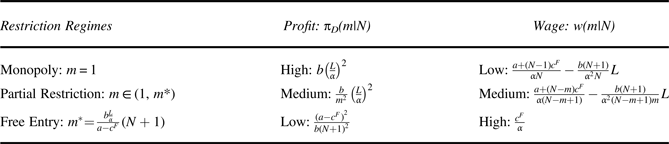
Table 1 summarizes domestic firms’ profits and domestic wages under different entry restriction regimes, where π D denotes domestic firms’ profits and w denotes domestic wages. The monopoly regime is m = 1 where the dictator maintains maximal FDI restrictions by allowing only domestic firms to produce onshore, while m = m* is the free entry regime and m* is the number of firms producing onshore without FDI restrictions or when restrictions do not bind—that is, the dictator allows more than m* firms to produce onshore.Footnote 30 The detailed derivations are provided in the appendix.
Profits and wages under different restriction regimes

There are several points worth emphasizing in the table. First, wages are increasing in m, the number of firms producing onshore, but profits are decreasing in m. As a result, labor always prefers the free-entry regime (m = m*), while domestic firms always prefer the monopoly regime (m = 1). Thus, the preferences of labor and domestic firms are inherently opposed to each other. The negative effect of free entry on domestic firms’ profits comes from two channels. The first channel is through the labor market. As more firms producing onshore drive up labor demand, domestic wages increase. As a result, domestic firms’ marginal cost of production also increases, resulting in lower profits. Free entry can also reduce domestic firms’ profits by increasing competition. As more firms move their manufacturing facilities onshore, the comparative advantage of domestic firms in terms of lower cost of production is reduced, resulting in a more competitive market, which further reduces domestic firms’ profits.
Second, while the profit difference for domestic firms under the monopoly regime and the free-entry regime, π D(1|N) − π D(m*|N), is increasing in N, the wage difference for labor under the free-entry regime and the monopoly regime, w(m*|N) − w(1|N), is also increasing in N. Thus, the preferences of labor and domestic firms become more divergent as the number of potential foreign entrants increases.
The Democratization Game
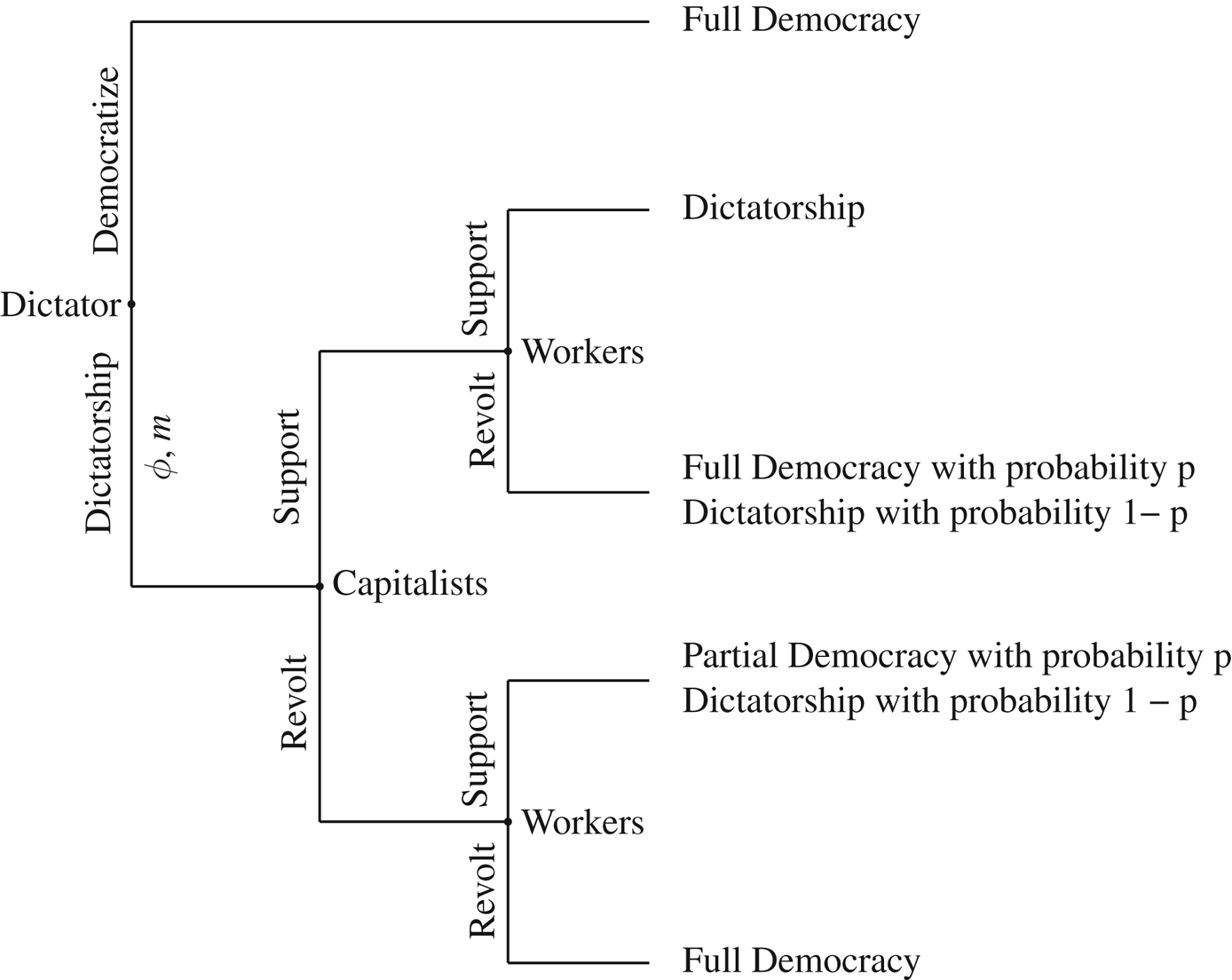
As in both Acemoglu and Robinson, and Ansell and Samuels,Footnote 31 I assume that within each class, the collective action problem has been solved. The income of domestic capitalists, who are the owners of domestic firms, is just the profit of domestic firms given the number of firms producing onshore and the total number of firms in the world, π(m|N), while the income of workers is the domestic wage, w(m|N). The game proceeds as follows.
1. The dictator's move
The dictator first decides whether to democratize preemptively or not. Define the dictator's democratization decision as a D ∈ {0, 1}, where a D = 1 means the dictator chooses to democratize. If the dictator chooses to democratize preemptively, she obtains a payoff of u D(a D = 1) = b ∈ ℝ under democracy, and the game ends. Conceptually, we can think of the dictator's payoff under democracy, b, as an outcome of several factors. For example, if the dictator expects to keep all her wealth intact and to wield influence behind the scenes after democratization, then the dictator's payoff under democracy would be quite high. We can also expect b to be high if the dictator's warm-glow benefit from initiating democratization, namely, the respect she obtains from the people and the international community, is high. On the other hand, if she expects to be exiled or even executed after losing power, then her expected payoff under democracy would be quite low. In this case, it is very unlikely for the dictator to democratize peacefully.
Given that workers are the majority in the population and that they always prefer the free-entry regime, the country under democracy always adopts the free-entry regime and allows foreign firms to produce in the country freely. Thus, free entry will be realized under democracy and the number of firms producing onshore is m*, where m* is defined in Table 1. The payoffs of capitalists and workers under democracy are just their incomes under the free-entry regime, which are
 $$\matrix{ {} \hfill & {u_C( {a_D = 1} ) = \pi ( m^\ast \vert N) , \;\qquad } \hfill & {} \hfill & \qquad \hfill \cr {} \hfill & {u_W( {a_D = 1} ) = w( m^\ast \vert N) , \;\qquad } \hfill & {} \hfill & \qquad \hfill \cr } $$
respectively.
If the dictator chooses not to democratize, she chooses the number of firms m ∈ [1, m*] allowed to produce in the country, and the proportion of profits, ϕ, to expropriate from domestic capitalists. After the dictator's decision, capitalists and workers decide sequentially whether to support the dictator or to revolt.
2. The revolt stage
Denote capitalists’ and workers’ revolt decisions as a C ∈ {0, 1} and a W ∈ {0, 1}, respectively, where a C = 1 and a W = 1 indicate that capitalists and workers choose to revolt, respectively. I assume that capitalists and workers suffer a cost of c s under dictatorship. This is a typical assumption in the literature of democratization because we can think of the country suffering a societal cost that impedes social development under dictatorship.
2.1. Neither capitalists nor workers revolt
If both capitalists and workers support the dictator, the dictator remains in power with probability 1. The dictator's payoff is the profit she expropriates from capitalists,
 $$u_D( a_C = 0, \;a_W = 0\vert a_D = 0, \;m, \;\phi ) = \phi \cdot \pi ( m\vert N) .$$
Payoffs for capitalists are the remaining profits minus the societal cost,
 $$u_C( a_C = 0, \;a_W = 0\vert a_D = 0, \;m, \;\phi ) = ( {1-\phi } ) \cdot \pi ( m\vert N) -c_s.$$
Workers’ payoffs are just the wage minus the societal cost,
 $$u_W( a_W = 0\vert a_C = 0, \;a_D = 0, \;m, \;\phi ) = w( m\vert N) -c_s.$$
2.2. Workers revolt alone
If only workers choose to revolt while capitalists support the dictator, then with probability p the working-class revolt succeeds and the country becomes a democracy, while the dictator remains in power with probability 1 − p. I denote c d as the dictator's cost of being deposed, where d stands for “deposed.” If the dictator remains in power, she gets the proportion ϕ of capitalists’ profits she demanded. If the dictator loses power, she incurs the cost of deposition, c d. Thus, the dictator's expected payoff amid a working-class revolt is
 $$Eu_D( a_W = 1, \;a_C = 0\vert a_D = 0, \;m, \;\phi ) = \underbrace{{( 1-p) \cdot \phi \pi ( m\vert N) }}_{{{\rm Workers\apos \;revolt \;fails}}}-\underbrace{{\,p\cdot c_d}}_{{{\rm Workers}\apos {\rm \;revolt \;succeeds}}}, \;$$
while expected payoffs for capitalists and workers are
 $$\eqalign{ Eu_C( a_W &= 1, \;a_C = 0\vert a_D = 0, \;m, \;\phi ) = \underbrace{{\,p\cdot \pi ( m^\ast \vert N) }}_{{{\rm Workers\apos \;revolt \;succeeds}}} \cr & \quad + \underbrace{{( 1-p) \cdot [ ( 1-\phi ) \pi ( m\vert N) -c_s] }}_{{{\rm Workers\apos \;revolt \;fails}}}, \;\cr Eu_W( a_W &= 1, \;a_C = 0\vert a_D = 0, \;m, \;\phi ) = \underbrace{{\,p\cdot w( m^\ast \vert N) }}_{{{\rm Workers\apos \;revolt \;succeeds}}} \cr & \quad + \underbrace{{( 1-p) \cdot [ w( m\vert N) -c_s] }}_{{{\rm Workers\apos \;revolt \;fails}}}-\underbrace{{c_r}}_{{{\rm revolt \;cost}}}, \;} $$
respectively, where c r is the revolt cost and r stands for “revolt.”
2.3. Capitalists revolt alone
If the dictator obtains the support of only workers while capitalists choose to revolt, the dictator is deposed with the same probability, p, and incurs a cost of c d if the revolt succeeds. In this case, the dictator's expected payoff under dictatorship is the same as in the case where workers revolt, that is,
 $$Eu_D( a_W = 0, \;a_C = 1\vert a_D = 0, \;m, \;\phi ) = \underbrace{{( {1-p} ) \cdot \phi \pi ( m\vert N) }}_{{{\rm Capitalists\apos \;revolt \;fails}}}-\underbrace{{\,p\cdot c_d}}_{{{\rm Capitalists\apos \;revolt \;succeeds}}}.$$
I assume that when capitalists are the only players revolting, a successful revolt leads to what Ansell and Samuels called “partial democracy,” meaning that political franchise is limited to the propertied upper class. Partial democracy is prevalent before the twentieth century, while it rarely occurs in the contemporary world. Later I will show that the absence of partial democracy in the contemporary world is partly a result of the increasing number of potential entrants, N, because workers now have higher stakes in the policy outcome compared to the case in which N is small, and thus are more likely to participate in the democratization process.
Given that capitalists always prefer monopolies over free entry, the number of firms producing onshore under partial democracy is equal to 1, that is, domestic monopolies are maintained. As a result, payoffs for capitalists and workers are
 $$\eqalign{ Eu_C( a_W &= 0, \;a_C = 1\vert a_D = 0, \;m, \;\phi ) = \underbrace{{\,p\cdot \pi ( 1\vert N) }}_{{{\rm Capitalists\apos \;revolt \;succeeds}}} \cr & \quad + \underbrace{{( 1-p) \cdot [ ( 1-\phi ) \pi ( m\vert N) -c_s] }}_{{{\rm Capitalists\apos \;revolt \;fails}}}-\underbrace{{c_r}}_{{{\rm revolt \;cost}}}, \;\cr Eu_W( a_W &= 0, \;a_C = 1\vert a_D = 0, \;m, \;\phi ) = \underbrace{{\,p\cdot w( 1\vert N) }}_{{{\rm Capitalists\apos \;revolt \;succeeds}}} \cr & \quad + \underbrace{{( 1-p) \cdot [ w( m\vert N) -c_s] }}_{{{\rm Capitalists\apos \;revolt \;fails}}}, \;} $$
respectively, where the cost of revolt is now borne by capitalists.
2.4. Both capitalists and workers revolt
If both capitalists and workers revolt, meaning the whole society is against the dictator, the dictator loses power with probability 1 and democracy is achieved. In this case, the dictator's only payoff is the cost of deposition,
 $$u_D( a_D = 0, \;m, \;\phi \vert a_W = 1, \;a_C = 1) = {-}c_d, \;$$
while capitalists’ and workers’ payoffs are the same as in democracy minus the revolt cost, that is,
 $$\eqalign{& u_C( a_C = 1\vert a_W = 1, \;a_D = 0, \;m, \;\phi ) = \pi ( m^\ast \vert N) -c_r, \;\cr & u_W( a_W = 1\vert a_C = 1, \;a_D = 0, \;m, \;\phi ) = w( m^\ast \vert N) -c_r, \;} $$
respectively.
Figure 1 presents the game tree of the entire democratization game.
Democratization game

Simplifying Assumptions
To focus on the main tradeoffs of interest, the model contains several simplifying assumptions. One is that domestic capitalists are not able to move their assets abroad under dictatorship. While this is a reasonable assumption in the preglobalization era, it is also reasonable to assume so in the age of globalization, since autocracies usually impose more restricted capital controls than democracies, which severely restrict capitalists’ ability to move their assets abroad.Footnote 32 Nonetheless, in Appendix section B.4, I analyze an extension of the model in which capitalists have the option of exiting the country by moving abroad in the age of globalization. The results show that, while the dictator's equilibrium strategy under dictatorship remains essentially unchanged, the inability to expropriate capitalists may reduce the dictator's payoff from protecting capitalists against foreign competition through FDI restrictions, thus increasing the dictator's incentive to democratize preemptively.
Second, to focus on domestic players’ roles in democratization, foreign firms are assumed not to be expropriated by the dictator. The relaxation of this assumption opens up the possibility that the dictator benefits from liberalizing FDI through expropriation of foreign investment. However, I show in Appendix section B.5 that allowing foreign firms to produce onshore will still reduce the amount of rents the dictator can extract depsite the dictator's ability to expropriate foreign firms. In other words, the key tensions between the dictator, who would like to impose full FDI restrictions, and workers, who would like to have full FDI liberalization, remain unchanged. What's more, foreign investment liberalization is usually pursed in tandem with the enforcement of investment contractFootnote 33 because foreign investors will increase their investment substantially only when they are assured that their rights will be respected.Footnote 34
Third, to focus on how FDI inflows affect domestic players’ incentives for democratization, the model assumes that firms and workers are price takers and that FDI is the only policy that the players fight over to increase their respective income, thus abstracting away from other elements of the economy. However, I also impose a standard assumption in the literatureFootnote 35 that the players can act collectively in the political sphere. Although these two assumptions might appear contradictory, they are actually closely related. To explain the logic, suppose that the workers and the firms can now bargain with each other over the domestic wages, and that the workers can obtain a higher level of wages through collective bargaining. In this case, the onshore firms’ marginal cost of production would increase, which would decrease the firms’ production. As a result, some workers will be laid off and there will be employed and unemployed workers. Thus, under the assumption that the workers act collectively as one unified group, they would not want to push the domestic wages beyond the market-clearing level. Instead, they would push for the policy that benefits the entire labor force, namely, FDI liberalization. In other words, modeling the players as price takers ensures that there will be no internal divisions within the working class and that the workers act collectively.
Equilibrium Democratization
The equilibrium concept used in this paper is Subgame Perfect Equilibrium (SPE). To solve the game backwards, I need to start by analyzing the subgame under dictatorship. To simplify the analysis, I let p, the probability that a revolt succeeds by each group revolting alone, be less than  ${1 \over 2}$. This ensures that if workers want to revolt alone, they still want to revolt if they know that capitalists will revolt, which is quite natural and intuitive.
Assumption 1  $p < \it{1 \over 2}$.
I further set the societal cost under dictatorship, c s, to be not too large relative to the revolt cost, c r, so that neither workers nor capitalists revolt when the only benefit democratization brings is to eliminate the societal cost, c s. That is, the only motivation each player has to revolt is to alter the number of firms producing onshore. This sharpens the result of the model while disgarding cases that are not theoretically interesting. It is also quite natural in light of the finding that neither the working class nor the capitalist elite has always been the vanguard for democracy. In the words of Bellin, both players are “contingent democrats.”Footnote 36
Assumption 2  $c_s < \it{{c_r} \over {1-p}}$.
To ensure equilibrium existence, I also assume throughout the analysis that neither player revolts when indifferent.
Thresholds of Potential FDI
I begin by defining several thresholds for N, the number of potential foreign entrants, since the democratization outcome in equilibrium crucially depends on which interval N lies. I first define the thresholds for workers, which Lemma 1 summarizes.
Lemma 1: Under Assumption 1 and 2, we have N* < N** < N***, such that
• When N ≤ N*, workers never revolt.
• When N ∈ (N*, N**], it is possible for the dictator to retain workers’ support by allowing some foreign firms to produce onshore even when capitalists revolt.
• When N ∈ (N**, N***], workers always join capitalists’ revolt but never revolt alone.
• When N > N***, it is possible for workers to revolt alone.
Figure 2 illustrates the various thresholds defined in Lemma 1. Recall from Table 1 that the preference of workers for free entry gets more intense as the number of potential foreign entrants, N, increases. Thus, when N is small, wage benefits from free entry under democracy are not large enough to motivate workers to revolt even if capitalists decide to do so. Thus, workers never revolt when N ≤ N*. When N ∈ (N*, N**], wage benefits under democracy are large enough for workers to join capitalists’ revolt when the dictator imposes maximal entry restrictions (m = 1). However, given that N is still relatively small, the benefits are still limited. As a result, it is possible for the dictator to retain workers’ support by partially liberalizing FDI despite capitalists’ revolt.
FDI threshold for workers

As N further increases (N ∈ (N**, N***]), workers’ benefits under democracy get larger, while the opportunity cost from entry restrictions under partial democracy also gets greater. As a result, whenever capitalists revolt, workers always join because they not only want to overthrow the dictator, but also want to prevent a democratization process dominated by capitalists, who will impose maximal entry restrictions once in power. As a result, the dictator is not able to retain workers’ support amid capitalists’ revolt when N ∈ (N**, N***].
When N gets even larger (N > N***), workers’ benefits under democracy are so large that they may even revolt without the help of capitalists. Thus, as N gets larger, it becomes more difficult for the dictator to retain workers’ support.
I next define a similar threshold for capitalists. First, note that, as the appendix shows, the condition that capitalists never revolt alone even when the dictator expropriates everything from them does not depend on N. Thus, I assume that capitalists always revolt alone when they are fully expropriated, which is guaranteed by Assumption 3.
Assumption 3  $\pi ( {\it 1}\vert N) > {{c_r} \over p}-c_s$.
Also note that capitalists’ profits under the free-entry regime, π(m*|N), are decreasing in N, the number of potential foreign entrants. In fact, as Table 1 shows, as N goes to infinity, capitalists’ profits go to 0 under the free-entry regime. Thus, I can find a threshold, N ′, such that when N ≥ N ′, capitalists do not join workers’ revolt even when they are fully expropriated because the small amount of profits they make under democracy are not enough to offset the revolt cost.
However, I consider the case where N ≥ N ′ as empirically unrealistic because even when the dictator expropriates everything from capitalists, capitalists will not revolt and instead leave their fate to workers, which is extremely unlikely in reality. Thus, from now on I will focus on the case of N < N ′ and assume N*** < N ′.
Assumption 4 N*** < N ′.
Notice that Assumption 4 is clearly satisfied when c r, the revolt cost, is not too large. In fact, since workers can always choose their ideal restriction regime (which is the free-entry regime) under democracy, as c r gets arbitrarily close to 0, workers will always revolt except when N is arbitrarily close to  $\underline N $, defined in the appendix as the lower bound of N below which no foreign firms want to produce onshore. At the same time, since capitalists always prefer having even a small amount of profits to losing everything to the dictator, they will always join workers’ revolt when being fully expropriated by the dictator except when N gets arbitrarily large, in which case their profits go to 0 under the free-entry regime. Thus, as c r gets arbitrarily close to 0, we have N*** goes to
 $\underline N $ while N ′ goes to infinity, satisfying Assumption 4.
The Preglobalization Age
I start the analysis by looking at the case in which N is relatively small, such that workers either do not revolt at all or revolt only when capitalists revolt, that is, N ≤ N**, which we can think of as the world in the preglobalization age. I begin by finding a liberalization level under dictatorship,  $m_U^W $, defined in the appendix, such that when N ∈ (N*, N**] and capitalists choose to revolt, workers are indifferent between joining and not joining the revolt.
The next result shows that under dictatorship, when N is less than N**, the dictator either makes both workers and capitalists indifferent, or expropriates everything from capitalists while risking a successful capitalists’ revolt.
Proposition 1: Under dictatorship,
1. When N ≤ N*, the dictator always maintains maximal entry restrictions (m = 1). She either expropriates everything from capitalists (ϕ = 1), and capitalists revolt; or she demands just enough rents (ϕ < 1) to make capitalists indifferent and retain their support. Workers always support the dictator.
2. When N ∈ (N*, N**], the dictator either expropriates everything from capitalists (ϕ = 1) and partially liberalizes entry (
 $m = m_U^W $), and capitalists revolt; or she demands just enough rents (ϕ < 1) to make capitalists indifferent and retain their support while either partially liberalizing entry ($m = m_U^W $) or maintaining maximal entry restrictions (m = 1). In any case, workers always support the dictator.


The proposition says that, when the number of potential foreign entrants is small (N ≤ N*), such that workers never revolt because of the limited wage benefits under free entry, the dictator always maintains maximal FDI restrictions. At the same time, she can either choose to take everything from capitalists and risk a successful capitalists’ revolt, or demand just enough profits from capitalists so that capitalists do not revolt. When the number of potential foreign entrants gets larger, such that workers may revolt with capitalists but never revolt alone (N ∈ (N*, N**]), the dictator can choose to expropriate everything from capitalists while partially liberalizing FDI so that only capitalists revolt, maintain maximal FDI restrictions and demand just enough profits from capitalists such that neither capitalists nor workers revolt, or partially liberalize FDI and retain the support of both players. In other words, in the preglobalization age, capitalists are the ones who push for democracy, while workers either stay out, or follow the lead of their capitalist elite. Thus, the analysis recovers the elite-based theory of democratization and demonstrates that it is essentially a special case of the current theory applying to the preglobalization period.
The next result shows that when N ∈ (N*, N**], the dictator's payoff from expropriating everything from capitalists while risking a successful capitalists’ revolt is a decreasing function in N, while the payoff from making both players indifferent over revolt, depending on the cost of revolt, may either increase or decrease in N.
Proposition 2: Under dictatorship,
• The dictator's payoff from expropriating everything from capitalists remains constant in N when N ≤ N* and decreases in N when N ∈ (N*, N**].
• The dictator's payoff from retaining both capitalists’ and workers’ support remains constant in N when N ≤ N*, while it may increase, decrease, or first decrease then increase in N when N ∈ (N*, N**].
Thus, the dictator's payoff from full expropriation keeps decreasing as the number of potential foreign entrants increases. This is because as N increases, the dictator, after full expropriation, has to liberalize FDI more to prevent workers from supporting capitalists’ revolt, which means that she has to keep a smaller amount of profits for herself.
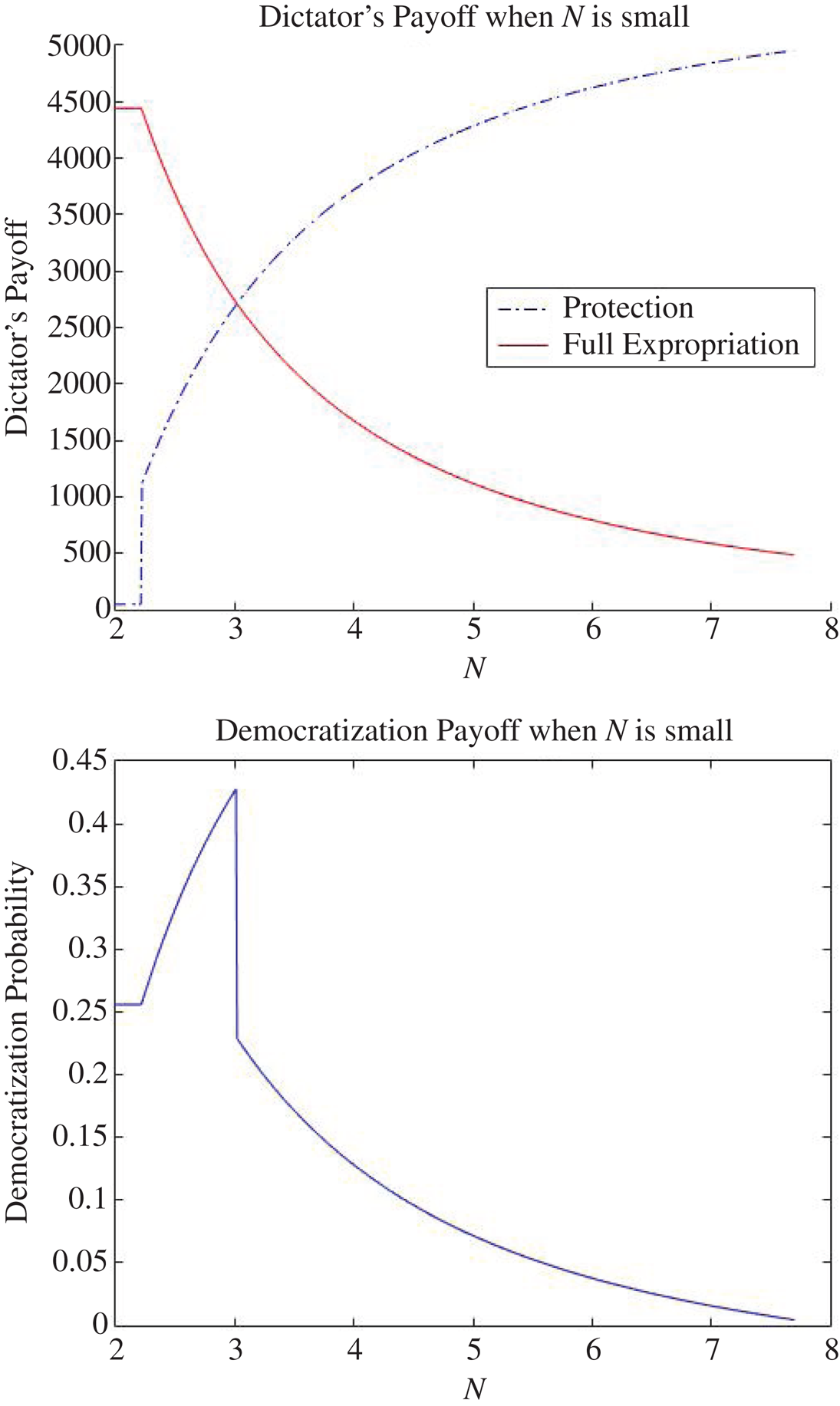
Figure 3 illustrates the result using simulation. The left graph pictures the dictator's expected payoffs under dictatorship when she protects capitalists through FDI restrictions in exchange for rents (dash-dotted line) and when she fully expropriates capitalists (solid line) for N ≤ N**. Notice that when N is small, it is optimal for the dictator to fully expropriate capitalists despite the possibility of a successful capitalists’ revolt. However, as N gets larger, the benefit from full expropriation gradually drops as a result of the increasing concessions the dictator has to make to retain workers’ support. On the other hand, the dictator is able to extract more rents from capitalists by offering them protection from foreign entrants as N increases. As a result, the payoff from protection keeps increasing, until N reaches a point where it surpasses the payoff from full expropriation. Thus, from this point on, the dictator would prefer to retain both players’ support through entry restrictions.
Dictator's payoff and democratization probability with N ≤ N**

The probability of democratization is pictured in the right graph, where I assume the dictator's payoff from democratizing preemptively, b, is a random variable that is uniformly distributed ex ante. Thus, the ex ante probability of democratization comes from two parts. The first is the probability that the dictator chooses to democratize preemptively, which depends on the value of b. The other part is the probability of a successful revolt when the dictator does not democratize preemptively, which, in this case, is the probability of a successful capitalist revolt. As the graph indicates, the probability of democratization gradually increases at first, as the payoff from full expropriation gradually drops for the dictator. However, as N further increases and reaches the point where the dictator switches from full expropriation to protection, the democratization probability experiences a sudden drop, since capitalists are not fighting for democracy any more. As N further increases, the democratization probability further reduces as the dictator's payoff from protection keeps increasing. Thus, countries’ democratization prospects become dimmer as N gets closer to N**.
The Age of Globalization
Here I study the case in which N is relatively large—when workers always join capitalists’ revolt and may even revolt alone, that is, N > N**, which we can think of as the world in the age of globalization. I begin by finding another threshold of liberalization,  $m_L^W $, defined in the appendix, where workers are indifferent between revolting alone and not revolting.
The next result shows that, when N is large, under dictatorship, the dictator may either ally with capitalists by imposing maximal entry restrictions while risking a successful working-class revolt, or partially liberalize FDI and retain both players’ support. Thus, as the level of potential FDI becomes large, it is never an optimal strategy for the dictator to antagonize capitalists. What's more, as N increases, only the payoff from the first option increases, while the payoff from partial FDI liberalization decreases.
Proposition 3: Under dictatorship,
1. When N ∈ (N**, N***], the dictator maintains maximal entry restrictions (m = 1) and demands just enough rents (ϕ < 1) to make capitalists indifferent and retain their support. Workers support the dictator.
2. When N > N***, the dictator either maintains maximal entry restrictions (m = 1), and then workers revolt; or she partially liberalizes entry (
$m = m_L^W $) to make workers indifferent and retain their support. In both cases, she demands just enough rents from capitalists (ϕ < 1) to retain their support.3. When N > N***, the dictator's payoff from imposing maximal entry restrictions (m = 1) increases in N, while her payoff from partial liberalization (
$m = m_L^W $) decreases in N.


These results show several interesting insights. First, as N further increases from the preglobalization interval to the globalization interval, there exists an intermediate section where neither capitalists nor workers revolt, namely when N ∈ (N**, N***]. This explains why we tend to observe democratization movements in waves, and each wave tends to be separated by a “quiet” period. The nature of democratization in the preglobalization and globalization age is also different: in the preglobalization age it is more about property rights and taxation, reflected in capitalists’ struggle over the proportion of their profits, ϕ, expropriated by the dictator, while in the globalization age it is more about wage, corruption, and cronyism, reflected in workers’ struggle over entry restrictions and collusion between the dictator and capitalists.
Second, as the friction of crossborder investment keeps decreasing in the globalization age, the level of potential FDI inflows also keeps growing. As a result, both the price capitalists are willing to pay in exchange for the dictator's protection and the cost to retain workers’ support for the dictator keep increasing. Thus, the dictator becomes more willing to protect capitalists at the expense of workers, resulting in the prevalence of crony capitalism in the modern era.
Third, the model also provides an explanation for why we rarely see partial democracies with limited franchise anymore. As workers have more stakes in the policy outcome, namely the policy over FDI restrictions, they are less likely to let capitalists monopolize the democratization process. As a result, whenever capitalists revolt, workers will also join the movement in order to have a say at the table. Knowing this, the dictator will strategically avoid a capitalists’ revolt because she knows that this will lead to a total revolution that will be joined by every section of the society.
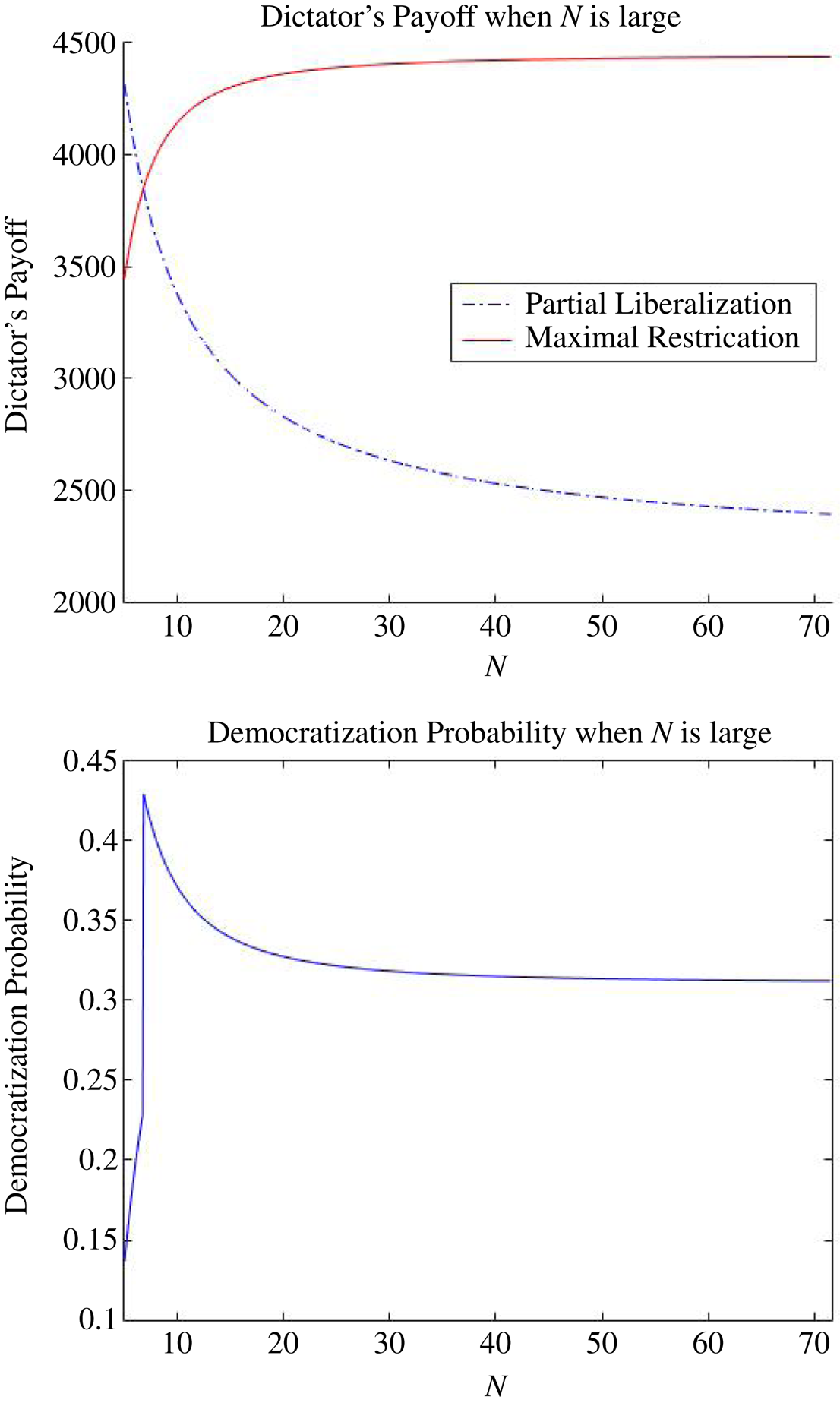
Figure 4 again illustrates the result using simulation. The graph on the left in Figure 4 shows the dictator's expected payoffs under dictatorship when she partially liberalizes FDI and retains the support of both capitalists and workers (dash-dotted line) and when she imposes maximal entry restrictions while risking a successful working-class revolt (solid line) for N > N***. As N increases, the dictator's payoff from maximal FDI restrictions keeps increasing, while her payoff from partial FDI liberalization keeps decreasing. As N increases up to a point where the two lines intersect, the dictator will switch her strategy from partial FDI liberalization to maximal FDI restrictions. As a result, there is a sudden jump in the democratization probability when workers begin to revolt.Footnote 37 We can think of it as the starting point of the third wave, where the working class becomes the vanguard for democratization. However, as N further increases, the likelihood of democratization gradually decreases, as the right graph in Figure 4 shows, where b is uniformly distributed. This is because the rent the dictator is able to extract from capitalists keeps increasing, which increases the dictator's incentive to cling to power despite widespread social unrest. As a result, the momentum of the third-wave democratization gradually tapers off.
Dictator's payoff and democratization probability with N > N***

Empirical Evidence for Historical Variations
Figure 5 depicts two interesting implications of the model that provide insights into democratization movements in various time periods. When potential FDI inflows are low (N < N**), taxation and expropriation force the capitalist elite to rise up against the dictator and push for partial democracy. While after a brief intermediate period, further increase in potential FDI inflows leads to democratization movements dominated by the working class (N > N***), whose grievances are about crony capitalism and the lower wage that results from it.
Historical variations of democratization

The Preglobalization Age
Prior to the age of globalization, the lack of both modern means of transport and a unified international financial system made crossborder investment extremely costly, greatly reducing the number of firms capable of moving their manufacturing facilities overseas. As a result, the level of potential FDI inflows was quite low in this period, corresponding to the case where N ≤ N**. Thus, the potential competition capitalists faced in these countries was also very low while the expropriation risk posed by the dictator was high, motivating capitalists to revolt. Meanwhile, given the lack of potential entrants in the market, the working class, who was still in the process of formation before the twentieth century, would not have benefited considerably from democracy. Thus, workers were not particularly motivated to fight for democracy in the preglobalization age, in addition to the fact that they faced possible structural impediments in many countries. As a result, we observe mainly an elite-dominated democratization in this period, leading to partial democracy with limited franchise. As several previous studies have shown, the Glorious Revolution in England,Footnote 38 the French Revolution,Footnote 39 and the Democratization of Britain in the late nineteenth century and Sweden in the early twentieth centuryFootnote 40 were indeed all dominated by capitalists, while the working class played at most a minor role.
The Glorious Revolution
The period leading up to the Glorious Revolution is a case in point, which Moore argues is Britain's “revolutionary break” with the past.Footnote 41 As North and Weingast documented,Footnote 42 the Stuarts’ fiscal needs in the seventeeth century led to increasing expropriation of wealth by the government. One way of expropriation was through forced loans. Predictably, these loans almost always led to default by the government.
Another way to expropriate involved the sale of monopolies—the government granting monopoly in a certain industry in exchange for a heavy patent fee. Besides putting “concessions up at auction with the deliberate purpose of exacting the highest bribes that could be realized,” Charles I also “levied a small fee on each unit of sale.”Footnote 43 Thus, despite strong resistance from Parliament, which called the monopolies one of the “evils and dangers” in the state, Charles I successfully brought in much more revenue from the sale of monopolies than his predecessors, which included an annual income of £30,000 from wine licences, £13,050 from tobacco licenses, and £30,825 from soap licenses. In fact, the price of monopoly was so heavy that “it was considerably greater at the margin than a 100 percent tax on profits.”Footnote 44 In light of the model, it was a clear attempt by the Crown to fully expropriate the capitalists (ϕ = 1), which inevitably led the capitalists to revolt.
Thus, the English Civil War, and ultimately the Glorious Revolution, followed. In both instances, the capitalists, using the wealth they made from Atlantic trade, actively supported Parliament.Footnote 45 With the capitalists’ help, Parliament prevailed in both conflicts, and the victory not only greatly strengthened capitalist’ rights but also established Parliament's exclusive authority over taxation. What's more, Parliament also gained the veto power over the government's budget and the “never-before-held” right to audit how the government spent its funds. These measures, together with the limits placed on the royal prerogative powers and the abolishment of the Star Chamber, greatly constrained the Crown's power. As a result, parliamentary supremacy was firmly established.
Sweden: 1809–1866
During the Age of Liberty (1719–72), Sweden actually had the most powerful parliament in Europe, which ended with King Gustav III, who successfully reestablished the king's authority over taxation and economic affairs through a series of executive coups.
In 1789, Gustav III used the secret committee he created to secure the Riksdag's guarantee of the entire state debt, further antagonizing the elite. Meanwhile, there was even more discontent with the government over the introduction of Crown monopolies in liquor, tobacco, and other industries, which the Riksdag tried but failed to stop.Footnote 46 Thus, like his counterpart in England, the king of Sweden also chose the full expropriation strategy (ϕ = 1), while maintaining maximal entry restrictions by monopolizing these industries (m = 1).
The situation reached a boiling point after the king raised an additional wartime tax in his effort to regain Finland from Russia, which amounted to five times the existing taxation granted by the Riksdag. The measure aroused widespread consternation, especially among the propertied class, who bore the major burden of the new tax.Footnote 47 As a result, Lieutenant Colenel Georg Adlersparre, supported by a group of noblemen, left his post and marched to Stockholm with a list of demands in 1809, including the abolition of the wartime tax, which forced Gustav IV Adolf to abdicate.
The Riksdag was immediately summoned after Gustav IV Adolf's abdication and passed the Constitution of 1809. The constitution reestablished the Riksdag's control over “all taxation, loans, the state bank, and national debt office … while various tolls and excises which formerly provided a standing revenue to the crown now became part of the regular taxation.”Footnote 48 However, the newly emerged industrialists, who obtained the membership of the Estate of the Burghers in 1830, did not stop there, and consistently pushed for parliamentary reforms that aimed at changing the four-estate structure (Nobility, Clergy, Burghers, Peasantry) of the Riksdag, in which the nobility were clearly overrepresented.Footnote 49 Ultimately, the industrialists prevailed in 1866, and the old four-estate structure gave way to bicameralism despite a close vote in the Estate of the Nobility, enfranchising 20 percent of the adult male population.Footnote 50 Thus, “the work begun in 1809 was now completed in 1866.”Footnote 51
The Age of Globalization
The late-developing countries in the post-Bretton Woods world face a quite different situation. When the late-developing countries such as South Korea and Indonesia embarked on their journey to industrialization, the West had been industrialized for more than a century and had a lot of competitive firms ready to compete with firms from the emerging market. Because improvements in technology also help reduce the friction of crossborder capital flows in the age of globalization, both factors helped increase potential FDI inflows toward these late-developing countries. Thus, for the third-wave countries, we have a case with a large number of foreign competitors (N > N***) ready to squeeze out the profit of newly established firms in the emerging market. As a result, capitalists in the third-wave countries prefer protection by the dictator despite high-level rent seeking, leading to the prevalence of crony capitalism in these countries, while workers in these countries would benefit a lot from FDI liberalization, thus pushing for democratization despite increasing resistance from the dictator.
South Korea
The authoritarian government in South Korea adopted an import-substitution strategy and maintained a strict control over FDI thoughout the 1970s and ’80s. Until 1985, South Korea maintained a “positive list” of control over foreign investment, meaning that any industry not on the list was not open to foreign investment.Footnote 52 In 1973, the regime further restricted foreign investment by forbidding companies that competed with Korean firms’ exports to invest.Footnote 53 As a result, the portion of the manufacturing sector under the top ten chaebols’ control jumped from 34.1 percent in 1978 to 67 percent in 1984.Footnote 54
Meanwhile, the regime in South Korea also tried to help the chaebols maintain their monopoly positions in their respective industries. In August 1980, the Chun regime announced that it would reorganize the heavy and chemical industries along lines that would eliminate competition among rival domestic producers and create specialized monopolies for supposedly more efficient export production. Soon after the announcement, President Chun arranged a meeting with the owner of Hyundai Group and Daewoo Group and asked them to swap assets so that each group could maintain a monopoly in their respective industries.Footnote 55
In exchange for the government's protection, the capitalists in South Korea needed to offer rents to the regime. Chung Ju Yung, the founder of Hyundai Group, later admitted that Korean businessmen had “donated” large sums of money to Chun Doo Hwan's personal political vehicle, the Ilhae Foundation, to avoid government reprisals.Footnote 56
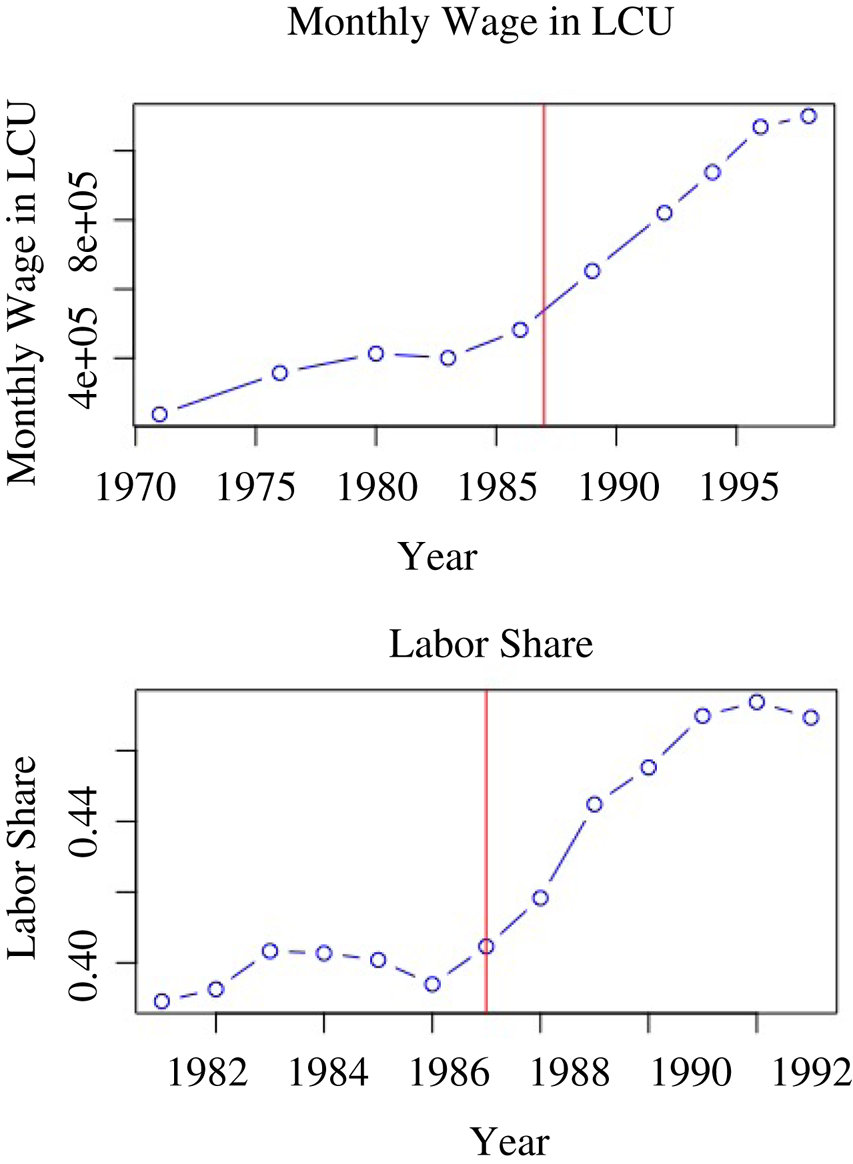
As a result of the regime's protectionist policies, real wage income in Korea grew only slowly in the years leading up to the 1987 democratization despite a booming economy (Figure 6, left),Footnote 57 while the labor share in the economy actually decreased between 1983 and 1986, as shown in the right graph in Figure 6.Footnote 58 Workers in South Korea often had to endure extremely harsh working conditions.Footnote 59
South Korea's average wage income before and after 1987

As a result, labor unrest and protests occurred throughout the 1970s and ’80s despite heavy repression. One of the more dramatic events was the incident at Sabuk in Kangwon, in which 3,500 coal miners, who had long suffered dangerous working conditions with very low wages, took control of the town for several days in April 1980. The riot initially started as a peaceful strike in which the workers demanded a substantial wage increase and the resignation of the union leader, whom the workers resented for being a puppet for the management. However, the strike turned violent after three protesters were hit by a police car. The workers then occupied the police station and set fire to the union office, forcing the police to withdraw from the area and the government to declare martial law. However, as a result of the lack of leadership and a growing anxiety over the consequences of their actions, the workers eventually surrendered to the police.Footnote 60
Another dramatic event took place at Daewoo Apparel in the Kuro Industrial Park. Three unions leaders at Daewoo Apparel were arrested on 22 June 1985 on charges of organizing overnight sit-ins during wage negotiation with the management. Upon hearing the news, forty-four union representatives met and decided to go on a strike. Workers at other firms in the Kuro Industrial Park later joined the strike in a solidarity movement. The stike eventually involved more than 2,500 workers.Footnote 61 Although a huge police assault and the sacking of more than 2,000 workers ended the strike, “the pattern of large-scale, militant and determined industrial action … was established.”Footnote 62
Then, in what became known as the “Great Workers’ Struggle of 1987,” over one million workers went into the streets demanding wage increases and shorter working hours. Between July and September, there were more than 3,500 labor conflicts, most of which were spontaneous and not centrally coordinated. The workers’ deep bitterness toward the management also revealed itself in some of the incidents. For example, the workers at Daewoo Motors forced the company presidents and vice-presidents to kneel in front of them. Consequently, the military regime was forced to broaden the terms of the democratic transition by amending the Trade Union Law, which greatly simplified “the process of registering and organizing unions and limiting administrative powers over internal union affairs.”Footnote 63
Upon winning the election, the government of Kim Young-Sam immediately kicked off South Korea's long-delayed economic liberalization by adopting the New Economic Policy (NEP). Under the government's “Five-Year FDI Liberalization Plan (1993–1998),”
132 out of 224 restricted sectors were liberalised. Corporate taxation of foreign invested firms was reduced, regulations on foreign ownership of land were relaxed and approval procedures were simplified. The Five-Year Plan was followed by another one starting in 1995 and by a 1994 Reform Plan for the Improvement in the Foreign Investment Environment.Footnote 64
As a result, a period of sustained growth in both real wage income and labor share followed (Figure 6).
It was clearly the working class who, unhappy about the cronyism and the lower wage that resulted from it, helped bring democracy to Korea, while capitalists never “actively sought to persuade the governing politico-bureaucratic elite to pursue democratization programs.”Footnote 65
Indonesia
As in South Korea, Indonesia adopted a development strategy of import substitution under the dictatorship of Suharto since the 1970s. In 1974, the government essentially closed all avenues for foreign investment. As a result, the average effective rate of protection (ERP) for the whole manufacturing sector, excluding natural gas and oil refining, reached 86 percent in 1987, which was outrageously high.Footnote 66 It was not until the downfall of Suharto's regime in 1998 that these restrictions on FDI were significantly relaxed when the succeeding democratic governments took advantage of foreign investment to foster Indonesia's economic recovery from the Asian financial crisis. Consequently, several previously closed sectors, including harbors, electricity generation, telecommunication, railways, and water supply, were now open to foreign investment. And the approval process for FDI was also greatly simplified following the establishment of the Capital Investment Coordinating Board (BKPM).Footnote 67
At a micro level, Suharto also tried to help well-connected firms to monopolize the economy. For example, the government helped the Salim Group maintain a monopoly in the soybean-crushing industry. As Brown noted, the entrenched monopolies were associated with a “well-connected elite of ethnic Chinese capitalists and a tiny pribumi elite sustained by ties to Suharto and the state.”Footnote 68 In exchange for protection, these well-connected ethnic Chinese capitalists had to offer rents to Suharto and his regime. Besides offering funds to state officials at various levels,Footnote 69 another typical way to offer such rents was by bringing Suharto's relatives into the company. For example, Suharto's stepbrother, Probosutedjo, was brought into the business by businessman Sudono Salim, who was the owner of the Salim Group.
Labor repression was widespread during Suharto's reign, and all unions had to join the government-sponsored union federation, the All Indonesian Labor Federation (FBSI). Although the regime increased the minimum wage substantially during the 1990s, many well-connected firms simply ignored workers’ legal entitlement to it.Footnote 70 As a result, there was continuous labor unrest throughout the 1980s and ’90s when workers demanded higher wages, better working conditions, and the freedom to organize.
One of the largest incidents at the time was the 1994 riot in Medan, which involved more than 20,000 workers. It initially started as protests against mostly Chinese factory owners who refused to abide by the minimum-wage law.Footnote 71 The workers then marched to the provincial office of the North Sumatra governor, Raja Inal Siregar, to meet the governor and to hear a promised address by him. However, when the meeting failed to materialize, the workers turned violent and began attacking passing cars and motorcycles and ransacking shops. It took over 2,500 soldiers and more than 100 arrests to quell the unrest.Footnote 72
Suharto's downfall in 1998, not surprisingly, was a result of a series of riots mainly targeting the Chinese-owned business, who the people thought were associated with entrenched cronyism and privileges. A rallying cry during that time was a demand to reform the justice system free from “KKN” (corruption, collusion, and nepotism).Footnote 73 Although the Asia financial crisis definitely played a role in stirring the mass riot, the regime was in trouble long before the crisis hit. Suharto's reluctance to carry out structural reforms as part of the IMF rescue package early on in the crisis, which would inevitably affect vested interests close to the regime if implemented, exacebated the crisis.Footnote 74 As Aspinall has argued, Indonesia's democratization was really a movement from below, and “the forces that finally cracked open the regime were triggered more by popular mobilization.”Footnote 75 Again it was the working class that brought democracy to Indonesia, not capitalists.
Statistical Evidence
To examine some of the model's implications for democratization in the age of globalization, namely, the third-wave democratization (N > N***), I use contemporary quantitative data. I also assess whether the patterns observed in Korea and Indonesia generalize. Appendix section C provides additional details. Although I cannot empirically observe N, the level of potential FDI inflows, for each country, I can observe the level of FDI restrictions, which can be thought of as m, the number of firms allowed to produce in the domestic market.
However, notice that while a higher level of FDI restrictions may correlate with a higher democratization probability due to working class revolt, it may also correlate with a lower democratization probability due to the increasing amount of rents the dictator is able to extract from capitalists, thus increasing the dictator's resistance to democratization. As a result, there is no clear-cut relationship between the level of FDI restrictions, m, and the likelihood of democratization.
Despite the lack of a clear-cut relationship between FDI restrictions and the likelihood of democratization, I can still indirectly test the mechanism by examining several related implications, which are summarized in Table 2. Recall that there are two possible equilibrium paths in the game when the level of potential FDI inflows is high (N ≥ N***), namely, the high-FDI-restriction path (m = 1) and the low-FDI-restriction path ( $m = m_L^W $). In the high-restriction path, the dictator imposes full FDI restrictions in order to shield domestic capitalists from foreign competition. In exchange, the dictator extracts more rents from capitalists (larger ϕ), leading to a higher level of corruption and cronyism. Thus, one implication of the theory is that we should observe a higher level of corruption in nondemocratic countries with a higher level of FDI restrictions.
FDI restrictions, workers’ revolt, and corruption

Note that in the high-restriction path (m = 1), workers will revolt against the dictator, while in the low-restriction path ( $m = m_L^W $), no working-class revolt will happen. Thus, another implication of the theory is that we should observe more working-class unrest in nondemocratic countries with a higher level of FDI restrictions.Footnote 76
I obtained data from different sources to examine these implications. The measure for FDI restrictions, government screening, is borrowed from PandyaFootnote 77 and is the main independent variable of interest. It measures the percentage of industries requiring discretionary regulatory requirements for foreign investors to invest, and captures the extent to which the government is able to arbitrarily restrict FDI inflows into domestic industries. The data cover the period from 1970 to 2000. Measures for democracy come from two sources. The indicator variable, democracy, comes from Cheibub, Gandhi, and Vreeland (CGV).Footnote 78 It equals 1 if they classify a country as democracy in a given year. The variable polity4 is the Polity Score from the Polity IV database for a country in a given year and ranges from -10 to 10, where 10 indicates the most democratic regime, and -10 indicates the most authoritarian regime.
The measure for corruption, control of executive corruption, comes from the Varieties of Democracy (V-Dem) project.Footnote 79 It measures the frequency with which members of the executive grant favors in exchange for bribes. The measure ranges from -5 to 5, where -5 implies that corruption is endemic and 5 implies that corruption hardly ever happens. This variable thus directly corresponds to the level of rent seeking, ϕ, in the model. The level of working-class unrest is captured by the number of annual general strikes from Banks.Footnote 80 It indicates the extent to which the working class in particular is dissatisfied with the government.
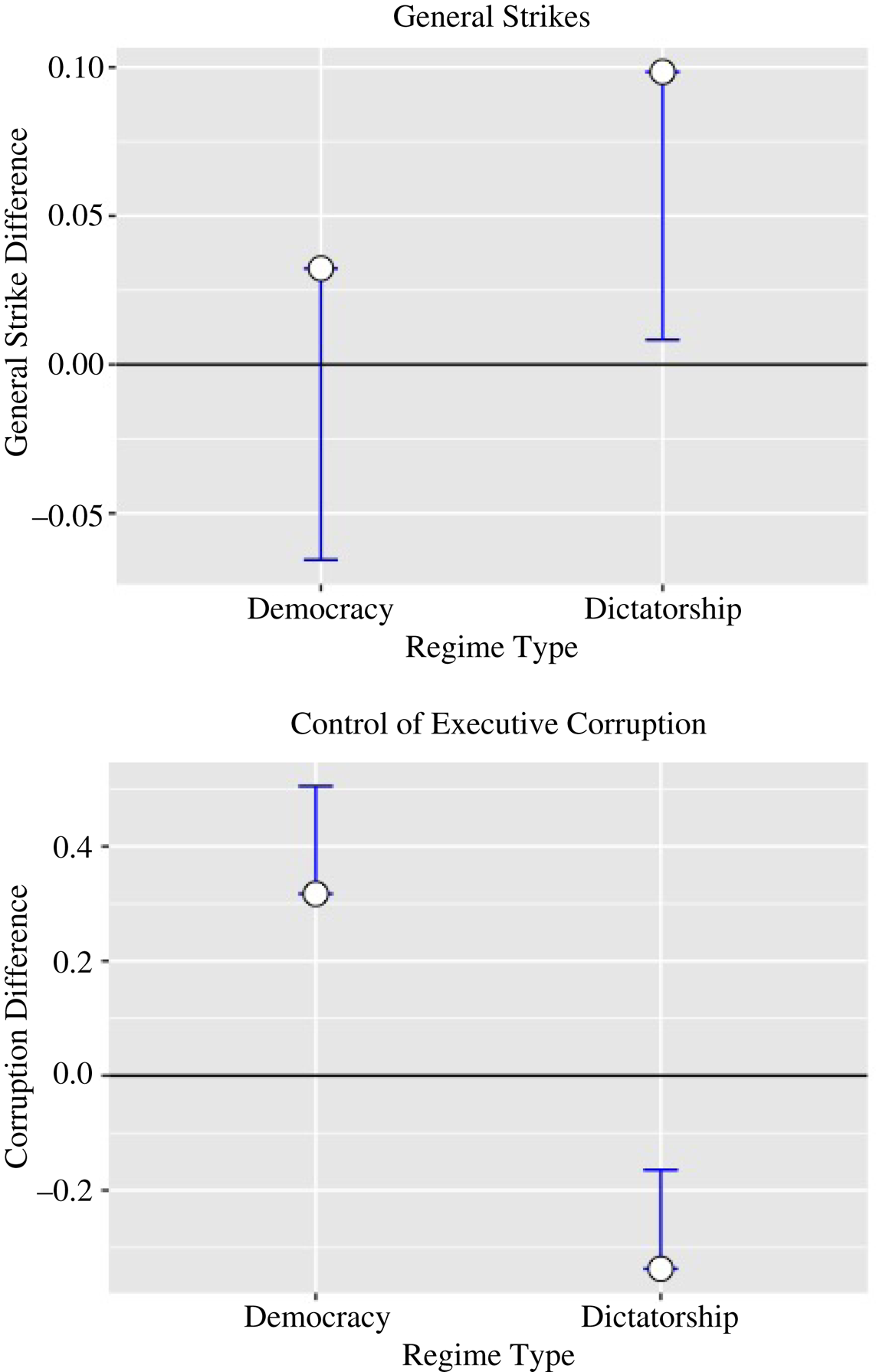
To motivate the analysis that follows, I divide all the observations in the data into two groups, “Full FDI Screening” and “Partial FDI Screening,” and look at whether nondemocratic countries with full FDI restrictions have more general strikes and higher levels of executive corruption than their counterparts with partial FDI restrictions. More specifically, a country is classified as having full fdi screening if its government screening measure equals 1 in a given year, meaning that all industries in the country require informal regulatory requirements for foreign investors to invest. Otherwise the country is classified as having partial fdi screening in a given year. Figure 7 shows the comparison using the CGV dichotomous measure of democracy.
Mean difference for democracy and nondemocracy subsamples

Specifically, the left graph in Figure 7 shows the difference of the average number of general strikes between the full fdi screenng group and the partial fdi screening group with 95 percent confidence interval from a one-tailed t-test. As the graph shows, nondemocratic countries with full FDI screening indeed have, on average, more general strikes than their counterparts with partial FDI screening, while the difference is statistically indistinguishable from 0 for democratic countries.
Similarly, the right graph in Figure 7 shows the difference of the average level of executive corruption between the “Full FDI Screening” group and the “Partial FDI Screening” group with a 95 percent confidence interval from a one-tailed t-test. As the graph shows, nondemocratic countries with full FDI screening indeed have more widespread corruption than their counterparts with partial screening, while the difference is again statistically indistinguishable from 0 for democratic countries.
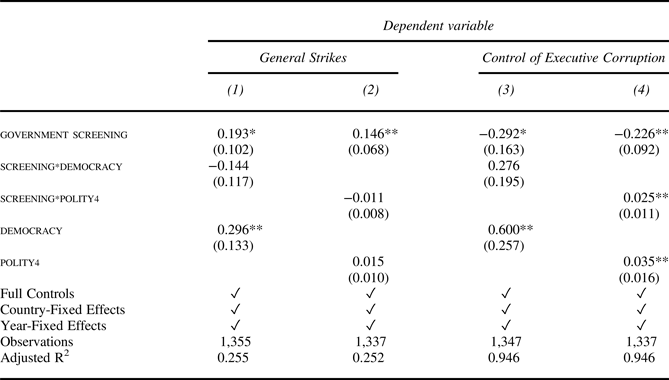
Table 3 presents the regression results that allow me to investigate this pattern more rigorously. In columns 1 and 2, the coefficients for government screening are positive and statistically significant in both specifications, indicating that a higher level of FDI restrictions over foreign investment is indeed associated with a greater number of general strikes. Similarly, the coefficients for government screening are negative and statistically significant in both columns 3 and 4, demonstrating that a higher level of FDI restrictions is also associated with a higher level of executive corruption.
General strikes, corruption, and FDI restrictions

Notes: Standard errors clustered by country are in the parentheses. *p < .10; **p < .05; ***p < .01.
Not surprisingly, democracies tend to have more strikes than nondemocracies, the positive coefficients for both democracy in column 1 and polity4 in column 2 show. This may reflect the fact that strikes are legal and allowed in democracy while they tend to induce violent government repressions in nondemocracy. Democracy is also associated with a lower level of executive corruption, as columns 3 and 4 indicate. This is to be expected because more public oversight combined with the possibility of losing power clearly reduces politicians’ incentives of taking bribes in democracy.
Although statistically insignificant, the coefficients for the interaction term of government screening and the two measures for democracy actually have the opposite sign from the coefficients for government screening in all four specifications, indicating that democracy tends to moderate the effects of FDI restrictions on both the number of general strikes and the level of executive corruption. Thus, the result reveals that the nature of FDI screening may be fundamentally different for democracies and nondemocracies. While FDI screening in nondemocracy is mainly about rent seeking and protecting governments’ cronies at the expense of workers, democratic governments may screen foreign investment to protect national security or workers’ rights, as the recent screenings by US and France over Chinese investment demonstrate.
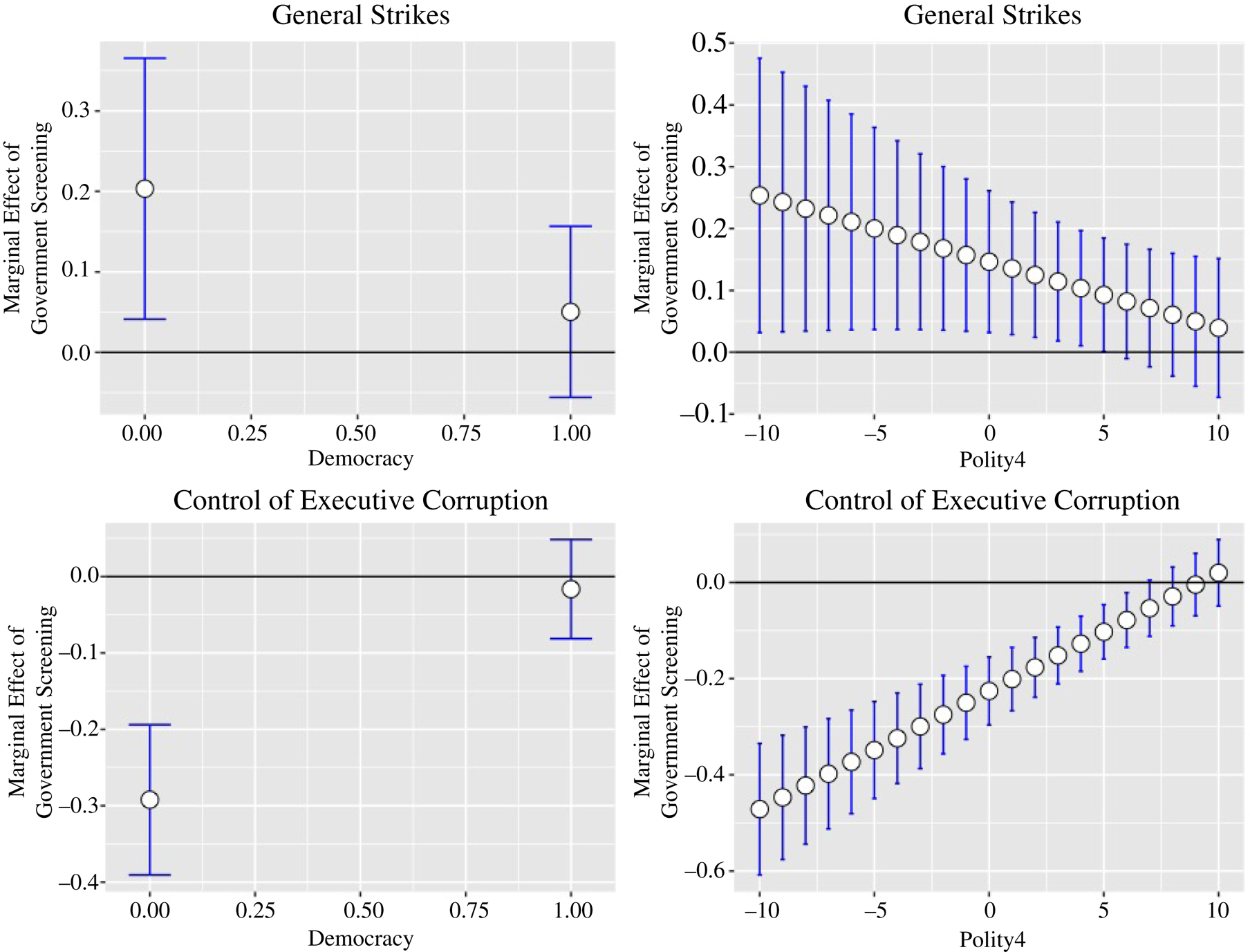
Figure 8 presents the marginal effects of government screening with a 90 percent confidence interval on both general strikes and control of executive corruption under different regime types. In all specifications, the effects of government screening become smaller and ultimately indistinguishable from 0 as democracy changes from 0 to 1 and polity4 increases from -10 toward 10. In fact, switching from no government screening to full government screening is actually associated with a slight increase in the control of corruption measure for countries with a Polity Score of 10.
Marginal effects of FDI restrictions under different regime types

Overall, the statistical results show that as FDI restrictions increase under dictatorship, there indeed tends to be more unrest on the part of the working class and more corruption on the part of the regime, supporting the theoretical results of the model.
Conclusion
Drawing insights from literatures on both FDI and democratization, this article presents a theory of how globalization in the form of increasing potential FDI inflows affects democratization and applies it to explain several empirical observations documented by previous research: the increasingly dominant role of the working class and the diminishing role of capitalists in the third-wave democratization movements, the prevalence of crony capitalism in the modern world, and the gradual tapering off of the momentum of the third-wave democratization.
Specifically, as the level of potential FDI inflows increases, workers are more willing to support democratization because of the large wage benefits from a free flow of FDI under democracy, while capitalists are less willing to support democratization because of their increasing need for protection from the dictator in the form of FDI restrictions. However, the effect of increasing potential FDI inflows on democratization prospects is ambiguous: it not only increases workers’ incentive to push for democratization, but also increases dictators’ resistance to it because of the larger share of rents they can extract from capitalists by offering them protection. Thus, globalization in the form of increasing potential FDI inflows turns out to be a double-edged sword for democratization.
One additional implication of the theory that lends itself to future empirical research involves the relationship between the level of technological sophistication of a country's economy and its prospects for democratization. Specifically, previous research show that although both skilled and unskilled workers benefit from FDI liberalization, skilled workers tend to benefit more than their unskilled counterparts.Footnote 81 As a result, support for FDI tends to increase with workers’ skills.Footnote 82 In other words, the wage benefit from democratization for skilled workers is greater than for unskilled workers. Thus, as a country's economy becomes more technologically sophisticated, we would reasonably expect an increase in the country's democratization prospects, as the group that benefits most from democratization, namely skilled workers, is getting stronger.
A second implication of the model that lends to further theoretical exploration involves how “fragmented production”—supply chains—affects democratization. In a world with fragmented production, some domestic firms may specialize in producing the final goods, while others may specialize in producing the intermediate goods that are used as inputs by firms producing the final goods. In this case, while both types of firms may benefit from FDI restrictions’ negative effects on domestic wages, firms producing the final goods may actually benefit from the entry of foreign firms producing the intermediate goods, which reduces the price of the intermediate goods and thus their marginal cost of production. In other words, supply chains may reduce the dictator's ability to extract rents from the final goods producers. In fact, supply chains may even induce the final goods producers to ally with the working class in pushing for FDI liberalization and democratization, driving a wedge between the two groups of domestic capitalists. Thus, although “fragmented production” is a rather recent phenomenon, it may indeed have profound implications for the future of democratization.
Data Availability Statement
Replication files for this article may be found at <https://doi.org/10.7910/DVN/G1WYLY>.
Supplementary Material
Supplementary material for this article is available at <https://doi.org/10.1017/S0020818321000059>.
Acknowledgments
I thank John Duggan, Randall Stone, Jack Paine, Sergio Montero, Tasos Kalandrakis, Gretchen Helmke, Mark Fey, Alexander Lee, Masaaki Higashijima, Martin C. Steinwand, Aníbal Pérez-Liñán, Justin Fox, Adam Przeworski, Pablo M. Pinto, José Antonio Cheibub, Ji Yeon Hong, and Sandro Brusco for valuable comments on the paper. I also thank Sonal S. Pandya for providing me with her data set on FDI restrictions. All remaining mistakes are mine.