Introduction
Bael (Aegle marmelos Correa) is widely distributed throughout the tropics and sub tropics. Since time immemorial, it is used in the preparation of several Ayurvedic medicines (Sharma et al., Reference Sharma, Bhatia, Bansal and Sharma2007). It is believed to have antimicrobial, antifungal and anti-inflammatory properties (Kaur and Kalia, Reference Kaur and Kalia2017). Aqueous decoction of Bael roots have hypoglycaemic activity (Karunanayake et al., Reference Karunanayake, Welihinda, Sirimanne and Adorai1984) and leaves have pesticidal property (Kulakkattolickal, Reference Kulakkattolickal1987). All parts of the Bael tree are consumed in one or other form for different purposes. The ripe fruits are aromatic, sweet and astringent, which helps in regeneration of skin, coolant, laxative, febrifuge and good for health (Jain, Reference Jain1968).
In India, Bael is grown on about 25 500 thousand hectare area with a production of 313 850 tons, which is a productivity of 12.31 tons per hectares productivity (Pandey et al., Reference Pandey, Shukla, Trivedi, Singh and Giri2020). Bael fruit crop is considered as a pre-eminent fruit crop of arid and semi-arid region (Kaur and Kalia, Reference Kaur and Kalia2017). It survives with a wide range of soil (pH range 5–10) and tolerant to water logging (Singh et al., Reference Singh, Singh and Saroj2018). Studies on Bael genetic resources have been conducted in natural condition. However, in the present study, Bael germplasm has been collected and conserved in the field gene bank for 15 years to systematically characterize and evaluate for different traits. Farmers and consumers are interested in traits like more fruit weight, thin shell, lesser shell weight, minimum seeds per fruit, minimum seed weight, high fruit yield, more total soluble solids, total carotenoids, etc. High TSS, carotenoids, phenols and tannins are important biochemical traits for selection of a variety with better quality fruits (Rahman et al., Reference Rahman, Halim, Mozumder, Ove and Khatun2024).
Ample untapped genetic variability is available in different traits which is a prerequisite for breeding. However, due to lack of comprehensive understanding regarding available genetic resources, it is often considered as an under exploited fruit (Dhakar et al., Reference Dhakar, Das, Nath, Sarkar and Singh2019). Varieties with thin shell, fine textured pulp, free of mucilage, few seeds, thorn less, high productivity and rich in bioactive compounds are still lacking in Bael. So far, no systematic study has been carried out in Bael to identify suitable genotypes for selection of high yield with better quality fruits (Nagar et al., Reference Nagar, Kumar, Kumatkar, Sharma and Singh2017). Nevertheless, in climate change perspective semi arid areas are increasing; hence, there is an urgent need to harness potential of Bael as an economically viable crop for such areas (Kesava Rao et al., Reference Kesava Rao, Wani, Singh, Ahmed, Srinivas, Bairagi and Amadevi2013).
Experimental
Plant exploration and germplasm collections expeditions were conducted in the subtropical region of India during the year 2003–2004. A total of 15 accessions having traits of horticultural importance were identified and scion wood was collected. Collected material was grafted on seedling rootstock and conserved in the field gene bank at ICAR – Central Institute for Subtropical Horticulture, Lucknow (Photo Plate 1). All accessions were planted in three replications and are maintained for characterization under uniform cultural practices. Bael tree attains maturity at the age of 15 years (approx.); hence, after 15 years, these plants were evaluated for 3 consecutive years during 2019–2021.
Field Gene Bank (A) Bael tree in fruiting in the field gene bank (B) Bael tree in fruiting in the field gene bank (C) Bael tree in fruiting in the field gene bank (d) Bael tree in fruiting in the field gene bank.

Data on morphological and yield characters of the fruit were recorded (Photo Plate 2). Total soluble solids at full ripe stage (ready to eat) have been measured with the help of the refractometer and expressed as 0Brix. Ascorbic acid (Davis and Masten, Reference Davis and Masten1991), reducing and non-reducing sugars (Nelson, Reference Nelson1944), titrable acidity (A.O.A.C, 1984), carotenoids (Mangels et al., Reference Mangels, Holden, Beecher, Forman and Lanza1993) and tannins (Folin and Ciocalteu, Reference Folin and Ciocalteu1927) were estimated in full ripe fruits. The ability to reduce ferric ions [ferric reducing antioxidant power (FRAP) value] was measured as described by Pulido et al. (Reference Pulido, Bravo and Saura-Calixto2000). Three years pooled data were statistically analysed as per method described by Gomez and Gomez (Reference Gomez and Gomez1984) using OP stat and XLSTAT software.
Photo Plate 2: Variability in morphological traits (A) Variability in fruit shape and size (B) Variability in seed shape and size (C) Genotype with highest yield (D) Genotype with highest vitamin ‘C’ and antioxidant value.

Discussion
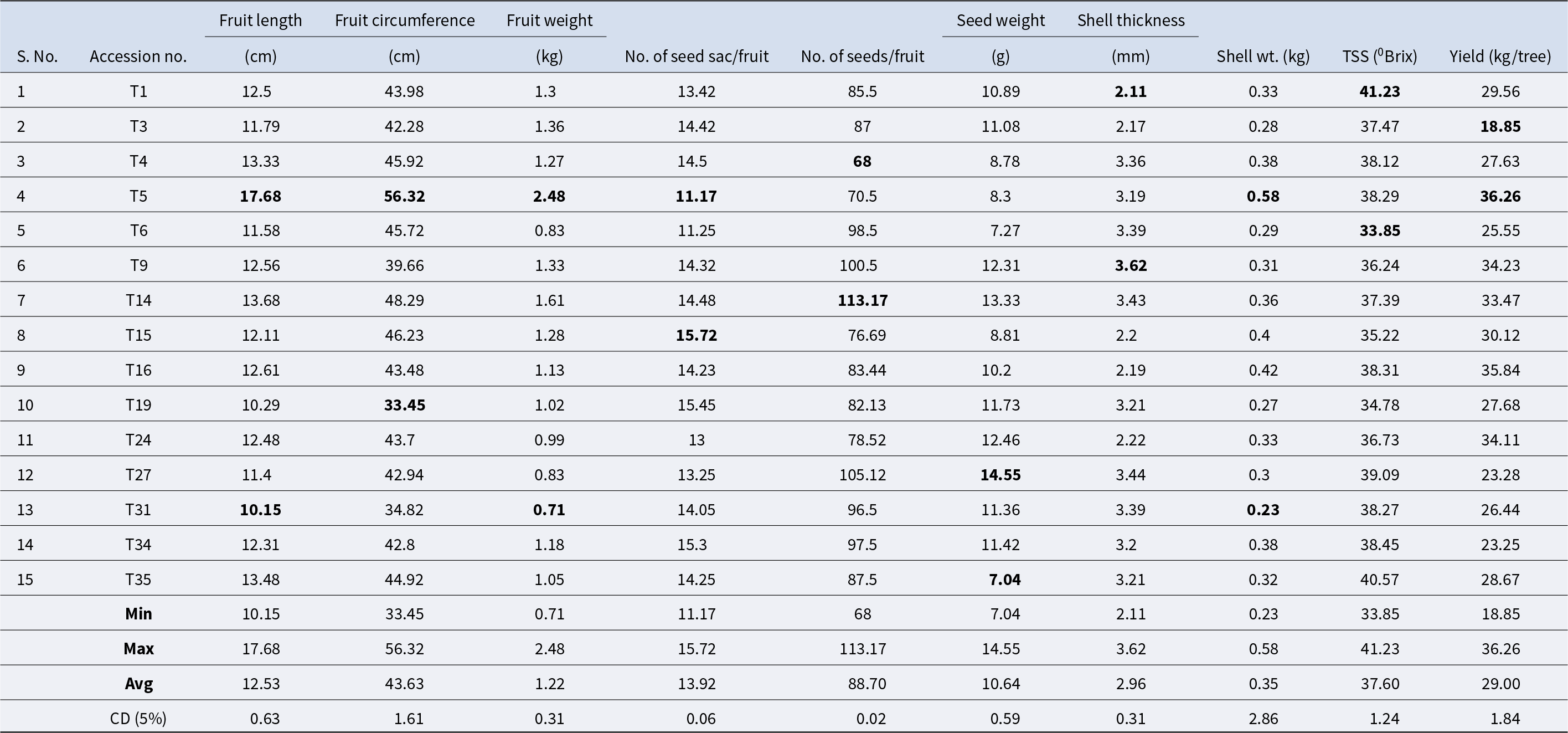
Passport information shows that rich diversity of Bael is available in subtropical region of India (Table S1). Results showed that genotype T5 had maximum fruit length, fruit circumference, fruit weight and highest yield with minimum number of seed sac per fruit and shell weight; hence, this may be preferred genotype for farmers and consumers. Radical variability in the fruit size of Bael is available in North India, which needs to be harnessed for improvement (Singh et al., Reference Singh, Singh and More2014). Genotype T4 had minimum number of seeds per fruit, whereas T14 had minimum seed weight. As less number as well as less seed weight is a desirable trait, hence, these genotypes may be probable parent in breeding program. Genotype T1 was found to have thinnest shell (2.11 mm). This may be a promising genotype for shell thickness trait (Table 1). Shell traits are important for commercialization of Bael. Variability in fruit characters, shell traits and yield of Bael available in North India has not been collected and characterized properly (Pandey et al., Reference Pandey, Tandon, Hudedamani and Tripathi2013). Hence, variability in natural condition could not be utilized in crop improvement program (Uddin et al., Reference Uddin, Islam, Alam and Hossain2016). Study reports that untapped natural variability was collected and conserved for 15 years to evaluate at one place.
Variability in fruit characteristics of bael germplasm collected from subtropical region of North India

Apparent variability was found in the biochemical traits of different genotypes. Genotype T1 was found to be most suitable for high TSS, whereas genotype T31 for high vitamin ‘C’ and tannin content as well as minimum acidity. Genotype T9 is important for its high sugar, vitamin ‘C’ and antioxidant content in terms of FRAP value. FRAP assay measures the antioxidant activity of fruits by measuring how well they reduce ferric ions (Fe3+) to ferrous ion (Fe2+). The FRAP assay is a quick and inexpensive method used to assess the antioxidant content (Table 2). Correlation study provides valuable insights about the inter relationships among the different parameters (Table S2 and Figure S1).
Biochemical traits of bael germplasm collected from subtropical region of North India

Conclusion
Genotype T5 with maximum fruit length, fruit circumference, fruit weight, highest yield with minimum number of seed sac per fruit and shell weight might be potential parent in Bael improvement programme. Other trait-specific superior genotypes [T4 (minimum number of seeds per fruit), T14 (minimum seed weight) and T1 (high TSS and thinnest shell), T9 (high sugar, vitamin ‘C’ and antioxidant value)] may be potential donor in breeding program.
Supplementary material
The supplementary material for this article can be found at https://doi.org/10.1017/S1479262125000103.
Acknowledgements
Authors are thankful to the Director, ICAR – Central Institute for Subtropical Horticulture, Lucknow for providing necessary facility and keen interest in the study.