Introduction
In recent years, due to the scarcity of kaolinite resources, kaolinitic claystone deposits in coal-bearing strata have been studied widely and exploited internationally. They are useful both scientifically as marker beds to assist with stratigraphic correlations in coal-bearing basins (Uysal et al. Reference Uysal, Golding and Audsley2000; Burger et al. Reference Burger, Zhou and Ren2002; Arbuzov et al. Reference Arbuzov, Mezhibor, Spears, Ilenok, Shaldybin and Belaya2016), and economically as raw materials in various industries because of their large kaolinite content and small impurity load (Ece et al. Reference Ece, Nakagawa and Schroeder2003; Nzeugang et al. Reference Nzeugang, El Ouahabi, Aziwo, Mache, Mounton and Fagel2018). Related research has shown that kaolinitic claystone deposits in coal-bearing strata are formed commonly by sedimentation or hydrothermal alteration (Bohor and Triplehorn Reference Bohor and Triplehorn1993; Liu and Zhang Reference Liu and Zhang1997; Liu et al. Reference Liu, Spears, Zhang and Xu2001; Spears Reference Spears2012; Erkoyun et al. Reference Erkoyun, Kadir, Külah and Huggett2017; Zhao et al. Reference Zhao, Ward, French, Graham, Dai, Yang, Xie and Zhang2018). The most common formation process is alteration of terrigenous clastic clay, feldspar, mica, and volcanic vitric fragments to kaolinite through leaching of alkaline ions and silica in an acid peat swamp environment (Dominguez et al. Reference Dominguez, Iglesias and Dondi2008; Ding et al. Reference Ding, Liu and Wang2009). Hydrothermal activity can contribute to kaolinization and other forms of alteration of volcanic glass or minerals in coal-bearing strata (Dai et al. Reference Dai, Li, Seredin, Ward, Hower, Zhou, Zhang, Song, Song and Zhao2014; Erkoyun et al. Reference Erkoyun, Kadir and Huggett2019; Zhao et al. Reference Zhao, Dai, Nechaev, Nechaeva, Graham, French and Sun2019).
Kaolinitic claystone is abundantly present in Upper Paleozoic coal-bearing strata in northern China. In the Datong Coalfield, such deposits are found in coal swamp basins of the Late Carboniferous–Early Permian period (He Reference He2006; Huo Reference Huo2013). The petrology and mineralogy (Liu Reference Liu1984; Zhang Reference Zhang1992; Zhao and Zheng Reference Zhao and Zheng1997; Liu et al. Reference Liu, Spears, Zhang and Xu2001; Zhou Reference Zhou2010; Yuan et al. Reference Yuan, Cao, Lin and Liu2011), and geochemistry (Zhu Reference Zhu1997; Liu et al. Reference Liu, Yang and Ding1998; Zou et al. Reference Zou, Liu and Liu2016; Liu and Zhang Reference Liu and Zhang1997) of these deposits have been studied and these studies have shown two main types of kaolinitic claystone in the Taiyuan Formation of the Datong Coalfield, namely cryptocrystalline kaolinitic claystone and tonstein. Although earlier studies inferred different origins for these two types of claystone, differences in their characteristics and how those differences relate to their putative origins have not been investigated comprehensively.
The aim of the present study was to investigate the petrological, mineralogical, and geochemical characteristics of cryptocrystalline kaolinitic claystone and tonstein in coal-bearing strata of the Datong Coalfield, northern China, with the goals of determining their sources and pathways of diagenetic alteration. In addition, this research sought to provides insights into the geochemical behavior and significant differences of major and trace elements in cryptocrystalline kaolinitic claystone and tonstein during kaolinization in coal-forming environments. Thus, the purpose of this study was to improve understanding of the formation mechanisms of different types of kaolinitic claystone associated with coal beds, with the ultimate goal of enhancing exploitation of these resources.
Geological Setting
Datong Coalfield
The Datong Coalfield is located in the northwestern Datong Basin, northern China (Fig. 1). The coalfield is, at its farthest points, 85 km long (N–S) and 30 km wide (E–W), with a total area of 1900 km2. The geological structure of the study area is a large open syncline (Yuan et al. Reference Yuan, Cao, Lin and Liu2011; Xi and Zhao Reference Xi and Zhao2011). Faults have developed in this area, most of which are normal with dips of >65°. A small-scale lamprophyre intrusion occurred in the middle of the coalfield during the Triassic Period (Gong Reference Gong2006). The coalfield has undergone many stages of uplift and subsidence during its history. The major strata in the Datong Coalfield are the Upper Carboniferous Benxi and Taiyuan Formations, Lower Permian Shanxi and Xiashihezi Formations, Upper Permian Shangshihezi Formation, and Jurassic strata (Zhou Reference Zhou2010). The Nanyangpo mine sampled in the present study is located in the southwestern part of the Datong Coalfield (Fig. 1).
Location and geological map of the Datong Basin, northern China and sample locations (modified from Gong Reference Gong2006)

The Shanxi and Taiyuan Formations, the two main coal-bearing units in the Datong Coalfield, contain a large number of claystone beds with a total thickness of 145 m (Fig. 2). The Shanxi Formation, which was deposited in a meandering river environment (Zhang and Zhao Reference Zhang and Zhao1990), consists mainly of siltstone, sandstone, limestone, claystone, and the No. 4 Coal seam, with a coarse quartz sandstone layer in the lowermost part of the formation. The Upper Carboniferous Taiyuan Formation, which was deposited in fluvial and deltaic environments, has a thickness ranging from 80 to 100 m (Cheng et al. Reference Cheng, Yang, Fan, Zhao, Gao, Sun and Wang2015; Wang et al. Reference Wang, Xie, Qin, Wang, Shen, Han, Liang and Wang2018; Wang and Guo Reference Wang and Guo2020). It consists mainly of fine to coarse sandstone, siltstone, claystone, and several coal seams, of which the No. 3, 5, and 8 coals are the most important economically (Fig. 2). The coal seams are underlain by claystones with a thickness of 2–8 m, and are capped by thin sandy claystones with an average thickness of ~1 m. The thicker coal seams contain partings with thicknesses ranging from 0.01 to 0.3 m. The Benxi Formation, underlying the Taiyuan Formation, was deposited in tidal flat and lagoonal environments (Zhao and Zheng Reference Zhao and Zheng1997). It consists of claystone, sandstone, and limestone, with bauxite occurring locally at the top of the formation (Fig. 2). It overlies unconformably the Ordovician strata.
Stratigraphic section of the Datong Coalfield (modified from Huo Reference Huo2013)

In the Late Paleozoic, the northern margin of the North China Block and the Siberian–southern Mongolian Block underwent initial continent–continent collision. During this orogenic process, a depression was formed at the margin of the subduction zone of the North China Block, and the coal-bearing Datong Basin was formed (Li Reference Li1981; Han et al. Reference Han, Song, Gao, Guo, Liu and Zhong2014). This basin was occupied during the Late Carboniferous by delta environments with abundant peat swamps, which were conducive to the formation of coal and coal-bearing claystone deposits (Huo Reference Huo2013).
Study Units
The study section can be divided into four units, with each unit consisting of a sequence from the roof to the floor of one specific coal seam: Unit 1 consists of the No. 3 Coal, roof, partings, and floor; Unit 2 of the No. 5 Coal, partings and floor; Unit 3 of the No. 8 Coal, roof, partings, and floor; and Unit 4 of the No. 9 Coal floor only.
Unit 1
The No. 3 Coal seam is 3–5 m thick and intercalated with partings that are kaolinitic claystone with thicknesses of 0.5–0.8 m. From top to bottom, the samples in Unit 1 consist of dark gray silty claystone, coal seams, black partings, and brown claystone (Fig. 3). A 0.5 to 1.0 m thick, dark gray silty claystone is the roof of No. 3 Coal seam and has a blocky structure (Fig. 4a). The bottom is a compacted blocky brown kaolinitic claystone (Fig. 4b) with an average thickness of ~5 m. Microscope and XRD investigations showed that the claystone samples in Unit 1 consist mainly of kaolinite and quartz with minor illite, siderite, feldspar, and calcite. The crystalline kaolinite grains are <0.1 mm wide, but kaolinite occurs mostly as a cryptocrystalline matrix (Fig. 4c). In addition, some platy kaolinite and spherulitic siderite are surrounded by matrix. Platy kaolinite was formed by alteration of feldspar, and the surface is brown because of disseminated iron (Fig. 4d). This unit also contains authigenic quartz, the particle size of which is generally <10 μm and which appears black in cathodoluminescence (CL) spectroscopy (Fig. 4m). Quartz grains with diameters of >100 μm and rounded edges are terrigenous clastic quartz, and their color under CL is brown (Gotze et al. Reference Gotze, Plötze and Habermann2001).
Simple stratigraphic histogram of the Nanyangpo mine and location of collected samples; K: cryptocrystalline kaolinitic claystone, T: tonstein

Photomicrographs of: a blocky structure, dark gray, silty claystone (Sample NP-7); b compact, blocky, brown claystone (Sample NP-9); c, d platy kaolinite and spherulitic siderite (Samples NP-7 and NP-10); e organic-rich claystone associated with pyrite (Sample NP-22); f, g mica and feldspar are mostly kaolinized and are cemented by a kaolinite matrix (Samples NP-17 and NP-20); h organic-rich, black claystone (Sample NP-26); i cryptocrystalline kaolinite with terrigenous clastic quartz (Sample NP-26); j dark gray, blocky, tuffaceous, sandy claystone (Sample NP-35); k kaolinite aggregates composed of cryptocrystalline kaolinite matrix (Sample NP-34); l quartz crystal fragments and weakly recrystallized vitric fragments (Sample NP-37); m–o brown terrigenous clastic quartz, blue-violet volcanic clastic quartz, and weakly or non-luminescent authigenic quartz (Samples NP-10 and NP-37); Kln: kaolinite Qz: quartz; Py: pyrite; Sd: siderite; OM: organic matter; VF: recrystallized vitric fragments; TQ: terrigenous clastic quartz; VQ: volcanic clastic quartz; AQ: authigenic quartz

Unit 2
The No. 5 Coal seam has several partings in the upper and middle parts that are composed of gray-black kaolinitic and dark gray sandy claystone (Fig. 3). This unit is capped by thick sandstone and conglomerate beds. The coal seam is 8–10 m thick with a blocky structure, and the dark gray, 0.3–0.5 m thick, coarse kaolinitic claystone alternates with coal layers. The lower claystone layer is ~4 m thick, is characterized by shiny, blocky structures, and contains pyrite nodules (Fig. 4e). The mineralogy of Unit 2 claystones consists of kaolinite, illite, quartz, pyrite, and trace amounts of anatase. These claystones have a granular texture. The kaolinite crystals are vermicular, up to 2 mm wide, and are derived from alteration of mica or feldspar (Fig. 4f, g). This coarsely phenocrystalline kaolinite is cemented by a cryptocrystalline kaolinite matrix. The Hinckley Indices (HI; Table 1) of these coarsely phenocrystalline kaolinites, which were calculated from the XRD patterns of the clay fractions, are 1.02 to 1.16, which is consistent with well-ordered kaolinite. Quartz was detected in the lower part, but not in the upper part of this unit. In the lower part, the pyrite content is up to 53.3%, where it occurs as framboids in the claystones (Fig. 4e). The framboidal pyrite is an aggregate of euhedral spherical pyrites <1 μm in diameter, a form representing a syngenetic origin in the water column (Algeo et al. Reference Algeo, Hinnov, Moser, Maynard, Elswick, Kuwahara and Sano2010; Wilkin and Barnes Reference Wilkin and Barnes1997).
Mineral composition and relative contents (%) of the samples from Nanyangpo mine

–: not determined.
Unit 3
The 3–5 m thick Unit 3 includes the No. 8 Coal seam roof, floor, and partings (Fig. 3). The coal has a blocky, shiny appearance and contains pyrite and intercalated organic-rich, hard, 0.2–0.6 m thick kaolinitic claystone layers (Fig. 4h). This unit is capped by a 0.5 m thick, dark gray, plastic, fine-grained claystone. The No. 8 Coal floor is a 1–3 m thick, dark brown, hard silty claystone. The main minerals in Unit 3 are kaolinite, quartz, and illite with minor amounts of feldspar, anatase, pyrite, siderite, and magnesite. Kaolinite occurs as a matrix, coating some terrigenous clastic quartz grains (Fig. 4i). Illite occurs as groundmass and has no obvious structure.
Unit 4
This unit contains both tonsteins and tuffaceous sandy claystones (Fig. 3). The upper part of this unit consists of a compact and massive, beige tonstein. The tonstein layers are 0.05–0.1 m thick and thinner than other claystone layers, such as kaolinitic claystone (0.5–5 m). These tonsteins are overlain by No. 9 Coal seam. The middle and lower parts of the unit contain a 5 m thick, dark gray, hard, blocky tuffaceous sandy claystone (Fig. 4j) which is composed dominantly of kaolinite with a smaller amount of quartz and trace amounts of siderite, magnesite, and anatase (Fig. 4k). Discrete kaolinite grains are of two types: (1) granular kaolinite similar to that of Unit 2; and (2) kaolinite aggregates with sizes of 1–3 mm, consisting of a cryptocrystalline kaolinite matrix and locally containing quartz crystal fragments and weakly recrystallized vitric fragments (Fig. 4l). The space between grains is filled with cryptocrystalline kaolinite matrix and tuffaceous clastic grains that are chert-like, recrystallized vitric fragments. The HI can reach 1.30 in this unit, indicating that the kaolinite is well ordered. Three types of quartz are present: terrigenous clastic grains, volcaniclastic grains, and authigenic quartz (chert). The characteristics of the terrigenous clastic grains and authigenic quartz are similar to those of Unit 1. The volcaniclastic quartz grains are 0.5–1 mm in size, have angular to sub-angular shapes, and frequently show melted margins, indicating deposition as a welded tuff. Under CL, volcaniclastic quartz exhibits a blue-violet color, permitting it to be distinguished easily from other types of quartz (Fig. 4n,o). The amount of anatase in this unit is greater than in the other units, which is consistent with the general mineralogy of tonsteins (Price and Duff Reference Price and Duff1969). These anatases may have formed through decomposition of Ti-rich volcanic glass, ilmenite, magnetite, or rutile (Ruppert and Moore Reference Ruppert and Moore1993).
Samples and Analytical Techniques
A suite of 39 samples was collected from a drillcore of the Taiyuan Formation in the Nanyangpo mine of the Datong Coalfield including claystones, sandstones, conglomerates, coal, and partings (Fig. 3). Samples NP-6 to NP-12 are from Unit 1, samples NP-16 to NP-24 from Unit 2, samples NP-25 to NP-30 from Unit 3, and samples NP-32 to NP-39 from Unit 4. All bulk samples were made into thin sections for observation of petrological characteristics. A subset of samples (n = 30) was crushed to powder with particle size of ~200 mesh using a tungsten carbide mill for mineralogical analyses, and 20 were selected for geochemical analysis.
Petrographic characterization of thin sections was carried out using a polarizing microscope (Nikon-LV 100Pol; Tokyo, Japan) at China University of Mining and Technology, Beijing, and a cathodoluminescence microscope (CL) (RELION CL VI; Bedford, Massachusetts, USA) at Petrochina Research Institute of Petroluem Exploration and Development. The CL microscope was operated at 13–15 kV, the current was 120–150 μA, and the exposure time was based on sample silicon content. Generally, exposure times were 60–80 s, but some areas with weak luminescence intensity required 100 s.
The whole-rock mineralogy of 30 samples was analyzed using an X-ray powder diffractometer (XRD) (Rigaku D/max-2500/PC; Tokyo, Japan) with Ni-filtered CuKα radiation and a scintillation detector at China University of Mining and Technology, Beijing. The XRD patterns were recorded over an interval of 2.5–70°2θ, with a scan speed of 2°2θ min–1. Quantitative abundances of minerals in the bulk rock were obtained using the adiabatic method of Brindley and Brown (Reference Brindley and Brown1980). Clay minerals were identified after separation of the clay fraction by dispersion for 4 h in deionized water, followed by centrifugation. Clays were resuspended by ultrasonic vibration for 10 min, after which oriented mounts were prepared by dropping a small amount of suspension onto a glass slide and drying in air, solvating with ethylene glycol (EG) vapor at 30°C for 8 h, and heating at 450°C for 2.5 h. Relative abundances of minerals in the clay fraction were determined using their typical reflections and the mineral intensity factors of Moore and Reynolds (Reference Moore and Reynolds1989).
In order to examine the microtextures of the claystones, SEM analysis was carried out using a HitachiS-4800 (Tokyo, Japan) Scanning Electron Microscope (SEM) equipped with an EDAX Genesis energy dispersive spectrometer (EDS) at the Beijing Center for Physical and Chemical Analysis. Quantitative EDS analyses were obtained from gold-coated polished thin sections of selected samples using a Si(Li) detector.
Twenty samples were selected for chemical analyses, including 16 cryptocrystalline kaolinitic claystone samples and four tonstein samples. (The tonstein beds were limited in number and thin and, therefore, difficult to sample.) Chemical analyses were carried out at the Beijing Center for Physical and Chemical Analysis. X-ray fluorescence spectrometry (XRF) (XRF-1800; Tokyo, Japan) was employed to determine the amounts of major element oxides. Concentrations of most trace elements were determined by inductively coupled plasma-mass spectrometry (ICP-MS) on an ELEMENT XR (Thermo Fisher Scientific, Waltham, Massachusetts, USA) after digestion of sample powders. The digestion reagent was a mixture of 4 mL of 65% HNO3 and 5 mL of 40% HF applied to 100 mg of each sample. This method has been proven to result in complete sample digestion for REEs (Dai et al. Reference Dai, Wang, Zhou, Hower, Li, Chen, Zhu and Zou2011). The detection limits for the analyses were between 0.01 and 0.1 wt.% for major elements, 0.1 to 5 ppm for trace elements, and 0.01 to 0.5 ppm for REEs. Loss on ignition (LOI) was determined as the weight difference after ignition at 900°C.
Results
XRD Analysis
The mineralogical compositions of samples (Table 1) and the XRD results of whole-rock samples and clay fractions (Fig. 5) showed that the two types of claystones (cryptocrystalline kaolinitic claystone and tonstein) have similar mineralogical assemblages, consisting mainly of kaolinite with minor quartz, anatase, feldspar, and siderite. The main difference between the two types is that illite and pyrite are limited to the cryptocrystalline kaolinitic claystones.
Typical XRD patterns of claystone samples in each section; Kln: kaolinite; Qtz: quartz; Ill: illite; Py: pyrite; K: cryptocrystalline kaolinitic claystone; T: tonstein

Kaolinite was identified based on its typical peaks at 7.15 Å and 3.58 Å, the absence of swelling with ethylene-glycol treatment, and by weakening of the 7.15 Å peak at temperatures above 450°C (Fig. 5). Well-ordered phases display sharp and strong peaks, whereas disordered phases exhibit broad and weak peaks in the XRD patterns. This feature suggests that kaolinite in the tonsteins generally exhibits a higher degree of ordering than that in the cryptocrystalline kaolinitic claystones. Illite was identified by characteristic peaks at 10 Å in the XRD patterns of the clay fractions.
SEM-EDS Analysis
The SEM observations showed that kaolinite in the claystones had various morphologies and crystal sizes. Kaolinite occurred mainly as euhedral to subhedral hexagonal platy crystals with diameters of 0.5–4 μm (Fig. 6a), and these crystals formed a single layer or several layers joined irregularly, face-to-face, to form banded or ellipsoidal aggregates (Fig. 6b) or cryptocrystalline kaolinite matrix. Some quartz, mica, and feldspar grains were observed embedded in the cryptocrystalline kaolinite matrix. Kaolinite occurred also as vermiform crystal grains with diameters of 5–10 μm which in many places showed gaps between layers (Fig. 6c,e). Kaolinite crystals with this morphology were seen in both cryptocrystalline kaolinitic claystone and tonstein samples. The reticular anatase found in kaolinite fissures (Fig. 6d) may have precipitated following dissolution of unstable Ti-containing minerals in the volcanic ash (Ruppert and Moore Reference Ruppert and Moore1993; Triplehorn et al. Reference Triplehorn, Stanton, Ruppert and Crowley1991). The EDS analysis showed that the Fe content of the anatase was large (Fig. 6f), probably due to isomorphic substitution of Fe for Ti (Li Reference Li2015).
SEM images of: a euhedral to subhedral particles of kaolinite forming the rock matrix (Sample NP-18); b banded and ellipsoidal kaolinite aggregates surrounded by cryptocrystalline kaolinite matrix (Sample NP-34); c vermiform kaolinite crystal grain (Sample NP-17); d grid-like anatase in the kaolinite fissures (Sample NP-34); e, f EDS spectra of spots 1and 2 (kaolinite and anatase, respectively).

Concentration Profiles of Major Elements
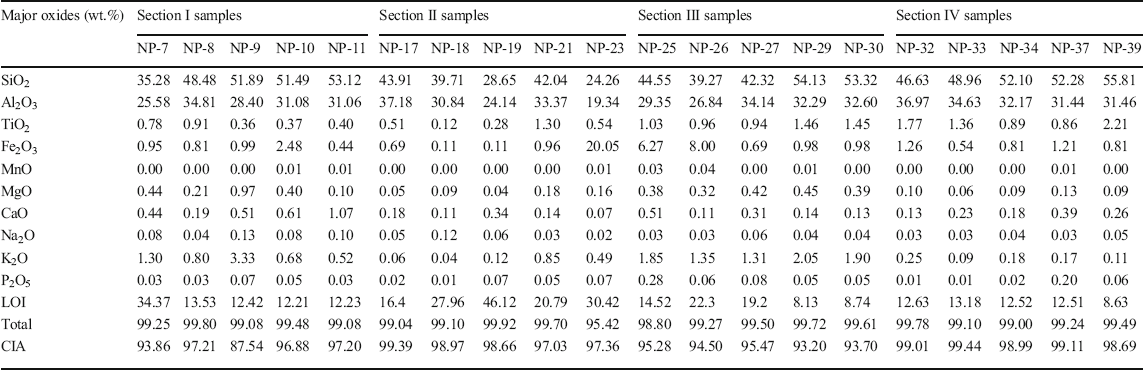
The concentrations of major elements in the claystones of the units studied (Table 2) revealed that Al2O3 and SiO2 contents ranged from 19.3 to 37.2 wt.% and 24.3 to 65.8 wt.%, respectively. Al2O3 was enriched during alteration of K-feldspars, plagioclase, and volcanic glasses in the volcanic ash. The large amount of SiO2 is due to the abundance of quartz and feldspar in the parent sediments. The present positive correlation of Al2O3 with SiO2 (r = +0.68, p < 0.01) (Fig. 7) suggested that both oxides were present mainly in kaolinite. The ratios of SiO2/Al2O3 ranged from 1.18 to 1.83 in cryptocrystalline kaolinitic claystone samples and from 1.26 to 3.07 in tonstein samples, which were mostly higher than the theoretical value of kaolinite (1.18) (Kang Reference Kang2015).
Major-element compositions (wt.%) of claystone samples in the study area, determined by XRF analysis

CIA = [Al2O3 / (Al2O3 + CaO* + Na2O + K2O)] × 100 (CaO* represents the amount in silicates only) (Nesbitt and Young Reference Nesbitt and Young1982), LOI: loss on ignition at 900°C.
Relational diagram for feature elements of the analyzed claystones (all correlations shown are for the kaolinitic claystone samples); r is Pearson’s correlation coefficient

The TiO2 content of the study samples ranges from 0.12 to 2.21 wt.%, with significantly higher values in the tonsteins than in the cryptocrystalline kaolinitic claystones (Fig. 8) because of their greater anatase content. In contrast, the TiO2 content of coal-seam partings was smaller than that of the floors and roofs of coal seams, which conforms to the hypothesis of Liu and Zhang (Reference Liu and Zhang1997) that organic acids in peat swamps can dissolve TiO2 in the partings. In the study samples, TiO2 does not show significant covariation with Al2O3 (Table 4).
Geochemical variations along the section studied in the Nanyangpo mine. The left column shows lithology. The red dotted lines separate the claystone from the sandstone; K: cryptocrystalline kaolinitic claystone; T: tonstein

The amounts of Na2O (avg. 0.05 wt.%), MgO (avg. 0.25 wt.%), K2O (avg. 0.87 wt.%), and CaO (avg. 0.30 wt.%) in the four units were generally small. The Fe2O3 content was largest in samples from the middle Taiyuan Formation (Fig. 8) owing to the presence of pyrite. Loss-on-ignition (LOI) values were 8.13–46.1 wt.%, with some organic-rich samples (especially coal partings) yielding greater LOI values.
Trace Elements in the Claystones
Trace-element enrichment factors in the claystones (EFs; Tribovillard et al. Reference Tribovillard, Algeo, Lyons and Riboulleau2006) were calculated as the ratio of the measured concentration of a particular element in a sample to its concentration in average upper continental crust (Table 3) (Taylor and McLennan Reference Taylor and McLennan1985; McLennan Reference McLennan2001). A number of trace elements were enriched significantly in the cryptocrystalline kaolinitic claystones of the study units, including Li, Cd, and Bi (EF > 2) and Ga, In, Sb, Pb, Bi, Th, U, Nb, and Ta (1 < EF < 2), but certain elements were depleted, including Be, V, Cr, Co, Ni, Rb, Cs, Sr, Ba, and Tl (EF < 0.5). In contrast, only Li (EF > 2) and Ga, Gd (1 < EF < 2) were enriched in the tonsteins of the study area, other elements were depleted (Fig. 9). In order to determine whether compositional differences between the cryptocrystalline kaolinitic claystone and tonstein samples were meaningful, the Student's t-test was performed on these two types of samples on an element-by-element basis (Table 5). The result revealed significant differences between the two types of samples with respect to the major element oxides, K2O and Na2O, as well as the trace elements Be, Sc, Ga, Rb, Sb, Cs, Pb, Tl, Bi, Th, U, Nb, and Ta.
Trace-element compositions (ppm) of claystone samples in the study area, determined by ICP-MS analysis

Eu/Eu* = EuN / (SmN × GdN)1/2 and Ce/Ce* = 3CeN / (2LaN+NdN) (Mongelli Reference Mongelli1997).
Enrichment Factors (EFs) of trace elements in cryptocrystalline kaolinitic claystones and tonsteins in the Nanyangpo mine. UCC data are from Taylor and McLennan (Reference Taylor and McLennan1985) and McLennan (Reference McLennan2001)

The high-field-strength elements (HFSE), including Zr, Hf, Nb, Ta, Th, and U, were enriched in most of the claystone samples because of their strong resistance to weathering (Panahi et al. Reference Panahi, Young and Rainbird2000). Nb, Ta, Th, and U concentrations were significantly higher in cryptocrystalline kaolinitic claystones than in tonsteins (Fig. 9; Table 5), which is consistent with tonsteins generally having smaller HFSE contents than other types of claystones (Zielinski Reference Zielinski1985). In the study samples, only Nb showed covariation with Al2O3 but other HFSEs exhibited significant correlations with MnO and CaO (Table 4), indicating that these elements were probably hosted in detrital minerals. A strong correlation between Zr and Hf (r = +0.87, p < 0.01; Fig. 7) indicated that both elements reside mostly in zircon. A strong correlation exists between Nb and Ta (r = +0.80, p < 0.01; Fig. 7) owing to their close geochemical affinity. The correlation between Th and Al2O3 is not strong (Table 4), indicating that Th may be hosted in secondary minerals or organic matter. U and Al2O3 showed a negative linear correlation (Table 4), suggesting that U was adsorbed on clay minerals (Taboada et al. Reference Taboada, Cortizas, García and García-Rodeja2006) and then lost during the process of kaolinization.
Pearson correlation coefficient of major oxides, trace elements, and some element groups of investigated samples

The large ion lithophile elements (LILEs), including Rb, Cs, Sr, and Ba, were almost entirely depleted in the samples, but the tonstein samples had lost a larger fraction of the LILEs (Fig. 9). Small amounts of LILE are due to these elements having been removed preferentially from the parent rock during kaolinization and to the small cation exchange capacity (CEC) of the neoformed kaolinite (Galán et al. Reference Galán, Aparicio, Fernández-Caliani, Miras, Márquez, Fallick and Clauer2016; Lopez et al. Reference Lopez, Bauluz, Fernández-Nieto and Oliete2005). Other trace elements including Li, Ga, Cd, In, Sb, Pb, and Bi were enriched in the cryptocrystalline kaolinitic claystones, but only Li and Ga were enriched in the tonsteins. Statistical analysis showed that those elements which do not show a positive correlation with Al2O3 (Table 4) may be present in secondary minerals (e.g. pyrite, anatase, or zircon) or organic matter.
Rare Earth Elements
The total REE contents (ΣREE) of the claystones in the study units ranged between 29.2 and 934 ppm with an average of 275 ppm. The ratio of total light rare earth elements (ΣLREE) to total heavy rare earth elements (ΣHREE) ranged between 6.4 and 26.8 with an average of 14.8 and indicates the fractionation of light and heavy rare earths, i.e. enrichment of LREE and depletion of HREE.
The REEs were normalized to chondrite values (Fig. 10) (McDonough and Sun Reference McDonough and Sun1995). Based on their distribution patterns, the main difference between cryptocrystalline kaolinitic claystone and tonstein samples are with regard to their Eu anomalies. The cryptocrystalline kaolinitic claystone samples exhibit pronounced negative Eu anomalies, having Eu/Eu* of 0.42–0.92 with an average of 0.70. Ce/Ce* values vary from 0.69 to 1.29 with an average of 0.90, revealing no anomaly or weak negative Ce anomalies. These features are consistent with a sedimentary origin of these claystones (Wang et al. Reference Wang, Wang, Zhou, Cui, Zhang, Li and Fan2013). The REE distribution patterns of the tonstein samples were characterized by weak negative to weak positive Eu anomalies (Eu/Eu* of 0.94 to 1.48 with an average of 1.16) and weak negative Ce anomalies (Ce/Ce* of 0.74 to 0.99 with an average of 0.82).
Distribution patterns of REE in the cryptocrystalline kaolinitic claystone and tonstein samples of Nanyangpo mine. REE are normalized to chondrite (chondrite data are from McDonough and Sun Reference McDonough and Sun1995)

The ΣREE contents of the study units may have been affected by remobilization during diagenesis. The ΣREE in the study area show a negative correlation with Al2O3 (r = –0.47, p = 0.07) but a positive correlation with MgO (r = +0.76, p < 0.01) and a weak covariation with K2O (r = +0.65, p < 0.01) (Fig. 7). The REEs may be mobilized and lost during alteration of the parent rocks.
Discussion
Salinity, Redox, and Weathering Conditions of the Depositional System
The sedimentary environment of the Upper Carboniferous–Lower Permian Taiyuan Formation in the Datong Basin was a mixed marine–continental transitional facies (Wang and Guo Reference Wang and Guo2020; Hou et al. Reference Hou, Shao, Wang, Xiao, Wang, Li and Mu2019; Liu et al. Reference Liu, Cao, Zhang and Li2020a). Salinity and redox conditions in the depositional system may be assessed using geochemical proxies. For example, Wei and Algeo (Reference Wei and Algeo2020) showed that, without the influence of carbonate, the ratio of Sr/Ba increases gradually during the transition from continental environments to marine environments. In the present study units, almost no carbonate minerals are present and the amount of CaO is very small, so Sr/Ba ratios were used to help infer the salinity of the depositional environment. The ratios of Sr/Ba in the claystones of Units 1, 2, and 4 are 0.27–0.83, 0.61–0.97, and 0.47–0.87, respectively (Fig. 8), suggesting a transitional environment with variation from brackish to marine conditions. Unit 3 yielded greater Sr/Ba ratios (0.89–2.10; Fig. 8) which are potentially consistent with fully marine sedimentation (Burton and Price Reference Burton and Price1990; Martinez-Ruiz et al. Reference Martinez-Ruiz, Kastner, Gallego-Torres, Rodrigo-Gámiz, Nieto-Moreno and Ortega-Huertas2015; Wei et al. Reference Wei, Algeo, Lu, Lu, Liu, Zhang, Peng, Zhang and Chen2018).
Redox conditions of the depositional system can be evaluated on the basis of trace-metal concentrations and enrichment factors (EFs) (Algeo and Liu Reference Algeo and Liu2020). U/Th ratios of 0.11–1.09 indicate oxic to anoxic conditions. The EFs of Mo and V are low, and UEF > MoEF, which are suggestive of dominantly suboxic conditions (Algeo and Tribovillard Reference Algeo and Tribovillard2009; Tribovillard et al. Reference Tribovillard, Algeo, Lyons and Riboulleau2006).
The chemical index of alteration (CIA) (Nesbitt and Young Reference Nesbitt and Young1982) was calculated to evaluate the degree of chemical weathering of detrital material in the study samples. This index was calculated using molecular proportions of the following oxides: CIA = [Al2O3 / (Al2O3 + CaO* + Na2O + K2O)] × 100, where CaO* represents the amount of CaO associated with the silicate fraction of the rock. The CIA values of the study samples were in the range 87.5–99.4; such high values are indicative of intense chemical weathering (Eggleton et al. Reference Eggleton, Foudoulis and Varkevisser1987). The kaolinite formed in an open acidic and hydrologic system in which Na, Ca, and K were leached out (Dalai et al. Reference Dalai, Rengarajan and Patel2004; Erkoyun et al. Reference Erkoyun, Kadir, Külah and Huggett2017). In addition, the CIA can also help to analyze paleoclimate conditions during weathering. The strong chemical weathering (CIA = 80–100) implies a warm and humid paleoclimate in the source area (Nesbitt and Young Reference Nesbitt and Young1982). Collectively, the foregoing analyses demonstrate that claystones in the Datong Coalfield were deposited in an acidic and anoxic transitional-marine environment.
Mineral Composition and Structure of Claystone
Textural and morphological images show that the claystones of the Nanyangpo mine contain pseudo-hexagonal platy and vermicular kaolinite crystals within a cryptocrystalline kaolinitic matrix accompanied by illite, quartz, and secondary diagenetic minerals. Similar compositions were reported by Baioumy and Gharaie (Reference Baioumy and Gharaie2008), Arbuzov et al. (Reference Arbuzov, Mezhibor, Spears, Ilenok, Shaldybin and Belaya2016), and Tauler et al. (Reference Tauler, Xu, Campeny, Amores, Melgarejo, Martinez and Gonçalves2019) for kaolinite-rich clay deposits from southern Iberia, kaolin deposits from Huíla (Colombia), and tonstein deposits from the Irkutsk Coal Basin, respectively. The Hinckley index shows that both ordered and disordered forms of kaolinite are present in the study samples (Table 1). The well-ordered (HI > 1) vermiform and plate-like morphologies suggest in situ formation (Erkoyun et al. Reference Erkoyun, Kadir and Huggett2019; Kadir and Erkoyun Reference Kadir and Erkoyun2013). These types of kaolinite can be generated by alteration of feldspars and micas in aluminosilicate clastics or volcanic ash (Erkoyun et al. Reference Erkoyun, Kadir, Külah and Huggett2017), and they are present in both the cryptocrystalline kaolinitic claystones and tonsteins. In contrast, the bulk of kaolinite in the study samples is disordered and occurs as a cryptocrystalline matrix, which may have formed through recrystallization of silica-alumina colloids produced by weathering in an acidic peat swamp environment (Kadir and Akbulut Reference Kadir and Akbulut2009). The action of organic acids in a swamp environment can alter terrigenous fine-grained clays and volcanic glass to a cryptocrystalline kaolinitic matrix (Liu et al. Reference Liu, Zhang, Liu, Liu, Li, Liu and Liu2020b; Kadir et al. Reference Kadir, Erman and Erkoyun2011). The weakly recrystallized vitric fragments and the presence of tuffaceous clastic grains in the tonsteins of the study units, as seen in the polarizing microscope images (Fig. 4l), may represent air-fall volcanic ash deposited in a non-marine, coal-forming environment (Bohor and Triplehorn Reference Bohor and Triplehorn1993; Liu et al. Reference Liu, Liu, Ding, Liu and Zhang2019). Minor amounts of illite were detected by XRD, but no textural evidence was found for illite authigenesis in any of the samples. Small proportions of detrital sediment are common in claystones (Spears Reference Spears2012), and this is the likely origin of illite in the study samples. Detrital illite represents an intermediate product in the mica/K-feldspar-to-kaolinite transformation series in the source area (Bauluz et al. Reference Bauluz, Mayayo, Yuste and González López2008).
Cathodoluminescence images revealed multiple types of quartz in the claystones, including terrigenous clastic quartz, volcanic clastic quartz, and authigenic quartz. The terrigenous clastic quartz exhibited good roundness and significant abrasion, consistent with long-distance transport (Knight et al. Reference Knight, Morison and Mortensen1999; Garzanti et al. Reference Garzanti, Andò, Vezzoli, Lustrino, Boni and Vermeesch2012). The volcanic clastic quartz had sharp edges and melting corrosion structures that are indicative of felsic ashfall deposits (Ward Reference Ward2002). The authigenic quartz precipitated in situ from Si-rich solutions (Dai et al. Reference Dai, Zhang, Seredin, Ward, Hower, Song, Wang, Li, Zhao and Kang2013). The distribution of these features between the cryptocrystalline kaolinitic claystones and tonsteins demonstrates their different origins. Specifically, terrigenous clastic quartz occurred mainly in kaolinitic claystones and were weathered products from the source area that were transported to the study area. Volcanic clastic quartz occurred in tonsteins and is the product of volcanic eruption, with the input of volcanic ash to the study area.
Nature of the Parent Rocks
The HFSEs can be used to determine the characteristics of parent rocks (Erkoyun et al. Reference Erkoyun, Kadir and Huggett2019). Zr/Hf ratios were 19.4–37.3 in the cryptocrystalline kaolinitic claystones versus 28–35.23 in the tonsteins, all of which are similar to values for granite (25–41) (Liu et al. Reference Liu, Yang and Ding1998), suggesting that the parent rocks of the claystones in the study area were mainly felsic in composition. The Nb/Ta ratio is used commonly as a tracer for magmatic parent rocks (Zhu et al. Reference Zhu, Wang, Marignac, Cuney, Mercadier, Che and Lespinasse2018, Reference Zhu, Feng, Li, Sima, Tang, Xu, Liu, Si, Li and Wen2019). In the present study, the Nb/Ta ratios of the cryptocrystalline kaolinitic claystone and tonstein samples were 9.4–17 and 15.5–19.3, respectively, consistent with felsic parent rocks (Dostal and Chatterjee Reference Dostal and Chatterjee2000).
The Al2O3/TiO2 ratios are effective indicators of parent rock type for claystones (Spears and Kanaris-Sotiriou Reference Spears and Kanaris-Sotiriou1976; Hayashi et al. Reference Hayashi, Fujisawa, Holland and Ohmoto1997; Sugitani et al. Reference Sugitani, Yamashita, Nagaoka, Yamamoto, Minami, Mimura and Suzuki2006), with values of 3–8, 8–21, and 21–70 being characteristic of mafic, intermediate, and felsic sources, respectively (Hayashi et al. Reference Hayashi, Fujisawa, Holland and Ohmoto1997; Dai et al. Reference Dai, Xie, Jia, Ward, Hower, Yan and French2017). In the present study, all cryptocrystalline kaolinitic claystones (except WP-39) exhibited TiO2-Al2O3 values indicative of a felsic source, whereas the tonstein samples had both felsic and intermediate sources (Fig. 11a). In the ΣREE vs. (La/Yb)N discrimination diagram of Allegre and Minster (Reference Allegre and Minster1978), most cryptocrystalline kaolinitic claystone samples fall into the granite field or overlapping field of granite and sedimentary rocks, with a smaller number of samples falling within the sedimentary rock field, whereas the tonstein samples fall into the overlapping field of basalt and sedimentary rocks (Fig. 11b). These results are consistent with the cryptocrystalline kaolinitic claystones being variably sourced from granite or sedimentary rocks, and the tonsteins being derived from an alkaline basalt source. This finding accounts for the significant differences in the Na2O and K2O compositions of these two types of claystone (Table 5).
Plots of elements in the kaolinitic claystone and tonstein samples from the Nanyangpo mine; a: relationship between Al2O3 and TiO2; b: the ΣREE–(La/Yb)N diagram for the samples (the base map is from Wang et al. Reference Wang, Xie, Qin, Wang, Shen, Han, Liang and Wang2018); K: cryptocrystalline kaolinitic claystone; T: tonstein

Student's t-test of kaolinitic claystone samples and tonstein samples

p < 0.05; ** p < 0.01.
The REE patterns have also been used to infer sedimentary rock sources, because mafic rocks have small ΣLREE/ΣHREE ratios and lack Eu anomalies, whereas more felsic rocks usually contain greater ΣLREE/ΣHREE ratios and negative Eu anomalies (Baioumy and Gharaie Reference Baioumy and Gharaie2008). In the present study, the LREE enrichment, HREE depletion, and negative Eu anomalies of most cryptocrystalline kaolinitic claystones confirmed their parent rock as felsic to intermediate igneous rocks or their sedimentary derivatives. Only two tonstein samples showed a weak positive Eu anomaly, indicating that their parent rock may be alkaline volcanic ash. Furthermore, according to Dai et al. (Reference Dai, Li, Seredin, Ward, Hower, Zhou, Zhang, Song, Song and Zhao2014) and Erkoyun et al. (Reference Erkoyun, Kadir and Huggett2019), high-temperature hydrothermal fluids circulating through coal deposits after peat accumulation can cause development of a positive Eu anomaly, so the thinness of the tonstein layers may have made them more prone to such diagenetic alteration processes. Although the ΣREE concentrations in samples WP-8 and WP-17 were markedly lower than other cryptocrystalline kaolinitic claystone samples, these samples exhibited similar chondrite-normalized REE distribution patterns (Fig. 10), which differ somewhat from tonstein samples. In addition, the ΣREE content in cryptocrystalline kaolinitic claystones (avg. 291 ppm) was greater than in tonsteins (avg. 215 ppm) (Table 4). Thus, the difference in ΣREE content and distribution patterns probably indicates that they are from different parent rocks (Hong et al. Reference Hong, Zhao, Fang, Algeo, Wang, Yu, Gong, Yin and Ji2019).
All of the available REE data were normalized to chondrite values (Fig. 12). These data derive from the possible parent rocks of the claystone, which include the Proterozoic metamorphic and magmatic rocks of the Yinshan Block (Liu et al. Reference Liu, Liang, Xiao and Zhang2015; Liu Reference Liu2010) and the Carboniferous volcanic rocks of the Xing'an-Mongolian Orogenic Belt (Fu et al. Reference Fu, Huang, Peng, Kusky, Zhou and Ge2016; Zhou and Jia Reference Zhou and Jia2000). Comparison between distribution patterns of REE (Figs 10 and 12) showed that the chondrite-normalized REE patterns of cryptocrystalline kaolinitic claystones are similar to those of metamorphic and magmatic rocks from the Yinshan Block. This means that these felsic rocks from the Yinshan Block provide metallogenic materials for the formation of claystone, as per the study of Cui (Reference Cui2011). But the parent rocks in the tonsteins are complex, which involves the mixing of volcanic material from the Xing'an-Mongolia Arc and the terrigenous clastic rocks from the adjacent Yinshan Block. As mentioned above, these volcanic materials may be imported in the form of volcanic ash. At the same time, these different parent rocks may cause the significant difference in element EFs between the kaolinitic and tonsteins samples.
Distribution patterns of REE in the probable sources of the studied claystones. REE are normalized to chondrite (McDonough and Sun Reference McDonough and Sun1995).

Neoformation of Kaolinite
This detailed research on the four units of the present study area has established a simplified schematic diagram of the formation model of the kaolinite in the Datong Coalfield (Fig. 13). Previous studies have shown that the claystones in the coal-bearing strata of the Datong Coalfield were deposited in a plain, with peat swamps developed throughout most of the basin during the Late Paleozoic (Guo and Wang Reference Guo and Wang2005; Xi and Zhao Reference Xi and Zhao2011). At the same time, plant residues released large quantities of organic acids during organic decomposition. This acidic environment facilitated dissolution of Fe, Si, and alkaline ions from original minerals in the parent rock, and provided a suitable environment for the formation of kaolinite (Ding et al. Reference Ding, Liu and Wang2009; Zhang et al. Reference Zhang, Luo and Zhang2012). The deposition of terrigenous and volcanogenic materials in the swampy environment resulted in transformation of feldspar and mica to kaolinite and volcanic ash to tonsteins, which are overlain and underlain by coal seams (Spears Reference Spears2012).
Formation model of the kaolinite in the Datong Coalfield

The weathering products (terrigenous clastic and colloidal solution) from the Yinshan Block and volcanogenic materials from the Xing'an-Mongolian Orogenic Belt provided the materials for the formation of claystone. The parent rocks rich in aluminosilicate minerals (feldspar and mica, etc.) depleted alkaline metal elements under weathering (Kadir et al. Reference Kadir, Külah, Eren, Önalgil and Gürel2014; Gouveia et al. Reference Gouveia, Prudencio, Figueiredo, Pereira and Waerenborgh1993). However, clay minerals such as kaolinite remained, and led to the enrichment of Si, Al, and Fe. These elements are often transported in the form of colloidal solutions (Jin et al. Reference Jin, Zhou, Huang, Xie, Jing and Liu2015; Kadir et al. Reference Kadir, Külah, Eren, Önalgil and Gürel2014). These terrigenous clastic grains and kaolinite aggregates are oriented, showing the characteristics of water flow (Liu et al. Reference Liu, Liu, Ding, Liu and Zhang2019). Therefore, those weathering products were transported to peat swamp under hydrodynamic conditions. The volcanic ashes were transported by air, however, and fell into the peat swamp sedimentary basin.
Conclusions
The Nanyangpo mine provides an excellent opportunity to improve understanding of the diagenetic process of kaolinitic claystone because it has two different types of kaolinitic claystone deposits, each with its own kaolinite identity. An integrated study on the mineralogy, chemical compositions, and textures of the claystone sediments showed that claystones associated with coal seams in the Datong Coalfield formed from terrigenous clastics, aluminosilicate colloidal solution, and volcanic ash in a swampy peaty coal environment, and the climate was hot and humid. These claystones occur on the roof, floor, or partings of the coal seams; their main mineral component is kaolinite, associated with illite, quartz, pyrite, anatase, feldspar, siderite, and calcite. The development of vermicular kaolinite crystals suggest a diagenetic origin. The well-ordered, vermiform and plate-like morphological kaolinites formed authigenically from alteration of feldspar and mica and appear in both cryptocrystalline kaolinitic claystone and tonstein. A kaolinite matrix and aggregates in cryptocrystalline kaolinitic claystone and tonstein formed by recrystallization of aluminosilicate colloidal solution and volcanic vitric fragment, respectively. In contrast, the kaolinite in tonstein has a greater degree of order.
The Al2O3/TiO2, Zr/Hf, and Nb/Ta ratios indicate that the parent rocks were felsic. The presence of volcanic quartz and vitric fragment indicates the input of volcanic ash. The chondrite-normalized REE patterns show that the parent rocks were metamorphic and magmatic rocks from the Yinshan Block, and volcanic material from the Xing'an-Mongolian Orogenic Belt. The high CIA values indicate intensive chemical weathering and an open acidic, hydrologic system. The U/Th ratios and the EFs of V, U, and Mo suggest a suboxic to anoxic environment. The leaching of Si+Fe and alkaline ions favored the formation of kaolinite under acidic conditions. The high ΣLREE/ΣHREE ratios, negative Eu anomalies, and depletion of Rb, Cs, Sr, and Ba resulted from alteration of feldspar and mica, or transportation from sediment source to the swamp peat area under reducing conditions. The correlation coefficients of the elements indicate that the REE occurred in the feldspar or mica minerals of the parent rocks, and the ΣREE content decreased with the alteration of feldspar minerals to kaolinite. The ΣREE content in cryptocrystalline kaolinitic claystone is greater than that in tonstein, which is caused by the difference in parent rocks. Overall, the formation of coal-bearing claystone is restricted mainly by two factors, one being the parent rocks and the other being the alteration and recrystallization during diagenesis.
Acknowledgments
This study was funded by the National Key R&D Program of China (No. 2019YFC1904903) and the Science and Technology Major Projects of Shanxi Province of China (No. 20181101003). The authors would like to thank the editor-in-chief Prof. Joseph W. Stucki, associate editor Prof. Selahattin Kadir, and the other anonymous reviewer for their careful comments on the manuscript, which greatly improved the quality of the paper. The authors are also grateful to Editors Kevin Murphy and Robert Preston for handling and editing the manuscript.
Funding
Funding sources are as stated in the Acknowledgments.
Declarations
Conflict of Interest
The authors declare that they have no conflict of interest.