Suicide is among the leading causes of death worldwide, with more than 720 000 people dying by suicide in 2021(1). In Japan, the suicide rate per 100 000 population was 24·6 for men and 10·9 for women in 2023(2). Although suicide rates in Japan have declined in recent years(2), rates remain among the highest among countries(3). The causes of suicide are multifaceted and involve complex interactions among social, cultural, biological, psychological and environmental factors(1). Recently, increasing attention has been paid to modifiable lifestyle factors, particularly diet, such as vegetable and fruit intake and dietary patterns, in the prevention of suicide and depression, a major risk factor for suicide.
Dietary fibre intake has attracted attention as a nutrient that is potentially associated with mental health. Dietary fibre may exert beneficial effects on mental health through its modulation of the gut microbiota and the production of microbial metabolites, such as SCFA(Reference Dalile, Van Oudenhove and Vervliet4). In addition, dietary fibre may be involved in the regulation of inflammation and metabolic homeostasis, which have been associated with depression(Reference Pugh and Chambers5,Reference Swann, Kilpatrick and Breslin6) . In humans, dietary fibre intake has been reported to be associated with a decreased prevalence or risk of depression(Reference Aslam, Lotfaliany and So7,Reference Saghafian, Hajishafiee and Rouhani8) . To date, however, the association between dietary fibre intake and suicide has not been examined. Here, we prospectively examined the association between dietary fibre intake and suicide risk using data from a large population-based cohort study in Japan.
Methods
Study design and participants
The Japan Public Health Center-based Prospective (JPHC) Study is a population-based cohort study among 140 420 residents aged 40–69 years in eleven public health centre areas across Japan. Details of the study procedure have been reported elsewhere(Reference Tsugane and Sawada9). In short, the first self-administered questionnaire survey was conducted in 1990–1993, where information on height, body weight, medical history, smoking status, physical activity and other lifestyle factors was obtained. Participants who responded to the questionnaire were regarded as consenting to participate in the study. The second survey was conducted 5 years later (1995–1998) to update information on lifestyle habits and health conditions. This study set this second survey as baseline because the questionnaire it used included comprehensive information on food intakes. This study was conducted according to the guidelines laid down in the Declaration of Helsinki, and all procedures involving human participants, including the procedure of informed consent, were approved by the Institutional Review Board of the National Cancer Center (2015–085) and the Ethics Committee of Fukuoka Women’s University (2022–27).
Of study participants in the first survey, 102 422 responded to the second survey, including the diet-related portion. We sequentially excluded 12 734 participants who did not respond to the first survey and 880 participants who reported extreme total energy intake (outside of the mean ± 3 SD according to sex). Finally, 88 808 (40 630 men and 48 178 women) were included in the analysis (Supplementary Figure 1).
Dietary assessment
A FFQ was used to assess the mean intake of 147 food and beverage items over the previous year(Reference Sasaki, Kobayashi and Ishihara10). For most food items, consumption frequency was described in nine response options, which ranged from rarely (<1 time/month) to ≥7 times/d. A standard portion size was specified for each food, and respondents were asked to denote their usual portion size from three options (<0·5 times, standard or >1·5 times), for which we assigned 0·5, 1·0 and 1·5, respectively. We calculated the mean daily intake of foods by multiplying the consumption frequency of each food and the standard size by the individual’s usual portion size. Dietary intake of energy and nutrients, including dietary fibre, was estimated by referring to the Standard Tables of Food Consumption in Japan (7th version)(11).
For intake of dietary fibre from food sources, cereals included rice, mixed rice/barley, bread, udon noodles, soba noodles, Chinese noodles and rice cakes; beans included soy products such as tofu, miso and soya milk; vegetables included green and yellow vegetables such as carrots, pumpkins and spinach, pickled vegetables and other vegetables such as cabbage and radish and fruits included oranges, apples, grapes and fruit juice.
The validity of the FFQ was assessed in a subsample using either 14- or 28-d dietary records. Spearman’s correlation coefficients of energy-adjusted intake of total dietary fibre between the FFQ and dietary records were 0·43 in men and 0·40 in women in cohort I(Reference Sasaki, Matsumura and Ishihara12) and 0·57 in men and 0·49 in women in cohort II(Reference Ishihara, Sobue and Yamamoto13).
Follow-up and outcome
The participants’ residency and vital status were followed up using the residential registry. Causes of death were confirmed via death certificates (with permission) and were defined according to the ICD-10. The focus of the present study was death from suicide (ICD-10: X60 to X84). Pearson-years of follow-up were calculated for each person starting from the date of response to the second survey questionnaire until either the date of death from suicide or the end of follow-up (December 31, 2018 for 9 areas, December 31, 2012 for 1 area and December 31, 2009 for 1 area), whichever came first.
Statistical analysis
Participants were divided into quartiles of energy-adjusted intake of total dietary fibre and dietary fibre from food sources (cereals, beans, vegetables and fruits) by residual methods. Baseline characteristics according to total dietary fibre intake were expressed as mean and percentage.
Cox proportional hazard regression analysis was performed to estimate hazard ratios and 95 % CI of mortality from suicide for quartile of dietary fibre intake, with the lowest category as reference. The first model was adjusted for age (years), sex and study site (11 areas). The second model was further adjusted for BMI (<21, 21–22·9, 23–24·9, 25–26·9 or ≥27 kg/m2), smoking status (never, past or current with a consumption of <20 or ≥20 cigarettes/d), alcohol consumption (non-drinker, occasional drinker or drinker with a consumption of <150, 150–299, 300–449 or ≥450 g ethanol/week), total physical activity (quartile of metabolic equivalent task hours/d), hypertension (yes or no), diabetes (yes or no), total energy intake (kcal/d), mental stress (low, medium and high), living status (alone, with spouse only, child(ren)/parent(s) with spouse, child(ren)/parent(s) without spouse or other), serious disease including cancer, cerebrovascular disease, myocardial infarction, chronic liver disease or renal disease (yes or no) and occupation (agriculture/forestry/fishery, salaried/self-employed/professional, multiple occupations, housework/unemployed or other). The third model was further adjusted for intake of vitamin B12 (μg/d), vitamin D (μg/d), Ca (mg/d), Zn (mg/d) and n-3 PUFA (%energy). Models for cereal, bean, vegetable and fruit fibre were additionally adjusted for the other types of fibre (g/d). Since the intake of folate, vitamin B6, Mg and Fe, which have been reported to be associated with depression(Reference Bender, Hagan and Kingston14–Reference Wu, Zhang and Li17), was highly correlated with dietary fibre intake (Pearson correlation coefficients 0·76 for folate, 0·56 for vitamin B6, 0·71 for Mg and 0·66 for Fe), these nutrients were adjusted for in a separate model (model 4). Variance inflation factors were all below 10, indicating no multicollinearity. An indicator variable for missing data was created for each covariate. Trend association was assessed by treating the median in each quartile of dietary fibre intake as a continuous variable. Covariates were selected based on previous studies and a causal framework for depression and suicide. Because BMI may be a potential mediator of the association between dietary fibre intake and suicide risk, we conducted a sensitivity analysis excluding BMI from model 2. Furthermore, we repeated the analyses after excluding deaths from suicide during the first 3 years of follow-up to minimize the potential influence of mental illness at baseline.
We also analysed the association between total dietary fibre intake and suicide risk stratified by age (<60 or ≥60 years old), sex, BMI (<25 or ≥25 kg/m2), smoking status in men only (non-smokers or current smokers), alcohol consumption (non-drinkers or drinkers), total physical activity (metabolic equivalent task h/d, <median or ≥median) and mental stress (low/middle or high). An interaction term was created by multiplying total dietary fibre intake (quartile) and the above stratifying variables (dichotomous) and added to the model to assess statistical interactions. We provide exact p-values without dichotomising the results. All analyses were performed using Statistical Analysis System (SAS) software version 9·4 (SAS Institute, Cary, NC, USA).
Results
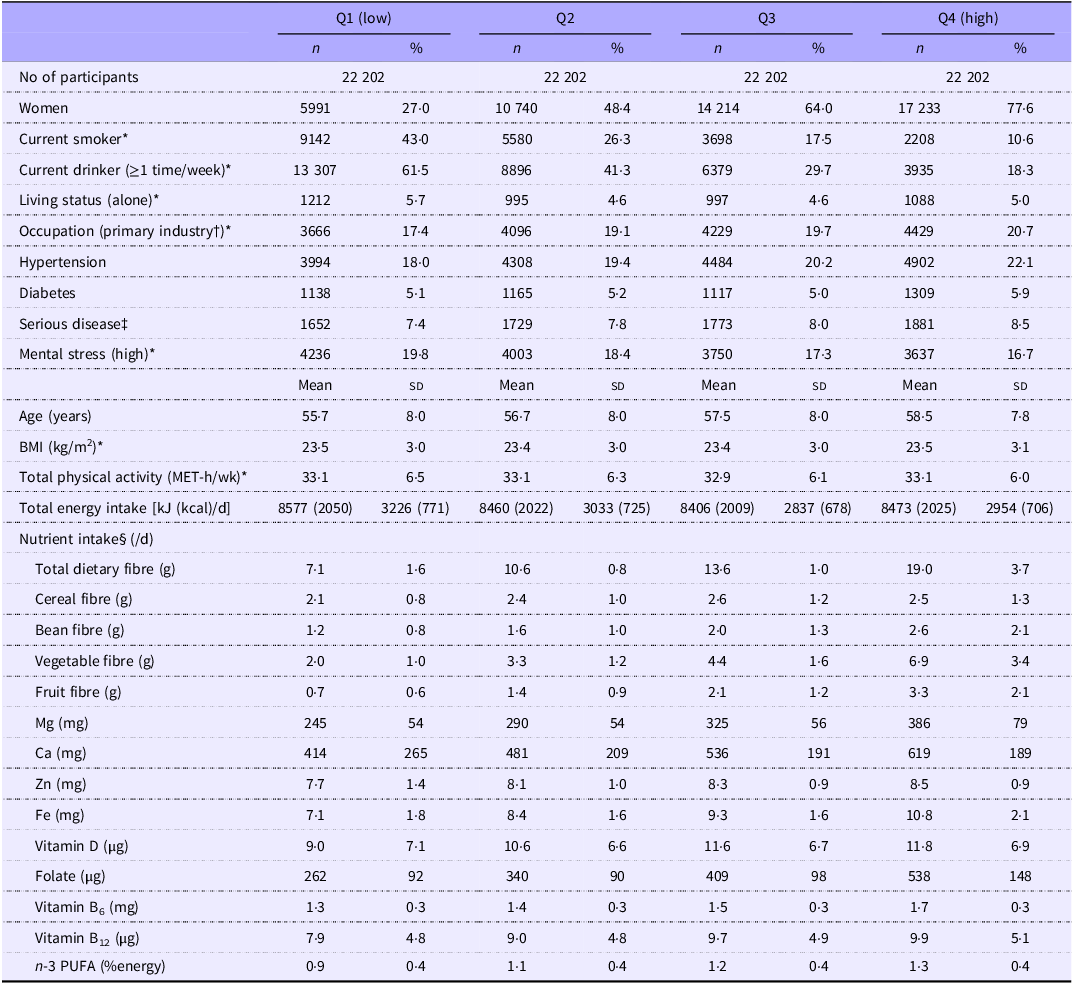
Baseline characteristics of the study participants according to quartile of total dietary fibre intake are shown in Table 1. Participants with higher intake of total dietary fibre were older; less likely to be men, current smokers or current drinkers and more likely to be employed in primary industries. They tended to have a lower prevalence of high mental stress and a higher prevalence of hypertension, diabetes and serious disease. They also tended to consume more Mg, Ca, Zn, Fe, vitamin D, folate, vitamin B6, vitamin B12 and n-3 PUFA than those with a lower intake of total dietary fibre.
Baseline characteristics according to quartile (Q) of total dietary fibre intake

Table 1. Long description
The table presents baseline characteristics of study participants categorized by quartiles of total dietary fibre intake. It includes four quartiles (Q1 to Q4) with 22,202 participants each. The table has 20 rows and 8 columns, with columns labeled as Q1 (low), Q2, Q3, and Q4 (high), each showing the number of participants (n) and percentage (%). Row labels include various characteristics such as the number of women, current smokers, current drinkers, living status (alone), occupation (primary industry), hypertension, diabetes, serious disease, and mental stress (high). Additionally, it provides mean values and standard deviations for age, BMI, total physical activity, total energy intake, and various nutrient intakes per day. Each row provides specific values for each quartile, showing trends and comparisons across different levels of dietary fibre intake.
Abbreviation: MET, metabolic equivalent of task.
* Participants with missing information were excluded (BMI, n 2415; smoking status, n 4222; alcohol consumption, n 2661; total physical activity, n 15 873; living status, n 2539; occupation, n 3512; mental stress, n 2188).
† Agriculture, forestry or fishery.
‡ Serious disease including cancer, cerebrovascular disease, myocardial infarction, chronic liver disease and renal disease.
§ Nutrient intake excluding n-3 PUFA was adjusted for energy intake using the residual method.
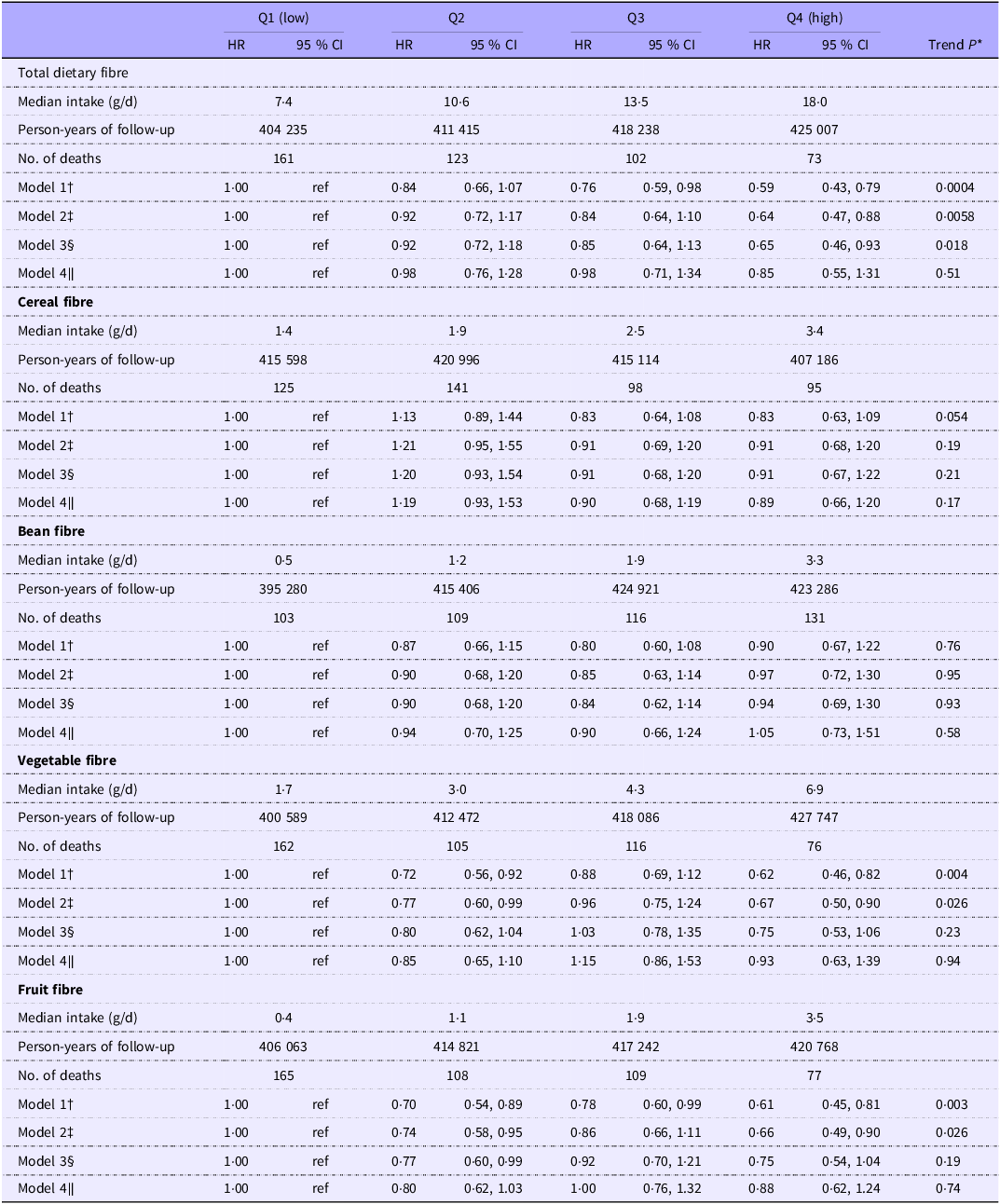
During 1 658 894 person-years of follow-up (mean 18·7 years), we identified 459 deaths from suicide. Hazard ratios of suicide according to quartile of dietary fibre intake are shown in Table 2. Total dietary fibre intake was associated with a lower risk of suicide in model 1, which adjusted for age, sex and study site, as well as in model 2, which adjusted for covariates other than dietary factors. In model 2, the hazard ratio for suicide on comparison of the highest with the lowest quartile of total dietary fibre intake was 0·64 (95 % CI 0·47–0·88). This result remained largely unchanged after additional adjustment for intakes of vitamin B12, vitamin D, Ca, Zn and n-3 PUFA (hazard ratio 0·65, 95 % CI 0·46–0·93) (model 3). However, further adjustment for folate, vitamin B6, Mg and Fe attenuated the association, which was no longer statistically significant (hazard ratio 0·85, 95 % CI 0·55–1·31) (model 4).
Hazard ratios (95 % CI) for suicide according to quartile (Q) of dietary fibre intake

Table 2. Long description
A table comparing hazard ratios (HR) and 95 percent confidence intervals (CI) for suicide across quartiles (Q1 to Q4) of dietary fiber intake. The table has 20 rows and 13 columns. Column headers include Q1 (low), Q2, Q3, and Q4 (high), each with HR and 95 percent CI sub-columns, and a Trend P* column. Row labels include Total dietary fibre, Cereal fibre, Bean fibre, Vegetable fibre, and Fruit fibre, each with median intake (g/d), person-years of follow-up, number of deaths, and four models (Model 1 to Model 4) with their respective HR and 95 percent CI values. Notable trends include a general decrease in HR for suicide with increasing dietary fiber intake across most models and fiber types, with significant trends observed in some models.
Abbreviation: ref, reference.
* Based on Cox proportional hazards model, assigning median intake to the quartile of dietary fibre intake.
† Adjusted for age (years), sex and study area (11 areas).
‡ Additionally adjusted for BMI (<21, 21–22.9, 23–24.9, 25–26.9 or ≥27 kg/m2), smoking status (never, past or current with a consumption of <20 or ≥20 cigarettes/d), alcohol consumption (non-drinker, occasional drinker or drinker with a consumption of <150, 150–299, 300–449 or ≥450 g ethanol/week), total physical activity (quartile of metabolic equivalent task hours/d), hypertension (yes or no), diabetes (yes or no), total energy intake (kcal/d), mental stress (low, medium and high), living status (alone, with spouse only, child(ren)/parent(s) with spouse, child(ren)/parent(s) without spouse or other), serious disease (yes or no) and occupation (agriculture/forestry/fishery, salaried/self-employed/professional, multiple occupations, housework/unemployed or other).
§ Additionally adjusted for intake of vitamin B12 (μg/d), vitamin D (μg/d), Ca (mg/d), Zn (mg/d) and n-3 PUFA (%energy); and mutually adjusted for intake of cereal fibre (g/d), bean fibre (g/d), vegetable fibre (g/d) and fruit fibre (g/d).
‖ Additionally adjusted for intake of folate (μg/d), vitamin B6 (mg/d), Mg (mg/d) and Fe (mg/d).
On analysis of dietary fibre from different food sources, both vegetable and fruit fibre intakes were associated with a lower risk of suicide in models 1 and 2. The hazard ratios (95 % CI) for suicide in the highest v. lowest quartile of dietary fibre intake were 0·67 (0·50–0·90) for vegetable fibre and 0·66 (0·49–0·90) for fruit fibre (model 2). Although the association was somewhat attenuated after additional adjustment for vitamin B12, vitamin D, Ca, Zn and n-3 PUFA, the risk of suicide was 25 % lower in the highest quartile of vegetable and fruit fibre intake compared with the lowest quartile (model 3). In model 4, which further adjusted for nutrients highly correlated with total dietary fibre intake, these associations were no longer apparent, with the corresponding hazard ratios (95 % CI) being 0·93 (0·63–1·39) for vegetable fibre and 0·88 (0·62–1·24) for fruit fibre. In contrast, cereal and bean fibre intake was not associated with suicide risk in any model.
In the sensitivity analysis excluding BMI from model 2, the association between dietary fibre intake and suicide risk remained materially unchanged (Supplementary Table 1). After exclusion of deaths from suicide during the first 3 years of follow-up, a similar trend was observed. The risk of suicide tended to decrease with higher intake of total, vegetable and fruit fibre in model 3; the hazard ratios (95 % CI) for suicide in the highest v. lowest quartile of dietary fibre intake were 0·69 (0·47–1·01) for total dietary fibre, 0·81 (0·56–1·17) for vegetable fibre and 0·78 (0·55–1·12) for fruit fibre. However, after additional adjustment for folate, vitamin B6, Mg and Fe, these associations were substantially attenuated; the corresponding values (95 % CI) were 0·90 (0·56–1·44) for total dietary fibre, 1·03 (0·67–1·58) for vegetable fibre and 0·93 (0·64–1·36) for fruit fibre.
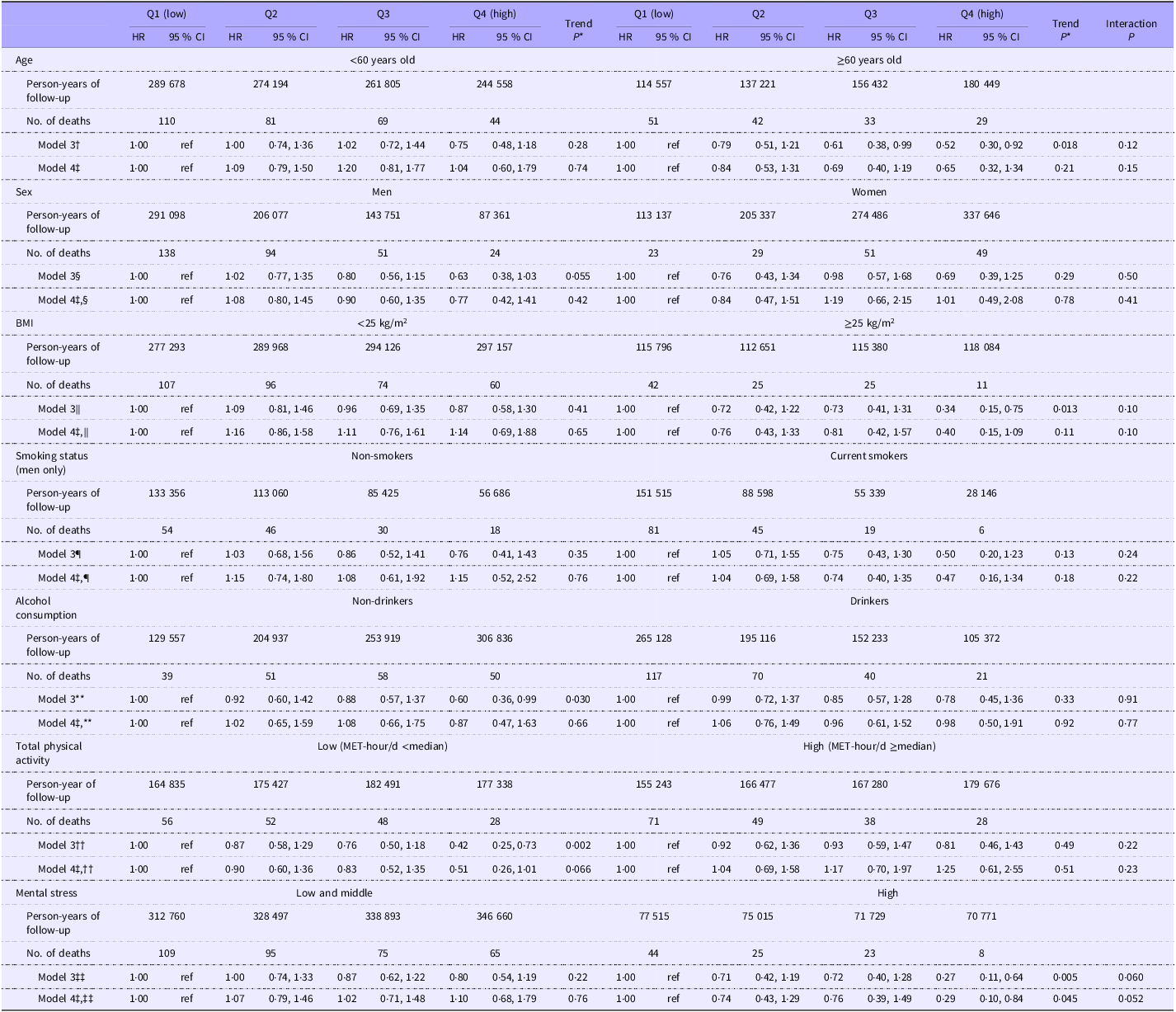
In stratified analyses, total dietary fibre intake was associated with a decreased risk of suicide among participants with high mental stress in model 4 (Table 3). In addition, the risk tended to decrease with total dietary fibre intake among obese participants and those with low physical activity in model 4. However, no interactions for these factors were observed.
Hazard ratios (95 % CI) for suicide according to quartile (Q) of total dietary fibre intake by age, sex. BMI, smoking status, total physical activity and mental stress

Table 3. Long description
The table presents hazard ratios (HR) and 95% confidence intervals (CI) for suicide according to quartiles (Q1 to Q4) of total dietary fibre intake, stratified by age, sex, BMI, smoking status, total physical activity, and mental stress. The table has 12 columns: Q1 (low) HR, Q1 95% CI, Q2 HR, Q2 95% CI, Q3 HR, Q3 95% CI, Q4 (high) HR, Q4 95% CI, Trend P, and Interaction P. It includes rows for different strata such as age groups (<60 years old, ≥60 years old), sex (men, women), BMI (<25 kg/m², ≥25 kg/m²), smoking status (non-smokers, current smokers), alcohol consumption (non-drinkers, drinkers), total physical activity (low, high), and mental stress (low and middle, high). Each row provides person-years of follow-up, number of deaths, and hazard ratios for models 3 and 4. Notable trends include a general decrease in hazard ratios with higher quartiles of dietary fibre intake in certain strata, such as participants with high mental stress and those with low physical activity.
Abbreviations: MET, metabolic equivalent of task; ref, reference.
* Based on Cox proportional hazards model, assigning median intake to quartile of total dietary fibre intake.
† Adjusted for age (years), sex, study area (11 areas), BMI (<21, 21–22.9, 23–24.9, 25–26.9 or ≥27 kg/m2), smoking status (never, past or current with a consumption of <20 or ≥20 cigarettes/d), alcohol consumption (non-drinker, occasional drinker or drinker with a consumption of <150, 150–299, 300–449 or ≥450 g ethanol/week), total physical activity (quartile of metabolic equivalent task hours/d), hypertension (yes or no), diabetes (yes or no), total energy intake (kcal/d), mental stress (low, medium and high), living status (alone, with spouse only, child(ren)/parent(s) with spouse, child(ren)/parent(s) without spouse or other), serious disease (yes or no), occupation (agriculture/forestry/fishery, salaried/self-employed/professional, multiple occupations, housework/unemployed or other) and intake of vitamin B12 (μg/d), vitamin D (μg/d), Ca (mg/d), Zn (mg/d) and n-3 PUFA (%energy).
‡ Additionally adjusted for intake of folate (μg/d), vitamin B6 (mg/d), Mg (mg/d) and Fe (mg/d).
§ Adjusted for the same variables as footnote †, with the exception of sex.
‖ Adjusted for the same variables as footnote †, but BMI was used as a continuous variable.
¶ Adjusted for the same variables as footnote †, but smoking status (<20 or ≥20 cigarettes/d) was used as an adjustment factor only among current smokers.
** Adjusted for the same variables as footnote †, but alcohol consumption (occasional drinker or drinker with a consumption of <150, 150–299, 300–449 or ≥450 g ethanol/week) was used as an adjustment factor only among drinkers.
†† Adjusted for the same variables as footnote †, but total physical activity was used as a continuous variable.
‡‡ Adjusted for the same variables as footnote †, with the exception of mental stress.
Discussion
In this large, population-based prospective cohort of Japanese adults, higher intake of total, vegetable and fruit dietary fibre was associated with a 25–35 % lower risk of suicide. These inverse associations were largely attenuated and no longer statistically significant after adjustment for intake of folate, vitamin B6, Mg and Fe. To our knowledge, this is the first study to examine the association between dietary fibre intake and suicide risk.
Our finding of the substantial attenuation of the association between dietary fibre intake and suicide risk after adjustment for correlated nutrients may reflect the challenge of isolating the contribution of any single nutrient from a food matrix when foods and nutrients are consumed as part of an overall dietary pattern. Dietary fibre does not travel alone. Participants with higher dietary fibre intake consume more vegetables, fruits and legumes, resulting in higher intakes of folate, Mg, vitamin B6 and Fe, all of which have independent associations with depression and brain health(Reference Bender, Hagan and Kingston14–Reference Wu, Zhang and Li17). In fact, these nutrients were strongly correlated with dietary fibre in our study (correlation coefficients 0·56–0·76). This degree of collinearity means that no amount of statistical adjustment can cleanly separate the effect of fibre from the dietary matrix it comes embedded in. This is a longstanding issue that has been extensively discussed in nutritional epidemiology(Reference Hu18,Reference Mozaffarian19) . Therefore, the present findings suggest that what we are likely observing is the protective effect of an overall health-promoting dietary pattern, rather than an isolated effect of fibre per se. Thus, dietary fibre may represent a broader dietary context or overall diet quality, reflecting the combined effect of multiple nutrients that are typically consumed together and are beneficial for mental health. This does not necessarily negate a meaningful role for dietary fibre, such as gut microbiota-related mechanisms or reduced systemic inflammation, rather such pathways likely act interactively alongside co-occurring nutrients(Reference Randeni and Xu20,Reference Śliwiński and Gawlik-Kotelnicka21) . This interpretation is supported by a prospective Australian study, which reported an inverse association between dietary fibre intake and depressive symptoms that was substantially attenuated after adjustment for other correlated dietary factors(Reference Swann, Breslin and Kilpatrick22). The authors noted that dietary fibre may reflect broader aspects of overall diet quality rather than exerting a fully independent effect(Reference Swann, Breslin and Kilpatrick22).
Despite attenuation after multivariable adjustment included highly correlated nutrients (such as folate, vitamin B6, Mg and Fe), our finding of a decreased risk of suicide associated with higher total dietary fibre before controlling for these nutrients is compatible with previous studies of suicide-related outcomes. In the National Health and Nutrition Examination Survey of the USA, dietary fibre intake was lower in suicide attempters than in non-attempters (unadjusted for other dietary factors)(Reference Zhang, Li and Torres23) and inversely associated with suicidal ideation (OR for the highest v. lowest quartile of total dietary fibre intake 0·66, 95 % CI 0·43–1·02), where adjustment for nutrients was limited to carbohydrates, unsaturated fatty acids and Na(Reference Huang, Fu and Lu24). In a meta-analysis of observational studies on depression, a major risk factor for suicide, participants in the highest category of total dietary fibre intake had 10 % lower odds of depression compared with those in the lowest category (OR 0·90, 95 % CI 0·86–0·95), though only five of fourteen included studies adjusted for any nutrients(Reference Saghafian, Hajishafiee and Rouhani8). Because previous studies did not fully account for closely related nutrients, a completely independent association of dietary fibre cannot be definitively established. Nevertheless, our findings, together with these lines of evidence, support the hypothesis that greater consumption of foods rich in dietary fibre may contribute to lowering the risk of suicide.
Although the association observed between dietary fibre intake and suicide was attenuated in the fully adjusted model, several potential mechanisms may be hypothesised. Dietary fibre, particularly fermentable fibre, is metabolised by gut microbiota into SCFA, which exert anti-inflammatory properties, modulate neurotransmitters and neurotrophic factors and stabilise blood glucose(Reference Ratajczak, Rył and Mizerski25–Reference Wu, Li and Zhou29). These pathways provide potential hypotheses for future research exploring how dietary fibre might be involved in mood regulation and stress responses.
In this study, before adjustment for correlated nutrients, inverse associations were observed for vegetable and fruit fibre but not for cereal or bean fibre. The meta-analysis found that the decrease in the odds of depression associated with higher intake of vegetable fibre (OR 0·73, 95 % CI 0·66–0·82) was greater than that associated with fruit (OR 0·90, 95 % CI 0·79–1·01) or cereal fibre (OR 0·87, 95 % CI 0·75–1·00)(Reference Saghafian, Hajishafiee and Rouhani8). In a Japanese study, higher intakes of vegetable and fruit fibre were associated with lower odds of depressive symptoms, whereas cereal fibre showed no such association(Reference Miki, Eguchi and Kurotani30). These findings suggest that the association of dietary fibre with mental health may differ by food source. Vegetable and fruit fibres are not only relatively rich in soluble and fermentable fibres but also serve as key sources of antioxidants and micronutrients such as folate, vitamin C and Mg, which may collectively contribute to mental health. In contrast, cereal fibres are mainly insoluble and less fermentable and thus contribute primarily to bowel regularity and blood glucose stabilisation(Reference Dhingra, Michael and Rajput31). Such qualitative differences among fibre sources, including solubility, fermentability and associated nutrient composition, may partly explain the observed differences in their associations with depression and suicide. In addition to qualitative differences, differences in fibre intake from each source may also contribute to the observed associations. In Japan, cereals are commonly consumed as refined grains such as white rice, which is relatively low in dietary fibre, and cereal fibre intake in Japan is accordingly lower than that in Western countries (mean cereal fibre intake: 2·4 g/d in our study and 7·0 g/d in the USA(Reference McGill, Fulgoni and Devareddy32)). Moreover, because white rice is habitually consumed as a staple food across the population, inter-individual variability in cereal fibre intake is smaller than that of vegetable and fruit fibre (interquartile range: 1·7–2·8 g/d for cereal fibre, 2·3–5·3 g/d for vegetable fibre and 0·7–2·5 g/d for fruit fibre). These factors may partly explain the lack of an observed association between cereal fibre intake and suicide.
Strengths of the present study included its large sample size, population-based prospective design, the relatively few participants lost during follow-up; use of a validated FFQ and adjustment for potentially important confounding variables. Our study also had some limitations. First, since we had no information on other potential confounding factors including socio-economic status, substance misuse and family history of suicidal behavior, the possibility of bias due to these confounders cannot be ruled out. In particular, socio-economic status may be an important confounder. Participants with lower household income tend to consume fewer vegetables and fruits(33), the primary sources of dietary fibre, while they are also at higher risk of suicide(Reference Hughes, Liu and Qin34). In addition, participants who consistently consume diets rich in vegetables, fruits and fibre-dense whole foods also tend to have more stable incomes, better access to healthcare, higher education levels, stronger social networks, lower rates of substance misuse and greater health literacy(Reference Darmon and Drewnowski35), all of which are independently protective against suicide(Reference Turecki and Brent36). Because such socio-economic and behavioural factors are difficult to fully eliminate, even when income data are available, the lack of socio-economic data in our study leaves open the possibility of substantial residual confounding. Therefore, the observed inverse association may partly reflect these unmeasured socio-economic and lifestyle advantages.
Second, we excluded participants who did not respond to the first survey, as information on pre-existing serious diseases was unavailable. This exclusion may have introduced selection bias if non-respondents differed in health status or suicide risk from respondents. Furthermore, participants who complete multi-stage longitudinal surveys are generally not representative of the general population, as they tend to be more health-conscious, highly educated and engaged with their own well-being. In our study, the estimated mean total dietary fibre intake was 12·6 g/d (median 12·0 g/d), which was lower than the national average (mean 15·0 g/d)(37). This difference may be largely attributable to the inherent property of FFQ to underestimate absolute dietary intake compared with weighed food records used in national surveys. However, the range of fibre intake being compared across quartiles in our study (from 7·1 g/d in Q1 to 19·0 g/d in Q4) was comparable with the population variance observed in national data (mean 15·0 g/d, sd 6·9 g/d)(37). This indicates that our study captures the broad spectrum of relative fibre consumption in Japan. Nevertheless, as our cohort may represent a relatively health-conscious population, the present findings may not be generalisable to less health conscious or non-Japanese populations.
Third, mental disorders such as depression at baseline were not assessed in the JPHC study. Depression present at the time of the baseline dietary assessment could have influenced both dietary fibre intake and future suicide risk. Lower intake of dietary fibre may be caused by loss of appetite as a result of depression; however, we confirmed that total energy intake was comparable across dietary fibre quartiles. Furthermore, to minimise this potential influence, we reanalysed data with exclusion of deaths from suicide during the first 3 years of follow-up and adjusted for mental stress at baseline. Nevertheless, because baseline depression data were unavailable, potential changes in diet quality or residual confounding by unmeasured mental health conditions cannot be entirely ruled out. Finally, dietary intakes were assessed at a single time point and thus may not reflect long-term intake levels. Moreover, the validity of dietary fibre intake assessed by the FFQ was moderate (0·40–0·57). Measurement error in the FFQ might result in biased association between dietary fibre intake and suicide risk, which would likely drive the results toward the null.
In conclusion, we found a decreased risk of suicide associated with dietary fibre intake, particularly from vegetables and fruits, among Japanese adults. However, this association was substantially attenuated after adjustment for highly correlated nutrients such as folate, vitamin B6, Mg and Fe. These findings suggest that greater consumption of foods rich in dietary fibre and related nutrients may be beneficial for mental health. From a public health perspective, encouraging dietary patterns rich in fibre such as vegetables and fruits may serve as a practical approach to supporting population mental health, though intervention studies are needed to confirm causal associations.
Supplementary material
For supplementary material/s referred to in this article, please visit https://doi.org/10.1017/S0007114526109374
Data availability statement
Data described in the manuscript, code book and analytic code may be available upon request. (For information on how to submit an application to gain access to JPHC data/or biospecimens, please follow the instructions at http://epi.ncc.go.jp/en/jphc/805/8155.html.)
Acknowledgements
We thank all the members of the JPHC Study team. The JPHC study members (as of April 2024) are listed at https://epi.ncc.go.jp/en/jphc/781/9509.html.
Author contributions
S.T. and N.S. designed the research and were the principal investigator; A.G., M.N., S.T. and N.S. conducted the surveys; A.N. analysed the data; T.M. provided statistical expertise; A.N. drafted the manuscript; A.N. and T.M. had primary responsibility for the final manuscript. All authors read and approved the final manuscript. We thank all the members of the JPHC Study team. The JPHC study members (as of April 2024) are listed at https://epi.ncc.go.jp/en/jphc/781/9509.html
Financial support
This study was supported by National Cancer Center Research and Development Fund (since 2011) and a Grant-in-Aid for Cancer Research from the Ministry of Health, Labour and Welfare of Japan (from 1989 to 2010). The funders had no role in the study design, data collection, data analysis and interpretation, writing of the report or the decision to submit the article for publication.
Competing interests
None.