Introduction
Young people aged 0–24 years make up 44% of the world's population (United Nations, 2011). While the global population continues to age, this is happening at a much slower pace in low- and middle income countries (LMICs). In these countries, children and youth make up 47% of the population compared to 30% in high-income countries (HICs). Most importantly, 91% of the world's children and youth live in LMICs (United Nations, 2011). Given that the prominent youth bulge has the potential to drive future global economic prosperity, the health and well-being of young people is an asset for the individual and their broader communities (Sawyer et al. Reference Sawyer, Afifi, Bearinger, Blakemore, Dick, Ezeh and Patton2012).
Mental and substance use disorders are major contributors to health-related disability in children and youth (Gore et al. Reference Gore, Bloem, Patton, Ferguson, Joseph, Coffey, Sawyer and Mathers2011; Sawyer et al. Reference Sawyer, Afifi, Bearinger, Blakemore, Dick, Ezeh and Patton2012; WHO, 2014). Half of all cases of mental disorders develop by age 14 years although most remain undetected and untreated until later in life (Patel et al. Reference Patel, Flisher, Hetrick and Mcgorry2007; WHO, 2014). This is concerning given the immediate and long-term adverse consequences on an individual's health and non-health outcomes. For example, a young person with conduct disorder is at increased risk of an array of negative consequences including poor educational achievement (Fergusson et al. Reference Fergusson, Horwood and Lynskey1993), increased risk of drug and alcohol use (Hopfer et al. Reference Hopfer, Salomonsen-Sautel, Mikulich-Gilbertson, Min, Mcqueen, Crowley, Young, Corley, Sakai, Thurstone, Hoffenberg, Hartman and Hewitt2013), unemployment, (Colman et al. Reference Colman, Murray, Abbott, Maughan, Kuh, Croudace and Jones2009), and higher rates of criminality (Kjelsberg, Reference Kjelsberg2002). In recent years, high prevalence of mental and substance use disorders have been consistently reported in national youth surveys conducted in a number of countries (Sawyer et al. Reference Sawyer, Arney, Baghurst, Clark, Graetz, Kosky, Nurcombe, Patton, Prior, Raphael, Rey, Whaites and Zubrick2001; Green et al. Reference Green, Mcginnity, Meltzer, Ford and Goodman2005; Ravens-Sieberer et al. Reference Ravens-Sieberer, Wille, Erhart, Bettge, Wittchen, Rothenberger, Herpertz-Dahlmann, Resch, Hölling, Bullinger, Barkmann, Schulte-Markwort and Döpfner2008; Kessler et al. Reference Kessler, Avenevoli, Costello, Greif Green, Gruber, Heeringa, Merikangas, Pennell, Sampson and Zaslavsky2012). For example, the US National Comorbidity Survey Adolescent Supplement found the point prevalence of any DSM-IV disorder was 23.4% (Kessler et al. Reference Kessler, Avenevoli, Costello, Greif Green, Gruber, Heeringa, Merikangas, Pennell, Sampson and Zaslavsky2012). Prospective longitudinal studies have found that the majority of children and youth experience a mental and/or substance use disorder prior to reaching adulthood (Moffitt et al. Reference Moffitt, Caspi, Taylor, Kokaua, Milne, Polanczyk and Poulton2010; Copeland et al. Reference Copeland, Shanahan, Costello and Angold2011). Investigating the global and country-level burden attributable to mental and substance use disorders in children and youth is important from both an epidemiological and global health policy standpoint, particularly given the large proportion of children and youth living in LMICs. This paper explores both the magnitude and patterns in the burden of mental and substance use disorders in young people aged 0–24 years while also identifying the limitations presented by the available epidemiological data and burden estimation methodology. Burden is investigated using data from the Global Burden of Disease Study 2010 (GBD 2010). GBD 2010 was one of the largest research undertakings in the health field, generating over 1 billion results for deaths, years of life lost due to premature mortality (YLLs), years lived with disability (YLDs) and disability-adjusted life years (DALYs), covering 291 causes for 187 countries aggregated into 21 regions, seven super-regions and the entire globe (Lim et al. Reference Lim, Vos, Flaxman, Danaei, Shibuya and Adair-Rohani2012; Lozano et al. Reference Lozano, Naghavi, Foreman, Lim, Shibuya and Aboyans2012; Murray et al. Reference Murray, Vos, Lozano, Naghavi, Flaxman and Michaud2012; Salomon et al. Reference Salomon, Vos, Hogan, Gagnon, Naghavi and Mokdad2012a , Reference Salomon, Wang, Freeman, Vos, Flaxman, Lopez and Murray b ; Vos et al. Reference Vos, Flaxman, Naghavi, Lozano, Michaud and Ezzati2012; Wang et al. Reference Wang, Dwyer-Lindgren, Lofgren, Rajaratnam, Marcus, Levin-Rector, Levitz, Lopez and Murray2012). The main trends were clear: humans across the globe were living longer albeit sicker with disease burden shifting from communicable to non-communicable diseases in almost every region (Murray et al. Reference Murray, Vos, Lozano, Naghavi, Flaxman and Michaud2012). As such, GBD 2010 provides a platform for comprehensively exploring of the global burden of mental and substance use disorders in children and youth.
Method
Given that ‘childhood’, ‘adolescence’, and ‘youth’ are ambiguous terms allocated to varying age ranges, we use the term ‘children and youth’ to describe young people aged from 0–24 years of age’. The methodology of GBD 2010 relating to mental and substance use disorders has been described comprehensively in previous publications (Lozano et al. Reference Lozano, Naghavi, Foreman, Lim, Shibuya and Aboyans2012; Murray et al. Reference Murray, Vos, Lozano, Naghavi, Flaxman and Michaud2012; Vos et al. Reference Vos, Flaxman, Naghavi, Lozano, Michaud and Ezzati2012; Whiteford et al. Reference Whiteford, Degenhardt, Rehm, Baxter, Ferrari, Erskine, Charlson, Norman, Flaxman, Johns, Burstein, Murray and Vos2013). Here, we give a brief explanation of the methodology utilized for each burden metric with a focus on considerations for the child and youth age group. A flowchart showing the GBD methodology step-by-step is available online (see Supplementary material).
Case definitions
Mental and substance disorders were defined according to the Diagnostic and Statistical Manual of Mental Disorders (DSM; APA, 2000) and the International Classification of Diseases (ICD; WHO, 1992). Inclusion required individual disorders to meet the threshold for a case according to at least one of these diagnostic criteria. Twenty disorders were included for burden quantification: major depressive disorder (MDD), dysthymia, anxiety disorders (as a single cause), bipolar disorder, schizophrenia, conduct disorder, attention-deficit/hyperactivity disorder (ADHD), autism, Asperger's syndrome, anorexia nervosa, bulimia nervosa, idiopathic intellectual disability, cannabis dependence, cocaine dependence, amphetamine dependence, opioid dependence, other drug dependence (a residual category), alcohol dependence, fetal alcohol syndrome, and a residual category of other mental and substance use disorders. Idiopathic intellectual disability was the remaining component once all other intellectual disability had been re-attributed to specific causes (e.g. neonatal encephalopathy) in order to avoid double counting. Certain major disorder groups, e.g. personality disorders, were not included because of exceedingly sparse epidemiological data (Erskine et al. Reference Erskine, Ferrari, Nelson, Polanczyk, Flaxman, Vos, Whiteford and Scott2013). The burden of these disorder groups was therefore represented in either the ‘other mental and substance use disorder’ or ‘other drug use disorder’ residual categories.
Disability-adjusted life years (DALYs)
DALYs are the metric of overall burden utilized by GBD 2010, calculated by summing years lived with disability (YLDs) and years of life lost due to premature mortality (YLLs). As such, DALYs represent both non-fatal (YLDs) and fatal (YLLs) burden with 1 DALY equivalent to the loss of 1 year of healthy life.
Years lived with disability (YLDs)
YLDs are calculated by multiplying the number of prevalent cases by a disability weight. Systematic reviews were conducted for each mental and substance use disorder (with the exception of the residual categories and idiopathic intellectual disability) according to the Preferred Reporting Items for Systematic Reviews and Meta-Analyses (PRISMA) guidelines (Moher et al. Reference Moher, Liberati, Tetzlaff and Altman2009). Electronic databases (PsycINFO, Medline, EMBASE) were searched while grey literature was also explored and experts were consulted for additional data sources. Studies were required to be representative of the general population, use DSM (APA, 2000) or ICD (WHO, 1992) criteria, and have been published since 1980. In order to maximize data inclusion, estimates derived from both DSM and ICD were included. To meet DSM or ICD criteria, a study needed to have used structured diagnostic instruments with validated crosswalks to DSM/ICD diagnoses. The initial literature search was conducted for the period 1980–2008 but manual checks of the literature were conducted in consultation with experts up until 2011. Estimates of prevalence, incidence, remission, duration, and excess mortality were extracted while details of study methodology were also recorded. Only point or past-year prevalence was accepted given demonstrated recall bias associated with lifetime estimates (Moffitt et al. Reference Moffitt, Caspi, Taylor, Kokaua, Milne, Polanczyk and Poulton2010; Compton & Lopez, Reference Compton and Lopez2014; Takayanagi et al. Reference Takayanagi, Spira, Roth, Gallo, Eaton and Mojtabai2014). For incidence, we used hazard rates with person-years of follow-up as the denominator. For mortality, standardized mortality ratios or relative risks were extracted while remission estimates required data on the proportion of cases fully remitted from a given disorder over a specified period of time. The methods and results of the systematic reviews for individual mental and substance use disorders have been published previously (Ferrari et al. Reference Ferrari, Baxter and Whiteford2011, Reference Ferrari, Somerville, Baxter, Norman, Patten, Vos and Whiteford2013b ; Baxter et al. Reference Baxter, Scott, Vos and Whiteford2013; Charlson et al. Reference Charlson, Ferrari, Flaxman and Whiteford2013; Degenhardt et al. Reference Degenhardt, Ferrari, Calabria, Hall, Norman, Mcgrath, Flaxman, Engell, Freedman, Whiteford and Vos2013, Reference Degenhardt, Baxter, Lee, Hall, Sara, Johns, Flaxman, Whiteford and Vos2014a , Reference Degenhardt, Charlson, Mathers, Hall, Flaxman, Johns and Vos b ; Erskine et al. Reference Erskine, Ferrari, Nelson, Polanczyk, Flaxman, Vos, Whiteford and Scott2013). The majority of available data were for prevalence, with data for other parameters (incidence, remission, mortality) generally only measured in HICs.
There was a lack of data for certain disorders and countries and, for some estimates, there were high levels of between-study variability caused by differing methodologies. In order to adjust for this variability and impute missing data, available epidemiological data for each disorder were entered into DisMod-MR. This Bayesian meta-regression tool utilizes a negative-binomial model of disease prevalence, incidence, remission, and case-fatality rates, and fits models using a randomized Markov-Chain Monte Carlo algorithm (Vos et al. Reference Vos, Flaxman, Naghavi, Lozano, Michaud and Ezzati2012). DisMod-MR applies internal consistency between data points from different epidemiological parameters while study-level covariates are used to adjust for between-study heterogeneity. In order to predict epidemiological estimates for countries and/or parameters with no available raw data, the tool uses country-level covariates and random effects at the country, region, and super-region level. Furthermore, an advantage for inference is that DisMod-MR calculates 95% uncertainty around all estimations, propagated from the raw epidemiological estimates. Disorder-specific DisMod-MR modelling strategies and output have been published elsewhere (Charlson et al. Reference Charlson, Ferrari, Flaxman and Whiteford2013; Degenhardt et al. Reference Degenhardt, Ferrari, Calabria, Hall, Norman, Mcgrath, Flaxman, Engell, Freedman, Whiteford and Vos2013, Reference Degenhardt, Baxter, Lee, Hall, Sara, Johns, Flaxman, Whiteford and Vos2014a , Reference Degenhardt, Charlson, Mathers, Hall, Flaxman, Johns and Vos b ; Erskine et al. Reference Erskine, Ferrari, Nelson, Polanczyk, Flaxman, Vos, Whiteford and Scott2013; Ferrari et al. Reference Ferrari, Charlson, Norman, Flaxman, Patten, Vos and Whiteford2013a ). For the purpose of GBD 2010, prevalent cases were estimated using DisMod-MR's age-, sex-, year-, region- and country-specific prevalence output and United Nations corresponding population data (United Nations, 2011).
In order to calculate YLDs, disability weights were also required for each disorder and for health states within certain disorders (e.g. mild, moderate, severe MDD). New disability weights were developed for GBD 2010 through population surveys conducted in Bangladesh, Indonesia, Peru, Tanzania, and the USA (n = 13 902), and an open-access internet survey (n = 16 328) available in multiple languages. In both surveys, participants were presented with pairwise comparisons selected from the 220 health states and asked to rate which of the two they considered the more ‘unhealthy’. Health states were presented as lay vignettes which were required to use only simple, non-clinical language and restricted to ⩽35 words in length. In order to derive disability weights, responses were fixed on a 0 (healthy) to 1 (death) scale, anchored using a selection of ‘population health equivalence’ questions comparing health benefits of different life-saving or disease-prevention programs. Survey vignettes and their disability weights have been published elsewhere (Salomon et al. Reference Salomon, Vos, Hogan, Gagnon, Naghavi and Mokdad2012a ).
The disability weights for anxiety disorders, MDD, and the drug use disorders were adjusted to account for changes in severity within the course of the disorder. The severity proportions were derived from three adult health surveys: the 1997 Australian National Survey of Mental Health and Wellbeing in adults (NSMHW) (Australian Bureau of Statistics, 1997), the US National Epidemiological Survey on Alcohol and Related Conditions (NESARC) 2000–2001 and 2004–2005 (US National Institutes of Health National Institute on Alcohol Abuse and Alcoholism, 2006), and the US Medical Expenditure Panel Survey (MEPS) (Agency for Healthcare Research and Quality, 2009). No data for children or youth were used in these analyses. These proportions adjusted for the number of cases in the mild, moderate, and severe categories as well as cases asymptomatic at time of survey. Given that the MEPS, NESARC and NSMHW made use of only an adult sample, data from the Great Smoky Mountains Study (GSMS) were used to adjust for time spent asymptomatic versus symptomatic in ADHD and conduct disorder (Ezpeleta et al. Reference Ezpeleta, Keeler, Erkanli, Costello and Angold2001; Erskine et al. Reference Erskine, Ferrari, Nelson, Polanczyk, Flaxman, Vos, Whiteford and Scott2013). Similarly, severity adjustments for bipolar disorder and schizophrenia were informed by a separate literature review investigating the severity and health states of low prevalence disorders which are not always well represented in population surveys (Ferrari et al. Reference Ferrari, Saha, Mcgrath, Norman, Baxter, Vos and Whiteford2012). Finally, co-morbidity between diseases and injuries included in GBD 2010 was accounted for through the use of microsimulations which created hypothetical populations to estimate the probability of an individual having multiple conditions. Disability weights were then adjusted downwards accordingly.
YLDs for each disorder were then calculated by multiplying their respective disability weight by the number of prevalent cases. This was done for each country, sex, age group, and time period.
Years of life lost due to premature mortality (YLLs)
Of the 291 diseases and injuries included in GBD 2010, 235 causes of mortality were identified. Cause of death estimates were based on a comprehensive database spanning 1980–2010 which consisted of vital registration, mortality surveillance, verbal autopsy and other sources (Lozano et al. Reference Lozano, Naghavi, Foreman, Lim, Shibuya and Aboyans2012). ICD codes were mapped to the GBD 2010 cause list, and deaths coded to unclear causes or to conditions unlikely to be causes of death were re-assigned via standard algorithms (Lozano et al. Reference Lozano, Naghavi, Foreman, Lim, Shibuya and Aboyans2012). Accidental poisoning deaths due to drugs or alcohol were recoded to those substance use disorder categories except in the case of accidental poisonings due to drugs occurring in children. YLLs were calculated by multiplying the number of deaths by the number of years estimated to be left at time of death based on standard life expectancy (e.g. 80 years if death occurred at 5 years with life expectancy estimated to be 85). YLLs were calculated by age, sex, and country. Uncertainty was calculated for all estimates by taking 1000 draws for each sex, age, and country. Mortality estimates were based on 17 258 country-years of data from 126 countries. YLLs were calculated for illicit drug use disorders, alcohol use disorders, schizophrenia, anorexia nervosa, and the residual group of other mental disorders. There was no cause-of-death data for the other mental disorders given no deaths were attributed directly to them. Important to note, suicide was classed as a separate cause in the injuries group given the physical injury of suicide was considered the cause of death rather than any underlying mental disorder.
Attributable burden
In response to the absence of suicide YLLs from mental and substance use disorder burden, supplementary comparative risk assessment (CRA) analyses have been conducted to quantify the additional burden attributable to mental and substance use disorders as risk factors for suicide (Ferrari et al. Reference Ferrari, Norman, Freedman, Baxter, Pirkis, Harris, Page, Carnahan, Degenhardt, Vos and Whiteford2014). These data were used to investigate the proportion of suicide YLLs that could be re-assigned from physical injury to mental and substance use disorders in those aged between 0 and 24 years. Given that GBD 2010 found suicide YLLs were highest (15%) in those aged between 20 and 24 years, this is a particularly important consideration (Wang et al. Reference Wang, Dwyer-Lindgren, Lofgren, Rajaratnam, Marcus, Levin-Rector, Levitz, Lopez and Murray2012). The association between mental and substance use disorders and suicide is well recognized with relative-risks ranging from 2.7 (95% uncertainty interval (UI) 1.7–4.3) for MDD and 9.8 (95% UI 9.0–10.7) for alcohol dependence (Ferrari et al. Reference Ferrari, Norman, Freedman, Baxter, Pirkis, Harris, Page, Carnahan, Degenhardt, Vos and Whiteford2014). The CRA framework employed by GBD 2010 compares the current health status with an optimum exposure distribution which has the lowest possible risk. In this case, the theoretical minimum was the counterfactual status of absence of mental or substance use disorders in the population (Lim et al. Reference Lim, Vos, Flaxman, Danaei, Shibuya and Adair-Rohani2012). The GBD 2010 methodology to estimate attributable burden involved conducting a systematic review and meta-analysis to estimate the pooled relative risk of suicide in those with mental and substance use disorders compared to the general population. This pooled relative-risk estimate was then combined with DisMod-MR prevalence outputs for each mental and substance use disorder to calculate population attributable fractions (PAFs). Finally, these PAFs were multiplied by the corresponding suicide YLLs to estimate suicide burden attributable to mental and substance use disorders by sex, age, year, region, and country. Attributable suicide burden was estimated for mental and substance use disorders found to be associated with an elevated risk of mortality. These were MDD, anxiety disorder, bipolar disorder, schizophrenia, anorexia nervosa, alcohol dependence, opioid dependence, amphetamine dependence, and cocaine dependence. The methodology and data input for calculating the proportion of suicide burden attributable to mental and substance use disorders has been described in detail elsewhere (Ferrari et al. Reference Ferrari, Norman, Freedman, Baxter, Pirkis, Harris, Page, Carnahan, Degenhardt, Vos and Whiteford2014).
Results
Globally in 2010, mental and substance use disorders were responsible for 55.5 million (values in parentheses are 95% uncertainty intervals) DALYs (49.6–61.2 million) in people aged 0–24 years. Overall, they were the 6th leading cause of DALYs in children and youth, accounting for 5.7% (5.0–6.3) of total disease burden in this age group. Mental and substance use disorders were the leading cause of global disability accounting for 54.2 million (48.5–60.0 million) YLDs, equivalent to a quarter of disability in children and youth worldwide (24.9%, 21.7–28.7).
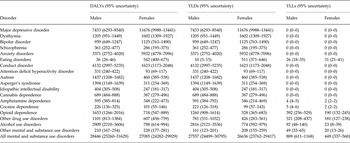
Table 1 shows the number of DALYs (in 1000 s) attributable to each mental and substance use disorder in males and females. In children and youth, eating disorders were the only mental disorders with associated mortality while all substance use disorders (except cannabis dependence) contributed to fatal burden. Deaths from suicide (including those due to an underlying mental or substance use disorder) or vehicular accidents resulting from alcohol were classified respectively to self-harm and transport injuries in GBD 2010. Furthermore, while YLLs directly attributable to schizophrenia were calculated (Whiteford et al. Reference Whiteford, Degenhardt, Rehm, Baxter, Ferrari, Erskine, Charlson, Norman, Flaxman, Johns, Burstein, Murray and Vos2013), none of these were attributed to those aged <25 years in GBD 2010. This resulted in mental and substance use disorders contributing 1.3 million (1.0–1.6 million) YLLs, equivalent to 0.2% (0.1–0.2) of all YLLs in children and youth globally. MDD was the leading cause of YLDs and DALYs in both males and females. The remaining mood disorders, anxiety disorders, and eating disorders were greater contributors to burden in females while conduct disorder, ADHD, autism spectrum disorders, and substance use disorders contributed more burden in males.
Number (in 1000 s) of DALYs, YLDs, and YLLs attributable to mental and substance use disorders in males and females aged 0–24 years in 2010

DALYs, Disability-adjusted life years; YLDs, years lived with disability; YLLs, years of life lost;
Eating disorders are inclusive of anorexia nervosa and bulimia nervosa. Alcohol use disorders are inclusive of alcohol dependence and fetal alcohol syndrome.
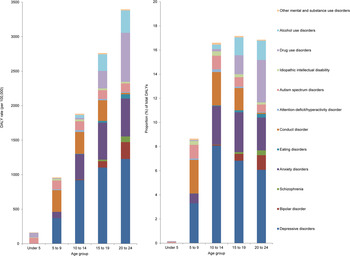
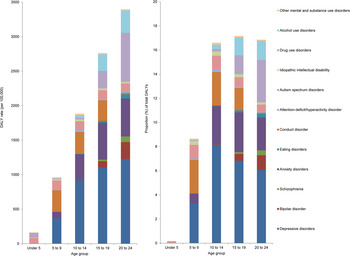
Fig. 1 shows the rate of DALYs (per 100 000) in 2010 for mental and substance use disorders within each age group prior to 25 years of age. Drug use disorders account for all mental and substance use disorder burden in those aged <1 year, reflecting the burden attributable to babies born with drug dependence. Substance use disorders become large contributors to burden from late adolescence onwards. Burden attributable to MDD and dysthymia begins in early childhood and increases throughout youth while ADHD and conduct disorder contribute most of their DALYs during childhood and early adolescence.
Disability-adjusted life year (DALY) rates (per 100 000) and proportions (%) for mental and substance use disorders for persons in each age group across childhood and youth in 2010.
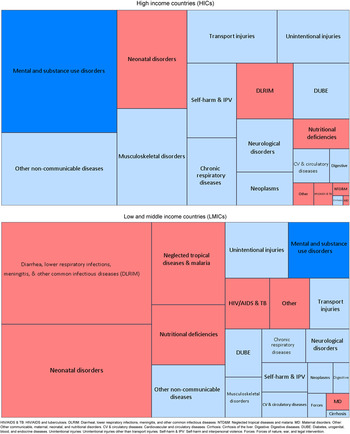
In both HICs (consisting of the Western Europe, Australasia, high-income North America, and high-income Asia Pacific regions) and LMICs, mental and substance use disorders were the leading cause of YLDs in children and youth with 34.8% (29.9–40.5) and 23.8% (20.6–27.2) respectively. Fig. 2 shows the proportion of DALYs for 0–24 years attributable to each of the 21 main cause groups in HICs and LMICs. Mental and substance use disorders were the leading cause of DALYs in HICs, contributing 8.3 million (7.4–9.3 million) DALYs equivalent to 20.8% (18.2–23.4) of the total burden of disease in children and youth. However, in LMICs the proportion of disease burden in children and youth attributable to mental and substance use disorders was smaller due to the ongoing mortality arising from other diseases. Over half of all DALYs in these countries were attributable to communicable, maternal, neonatal, and nutritional disorders as shown in Fig. 2. Thus, mental and substance use disorders were the 7th highest cause of disease burden in LMICs, accounting for 5.0% (4.5–5.7) of total burden (47.2 million, 42.5–52.2 million DALYs).
Proportion of total disability-adjusted life years in high-income countries and low- and middle-income countries attributable to each main cause group for persons aged 0–24 years in 2010.

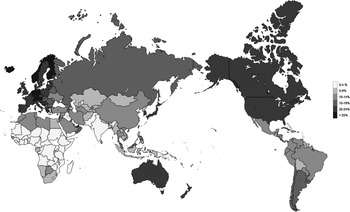
Fig. 3 demonstrates the proportion of total DALYs in children and youth accounted for by mental and substance use disorders at the country level. The vast majority of sub-Saharan Africa along with South Asia had the lowest proportions of burden attributable to mental and substance disorders in children and youth while HICs had the highest proportions. However, despite clear trends in burden, many of these differences in proportions between countries were within wide bounds of uncertainty which resulted from the lack of epidemiological data, particularly for LMICs.
Proportion of disability-adjusted life years attributable to mental and substance disorders in each country for children and youth in 2010. South Sudan, Western Sahara, and French Guiana were not included for burden calculations in GBD 2010.

While mental and substance use disorders contribute less burden proportionately in regions such as sub-Saharan Africa, the patterns are continually evolving as disease prevalence changes. For example diarrhea, lower respiratory infections, meningitis, and other common infectious diseases collectively were responsible for 157.3 million DALYs (138.3–176.8 million) in sub-Saharan Africa in 1990; equivalent to 40.0% (35.0–45.3%) of total burden for children and youth in that region. By 2010, this dropped to 95.7 million DALYs (86.3–104.6 million) or 24.9% (22.2–27.6%). Conversely, mental and substance use disorders contributed 5.3 million DALYs (4.8–5.9 million) or 1.3% (1.2–1.5%) in 1990. By 2010, this increased to 2.3% [2.1–2.6%; 8.9 million DALYs (8.1–9.8 million)] of total DALYs in children and youth in sub-Saharan Africa.
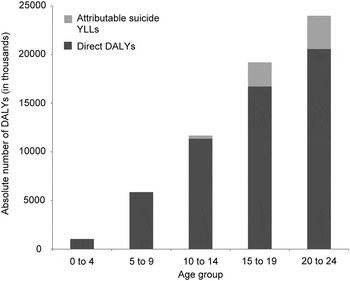
The burden estimates presented thus far exclude any excess deaths attributable to mental and substance use disorders as risk factors for suicide. After burden reattribution, mental and substance use disorders were responsible for an additional 6.3 million suicide YLLs in children and youth across the globe in 2010. This was equivalent to mental and substance use disorders explaining 59% of all suicide YLLs for children and youth in GBD 2010. Adding these attributable suicide YLLs increased the burden of mental and substance use disorders from 55.5 million to 61.8 million DALYs and their proportion of total DALYs from 5.7% to 6.3%, subsequently pushing their DALY ranking up from 6th to 5th place. Fig. 4 shows the additional suicide burden attributable to mental and substance use disorders in each child and youth age group.
Additional suicide burden attributable to mental and substance use disorders for each age group across childhood and youth, over and above disability-adjusted life years (DALYs) assigned as a direct cause. Attributable suicides years of life lost (YLL) were only evident from the age of 5 years onwards.

Discussion
Mental and substance use disorders are the leading cause of disability in children and youth worldwide and the sixth leading cause of DALYs. Currently in LMICs, a large proportion of burden in children and youth is still accounted for by infectious diseases and neonatal disorders (Fig. 2). However, these diseases are gradually being addressed through increased vaccination rates, greater accessibility to treatment, improved pre- and post-natal care, extension of education, delay of marriage, and better nutrition, sanitation and water quality (Lozano et al. Reference Lozano, Naghavi, Foreman, Lim, Shibuya and Aboyans2012; Murray et al. Reference Murray, Vos, Lozano, Naghavi, Flaxman and Michaud2012; Wang et al. Reference Wang, Dwyer-Lindgren, Lofgren, Rajaratnam, Marcus, Levin-Rector, Levitz, Lopez and Murray2012). As this trend continues and deaths due to these diseases are prevented, the proportion of DALYs attributable to infectious diseases and neonatal disorders will decrease. Improved infant survival will also result in greater absolute numbers of children living to the ages at which mental and substance use disorders are most prevalent. Specific services and prevention strategies for mental and substance use disorders are largely unavailable in LMICs (Saraceno et al. Reference Saraceno, Van Ommeren, Batniji, Cohen, Gureje, Mahoney, Sridhar and Underhill2007). Health resources will be required to meet this future demand. Service delivery for children and youth with mental and substance use disorders in LMICs will be further complicated by co-occurring social adversities (Walker et al. Reference Walker, Wachs, Grantham-Mcgregor, Black, Nelson, Huffman, Baker-Henningham, Chang, Hamadani, Lozoff, Gardner, Powell, Rahman and Richter2011) such as intimate partner violence (Devries et al. Reference Devries, Mak, Bacchus, Child, Falder, Petzold, Astbury and Watts2013), childhood sexual abuse (Chen et al. Reference Chen, Murad, Paras, Colbenson, Sattler, Goranson, Elamin, Seime, Shinozaki, Prokop and Zirakzadeh2010), conflict (Charlson et al. Reference Charlson, Steel, Degenhardt, Chey, Silove, Marnane and Whiteford2012), and poverty (Patel and Kleinman, Reference Patel and Kleinman2003). Nevertheless, LMICs have an opportunity to devote their resources to implementing effective service systems for children and youth with mental and substance use disorders, unfettered by the inertia of outdated yet entrenched ineffective systems now retained in many HICs (The Economist, 2008; Lewis et al. Reference Lewis, Synowiec, Lagomarsino and Schweitzer2012).
Previous longitudinal studies have found that individuals who develop their mental or substance use disorder at a young age are at an increased risk of chronic or recurrent mental disorders and disabling physical conditions in adulthood (Zoccolillo, Reference Zoccolillo1992; Bardone et al. Reference Bardone, Moffitt, Caspi, Dickson and Silva1996, Reference Bardone, Moffitt, Caspi, Dickson, Stanton and Silva1998; Wilens et al. Reference Wilens, Biederman, Mick, Faraone and Spencer1997; Fergusson and Woodward, Reference Fergusson and Woodward2002; Odgers et al. Reference Odgers, Caspi, Broadbent, Dickson, Hancox, Harrington, Poulton, Sears, Thomson and Moffitt2007). While identification and treatment of mental and substance use disorders during childhood and youth is desirable, effective prevention strategies are likely to have the greatest capacity to reduce burden. This is a challenge with mental and substance use disorders having complex and intertwined risk factors (e.g. genetics, poverty, parental mental illness, childhood adversity) which are difficult to modify and quantify. Identifying risk factors (e.g. child abuse and neglect, bullying, intimate partner violence) that are both quantifiable and modifiable through targeted intervention strategies is an immediate priority (Scott et al. Reference Scott, Moore, Sly and Norman2014). Investment is also needed in programmes that have the potential to reduce the likelihood of mental and developmental disorders in childhood such as parenting skills training (Furlong et al. Reference Furlong, Mcgilloway, Bywater, Hutchings, Smith and Donnelly2012) and maternal mental health interventions (Rahman et al. Reference Rahman, Fisher, Bower, Luchters, Tran, Yasamy, Saxena and Waheed2013). Reducing poverty has been shown to be followed by a reduction in childhood mental disorder (Costello et al. Reference Costello, Compton, Keeler and Angold2003), although addressing issues such as poverty, gender inequality, and social exclusion on a global scale requires significant investment and impetus. Furthermore, the increasing proportion of burden attributable to mental and substance use disorders in children and youth in LMICs will also demand integrated care for both mental and substance use disorders and physical health conditions (Collins et al. Reference Collins, Insel, Chockalingam, Daar and Maddox2013; Ngo et al. Reference Ngo, Rubinstein, Ganju, Kanellis, Loza, Rabadan-Diehl and Daar2013; Patel et al. Reference Patel, Belkin, Chockalingam, Cooper, Saxena and Unützer2013).
GBD 2010 quantifies burden in terms of health loss ‘within the skin’ of the individual with, for example, the impact on family and educational outcomes not considered. This is particularly problematic in children and youth who are dependent on family or carers and for whom the disorder can adversely alter their educational trajectory, social development, employability, and adaptive functioning (Mannuzza et al. Reference Mannuzza, Klein, Bessler, Malloy and Lapadula1993; Bardone et al. Reference Bardone, Moffitt, Caspi, Dickson and Silva1996, Reference Bardone, Moffitt, Caspi, Dickson, Stanton and Silva1998). Furthermore, the increased risk of other health conditions in adulthood as a result of mental and substance use disorders in childhood and youth is not represented in the GBD 2010 framework nor is the increased risk of intentional or unintentional harm to victims by young people with conditions, such as conduct disorder, who are more likely to engage in violent behaviour (Apter et al. Reference Apter, Gtohelf, Orbach, Weizman, Ratzoni, Har-Even and Sam1995).
Furthermore, the true extent of the association between mortality and mental and substance use disorders in children and youth was not reflected in the direct YLL burden estimations. Mortality was only attributed to a mental or substance use disorder if that disorder was the direct cause of death according to ICD-10 guidelines (WHO, 1992) meaning that most deaths in individuals with a mental disorder were attributed to the direct physical cause of death. While our burden reattribution analyses allowed the inclusion of suicide in mental and substance use disorder burden post-GBD 2010, these analyses could only include disorders which had both evidence of excess mortality and sufficient data on the relative risk of suicide. Thus, while the inclusion of attributable suicide burden substantially increased mental and substance use disorder DALYs, it still does not reflect suicide burden which may be attributable to other mental disorders such as conduct disorder (Marttunen et al. Reference Marttunen, Aro, Henriksson and Lönnqvist1991; Brent et al. Reference Brent, Perper, Moritz, Allman, Friend, Roth, Schweers, Balach and Baugher1993; Apter et al. Reference Apter, Gtohelf, Orbach, Weizman, Ratzoni, Har-Even and Sam1995), ADHD (Chronis-Tuscano et al. Reference Chronis-Tuscano, Molina, Pelham, Applegate, Dahlke, Overmyer and Lahey2010; Nigg, Reference Nigg2013), and pervasive developmental disorders (Raja et al. Reference Raja, Azzoni and Frustaci2011; Mayes et al. Reference Mayes, Gorman, Hillwig-Garcia and Syed2013). Furthermore, current evidence was insufficient to attribute other non-fatal and fatal burden to mental and substance use disorders, e.g. injury burden to ADHD and/or conduct disorder. These limitations mean GBD 2010 underestimates the full extent of the burden arising from mental and substance use disorders in children and youth.
Burden estimations are inevitably limited by lack of data which is particularly noticeable for children and youth (Whiteford et al. Reference Whiteford, Degenhardt, Rehm, Baxter, Ferrari, Erskine, Charlson, Norman, Flaxman, Johns, Burstein, Murray and Vos2013), for ‘childhood’ mental disorders such as conduct disorder and ADHD (Erskine et al. Reference Erskine, Ferrari, Nelson, Polanczyk, Flaxman, Vos, Whiteford and Scott2013), and for LMICs (Degenhardt et al. Reference Degenhardt, Bucello, Calabria, Nelson, Roberts, Hall, Lynskey and Wiessing2011; Ferrari et al. Reference Ferrari, Baxter and Whiteford2011, Reference Ferrari, Somerville, Baxter, Norman, Patten, Vos and Whiteford2013b ; Baxter et al. Reference Baxter, Scott, Vos and Whiteford2013; Charlson et al. Reference Charlson, Ferrari, Flaxman and Whiteford2013; Erskine et al. Reference Erskine, Ferrari, Nelson, Polanczyk, Flaxman, Vos, Whiteford and Scott2013) which often have the largest proportions of individuals aged <25 years (United Nations, 2011). This limitation gives GBD 2010 burden estimates large uncertainty ranges and makes it difficult to detect regional differences or changes over time which are often most informative for policy makers and global organizations. As more epidemiological data for mental and substance use disorders in children and youth becomes available, particularly in LMICs, the uncertainty surrounding burden estimates will lessen and allow more concrete conclusions to be drawn.
Despite limitations, GBD 2010 found mental and substance use disorders to be the leading cause of disability in children and youth across the globe. In terms of DALYs, mental and substance use disorders were the leading cause of total burden in HICs and the seventh leading cause in LMICs, ranking them as the sixth leading contributor to disease burden in children and youth worldwide. With reductions in infectious diseases and neonatal disorders in LMICs, the proportion of disease burden attributable to mental and substance use disorders will grow, and health services, particularly in LMICs, need to adapt to meet the changing health needs of their populations (Dua et al. Reference Dua, Barbui, Clark, Fleischmann, Poznyak, Van Ommeren, Yasamy, Ayuso-Mateos, Birbeck, Drummond, Freeman, Giannakopoulos, Levav, Obot, Omigbodun, Patel, Phillips, Prince, Rahimi-Movaghar, Rahman, Sander, Saunders, Servili, Rangaswamy, Unützer, Ventevogel, Vijayakumar, Thornicroft and Saxena2011; Ertem and WHO, 2012; Collins et al. Reference Collins, Insel, Chockalingam, Daar and Maddox2013; Ngo et al. Reference Ngo, Rubinstein, Ganju, Kanellis, Loza, Rabadan-Diehl and Daar2013; Patel et al. Reference Patel, Belkin, Chockalingam, Cooper, Saxena and Unützer2013).
Supplementary material
For supplementary material accompanying this paper visit http://dx.doi.org/10.1017/S0033291714002888.
Acknowledgements
This research received no specific grant from any funding agency, commercial or not-for-profit sectors. H.E.E., A.J.F., H.A.W., and J.G.S. are affiliated with the Queensland Centre for Mental Health Research which receives its core funding from the Queensland Department of Health. T.V. received funding for GBD 2010 from the Bill and Melinda Gates Foundation. G.P. is supported by a NHMRC Senior Principal Research Fellowship. These funding agencies had no involvement in this study. We thank all those who contributed to the burden estimates in GBD 2010.
Declaration of Interest
None.