


More than 1.5 billion people worldwide are reported to have chronic pain (American Academy of Pain Medicine, 2015), reflecting a major global socioeconomic burden. The total yearly expenditure associated with chronic pain in Australia is estimated at AU, $34.3 billion, and one out of five Australians are reported to be living with a chronic pain condition (Pain Management Research Institute, 2015). One of the most common types of pain conditions is musculoskeletal pain. Symptoms of chronic musculoskeletal pain include persistent, local, or widespread symptoms of pain, tenderness, peripheral nerve irritation, weakness, and limited motion and stiffness (International Association for the Study of Pain [IASP], 1986). Individuals with chronic musculoskeletal pain often experience disruption with day-to-day activities, additional health problems such as depression, and an overall lower quality of life (Edwards, Bingham, Bathon, & Haythornthwaite, Reference Edwards, Bingham, Bathon and Haythornthwaite2006; Quartana, Campbell, & Edwards, Reference Quartana, Campbell and Edwards2009). Musculoskeletal pain disorders, specifically, are frequent reasons for work absence and work-related disability (Walsh et al., Reference Walsh, Brooks, Hazes, Walsh, Dreinhöfer, Woolf and Lidgren2008), and compensation claims for work-related injuries account for over 40% of the AU$57.5 billion annual costs of work-related disorders and diseases in Australia (Zheltoukhova, Bevan, & Reich, Reference Zheltoukhova, Bevan and Reich2012).
Because of high prevalence rates of work-related disability, individuals with chronic musculoskeletal pain constitute a substantial proportion of clients seen by rehabilitation counsellors and rehabilitation psychologists (Robinson & O’Brien, Reference Robinson, O’Brien, Frank, Rosenthal and Caplan2010). Present opinion in pain rehabilitation has established that chronic pain should be understood through the lens of a biopsychosocial perspective by examining the influence of and interaction between biological and psychosocial factors (Williams, Hapidou, Lin, & Abbasi, Reference Williams, Hapidou, Lin and Abbasi2007). Biological factors refer to physiological components, while psychosocial factors encompass cognitive, emotional, behavioural, and environmental variables. Collectively, these biopsychosocial factors shape the way individuals tolerate, minimise, or adjust to their chronic pain condition.
From a clinical perspective, the observation that people with chronic pain can share similar conditions yet have varying coping and rehabilitation outcomes has led to strong interest in the cognitive and behaviour coping mechanisms used by pain patients (Boersma & Linton, Reference Boersma and Linton2006; Ehde, Dillworth, & Turner, Reference Ehde, Dillworth and Turner2014; Harland & Georgieff, Reference Harland and Georgieff2003). Turk and Rudy (Reference Turk and Rudy1988, Reference Turk and Rudy1990) identified three distinct biopsychosocial and behavioural response profiles of chronic low back pain patients, and described how these patients can benefit from tailored cognitive-behavioural therapy (CBT) programmes. Their taxonomy of chronic pain patients included a dysfunctional cluster with higher than average levels of pain severity, life interference, psychological distress, and lower life control and activity; an interpersonally distressed cluster having little to no support from others in their environment; and an adaptive coper cluster with significantly reduced pain severity, interference with activities, and affective distress, and greater perceptions of life control (Turk & Rudy, Reference Turk and Rudy1988, Reference Turk and Rudy1990). Research has indicated individuals with chronic pain who utilise adaptive coping strategies require less intensive psychosocial interventions than those who utilise passive or maladaptive coping strategies (Jensen, Turner, Romano, & Karoly, Reference Jensen, Turner, Romano and Karoly1991; Ross, Reference Ross2004; Turner, Jensen, & Romano, Reference Turner, Jensen and Romano2000).
Although Turk and his associate (1988, 1990) derived an empirically based taxonomy of pain patients and suggested potential for such classification systems in rehabilitation practice, a study limitation is that they did not identify pain profiles based specifically on cognitive-behavioural coping strategies (e.g., problem-solving coping, emotional coping, and avoidant coping). Other studies have evaluated cognitive-behavioural coping strategies used among pain patients in clinical rehabilitation settings. For instance, Rosenstiel and Keefe (Reference Rosenstiel and Keefe1983) constructed the 42-item CSQ based on habitually used cognitive and behavioural coping strategies by individuals with chronic musculoskeletal pain. Since that time, revised versions of the CSQ have been developed such as the CSQ-24. The CSQ-24 was developed and validated to improve the utility of previous pain coping measures (Harland & Georgieff, Reference Harland and Georgieff2003). The new questionnaire retained 24 items and yielded a four-factor solution that incorporates catastrophising, diversion, cognitive coping, and reinterpreting factors. Chiu et al. (Reference Chiu, Jochman, Fujikawa, Strand, Cheing, Lee and Chan2014) further validated the factorial and construct validity of the CSQ-24 for use as a brief coping measure in outpatient rehabilitation settings. To expand the use of the CSQ-24 in clinical settings, it will be important to investigate pain coping profiles among rehabilitation clients using the CSQ-24.
Purposes of Study
The main purpose of the present study was to use cluster analysis to identify pain coping profiles of workers’ compensation clients with chronic musculoskeletal pain using the CSQ-24. A secondary purpose was to determine the effects of pain coping strategy patterns on rehabilitation outcomes including physical-affective factors and quality of life factors.
Method
Participants
Participants were 171 workers’ compensation clients recruited from six outpatient facilities that provided pain rehabilitation interventions in Alberta, Canada. Criteria for selection included: 21 years or older and a medical diagnosis of nonmalignant, work-related pain for at least three months, according to the criteria for chronicity specified by the IASP (1986). One hundred ninety-seven research packets were distributed, and 145 clients returned the packets with a response rate of 73.6%. In addition, five psychologists were contacted to help advertise for this research project in their respective outpatient rehabilitation agencies. Twenty-six rehabilitation clients then expressed their interest in the research project, and all 26 clients returned the research packets.
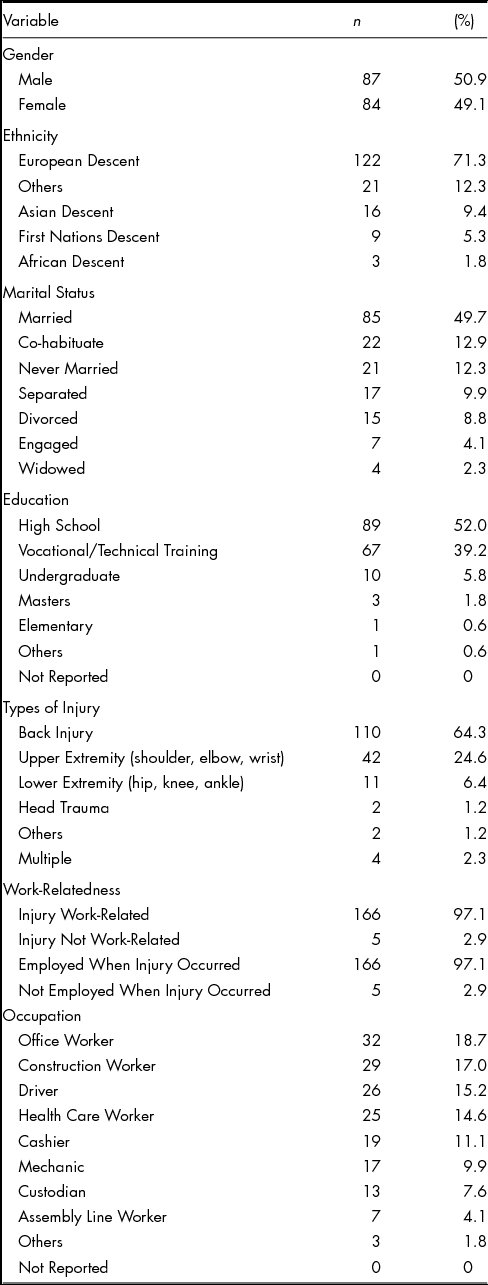
Descriptive data for the participants are presented in Table 1. Participants included 87 (50.9%) men and 84 (49.1%) women, with a mean age of 42.5 years (SD = 9.9, range = 19 to 67), and 62.6% were married or living with a partner. Participants were primarily Canadians of European descent (71.3%) with predominantly a high school or vocational–technical school education (91.2%). A majority identified their socioeconomic status as lower middle (39.8%) to middle (45.6%) class. The mean time since injury onset was 26.1 months (SD = 51.8), and major types of injuries included back (64.3%), upper extremity and lower extremity (31.0%), and mild head trauma with orthopaedic pain (1.2%). Occupations of the participants included construction, transportation, manufacturing, janitorial, health care, mechanical, and services, representing jobs requiring a varied range of physical demand characteristics.
Sample Characteristics

Instruments
Coping Strategies Questionnaire-24 (CSQ-24)
The CSQ-24, developed by Harland and Georgieff (Reference Harland and Georgieff2003), was used to measure pain coping strategies. The CSQ-24 is composed of 24 items and four subscales: (a) catastrophising (e.g., ‘It's terrible, and I feel it's never going to get any better’); (b) diversion (e.g., ‘I try to think of something pleasant’); (c) reinterpretation (e.g., ‘I try to feel distant from the pain, almost as if the pain was in somebody else's body’); and (d) cognitive coping (e.g., ‘I tell myself to be brave and carry on despite the pain’). Items are rated on a 7-point Likert-type scale from 0 (never do that) to 6 (always do that), resulting in subscale scores ranging from 0 to 36. Harland and Georgieff (Reference Harland and Georgieff2003) found that internal consistency estimates for the CSQ subscales ranged from .75 to .85.
Visual Analogue Scale (VAS)
Pain intensity was assessed using the VAS developed by Price, McGrath, Rafii, and Buckingham (Reference Price, McGrath, Rafii and Buckingham1983). It asks respondents to record their perceptions of pain intensity on a 100-mm horizontal line. The respondent is asked to draw a perpendicular line intersecting the horizontal line, indicating the average perceived intensity of pain experienced for the past week. The left end of the line is anchored with the label ‘no pain at all’ (0), and the right end of the line is anchored with the label ‘intense/worst pain’ (100). The number of millimetres from the left extreme to the point where the perpendicular line intersects the horizontal line is recorded as the VAS score, which can range from 0 to 100, with higher scores indicating greater intensity of perceived pain. Test–retest reliability estimates over different intervals have ranged from .60 to .97 (Ahles, Ruckdeschel, & Blanchard, Reference Ahles, Ruckdeschel and Blanchard1984; Price et al., Reference Price, McGrath, Rafii and Buckingham1983).
Recent Life Changes Questionnaire (RLCQ)
The RLCQ was developed by Miller and Rahe (Reference Miller and Rahe1997) to operationalise level of stress associated with major life events. It is composed of 74 major life events and five domains: (1) health, with seven items (e.g., ‘an injury or illness which kept you in bed a week or more, or sent you to the hospital’); (2) work, with 16 items (e.g., ‘change to a new type of work’); (3) home and family, with 27 items (e.g., ‘major change in living conditions’); (4) personal and social, with 18 items (e.g., ‘change in personal habits’); and (5) financial, with seven items (e.g., ‘major change in finances-decreased income’). A response of ‘yes’ or ‘no’ indicates whether an event occurred in the past 12 months. Each life event is associated with its own life change units (LCUs), the higher the number of the LCU, the more stressful the life event (e.g., 45 LCUs are assigned to a ‘yes’ response to the engage to marry event). A score of 500 or more indicates the potential for high stress in one's life.
West Haven–Yale Multidimensional Pain Inventory (WHYMPI)
The WHYMPI Interference subscale (WHYMPI-I) was used to assess the disruption of activities due to pain (Kerns, Turk, & Rudy, Reference Kerns, Turk and Rudy1985). The WHYMPI consists of five subscales; however, only the interference subscale was used for this study. It consists of nine items (e.g., ‘In general, how much does your pain problem interfere with your day-to-day activities?’). Each item is rated on a 7-point Likert-type scale ranging from 0 (none) to 6 (extreme), and scores are summed across items to produce a WHYMPI-I total score, which can range from 0 to 54. Kerns et al. (Reference Kerns, Turk and Rudy1985) reported an internal consistency reliability estimate of .90 for this subscale, with a test–retest reliability estimate over a two-week interval of .86.
Centre for Epidemiologic Studies–Depression Scale (CES–D)
The CES–D (Radloff, Reference Radloff1977) was developed to operationalise depressive symptomatology in the general population and consists of 20 items (e.g., ‘I felt that I could not shake off the blues even with help from my family or friends’). Each item is rated on a 4-point Likert-type scale on ‘feelings/behaviours during the past week,’ ranging from 0 (rarely or none of the time) to 3 (most or all of the time); responses to the 20 items are summed to produce a CES–D total score, which can range from 0 to 60. Radloff (Reference Radloff1977) reported internal consistency estimates ranging from .84 to .90 in several clinical populations, and Turner and McLean (Reference Turner and McLean1989) found an estimate of .88 using a sample with physical disabilities.
World Health Organisation Quality of Life–Brief Version (WHOQOL-BREF)
The WHOQOL-BREF was used to measure the participants’ quality of life (The WHOQOL Group, 1998). It is composed of 26 items with four subscales: physical health (e.g., ‘To what extent do you feel that physical pain prevents you from doing what you need to do?’), psychological health (e.g., ‘How often do you have negative feelings, i.e., blue mood, despair, depression?’), social relationships (e.g., ‘How satisfied are you with the support you get from your friends?’), and environment (e.g., ‘How healthy is your physical environment?’). The items are rated on a 5-point Likert-type scale. Internal consistency reliability estimate exceeds .80, with test–retest reliabilities of .83 (physical health), .84 (psychological health), .88 (social relationships), and .92 (environment). It also demonstrated convergent validity with the RAND 36-Item Health Survey (The WHOQOL Group, 1998). In addition, Miller, Chan, Ferrin, Lin, and Chan (Reference Miller, Chan, Ferrin, Lin and Chan2008) validated the WHOQOL-BREF with a sample of individuals with spinal cord injury and reported the Cronbach's alpha coefficients for the physical health, psychological health, social relationships, and environment factors to be .82, .82, .74, and .80, respectively.
Procedures
Ethics approval was obtained from the University of Wisconsin–Madison in the United States. After subsequent approval was secured at each of the outpatient rehabilitation facilities, participants were recruited either by one of the co-authors who was completing her pre-doctoral psychology internship in one of the facilities or by psychologists on staff in each of the respective facilities, with a script provided to facilitate consistency in recruitment and distribution of instrument packets to participants. Packets included a brief cover letter explaining the study, an informed consent form, and a 14-page questionnaire divided into sections for each of the measures. Completion of the research packet was estimated to require 45–60 minutes, and participants were given the option of completing the survey on site or taking it home to complete within 3–4 days, with a stamped return envelope provided.
Data Analysis
The Statistical Package for the Social Sciences (SPSS, version 18.0) was used to analyse the data. Descriptive statistics were computed for all study variables. Cluster analysis was used to identify homogeneous subgroups of participants on the basis of their mean scores on each of the four CSQ-24 subscales: catastrophising, diversion, cognitive coping, and reinterpreting. Ward's hierarchical agglomerative clustering method was used, with squared Euclidean distance as the index of pairwise similarity–dissimilarity between participant profiles. MANOVA was used to determine whether participants in the three coping cluster groups differ from each other in a linear combination of four physical-affective dependent variables (stress, pain, activity interference, depression) and a set of quality of life variables (physical health, psychological health, social relationships, and environment).
Results
Cluster analysis
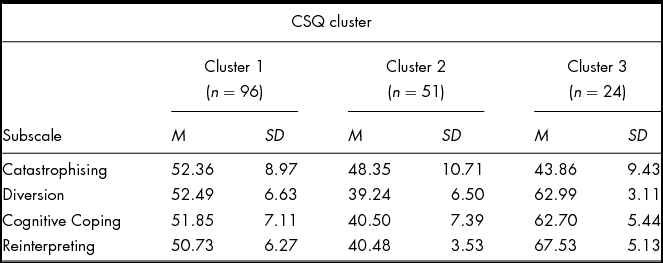
To identify an optimal grouping of participants in the clustering hierarchy, the agglomeration schedule was examined to find a late stage in the hierarchy, with a relatively small number of participant clusters, in which the error sum of squares coefficients increased dramatically at subsequent stages in the hierarchy after relatively small increases at previous stages (Berven & Hubert, Reference Berven and Hubert1977). The stage producing three clusters of participants had relatively small increases of 72.98 and 98.07 in the error sum of squares from one stage to the next at the two stages preceding the three-cluster stage compared with increases of 127.39 and 165.95 at the two subsequent stages in the hierarchy. Cluster homogeneity dropped substantially after the three-cluster stage, and it provided a good balance between maximising cluster homogeneity and providing a managing number of participant clusters. The mean item scores for each of the three clusters on each of the CSQ-24 coping strategies are provided in Table 2. For ease of interpretation, the mean item scores were transformed into standardised T-scores. A graphic representation of the CSQ-24 group profiles is presented in Figure 1.
Means and Standard Deviations of the CSQ-24 for the Three Participant Clusters
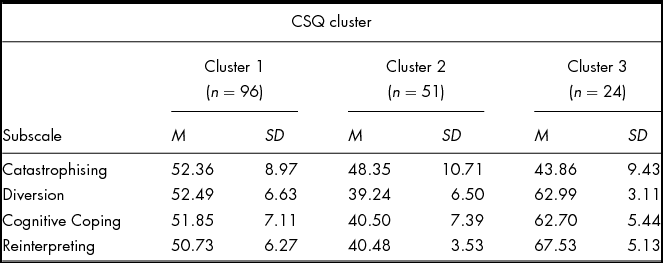
Note. Cluster 1 = mixed coping; Cluster 2 = catastrophising; Cluster 3 = positive coping.
CSQ-24 profiles for the three participant clusters. Cluster 1 = mixed coping; Cluster 2 = catastrophising; and Cluster 3 = positive coping.
Cluster 1: Mixed coping
Cluster 1 was composed of 96 participants (56%), with relatively consistent average T-scores on all four subscales: catastrophising, diversion, cognitive coping, and reinterpreting. Their average T-scores indicated that they used less positive coping strategies and more catastrophising strategies than the positive coping group (Cluster 3), and although participants in this cluster used a similar level of catastrophising strategies as the catastrophising group, they also used more positive coping strategies than the catastrophising group (Cluster 2).
Cluster 2: Catastrophising
Cluster 2 was composed of 51 participants (30%), with a high, average T-score on catastrophising and the lowest scores on diversion, cognitive coping, and reinterpreting compared to the other two groups (about one standard deviation below the mean). Participants in this group appear to use catastrophising solely as a coping strategy.
Cluster 3: Positive coping
Cluster 3 was composed of 24 participants (14%) with the highest scores on diversion, cognitive coping, and reinterpreting and the lowest scores on catastrophising. The high scores on the diversion, cognitive coping, and reinterpretation subscales indicate that participants in this group used the highest level of positive coping strategies and the lowest level of catastrophising compared to the mixed coping and catastrophising groups. This cluster is also the smallest in size, indicating that the majority of the participants in the present study are not implementing high levels of positive coping strategies.
Multivariate analysis of variance
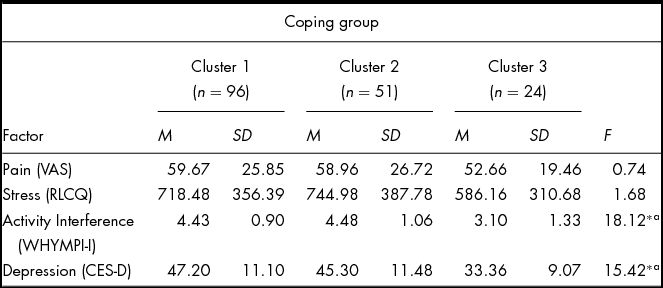
In the first MANOVA, we compared the three coping cluster groups on a set of physical-affective dependent variables (pain, stress, activity interference, and depression). MANOVA revealed a significant multivariate effect, Wilks's Lambda = .76, F(8, 330) = 6.21, p < .001. Therefore, a univariate ANOVA was computed for each dependent variable. The ANOVA results indicated the three groups differed significantly on two of the physical-affective variables: (a) activity interference, F(2, 168) = 18.12, p < .001, η2. = .18, indicating the effect of group differences accounted for 18% of the variance in activity interference; and (b) depression, F(2, 168) = 15.42, p < .01, η2. = .16, indicating the effect of group differences accounted for 16% of the variance in depression. Post hoc comparisons using protected t-test indicated that participants in the positive coping group had lower activity interference scores when compared to individuals in the mixed coping group F(1, 168) = 30.63, p < .01 and catastrophising group F(1, 168) = 32.94, p < .01; the positive coping group also had lower depression scores when compared to individuals in the mixed coping group F(1, 168) = 25.71, p < .01 and catastrophising groups F(1, 168) = 19.14, p < .01. The mixed coping and catastrophising groups did not differ on activity interference and depression. Means and standard deviations of the physical-affective variables for the three cluster groups are presented in Table 3.
Means and Standard Deviations of the Physical-Affective Variables for the Three Coping Groups
Note. Cluster 1 = mixed coping; Cluster 2 = catastrophising; Cluster 3 = positive coping. VAS = Visual Analogue Scale; RLCQ = Recent Life Changes Questionnaire; WHYMPI-I West Haven–Yale Multidimensional Pain Inventory–Interference; CES-D = Centre for Epidemiologic Studies—Depression Scale.
aCluster 3 > Cluster 1 and 2.
*p < .01.
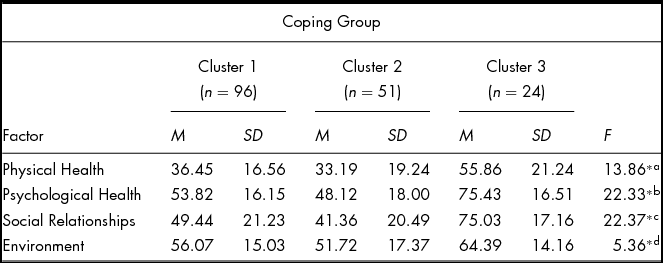
A second MANOVA was computed to determine whether the three coping groups differed on the four quality of life variables. MANOVA revealed a significant multivariate effect, Wilks's Lambda = .77, F(8, 294) = 5.19, p < .001; therefore, a univariate ANOVA was computed for each dependent variable. The ANOVA results indicated significant differences on all of the quality of life variables. Post hoc comparisons using protected t-test indicated that participants in the positive coping group had significantly higher scores on physical health F(1, 168) = 31.12, p < .01; psychological health F(1, 168) = 48.60, p < .01; social relationships F(1, 168) = 52.93, p < .01; and environment F(1, 168) = 11.30, p < .05; when compared to individuals in the catastrophising groups; they also had significantly higher scores on physical health F(1, 168) = 20.00, p < .01; psychological health F(1, 168) = 25.20, p < .01; and social relationships F(1, 168) = 30.94, p < .01 when compared to individuals in the mixed coping group. The mixed coping and catastrophising groups did not significantly differ on all quality of life variables. Means and standard deviations of the quality of life variables for the three cluster groups are presented in Table 4.
Means and Standard Deviations of the WHOQOL-BREF Subscales for the Three Coping Groups
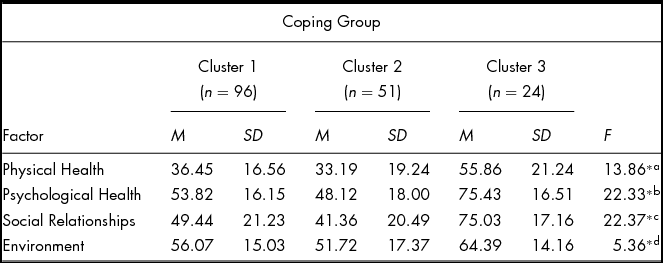
Note. Cluster 1 = mixed coping; Cluster 2 = catastrophising; Cluster 3 = positive coping.
aη2 = .14. bη2 = .21. cη2 = .21. dη2 = .06.
*p < .01.
Discussion
The pain rehabilitation literature has conceptualised pain coping as a dynamic and interactive process influenced by biological, psychological, and social factors. Assessment and treatment using a biopsychosocial approach is considered ‘gold standard’; however, the role of pain coping strategies in the rehabilitation process is in its early stages of scientific research (Phillips, Carroll, Voaklander, Gross, & Beach, Reference Phillips, Carroll, Voaklander, Gross and Beach2012). The primary goal of the present study was to investigate pain coping profiles using the CSQ-24 among workers’ compensation clients living with chronic musculoskeletal pain. Using cluster analysis, three distinct groupings of pain coping strategies (mixed coping, catastrophising, and positive coping) were found. While Turk and Rudy (1988, Reference Turk and Rudy1990) determined biopsychosocial and behavioural response profiles of people with chronic pain indirectly using pain severity, perceived stress, mood, social support, and life control, we directly identified pain coping profiles in terms of cognitive-behavioural coping strategies.
The majority of the participants (56%) in our study reported engaging in mixed coping strategies, meaning these individuals used a similar mix or amount of catastrophising strategies and positive coping strategies. Another group of clients, representing 30% of the participants in the current study, used catastrophising as a coping strategy more often than positive coping strategies. In fact, individuals in the catastrophising group had a significantly reduced rate of positive coping strategies in comparison to the other two groups, and appeared to use catastrophising solely as a coping strategy. We also found a group (14%) that predominantly used positive coping strategies such as diversion, reinterpretation, and cognitive coping methods.
The results of our study indicate that the use of positive coping strategies is linked to successful rehabilitation outcomes, including better mental health, reduced problems with activity interference, and higher quality of life. This is consistent with the pain rehabilitation literature, as adaptive coping strategies have been related to positive outcomes for patients with chronic pain (Chiu et al., Reference Chiu, Jochman, Fujikawa, Strand, Cheing, Lee and Chan2014; Lee, Chan, & Berven, Reference Lee, Chan and Berven2007; Stoffel, Reis, Schwarz, & Schröder, Reference Stoffel, Reis, Schwarz and Schröder2013; Turner et al., Reference Turner, Jensen and Romano2000). However, our findings also revealed that clients using catastrophising strategies had higher levels of activity interference and depression, as well as lower quality of life. This is also an expected result as catastrophising has consistent and robust associations with a wide array of pain-related outcomes including activity interference and depression (Edwards et al., Reference Edwards, Bingham, Bathon and Haythornthwaite2006; Lee et al., Reference Lee, Chan and Berven2007; Lee, Wu, Lee, Cheing, & Chan, Reference Lee, Wu, Lee, Cheing and Chan2008; Sullivan et al., Reference Sullivan, Thorn, Haythornthwaite, Keefe, Martin, Bradley and Lefebvre2001). Pain catastrophising has also been previously associated with higher pain intensity, perceived disability, and depression in workers’ compensation clients (Phillips et al., Reference Phillips, Carroll, Voaklander, Gross and Beach2012). Finally, there were no significant differences among participants in this study with regard to actual stress and/or pain intensity, which contradicts Turk and Rudy's (Reference Turk and Rudy1988, Reference Turk and Rudy1990) subgroup differences partly based on levels of pain intensity and perceived stress. Therefore, pain intensity and perceived stress may not be relevant to the use of cognitive-behavioural coping styles among workers’ compensation clients with chronic pain.
Implications for rehabilitation counselling practice
Chronic pain negatively impacts many aspects of an individual's life, and individuals who are not engaged in adaptive coping may require additional time and attention from clinicians in order to make rehabilitation gains (Ross, Reference Ross2004; Turk & Rudy, Reference Turk and Rudy1990). Clinicians may find that evaluating a client's pain coping style using a standardised assessment tool like the CSQ-24 can greatly aid the initial rehabilitation planning process, and will help both the client and clinician formulate goals aimed at developing and/or maintaining positive coping strategies. Increasing activity and participation is a typical goal related to coping and rehabilitation. Most individuals with chronic musculoskeletal pain and positive coping skills actively engage in rehabilitation programmes, employment, or have other meaningful activities that have not ceased due to a work-related disability (de Vries, Reneman, Groothoff, Geertzen, & Brouwer, Reference De Vries, Reneman, Groothoff, Geertzen and Brouwer2012). Yet, clients with maladaptive pain coping strategies, like catastrophising, tend to have negative consequences associated with rehabilitation goals, including problems with day-to-day activities and subsequent depression (Lee et al., Reference Lee, Chan and Berven2007).
Maladaptive coping strategies in people with musculoskeletal pain are often not identified early enough as a ‘red flag,’ and referrals to rehabilitation counsellors or psychologists may not happen until chronic pain is deeply entrenched (Leyshon, Reference Leyshon2009). Understanding the link between how clients cope with chronic pain and activity levels may cue therapists as to which clients may be more likely to be exhibit symptoms of depression in a population that already has a markedly elevated risk (Lee et al., Reference Lee, Chan and Berven2007). Beck's (Reference Beck1967, Reference Eccleston, Morley and Williams1979) cognitive theory identified catastrophising as a major cognitive vulnerability factor for depression. According to Lee and her colleagues (Reference Lee, Chan and Berven2007) catastrophising can be due to activity interference. Reduction in activities provides individuals with ample time to ruminate, which results in a preoccupation with negative self-evaluation, negative outcome expectancies, and cognitive distortions. Therefore, engaging workers’ compensation clients with chronic pain in meaningful activities through physical and occupational therapy can be useful in diminishing the impact of activity interference on catastrophising. In addition, psychological treatment for pain management using CBT (Ehde et al., Reference Ehde, Dillworth and Turner2014) should be considered. Techniques used with clients experiencing pain may include relaxation training, behavioural activation, activity pacing, problem-solving training, or cognitive restructuring (Thorn, Reference Thorn2004). One of the most promising CBT interventions for chronic pain appears to be coping skills training with a focus on cognitive skill development and behavioural rehearsal (Eccleston, Morley, & Williams, Reference Eccleston, Morley and Williams2013). Such a proactive, self-management approach may help prevent individuals from slipping into a pattern of using a more negative coping style.
Limitations
There are several limitations in this study that should be considered when interpreting the results and addressed in future research. First, a convenience sample was used, the participants were workers’ compensation clients with chronic musculoskeletal pain from Alberta, Canada. Therefore, it is possible the coping profiles may not generalise to diverse groups or to individuals with other pain conditions. Second, the average term of pain duration for participants in this study was about 26 months, and previous research indicates that cognitive coping strategies tend to be associated with a shorter pain duration (Jensen & Karoly, Reference Jensen and Karoly1991). Our study participants may have initially used positive coping strategies, but over time selected to use a mix of coping strategies or began to predominately use catastrophising strategies. In future studies, a wide range of physical, functional, psychosocial, and behavioural factors should be utilised when creating subgroups of clients to provide an even more holistic pain profile (Turk & Rudy, Reference Turk and Rudy1990). Third, we did not cross-validate the study using a second sample to offer additional confirmation of the validity and uniqueness of the clustering profile derived from the CSQ-24, and also did not rule out the potential demographic confounds in this study. More research utilising confirmatory factor analysis with the CSQ-24 is necessary to increase the accuracy of the subgroups, clinical utility, and predictive validity of coping profiles of individuals experiencing chronic musculoskeletal pain.
Conclusion
There is growing evidence that chronic pain conditions can be broadly categorised based on different pain coping strategies, providing greater potential for targeted interventions in pain management. The present study used the CSQ-24 to identify three distinct cognitive-behavioural coping patterns (mixed coping, catastrophising, and positive coping) among workers’ compensation clients living with chronic musculoskeletal pain. Empirical evidence indicates the pain coping strategies used among participants with chronic pain are related to rehabilitation outcomes. In addition, our results provide further support for the utility of the CSQ-24 in clinical rehabilitation settings to assess pain coping patterns. The implications of the current study highlight the additional information needed to determine the optimal treatment and/or rehabilitation services for workers’ compensation clients.
Acknowledgements
The contents of this article were developed with support from the Rehabilitation Research and Training Center on Evidence-Based Practice in Vocational Rehabilitation (RRTC-EBP VR) at the University of Wisconsin-Madison and the University of Wisconsin-Stout and with funding provided by the U.S. Department of Education, National Institute on Disability and Rehabilitation Research (Grant H133B100034). The ideas, opinions, and conclusions expressed, however, are those of the authors and do not represent recommendations, endorsements, or policies of the U.S. Department of Education.