Introduction
Strongyloides stercoralis is a soil-transmitted helminth that infects an estimated 300–600 million people worldwide, with endemic transmission across tropical and subtropical regions and persistent prevalence among migrants and travellers in nonendemic countries (Buonfrate et al. Reference Buonfrate, Bradbury, Watts and Bisoffi2023; Czeresnia and Weiss Reference Czeresnia and Weiss2022). Infective filariform larvae typically enter through the skin, migrate through the bloodstream to the lungs, ascend the tracheobronchial tree, are swallowed, and mature into parthenogenetic adult females in the small intestine (Bisoffi et al Reference Bisoffi, Buonfrate, Montresor, Requena-Méndez, Muñoz, Krolewiecki, Gotuzzo, Mena, Chiodini, Anselmi, Moreira and Albonico2013; Buonfrate et al Reference Buonfrate, Bradbury, Watts and Bisoffi2023). Eggs hatch within the intestinal mucosa, releasing rhabditiform larvae that are either passed in stool or transform into filariform larvae capable of penetrating the intestinal mucosa or perianal skin, producing an autoinfective cycle (Buonfrate et al Reference Buonfrate, Bradbury, Watts and Bisoffi2023; Luvira et al Reference Luvira, Siripoon, Phiboonbanakit, Somsri, Watthanakulpanich and Dekumyoy2022). Larvae may become detectable in stool approximately 3–4 weeks after initial infection, although chronic infection may persist for decades through autoinfection (Yang et al Reference Yang, Xu, zhang, Liao, Liu, Deng and Wang2025). Unlike most helminth infections, Strongyloides is capable of autoinfection, allowing the parasite to persist for decades after initial exposure (Gordon et al Reference Gordon, Utzinger, Muhi, Becker, Keiser, Khieu and Gray2024). As a result, individuals with latent infection may remain asymptomatic for years while harbouring a lifelong risk of severe disease under conditions of immunosuppression.
Systemic corticosteroids are a common precipitating factor for Strongyloides hyperinfection and dissemination (Luvira et al Reference Luvira, Siripoon, Phiboonbanakit, Somsri, Watthanakulpanich and Dekumyoy2022). Corticosteroids promote accelerated larval replication and impair host immune responses, leading to overwhelming parasite burden and translocation of enteric bacteria (Yeh et al Reference Yeh, Aggarwal, Carrig, Azeem, Nguyen, Devries, Destache, Nguyen and Velagapudi2023). Clinically, this can manifest as sepsis, gram-negative bacteraemia, acute respiratory failure, and multiorgan dysfunction, with reported mortality rates exceeding 50% in severe cases (Marcos et al Reference Marcos, Terashima, DuPont and Gotuzzo2008a). Despite the well-described pathophysiology and dramatic outcomes reported in case series, the true population-level risk associated with corticosteroid exposure in patients with latent Strongyloides infection remains poorly quantified.
Current clinical guidance regarding screening and empiric treatment for Strongyloides prior to corticosteroid initiation is inconsistent and often limited to select high-risk populations, such as transplant candidates or individuals from highly endemic regions (Bisoffi et al Reference Bisoffi, Buonfrate, Montresor, Requena-Méndez, Muñoz, Krolewiecki, Gotuzzo, Mena, Chiodini, Anselmi, Moreira and Albonico2013; Mejia and Nutman Reference Mejia and Nutman2012; Requena-Méndez et al Reference Requena-Méndez, Chiodini, Bisoffi, Buonfrate, Gotuzzo and Muñoz2013). In routine clinical practice – particularly in emergency and inpatient settings – systemic corticosteroids are frequently initiated without prior evaluation for latent parasitic infection. Reliance on eosinophilia as a screening marker is unreliable, as eosinophil counts may be normal or suppressed in severe strongyloidiasis and following steroid exposure (Khoury et al Reference Khoury, Stokes, Gadkari, Makiya, Legrand, Hu, Klion and Franco2018). Consequently, many cases of clinically significant Strongyloides-related complications may go unrecognized or be attributed to nonspecific infectious syndromes.
Existing evidence linking corticosteroids to adverse outcomes in Strongyloides infection is largely derived from case reports, small case series, and single-centre observational studies, which are limited by selection bias and lack appropriate comparator groups (Constante et al Reference Constante, Domingos, Neves Coelho, Baptista Fernandes, Baptista and Maio Herculano2023; Domiınguez et al Reference Domiınguez, Péerez-Lóopez, Sáanchez, Contreras, Guerrero and Abildúua2022; Enayat et al Reference Enayat, Eshrat Beigom, Seyed Reza, Mohammad Amin and Zohre2025; Ghosh and Ghosh Reference Ghosh and Ghosh2007; Khadka et al Reference Khadka, Khadka, Thapaliya and Karkee2018; Ramprasad et al Reference Ramprasad, Kodan, Jonnalagadda, Bir, Verma, Sahni, Vikram, Soneja, Mirdha and Wig2022; Uslu et al Reference Uslu, Demirel, Aydoğ, Dinç and Taylan Özkan2025). Large-scale, real-world data evaluating the association between corticosteroid exposure and clinically meaningful outcomes – such as sepsis, bacteraemia, intensive care unit (ICU) admission, and mortality – are sparse. Moreover, it remains unclear whether adverse outcomes among steroid-exposed patients reflect the independent effect of corticosteroids alone or are specifically amplified in the setting of latent Strongyloides infection.
To address these gaps, we conducted a multicentre retrospective cohort study using the TriNetX Research Network to evaluate outcomes among patients with laboratory-confirmed latent Strongyloides infection who did and did not receive systemic corticosteroids. We further compared steroid-exposed patients with latent Strongyloides infection to steroid-exposed patients who tested negative for Strongyloides to assess whether observed risks were specific to latent infection. We hypothesized that corticosteroid exposure among patients with latent Strongyloides infection would be associated with increased risks of infectious complications, critical illness, and mortality.
Methods
Study design and data source
We conducted a retrospective, multicentre cohort study using data from the TriNetX Global Collaborative Network (https://trinetx.com), a federated electronic health record (EHR) research platform comprising 172 healthcare organizations (HCOs) across multiple geographic regions. The network aggregates de-identified patient-level data, including demographics, diagnoses, procedures, medications, laboratory values, and vital signs, from participating institutions. Investigators using the platform do not receive identifiable patient-level data, healthcare organization names, country-level attribution, or site-specific results; all outputs are provided as aggregate counts and summary statistics. Data quality, mapping, and normalization are standardized across sites, and all analyses were performed within the TriNetX analytics environment using de-identified data. This study was determined to be exempt from institutional review board oversight in accordance with applicable regulations governing research using de-identified data.
Study population
Adult patients (≥18 years) with serologic evidence of latent Strongyloides stercoralis infection were identified using laboratory records for Strongyloides stercoralis IgG antibody testing by immunoassay. The index date was defined as the date of the first qualifying Strongyloides IgG test. Patients were excluded if they had evidence of active strongyloidiasis at or prior to the index date, defined by International Classification of Diseases, Tenth Revision, Clinical Modification (ICD-10-CM) codes for disseminated strongyloidiasis, intestinal strongyloidiasis, or cutaneous strongyloidiasis. These exclusions were applied to restrict the cohort to patients with latent infection and to minimize misclassification of active disease. Confirmatory stool microscopy, stool culture, or stool PCR was not required for cohort inclusion because these data were not uniformly available across participating healthcare organizations within the TriNetX platform. Accordingly, latent infection was operationalized using recorded positive Strongyloides stercoralis IgG serology in the absence of diagnostic codes for active intestinal, cutaneous, or disseminated strongyloidiasis.
Study definitions, variables, and outcomes
Systemic corticosteroid exposure was defined as receipt of any systemic glucocorticoid, including prednisone, prednisolone, methylprednisolone, dexamethasone, or hydrocortisone, administered orally or parenterally within 30 days of the index Strongyloides IgG test. Patients were categorized into the following cohorts: (1) Latent Strongyloides + Steroid Exposure: patients with positive Strongyloides IgG serology who received systemic corticosteroids within 30 days of the index date; (2) Latent Strongyloides without Steroid Exposure: patients with positive Strongyloides IgG serology who did not receive systemic corticosteroids within 30 days of the index date. To assess whether observed risks were specific to latent Strongyloides infection rather than steroid exposure alone, a secondary comparison cohort was constructed consisting of (3) IgG-Negative + Steroid Exposure: patients who tested negative for Strongyloides IgG and received systemic corticosteroids within 30 days of testing.
Baseline covariates were assessed using data from the two years preceding the index date unless otherwise specified and included demographic characteristics (age, sex, race), comorbid conditions (chronic kidney disease, diabetes mellitus, heart failure, coronary artery disease, liver disease, obesity, HIV infection, rheumatologic disease, inflammatory bowel disease, hematologic malignancy, prior solid organ transplantation), immunosuppressive medication use (calcineurin inhibitors, mycophenolate, chemotherapy), and laboratory values at presentation (white blood cell count, eosinophil count, and serum albumin). Codes and operational definitions used to define inclusion criteria, exposures, exclusion criteria, covariates, and outcomes are provided in Supplementary Table S1.
The primary outcome was all-cause mortality within 90 days of the index date. Secondary outcomes included sepsis, bacteraemia, and intensive care unit (ICU) admission within 30 and 90 days. Outcomes were identified using ICD-10-CM diagnosis codes and EHR-derived encounter data. All outcomes were assessed following cohort assignment.
An exploratory sub-analysis was conducted among patients with latent Strongyloides infection who received systemic corticosteroids to evaluate the association between prophylactic ivermectin use and clinical outcomes. Prophylactic ivermectin exposure was defined as receipt of ivermectin from 30 days before through 7 days after initiation of systemic corticosteroids. Patients were stratified into two groups: (1) Prophylactic Ivermectin, and (2) No Prophylactic Ivermectin.
Given the smaller sample size and lower event rates in this subgroup, propensity score matching was performed to balance baseline demographic characteristics, comorbid conditions, immunosuppressive therapies, and laboratory values between groups. After matching, outcomes were compared using odds ratios with 95% confidence intervals.
The primary outcome for this sub-analysis was a composite endpoint, defined as the occurrence of any of the following within 90 days of the index date: all-cause mortality, ICU admission, or sepsis. This sub-analysis was considered exploratory and hypothesis-generating.
Statistical analysis
Categorical variables are reported as counts and valid percentages, and continuous variables are reported as means with standard deviations. To account for baseline differences between groups, propensity score matching (PSM) was performed separately for each pairwise comparison. Propensity scores were estimated using logistic regression incorporating all covariates listed above. Patients were matched 1:1 using nearest-neighbour matching without replacement and a caliper of 0.1 of the standard deviation of the logit of the propensity score. Balance between matched cohorts was assessed using standardized differences, with values <0.2 considered indicative of adequate balance.
After matching, outcomes were compared between cohorts using the matched samples. Binary outcomes were evaluated using odds ratios (ORs) with 95% confidence intervals (CIs). Time-to-event analyses for 90-day mortality and 90-day sepsis were additionally performed using multivariable Cox proportional hazards regression, with hazard ratios (HRs) and 95% CIs reported. Steroid exposure reflected receipt of systemic corticosteroids within 30 days of the index Strongyloides IgG test.
Covariates included in the Cox models were selected a priori based on clinical relevance and potential confounding, including demographic characteristics, comorbid conditions, concomitant immunosuppressive therapies, steroid indication diagnoses, and baseline laboratory values when available. For the 90-day mortality analysis, a more parsimonious covariate set was used to reduce the risk of model overfitting, given the lower number of mortality events. In contrast, the 90-day sepsis analysis included a broader set of covariates, reflecting the higher event rate and greater statistical power for that outcome.
Proportional hazards assumptions were assessed graphically and were not violated. Statistical significance was defined as a two-sided p value <0.05. All analyses were conducted within the TriNetX analytics platform.
Results
Study population and baseline characteristics
Among patients with serologic evidence of latent Strongyloides infection, 494 received systemic corticosteroids, and 1,501 did not. Prior to matching, patients who received steroids were older and had a substantially higher burden of comorbid illness, including chronic kidney disease, diabetes mellitus, heart failure, coronary artery disease, obesity, rheumatologic disease, prior solid organ transplantation, hematologic malignancy, and exposure to other immunosuppressive therapies (Table 1). Laboratory abnormalities at presentation were also more pronounced among steroid-exposed patients, including higher white blood cell counts, lower albumin levels, and lower eosinophil counts.
Characteristics of patients with latent Strongyloides who did and did not receive steroid therapy. Categorical variables given in total number of patients and valid percentages (%). Continuous variables are depicted as mean plus/minus the standard deviation

Table 1. Long description
The table is divided into two main sections: Before matching (n equals 494 with steroids, n equals 1,501 without) and After matching (n equals 405 for both groups).
Demographics:
- Age: Before matching, 52.7 plus or minus 16.1 vs 48.7 plus or minus 16.6. After matching, 53.9 plus or minus 16.7 vs 55.5 plus or minus 15.6.
- White: Before matching, 38.6 percent vs 26.2 percent. After matching, 32.3 percent vs 30.9 percent.
- Male: Before matching, 62.6 percent vs 58.5 percent. After matching, 61.0 percent vs 61.5 percent.
Comorbidities (After matching values):
- Chronic kidney disease: 33.3 percent vs 37.8 percent.
- Diabetes mellitus: 33.6 percent vs 38.3 percent.
- Heart failure: 15.3 percent vs 17.8 percent.
- Rheumatoid arthritis: 9.1 percent vs 9.9 percent.
- H I V / A I D S: 2.5 percent vs 2.5 percent.
Medications (After matching values):
- Calcineurin inhibitors: 7.2 percent vs 5.2 percent.
- Mycophenolate: 4.2 percent vs 2.5 percent.
- Chemotherapy: 6.4 percent vs 8.4 percent.
Laboratory values at presentation (After matching values):
- White blood cell count: 9.26 plus or minus 4.88 vs 8.78 plus or minus 4.65.
- Eosinophils: 0.81 plus or minus 0.52 vs 0.89 plus or minus 0.59.
- Albumin: 3.79 plus or minus 0.78 vs 3.92 plus or minus 0.77.
Standardized differences (Std diff) significantly decreased for most variables after matching, with all values reaching 0.10 or lower.
After propensity score matching, 405 steroid-exposed patients were matched to 405 patients with latent Strongyloides infection who did not receive steroids. Post-matching balance was substantially improved across demographic characteristics, comorbidities, immunosuppressive medications, and laboratory values, with all standardized differences ≤0.1 (Table 1).
Outcomes among patients with latent Strongyloides infection
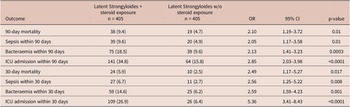
In the propensity-matched cohort, receipt of systemic corticosteroids was associated with significantly worse clinical outcomes (Table 2). Ninety-day mortality was higher among steroid-exposed patients compared with those who did not receive steroids (9.4% vs. 4.7%; odds ratio [OR] 2.10, 95% CI 1.19–3.72; P = 0.01). Steroid exposure was also associated with increased odds of sepsis within 90 days (9.6% vs. 4.9%; OR 2.05, 95% CI 1.17–3.58; p = 0.01), bacteraemia within 90 days (18.5% vs. 9.6%; OR 2.13, 95% CI 1.41–3.23; p = 0.0003), and ICU admission within 90 days (34.8% vs. 15.8%; OR 2.85, 95% CI 2.03–3.98; p < 0.0001).
Outcomes of patients with latent Strongyloides who did and did not receive steroid therapy after propensity score matching. Categorical variables given in total number of patients and valid percentages (%)

Table 2. Long description
The table consists of six columns: Outcome, Latent Strongyloides plus steroid exposure (n = 405), Latent Strongyloides without steroid exposure (n = 405), O R, 95 percent C I, and p-value.
* 90-day mortality: 38 (9.4 percent) with steroids vs 19 (4.7 percent) without; O R 2.10; 95 percent C I 1.19–3.72; p-value 0.01.
* Sepsis within 90 days: 39 (9.6 percent) with steroids vs 20 (4.9 percent) without; O R 2.05; 95 percent C I 1.17–3.58; p-value 0.01.
* Bacteraemia within 90 days: 75 (18.5 percent) with steroids vs 39 (9.6 percent) without; O R 2.13; 95 percent C I 1.41–3.23; p-value 0.0003.
* I C U admission within 90 days: 141 (34.8 percent) with steroids vs 64 (15.8 percent) without; O R 2.85; 95 percent C I 2.03–3.98; p-value less than 0.0001.
* 30-day mortality: 24 (5.9 percent) with steroids vs 10 (2.5 percent) without; O R 2.49; 95 percent C I 1.17–5.27; p-value 0.017.
* Sepsis within 30 days: 27 (6.7 percent) with steroids vs 11 (2.7 percent) without; O R 2.56; 95 percent C I 1.25–5.22; p-value 0.008.
* Bacteraemia within 30 days: 59 (14.6 percent) with steroids vs 25 (6.2 percent) without; O R 2.59; 95 percent C I 1.59–4.23; p-value 0.001.
* I C U admission within 30 days: 109 (26.9 percent) with steroids vs 26 (6.4 percent) without; O R 5.36; 95 percent C I 3.41–8.43; p-value less than 0.0001.
Similar associations were observed for short-term outcomes. Within 30 days, steroid exposure was associated with higher mortality (5.9% vs. 2.5%; OR 2.49, 95% CI 1.17–5.27; p = 0.017), sepsis (6.7% vs. 2.7%; OR 2.56, 95% CI 1.25–5.22; p = 0.008), bacteraemia (14.6% vs. 6.2%; OR 2.59, 95% CI 1.59–4.23; p = 0.001), and ICU admission (26.9% vs. 6.4%; OR 5.36, 95% CI 3.41–8.43; p < 0.0001).
Comparison with steroid-exposed patients without Strongyloides infection
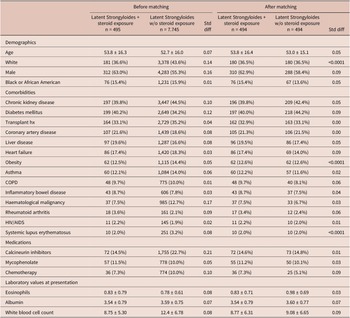
To evaluate whether these risks were specific to latent Strongyloides infection rather than steroid exposure alone, steroid-exposed patients with latent Strongyloides infection were compared with steroid-exposed patients who tested negative for Strongyloides IgG. Prior to matching, differences were observed in race, hematologic malignancy, immunosuppressive medication use, and laboratory values (Table 3). After propensity score matching, 494 patients were included in each group, with good covariate balance achieved (standardized differences ≤0.1).
Characteristics of patients with latent Strongyloides who received steroids and patients who tested negative for Strongyloides who received steroids. Categorical variables given in total number of patients and valid percentages (%). Continuous variables are depicted as mean plus/minus the standard deviation

Table 3. Long description
The table is divided into two main sections: Before matching and After matching. Each section compares Latent Strongyloides plus steroid exposure against Latent Strongyloides without steroid exposure, including a Standardized Difference column.
Demographics:
* Age: Before matching, 53.8 plus or minus 16.3 vs 52.7 plus or minus 16.0. After matching, 53.8 plus or minus 16.4 vs 53.0 plus or minus 15.1.
* White: Before matching, 36.6 percent vs 43.6 percent. After matching, both groups are 36.5 percent.
* Male: Before matching, 63.0 percent vs 55.3 percent. After matching, 62.9 percent vs 58.4 percent.
* Black or African American: Before matching, 15.4 percent vs 15.9 percent. After matching, 15.4 percent vs 13.6 percent.
Comorbidities (After matching values):
* Chronic kidney disease: 39.8 percent vs 42.4 percent.
* Diabetes mellitus: 40.0 percent vs 44.2 percent.
* Transplant history: 32.9 percent vs 33.1 percent.
* Coronary artery disease: 21.3 percent vs 21.5 percent.
* Liver disease: 19.5 percent vs 17.4 percent.
* Heart failure: 17.4 percent vs 14.0 percent.
* Obesity: 12.6 percent vs 12.6 percent.
* Asthma: 12.2 percent vs 11.6 percent.
* C O P D: 9.7 percent vs 8.1 percent.
* Inflammatory bowel disease: 8.7 percent vs 7.5 percent.
* Haematological malignancy: 7.5 percent vs 6.7 percent.
* Rheumatoid arthritis: 3.4 percent vs 2.4 percent.
* H I V / A I D S: 2.2 percent vs 2.0 percent.
* Systemic lupus erythematosus: 2.0 percent vs 2.0 percent.
Medications (After matching values):
* Calcineurin inhibitors: 14.6 percent vs 14.8 percent.
* Mycophenolate: 11.2 percent vs 10.1 percent.
* Chemotherapy: 7.3 percent vs 5.1 percent.
Laboratory values at presentation (After matching values):
* Eosinophils: 0.83 plus or minus 0.71 vs 0.98 plus or minus 0.69.
* Albumin: 3.54 plus or minus 0.79 vs 3.60 plus or minus 0.77.
* White blood cell count: 8.77 plus or minus 6.31 vs 9.08 plus or minus 6.65.
In the matched analysis, latent Strongyloides infection was not associated with increased 90-day mortality compared with IgG-negative steroid-exposed controls (7.1% vs. 7.3%; OR 0.97, 95% CI 0.60–1.57; p > 0.2) (Table 4). However, Strongyloides IgG positivity was associated with higher odds of infectious and critical care outcomes. Patients with latent Strongyloides infection had increased odds of sepsis within 90 days (10.8% vs. 6.9%; OR 1.63, 95% CI 1.04–2.55; p = 0.034), bacteraemia within 90 days (19.5% vs. 14%; OR 1.49, 95% CI 1.06–2.08; p = 0.022), and ICU admission within 90 days (39.9% vs. 20.1%; OR 2.65, 95% CI 1.99–3.52; p < 0.0001).
Outcomes of patients with latent Strongyloides who received steroids and patients who tested negative for Strongyloides who received steroids after propensity score matching. Categorical variables given in total number of patients and valid percentages (%)

Table 4. Long description
The table consists of six columns: Outcome, Latent Strongyloides plus steroid exposure (n = 494), I g G negative plus steroid exposure (n = 494), O R, 95% C I, and p-value.
* 90-day mortality: Latent group 35 (7.1%), I g G negative 36 (7.3%), O R 0.97, C I 0.60–1.57, p-value > 0.2.
* Sepsis within 90 days: Latent group 53 (10.8%), I g G negative 34 (6.9%), O R 1.63, C I 1.04–2.55, p-value 0.034.
* Bacteraemia within 90 days: Latent group 96 (19.5%), I g G negative 69 (14.0%), O R 1.49, C I 1.06–2.08, p-value 0.022.
* I C U admission within 90 days: Latent group 197 (39.9%), I g G negative 99 (20.1%), O R 2.65, C I 1.99–3.52, p-value < 0.0001.
* 30-day mortality: Latent group 22 (4.4%), I g G negative 23 (4.7%), O R 0.95, C I 0.52–1.74, p-value > 0.2.
* Sepsis within 30 days: Latent group 38 (7.7%), I g G negative 20 (4.1%), O R 1.97, C I 1.13–3.44, p-value 0.016.
* Bacteraemia within 30 days: Latent group 69 (14.0%), I g G negative 43 (8.7%), O R 1.70, C I 1.13–2.55, p-value 0.0097.
* I C U admission within 30 days: Latent group 163 (33.0%), I g G negative 116 (23.5%), O R 1.60, C I 1.21–2.12, p-value 0.0009.
Short-term outcomes demonstrated similar patterns. Within 30 days, latent Strongyloides infection was associated with increased odds of sepsis (7.7% vs. 4.1%; OR 1.97, 95% CI 1.13–3.44; p = 0.016), bacteraemia (14% vs. 8.7%; OR 1.7, 95% CI 1.13–2.55; p = 0.0097), and ICU admission (33% vs. 23.5%; OR 1.6 95% CI 1.21–2.12; p = 0.0009), without a significant difference in 30-day mortality.
Multivariable time-to-event analyses
In multivariable Cox proportional hazards models evaluating 90-day outcomes among patients with latent Strongyloides stercoralis infection, systemic corticosteroid exposure was independently associated with increased hazards of both mortality and sepsis (Supplemental Tables 2–3; Figure 1).
Forest plots of multivariable Cox proportional hazards models evaluating factors associated with (A) 90-day mortality and (B) 90-day sepsis among patients with latent Strongyloides stercoralis. Points represent adjusted hazard ratios (HRs) and horizontal bars denote 95% confidence intervals. The vertical dashed line indicates the null value (HR = 1.0), and the x-axis is displayed on a logarithmic scale. Steroid use reflects receipt of systemic corticosteroids within 30 days of the index Strongyloides IgG test. Models were adjusted for demographic characteristics, comorbid conditions, concomitant immunosuppressive therapies, steroid indication diagnoses, and baseline laboratory values, as listed in the figure.

Figure 1. Long description
Two forest plots side-by-side. Both use a logarithmic x-axis for Hazard Ratio (H R) ranging from 0.1 to 5.0, with a vertical dashed line at 1.0 representing the null value.
Left Panel: 90-day Mortality.
* Steroid Use: Point is significantly to the right of the null line, approximately at H R 3.2.
* Male: Point is to the left of the null line.
* Age (per year): Point is exactly on the null line.
* Chronic kidney disease: Point is to the right of the null line.
* Diabetes mellitus: Point is slightly to the right of the null line.
* C O P D exacerbation: Point is slightly to the right of the null line.
* Asthma exacerbation: Point is slightly to the right of the null line.
* Transplant history: Point is significantly to the left of the null line, approximately at H R 0.3.
* Calcineurin inhibitors: Point is exactly on the null line with wide confidence intervals.
Right Panel: 90-day Sepsis.
* Steroid Use: Point is significantly to the right of the null line, approximately at H R 3.5.
* Male and Age (per year): Points are on the null line.
* Chronic kidney disease and Diabetes mellitus: Points are slightly to the right of the null line.
* Rheumatoid arthritis: Point is to the left of the null line with very wide confidence intervals.
* C O P D exacerbation and Asthma exacerbation: Points are to the right of the null line.
* Transplant history: Point is to the left of the null line.
* Calcineurin inhibitors: Point is to the right of the null line.
* Mycophenolate: Point is to the right of the null line.
* Chemotherapy: Point is to the left of the null line.
* Liver disease and Heart failure: Points are to the right of the null line.
* H I V / A I D S: Point is slightly to the right of the null line.
* Inflammatory bowel disease: Point is to the right of the null line.
* Systemic lupus erythematosus: Point is to the left of the null line with the widest confidence intervals shown.
* White blood cell count: Point is on the null line.
* Eosinophils: Point is to the left of the null line.
* Albumin: Point is to the right of the null line.
* Hematological malignancy: Point is significantly to the right of the null line, approximately at H R 4.0.
For 90-day mortality, receipt of systemic corticosteroids within 30 days of the index Strongyloides IgG test was associated with more than a threefold increased hazard of death (hazard ratio [HR] 3.16, 95% CI 2.01–5.02; p < 0.0001). Increasing age was also independently associated with mortality risk (HR per year 1.04, 95% CI 1.02–1.05; p < 0.0001), as was chronic kidney disease (HR 1.92, 95% CI 1.22–3.04; p = 0.005). Transplant history was associated with a lower hazard of mortality (HR 0.28, 95% CI 0.10–0.77; p = 0.0129). Sex, diabetes mellitus, COPD exacerbation, asthma exacerbation, and calcineurin inhibitor use were not significantly associated with mortality in the adjusted model (Supplemental Table 2; Figure 1A).
In the multivariable analysis of 90-day sepsis, systemic corticosteroid exposure remained independently associated with increased sepsis risk (HR 3.01, 95% CI 1.72–5.23; p = 0.0001). Additional factors associated with higher sepsis hazard included calcineurin inhibitor use (HR 2.55, 95% CI 1.25–5.19; p = 0.0098), liver disease (HR 2.09, 95% CI 1.39–3.16; p = 0.0004), heart failure (HR 2.10, 95% CI 1.35–3.27; p = 0.0009), inflammatory bowel disease (HR 1.96, 95% CI 1.15–3.36; p = 0.0139), and hematologic malignancy (HR 4.06, 95% CI 2.16–7.61; p < 0.0001). Age, sex, chronic kidney disease, diabetes mellitus, transplant history, pulmonary comorbidities, other immunosuppressive therapies, and baseline laboratory values were not significantly associated with sepsis risk after adjustment (Supplemental Table 3; Figure 1B).
Prophylactic ivermectin use among steroid-exposed patients with latent Strongyloides
To explore whether prophylactic antiparasitic therapy modified the risk of adverse outcomes among steroid-exposed patients with latent Strongyloides infection, we performed a prespecified sub-analysis restricted to patients with positive Strongyloides IgG serology who initiated systemic corticosteroids. Patients were stratified by receipt of prophylactic ivermectin, defined as administration within the peristeroid window, and compared with those who did not receive ivermectin (Supplemental Table 4).
Prior to matching, patients who received prophylactic ivermectin (n = 95) and those who did not (n = 415) were broadly similar with respect to age, sex, and race but differed in several clinically relevant characteristics, including obesity, HIV infection, rheumatologic disease, hematologic malignancy, and use of concomitant immunosuppressive therapies. After 1:1 propensity score matching, 85 patients who received prophylactic ivermectin were matched to 85 patients who did not, achieving good balance across demographic characteristics, comorbid conditions, immunosuppressive medication use, and baseline laboratory values, with all standardized differences ≤0.22.
In the matched cohort, receipt of prophylactic ivermectin was associated with a significantly lower risk of the composite outcome of 90-day all-cause mortality, ICU admission, or sepsis (12.9% vs. 27.1%; OR 0.40, 95% CI 0.18–0.89; p = 0.024). These findings suggest a potential protective association between prophylactic ivermectin use and clinically meaningful adverse outcomes among steroid-exposed patients with latent Strongyloides infection.
Discussion
In this large, multicentre, real-world cohort study, systemic corticosteroid exposure among patients with latent Strongyloides infection was associated with substantially worse short- and intermediate-term clinical outcomes. After rigorous propensity score matching, steroid-exposed patients with latent Strongyloides infection experienced significantly higher risks of mortality, sepsis, bacteraemia, and ICU admission at both 30 and 90 days compared with matched patients with latent infection who did not receive steroids. These associations were consistent across multiple clinically meaningful endpoints and persisted despite adjustment for comorbid conditions, concomitant immunosuppressive therapies, and baseline laboratory abnormalities.
These findings were further reinforced by multivariable time-to-event analyses. In Cox proportional hazards models, systemic corticosteroid exposure was independently associated with a more than threefold increased hazard of 90-day mortality and a more than twofold increased hazard of 90-day sepsis, even after adjustment for demographic characteristics, comorbid conditions, immunosuppressive therapies, steroid indication diagnoses, and baseline laboratory values. The concordance of results across both propensity-matched analyses and adjusted Cox models strengthens the inference that corticosteroid exposure is a key driver of adverse outcomes in this population and reduces the likelihood that findings are attributable solely to residual baseline differences or analytic approach.
When steroid-exposed patients with latent Strongyloides infection were compared with steroid-exposed patients who tested negative for Strongyloides, mortality did not differ significantly between groups. However, Strongyloides seropositivity was associated with significantly increased risks of sepsis, bacteraemia, and ICU admission. This pattern suggests that the excess mortality observed among steroid-exposed patients with latent Strongyloides infection is likely mediated through infectious and critical illness pathways rather than reflecting a generalized effect of corticosteroid exposure alone. Together, these findings support a biologically coherent model in which corticosteroid-induced immunosuppression precipitates clinically significant complications of latent Strongyloides infection, even in the absence of overt disseminated disease coding.
The observed associations are consistent with the known pathophysiology of Strongyloides stercoralis. Corticosteroids promote accelerated autoinfection by increasing larval replication and impairing host immune defences, predisposing patients to hyperinfection and dissemination (Gordon et al Reference Gordon, Utzinger, Muhi, Becker, Keiser, Khieu and Gray2024). These processes facilitate translocation of enteric bacteria, resulting in gram-negative bacteraemia, sepsis, and multiorgan failure. While disseminated strongyloidiasis is classically described as a rare but catastrophic complication, our findings suggest that clinically consequential infectious morbidity may occur more frequently and may be underrecognized in routine clinical practice, particularly when explicit diagnostic codes for disseminated disease are absent.
This study extends prior case series and small observational reports by providing large-scale, outcome-focused evidence of the risks associated with steroid exposure in patients with latent Strongyloides infection. In particular, Ramprasad and colleagues demonstrated a Strongyloides seroprevalence of 20% among steroid recipients in a tertiary care centre in North India, highlighting the importance of screening prior to immunosuppressive therapy (Ramprasad et al Reference Ramprasad, Kodan, Jonnalagadda, Bir, Verma, Sahni, Vikram, Soneja, Mirdha and Wig2022). While that study established the burden of latent infection among patients receiving corticosteroids, it did not assess downstream clinical outcomes associated with steroid exposure in seropositive individuals. Our study advances this literature by linking laboratory-confirmed seropositivity, corticosteroid exposure, and clinically meaningful outcomes over time, thereby demonstrating that latent Strongyloides infection is not merely prevalent among steroid recipients but clinically consequential when systemic corticosteroids are administered.
Notably, eosinophil counts were lower among steroid-exposed patients prior to matching and did not reliably distinguish high-risk patients after matching or multivariable adjustment. This finding aligns with prior reports that eosinophilia may be absent in severe strongyloidiasis and underscores the limitations of relying on eosinophil counts alone as a screening strategy (Ashiri et al Reference Ashiri, Rafiei, Ansari and Beiromvand2025; Buonfrate et al Reference Buonfrate, Bradbury, Watts and Bisoffi2023; Marcos et al Reference Marcos, Terashima, DuPont and Gotuzzo2008b; Montes et al Reference Montes, Sawhney and Barros2010; Requena-Méndez et al Reference Requena-Méndez, Chiodini, Bisoffi, Buonfrate, Gotuzzo and Muñoz2013). Our results therefore support the use of targeted serologic testing and raise consideration for empiric antiparasitic therapy in appropriate clinical contexts.
In an exploratory sub-analysis among steroid-exposed patients with latent Strongyloides infection, prophylactic ivermectin use was associated with a lower risk of a 90-day composite outcome of mortality, ICU admission, or sepsis after propensity score matching. Given the modest sample size and limited number of events, this finding should be interpreted cautiously and viewed as hypothesis-generating rather than definitive evidence of benefit.
These results complement prior work from Thailand that compared empirical ivermectin prophylaxis with faecal examination–guided therapy among hospitalized patients receiving high-dose corticosteroids (Yongbantom et al Reference Yongbantom, Sribenjalux, Manomaiwong and Meesing2023). In that study, no cases of hyperinfection or disseminated strongyloidiasis were observed in either group, and empirical prophylaxis was associated with higher cost without demonstrable superiority in preventing parasitologically confirmed Strongyloides infection. In contrast, our study focuses on patients with laboratory-confirmed latent infection and evaluates clinically meaningful outcomes rather than parasite detection alone, suggesting that targeted prophylaxis in seropositive patients may mitigate short-term infectious and critical care morbidity.
This study has several limitations. First, its retrospective observational design precludes causal inference, and residual confounding may persist despite propensity score matching and multivariable adjustment. In particular, unmeasured factors such as corticosteroid dose, duration, and indication severity, as well as country of origin, travel history, and socioeconomic determinants of health, were not fully captured. Second, Strongyloides infection status was determined by IgG serology rather than uniform stool microscopy, stool culture, or stool PCR confirmation. Although serologic testing is more sensitive than stool-based testing for chronic infection, sensitivity and specificity vary by assay and reference standard, false negatives may occur – particularly in immunocompromised patients – and serology cannot distinguish remote from more recent infection. Therefore, exposure misclassification remains possible. Third, outcomes were identified using administrative codes and EHR-derived data, which may undercapture clinically suspected hyperinfection or misclassify infectious syndromes. Moreover, the TriNetX database lacks granular microbiologic and parasitologic data that would allow direct confirmation of disseminated strongyloidiasis in all cases. The exploratory sub-analysis evaluating prophylactic ivermectin use was limited by a relatively small sample size and low event counts, which constrained statistical power and precluded more granular time-to-event modelling. Accordingly, these findings should be interpreted cautiously and viewed as hypothesis-generating, underscoring the need for larger prospective studies to more definitively assess the effectiveness of targeted ivermectin prophylaxis in this population.
Despite these limitations, this study is strengthened by its large sample size, multicentre design, use of laboratory-confirmed Strongyloides serology, robust matching strategy, and complementary time-to-event analyses demonstrating consistent associations across analytic approaches. The convergence of findings across propensity-matched comparisons and Cox proportional hazards models further supports their validity.
In conclusion, among patients with latent Strongyloides infection, systemic corticosteroid exposure was independently associated with markedly increased hazards of mortality and sepsis, as well as higher risks of bacteraemia and ICU admission. These findings identify latent Strongyloides infection as a clinically important and potentially modifiable risk factor in patients receiving corticosteroids. Enhanced screening strategies, increased clinician awareness, and consideration of empiric antiparasitic therapy in high-risk populations may represent important opportunities to reduce preventable morbidity and mortality. Prospective studies and implementation-focused research are needed to define optimal screening and treatment approaches and to clarify the mechanisms underlying these associations.
Supplementary material
The supplementary material for this article can be found at http://doi.org/10.1017/S0022149X26101965.
Financial support
This research received no specific grant from any funding agency, commercial or not-for-profit sectors.
Competing interests
The authors have no conflicts of interest to disclose.
Ethical standard
The authors assert that all procedures contributing to this work comply with the ethical standards of the relevant national and institutional committees on human experimentation and with the Helsinki Declaration of 1975, as revised in 2008.