Introduction
Weed management is a critical component of warm-season pasture systems in the southern United States. Multiple herbicide options are available for broadleaf weed management in pastures and hayfields; among these are 2,4-D, dicamba, metsulfuron, and several pyridine carboxylic acid herbicides including aminopyralid, clopyralid, fluroxypyr, picloram, and triclopyr (DiTomaso Reference DiTomaso2000; Payne et al. Reference Payne, Sleugh and Bradley2010; Sellers et al. Reference Sellers, Ferrell, MacDonald and Kline2009). Specific tank mixes including aminopyralid or picloram may provide soil residual activity that increases the seasonal length of broadleaf weed control. This is highly desirable, as many warm-season weeds germinate or emerge throughout the late spring and summer. Enloe et al. (Reference Enloe, Ducar and Dorough2010) found that aminopyralid plus 2,4-D provided season-long control of bitter sneezeweed [Helenium amarum (Raf.) H. Rock] and Carolina horsenettle (Solanum carolinense L.) with a single June treatment. Other nonresidual herbicide programs can also provide excellent weed-specific control; for example, triclopyr plus fluroxypyr is extremely effective on dogfennel [Eupatorium capillifolium (Lam.) Small ex Porter & Britton] (Sellers et al. Reference Sellers, Ferrell, MacDonald and Kline2009) and blackberry (Rubus spp.) (Ferrell et al. Reference Ferrell, Sellers, MacDonald and Kline2009). Both strategies are useful and necessary for producers, depending on management goals and weed species they must manage. Additionally, the timing of both strategies may vary by target species. For example, spring treatments are often used to control late flushes of winter weeds and the initial flush of warm-season annual weeds, whereas early-summer treatments are applied to control later emerging perennial weeds such as Carolina horsenettle.
One of the most serious issues with pyridine carboxylic acid herbicides used for broadleaf pasture weed control has been concomitant damage to forage legumes, especially clover species. This is often manifest through direct injury to emerged clovers at the time of treatment, and through soil residual activity that results in severe injury or complete mortality to clovers planted in the fall or the following growing season. This has also been an important issue for conservation reserve program lands that have been returned to crop production, especially in the northern Great Plains. Mikkelson and Lym (Reference Mikkelson and Lym2011) found significant sunflower, soybean, and alfalfa injury when planted 8 to 11 mo after aminopyralid treatment.
Laird et al. (Reference Laird, Miller, Griffin, Twidwell, Alison and Blouin2016) examined the impact of residual (picloram + 2,4-D) and nonresidual (triclopyr + fluroxypyr) programs on four clover species in Louisiana. They found that the residual program with picloram resulted in significantly lower cover for all four clover species, including crimson clover. However, their application and seeding occurred on the same day, indicating that picloram residual activity with an October application timing was highly injurious to clover growth the following year. Aminopyralid plus 2,4-D applied in the fall or late winter to control hairy buttercup (Ranunculus sardous Crantz) resulted in 100% control of established white clover the following spring (Enloe et al. Reference Enloe, Johnson, Renz, Dorough and Tucker2014). Picloram plus 2,4-D applied at a range of rates and timings resulted in essentially complete control of ladino clover (Trifolium repens L.) and red clover (Trifolium pratense L.) within the year of treatment and severe injury of new plantings of both clovers the following spring (Beeler et al. Reference Beeler, Rhodes, Bates, Main and Mueller2004).
To date, many herbicide studies of this nature have primarily focused on legume management in perennial cool-season grass pastures, predominantly tall fescue [Lolium arundinaceum (Schreb.) Darbysh.], where legumes are an important component to help dilute fescue toxicosis (Thompson et al. Reference Thompson, Fribourg, Waller, Sanders, Reynolds, Phillips, Schmidt, Crawford, Allen, Faulkner, Hoveland, Fontenot, Carlisle and Hunter1993). Previous legume establishment strategies have focused on controlling weeds in cool-season pastures and then adding desirable clover varieties to grow in combination with the cool-season forage base (Beeler et al. Reference Beeler, Rhodes, Bates, Main and Mueller2004). In most instances, white clover (Trifolium repens L.), the most commonly used perennial legume in legume–grass mixtures worldwide (Ball and Lacefield, Reference Ball and Lacefield2000), is planted into perennial cool-season systems.
Pastures and hayfields in the Southeast, however, differ in their forage adaptation because of differences in soil type and climatic conditions. Areas of the Deep South consist predominantly of warm-season perennial pastures overseeded by winter annual grasses and legume mixtures for use during the cooler dormant season (Evers Reference Evers2005). These species are often used within a single grazing season over dormant bermudagrass sods. Producers often use annual clover species that complement commonly overseeded winter annual grasses such as Italian ryegrass [Lolium perenne L. subsp. multiflorum (Lam.) Husn.]. Crimson clover is a prolific reseeder and the most common cool-season annual clover planted within this region (Ball et al. Reference Ball, Hoveland and Lacefield2015; Knight Reference Knight1985). Crimson clover has been utilized in the United States for the last 150 yr and is the most important annual clover to US agriculture (Smith Reference Smith2010). Overseeded annual forage systems represent an important source of high-quality grazing for supporting livestock production in the winter and early-spring months (Beck et al. Reference Beck, Stewart, Phillips, Watkins and Gunter2007; Gunter et al. Reference Gunter, Whitworth, Montgomery and Beck2012; Hoveland et al. Reference Hoveland, Anthony, McGuire and Starling1978); however, the use of mixed grass–legume pastures limits the range of available herbicides for controlling problematic weeds. Of the technologies available, it is important to assess potential implications of herbicide activity on aboveground pasture productivity and species composition. The susceptibility of cool-season legumes to various herbicides may also decrease their potential for nitrogen contribution and forage quality within this production system––attributes that represent a significant benefit of legume use to the producer.
The objective of this research was to develop a better understanding of how commonly used pasture herbicides and treatment timings influence the success of post-treatment crimson clover seeding. We compared the impact of two pasture herbicide programs utilizing residual vs nonresidual pyridine carboxylic acid herbicides at spring and early-summer timings on the establishment success of a subsequent fall crimson clover seeding. We also compared these approaches when used in single vs repeated annual spring applications.
Materials and Methods
Field experiments were conducted from May 2014 through May 2016 in two warm-season perennial pastures in central and south Alabama. The experiments were located at the Wiregrass Research and Extension Center in Headland, AL (31°21'7.45“N, 85°19'25.38“W; elevation 113 m) and on a cooperator’s farm near Camden, AL (31°58'1.82“N, 87°19'12.47“W; elevation 34 m) to evaluate post-application herbicide effects in warm-season perennial grass pastures overseeded with ‘Dixie’ crimson clover in the fall. Pastures were predominantly bermudagrass sod, and locations were selected based on common use and soil suitability for legume production. Soils were Dothan fine sandy loam (fine-loamy, kaolinitic, thermic Plinthic Kandiudults) at Headland and Malbis silt loam (fine-loamy, siliceous, subactive, thermic Plinthic Paleudults) at Camden (Table 1).
Physical and chemical characteristics of soil at the Camden and Headland, AL experiment locations.

a Abbreviations: CEC, cation exchange capacity.
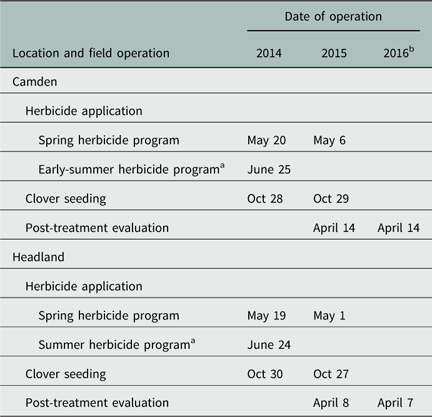
Two herbicide premixes labeled for pasture use in the Southeast were evaluated––one with considerable soil residual activity and one with essentially none. A nontreated control treatment was included for comparison. The residual herbicide program evaluated was aminopyralid plus 2,4-D [0.09 + 0.7 kg ae ha–1; GrazonNext HL®, Dow AgroSciences, Indianapolis, IN (Anonymous 2015)], and the nonresidual program was triclopyr plus fluroxypyr [0.63 + 0.21 kg ae ha–1; PastureGard HL®, Dow AgroSciences (Anonymous 2016)] plus 2,4-D [1.12 kg ae ha–1; DMA 4, Dow AgroSciences (Anonymous 2011)]. These rates are commonly used in warm-season pastures in the Southeast. Treatment application timings were designed to evaluate possible herbicide program effects on crimson clover seeding in the fall after spring (May) and early-summer (June) application. The spring herbicide program was also compared when used as single vs repeated annual applications. The dates of major field operations, including applications of specific herbicide programs, are provided in Table 2. Spring herbicide treatments were applied on May 20, 2014 in Camden and on May 19, 2014 in Headland. Early-summer herbicide treatments were sprayed on June 25, 2014 in Camden and on June 24, 2014 in Headland. The annual spring sequential treatment was applied on May 6, 2015 in Camden and on May 1, 2015 in Headland. Each year, sites were harvested to a 5-cm stubble height prior to herbicide application, and a nonionic surfactant (Induce; Helena Chemical Co., Collierville, TN) was added at 0.25% v/v for all herbicide treatments and timings. Herbicide treatments were broadcast applied with an ATV-mounted boom sprayer using a compressed air system at 250 kPa with 11002 Teejet air induction nozzles at 187 L ha–1. Plot size was 3 by 12 m (10 by 40 ft), and the eight herbicide treatments and the untreated control were arranged in a randomized complete block design, with four replications at each location.
Dates and locations of major field operations.

a Early-summer applications occurred in year 1 only.
b Year 2 evaluated single (1 yr) and repeated (2 yr) spring applications.
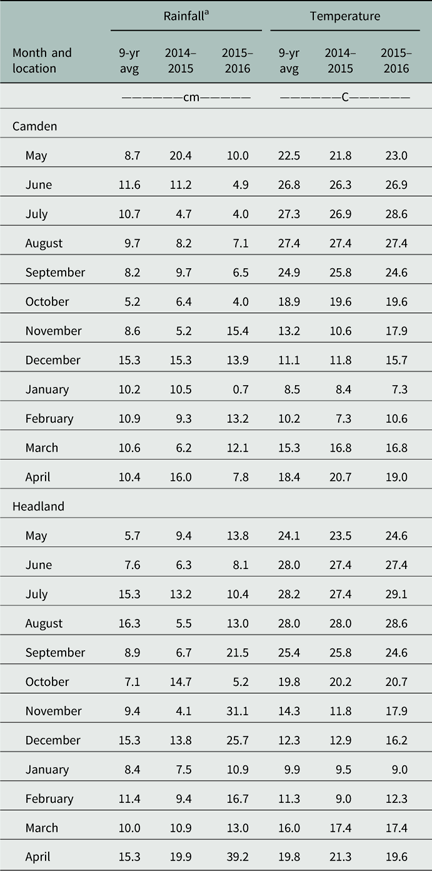
Following herbicide application, bermudagrass pastures were grazed and residual material harvested for hay throughout the summer months. In late summer of each year, cattle were removed from the pasture area and plots were prepared for overseeding with ‘Dixie’ crimson clover. Any remaining residual material was harvested via clipping to a 5-cm stubble height. During the last week of October, crimson clover was seeded perpendicular to herbicide treatment using a no-till drill with a small-seed box at a seeding rate of 28 kg ha–1 and a planting depth of 1 to 1.5 cm, following current recommendations of the Alabama Cooperative Extension System (Johnson and Ball, Reference Johnson and Ball2013). Clover was overseeded approximately 5.5 mo after spring and 4 mo after the early-summer herbicide treatment timing. Plot areas were excluded from pasture use and not disturbed from fall planting through spring evaluation to determine clover establishment and growth, so as to avoid confounding effects of preferential grazing and overuse. Absolute vegetative cover (percentage of ground covered by actively growing forage) was estimated after clover seedhead emergence on April 14, 2015 and 2016 in Camden and on April 8, 2015 and April 7, 2016 in Headland. Cover data were collected in three randomly placed 0.25-m2 quadrats within each plot. Cover to the nearest 1% was visually assessed as the percentage of crimson clover, grass, and other cover (i.e., non-forage weeds or bare area) present. At the time of visual assessment, bermudagrass was still dormant and therefore comprised an insignificant amount of the green grass cover component at each location. Volunteer annual ryegrass (Lolium multiflorum L.) was the predominant grass species present at each site. Other plant species present included rescue grass (Bromus catharticus Vahl), curly dock (Rumex crispus L.), and hairy buttercup, which were classified as nonforage weeds in the “other” category. Both sites were selected because of relatively low known weed abundance, to reduce confounding effects of interspecific weed competition on clover establishment. At the time of vegetative cover assessment, clover height within each quadrat was measured. Vegetative material was harvested from each quadrat at a 5-cm clipping height and separated into the same components used for cover estimation for botanical composition of the pasture. Samples were weighed and dried for approximately 48 h at 60 C, and dry weights were recorded for dry matter and yield determination. Total and component herbage mass were estimated as dry matter (DM) per unit area (kg DM ha–1). Plot evaluations were conducted approximately 10.5 and 9 mo after the spring and early-summer application timings, respectively, and 6 mo after clover planting. Weather data throughout the study, as well as historical weather data, were collected from the local regional airport closest to each location. These stations were KDHN in Dothan, AL (located approximately 16 km from the Wiregrass Research and Extension Center in Headland, AL) and KPRN in Greenville, AL (located approximately 77 km from the cooperator’s farm near Camden, AL) (Table 3). These distances may potentially limit their explanatory use, especially for precipitation figures. However, they do provide the data that were available closest to the study sites.
Monthly rainfall (cm) and average monthly temperatures (C), in comparison to 9-yr average, for Camden and Headland from May 2014 through April 2016.

a Rainfall and temperature data collected from regional airports nearest to study location: KPRN Greenville, AL (Camden), KDHN Dothan, AL (Headland).
Vegetative cover and yield data were analyzed using the PROC MIXED procedure of SAS (SAS Institute, 2003). Treatment, year, and location were considered fixed effects. Block and its interactions with treatment were considered random effects. Fisher’s LSD at P<0.05 was used to separate least square means as appropriate. To better examine the influence of aboveground pasture species diversity on clover production, clover cover was regressed against grass and weed cover for both locations using a linear regression approach in SAS (SAS Institute, 2003). For this analysis, locations were combined to better highlight the relationship among species composition across sites in the study. The cover data were not relativized to 100% to maintain the variation present in the absolute cover values.
Results and Discussion
There were significant treatment-by-location interactions for grass component yield (P=0.0004) and grass and weed cover data (P=0.001 and 0.022, respectively). Therefore, treatment data were analyzed separately by location.
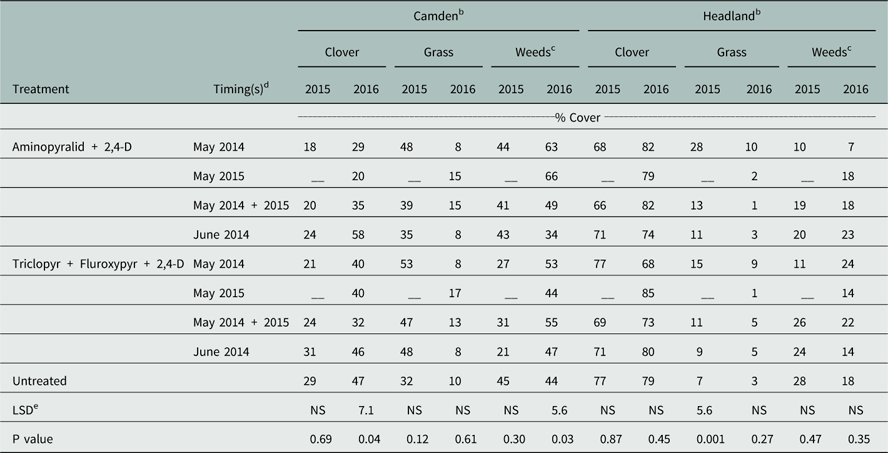
In 2015, crimson clover and weed ground cover did not differ among treatments at either location. Grass ground cover did not differ between treatments in Camden; however, it was greater in plots treated with aminopyralid plus 2,4-D the previous spring than in all other treatments at Headland (Table 4). Grass cover was also slightly higher in the spring-treated triclopyr + fluroxypyr + 2,4-D treatment than the untreated control. The same treatment applied in the early summer was not different from the nontreated control. Given this inconsistency, the variability in grass cover cannot clearly be attributed to any herbicide effect.
Clover, grass, and weed cover response (%) to single and repeated annual herbicide treatments in Camden and Headland, AL.Footnote a

a Abbreviations: __, No data to report; NS, nonsignificant.
b Treatment data were analyzed separately by location due to environmental differences.
c Weeds are defined as nonforage plants or bare area present. Winter weed spectrum included rescuegrass, curly dock, and hairy buttercup.
d Timing of herbicide application prior to fall establishment of crimson clover. Application timings represent spring or early-summer application (May and June 2014) and single (May 2014 or May 2015) or repeated (May 2014 plus May 2015) applications. Assessments occurred after clover seedhead emergence in April of the year following application.
e Fisher’s LSD at (P≤0.05) was used to separate least square means as appropriate.
In 2016, plant cover components (clover, grass, weeds) did not differ between treatments in Headland (Table 4). In addition to a lack of significance, there was no numerical trend to suggest that the repeated residual herbicide program resulted in lower clover cover than the nonresidual program or the untreated control. In fact, in both years crimson clover dominated vegetative cover at this location. In Camden, percentage clover cover (Table 4) was higher in the plots having summer 2014 applications of aminopyralid plus 2,4-D (58%) than all other treatments. However, there was no consistent trend in clover cover response to the residual herbicide program to suggest a plantback issue. Weed cover generally increased in all treatments between the years, averaging 44% in the untreated check plots in 2016. However, it was higher in several of the residual and nonresidual herbicide-treated plots than in the untreated control. Grass cover did not differ among treatments at either location in 2016.
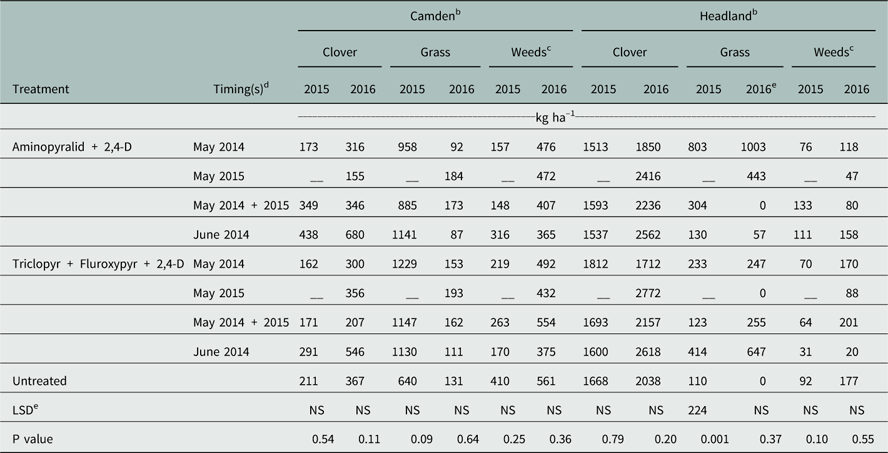
Yields of clover and weed components did not differ among treatments at either location in either year. Likewise, grass yield did not differ among treatments in either year in Camden or in Headland in 2016 (Table 5). Consistent with grass ground cover in Headland in 2015, grass yields in the plots having spring treatment with aminopyralid plus 2,4-D were higher than all other treatments. Grass yields in the early-summer triclopyr plus fluroxypyr + 2,4-D treatment were also slightly higher than the untreated control (Table 5).
Clover, grass, and weed yield (kg ha–1) after single and repeated annual herbicide treatments in Camden and Headland, AL.Footnote a

a Abbreviations: __, No data to report; NS, nonsignificant.
b Treatment data were analyzed separately by location because of environmental differences.
c Weeds are defined as nonforage plants or bare area present. Winter weed spectrum included rescuegrass, curly dock, and hairy buttercup.
d Timing of herbicide application prior to fall establishment of crimson clover. Application timings represent spring or early-summer application (May and June 2014) and single (May 2014 or May 2015) or repeated (May 2014 plus May 2015) applications. Assessments occurred after clover seedhead emergence in April of the year following application.
e Grass component yield was negligible in plots with 0, therefore data for those plots was not included in the analysis.
f Fisher’s LSD at (P≤0.05) was used to separate least square means as appropriate.
In addition to the cover and yield data, clover height data were collected each year. Clover height did not differ among treatments at either location or either year (data not shown).
These studies indicate no consistent plantback issues in fall seeding crimson clover following a single spring or early-summer residual (aminopyralid + 2,4-D) or nonresidual (triclopyr + fluroxypyr + 2,4-D) pasture herbicide program. Additionally, we found no cumulative negative effects following 2 yr of either herbicide program. These results are in contrast to Lane and Anderson (Reference Lane and Anderson2016), who examined crimson clover response to aminopyralid + 2,4-D applied in April, May, June, or July. In February the following year, they found that aminopyralid +2,4-D greatly reduced crimson clover stands through residual activity for April, May, June, or July application timings. They concluded that precipitation was well below average the entire growing season during which the herbicide treatments were applied––a condition that probably slowed the rate of aminopyralid degradation from the soil, resulting in carryover. Mikkelson and Lym (Reference Mikkelson and Lym2011) found that aminopyralid reduced alfalfa, soybean, and sunflower yields when planted 8 to 11 mo after treatment. However, greater injury was observed from the fall than spring application timing. They suggested that the warmer conditions of summer with good soil moisture increased aminopyralid degradation.
Our differences in pasture composition may be partially attributed to variances in weather between the experimental years. Temperature differences from normal were limited and very similar between sites (Table 3). Both sites experienced slightly cooler than normal conditions in November 2014 and February 2015, and slightly warmer than normal conditions in March and April of 2015. The following growing season, both sites experienced slightly warmer than normal conditions in November and December of 2015. Temperature patterns closely followed long-term averages at both sites in almost all other months.
Unlike temperature, precipitation patterns varied strongly between sites and years (Table 3). In 2014, for the period of May through October, cumulative precipitation was slightly higher at Camden (60.6 cm) than Headland (55.8 cm). These were both close to the long-term average for both Camden (54.1 cm) and Headland (60.1 cm). In 2015 for the same period, cumulative precipitation was much lower at Camden (36.5 cm) than Headland (72 cm). This demonstrated that Camden was well below average and Headland was above average for that period where lower precipitation would most likely increase aminopyralid persistence. However, clover cover was not different between the residual and nonresidual programs at Camden in the year following this period. Lane and Anderson (Reference Lane and Anderson2016) reported that dry summer conditions may reduce the natural degradation process of herbicides and contribute to a longer residual activity than under wetter conditions in overseeded warm-season perennial grass pastures. However, the authors reported lower cumulative rainfall values than those reported for either location in the present study. For example, the May to mid-October period in their study at Huntsville, TX received approximately 27 cm of precipitation, which was approximately 31 cm less than the average and 10 cm less than we observed for the same period at Camden in 2015.
Cumulative precipitation at Camden for the November to April period for 2014 to 2015 and 2015 to 2016 was 62.5 cm and 63.4 cm, respectively. This was very similar to the long-term cumulative average for this period (66 cm). Cumulative precipitation at Headland for the November to April period for 2014 to 2015 and 2015 to 2016 was 65.6 and 136.6 cm, respectively. For the November 2014 to April 2015 period, this was very similar to the long-term cumulative average (69.8 cm), though it was nearly double for the November 2015 to April 2016 period, making for an extremely wet year. Soil–climate interactions can influence the residence time of herbicides with residual activity in the soil profile. Bukun et al. (Reference Bukun, Shaner, Nissen, Westra and Brunk2010) observed that binding of aminopyralid and clopyralid was highly correlated to soil organic matter and texture, but not soil pH. With increasing soil organic matter and clay content, these compounds are more tightly adsorbed in the soil profile. The authors estimated herbicide leachability through a groundwater ubiquity score (GUS) based on the K oc and reported half-lives of these herbicides from Gustafson (Reference Gustafson1989) and Senseman et al. (Reference Senseman, Hancock, Wauchope, Armburst, Peters, Massey, Johnson, Reynolds, Lichtner, MacDonald, Rushing, Kitner, McLean and Vencill2007), respectively. The GUS for aminopyralid ranged from 3.9 to 4.1, which suggests that this herbicide has potential to leach. Silt and sandy loams have relatively low cation exchange capacity and soil organic matter (Weil and Brady, Reference Weil and Brady2016), which reduces the opportunity for adsorption of aminopyralid-based herbicides. When coupled with the variation in rainfall and warm climatic conditions experienced in the region, this may have contributed to a lack of herbicide response in this present study.
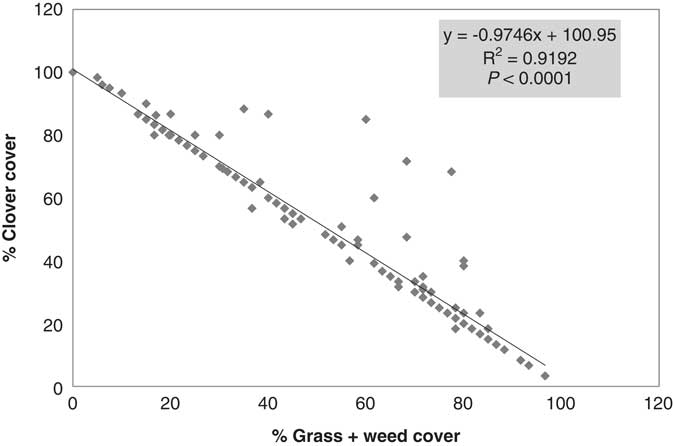
Although we selected sites with low known weed pressure, the Camden site had relatively high annual grass cover in 2015 and high weed cover in 2016. These were concomitant with low clover cover in both years. In Headland, crimson clover was the dominant species across the plots, with limited grass and weed cover in both years. To better examine the influence of aboveground pasture species diversity on clover production, clover cover was regressed against grass and weed cover for both locations. Locations were combined to better highlight the relationship among species composition across sites in the study. The grass and weed cover was primarily composed of the annuals Italian ryegrass and hairy buttercup and the early-season perennial, curly dock, which tends to function more like a spring ephemeral in the Deep South. Regression analysis was highly significant and indicated a strong relationship between crimson clover cover and combined grass and weed cover (Figure 1). Crimson clover cover strongly decreased as grass and weed cover increased––a result that may be related to greater interspecific competition at higher levels of grass and weed cover. These data illustrate that where there is vigorous growth and contribution of crimson clover, there is less opportunity for grass and weed encroachment. Therefore, changes in pasture dynamics in this study were potentially more associated with spatial competition for light, nutrients, and water among clover, grass, and weed species across locations than the specific herbicide treatment or time of application.
Regression analysis of clover and clover + grass cover (%) from 2014 to 2016 across locations.

Crop weed competition has been well studied, and our results strongly support the influence of competing species on crimson clover productivity. Stern and Donald (Reference Stern and Donald1962) clearly demonstrated that dense grass cover reduced clover cover through decreased light penetration to the shorter statured clover. Additionally, multiple studies in annual range systems have documented the drivers regulating species composition including climate and plant competition (Bartolome et al. Reference Bartolome, Frost, McDougald and Connor2002; Biswell Reference Biswell1956; George et al. Reference George, Bartolome, McDougald, Connor, Vaughn and Markegard2001; Heady Reference Heady1961). Italian ryegrass and crimson clover have a similar seasonal growth distribution (Ball et al., Reference Ball, Hoveland and Lacefield2015) and may experience interspecies competition during the growing season. Fejer (Reference Fejer1959) observed species-specific competition of perennial Italian ryegrass and white clover, where with increasing tiller production of ryegrass, there was suppression of white clover production. Harris (Reference Harris1972) evaluated the effects of plant density, cutting height, and competition of perennial Italian ryegrass genotypes with white clover. In their study, increasing plant density of annual ryegrass depressed the competitive ability of clover because of increased tiller weight by ryegrass; this supports the relationship observed between grass and weed cover with crimson clover in the present evaluation.
Soil fertility differences among sites also probably contributed to the differences in pasture composition between sites. Both phosphorus and potassium levels were much higher at Headland than at Camden (Table 1) where clover cover was higher (Table 4). In mixed grass–clover pastures, additions of these two nutrients have been shown to significantly improve clover cover (Blaser and Brady Reference Blaser and Brady1950; Trumble and Shapter Reference Trumble and Shapter1937). Soil potassium availability is linked to improved nodulation, nitrogen fixation, and shoot regrowth potential in legume pastures (Barta Reference Barta1982). The Headland location has historically been a heavily utilized pasture in the summer months and a hay feeding area during the winter––a condition that may have contributed to increased phosphorus and potassium levels from animal nutrients over time.
These studies demonstrate the complexity of annual legume plantback issues with soil residual herbicides in pastures, where differences in climate and soils can strongly interact with soil fertility and resident vegetation to influence results. Our results did not indicate soil residual herbicide issues for crimson clover plantback in the fall following spring or early-summer application of aminopyralid + 2,4-D. However, soil fertility and competition from resident annual grasses and weeds strongly influenced productivity. This conundrum continues to be an issue, as there are no selective herbicides for weed control in dormant warm-season pastures overseeded with annual clovers. Future studies should examine the interaction of site-specific conditions and climate to better predict when herbicide residual issues are likely to arise, especially for mixed annual grass–legume pastures.
Acknowledgments
The authors would like to thank Dow AgroSciences and the Alabama Agricultural Experiment Station for support of this research. The authors also thank Mr. Leo Hollinger for use of the Camden site, lab technician Susan Sladden for her expertise with in-field and in-lab data collection and management, and the beef-forage graduate students at Auburn University.