Introduction
The growth in the older population is associated with an increased prevalence of chronic diseases and the so-called geriatric syndromes, amongst which the syndrome of frailty stands out.Reference Lima-Costa, Barreto and Giatti1–Reference Chaimowicz, Freitas, Py, Cançado, Doll and Gorzoni4 This syndrome is of clinical and public health concern because it is associated with adverse health outcomes, such as functional decline, dependency, recurrent falls, fractures, institutionalization, hospitalization and mortality, in older people of both genders.Reference Ferrucci, Guralnik, Studenski, Fried, Cutler and Walston5–Reference Cawthon, Marshall, Michael, Dam, Ensrud, Barrett-Connor and Orwoll7 The prevalence of frailty in the older community population ranges from 6.9 to 20%,Reference Fried, Tangen, Walston, Newman, Hirsch, Gottdiener, Seeman, Tracy, Kop, Burke and McBurnie8, Reference Ottenbacher, Ostir, Peek, Snith, Raji and Markides9 with an annual incidence of about 7%.Reference Fried, Tangen, Walston, Newman, Hirsch, Gottdiener, Seeman, Tracy, Kop, Burke and McBurnie8, Reference Ávila-Funes, Helmer, Amieva, Barberger-Gateau, Goff, Ritchie, Portet, Carrière, Tavernier, Gutiérrez-Robledo and Dartigues10, Reference Ávila-Funes, Amieva, Barberger-Gateau, Le Goff, Raoux, Ritchie, Carrière, Tavernier, Tzourio, Gutiérrez-Robledo and Dartigues11
Despite differences in the definition of frailty, there is consensus that it is a multifactorial condition that is progressive, characterized by vulnerability to stressors of low impact and with decreased ability to maintain homeostasis. It is related to, but independent of, co-morbidity and functional disability.Reference Raphael, Cava, Brown, Renwick, Heathcote, Weir, Wright and Kirwan12–Reference Rockwood and Mitnitski20 The lack of consensus on the best definition for frailty implies other problems: which markers should be used to identify the syndrome, which should be considered contributory factors, and which factors are a consequence of it?Reference Levers, Estabrooks and Kerr21
The operational definition of the phenotype of frailtyReference Fried, Tangen, Walston, Newman, Hirsch, Gottdiener, Seeman, Tracy, Kop, Burke and McBurnie8 considers only physical markers to characterize an older person as frail, whereas the operational definition of the Frailty Index (FI) also considers cognitive, psychological and environmental factors.Reference Rockwood and Mitnitski20, Reference Fisher22, Reference Kuh23 Several studies indicate the major and decisive role of muscle weakness in the process of frailty, and identify the potential causes as being sarcopenia, and neuroendocrine and/or immune dysfunction.Reference Bortz13, Reference Vanltallie24–Reference Ávila-Funes and Garcia-Mayo26 Exercise is suggested as a safe method to prevent and reverse the syndrome, though this has yet to be proven in controlled clinical trials.
In this context, the present systematic review aimed to analyse the definitions and markers of the frailty syndrome suggested in the literature.
Search methods
This review is characterized as systematic, retrospective and secondary according to the criteria of Sampaio and Mancini.Reference Sampaio and Mancini27 Relevant articles were selected from the MEDLINE (PubMed), LILACS and COCHRANE databases, using a strategy searching for systematic reviews, controlled clinical trials, randomized evaluation studies or meta-analyses, with the following key words combined: ‘Frail’ OR ‘Frailty’ AND ‘Elderly’ AND ‘Biological Markers’. The search limits were: language (Portuguese, Spanish and English), age (adults over 60 years of age) and publication date (articles published between 1998 and 2008). After the initial search of databases resulted in 1251 abstracts, these were read by a single evaluator (LLB) to determine the articles appropriate to be read in their entirety. Papers were excluded if they were not available in Brazil, the problem definition and/or methodology was inadequate, the type of study, objectives, definitions of frailty and/or the markers analysed were not specified, or if the way in which each marker was used to identify frail older people was not clear. The 66 abstracts selected had their papers read in full by two evaluators (LLB and RLM) and a further 41 articles were excluded because of the lack of adequate description of methodology, type of study, the setting in which data were collected and/or markers used. The 25 articles included then had their data recorded on a script containing the following information: bibliographic reference, research objectives, type of study, characterization of the subjects, definition of frailty and its descriptors, methodology description and conclusions. They were then separated into four groups: (1) observational (cross-sectional or longitudinal) studies, (2) intervention studies, (3) literature reviews or systematic reviews, and (4) qualitative studies.
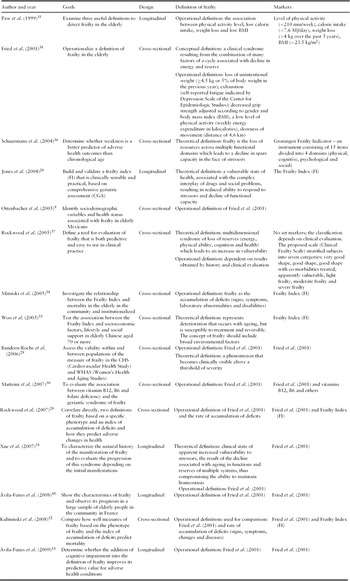
Observational studies – cross-sectional or longitudinal (Table 1)
Of the 15 observational studies, 10 were cross-sectional observational studies and 5 were longitudinal. Most (n = 13) used theoretical and operational definitions for the frailty syndrome, whilst two used only a theoretical definition. Regarding markers, 12 of the studies used the phenotype of frailty, five used the Frailty Index, three used both the phenotype and Index, and five used other markers.
Observational studies (cross-sectional and longitudinal)

The operational definition of the phenotype of frailtyReference Fried, Tangen, Walston, Newman, Hirsch, Gottdiener, Seeman, Tracy, Kop, Burke and McBurnie8 considers five physical markers: unintentional weight loss (10 lbs in past year), self-reported exhaustion, weakness (grip strength), slow walking speed, and low physical activity. Older people are characterized as frail in the presence of three or more markers, pre-frail when one or two markers are present, and robust when there are no positive markers. The operational definition of the Frailty Index considers ten areas, to be detected from Comprehensive Geriatric Assessment (CGA): cognition, mood and motivation, communication, mobility, balance, bowel function, bladder function, instrumental activities of daily living (IADL) and basic activities of daily living (ADL), nutrition and social aspects. The Frailty Index is calculated as the sum of the changes identified, divided by the total number of items evaluated, allowing the stratification of the frailty as mild (0–7), moderate (7–13) or severe (≥13).
Regarding markers, most articlesReference Ottenbacher, Ostir, Peek, Snith, Raji and Markides9–Reference Ávila-Funes, Amieva, Barberger-Gateau, Le Goff, Raoux, Ritchie, Carrière, Tavernier, Tzourio, Gutiérrez-Robledo and Dartigues11, Reference Rockwood and Mitnitski20, Reference Bandeen-Roche, Xue, Ferruci, Walston, Guraldik, Chaves, Zeger and Fried29–Reference Kulminski, Ukraintseva, Kulminskaya, Arbeev, Land and Yashin32 used the physical markers of the phenotype of frailty. Only three studiesReference Kulminski, Ukraintseva, Kulminskaya, Arbeev, Land and Yashin32–Reference Mitniski, Song, Skoog, Broe, Cox, Grunfeld and Rockwood34 used the markers proposed by the Frailty Index. The fact that most studies use the operational definition and markers of the phenotype of frailty supports the suggestion by Fried et al.Reference Fried, Tangen, Walston, Newman, Hirsch, Gottdiener, Seeman, Tracy, Kop, Burke and McBurnie8 that the markers are inexpensive and easy to use, and provide a simple basis for standardization of identification of frailty in older people. On the other hand, according to Jones et al.,Reference Jones, Song and Rockwood28 the Frailty Index is a viable measure in clinical practice because it is calculated from data obtained from CGA without the need for special instruments.
Rockwood and MitnitskiReference Rockwood and Mitnitski20 correlated these two measures, Index and Phenotype, and found a moderate correlation between them (r = 0.65), but it is not clear which would be more accurate to characterize a frail older population. The study by Kulminski et al.Reference Kulminski, Ukraintseva, Kulminskaya, Arbeev, Land and Yashin32 compared the ability of the two measures to predict death and showed that, of the 1073 most frail individuals with the lowest survival, the Phenotype of Frailty underestimated the risk of death of 720 individuals, while the Frailty Index, because it assesses a broader spectrum of disorders than the phenotype, did the same for only 134 older people. The authors conclude that the integration of both approaches is highly promising for increasing the precision of discrimination of the risk of death and especially for identification of the most vulnerable elderly people.
Paw et al.Reference Paw, Dekker, Feskens, Schoutern and Kromhout35 used the association between physical activity level (<210 min/week), low calorie intake (<7.6 MJ/day), weight loss (>4 kg in the last 5 years) and low body mass index (BMI) (<23.5 kg/m2) to identify frail older people. Schuurmans et al.Reference Schuurmans, Steverink, Lindenberg, Frieswijk and Slaets36 described the Groningen Frailty Indicator as a fast and easy instrument to administer, consisting of 15 items divided into four domains (physical, cognitive, psychological and social). Finally, Rockwood et al.Reference Rockwood, Song, Macknight, Bergman and Hogan37 proposed the use of the Clinical Frailty Scale, which classifies older people into seven categories (very good shape; good shape; good shape with co-morbidities treated; apparently vulnerable; mild, moderate or severe frailty). Only one study took into account reduced serum levels of vitamin B12 and B6 as markers of frailty.Reference Matteini, Waltson, Fallin, Bandeen-Roche, Kao, Semba and Allen30 Some authorsReference Ávila-Funes, Helmer, Amieva, Barberger-Gateau, Goff, Ritchie, Portet, Carrière, Tavernier, Gutiérrez-Robledo and Dartigues10, Reference Ávila-Funes, Amieva, Barberger-Gateau, Le Goff, Raoux, Ritchie, Carrière, Tavernier, Tzourio, Gutiérrez-Robledo and Dartigues11 emphasize the need for cognitive assessment as critical to detect frailty in older people, as cognitive decline increases the predictive value of other adverse changes in health.
Overall, these studies show that the syndrome of frailty is predictive of adverse changes in health, mobility and ADL and IADL, and risk of institutionalization and death in the older population.Reference Ávila-Funes, Helmer, Amieva, Barberger-Gateau, Goff, Ritchie, Portet, Carrière, Tavernier, Gutiérrez-Robledo and Dartigues10, Reference Jones, Song and Rockwood28, Reference Mitniski, Song, Skoog, Broe, Cox, Grunfeld and Rockwood34, Reference Schuurmans, Steverink, Lindenberg, Frieswijk and Slaets36, Reference Rockwood, Song, Macknight, Bergman and Hogan37 Bandeen-Roche et al.Reference Bandeen-Roche, Xue, Ferruci, Walston, Guraldik, Chaves, Zeger and Fried29 showed that after adjustment for co-morbidity and other key covariates, compared with robust individuals, frail women had 6-fold higher risk of death and more than 10-fold higher risk of incident IADL and ADL disability and nursing home entry. The study of an elderly Chinese cohort by Woo et al.Reference Woo, Goggins, Sham and Ho33 found a correlation between the Frailty Index and inadequate finances, low physical activity, poor social support network and non-participation in community/religious activities. This demonstrates that the Frailty Index is influenced by social and environmental factors, rather than solely physical, in keeping with the concept of frailty being multi-dimensional.
Another important finding in some studiesReference Bandeen-Roche, Xue, Ferruci, Walston, Guraldik, Chaves, Zeger and Fried29, Reference Xue, Bandeen-Roche, Varadhan, Zhou and Fried31 was the existence of a hierarchy in the expression of factors associated with physical frailty, with the presence of muscle weakness, slow walking, or low physical activity being 3.7, 1.7 and 1.9 times greater than the presence of weight loss, respectively. Moreover, these same studies found that whilst weakness manifests itself early and is reversible, exhaustion and loss of weight are found towards the end of the cycle of frailty and identify people who show a tendency to a rapid progression. In this context, Xue et al.Reference Binder, Yarasheski, Steger-May, Sinacore, Brown, Schechtman and Holloszy39 conclude that it is not the number of markers that determines the risk of becoming frail, but which markers manifest first.
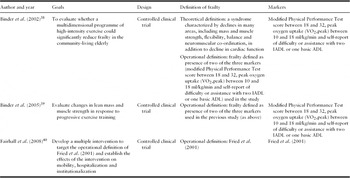
Intervention studies (Table 2)
Of the three studies included in this group (two by the same authors), two used an operational definition and one both a theoretical and operational definition. The markers used were diverse, with only one study adopting the criteria proposed by the Phenotype of Frailty and the others using varied physical markers. Since these studies are intervention research, it is suggested that physical markers are a more easily measurable and comparable parameter in clinical practice.
Intervention studies

One of the studies used programmed and supervised high-intensity exercises for flexibility, muscle strength and enduranceReference Binder, Schechtman, Ehsani, Steger-May, Brown, Sinacore, Yarasheski and Holloszy38 and another used a supervised and progressive exercise programme of strength.Reference Binder, Yarasheski, Steger-May, Sinacore, Brown, Schechtman and Holloszy39 The other studyReference Fairhall, Aggar, Kurrle, Sherrington, Lord, Lockwood, Monaghan and Cameron40 introduced a multiple and specific intervention for each frail older person according to the criteria of frailty proposed by Fried et al.Reference Fried, Tangen, Walston, Newman, Hirsch, Gottdiener, Seeman, Tracy, Kop, Burke and McBurnie8 (i.e. nutritional intervention for those who had lost weight, psychological and psychiatric intervention for exhaustion; low physical activity sessions of physiotherapy for slowness or weakness).
The study by Binder et al.Reference Binder, Schechtman, Ehsani, Steger-May, Brown, Sinacore, Yarasheski and Holloszy38 demonstrated that supervised muscle strengthening exercises are safer and more effective than home exercises in reducing physical changes and in improving the functional limitations of frail older people. The same authors in 2005Reference Binder, Yarasheski, Steger-May, Sinacore, Brown, Schechtman and Holloszy39 showed that a programme of supervised and progressive strength exercises induced significant increases in lean body mass and muscle strength in frail older people, so reversing sarcopenia, one of the most significant markers of the syndrome of frailty. The three studies do not provide consensus about the best management for frail older people, showing only that exercises to improve flexibility, strength, balance and endurance provide benefits to this group when sarcopenia and functional disability are considered. A broader and individualized intervention, such as that proposed by Fairhall et al.,Reference Fairhall, Aggar, Kurrle, Sherrington, Lord, Lockwood, Monaghan and Cameron40 may be most appropriate to treat frailty.
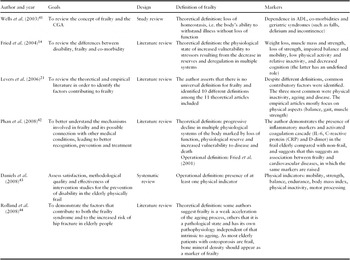
Literature and systematic reviews (Table 3)
Of the 25 articles initially considered in this group, only six were included as most failed to describe the methodology or the type of studies reviewed. Five of the studies that were included used only a theoretical definition of frailty, considering it to be a state of loss of homeostasis, marked by a depletion of reserves and increased vulnerability to low impact stressors.Reference Fried, Ferruci, Dater, Williamson and Anderson14, Reference Levers, Estabrooks and Kerr21, Reference Wells, Seabrook, Stolee, Borrie and Knoefel41, Reference Phan, Alpert and Fain42 Only the study of Daniels et al.Reference Daniels, Rossum, Witte, Kempen and Heuvel43 made use of an operational definition which considered that frail older people had a deficit of at least one physical marker: mobility, muscle strength, endurance, nutrition, physical activity and motor processing (co-ordination, or movement planning or speed). Phan et al.Reference Phan, Alpert and Fain42 used inflammatory markers (interleukin-6, C-reactive protein and D-dimer) to characterize the frailty syndrome, and suggest an association between frailty and cardiovascular disease, by atherosclerosis reducing blood flow to muscles and nerves, leading to sarcopenia. In addition, there are risk factors in common, such as being overweight and physical inactivity. Rolland et al.,Reference Rolland, Abellan van Kan, Bénétos, Blain, Bonnefoy, Chassagne, Jeandel, Laroche, Nourhashémi, Orcel, Piette, Ribot, Ritz, Roux, Taillandier, Trémollières, Weryha and Vellas44 in turn, suggest the use of bone mineral density as a possible marker of the frailty syndrome, because of shared risk factors and common mechanisms such as falls, weight loss, sarcopenia, cognitive decline, depression and hormonal changes. Only this study and that by Fried et al.Reference Fried, Ferruci, Dater, Williamson and Anderson14 mention cognitive deficit as a probable marker of frailty.
Literature and systematic reviews

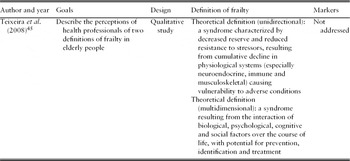
Qualitative studies (Table 4)
A single qualitative study was found that examined the perceptions of senior health professionals about two definitions of frailty, one with a unidimensional and the other with a multidimensional emphasis.Reference Teixeira45 The health professionals considered the unidimensional definition of Fried et al.Reference Fried, Tangen, Walston, Newman, Hirsch, Gottdiener, Seeman, Tracy, Kop, Burke and McBurnie8 to be overly biological and inadequate to describe frailty. It was considered relevant to the definition of ageing, which can be distinguished from the syndrome of frailty by the reversibility of the latter. There was a consensus on the complementarity between physical and psychosocial dimensions of frailty and the importance of considering it as a multifactorial and multidimensional entity.
Qualitative studies

Conclusion
This systematic review demonstrated the lack of consensus definition and markers for the syndrome of frailty, as well as the widespread use of operational definitions that prioritize physical factors to characterize an older person as frail. Important questions remain. What is the contribution of cognitive impairment to the process of frailty? What are the contributory factors and the factors resulting from the syndrome? What is the best treatment? Future research should aim to answer these questions, as well as better define and standardize markers of frailty.
Conflicts of interest
The authors declared no conflicts of interest.