Introduction
Horseflies (Diptera: Tabanidae) are mechanical vectors of important livestock diseases such as surra and nagana, caused by the protozoa Trypanosoma evansi (Desquesnes et al. Reference Desquesnes, Dargantes, Lai, Lun, Holzmuller and Jittaplapong2013) and Trypanosoma vivax (Fetene et al. Reference Fetene, Leta, Regassa and Büscher2021) (Trypanosomatidae), respectively. Tabanids are also common nuisance pests of people and animals (Baldacchino et al. Reference Baldacchino, Desquesnes, Mihok, Foil, Duvallet and Jittapalapong2014). Other examples of their roles in the biology of diseases are parasite transportation (Dermatobia hominis) (Oestridae), biological transmission (Loa loa) (Onchocercidae), and the mechanical transmission of viruses (equine infectious anaemia), other protozoa (Besnoitia besnoiti) (Sarcocystidae), and bacteria (Bacillus anthracis (Bacillaceae), Anaplasma marginale (Ehrlichiaceae)). Their high fecundity, diverse biology, and seasonal nature have precluded large-scale control as for tsetse fly (Diptera: Glossinidae) (Lehane et al. Reference Lehane, Alfaroukh, Bucheton, Camara, Harris and Kaba2016). For example, a large-scale tsetse control campaign with insecticide-impregnated cloth targets in Zimbabwe had little impact on tabanid numbers (Vale et al. Reference Vale, Lovemore, Flint and Cockbill1988) but reduced tsetse by 99.99%.
Although useful traps for sampling tabanids have existed since the development of the Manitoba trap in Canada (Thorsteinson et al. Reference Thorsteinson, Bracken and Hanec1964), only one tabanid control programme has been implemented to date at Cape Cod, Massachusetts, United States of America (Wall and Doane Reference Wall and Doane1980). This project uses box traps and is funded by local authorities to reduce attacks from greenheads such as Tabanus nigrovittatus Macquart at beachfront recreational areas. Control in other contexts has not been attempted, although “horsefly” traps are available commercially and claim to reduce attacks of biting flies even when deployed in small numbers. Local control in isolated settings could nevertheless be practical, for example, for protecting high-value animals such as dairy cattle (Baldacchino et al. Reference Baldacchino, Desquesnes, Duvallet, Lysyk, Mihok, Claire, Jérémy, Willem and Renate2018) or endangered wildlife (Nardelli Reference Nardelli2016), but the impacts on biting rates or disease transmission have not been tested.
The control of tabanids, with or without the use of insecticide-impregnated materials, needs to be both economical and practical. Material choices for a maintenance-free device are particularly important in the tropics. Durable materials are required for colour fastness to attract flies, and suitability for retaining insecticides, if desired, must be considered (Mebourou et al. Reference Mebourou, Bourquin, Oloo, Vallat and Guerin2020). Insecticide-impregnated materials have been used for decades in tsetse control, but until recently, they have not been explored for biting flies (Sasaki Reference Sasaki2015; Sharif et al. Reference Sharif, Liénard, Duvallet, Etienne, Mongellaz and Grisez2020). With these objectives in mind, Mihok and Carlson (Reference Mihok and Carlson2021) reported on the performance of new trap formats and materials for portable and fixed versions of Nzi traps in Ontario and the Northwest Territories, Canada. Since the trap design was published in 2002, Nzi traps have now been used for sampling tabanids in 28 countries, as reported in 63 publications.
Tests of Nzi traps relative to other standard traps for tsetse, tabanids, and stable flies were conducted when the trap was first developed in Kenya (Mihok Reference Mihok2002), and efficacy for other biting flies was later tested in Canada and the United States of America (Mihok et al. Reference Mihok, Carlson, Krafsur and Foil2006). In more recent work, several materials were found to be useful replacements for standard phthalogen blue cotton, which is now difficult to obtain (Onju et al. Reference Onju, Thaisungnoen, Masmeatathip, Duvallet and Desquesnes2020). As this work was being completed, a few promising formats were tested at Cape Cod and in the Sudan and the Philippines, where vector control for trypanosomiasis is of interest (Rahman Reference Rahman2005; Mekata et al. Reference Mekata, Konnai, Mingala, Abes, Gutierrez and Dargantes2013). Here, we report the finding of extremely high catches of greenheads in a painted plywood Nzi trap (Mihok and Carlson Reference Mihok and Carlson2007) relative to the conventional box trap used for tabanid control at Cape Cod. Good performance of traps made from durable fabrics and netting in challenging tropical areas is also presented.
Material and methods
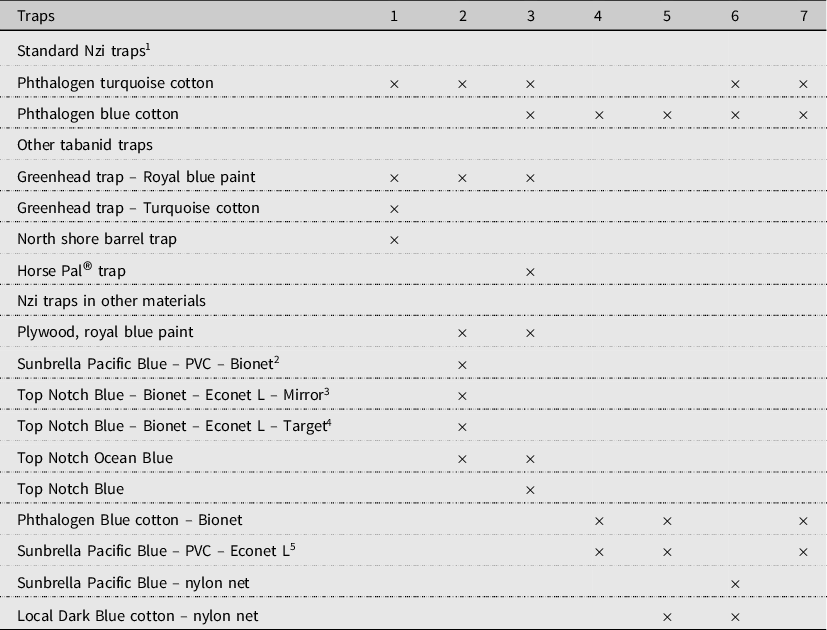
Experiments were carried out in the United States of America, the Sudan, and the Philippines. Standard cotton Nzi traps were included in each test as a control; they were phthalogen blue (Mount Kenya Textiles, Nanyuki, Kenya or TDV Industries, Laval, France; type IF3GM; copper phthalocyanine (CuPc)) or a similar home-dyed phthalogen turquoise (sulphonated CuPc). Phthalogen turquoise was tested in the present study because it repeatedly has been proven to be equivalent to or superior to phthalogen blue for several tabanids at Russell, Ontario, Canada, where most development work has been conducted (Mihok and Carlson Reference Mihok and Carlson2021). A colour-fast acrylic used in awnings or for marine applications (Sunbrella, Glen Raven Inc., Glen Raven, North Carolina, United States of America) was typically used for a standard black. Many other durable retail alternatives in polyester are available. Standard netting was ultraviolet-resistant white polyester mosquito netting (in the United States of America experiments) or Ludvig Svensson Econet L (in the Sudan and Philippines experiments; Ludvig Svensson Inc., Kinna, Sweden). Except for a local trap in the Sudan, traps or materials were supplied by the first author to standardise experiments. All traps tested are presented for cross-reference, by experiment in Table 1, with further details provided in the Results section.
Traps tested in experiments 1–3 (Cape Cod), 4–6 (Sudan), and 7 (Philippines). PVC, Strataglass polyvinyl chloride cone.

1 Polyester netting was used for the back and cone unless stated otherwise for all standard and experimental traps. In standard traps, Econet L was substituted in the Sudan in experiments 4 and 5, and local nylon netting was substituted in experiment 6. In the Philippines, in experiment 7, Econet L was used in the phthalogen blue trap, and Amber Lumite was used in the phthalogen turquoise trap.
2 Sunbrella Pacific Blue and Black fabric, Strataglass PVC cone, and Bionet back.
3 Bionet cone, Econet L back, blue and black reversed on one side.
4 Bionet cone, Econet L back, netting, and black reversed to form a solid black target at the back of the trap; Mirror and Target versions of Nzi traps were tested in Mihok and Carlson (Reference Mihok and Carlson2021) with schematics in supplemental information Fig. S3 in that paper.
5 Sunbrella Pacific Blue and Black fabric, Strataglass PVC cone, and Econet L back.
Materials tested previously are documented in Mihok and Carlson (Reference Mihok and Carlson2021). Colour images, reflectance spectra, and notes on spectroscopy methods are online in Fig. S1 in that publication. All the “durable” materials tested in the present study have warranties of 5–10 years. They were exposed to full sun at Russell by the first author for up to six years to confirm the manufacturers’ claims.
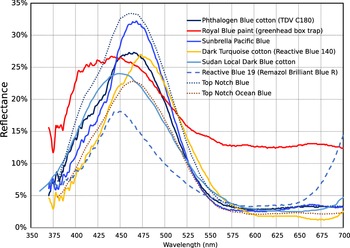
The characteristics of a few new materials tested for the first time are provided, along with colour images and reflectance spectra, in Figures 1–4. Spectra in Figure 2 are diffuse reflectance measurements between 360/370 and 700 nm taken by D. Carlson (United States Department of Agriculture, Agricultural Research Service) with an Ocean Optics USB 2000 fibre optic spectrophotometer (Ocean Insight, Orlando, Florida, United States of America) or by P. Guerin (University of Neuchâtel, Neuchâtel, Switzerland) with a Datacolor Check portable spectrophotometer (Datacolor, Lawrenceville, New Jersey, United States of America).
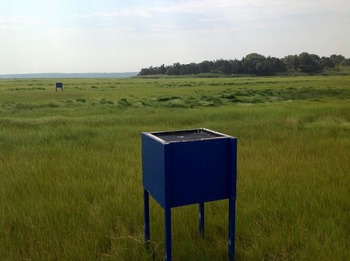
Greenhead box trap at the Cape Cod salt marsh, Massachusetts, United States of America.

Reflectance spectra of materials.

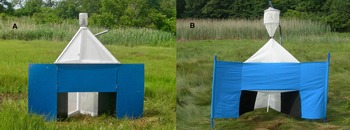
A, Royal blue plywood and B, phthalogen turquoise cotton Nzi traps at the Cape Cod salt marsh, Massachusetts, United States of America.

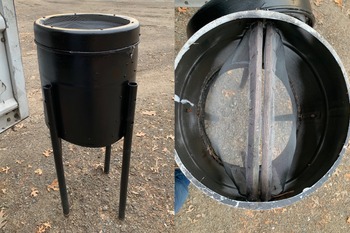
North Shore barrel trap.

United States of America
Three experiments were conducted at a salt marsh near Barnstable, Cape Cod (41° 42' N, 70° 22' W) in the summers of 2007–2009. This study area is 560 km southeast of where most experimental work has been conducted at Russell, Ontario, Canada (Mihok and Carlson Reference Mihok and Carlson2021). Summer weather in both areas is roughly similar, with daily statistics available from government services. The choice of which formats to test was based on similar tests conducted in parallel in Canada. Experiments focused on Nzi traps made from colour-fast, solution-dyed fabrics such as Sunbrella acrylic and Top Notch polyester (Marlen Textiles, New Haven, Missouri, United States of America), with or without substitutions for netting. Canadian studies included many trap tests for Tabanus quinquevittatus Wiedemann (Thompson and Pechuman Reference Thompson and Pechuman1970), a species similar to the greenheads found at Cape Cod.
A box trap used locally was included in each experiment (Fig. 1). It was painted dark royal blue (semi-gloss) on the outside and black on the inside, with an inner dark wire mesh baffle, following the design in Wall and Doane (Reference Wall and Doane1980). The paint had a broad peak in the violet–blue range at 440 nm, with modest reflectance in the ultraviolet and a reddish tint (Fig. 2). A phthalogen turquoise cotton Nzi trap (peak 473 nm) was used as a standard at Cape Cod because it consistently improved catches in ongoing work in Canada (mean of 1.75 times catches with phthalogen blue, six comparisons in Ontario for dark shades). Its suitability as a control relative to a phthalogen blue standard was validated at Cape Cod in experiment 3; simultaneous comparisons of these alternative standards were also made in the Sudan and the Philippines (Table 1).
In experiment 1, four kinds of traps, in duplicate, were set at 20-m intervals and randomly rotated among eight sites for 17 days (N = 34 per trap type, two of each type per day for 17 days). The last two experiments were sequential replicates of a 7 × 7 Latin square over 14 days (N = 14). Traps faced north into gusty, prevailing winds and were set from 10:00 to 13:00 Eastern Time daily in July and August. All traps were baited with a Dragonfly® octenol lure (1-octen-3-ol; BioSensory, Inc., Putnam, Connecticut, United States of America).
The last two experiments included a painted plywood Nzi trap in the same royal blue paint as the box trap and in the same format as the plywood traps in Ontario (Mihok and Carlson Reference Mihok and Carlson2007; Fig. 3). It differed only in having wooden supports painted white to provide a regular shape for the netting. A North Shore barrel trap was also tested (Northeast Massachusetts Mosquito Control and Wetlands Management District). It was made from a 30-gallon (113.5-L) plastic barrel that was spray painted glossy black (74 cm height × 48 cm diameter), with an inner wire mesh baffle as used in the box trap (Fig. 4). As a commercial control (Kline et al. Reference Kline, Hogsette and Rutz2018), we tested the Horse Pal® trap (Newman Enterprises, Omro, Wisconsin, United States of America) once. It is a cream-coloured box trap with a shiny black ball decoy and a net canopy (Watson et al. Reference Watson, Denning, Calibeo-Hayes, Stringham and Mowrey2007).
Horseflies caught in box traps at Cape Cod were nearly all greenheads (98%), consisting of both T. nigrovittatus and T. conterminous Walker. These species cannot be reliably distinguished using morphometric criteria and were therefore not differentiated in the present study. Of 15 greenheads that were typed by cuticular hydrocarbons in this region (Sakolsky et al. Reference Sakolsky, Carlson, Sutton and Stoffolano1999), 73% were T. nigrovittatus and 27% were T. conterminous. Tabanus lineola Fabricius is also present at about 2% of the horsefly catch but was not counted (Wall and Doane Reference Wall and Doane1980). These values from unbaited traps are likely similar to what would be collected if octenol-baited traps were used (Hayes et al. Reference Hayes, Doane, Sakolsky and Berrick1993).
Sudan
Three experiments with unbaited Nzi traps were conducted in a periurban environment at Khartoum (15° 30' N, 32° 30' E) in 2007 at the fodder plots of the Sudan University of Science and Technology (Khartoum, Sudan; Mohamed-Ahmed and Mihok Reference Mohamed-Ahmed and Mihok2009). Trypanosoma vivax infections occur in animals near Khartoum (Eltahir et al. Reference Eltahir, Osman, Rahman, Hassan and Mohamed-Ahmed2020). Experiments focused on durable materials such as Sunbrella and horticultural netting. Conditions in this desert setting are harsh, with strong sunlight and extremely high temperatures. A phthalogen blue cotton trap was used as a standard. It was, however, sewn with more durable Econet L horticultural netting (65% ultraviolet, 81% visible light transmittance), with transmission properties similar to standard netting (54% ultraviolet, 80% visible light). Bionet horticultural netting (42% ultraviolet, 91% visible light; Klayman Meteor, Ltd., Ramat Hasharon, Israel) and long-lasting clear Strataglass polyvinyl chloride cones (0% ultraviolet, 91% visible light; Strataglass, Fort Lauderdale, Florida, United States of America) were also tested.
Experiments were 3 × 3 or 4 × 4 Latin squares at widely spaced sites, with sequential or simultaneous replicates and daily trap rotations (N = 6–8). A local Nzi trap made from dark blue “Jinja” cotton (United Textiles, Nairobi, Kenya) was included in the last two experiments (peak 450 nm). It was sewn with nylon netting (68% ultraviolet, 88% visible light). The best match of this unknown blue fabric to selected reference dyes noted in Mihok et al. (Reference Mihok, Carlson, Krafsur and Foil2006) was to an anthraquinone dye, Reactive Blue 19 (Fig. 2).
Philippines
A three-month trapping survey was conducted from August to October 2007 at two villages in Agusan del Sur, Mindanao, where T. evansi infections occur in livestock (Dargantes et al. Reference Dargantes, Mercado, Dobson and Reid2009; Mekata et al. Reference Mekata, Konnai, Mingala, Abes, Gutierrez and Dargantes2013). The villages were San Gabriel, Veruela (8° 06' N, 125° 55' E) and Duangan, Esperanza (8° 37' N, 125° 44' E). This tropical location had humid or cloudy weather with frequent rain. Traps in three fabric-netting combinations were compared to a standard phthalogen blue Nzi trap with durable Econet L, as in the Sudan. Traps were set, in duplicate, at eight sites at each village (sequential surveys); tabanids were counted every two to three days, with catches standardised to catch per day for statistical analysis. Traps were rotated among sites weekly or every two weeks. They were set 50 m apart in animal grazing areas, facing west.
Statistical analyses
Analyses of variance were performed for log(x + 1)-transformed catches (Mihok and Lange Reference Mihok and Lange2012). Results are summarised as detransformed mean catches per day, with relative catch indices and their 95% confidence interval provided for cross-comparison. The catch index – also termed a response ratio – is the ratio of the detransformed mean for the test trap to the standard. The outcome was an a priori test for a significant difference relative to a standard Nzi trap (P < 0.05 based on the analysis of variance mean square error), considering sites and days. Total catches are also provided for an intuitive index of fly abundance. An example analysis for a typical Latin square experiment is provided in Mihok and Carlson (Reference Mihok and Carlson2021), supplemental information Appendix S2. This statistical approach has been used in experimental studies of insect behavioural ecology for many years (Vale Reference Vale1993).
Results
United States of America
The total catch was 55 230 Tabanidae, with an arithmetic mean of 166 tabanids/trap/day and a maximum of 2088. No gross change in fauna was noted (mainly two cryptic Tabanus). Daily weather at Barnstable, Cape Cod in experiments 1 and 2 was mostly sunny, hot, and humid, with only a few days of light rain. Inclement weather occurred throughout some of experiment 3, with cooler temperatures and some rain and fog. Gusty winds were typical throughout.
In experiment 1, a standard phthalogen turquoise Nzi trap caught approximately twice as many Tabanus as the local box and barrel traps did and the box trap wrapped in turquoise fabric did (Table 2). In experiment 2, we expanded fabric comparisons and tested a painted plywood Nzi trap. The plywood trap caught three times as many Tabanus as the standard turquoise trap did and about 19 times as many greenheads as the box trap did (Table 2). A Sunbrella trap with an ultraviolet-blocking Strataglass cone and a partially ultraviolet-blocking netting back (Bionet) caught as many Tabanus as the standard trap did. Three speculative nonstandard Nzi trap formats caught fewer greenheads.
Total catches per trap and detransformed mean catches (flies/trap/day) and catch indices of Tabanidae relative to a standard phthalogen turquoise cotton Nzi trap at Cape Cod, United States of America (traps were set only from 10:00 to 13:00 local time). TN, Top Notch; PVC, Strataglass polyvinyl chloride cone.

* Significant at P < 0.05 in a priori comparison versus standard trap.
† Index, ratio of detransformed mean catch in the experimental trap to the detransformed mean catch in the standard trap. All Nzi traps with white polyester mosquito netting.
1 Sunbrella Pacific Blue and Black fabric, Strataglass PVC cone, and Bionet back.
2 Bionet cone, Econet L back, blue and black reversed on one side.
3 Bionet cone, Econet L back, netting, and black reversed to form a solid black target at the back of the trap.
In experiment 3, we retested the plywood Nzi trap during suboptimal weather (Table 2). It still caught twice as many Tabanus as the standard turquoise Nzi trap did and about seven times as many Tabanus as the box trap did. The turquoise fabric had faded to a medium shade after two summers of experimental use. Any fading of the plywood trap was unlikely, although no sample was kept for review. The plywood trap caught about six times as many Tabanus as the Horse Pal® trap did. Lastly, the turquoise Nzi trap caught significantly more tabanids than the Horse Pal® trap did. No difference in catch occurred between a faded turquoise trap after three seasons of use relative to a new phthalogen blue cotton trap. A new turquoise trap likely would have caught more tabanids than the standard phthalogen blue trap, given previous tests of light and medium shades (Mihok and Carlson Reference Mihok and Carlson2021). Catches were also equivalent to a standard phthalogen blue trap for the dark and bright shades of Top Notch polyester (Ocean Blue and Blue) in the standard format of blue–black and netting.
Sudan
The total catch was 4557 tabanids (44% Atylotus agrestis (Wiedemann), 41% Tabanus sufis (Jennicke), 14% Tabanus taeniola (Palisot)), with an arithmetic mean of 49 tabanids/trap/day and a maximum of 212. Experiments were conducted during extremely hot, sunny weather with light winds. Daily maximum temperatures were 40–47 °C in experiments 4 and 5 and 34–39 °C in experiment 6.
In experiment 4 with random trap orientations, partially ultraviolet-blocking Bionet substituted for Econet L in a phthalogen blue Nzi trap did not affect catches (Table 3). A Sunbrella trap with a fully ultraviolet-blocking polyvinyl chloride cone and an Econet L back caught significantly fewer tabanids. In experiment 5, the same traps were retested relative to a trap made from local materials with all traps facing west. Catches were statistically equal among all four traps. In experiment 6, with traps facing south, local nylon netting was used for all traps for a more direct comparison of fabric substitutions. Catches did not differ significantly among all four traps.
Total catches per trap and detransformed mean catches (flies/trap/day) and catch indices of Tabanidae relative to a standard phthalogen blue cotton trap at Khartoum, Sudan and at Agusan del Sur, Philippines.

* Significant at P < 0.05 in a priori comparison versus standard trap.
† Index, ratio of detransformed mean catch in the experimental trap to the detransformed mean catch in the standard trap.
1 Sunbrella Pacific Blue and Black fabric, Strataglass PVC cone, and Econet L back.
Philippines
The total catch in experiment 7 at Agusan del Sur over 26 collections was 3843 tabanids, with an arithmetic mean of eight tabanids/trap/day and a maximum of 62 (Table 3). Rain occurred on three of four trapping days, with an average rainfall of 12 mm/day and average daily temperatures of 32–33 °C. The catch consisted mostly of Tabanus ceylonicus Schiner and T. partitus Walker, with a few Chrysops cinctus Bigot. Substitution of Bionet for Econet L in a standard trap resulted in a significantly higher catch (Index 1.7). Substitution of Amber Lumite for netting and phthalogen turquoise for phthalogen blue also resulted in a significantly higher catch (Index 2.5). Catches were halved relative to the standard in a Sunbrella trap with a Strataglass cone and an Econet L back.
Discussion
Recently reported tests of materials in Canada were the foundation of this study and suggested that four types of substitutions for standard Nzi traps could be useful (Mihok and Carlson Reference Mihok and Carlson2021). These were substituting: (1) phthalogen turquoise for phthalogen blue, (2) solution-dyed synthetic fabrics for blue and black, (3) horticultural netting for mosquito netting, and (4) reflective plastics for various components. We discuss our findings for each of these substitutions in turn.
Improving catches with phthalogen turquoise
Phthalogen turquoise increased catches of Tabanus in the Philippines relative to standard phthalogen blue (Index 2.5) during often-suboptimal weather. This result is similar to the 1.75-fold average increase observed in Canada for other tabanids. At Cape Cod, a turquoise Nzi trap performed as well as a new phthalogen blue trap did and caught 2.4, 6.3, and 3.5 times more Tabanus than the local box trap did. The poor performance of the box trap was not specific to the use of royal blue paint, because a trap wrapped in turquoise fabric also did poorly, as did the black barrel trap and the Horse Pal® trap. Kline et al. (Reference Kline, Hogsette and Rutz2018) also compared Nzi and Horse Pal® traps at two locations in Florida, United States of America. Unbaited Sunbrella Nzi traps caught 1.7 and 8.9 times as many tabanids (total catches) as the Horse Pal® trap did. The 8.9-times relative catch included many yellow flies, Diachlorus ferrugatus (Fabricius) (Diptera: Tabanidae), which are a major nuisance in the southern states. Sunbrella Nzi traps have also been compared with Horse Pal® traps in Sweden, with and without baits. Catches were lower in the Horse Pal® trap but not significantly so (Vaduva Reference Vaduva2020).
Catches with turquoise traps were equivalent to blue in the Sudan during sunny weather for Atylotus and Tabanus. Equivalent catches also occurred for very light shades of turquoise in tests of experimental triangular blue–black traps in Kenya, where Atylotus dominated (Mihok Reference Mihok2002). Use of a particularly dark shade of phthalogen blue is not critical for obtaining good catches of tsetse (Green Reference Green1994). In contrast, high tabanid catches require dark shades of turquoise (5% or higher), similar to those used in standard phthalogen blue fabrics (Mihok and Carlson Reference Mihok and Carlson2021).
The dark turquoise colour produced by sulphonated CuPc reactive dyes for cotton is not readily available commercially, although light to medium shades can be found in quilting cottons. This colour is easily custom-dyed but has the disadvantage of fading after one season’s use. Phthalogen blue cottons produced with ingrain dyeing fade little after several years. A colour-fast phthalogen turquoise (phthalogen IFBM, NiPc) also exists in an ingrain dye (Vollmann Reference Vollmann and Venkataraman1971) but is no longer in production. Solution-dyed synthetic fabrics in blue similar to phthalogen blue (PB 15) are readily available and should be tested for suitability. Unfortunately, the turquoise palette for solution dyeing of synthetics is limited (Hawkyard Reference Hawkyard2004). Hence, we have yet to identify a suitable colour match to phthalogen turquoise. Pigments based on other phthalocyanine pigments (PB 16 and PB 17) may nevertheless be worth exploring for tinting paints or plastics.
The effectiveness of turquoise substitutions has not been explored by other researchers, but a few examples of useful trap results with greenish blue fabrics exist. For example, Gonzaga and Garduque (Reference Gonzaga and Garduque2015) caught 38 818 tabanids in another area of the Philippines using 15 unbaited traps set for a year. The traps used a greenish blue local polyester (Katrina, no spectrum available) in place of phthalogen blue cotton. Nzi traps in a blue polyester (Onju et al. Reference Onju, Thaisungnoen, Masmeatathip, Duvallet and Desquesnes2020) with a greenish tint (Solon, with a peak at 469 nm) also caught many tabanids in survey trapping in Thailand (Changbunjong et al. Reference Changbunjong, Sedwisi, Weluwanarak, Nitiyamatawat, Sariwongchan and Chareonviriyaphap2018). Unfortunately, neither author made direct comparisons of catches relative to traps made from a standard fabric.
Improving catches with a plywood trap
At Cape Cod, a plywood trap performed extremely well, catching 19 times as many greenheads as a box trap did during fair weather in experiment 2 and seven times as many during often-inclement weather in experiment 3. In previous work in Ontario, catches of tabanids in Nzi traps were about the same as in a greenhead box trap equipped with a black ball decoy; otherwise, catches were considerably higher in Nzi traps (Mihok and Carlson Reference Mihok and Carlson2007). Other than the use of royal blue paint and a rigid frame for the cone, the Nzi trap format at Cape Cod was the same as in Ontario (Mihok and Carlson Reference Mihok and Carlson2007). Plywood traps also caught 2–3 times more greenheads than a turquoise fabric trap did. In contrast, many comparisons of plywood and fabric Nzi traps have not detected significant differences in catch among traps made from matching fabrics or painted plywood (Mihok and Carlson Reference Mihok and Carlson2021).
The uniform background of the salt marsh habitat of greenheads may explain the differential trap performance at Cape Cod. Allan and Stoffolano (Reference Allan and Stoffolano1986) tested attraction to shapes and patterns using sticky targets and concluded, “These results indicate that solid, compact, large objects with high contrast against the background were the most attractive.” We can speculate that the geometric shape of a plywood trap may account for improved performance for this species group relative to a more irregular fabric trap. In Ontario, plywood traps also catch many cluster flies (Mihok et al. Reference Mihok, Carlson, Krafsur and Foil2006) and Asian lady beetles. These species enter homes in autumn in large numbers and also appear to be unique in their behaviour.
Another possible explanation for differences in catch between painted plywood and cloth traps could be the differences in reflection of polarised light. Mihok and Carlson (Reference Mihok and Carlson2021) found higher catches with highly reflective Plexiglas® versus fabric Nzi traps in Ontario. Classic tabanid traps such as the Manitoba trap exploit attraction to polarised light using shiny black decoys, without any colour cues (Horváth et al. Reference Horváth, Blahó, Egri, Lerner and Horváth2014; Meglič et al. Reference Meglič, Ilić, Pirih, Škorjanc, Wehling, Kreft and Belušič2019). This is why some traps with Strataglass and plastic cones were tested in the Sudan and the Philippines. Traps at Cape Cod were painted with the semi-gloss paint used in the ongoing control programme. Polarisation cues visible to the naked eye were present but not striking. Ontario experiments with painted plywood traps have differed in that they have been conducted with mainly matt paints (Mihok and Carlson Reference Mihok and Carlson2007, Reference Mihok and Carlson2021). Polyester fabrics such as Top Notch are also slightly shiny, whereas Sunbrella acrylic has been engineered to have little shininess. These subtle features of alternative materials have never been quantified due to the need for sophisticated equipment to quantify specular reflection.
How traps were operated may also be significant in terms of reflection of polarised light at different latitudes or at different times of the day. At Cape Cod, greenheads were captured over only a few hours. They would have flown towards the sun while approaching the entrance of a north-facing trap. The sun was southeast to south (altitude of 49–69°), illuminating the inside of the trap through the back netting. This angle is near Brewster’s angle; hence, the sides, but not the front, of the trap would have reflected some polarised light. The exact angle of approach may, however, not be critical; for example, Tabanus quinquevittatus approaches an unbaited Nzi trap set facing east from all sides (Mihok et al. Reference Mihok, Carlson and Ndegwa2007). When octenol is present (as at Cape Cod), only a small bias occurred for upwind flight with flies investigating all sides of a trap before entering. In Ontario, nearly all experimental data have come from traps set facing west, with polarised light reflecting off the front of the trap. Flight activity is highest from solar noon at a high sun angle similar to Brewster’s angle.
One other useful site-specific finding is that trap orientation did not affect catches in the Sudan, in particular when a Strataglass cone, with strong polarisation cues and specular reflection, was tested. Traps were set either with random orientations or facing the west (i.e., towards the setting sun). Tabanids are most active between 15:00 and 18:00 (local time) at Khartoum (Mohamed-Ahmed and Mihok Reference Mohamed-Ahmed and Mihok2009). The sun angle at peak activity would have decreased from 58–55° to 16–12° in the three experiments (May to September), mostly lower than Brewster’s angle.
Other than casual observations of tabanids investigating Nzi traps (Vaduva Reference Vaduva2015), there are no other insights into how minor variations in materials or how traps are set may affect catches. Altogether, an explanation for why plywood traps caught more greenheads than fabric traps did at Cape Cod but not in Ontario remains elusive.
Use of durable fabrics and netting
At Cape Cod, the best durable trap format was Sunbrella Pacific Blue acrylic with Bionet, as in similar tests in Canada (Mihok and Carlson Reference Mihok and Carlson2021). Sunbrella traps have also performed well in independent studies in the United States of America, Europe, and Australia. We therefore continue to recommend Pacific Blue Sunbrella as a secondary standard, given the difficulty of obtaining phthalogen blue cotton (Onju et al. Reference Onju, Thaisungnoen, Masmeatathip, Duvallet and Desquesnes2020). This product has a worldwide retail base and has been consistent in quality over the last two decades.
We also tested durable Top Notch polyester traps in two nominal phthalogen blues with standard netting. Polyesters retain insecticides well (Mebourou et al. Reference Mebourou, Bourquin, Oloo, Vallat and Guerin2020); acrylics have rarely been tested (Geden Reference Geden2006). Top Notch traps caught approximately 30% fewer greenheads than a turquoise standard (Index = 0.7), but in only one case was the catch significantly lower. Two rearrangements of the panels in the Top Notch traps caught significantly fewer greenheads, as was found in similar speculative tests in Canada (Mihok and Carlson Reference Mihok and Carlson2021). Top Notch “Blue” has been discontinued but has been replaced with similar blues under different brand names.
Experiments in the Sudan and the Philippines focused on traps with horticultural netting that can withstand harsh tropical sunlight for five or more years. In the most challenging setting in the Sudan, nearly all fabric and netting options caught similar numbers of tabanids. In the Philippines, a trap with Bionet instead of Econet L caught 1.7 times more tabanids, a catch increase sometimes noted in Canada with Bionet, which blocks some ultraviolet light. The use of Amber Lumite (Bioquip, Rancho Dominguez, California, United States of America) in the turquoise trap appeared to be appropriate, but this netting has not been extensively tested and is darker than recommended from a meta-analysis of trap performance. Catches may have been even higher if more transparent netting had been chosen (Mihok and Carlson Reference Mihok and Carlson2021).
Use of plastic cones
Exploiting the attraction of tabanids to polarised light by substituting transparent plastics with ultraviolet-blocking properties in place of netting provided modest but significant increases in catches in Mihok and Carlson (Reference Mihok and Carlson2021). To follow up, a Sunbrella trap with a fully ultraviolet-blocking Strataglass polyvinyl chloride cone was tested at all locations, with Bionet or Econet L for the back to minimise heat build-up. Catches were lower in all four tests (Index 0.38–0.83); based on this, substituting plastic for netting may not be worth exploring further.
A reflective blue–black Plexiglas® trap was a particularly effective trap in Canada but has yet to be tested elsewhere. This format may exploit the attractive properties of the colour blue as well as polarised reflections (Meglič et al. Reference Meglič, Ilić, Pirih, Škorjanc, Wehling, Kreft and Belušič2019). Given excellent results for a plywood trap at Cape Cod, more economical plastics are worth exploring in place of a Plexiglas® trap, which is robust but expensive. At Cape Cod, the public has already done so. They have substituted the blue plastic shrink-wrap used for winterising sailboats for the blue and the black panels of Nzi traps in Do-It-Yourself Nzi traps. The efficacy of this innovation has yet to be tested.
Conclusions
Portable Nzi traps can be made from several types of fabrics and netting, but prudence is recommended in the use of uncharacterised materials. We continue to recommend phthalogen blue cotton or Sunbrella Pacific Blue acrylic for standard fabric Nzi traps. Custom-dyed phthalogen turquoise cotton can also be used but at the cost of having to replace the turquoise fabric every season. Further innovation is also worth pursuing for fixed traps that use more economical materials, given the excellent performance of painted plywood and Plexiglas® traps.
Acknowledgements
The authors thank R. Whitehurst of Rincon-Vitova Insectaries for providing a Horse Pal® trap, K. McHugh for editorial assistance, and D. Carlson and P. Guerin for measuring reflectance spectra. Field support was provided by the Cape Cod Mosquito Control Project, Sudan University of Science and Technology, and Central Mindanao University.
Competing interests
The authors declare no competing interests.