Introduction
Thailand Creative & Design Center (TCDC) was launched in 2005 and aimed to bring creativity and design as part of the drive in the development of Thailand's economy. Integrating cultural capital, innovation, and technology in product and service development would enhance the competitiveness of Thai products and services on the international market, as well as shift the foundation of the economy from manufacturing to value-added products and services, according to the creative economy approach.
One of the main goals in establishing the TCDC was to increase awareness in adopting a creativity and design approach in Thai society. For reasons of accessibility, the first establishment of the TCDC was located inside a department store in the heart of Bangkok. With the easily-accessible 4000 square metre location, novel services, one of the region's largest design libraries, state-of-the-art exhibition spaces, and inspiring sets of networking and business development activities, TCDC Bangkok has become a well-known hub for designers, entrepreneurs, and the creative industry worldwide in a short period of time.
The library component of the facility is called the TCDC Resource Center, housing more than 60,000 physical copies of reference collections and continuously updated information from around the world in topics related to creativity, design, arts, and business. These physical collections can be used on-site only. In addition to books, printed materials, periodicals, multimedia, and online databases, the TCDC Resource Center also continuously collects and repackages design trend forecast and prediction analyses from world leading design research institutions. In collaboration with Material Connexion®, it also houses a special collection of materials from around the globe, providing hand-on experience as a source of inspiration and innovation.
Since the number of TCDC members and patrons has increased dramatically since its inception, the expectations from stakeholders have become higher and more diverse. TCDC stakeholders include government agencies, the private sector, educators, the designer community, and the public. With the limitations of the former space, the TCDC sought to relocate from a high-traffic department store to a larger and more iconic space. In the end, a unique historic central post office building was chosen to be the new location of the TCDC.
The relocation was an opportunity for the TCDC to be able to serve a wider group of members and visitors. It also posed great challenges for its products and services. To address those challenges, the TCDC was determined to reconsider its mission in the hope that it would deliver new services that would meet the needs of current users, as well as new target groups.
This article documents the TCDC Resource Center's service design experience during its relocation in 2017. The purpose of this project was to devise a new service blueprint, delivering products and services that could increase members’ and visitors’ satisfaction level, leading to revisits and loyalty, as well as increasing the numbers of new members and visitors.
Application of design thinking and service design
Design, as most people understand it, is a process of enhancing a product or service's appearance, focusing on style and aesthetics. This, however, is only one aspect of design. Design also involves problem solving, balancing stakeholder benefits, and connecting all kinds of people and objects. It requires both analytical and intuitive thinking. Outcomes of a good design process should not only look good but should also be practical and feasible. As a part of its relocation plan, the TCDC applied service design, an approach rooted in design thinking, to improve its products and services.
Even though service design literally means improving services, this principle, in fact, enhances user experience from every perspective. User experience, according to the service design principle, is not limited to during service exploitation but also includes activities before and after.Footnote 1 Experience also covers emotions and feelings that occur while interacting with any touch points of the service. These feelings affect how they value the service, how likely it is that they will use the service again, and whether they are going to communicate information about the service to other people.
Since user experience does not only refer to the direct consumption of products and services but also includes interaction with communication channels such as websites, social media, and applications, these interactions are considered service touch points too. Service providers need to pay attention to every touch point throughout the user experience. Failing thoroughly to understand a user's overall journey could create an unsatisfactory experience, which could have an adverse impact on the entire service since an unsatisfied user will probably not return and will likely share their unfavourable experience with others.
Service design is a mixed approach that integrates design, organisation, management, and engineering practice. The approach can be summarised in five principlesFootnote 2 as follows:
1. User-centred approach: Service experience must be designed from the actual users’ point of view.
2. Co-creative: People involved in user relationship management must take part in the design process.
3. Evidencing: Although certain services are intangible, they must all be treated as work that could be designed and edited.
4. Sequencing: All stages in the service are sequential and connected as one big picture.
5. Holistic thinking: The environment related to the service must be considered to foster a pleasant and valuable experience for users.
Service design process: TCDC experience
When applying the service design principle, it is important to understand that even though there are some guidelines to follow, the process may not take place in the exact order according to the guidelines. Service design is an endless iterative process that can be repeated over and over. It requires designers to understand, examine, analyse, and experiment repeatedly to find ways that meet the changing needs of users.
To gain various perspectives, the TCDC assembled a service design team consisting of staff with different expertise from all units involved in creating the user experience. The team consisted of librarians, visitor service staff, administrative staff, business development officers, information technology staff, and a facility manager.
Developing empathy
Service design requires that the design team empathise with users by adopting a user-centred approach and considers all stakeholders’ perspectives whether or not they have a direct or indirect interaction with the services. The expectation of developing empathy is aimed at being able to gain insights into user experience, particularly how a user perceives a problem of their interaction with the service (a “pain point”). The design team then uses these user pain points to find ways of improving the service.Footnote 3
To develop empathy, the TCDC service design team mutually set design goals and objectives, considered all stakeholders that are involved in services, developed user personae to gain understanding into the user's point of view, and analysed the user's journey.
Identifying goals
Since all service elements and processes must be aligned with organisation goals, all team members collaborated to thoroughly understand the objectives, issues and frameworks they were working with. After considering perspectives from the team members as well as the TCDC administrators, the goal of the TCDC's service design project for the relocation was to create new services to meet the needs of designers and entrepreneurs in creative industries as well as in other targeted groups.
Mapping stakeholders
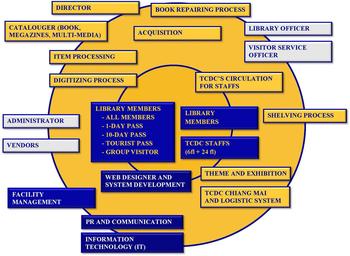
It is important to understand that not only users who utilise a service, but also people who engage with the service in any aspect are important in the successful implantation of that service. The design team needed to analyse the relationship of everybody who might engage with a service.Footnote 4 As a result, the main stakeholders of the TCDC services were still the users -- both regular members and general visitors. Staff, librarians, partners or suppliers, purchasing officers, finance officers, and administrators were placed, respectively, in the subsequent tiers of the stakeholder map. This stakeholder map helped remind the TCDC design team to contemplate who was considered when they ideated new services (see Fig. 1).
The TCDC stakeholder map

Constructing user personae
A good service is not one designed for every kind of user but one that is personalised for targeted users. To achieve this, a design team must have a profound understanding of the different user groups including their personalities, goals, lifestyles, and expectations.Footnote 5 With this understanding, a team is able to create personalised services that will fully satisfy these targeted users.
To develop user personae, the TCDC design team observed users in a natural setting on-site and randomly interviewed selected users in-depth about their daily lives as well as how they perceive and use the services. The purpose of data collection was to discover user lifestyles, daily life patterns, occupations, interests, behaviour and needs. This data, indeed, informed the team about the users’ expectations and set the team's criteria for quality judgement.
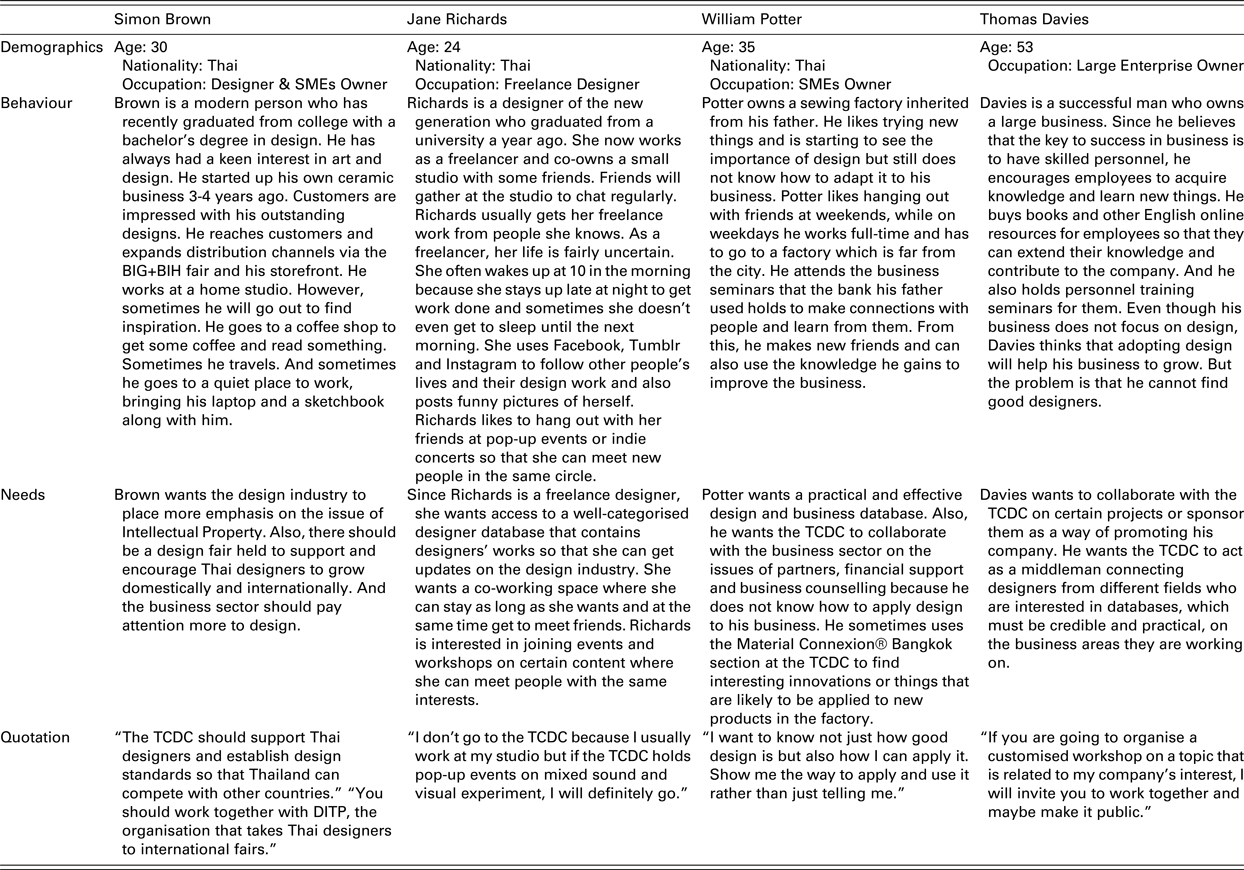
After hours of on-site observation and the interviewing of more than twenty users, the design team came up with seven personae to represent the characteristics of TCDC target user groups (for examples, see Table 1).
Selected user personae for the TCDC service design

Analysing the customer journey
Apart from understanding user personae, the design team also wanted to understand the entire journey and how users interact with services. Additionally, the design team had to identify all touch points and analyse whether these touch points provided a pleasant experience or created problems for users. This process helped the team to identify areas of improvement more clearly.Footnote 6
In analysing the customer journey at the TCDC, the design team covered experience from the pre-service period to the post-service period. Issues considered in each period of the customer journey are as follows:
Pre-service period
1. User awareness and consideration of service
2. Transportation and travel experience to the TCDC (including parking)
3. User interaction with the website and social media prior to a visit
Service period
1. Issuing a member card
2. Access points, front counter and staff
3. Service protocols
4. Users’ basic needs
5. Ending of service delivery
Post-service period
1. Transportation and travel experience from the TCDC
2. Recording user activities
3. Post-service reminder
In each stage of the customer journey, the design team not only examined user procedures and touch points but also identified user emotions, feelings and thoughts during each step. The data gathered to develop personae through observations and interviews also contributed to the analysis of user emotions in the customer journey.
Service ideation
According to service design principles, services should respond to a holistic view of an organisation, and not remain siloed in any particular section. To reach this goal, the team held multiple brainstorming sessions to generate ideas and find possible solutions. During the ideation process, feasibility and practicality were not necessarily the top priority. Rather, creativity played an important role. The objective of this stage was that the team be able to devise new user experiences that had never been delivered before.
After exploring possible solutions, the team voiced opinions about each idea. The design team members were encouraged to use a “yes, and…” kind of opinion, rather than “yes, but…”. This helped the team members to provide positive feedback and furthered the solutions to the next level by connecting or combining different solutions.
To choose which solutions were to be prototyped and tested, the design team had to consider the balance between effort and impact for each solution. Solutions that had a high impact, but did not require much effort or many resources, were more interesting than those in adverse and were to be implemented first. However, the prioritisation for service development plans also considered the resources available.
The followings are new and revised services ideated from the service design process for the new location. Please note that, from a holistic perspective, these services are not limited solely to physical space.
• Consulting service: To directly connect users to experienced and authoritative sources of information, the design team proposed a service where users can make a one-on-one appointment to see consultants and experts in different fields such as design, business, marketing and legal matters.
• Personalised bookmark service: Since the TCDC Resource Center is a reference library where a circulation service is not available, the design team proposed this service to help remind users which books and resources they have used. Users are provided with personalised bookmarks that are linked to their e-mails. When users finish using the materials, they can leave these personalised bookmarks in the materials. When the books are reshelved, staff sends a list of bookmarked materials with the page numbers where the bookmarks are found to the user's email.
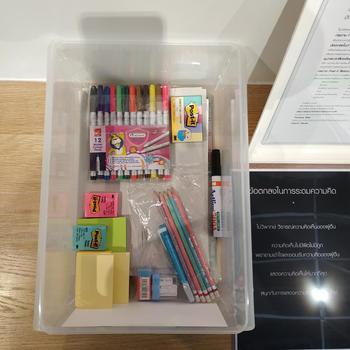
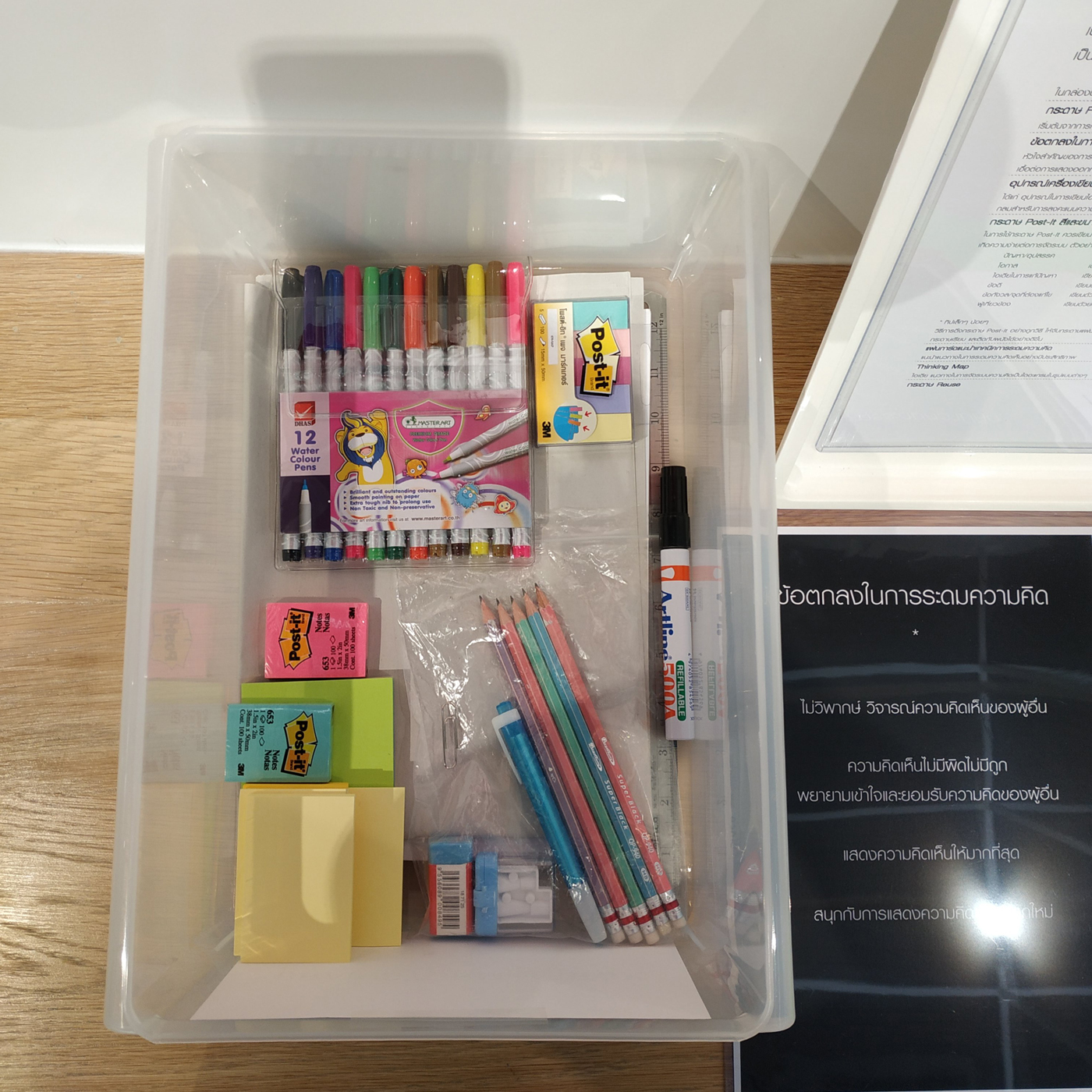
• Brainstorming box: To facilitate the brainstorming process, the design team proposed the Brainstorming box (see Fig. 2), a toolbox containing Post-it notes of different sizes and colours, paper, design templates, tips for brainstorming, to be placed in all creative rooms.
• Co-working space with depository: The design team proposed developing this space for users who need a space to work by themselves, in groups, or to meet and talk with clients. Since it is intended specifically for frequent users, overnight storage space is available.
• Maker Space: The Maker Space is a facility where ideas are transformed and put into action. The team proposed this space so users can see whether their plans and ideas are practical and able to be implemented.
• Communicator: The design team proposed the communicator as a group of staff that would help users to access the resources they want more easily. It would also connect users and create a cooperative user network in which users could seek help and discuss things together.
• New entrance: Since users felt uncomfortable and unwelcome because of the key-card controlled turnstile entrance, the design team proposed an open entrance where users can just walk in after scanning cards at the front counter.
• Shelves and area arrangement: The design team proposed rearranging different collections according to the purpose of the space. For instance, regular books would be stored in the areas intended for quiet research, while the spaces that are intended to stimulate creativity and inspiration, such as a co-working space, would house new books, current periodicals, and recommended books.
• New books management: When new books arrive, it usually takes them quite a long time to go through library procedures before being placed on shelves. The design team proposed changing the procedures so that the new books would go to the shelves first and then, subsequently, follow the library procedures.
• Access to trend books: Since trend books are costly materials, they were housed in a closed stack and required a special request for use. To remove the barrier to these valuable resources, the design team proposed to open shelves where users have direct access to this in-demand collection. This would help users to accelerate their creative and design processes.
• Design materials: Apart from providing worldwide design materials information from the Material Connexion® database, the design team proposed adding more local Thai materials to the database as well as providing comprehensive metadata to enhance the access to these materials.
• Refreshment area: To make the spaces livelier and more user-oriented, the design team proposed making snack and drinks vending machines available in a designated area near the entrance.
• Updated website and social media: By adopting a user-centred approach, the design team recommended adding more information to the website that users want to know or need to know in a way that is easy to understand and is concise. For example, the team recommended reduced information about the organisation and increased information in sections that users are interested in such as new books, recommended books, search and reservations. The team also recommended rearranging sections in the menu and minimising redundant information or content that can be easily found elsewhere. Apart from the TCDC website, the team also proposed a Facebook page called TCDC Resource Center to build a community where the TCDC and users can discuss and talk about design knowledge and resources.
• New contact channel: To increase an opportunity to reach a wider group of audience beyond members, The design team proposed opening a public communication channel through Line, one of the most popular mobile chat applications, where users can contact TCDC staff to ask questions or reserve services in a personal environment.
• Web application: To use services at the TCDC more easily, the design team proposed developing an application by which users can connect with member cards and use for entry, reservations, and other services.
Brainstorming box
Prototyping and testing
Before relocating and operating new services, every service that had been designed was prototyped and tested to see whether it was worth investing in. Prototyping is important for determining whether the ideas solve the issues, whether they meet user demand, whether users are interested in those services, and what is still missing. The process of developing and testing a prototype was kept simple and inexpensive so that it allowed for action to be taken immediately. While every idea initiated during service ideation process was prototyped, the list below includes selected examples of prototyping done prior to the implementation:
1. Highlighting the new books section to make users feel that there are always new books arriving and the collection is up to date.
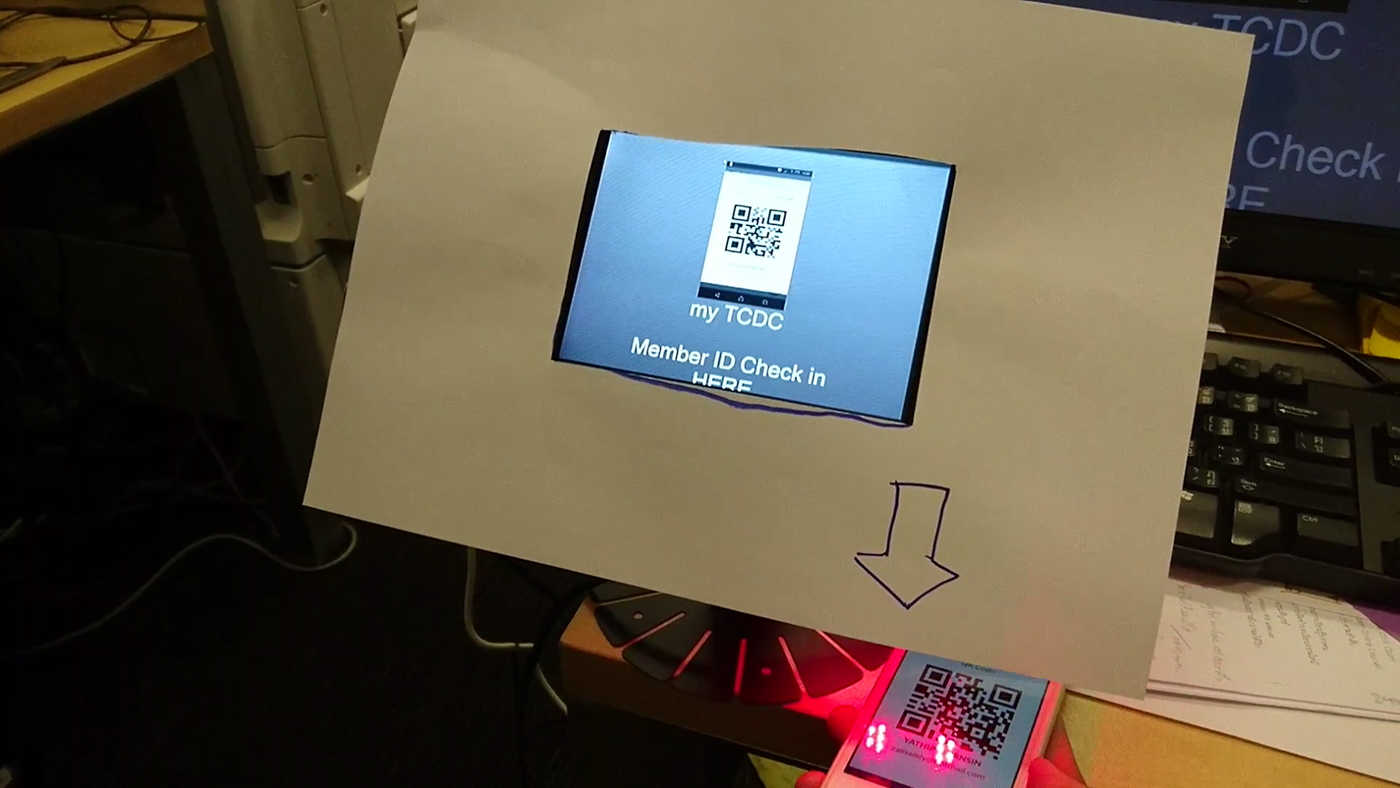
2. Opening a fast lane entrance, which users can scan barcodes to enter. The testing was to see whether users prefer it to the turnstile entrance.
3. Turning the multimedia room into a refreshment area.
4. Providing a brainstorming box in all creative rooms.
5. Presenting ideas and plans on new services in the Exhibition Room, aiming to encourage users to express their opinions on the proposals.
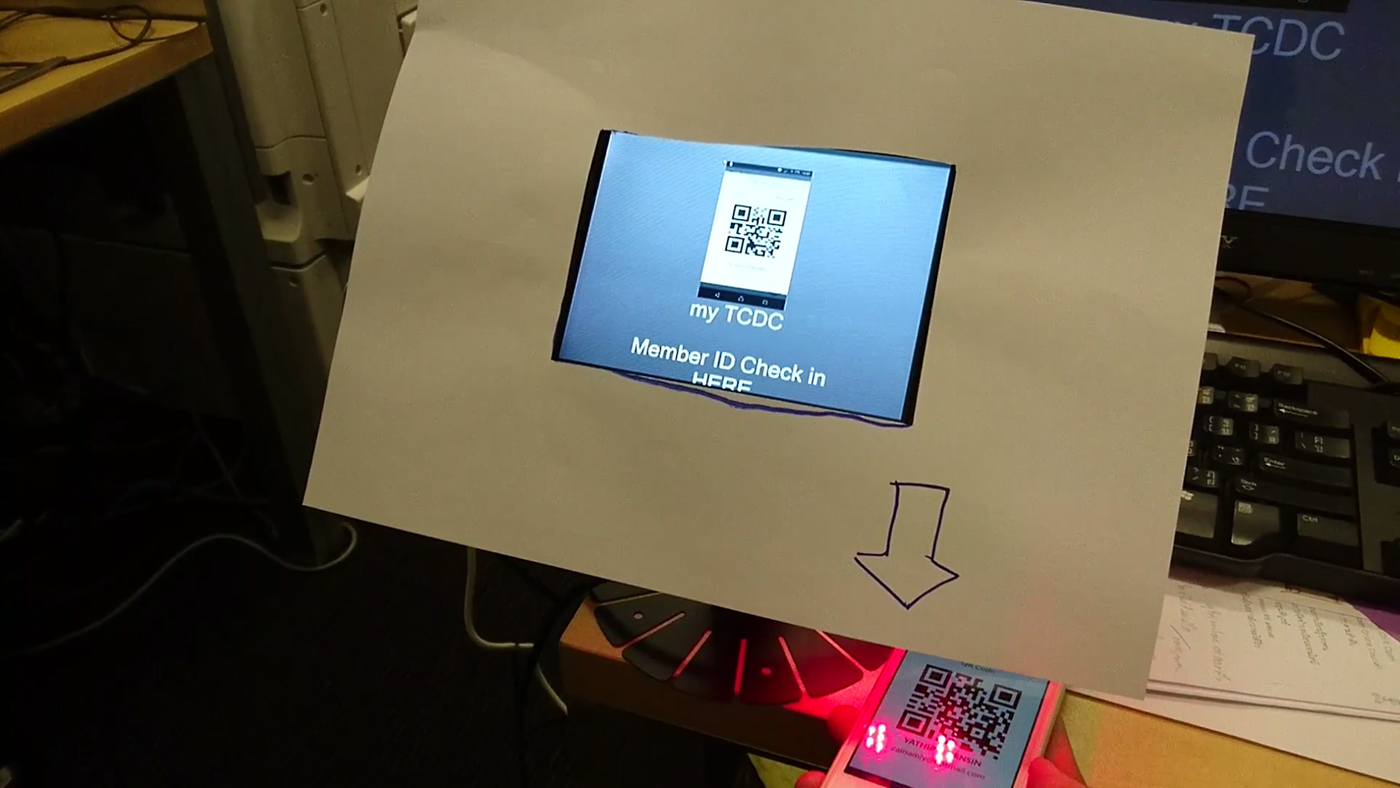
The prototypes were of the same size as the real products (see Fig. 3). Users were asked to test and comment on their experience using these prototypes. They were asked to express their opinions verbally and some were asked to write them on Post-it notes. Certain prototypes were tested by observing the number of user interactions.
Prototype of the member check-in at the entrance
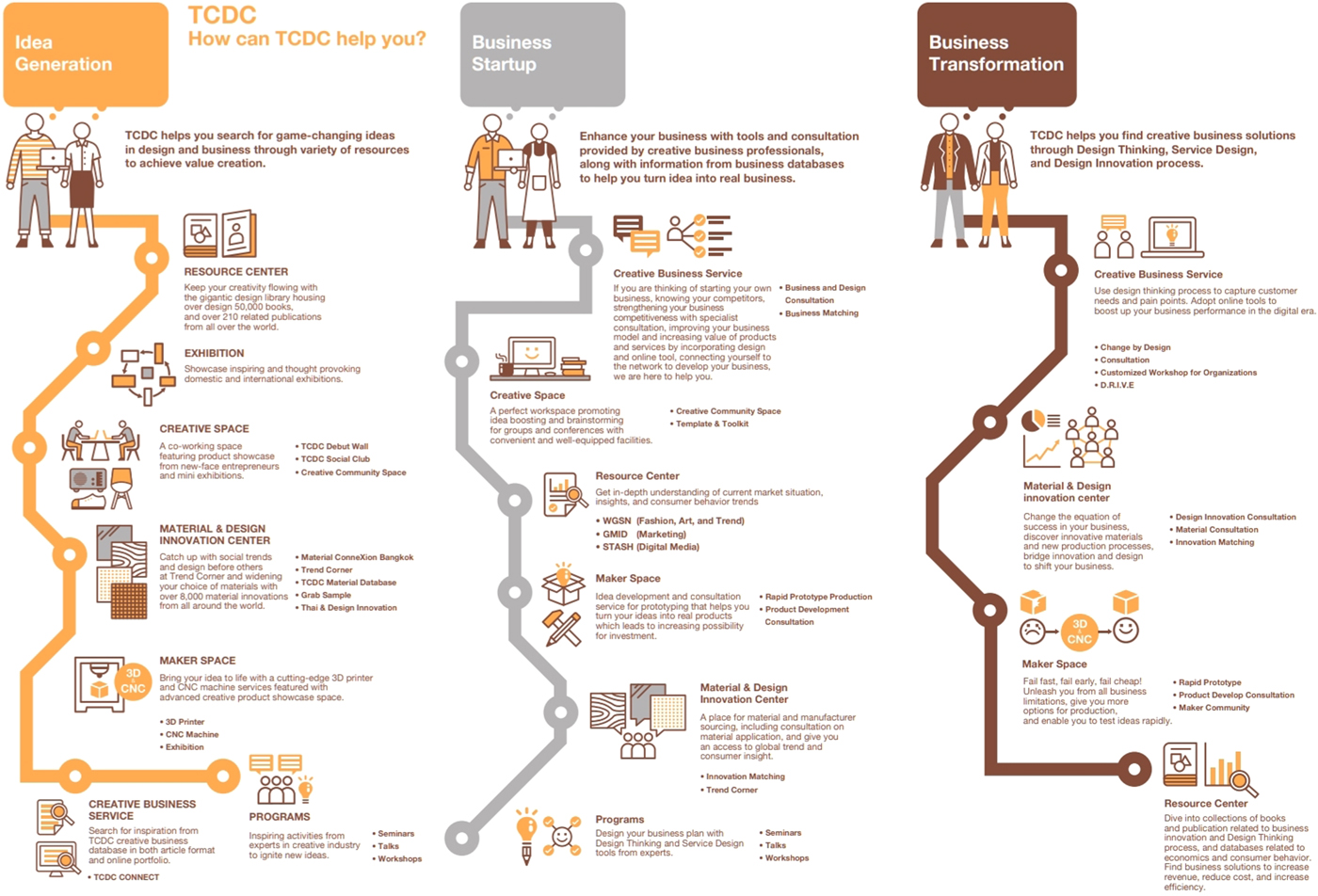
Please note that not every service chosen could be deployed at the TCDC since there were other aspects that needed to be considered, namely the budget and impact. To consider all factors, services were prioritised and elaborated on in detail as a service blueprint (see Fig. 4). The service blueprint was then sent to all service staff and other related departments so that they would have the same understanding of the process and could work harmoniously and effectively. In addition, the blueprint was also communicated to the physical design team.
TCDC Service blueprint
Prompting for the iterative process
It is important to remember that the service design process does not end once the services are launched. The services deployed only satisfy the users for the time being, but this does not guarantee that users will be satisfied over time since their needs are always changing. Thus, the TCDC provides various channels for receiving feedback. Feedback channels installed at the new TCDC Bangkok location include a comment board in the refreshment area, a comment box on the website, e-mail, the web application, Line application, as well as personal contact. The team also observes feedback from TCDC social media outlets as well as usage statistics.
User responses from every touch point are documented in a daily report and discussed in the service operation team's morning briefing. Solutions that can be deployed quickly will be prototyped and tested immediately. For solutions that require additional resources (for instance, budget and staff), issues will be directed upwards to the service committee that incorporates representatives from all departments. The feedback mechanism ensures that there will be continuous improvement at the TCDC.
Conclusion
Applying design thinking and service design has, indeed, helped connect TCDC with its users. The goal was to maximise user satisfaction at every possible touch point in the hope that it will promote a return to the service and brand loyalty. The entire design process took two years: six months for developing empathy, six months for the ideation process, six months for prototyping and testing, and another six months for relocation and installation. The iterative aspect helped the design team to catch up with ever-changing user needs and new targeted groups.
After prototyping and testing, all facility-based services including Maker Space, Co-working Space, the new entrance, shelf and area arrangement were then communicated to the space design team as requirements during the facility design phase. The tool-oriented services -- such as the personalised bookmarking service and brainstorming box -- have also been in place since the opening of the new location. For personnel-oriented service, the consulting service has been arranged by reassigning current staff duties while the communicator service has yet to be implemented since it requires enormous resources to change the way staff communicates with users. Implementation will also require a robust, efficient tool or system to connect all related information to prepare the service team to offer the communicator service. The resource-based services -- new book management, trend books access, local design material acquisition -- have also been implemented as part of routine operation. A web application and a Line official account were developed prior to the opening of the new location, and the website was redesigned and is continuously updated.
Certain services were able to be created in a short period of time, while other services required collaborations and resources from other stakeholders. The latter were not implemented all at once, but rather in line in development during the implementation period. The TCDC is still monitoring and readjusting services to fit the real user needs and behavior. For example, the service rates of depository at the co-working space were changed from a monthly basis to a daily basis due to a lack of long-term need. For the bookmark service, in addition to sending a list of resources via email, users are now able to access a list of those resources in a “Private Bookshelf” section of the website.
One of the challenges in applying service design is the collaboration effort among design team members from various departments, each with their specific expertise. Since normal and routine workloads remained, effective communication was critical to keeping everyone engaged.
In addition to this relocation project, design thinking and service design have become core principles in all branches of TCDC's business. In a broader context, with the mission to bring creativity and design as an element to drive the development of Thailand's economy, the TCDC and its partners, based on design thinking and service design approaches, have expanded their outreach effort to other provincial parts, namely Chiang Mai in Northern Thailand and Khon Kaen in Northeastern Thailand. Moreover, the TCDC has cooperated with 35 universities all over the country in distributing design resources and setting up mini TCDC centres to support and encourage potential designers. Ideally this will help develop and improve new and relevant user experiences for various creative and design communities in Thailand.
Acknowledgements
The authors would like to thank the TCDC library team and service team for contributing tremendously to the relocation project as well as Simon Wright for assisting in the preparation process of this article.