Introduction
Over the last years, a biological perspective on mental illness has made a tremendous contribution to our understanding and treatment of mental disorders, leading many psychiatrists to see psychiatry ‘realigning with neurology and potentially creating a new discipline of clinical neuroscience’ (Insel, Reference Insel2009). This transformation of psychiatry into a biomedical discipline is echoed in changing perceptions of mental illness among the general public. A meta-analysis of time trends of public attitudes towards depression and schizophrenia showed that, across several countries, a consistent trend towards stronger endorsement of biological causes and towards stronger recommendation of medical treatment has emerged (Schomerus et al. Reference Schomerus, Schwahn, Holzinger, Corrigan, Grabe, Carta and Angermeyer2012). The increasing knowledge of the biological correlates of mental illness has been hoped to result in greater social acceptance of persons with mental illness (Fusar-Poli et al. Reference Fusar-Poli, Broome and Cortesi2007) and has resulted in efforts of anti-stigma campaigns to explicitly portray mental disorders as medical conditions (National Alliance for Mental Illness, 2008, 2009). However, the evolution of the public's understanding of mental illness has not resulted in greater social acceptance of persons suffering from these disorders. On the contrary, particularly with regard to schizophrenia, the public seems to have become even less tolerant (Angermeyer & Matschinger, Reference Angermeyer and Matschinger2005; Grausgruber et al. Reference Grausgruber, Schöny, Grausgruber-Berner, Koren, Apor, Wancata and Meise2009; Pescosolido et al. Reference Pescosolido, Martin, Long, Medina, Phelan and Link2010; Schomerus et al. Reference Schomerus, Schwahn, Holzinger, Corrigan, Grabe, Carta and Angermeyer2012). While these developments could be coincidental, there is a debate whether biological causal attributions may in fact produce negative attitudes towards persons with mental illness (Haslam et al. Reference Haslam, Rothschild and Ernst2000; Corrigan & Watson, Reference Corrigan and Watson2004; Phelan, Reference Phelan2005; Angermeyer et al. Reference Angermeyer, Holzinger, Carta and Schomerus2011).
Several theoretical models have been proposed to conceptualize a potential association of causal beliefs about mental disorders and social acceptance of persons with mental illness. Some models predict more favourable attitudes resulting from biological causal beliefs, other models predict stronger rejection. In doing so, each model focuses on different mediating attitudes. The expectation that biological causal attributions improve attitudes towards persons with mental illness draws on ‘attribution theory’ (Weiner, Reference Weiner1995) and its application to mental illness (Corrigan, Reference Corrigan2000). Here, notions of ‘guilt and responsibility’ are central to the rejection of persons with mental illness, producing anger and rejection. Because genetic and biological factors are beyond the control of the individual, biological explanations of mental illness would reduce the perceived responsibility of the affected person and thus reduce social rejection. More specifically, attribution theory distinguishes two types of responsibility, which are both relevant for mental illness: onset responsibility, for getting a disease, and offset responsibility for not being able to get well again (Corrigan & Watson, Reference Corrigan and Watson2004).
Another hypothesis predicting favourable consequences of biological illness models connects advancements in genetic knowledge with increased optimism regarding treatment, a position derived from analyses of newspaper reporting on genetics and mental illness and termed ‘genetic optimism’ (Conrad, Reference Conrad2001). It assumes that genetic causal beliefs produce the expectation that ‘effective treatments’ of this condition exist or will soon be developed, and that this will reduce social rejection of affected persons.
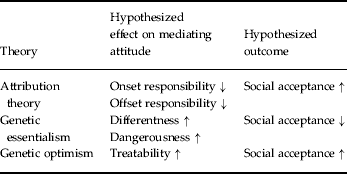
Contrary to this optimistic view, ‘genetic essentialism’ (Nelkin & Lindee, Reference Nelkin and Lindee1995) has linked genetic causal beliefs to aggravating ‘notions of being different’. If genes are perceived as being fundamental to our personal identity, determining who we are and how we behave, attributing mental illness to genetic causes would enhance a perceived profound difference between ‘us’ and ‘them’. This would make mental illness seem more severe and persistent (Phelan, Reference Phelan2005), and it would foster notions of ‘dangerousness’, since biogenetic causes would allow less self-control of the affected individual (Dietrich et al. Reference Dietrich, Matschinger and Angermeyer2006). Ultimately, this would lead to stronger rejection of persons with mental illness. Table 1 summarizes the three theoretical models and the predicted effects on different mediating attitudes and social acceptance.
Hypothesized mediated effects of biogenetic causal explanations on social acceptance, according to different theoretical frameworks

↓, Decrease; ↑, increase.
Attitude research has consistently shown that the public holds illness-specific attitudes and beliefs about mental illness. For example, while the stereotype of dangerousness is highly prevalent regarding schizophrenia and substance abuse disorders, it is far less important with regard to depression (Link et al. Reference Link, Phelan, Bresnahan, Stueve and Pescosolido1999; Crisp et al. Reference Crisp, Gelder, Goddard and Meltzer2005). Responsibility in turn is frequently attributed to persons with alcohol dependence, but considerably less frequently to persons suffering from depression or schizophrenia (Schomerus et al. Reference Schomerus, Matschinger and Angermeyer2006b ; Angermeyer et al. Reference Angermeyer, Holzinger, Carta and Schomerus2011). Effective treatment is more often assumed to be available for alcoholism and depression, compared with schizophrenia (Schomerus et al. Reference Schomerus, Matschinger and Angermeyer2006a ). Depending on the disease, the mediating attitudes central to the different hypothetical models thus seem to be of different salience. Consequently, different theories may best predict the relationship of biological causal beliefs and social distance in different mental disorders. For example, while attribution theory may be of little relevance for attitudes towards persons with schizophrenia, since blame and responsibility are not frequently attributed to them, it may be quite relevant for attitudes towards persons with alcohol dependence, who are strongly held responsible for their condition. As a result it would be possible that biological causal attributions work to the advantage of one group of patients and to the disadvantage of others.
Although psychiatry offers a multifaceted causal model for most mental disorders, stressing the combination of biogenetic and psychosocial causes as part of a stress-diathesis model (Zubin & Spring, Reference Zubin and Spring1977), the debate has so far largely focused on the role of biogenetic causal beliefs for the acceptance of persons with mental illness. Psychosocial causal attributions have shown little change in the general population over the last 20 years, consistently being endorsed by a majority of respondents (Schomerus et al. Reference Schomerus, Schwahn, Holzinger, Corrigan, Grabe, Carta and Angermeyer2012). Population studies examining the relevance of psychosocial aetiological theories for social acceptance of persons with mental illness come up with inconclusive results. Belief in current stress as a cause of the problem was found to be associated with greater tolerance in some (Martin et al. Reference Martin, Pescosolido and Tuch2000; van 't Veer et al. Reference van 't Veer, Kraan, Drosseart and Modde2006; Schnittker, Reference Schnittker2008), but not in all studies (Bag et al. Reference Bag, Yilmaz and Kirpinar2006; Martin et al. Reference Martin, Pescosolido, Olafsdottir and McLeod2007; Jorm & Griffiths, Reference Jorm and Griffiths2008). The same mixed picture emerges with regard to early stressors like childhood sexual abuse or growing up in a broken home (Dietrich et al. Reference Dietrich, Beck, Bujantugs, Kenzine, Matschinger and Angermeyer2004; van 't Veer et al. Reference van 't Veer, Kraan, Drosseart and Modde2006; Schnittker, Reference Schnittker2008). Theoretically, two opposing effects of psychosocial causal beliefs seem plausible: Reducing personal responsibility, and potentially reducing notions of differentness, psychosocial causal beliefs could improve social acceptance of persons with mental illness. Childhood-related causes in particular, however, could also ‘reduce’ social acceptance, since they might be considered as unchangeable, and might even be perceived as constituting a fundamental difference between those exposed and unaffected persons.
The aim of this paper is thus twofold. First, we compare the role of biogenetic causal beliefs for the acceptance of persons with schizophrenia, depression and alcohol dependence, simultaneously examining the mediating role of key attitudes related to attribution theory, genetic optimism and genetic essentialism. In doing so, we want to find out if and how biogenetic causal explanations are related to attitudes towards persons with different mental disorders. Second, we examine the role of psychosocial beliefs within the identical framework. By comparing the correlates of different aetiological models in each of the three disorders, we explore whether alternative illness explanations could potentially be more favourable for persons with mental illness than biogenetic explanations.
Method
Survey
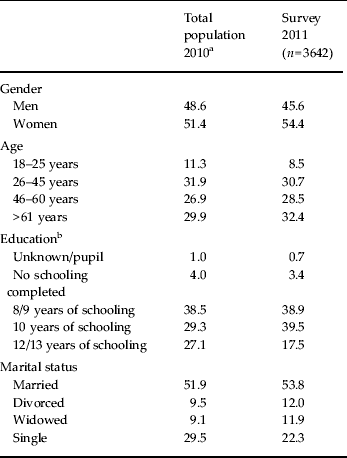
In two waves during March and April 2011 and November and December 2011, we conducted a representative population survey in Germany among adult persons of German nationality (>18 years) living in private households. The sample was drawn using a random sampling procedure with three stages: (1) electoral wards, (2) households, and (3) individuals within the target households. Target households within the sample points were determined according to the random route procedure; target persons within households were selected by random digits. Informed consent was considered to have been given when individuals agreed to complete the interview. Fieldwork was done by USUMA GmbH (Germany), a company specialized in market and social research. Altogether, 3642 persons completed the interview, reflecting a response rate of 64.0%. Table 2 shows the sociodemographic characteristics of our sample and the general population. Although containing slightly more women and fewer better-educated and single respondents, our sample can be considered largely representative of the German population.
Sociodemographic characteristics of the population sample

Data are given as percentage.
a Data from the Statistical Office Germany.
b Only persons ⩾20 years, population data for younger persons not available.
Interview
Personal, fully structured interviews were conducted face to face. The interview started with presenting an unlabelled case vignette of a person with either schizophrenia, depression or alcoholism. The wording of the vignettes is provided in the Supplementary material (available online). Vignettes offer a way to depict a mental disorder without using diagnostic terms and have a long tradition in psychiatric attitude research (Link et al. Reference Link, Cullen, Frank and Wozniak1987). While they cannot substitute real-life contact with a person with mental illness, they allow for a standardized presentation of multiple facets of a disorder in large samples. The gender of the person described in the vignette varied at random. Identical vignettes had been used in earlier surveys, were constructed to be consistent with the diagnostic criteria of the respective disorders in the Diagnostic and Statistical Manual of Mental Disorders, Third Edition Revised (DSM-III-R) and had undergone validation by blinded experts in psychopathology (Angermeyer & Matschinger, Reference Angermeyer and Matschinger1997).
Measures
Causal beliefs
We elicited beliefs about possible causes of the problem described in the vignette with a list of 10 possible causes, each of which had to be rated on a five-point Likert scale anchored with 1 = ‘certainly a cause’ and 5 = ‘certainly not a cause’. Answers to these items were entered into an explorative principal-component factor analysis, yielding three factors with an eigenvalue >1. Varimax rotation resulted in three uncorrelated factors. Items loading primarily on the first factor (eigenvalue 3.45) were ‘stressful life event’ (0.74), ‘work-related stress (including unemployment)’ (0.74), ‘problems with partner and family’ (0.72) and ‘unconscious conflict’ (0.76). Since we know from previous surveys that the public perceives an ‘unconscious conflict’ primarily as a present conflict that the person is not aware of (Schomerus et al. Reference Schomerus, Matschinger and Angermeyer2008), we termed this factor ‘current stress’. Items loading on the second factor (eigenvalue 2.13) were ‘grown up in a broken home’ (rotated factor loading, 0.84), ‘lack of parental affection’ (0.83) and ‘childhood sexual abuse’ (0.78). We termed this factor ‘childhood adversities’. The third factor (eigenvalue 1.12) comprised the items ‘chemical imbalance in the brain’ (0.88), ‘brain disease’ (0.86) and ‘heredity’ (0.72), and was thus termed ‘biogenetic causes’. The three factors accounted for a cumulative variance of 67%. For our analyses, we reversed the rotated factor scores, with higher scores indicating higher agreement with the appropriate causes. This yielded a z-transformed score for each factor (mean = 0, s.d. = 1).
Theory-specific attributions
We elicited specific attributions by asking respondents to indicate their agreement with the following statements on five-point Likert-scales, 1 indicating strong agreement and 5 indicating strong disagreement with the statement: ‘The person is himself/herself to blame for getting his/her condition’ (onset responsibility); ‘The person only has to pull herself/himself together to get well again’ (offset responsibility); ‘Somehow this person is completely different from other people’ (differentness); ‘This person is dangerous’ (dangerousness). ‘With treatment, this person's condition is going to improve markedly’ (treatability). Again, we reversed item scores so that higher scores indicate stronger agreement with the statement.
Social acceptance
Respondents were then asked how willing they would be to accept the person described in the vignette in various social relationships, using the social distance scale developed by Link et al. (Reference Link, Cullen, Frank and Wozniak1987). This scale encompasses the following social situations: rent a room, work together, have as neighbour, let take care of a little child, have marry into family, introduce to friends, recommend for a job. With the help of five-point Likert scales respondents could indicate to what extent they were willing or unwilling to engage in the proposed relationships. The scale showed high reliability (α = 0.91). We used a sum score of all seven items for our analyses, higher scores indicating greater social acceptance of the person.
Statistical analysis
For each vignette condition, we performed a path analysis simultaneously comprising the three orthogonal factors representing different causal attributions, the theory-based mediating attitudes, and social acceptance, as well as age, gender and education. Direct effects, indirect effects, total effects and total indirect effects of this multiple mediator path model were estimated by computing the respective products and sums of products separately for each of the three vignettes (Alwin & Hauser, Reference Alwin and Hauser1975; MacKinnon et al. Reference MacKinnon, Fairchild and Fritz2007; Preacher & Hayes, Reference Preacher and Hayes2008; Wu & Zumbo, Reference Wu and Zumbo2008; MacKinnon & Fairchild, Reference MacKinnon and Fairchild2009). Estimating the standard errors of the multiple products of coefficients was done with bootstrapping (10 000 replications), since the distribution of products and the sum of all indirect effects cannot be considered normal (Aroian, Reference Aroian1947; Aroian et al. Reference Aroian, Taneja and Cornwell1978) and the multivariate delta method (Sobel, Reference Sobel1982, Reference Sobel1986) might lead to biased estimation. To evaluate the size of indirect effects the proportion of mediated effects (PMEs) is provided as percentage of the total effect (MacKinnon et al. Reference MacKinnon, Warsi and Dwyer1995; Raykov & Mels, Reference Raykov and Mels2007). We used Wald tests to examine whether path coefficients differ between conditions. Computations were carried out by Mplus 6.12 (Muthén & Muthén, USA) and STATA Release 12 (StataCorp LP, USA).
Results
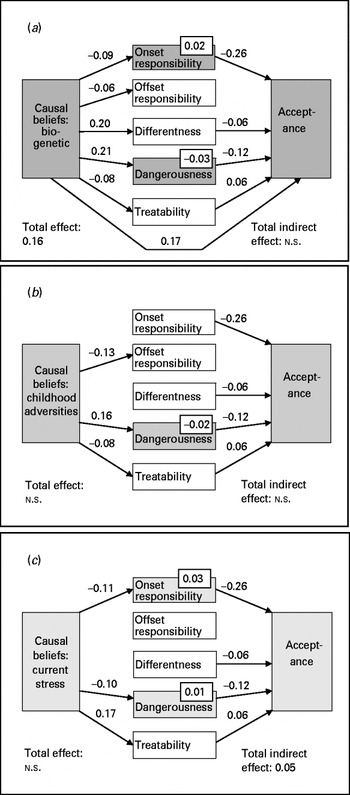
Figs. 1–3 summarize the results of the path analysis for the relationship between causal beliefs and social acceptance for schizophrenia, depression and alcohol dependence. All figures are derived from the same path analysis, details of which are reported in Supplementary Table S1. Fig. 1 shows the effect of causal beliefs in schizophrenia, Fig. 2 related to depression, and Fig. 3 related to alcohol dependence. Only significant paths are depicted (p < 0.05). Our models explained 17% of the variance of social acceptance in depression and schizophrenia, and 14% in alcoholism. In our figures, we present standardized path coefficients (β). Standardized coefficients illustrate the effect size of significant relationships. They indicate how many standard deviations the dependent variable will change if the independent variable changes by one standard deviation. Since standardization depends on the distribution of values within a sample, standardized coefficients cannot directly be compared between the three vignette conditions. Unstandardized coefficients of the complete models are given in Supplementary Table S1.
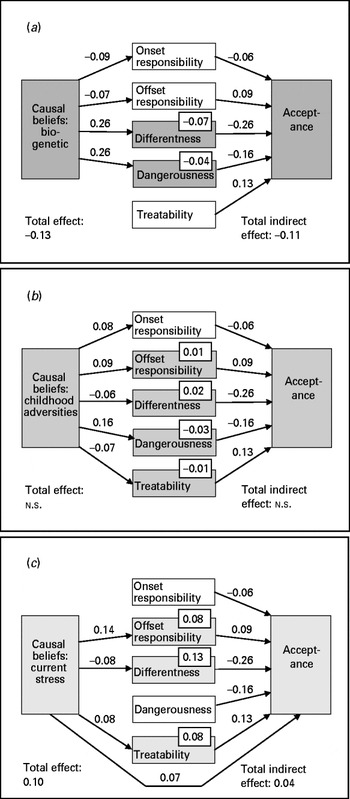
Different causal explanations and social acceptance of a person with schizophrenia. Path analysis is shown, with standardized path coefficients. Only significant coefficients are reported (p < 0.05). Numbers on arrows are direct effects. Numbers in boxes are indirect effects. n.s., Non-significant. The data are from a representative population survey in Germany (n = 1183).

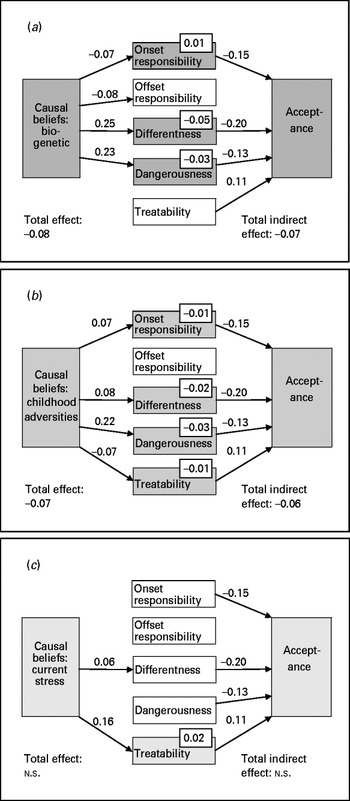
Different causal explanations and social acceptance of a person with depression. Path analysis is shown, with standardized path coefficients. Only significant coefficients are reported (p < 0.05). Numbers on arrows are direct effects. Numbers in boxes are indirect effects. n.s., Non-significant. The data are from a representative population survey in Germany (n = 1173).

Different causal explanations and social acceptance of a person with alcohol dependence. Path analysis is shown, with standardized path coefficients. Only significant coefficients are reported (p < 0.05). Numbers on arrows are direct effects. Numbers in boxes are indirect effects. n.s., Non-significant. The data are from a representative population survey in Germany (n = 1126).

Relationship of the mediator variables with social acceptance
The right halves of the subfigures a–c are identical in each figure, illustrating the relationship of the mediator variables with social acceptance. In schizophrenia (Fig. 1), all five mediating attitudes are associated significantly with social acceptance, and mostly in the direction hypothesized in Table 1. While differentness (β = −0.26), dangerousness (β = −0.16) and onset responsibility (β = −0.06) are all related to less acceptance, perceived treatability is related to more acceptance (β = 0.13). Contrary to expectations, the perception that the person is responsible for getting better (offset responsibility, ‘only has to pull himself/herself together’) is related to greater social acceptance of a person with schizophrenia (β = 0.09). In depression and alcoholism (Figs 2 and 3), the directions of these associations are similar, but only those with onset responsibility, differentness, dangerousness (all reducing acceptance) and treatability (increasing acceptance) are significant. The strength of the association is also different in the three conditions: In alcohol dependence, for example, the influence of onset responsibility is stronger than in schizophrenia (Wald test, p < 0.001) and depression (p < 0.05), while the influence of differentness is stronger in schizophrenia and depression than in alcohol dependence (p < 0.001). The negative role of perceived dangerousness, in contrast, is similar across all conditions (p = 0.611).
Causal attributions and social acceptance
Schizophrenia
The left halves of the subfigures a–c show how the three types of causal beliefs are associated with the mediating attitudes, and whether any direct effect on social acceptance exists. In schizophrenia, biogenetic causal attributions (Fig. 1 a) are related to more perceived differentness and dangerousness (both β = 0.26), and (to a lesser extent) less onset and offset responsibility (β = −0.09, β = −0.07). There is no significant direct effect on social acceptance. Attitudes mediating a significant indirect effect of biogenetic causal beliefs on social acceptance are depicted in grey, and the according path coefficient of this mediated effect is inserted in a box. In schizophrenia, the largest indirect effect is mediated through perceived differentness (β = −0.07), followed by dangerousness (β = −0.04). All indirect effects sum up to a total indirect effect of β = −0.11, accounting for 88% of the total effect of biogenetic causal beliefs on social acceptance (β = −0.12, PME = 88%). Overall, biogenetic causal attributions are thus associated with lower social acceptance of a person with schizophrenia, and this effect is largely mediated by perceived differentness and dangerousness.
Fig. 1 b shows the according model for the belief that childhood adversities are a cause of schizophrenia. This belief is associated with stronger perceptions of onset and offset responsibility and dangerousness, and lower perceptions of differentness and treatability. Several mediated effects are significant, but in opposing directions: while increased offset responsibility and reduced differentness both lead to more social acceptance, increased dangerousness and reduced treatability have the opposite effect. As a result, there is no significant total indirect (mediated) effect and also no significant total effect of belief in childhood adversities on social acceptance.
Fig. 1 c shows the model for belief in current stress as a cause of the problem. It shows a total positive effect of β = 0.10. This effect is composed of a direct, not mediated effect of belief in current stress on social acceptance, increasing social acceptance by β = 0.07, and a total indirect effect of β = 0.04 due to an association with more offset responsibility, less differentness and more perceived treatability.
Depression
In depression, the effects of biogenetic causal attributions on social acceptance are generally similar to the effects seen in schizophrenia, with negative effects mediated through increased perceptions of dangerousness (β = −0.03) and differentness (β = −0.05, Fig. 2 a). Different to schizophrenia, however, there is a small, but significant positive effect mediated through reduced onset responsibility (β = 0.01). In this inconsistent mediation model (containing both negative and positive paths), negative coefficients are greater, resulting in a negative total indirect effect (β = −0.07) and a negative total effect (β = −0.08). Similar to schizophrenia, most of the total effect is due to the observed indirect effects, which is reflected in a high PME (90%).
In depression, belief in a causative role of childhood adversities is associated with overall ‘reduced’ social acceptance of the affected person (Fig. 2 b: total effect β = −0.07). This effect is almost entirely mediated through increased notions of onset responsibility, differentness and dangerousness, and through a reduced belief in the treatability of the condition (PME = 98%).
Although increased perceptions of treatability mediate a small positive effect of belief in current stress as the cause of the problem on social acceptance (β = 0.02, Fig. 2 c), this does not affect overall social acceptance significantly.
Alcohol dependence
Different to schizophrenia and depression, biogenetic causal explanations are associated with more social acceptance in alcohol dependence (Fig. 3 a; total effect β = 0.16). Two indirect effects are significant, albeit with different directions: a positive effect mediated through a reduction of onset responsibility is outweighed by a negative effect mediated through increased perceptions of dangerousness, which is reflected in an insignificant total indirect effect and a low PME (10%). The overall effect of biogenetic causal attributions on social acceptance of alcohol-dependent persons is thus largely due to a direct effect between both variables (β = 0.17).
Although belief in childhood adversities is associated with increased notions of dangerousness, overall the total direct and total indirect effect of this causal explanation on social acceptance remains insignificant (Fig. 3 b). Similarly, the total effect of belief in current stress as a cause of alcohol dependence remains insignificant (Fig. 3 c), although reduced notions of dangerousness and onset responsibility mediate significant positive indirect effects.
Influence of sociodemographic variables
Age, education and gender are included as potential confounding variables in our model. Of these, only age had a significant effect on social acceptance, being associated with less acceptance in all three conditions. Effects of sociodemographic variables on social acceptance and the mediator variables are reported in Supplementary Table S1.
Discussion
Summarizing our findings, we found proof of the predictions of genetic essentialism in schizophrenia and depression (see Table 1), where biogenetic causal beliefs are associated with higher perceived dangerousness and stronger differentness, both leading to lower social acceptance of the affected person. The high PME in both models (88% and 90%) confirms the relevance of the hypothesized mediators for the overall effect of biogenetic causal beliefs. In contrast, biogenetic causal beliefs predict better social acceptance of a person with alcohol dependence, but largely independent from the theoretical models examined in this study. The role of psychosocial causal explanations is also illness specific. In schizophrenia, belief in current stress as a cause has a positive effect on social acceptance by reducing perceived differentness and increasing perceived treatability and offset responsibility. In depression, however, the belief that the problem is caused by childhood adversities results in less social acceptance, mediated by increasing notions of dangerousness and differentness.
Before discussing the theoretical and practical implications of our findings in detail, some limitations of our study need mentioning. First, the explanatory power of our models and the observed effect sizes were low, highlighting that causal explanations are only one factor among others determining social acceptance of persons with mental illness. Other factors shown to enhance social acceptance that were beyond the scope of this analysis are previous contact with persons with mental illness (e.g. Pattyn et al. Reference Pattyn, Verhaeghe and Bracke2012), or belief in a continuity of symptom experience (Schomerus et al. Reference Schomerus, Matschinger and Angermeyer2013). Second, although our path models test theoretical predictions on causal relationships, our cross-sectional analyses cannot prove causality, but describe correlations. Our findings are in line, however, with experimental studies in selected groups that found, for example, increased notions of dangerousness after presentation of biogenetic illness explanations for a mental illness (Walker & Read, Reference Walker and Read2002; Lam et al. Reference Lam, Salkovskis and Warwick2005; Bennett et al. Reference Bennett, Thirlaway and Murray2008). Third, we assessed the mediating attitudes in our model with single items. Although these items had all been pre-tested, construction and use of scales of three or more items for each attitude would have further increased the validity of our findings. Fourth, our survey was conducted in Germany, hence our results might not be valid in different cultural contexts (WonPat-Borja et al. Reference WonPat-Borja, Yang, Link and Phelan2012), but are likely to apply to other western industrialized countries (Schomerus et al. Reference Schomerus, Schwahn, Holzinger, Corrigan, Grabe, Carta and Angermeyer2012). Finally, the use of unlabelled case vignettes may cloud a potential difference between perceived causes of unusual behaviour and perceived causes of an illness. To address this concern, we have repeated our analysis with subsamples of respondents who identified the person described as suffering from a mental illness (for detailed results, see Supplementary Table S1), yielding similar models in schizophrenia and depression, but statistically weaker relationships in alcohol dependence. On the other hand, the design of our study carries several strengths: by comparing different theoretical predictions by means of multiple mediation models, it enables a detailed account of the mechanisms responsible for the relationship of causal beliefs and social acceptance in mental illness. Being based on a large representative population sample, it can also show inconsistent models, where different mediators work in different directions (MacKinnon et al. Reference MacKinnon, Fairchild and Fritz2007). By using factors representing the causal explanations ‘biogenetic’, ‘childhood adversities’ and ‘current stress’, it covers a bio-psychosocial aetiological model of mental disorders consistent with present psychiatric knowledge. By eliciting attitudes regarding three different disorders, it also accounts for illness-specific belief systems. Finally, by employing unlabelled case vignettes, it elicits causal beliefs that are not biased by use of any medical language within the interview.
Theoretical implications
Looking at our results on biogenetic causal attributions, our findings support the predictions of genetic essentialism for both depression and schizophrenia. They corroborate earlier studies that similarly found genetic causal attributions linked to greater rejection (e.g. Dietrich et al. Reference Dietrich, Matschinger and Angermeyer2006; Schnittker, Reference Schnittker2008), and they suggest that notions of dangerousness and differentness are at the core of this sentiment (Dar-Nimrod & Heine, Reference Dar-Nimrod and Heine2011). However, the term ‘genetic essentialism’ might be too narrow to describe the effect of certain causal attributions on social acceptance of persons with mental illness, since we used a combination of genetic and other biological causal beliefs as independent variable. These variables represented a single factor in a factor analysis of 11 different causal explanations, and the items referring to ‘chemical imbalance’ and ‘brain disease’ even loaded higher on this factor than belief in heredity. Notions of differentness and dangerousness thus seem not exclusively to be tied to genetic causes, but to a set of biogenetic causal explanations.
Beyond ‘biogenetic essentialism’, another facet of essentialist beliefs seems to shape social acceptance in depression. Here, belief in childhood causes was associated with stronger perceptions of differentness and dangerousness, increased blame, and reduced perceptions of treatability. These findings contrast with expectations that psychosocial explanations, including childhood trauma, would frame a mental disorder as an understandable reaction to adversities that could have happened to anybody (Walker & Read, Reference Walker and Read2002; Corrigan & Watson, Reference Corrigan and Watson2004). Instead, they suggest that ‘psychological essentialism’, which includes genetic essentialism but also covers notions of other, seemingly irreversible biological and biographical, differences seems a useful concept to understand the implications of different causal beliefs for depression. Research in social psychology has demonstrated that essentialist thinking in general is associated with stronger endorsement of negative stereotypes about other persons (Bastian & Haslam, Reference Bastian and Haslam2006). Several characteristics of an attribute like its unalterability and inductive potential have been proposed to define essentialist beliefs (Haslam et al. Reference Haslam, Rothschild and Ernst2000). Childhood trauma, that cannot be reversed and might be perceived as inducing life-lasting psychological consequences, might thus trigger essentialist beliefs about a group fundamentally distinct from other persons. Our findings suggest that the stigmatizing potential of childhood trauma, which has so far not been examined in population studies, merits more scientific attention (Schomerus, Reference Schomerus, Spitzer and Grabe2012).
Concerning attribution theory, our results need to be differentiated between onset and offset responsibility. In all three disorders, the hypothesized effects regarding ‘onset’ responsibility were present: biogenetic causal beliefs reduced onset responsibility which in turn reduced social acceptance, yielding a small but significant positive indirect effect on social acceptance in depression and alcoholism. However, the contribution of this effect to overall social acceptance was negligible, being outweighed by the adverse effects mediated by perceived differentness and dangerousness, respectively. The multiple mediation approach of our study thus allows the conclusion that, with regard to onset responsibility for mental disorders, attribution theory is not wrong, but irrelevant.
In contrast, our findings regarding ‘offset’ responsibility were less clear. Although biogenetic causal beliefs reduced agreement to the statement ‘the person only has to pull himself/herself together in order to get well’, this statement was unexpectedly associated with increased social acceptance in schizophrenia [and also just below significance (p = 0.074) in alcohol dependence, see Supplementary Table S1]. While certainly carrying notions of anger, offset responsibility may have another significance: the expectation that the person should ‘pull himself/herself together’ probably also implies some extent of control over the disease, which could increase social acceptance. The overall strength and direction of the association would thus depend on the relative importance of these two conflicting implications (anger and perceived control) for a specific disorder.
Finally, corroborating earlier work by Phelan et al. (Reference Phelan, Yang and Cruz-Rojas2006), we did not find any indication justifying ‘genetic optimism’, i.e. the expectation that biogenetic causal beliefs increase perceived treatability. On the contrary, the only significant path linking biogenetic causal beliefs and perceived treatability (in alcohol dependence) was negative. So far, assuming a mental disorder has a biogenetic cause is not related to greater optimism about its treatment.
Practical implications
How should the causes of mental disorder be communicated to the public? Ideally, depiction of mental illness should refer to the latest scientific evidence in a balanced and nuanced manner. Often, however, this is not the case. A recent analysis of the reporting of mental disorders research in British media found a strong emphasis on biological research, while research on psychological interventions was rarely covered (Lewison et al. Reference Lewison, Roe, Wentworth and Szmukler2012). Information websites on major depressive disorder in the USA were found to provide a balanced view on causes and treatment if they were provided by universities or by government organizations, but tended to overemphasize biological causes if they were run by non-governmental organizations or pharmaceutical companies (Hansell et al. Reference Hansell, Bailin, Franke, Kraft, Wu, Dolsen, Harley and Kazi2011). Our findings suggest that a reductionist view of mental illness is not in the interest of the affected persons, and underline that biogenetic causal explanations need to be contextualized within a vulnerability–stress concept that includes the role of current stress, an explanation that increased social acceptance in schizophrenia. Biogenetic explanations should not mistakenly be used to enhance therapeutic optimism, because they are not associated with beliefs in better treatability. This does not contradict findings that associate biogenetic causal beliefs with recommendation of more hospital treatment and pharmacotherapy (Phelan et al. Reference Phelan, Yang and Cruz-Rojas2006; Schnittker, Reference Schnittker2008). These recommendations just seem not to be the result of therapeutic optimism, but of notions about the severity of the condition. Biogenetic explanations should finally not be used to reduce blame in schizophrenia and depression (Boysen, Reference Boysen2011), because this carries the unwanted side effect of increasing notions of differentness and dangerousness and may ultimately impair social acceptance of affected persons.
The picture is less clear in alcohol dependence. Here, biogenetic causal explanations appear to be beneficial, increasing the social acceptance of persons affected by this disorder. This backs up efforts of researchers and advocacy groups like Alcoholics Anonymous stressing the disease character of alcohol dependence (Kurtz, Reference Kurtz2002; Sellman, Reference Sellman2010). However, our model was unable to depict the exact mechanism of this effect (being almost entirely due to a direct, unmediated effect of biogenetic causal beliefs on social acceptance), and in particular, it did not confirm the expected relevance of reducing blame through biomedical explanations. The apparent association of biogenetic causal beliefs and social acceptance in alcohol dependence should thus be the subject of further research.
Finally, when communicating psychosocial causes of mental disorders, unwanted side effects have also to be considered. Educating the public about the possibility to address childhood trauma successfully in psychotherapy appears an urgent task, since childhood causes were associated with reduced belief in the treatability of schizophrenia, depression and alcohol dependence.
In conclusion, our study substantiates the concern that overemphasizing the biological correlates of mental disorders potentially harms those suffering from depression and schizophrenia. By using multiple mediator models, it shows the different, partly inconsistent mechanisms mediating the influence of causal beliefs on social distance. It demonstrates that reduced blame and therapeutic optimism are not the most relevant correlates of biogenetic causal attributions, but stronger notions of dangerousness and differentness. Our study also cautions, however, that the relationship between causal attributions and social acceptance is illness specific, with positive (and largely unexplained) associations in alcohol dependence. While current stress as a causal explanation for mental illness seems to carry some destigmatizing potential, childhood-related psychosocial explanations can also have unwanted consequences that require further exploration.
Supplementary material
For supplementary material accompanying this paper visit http://dx.doi.org/10.1017/S003329171300072X.
Acknowledgements
This study was funded by the Fritz Thyssen Stiftung (Az. 10.11.2.175).