INTRODUCTION
Human schistosomiasis is a significant health problem in endemic regions, especially in Africa. In addition, rising numbers of schistosomiasis patients have been detected in Schistosoma-free areas, mainly due to the increase in off-track tourism, the spread of schistosomiasis in previously non-endemic areas (Lademann et al. 2000) and the recent waves of immigrants from endemic countries reaching Europe (e.g. Bou et al. 2001; Roca et al. 2002).
Schistosomiasis diagnosis is based in the examination of stool or urine samples for the detection of parasite eggs. Sometimes, specific serology or elevated eosinophilia supports the diagnosis. However, diagnostic sensitivity is still low and thus positive samples are misdiagnosed. Furthermore, collection of diagnostic samples such as stool or blood can be difficult in some population groups, which could hamper diagnostic procedures.
During the last few years, several authors have tried to set new diagnostic tools with higher specificity and sensitivity, some based on the detection of Schistosoma DNA by the polymerase chain reaction (PCR) technique. Specifically, an S. mansoni sequence containing 121-base pair tandem repeats (Hamburger et al. 1991) was used to design specific primers (Hamburger et al. 1998a,b), which have been further applied for the amplification of the corresponding sequence in human patients' stool and serum (Rabello et al. 2002; Pontes et al. 2002, 2003). Some other Schistosoma sequences have been described and used to design PCR reactions, although they have been not applied to human samples (e.g. Kane and Rollinson 1998; Barber et al. 2000; Hamburger et al. 2001).
Here, we established a new PCR approach, based on the specific amplification of a genus-specific product from the 28S ribosomal DNA subunit of Schistosoma spp. and several species-specific amplicons for the main 4 Schistosoma species affecting man and S. bovis. In addition, we applied the new PCR tools to urine samples from patients with schistosomiasis and other helminthic and protozoal diseases, in order to evaluate the performance of our new diagnostic approach in clinical samples.
MATERIALS AND METHODS
Experimental models and parasites
Trichinella spiralis, Strongyloides venezuelensis and Schistosoma bovis were collected from their respective experimental models (Denham and Martinez 1970; Conway et al. 1994; Abane et al. 2000). Fasciola hepatica and Ascaris lumbricoides adult worms were collected from naturally infected cows and pigs, respectively, in a local abattoir.
DNAs
Genomic DNAs from S. bovis, F. hepatica, T. spiralis and S. venezuelensis worms, and from Homo sapiens blood samples, were extracted with the NucleoSpin Tissue kit (Macherey Nagel, Germany). S. haematobium, S. japonicum and S. intercalatum ethanol-fixed adult worms, a kind gift from Dr D. Rollinson (Natural History Museum, London), and ethanol-fixed A. lumbricoides worms, were used to extract genomic DNAs using the NucleoSpin Trace kit (Macherey Nagel, Germany).
S. mansoni, Trypanosoma cruzi, Giardia lamblia, Entamoeba histolytica and E. multilocularis, Leishmania panamensis and Plasmodium falciparum DNAs were a kind gift from Drs G. V. Hillyer (Puerto Rico University), P. Bonay (Universidad Autónoma, Madrid), N. Müller (Institute of Parasitology, University of Berne), E. Tannich (Bernhard Nocht Institute of Tropical Medicine, Hamburg), B. Gottstein (Institute of Parasitology, University of Berne) and F. Martínez (INDICASAT, Panama), respectively.
All DNA samples were diluted at 1 μg/μl in distilled water and stored at −20 °C until use.
Diagnostic samples
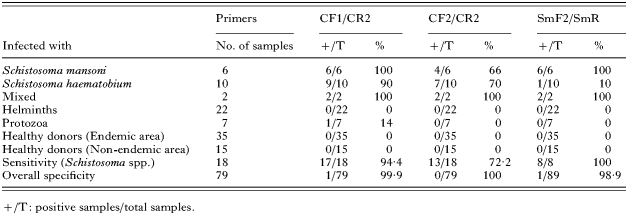
Eighteen human urine samples from Schistosoma-infected sub-Saharan patients were collected in the Hospital Insular, Gran Canaria, and Hospital Carlos III, Madrid, Spain. These were selected from patients presenting eosinophilia and with a confirmed schistosomiasis diagnosis i.e. S. mansoni (n=6), S. haematobium (n=10) and mixed S. mansoni/S. haematobium infection (n=2), through the detection of parasite eggs in stool or urine (see Table 2).


Twenty-two urine samples from patients with helminths other than Schistosoma i.e. 7 filariae, 7 uncinaria, 2 Strongyloides stercoralis, 4 Trichuris trichura, 1 Enterobius vermicularis and 1 Taenia solium, 7 with protozoan parasites, 2 Plasmodium spp., 1 Trichomonas vaginalis, 3 Giardia lamblia and 1 Blastocystis hominis and 35 from healthy donors from schistosomiasis endemic areas (sub-Saharan) were collected in the Hospital Insular, Gran Canaria, Spain. Fifteen samples from healthy donors from non-endemic areas were collected in our laboratory (see Table 2).
DNA extraction from human urine (3 ml each) was performed with the NucleoSpin Trace kit (Machery Nagel, Germany), using the manufacturer's instructions.
Primers design and PCR
The 28S and ITS–rDNA sequences from Schistosoma spp. (S. mansoni, AY157173; S. japonicum, Z46504; S. intercalatum, AJ223840; S. bovis, AY157266 and S. haematobium, AJ223838) and other parasites (Fasciola hepatica, AY222244; Strongyloides stercoralis, U39489 and Ascaris lumbricoides, U94751) available in the GenBank were compared using the MultAlin facility at http://www.expasy.ch. From the corresponding consensus sequences, several regions were selected for further primer design. Selected regions were subjected to similarity searches through the BLAST program (http://www.ch.embnet.org/ software/BottomBLAST.html) to check possible matches with sequences from other organisms.
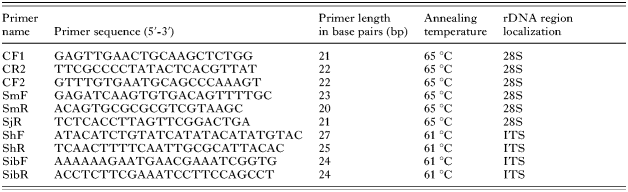
Two primer pairs were designed, putatively amplifying only Schistosoma 28S rDNA: CF1/CR2 and CF2/CR2 (see Table 1), giving genus-specific PCR products of 877 and 1032 base pairs (bp), respectively.
Specific primers were designed for the amplification of the 28S rDNA region from S. mansoni (SmF/SmR) and S. japonicum (CF1/SjR), and the ITS rDNA region from S. haematobium (ShF/ShR) and S. intercalatum or S. bovis (SibF/SibR), putatively giving species-specific PCR products of 350, 645, 607 and 825 bp, respectively (see Table 1).
PCR reactions were carried out in a final volume of 20 μl with 2 μl of 10× reaction buffer, 3 mM MgCl2, 2·5 units Taq polymerase (Bioline, Germany), 2 μM each primer (TIB-MOLBIOL, Germany), 0·5 mM dNTPs (Roche) and 1 μl of template DNA, either from parasites' extracts or from extracted human urine samples. PCR was performed in 35 cycles, each consisting of 94 °C for 20 sec, 65 or 61 °C for 20 sec (see Table 1) and 72 °C for 30 sec. Corresponding PCR products were electrophoresed, together with the molecular weight markers (XVI, Roche) in 1% agarose in Tris-borate EDTA gels with 0·5 μg/ml ethidium bromide, and visualized in a UV transilluminator.
PCR sensitivity and specificity
Sensitivity was measured for each primer pair using 2-fold serial dilutions of 1 μg/μl DNA from S. mansoni, S. japonicum, S. haematobium and S. intercalatum (for CF1/CR2, CF2/CR2 and SmF/SmR; CF1/SjR; ShF/ShR, and SibF/SibR primer pairs, respectively) in a PCR reaction performed as above-mentioned.
Potential reaction inhibition or DNA losses during human urine extraction procedures were assessed as follows: 3 μg S. mansoni DNA was added to 3 ml of urine from a healthy donor either before or after DNA extraction. Subsequently, specific amplifications with CF1/CR2 were carried out with serial (2-fold) dilutions of (i) parasite DNA alone, (ii) extracted parasite DNA in urine and (iii) parasite DNA added to extracted urine.
PCR specificity was tested in a similar manner. Firstly, PCR amplification was performed with 1 μg of S. mansoni, S. intercalatum, S. bovis, S. haematobium, S. japonicum, Fasciola hepatica, Echinococcus multilocularis, Strongyloides venezuelensis, Ascaris lumbricoides, Toxocara canis, Trichinella spiralis, Entamoeba histolytica, Giardia lamblia, Trypanosoma cruzi, Leishmania panamensis, Plasmodium falciparum or Homo sapiens DNA with respective primer pairs (see above) as above-mentioned. Secondly, test specificity was assessed with the selected 79 human urine samples (Table 2) with primer pairs CF1/CR2, CF2/CR2 and SmF/SmR using the above-mentioned PCR conditions.
RESULTS
PCR detection limit
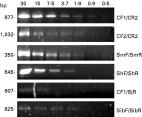
PCR sensitivity measured on S. mansoni DNA with the CF2/CR2 and SmF/SmR primer pairs was shown to be 1·9 pg (Fig. 1). The detection limit was lower amplifying S. mansoni DNA with the primer pair CF1/CR2 (0·98 pg; Fig. 1).

Fig. 1. PCR sensitivity. PCR reactions were carried out with serial dilutions (30 to 0·5 pg) of Schistosoma mansoni (CF1/CR2, CF2/CR2, SmF/SmR), S. haematobium (ShF/ShR), S. japonicum (CF1/SjR) and S. intercalatum (SibF/SibR) DNA, and the genus- and species-specific primer pairs CF1/CR2, CF2/CR2, SmF/SmR, ShF/ShR, SjF/SjR and SibF/SibR indicated (see Table 1). PCR products were separated in 1% agarose gels and stained with ethidium bromide. Sizes for each amplicon are indicated in the left of the figure, in base pairs (bp).
The detection limit of the PCR reactions on S. haematobium, S. japonicum and S. intercalatum or S. bovis DNA with primer pairs ShF/ShR, SjF/SjR and SibF/SibR, respectively, were 3·7, 15 and 3·7 pg, respectively (Fig. 1).
Losses in sensitivity of the PCR reaction when performed on human urine samples, either due to DNA losses during extraction procedures or to potential inhibitory components present in urine, were also tested (see Materials and Methods). Inhibitory phenomena lower the detection limit from 0·98 to 3·7 pg of the parasites' DNA. These, together with DNA losses during extraction procedures, settled the PCR sensitivity in 30 pg parasite DNA for human urine samples (data not shown).
PCR sensitivity
In human urine samples, the CF1/CR2 primers showed 94·4% sensitivity on the selected samples (Table 2). Primers CF2/CR2 gave lower sensitivity (72·2%; Table 2).

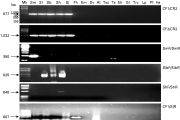
Fig. 2. PCR specificity. PCR reactions were carried out using 1 μg of DNA from Schistosoma mansoni (Sm), S. intercalatum (Si), S. bovis (Sb), S. haematobium (Sh), S. japonicum (Sj), Fasciola hepatica (Fh), Echinococcus multilocularis (Em), Strongyloides venezuelensis (Sv), Ascaris lumbricoides (Al), Toxocara canis (Txc), Trichinella spiralis (Ts), Entamoeba histolytica (Eh), Giardia lamblia (Gl), Trypanosoma cruzi (Trc), Leishmania panamensis (Lp), Plasmodium falciparum (Pf) or Homo sapiens (Hs), with the primer pairs CF1/CR2, CF2/CR2, SmF/SmR, SibF/SibR, ShF/ShR and CF1/SjR (see Table 1). PCR products were separated in 1% agarose gels and stained with ethidium bromide. Sizes for each amplicon (arrows) and the closer molecular weight markers (in the upper gel) are indicated to the left of the figure, in base pairs (bp). Mk, molecular weight markers (XVI, Roche).
The specific SmF/SmR primers were shown to be the most sensitive (100%; Table 2). When ShF and ShR primers were used in human samples, sensitivity was much lower than expected (40%; data not shown).
PCR specificity
The primer pairs specifically designed to recognize S. mansoni, S. haematobium or S. japonicum DNA showed 100% specificity on respective DNAs, and those specifically designed on the S. intercalatum and S. bovis rDNA sequences resulted in the amplification of S. haematobium DNA as well, and thus this last primer pair was not used for human samples (Fig. 2). No amplification product was detected with the above-mentioned primer pairs when the additional parasites and host DNAs used in our study were added as template for the PCR reaction, with the exception of a faint band, although at a different molecular weight than the specific amplicon, when DNA from Trichinella spiralis was used as template with the SmF/SmR primers (Fig. 2). Similarly, the CF1/CR2 and CF2/CR2 primer pairs gave the corresponding PCR products only when Schistosoma spp. DNA was used as template for the PCR reaction (Fig. 2).

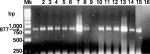
Fig. 3. PCR on human samples. PCR reactions were carried out with DNA extracted from urine of S. mansoni (1–6), S. haematobium (7–12) and S. mansoni plus S. haematobium (13 and 14) infected patients, using the genus-specific primers CF1 and CR2. The molecular weight of the specific amplicon (arrow) and the closer molecular weight markers are shown. 15, positive (S. mansoni DNA) and 16, negative (DNA from a healthy donor urine sample) controls. Mk, molecular weight markers (XVI, Roche); bp, base pairs.
In human samples, specificity varied depending on the primer pair used for amplification. Thus, the genus-specific CF1/CR2 (Fig. 3) and CF2/CR2 primer pairs showed a 99·9% and 100% specificity, respectively. Amplification with the SmF/SmR primers was shown to be 98·9% specific, detecting a single false positive from a S. haematobium patient sample (Table 2). With any of the above-mentioned primer pairs, no amplification was detected in samples from healthy donors (Table 2). Finally, ShF/ShR primers were not tested regarding their specificity in human samples due to their low sensitivity on these samples.
DISCUSSION
Schistosomiasis is a chronic disease and the latest estimates for sub-Saharan Africa are that it kills 200000 people every year (Vennervald and Dunne 2004). In addition, rising schistosomiasis cases have been detected in non-endemic areas, principally due to the recent waves of immigrants reaching Europe from countries where this disease is endemic (e.g. Roca et al. 2002).
The most common test for schistosomiasis diagnosis is still the microscopical examination of stool or urine. However, microscopy has limited sensitivity, especially when parasitaemia is low. During the last decade, diagnostic methods for schistosomiasis based on the specific detection of antigens or antibodies have been developed, but lack of sensitivity and specificity remains a problem (reviewed by Doenhoff et al. 2004). Thus, a considerable number of schistosomiasis patients can be misdiagnosed. In addition, false positives mainly due to cross-reactivity of the current used serological tools are also relatively frequent (Sorgho et al. 2005). Consequently, there is a need for the development of new, more sensitive and specific diagnostic tools with potential application in the routine schistosomiasis diagnosis.
Here, we were prompted to develop a new, more sensitive and specific PCR-based approach for the amplification of defined regions from the 28S or ITS ribosomal DNA of 5 Schistosoma species. Firstly, we could find 2 primer pairs amplifying 2 genus-specific 28S rDNA regions from schistosomes of 877 and 1032 bp. PCR with the same primer pairs did not result in a detectable amplification product when DNA from 11 parasites, different from Schistosoma spp. and commonly found in the same endemic areas, was used as template. Amplifications with both primer pairs achieved high sensitivity (0·98–1·9 pg). To date, this is the first PCR-based tool described for the specific detection of S. mansoni, S. haematobium, S. intercalatum, S. japonicum and S. bovis DNA, probably facilitating the genus-specific amplification of all other Schistosoma species.
Secondly, we designed primers for the specific and differential amplification of each of the above-mentioned Schistosoma species. Thus, we could specifically detect as a single PCR amplicon S. mansoni, S. haematobium and S. japonicum DNA, with sensitivities ranging from 1·9 to 15 pg. Similar results were obtained by Pontes et al. (2002) for a specific S. mansoni PCR, although with higher sensitivities (1 fg) attributable to the PCR target – a highly repetitive sequence inside the parasite genome. Nevertheless, specificity was tested only with 4 other parasite DNAs and no amplification was attempted with DNA from additional Schistosoma species (Pontes et al. 2002). Moreover, we could detect a common PCR product for S. intercalatum, S. bovis and S. haematobium with primers designed on the S. intercalatum/S. bovis rDNA sequences. Thus, differentiation between S. intercalatum and S. haematobium infections could be done combining both the specific S. haematobium and S. intercalatum primer pairs under our experimental conditions, since respective PCR products differ in their size.
We further wanted to know about the performance of the newly designed PCR reactions on human samples. For this, we took into account the fact that the collection of diagnostic samples such as stool or blood may be difficult in some population groups, thereby hampering diagnostic procedures. We therefore applied the new PCR method in easy-to-handle patients' urine samples, calculating that losses during DNA extraction procedures and potential inhibitors present in the samples lowered the sensitivity of our test to 30 pg.
Pathogen-specific DNA has previously been detected in urine by PCR in other parasitic diseases (e.g. Lucena et al. 1998), suggesting the excretion of pathogen DNA in patients' urine. We surmise that the death of Schistosoma worms and eggs releases para site DNA into the patient's circulation, the excreted DNA fragments from Schistosoma present in urine being sufficient for the detection of the parasite by PCR. This assumption was confirmed through the detection of schistosomal DNA in 17 of 18 selected urine samples from patients with confirmed schistosomiasis, resulting in 94·4% sensitivity for our PCR diagnostic tool using the genus-specific CF1/CR2 primers. The PCR failed to detect a single sample from an S. haematobium-infected patient – confirmed originally by the detection of parasite eggs in urine – , and thus was certainly misdiagnosed by the DNA amplification. This could be attributed to ‘patient specific’ inhibitors present in the urine or to DNA degradation during transportation and/or manipulation of the sample. In addition, it could be assumed that DNA from S. japonicum, S. intercalatum and S. mekongi can also be readily detected in urine by PCR using our approach.
The use of S. mansoni-specific primers on the same samples gave 100% sensitivity. This value is higher than that obtained by Pontes et al. (2003) in a PCR of a S. mansoni repetitive sequence on stool samples from individuals living in an S. mansoni endemic area. On the contrary, when S. haematobium-specific primers were used in the PCR on urine samples from patients with this parasite, we could only detect 40% of the cases. This lower sensitivity could be attributed either to the performance of S. haematobium primers in real samples, which could be hampered by inhibitors, or to the fact that those primers were designed on the ITS region, while the most sensitive primer pairs CF1/CR2 and SmF/SmR are located in the 28S DNA subunit of the parasite.
Regarding the primer pair designed to amplify S. intercalatum DNA, this was not applied to human samples since its use resulted in the amplification of S. intercalatum, S. haematobium and S. bovis DNA, and thus we considered them less useful for a practical diagnosis approach. Similarly, S. japonicum-specific primers were not applied to human urine samples, due to the geographical origin of patients (sub-Saharan), in which we should not expect a S. japonicum infection.
We further proved the high specificity of our test (from 99·9 to 100% for the 3 tested primer pairs), performing the PCR with both the genus and S. mansoni-specific primers on urine from 29 patients with parasites other than Schistosoma and 50 samples from healthy donors living in both schistosomiasis endemic and non-endemic areas. The single positive sample detected with the CF1/CR2 primers could represent a true Schistosoma-infected individual, which was misdiagnosed by coprology/urology.
In summary, we have developed a new PCR approach that allows the specific and sensitive amplification of genus- and species-specific amplicons for 5 Schistosoma species. In addition, our results show that urine can be used as template source for schistosomiasis clinical diagnosis.
This work was supported by the Projects: Redes Temáticas de Investigación Cooperativa de Centros de Enfermedades Tropicales RICET (FIS, ref. C03-04), Spain. N.S. acknowledges financial support (fellowship) from Banco Santander Central Hispano. M.S.L., holder of a ‘Ramón y Cajal’ contract, acknowledges financial support from the Ministerio de Ciencia y Tecnología, Spain.