The pygmy killer whale, Feresa attenuata Gray 1874, is a small cetacean that inhabits offshore tropical and subtropical waters in the Pacific, Indian and Atlantic Oceans (Ross & Leatherwood, Reference Ross, Leatherwood, Ridway and Harrison1994). Despite the great effort of field research very little is known about the distribution, biology and conservation status of this species. Therefore, this dolphin has been classified as ‘data deficient’ by the World Conservation Union (IUCN). Nevertheless, photo-identification studies have suggested that F. attenuata exhibits a pattern of site fidelity in Hawaiian waters (McSweeney et al., Reference McSweeney, Baird, Mahaffy, Webster and Schorr2008).
In the Atlantic, the pygmy killer whale has been recorded from the south-east coast of the United States (Forrester et al., Reference Forrester, Odell, Thompson and White1980), Gulf of Mexico (Ross & Leatherwood, Reference Ross, Leatherwood, Ridway and Harrison1994; Delgado-Estrella & Villa, Reference Delgado-Estrella and Villa1998; Aguilar-Aguilar & Moreno-Navarrette, Reference Aguilar-Aguilar and Moreno-Navarrete2002), the Bay of Biscay (Williams et al., Reference Williams, Williams and Brereton2002), Sénégal (Cadenat, Reference Cadenat1958), the British Virgin Islands (Mignucci-Giannoni et al., Reference Mignucci-Giannoni, Toyos-González, Pérez-Padilla, Rodríguez-López and Overing1999), Guadeloupe (Rinaldi et al., Reference Rinaldi, Rinaldi and Sahagian2006), Puerto Rico (Rodríguez-López & Mignucci-Giannoni, Reference Rodríguez-López and Mignucci-Giannoni1999), Venezuela (Bolaños & Villarroel-Marin, Reference Bolaños and Villarroel-Marin2003; Bermúdez-Villapol et al., Reference Bermúdez-Villapol, Sayegh, Esteves, Rangel, Rosso and Vera2006), Argentina (Lichter et al., Reference Lichter, Fraga and Castello1990), and Brazil (Siciliano et al., Reference Siciliano, Moreno, Demari e Silva and Alves2006).
Most information about this species has come from stranded or by-caught individuals, which provides a great opportunity to better understand the biology, distribution and prey species consumed.
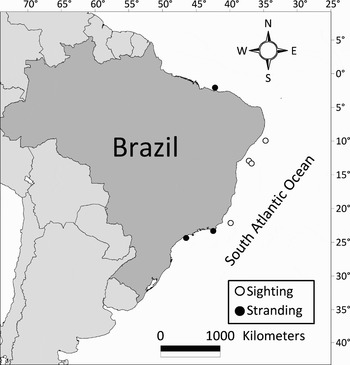
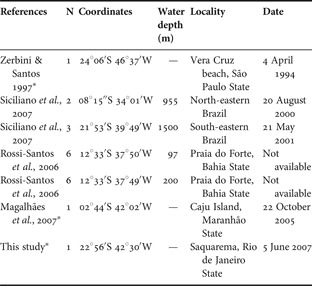
To date, only six records of F. attenuata are known for the Brazilian waters, including four sightings and two strandings (Zerbini & Santos Reference Zerbini and Santos1997; Magalhães et al., Reference Magalhães, Garri, Tosi, Siciliano, Chellappa and Silva2007; Rossi-Santos et al., Reference Rossi-Santos, Baracho, Neto and Marcovaldi2008; Siciliano et al., Reference Siciliano, Moreno and Silva2008) (Table 1; Figure 1). Zerbini & Santos (Reference Zerbini and Santos1997) recorded the first occurrence of F. attenuata for the Brazilian coast through an emaciated specimen stranded on the coast of São Paulo State in April 1994. A second stranding was reported by Magalhães et al. (Reference Magalhães, Garri, Tosi, Siciliano, Chellappa and Silva2007) who reported a skull found in Caju Island, Maranhão State, in June 2007.
Strandings and sightings of pygmy killer whales (Feresa attenuata) on the Brazilian coast.

Strandings and sightings of pygmy killer whales (Feresa attenuata) in Brazil.

*strandings.
Rossi-Santos et al. (Reference Rossi-Santos, Baracho, Neto and Marcovaldi2008) recorded two groups of six individuals of pygmy killer whales off the Bahia coast, north-eastern Brazil. The first group was sighted in water depth of 97 m at about 7.5 nautical miles from the coast and the other group was recorded two hours after the first one (8 km distant), at 200 m depth. Siciliano et al. (Reference Siciliano, Moreno and Silva2008) described a sighting of two individuals of pygmy killer whales in deep waters (955 m depth) off the north-eastern coast of Brazil. The same authors recorded a group of at least three F. attenuata on 21 May 2001 in Campos Basin, south-eastern Brazil, at approximately 1500 m depth.
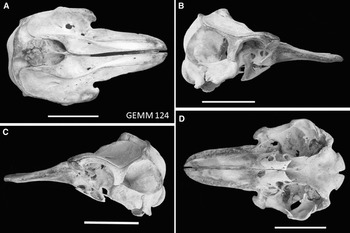
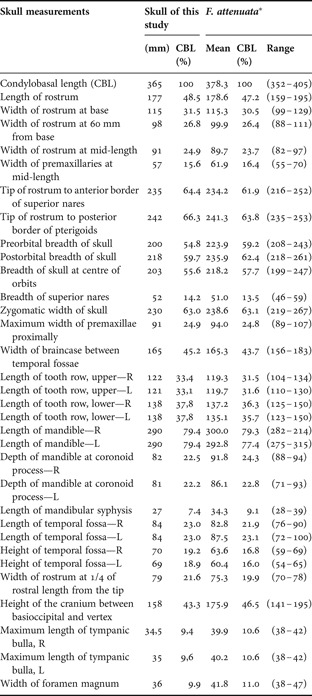
The aim of this note is to contribute new information about this poorly known cetacean on the Brazilian coast. Since 1999 the marine mammal research group GEMM-Lagos (Grupo de Estudos de Mamíferos Marinhos da Região dos Lagos) has regularly patrolled 235 km of coastline from Saquarema (22°55′12″S 042°30′37″W) to Quissamã (22°06′24″S 041°28′20″W) recovering stranded marine mammals, sea turtles and wrecked seabirds. On 5 June 2007 we recorded a male pygmy killer whale (GEMM 124) with 270 cm of body length stranded in moderate state of decomposition (code 3; Geraci & Lounsbury, Reference Geraci and Lounsbury2005) on the coast of Saquarema, Rio de Janeiro State. The specimen was classified on site as F. attenuata based on teeth count (8–11 pairs in the upper jaw and 11–13 pairs in the lower jaw), head morphology and dorsal fin. After the preparation of the skeleton, the cetacean could be confirmed as pygmy killer whale through the examination of skull morphology and measurements. According to Ross & Leatherwood (Reference Ross, Leatherwood, Ridway and Harrison1994) this species presents broad rostrum about half the length of the skull. The premaxillae are greatly expanded proximately, narrowing to their least width in the proximal half of the rostrum, and expanding laterally in the distal half to more than two-thirds of rostral width before tapering to the rostrum tip. Pictures of the skull are presented in Figure 2, and cranial measurements are given in Table 2.
Skull of the pygmy killer whale, Feresa attenuata, stranded on Saquarema beach, Rio de Janeiro State, Brazil. (A) Dorsal view; (B) lateral view (right side); (C) lateral view (left side); (D) ventral view. Bars (long side): 15 cm.

Skull measurements (in mm) of the pygmy killer whale, Feresa attenuata, stranded on Saquarema beach (Rio de Janeiro State, Brazil) compared with the mean values obtained for the species.

*Measurements taken in accordance to Nishiwaki et al. (Reference Nishiwaki, Kasuya, Kamya, Tobayama and Nakajima1965), Best (Reference Best1970), Ross (Reference Ross1984) and Zerbini & Santos (Reference Zerbini and Santos1997); R, right; L, left.
Offshore species of cetaceans (e.g. Kogia sima, K. breviceps, Globicephala macrorhynchus and Stenella attenuata) and seabirds (e.g. Calonectris borealis, Thalassarche chlororhynchos, T. melanophris, Puffinus gravis and Stercorarius parasiticus) have frequently beached in the south zone of our study area (e.g. Massambaba beach, 22°56′S). One possible explanation for these events is the narrow continental shelf observed in this region and the abundance of food resources associated with the coastal upwelling system. These particular circumstances may provide ideal conditions for many species, including oceanic cetaceans, to come to shallow waters to forage. The sighting of three individuals in the Rio de Janeiro waters (Siciliano et al., Reference Siciliano, Moreno and Silva2008) and our record presented in this paper suggest that F. attenuata may frequently use this region in order to take advantage of large diversity and abundance of food resources. The geographical position of the sightings of pygmy killer whales on the Brazilian coast suggest that this species could use the edge of the continental shelf of the north-east and south-east Brazilian waters for resting or foraging (Siciliano et al., Reference Siciliano, Moreno and Silva2008).
In addition, the localities recorded for F. attenuata in Brazil agree with the habit preference of this species for tropical and warm temperate waters. Lichter et al. (Reference Lichter, Fraga and Castello1990) reported the first record of F. attenuata for the south-western Atlantic through a specimen stranded on the Argentina coast; however this occurrence may be considered an extralimital record.
Zerbini et al. (Reference Zerbini and Santos1997) found cephalopod beaks in the stomach of a stranded pygmy killer whale on the coast of São Paulo State. Analysing the habitat preference of the identified cephalopod beaks these authors suggested that this specimen fed over the outer continental shelf and slope. In the stomach content of the present specimen there was only a small beak of an unidentified sepiolid specimen.
Very little is known about the distribution, biology and conservation status of F. attenuata, and the population size has not been yet estimated. However, studies have suggested that the global population of this small cetacean is not abundant (Jefferson et al., Reference Jefferson, Webber and Pitman2008). The greatest problem in studying pygmy killer whales in the field is their similarity to other cetaceans (e.g. Peponocephala electra and Pseudorca crassidens) (Leatherwood et al., Reference Leatherwood, Reeves, Perrin and Evans1988; Williams et al., Reference Williams, Williams and Brereton2002).
Increasing the effort of field studies of cetaceans over the continental shelf in addition to a long-term monitoring programme of cetacean strandings may provide a great opportunity to add new scientific information about this rare species, such as its biogeography and biology.
ACKNOWLEDGEMENTS
The authors wish to express their gratitude to the lifeguards of the Corpo de Bombeiros de Saquarema for the information about the specimen presented in this scientific work. We also would like to acknowledge Jonis Fulgencio de Moura and Maicon Moura for helping to recover the carcass in Saquarema. Thanks also go to the Oceanites research team (GEMM-Lagos) for their help during field and laboratory activities. Roberta Aguiar dos Santos, CEPSUL–ICMBio, Itajaí, kindly identified the sepiolid beak presented in our specimen.