It is 29 November 1978. The stage of the Chicago Lyric Opera is still shrouded in darkness as a virtually inaudible, almost sub-audio rumble emanates from the void. The murky sustain comes from half of the string bass section, which has tuned its instruments scordatura from the already extended lowest string down a whole step from C1 to an open B♭0, an obscure pitch in both perceptual and stylistic senses.Footnote 1 The world premiere of Krzysztof Penderecki's largest work to date, Paradise Lost, is underway.
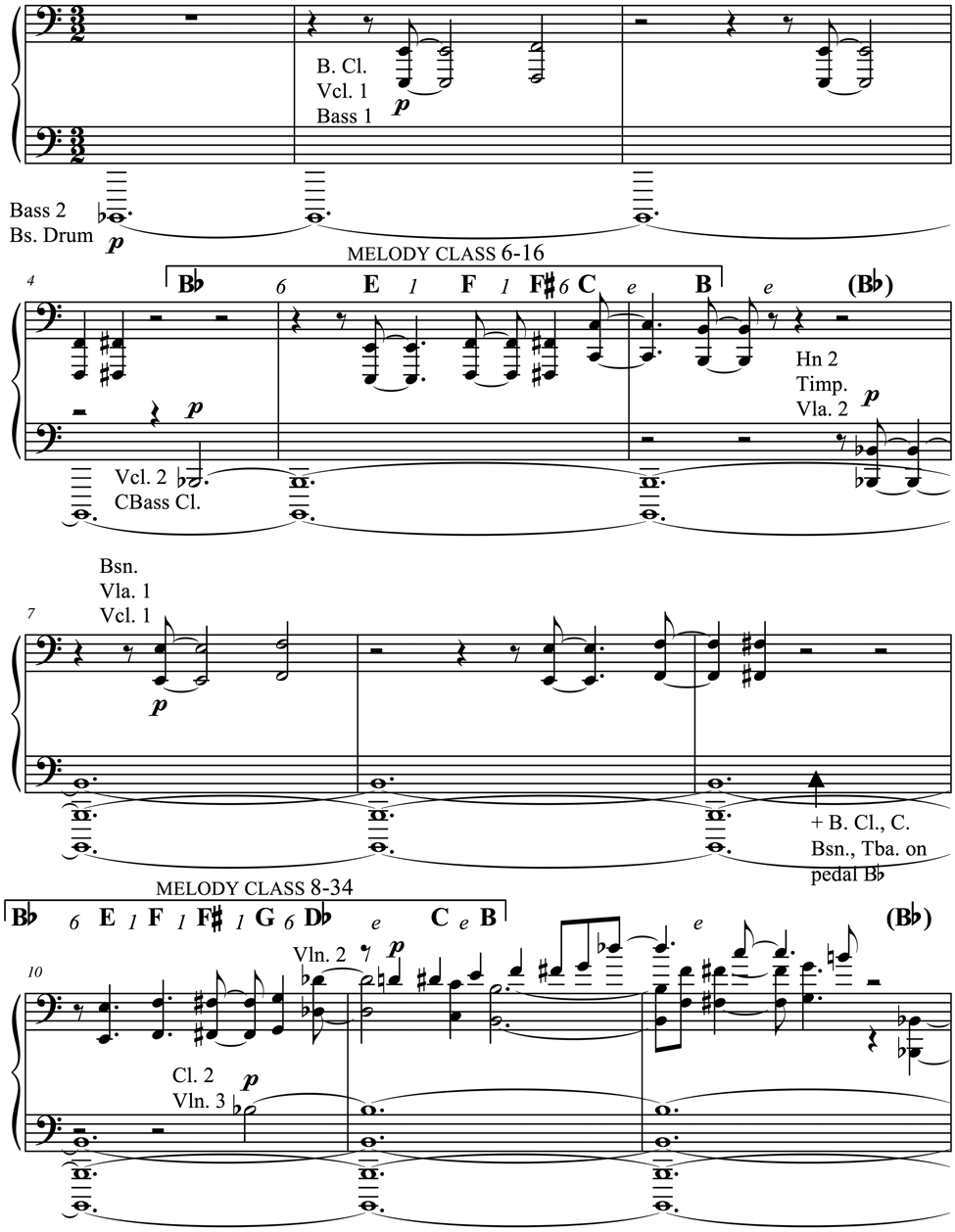
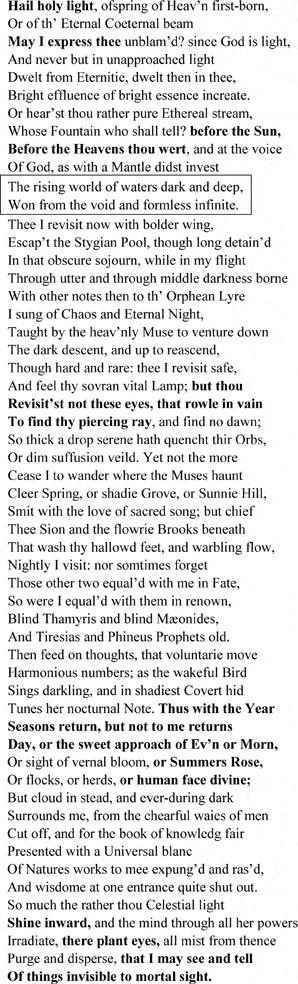
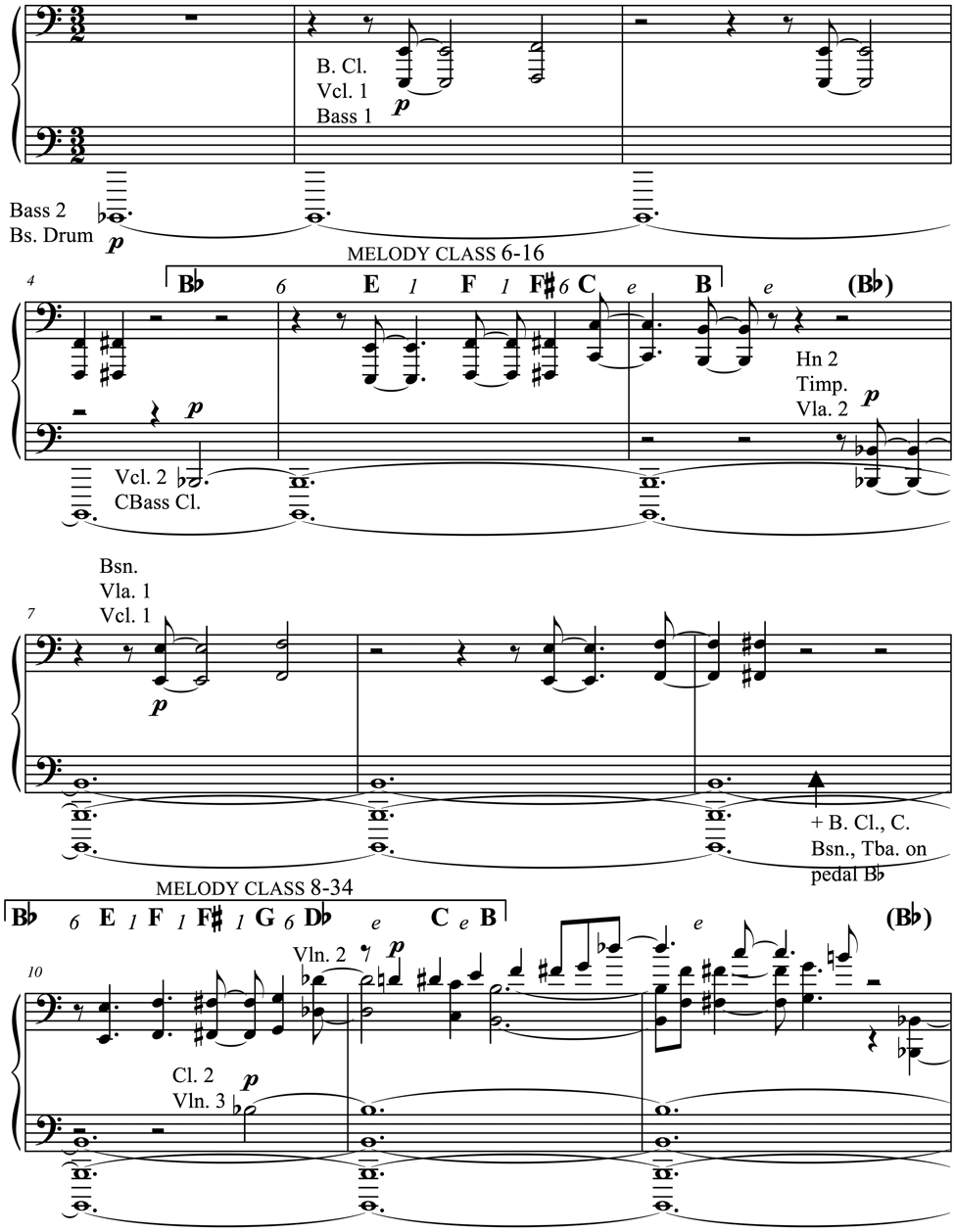
Example 1 provides a piano-score reduction of the ensuing thirteen bars, along with annotations that will be explained in due course. To musicologist Regina Chlopicka's ears, ‘the theme emerges from silence slowly, before our eyes. Unformed sound matter starts acquiring the shape of motives, low and dark registers slowly lighten up, changing tone colours.’Footnote 2 After these opening bars, this instrumental introduction to Penderecki's sacra rappresentazione continues to swell in texture, register, dynamics, and contrapuntal density until the intensity reaches a breaking point and the orchestra implodes; only the B♭ bass pedal survives unscathed. As the motives from the opening bars begin to regroup, a voice representing Paradise Lost's poet John Milton resounds through the dark hall. Yet his narrated prologue for the first act begins not with the epic poem's famous opening verses, but rather with lines selected from the invocation that commences Book III:
Penderecki, Paradise Lost, Act I, Scene 1, bb. 1–12.
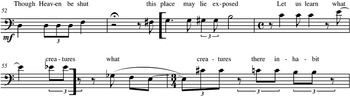
Immediately thereafter, light bathes the stage, accompanied by a scintillating and dissonant harmony in high winds and strings. A mixed chorus intones the text ‘Sing, heavenly muse/What in us is dark illumine/And justify the ways of God to man’, which comes from early in Book I – specifically, lines 6, 22, 23, and 26. Only thereafter does Milton as narrator return to present the poem's initial lines, thus concluding the prologue:
What is a listener seated in Chicago's Civic Opera House to make of this introduction? First, if this listener knows Milton's original poem well, he or she may recognize not only the aforementioned permutation, but also other decisions that shift the weight of the narrative in both explicit and subtle ways. Second, if this listener knows well a new approach to writing melodies that Penderecki had begun to adopt in the 1970s, then this listener is well positioned to appreciate something special, even singular, about the music of this work's beginning. My ultimate goal in this article is to suggest correlations between these textual changes and this musical singularity.
As the opera unfolds, one familiar with Milton's poem will find librettist Christopher Fry's permutation of its original ordering in this introduction hardly anomalous, as Milton's own chronology of events markedly differs from that of the Bible. Fry's ordering throughout his libretto markedly differs from both chronologies, as skillfully demonstrated in a comparative analysis of all three texts by Agnieszka Draus. As for the opera's beginning, she notes that
[while] Milton begins his poem with the lamentation of the Fallen Angels[,] Penderecki starts his opera with a scene set toward the end in Milton, that of the lamentation of Adam and Eve after the Fall. He concentrates on the human experience and desists from presenting us with any of the history preceding the creation of Man: the creation of the universe, the war in Hell and the fall of the Rebel Angels.Footnote 5
While this interpretation adeptly characterizes the drama that follows the prologue, it glosses over possible implications of the texts used in the prologue itself. The invocation that begins Book III, provided in full in Table 1, contains some of Milton's most autobiographical and self-revealing aspects of the entire poem. Although Fry lifts but a small percentage of lines – and some only in part – from the invocation, which are printed in bold, he nonetheless captures how the poet finds his blindness both insufferable (‘but thou/Revisit'st not these eyes, that rowle in vain/To find thy piercing ray’) but also symbolic of his artistic endeavors (‘Shine inward/there plant eyes/that I may see and tell/Of things invisible to mortal sight’). The use of the latter also establishes a clear framing function – a veritable author's preface – for the dramatic content of the opera. However, despite its formal segregation from Genesis's drama, the connotations of Milton's prologue in Fry's Paradise Lost seep through the frame, in that the Book III invocation draws a parallel between Milton's literary creative act and God's cosmological creative act. Although Milton does not directly refer to the creation story until Book VII – as Raphael relates to Adam how the world was created after Satan was thrown out of Heaven – the language of the Book III invocation strongly alludes to the opening verses of Genesis for the first time in the poem. In particular, the lines within the rectangular enclosure in Table 1 invoke the imagery of Genesis 1: 1–2: ‘In the beginning God created the heaven and the earth. And the earth was without form, and void; and darkness was upon the face of the deep. And the Spirit of God moved upon the face of the waters.’ Literary scholar Dale G. Priest takes this parallel further:
[In the Genesis verses,] the Spirit, acting for God, will function as creative agent to invest chaos with form. In such a way the bard [Milton] hopes to gain access to a high but secondary creative power (the gift of ‘holy Light’) to assist and inspire him in his task of rendering more luminous to human eyes the otherwise obscure mysteries of his subject.Footnote 6
Milton, Paradise Lost, Book III, lines 1–55. (The prologue of Fry's libretto is shown in bold. The rectangular enclosure spotlights the reference to Genesis 1: 1–2.)

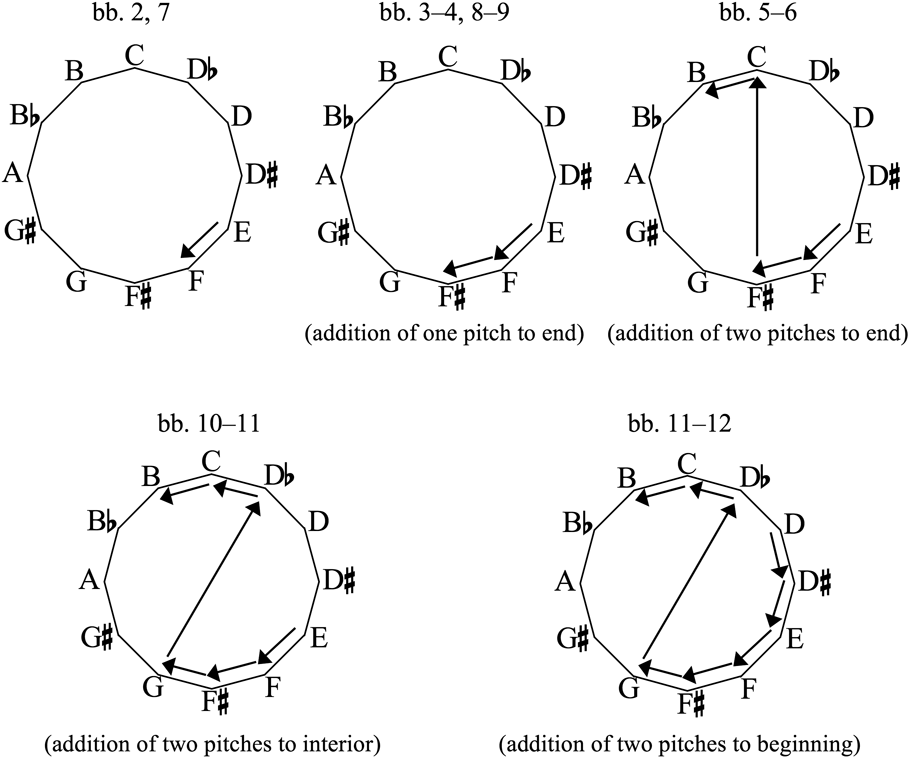
Although Fry's prologue only touches on the Genesis reference in the Book III invocation, Penderecki's music seizes it more firmly, albeit through more abstract means. Chlopicka's portrayal of the opening bars quoted earlier strongly resonates with biblical cosmogony. What about these opening bars in particular suggests a connection to the opening verses of Genesis? The contra B♭ pedal conjures both ‘dark’ and ‘deep’ senses, and its sheer longevity lends a primordial timelessness to the scene. (Paradise Lost's opening bass pedal, which lasts for five full minutes, bests Wagner's primordial E♭ bass pedal that begins Das Rheingold by around a minute and a half.) The absence in bb. 1–4 and 7–9 of any metrical periodicity, the musical equivalent on a microcosmic scale of the regular synodic rhythm of day and night, also contributes to this timelessness. (From this perspective, another Wagnerian opening, that of Parsifal, comes to mind.Footnote 7) The first motive in b. 2 could not be a more primeval melodic idea, as it has the fewest number of notes in its breadth (two) and the smallest number of equal-tempered semitones in its single interval (one). Subsequent melodic undulations might be heard as the slow cresting and falling of broad, massive waves, or, closer to Chlopicka's reading, a glacially-paced yet systematic growth of order out of chaos, connoting events a bit later in the creation story. Example 2 chronicles this latter interpretation; the opening melodic cell E–F in b. 2 grows both from without (on both the leading and trailing edges) and within to form longer melodic strands. Most, if not all of these processes aggregate to an overall formal process of creatio ex nihilo, the term used to describe comparable openings in orchestral works by Bruckner, Mahler, and so forth.Footnote 8 (This formal technique is one of many that Penderecki drew from tradition during his so-called ‘Neo-Romantic’ period, of which Paradise Lost is representative.) Since these various elements – the virtually endless bass pedal, the notable lack of metre, the deliberate motivic maturation from a single seed – occur together in the opera most profusely at this point (in the beginning), this singular musical event also befits an association with a singular historical event: creation.
Growth of melodic material in bb. 1–12.
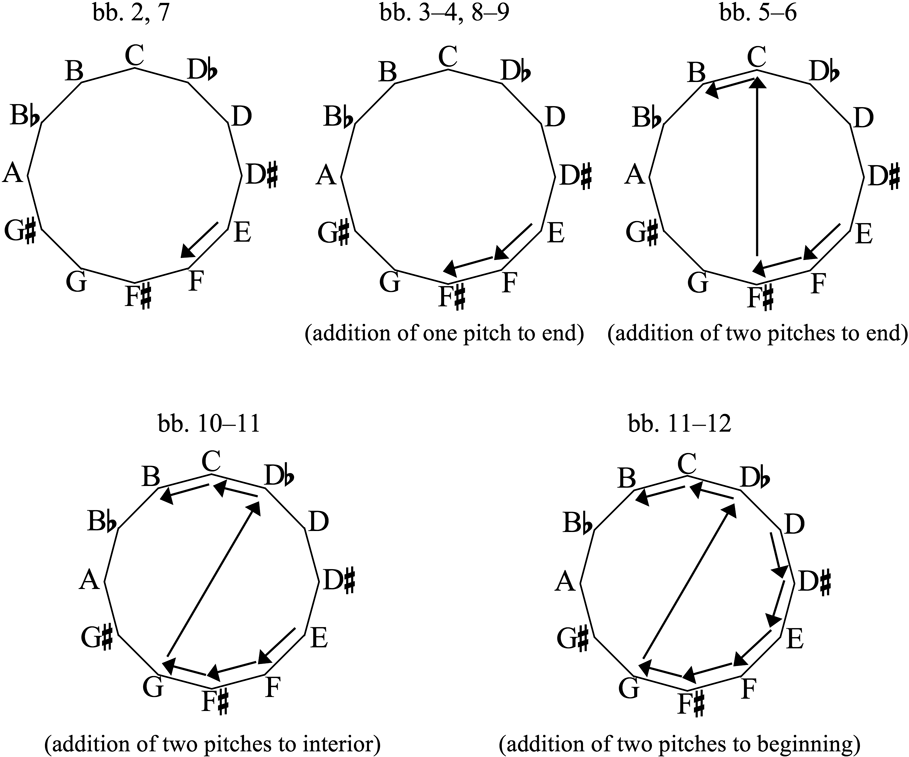
Yet, from another perspective, this musical beginning seems hardly set apart. Its melodic material archetypically conforms to certain constraints that permeate Penderecki's neo-Romantic music. Penderecki scholarship has posited that the composer's melodic lines from this period generally comply with two restrictions: ic1/6 concentration, in which adjacent pitch classes in a melody tend to be separated most often by the pitch-class (and often registral) interval of a semitone or, second most often, a tritone; and 9-pc diversity: melodic spans that do not duplicate a pitch class tend to be on average nine notes long.Footnote 9 For example, the melodic line D–D♯–E–F–F♯–G–D♭–C–B in bb. 11–12 of Example 1 perfectly meets both of these constraints, since it exclusively uses semitones that are relieved with a single tritone, and the nine-note melody never reuses a pitch class. These constraints are visually apparent within the last circle of Example 2, which represents this melody spatially: the melodic motion is either along the perimeter (semitonal) or a diameter (tritonal), and no pitch class is repeated. The melodic line E–F–F♯–G–D♭–C–B–F–F♯–G in bb. 10–11, which exclusively uses semitones and tritones but repeats pitch classes after spans of merely six or seven notes, is still representative although it falls a bit short of the norm of 9-pc diversity. Generally speaking, the modernist ‘contratonal’ aesthetic aim of 9-pc diversity is to avoid sounding a pitch class again ‘too soon’. In the case of E–F–F♯–G–D♭–C–B–F–F♯–G in bb. 10–11, short-term echoic memory of its incipit may fade during the long B, thus mitigating the pitch-class duplication. Other factors – phrase breaks or protracted durations, the obvious recycling of melodic components, and so forth – also temper such violations, such that one is able to discern that these constraints are essential features of this music despite its occasional noncompliance, much like one is able to discern that the common-practice repertoire is essentially diatonic despite its use of chromaticism.
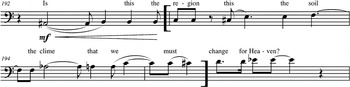
These two constraints efficiently encapsulate the remarkable consistency of melodic material in Paradise Lost, particularly the instrumental lines. However, this consistency also has ramifications for dramatic interpretations of its melodic content. Chlopicka claims that the opera associates the tritone with Satan, in accord with the extra-musical connection between the interval and the diabolus in musica ostensibly begun in medieval times and perpetuated in various well-worn guises for centuries thereafter.Footnote 10 Indeed, this association comes to the fore, but only harmonically, owing almost entirely to a class of ‘Satan’ chords. These chords stack alternating minor seconds and tritones at least six notes high, and often accompany Satan, his minions, and/or the world of Hell.Footnote 11 But the preponderance of tritones in the melodic fabric of the opera generally dilutes the diabolus association in the horizontal dimension;Footnote 12 more precisely, the tritone does not appear in Satan's vocal lines more often than those of any other character. Moreover, if Satan's vocal lines use any distinctive melodic material throughout the opera, it is the hexatonic scale: a six-note collection formed by alternating minor seconds and minor thirds that does not contain a single tritone between any two of its members. Example 3 provides four important passages within Satan's vocal material that contain a complete hexatonic collection (placed within brackets).Footnote 13
Excerpts from Satan's vocal material.
Act IA, bb. 192–95

Act IB, bb. 52–55

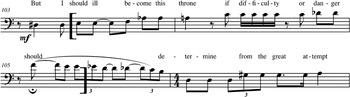
Act IB, bb. 103–6

Act IIA, b. 78

Penderecki's consistent employment of melodic semitones and tritones also seems to have ramifications for the distinctiveness of the opening. Harold Blumenfeld, in reviewing the opera for The Musical Times, noted that:
Penderecki has extracted the bulk of his orchestral music from one basic chromatic musical gesture, in dual form: two rising semitones followed by three semitones descending from above them (and, by extension, three upward and four downward semitones): slippery material to support so huge an edifice. He subjects this material to exhaustive manipulation, but most of his variation techniques are too obvious, even on first hearing.Footnote 14
When focusing on melodic intervals tout court, Penderecki's opening bars appear to either blend into the canvas, or, in Blumenfeld's reading, constitute a pattern that is replicated to generate the opera's sonic wallpaper. Not only does the melodic material of these bars exclusively use semitones and tritones and eschew pitch-class duplication, establishing the opera's melodic staple, but the rising and falling gesture Blumenfeld describes also reappears throughout the work. Therefore, while other aspects of this instrumental introduction suggest an association with the genesis of the cosmos, it would seem that the melodic material is too ‘slippery’ to adhere to this association, as it is simply not distinctive enough. The purpose of the analysis that follows is to suggest otherwise. First, I will draw and build upon a recent study of Penderecki's neo-Romantic melodies, tease these melodies apart from one another in meaningful ways, and demonstrate that two of the pitch-class sequences in Penderecki's opening bars of Paradise Lost exhibit a very special musical feature. Then, I will build a case for a correlation between this musical feature and the extra-musical concepts of biblical Creation, Milton's creation, and the incarnation of Christ.
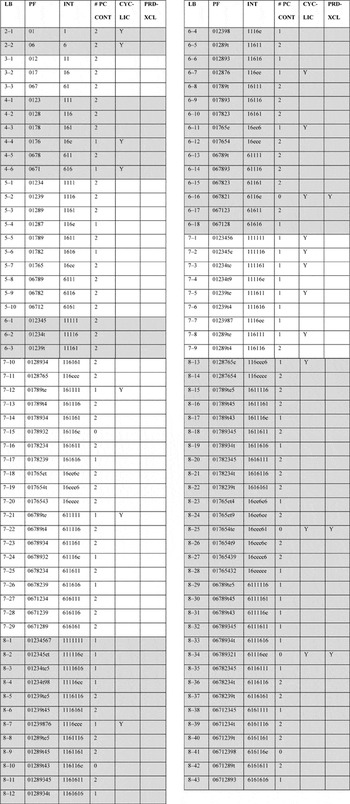
The two restrictions of 9-pc diversity and ic1/6 concentration can serve not only as stylistic generalizations, but also as bases for a robust yet idiosyncratic set of expectations that one familiar with this style can bring to a melody embedded within a work written in this style.Footnote 15 For instance, if the melody E–F–F♯–C–B in bb. 5–6 were to be followed by another note and conform to the two restrictions, then the pitch class B♭ would be the most expected, as it is the only pitch class that is either a semitone or a tritone from the final pitch B and has not yet been presented in the melody. This has the potential to create an expectation similar to that provoked by a dominant triad or a leading tone in tonal music: all other things being equal, there is exactly one highly expected continuation. While there are other melodies such as this that have only one highly expected continuation, there are others that have two equally plausible continuations, and still others that have none. This tripartite categorization of all possible ‘Penderecki melodies’ from two to eight notes long, which make up what I have called the ‘Penderecki set’, is reprinted and further described in Table 2. The melodies are first gathered into 111 classes by transpositional or inversional equivalence, since all melodies in a class will share the same ‘expectancy profile’. The melody E–F–F♯–C–B, for example, is considered equivalent to melodies such as F–F♯–G–C♯–C and E–D♯–D–G♯–A; all three are in ‘melody-class’ 5–4, which is represented by a prime form of 01287 in the set-class nomenclature of Allen Forte.Footnote 16
The Penderecki set. LB: ‘Forte’ label; PF: Prime form (t=pc 10, e=pc 11); INT: Interval series (e=pc interval of 11); ♯ PC CONT: number of different pitch classes that can follow the melody without violating the constraints; CYCLIC: Y (yes) if PF ends with a 1, 6, or e; PRDXCL (paradoxical): Y (yes) if ♯PC CONT=0 (terminal) and CYCLIC=Y.

The next column in Table 2 represents the series of pitch-class intervals in the melody: 1 for ascending semitone, 6 for tritone, and 11 for descending semitone, or their pitch-class equivalents. (In both the prime form labels and the interval series,‘t’ represents 10 and ‘e’ represents 11). The column marked ‘♯ PC CONT’ indicates the number of ways a melody in a particular class may continue to another pitch class while not violating the two restrictions of the style. Melodies in sixty-four classes have exactly two such continuations, melodies in forty-one classes have exactly one, and melodies in only six classes have none. I have described melodies in this last and smallest category as terminal, as they cannot continue without contravening the two restrictions, so they might as well stop. Indeed, some of Penderecki's terminal melodies do just that; one from my earlier article is reprinted in Example 4. To continue the tonal analogy from earlier, the endings of terminal melodies are akin to tonic triads or tonic scale degrees, in that they evince relatively little bias as to what chord or melodic tone should follow.
Example of a terminal melody – Penderecki, The Devils of Loudon, Fig. 4–5.

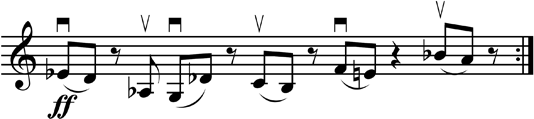
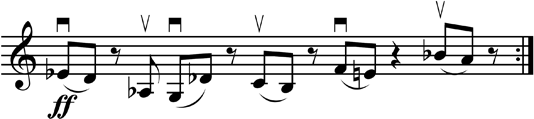
Two additional descriptors that extend this taxonomy will be useful in the ensuing discussion. First, a Penderecki melody is cyclic if its first and last intervals span the unordered pitch-class interval of a semitone or tritone; a ‘Y’ in the ‘CYCLIC’ column of the Table singles out the eighteen classes that contain cyclic melodies.Footnote 17 This allows a cyclic melody to repeat itself without infringing upon ic1/6 concentration. Indeed, some of Penderecki's cyclic melodies do just that; one from Paradise Lost, a frantic 11-note violin ostinato repeated multiple times during a senza misura section, is provided in Example 5. Second, a Penderecki melody is paradoxical (abbreviated to PRDXCL in the Table) if it is both terminal and cyclic. As indicated in the Table, only three melody classes – 6–16, 8–25, and 8–34 – out of the 111 in the Penderecki set belong to both the set of six terminal melody classes and the set of eighteen cyclic melody classes, and are thus paradoxical. This term is intended to capture a contradiction that one knowledgable of Penderecki's melodic constraints may experience.Footnote 18 On the one hand, the melody has run its full course within the two imposed melodic restrictions; that is, a typical Penderecki melody would go no further. On the other hand, the melody teeters on the brink of returning to its beginning while maintaining ic1/6 concentration; that is, a typical Penderecki melody could go further. Because 9-pc diversity is on a sliding scale – ‘the lengths of Penderecki's non-duplicative pitch successions exhibit a substantial degree of variance’ around an average of nine pcsFootnote 19 – the word ‘typical’ can assume two different meanings in my two prior sentences, and give rise to a contradiction peculiar to paradoxical melodies.Footnote 20
Example of a cyclic melody – Penderecki, Paradise Lost, Act IA, b. 251.
From this vantage point, the beginning of the opera assumes an exceptional role: it is the only time in the entire two-hour work in which melodies from two of the three paradoxical melody classes – 6–16 and 8–34, as shown in Example 1 – are presented in immediate succession. Therefore, this unusual paradoxical feature is highlighted in this opening simply by employing two different melodies that both possess it. (Because this singular event occurs at the beginning of the work, recognition of this paradoxical feature requires foreknowledge of Penderecki's preoccupation with 9-pc diversity and ic1/6 concentration, which prevails in his First Violin Concerto, premiered over two years before Paradise Lost, and which occurs frequently but more sporadically in his music throughout the 1970s). Timbre, register, and texture also play special roles in creating the experience of paradox during this prelude. In the first four bars, there is little rationale for melodically connecting the sustained pedal B♭ with the E–F and E–F–F♯ motives, although the B♭–E tritone technically exemplifies ic1/6 concentration: the B♭0 pitch is too low and barely audible, and the time interval between its attack and the E in b. 2 is too long. However, in b. 4, the B♭ pedal is rearticulated an octave higher with ‘cello and clarinet timbres, and the following motive starting on E comes sooner with the same timbres, creating a stronger melodic ligation for the six pitches bracketed under 6–16 in Example 1. If one allows this reading, then the dual status of b. 4's B♭ as initial melodic tone and pedal tone invokes the paradox in a dramatic way, for when the listener arrives at the end of the B♭–E–F–F♯–C–B succession, there simultaneously exist the opposing senses that the melody has painted itself into a corner, but that it could be heard to continue to the still-sustaining pedal B♭, which is at once first in the melody and potentially next in the melody. The music vacillates between a well-defined ending (being terminal), and an option for not ending (being cyclic) or perhaps even never ending, considering how the subsequent pitches run through the same pattern, now with the bassoon colour providing the timbral link and the longer 8–34 melody conjuring another paradox.
Whereas my earlier study examines some of the syntactical ramifications of Penderecki's two melodic restrictions, I endeavour here to suggest some of the semantic potential of this system by proposing two narrative correlates to this musical-structural paradox. First, as argued earlier, the choice to begin the opera with a citation of the opening invocation from Book III, instead of the opening of Book I, clearly refers to the first day of creation when God created the heavens and the earth. Advocating a relational view of time (in contrast to a Newtonian view of absolute, unbounded time), philosopher and theologian William Lane Craig states that ‘God would exist timelessly and independently ‘prior’ to creation; at creation, which he has willed from eternity to appear temporally, time begins, and God subjects himself to time by being related to changing things.’Footnote 21 A scientific view of creation can lead to similar notions; for example, physicist Paul Davies writes that ‘just as the big bang represents the creation of space, so it represents the creation of time… Crudely speaking, time itself began with the big bang.’Footnote 22 There is little impediment to interpreting a cyclic melody as representing timelessness: although the melody itself unfolds in time, the notion that the melody persists along the same ‘trajectory’ and yet somehow returns to its point of origin resonates with notions of the atemporal. A setting of the phrase ‘In sempiternam’ [‘in the eternal’] from Rossini's Stabat Mater, as shown in Example 6, serves as one such example using a more conventional sequential trajectory: although the ascending minor-third transpositions linearly direct the music away from G minor, the music nonetheless returns to G minor. If one correspondingly interprets terminal melodies representing finitude and the temporal, then a paradoxical melody would best represent the singular moment in which time's absence and time's presence stand back to back, the moment of creation. Furthermore, since Fry's libretto incorporates Milton as a character (albeit a narrator) in the opera based on the poet's creation, the parallels between God as cosmological creator and Milton as literary creator intimated in the Book III invocation buttress this paradox: Milton is outside of, and then participates in, the opera's narrative and chronology, just as God is outside of, then participates in, time itself.
Rossini, Stabat Mater, No. 10, bb. 87–91.

Second, and even more speculatively, I would like to put forward that these melodies presage a significant change in focus that occurs in Fry's and Penderecki's reworking of Milton's poem. In Regina Chlopicka's interpretation of the original epic, ‘Milton presents Christ as a hero, or a powerful leader, equipped with a full selection of attributes of power, fighting against Satan in order to render his complete defeat.’Footnote 23 Indeed, although Milton paints an elaborate picture of the Son of God's sacrificial love during Book III, he also makes this decree: ‘Nor shalt thou by descending to assume / Man's nature, lessen or degrade thine own’ (303–4). In contrast, Chlopicka notes that ‘in Penderecki's work, the figure of the Messiah is stripped of any external features of grandeur and power’.Footnote 24 His melodic lines sung in English bear a much stronger relationship to those of Adam and Eve than the spoken dialogue and Hebrew melismas that combine to form the Voice of God. The impression is that Penderecki's Christ (never named as such in Milton's poem, instead referred to only as ‘Son of God’) has in fact assumed at least some of Man's nature.
However, this change of focus accentuates a central contradiction of Christian theology that, as with my first interpretation, involves time. On the one hand is the view of God as eternal: as Saint Anselm describes it, God ‘exists neither yesterday, today, nor tomorrow, but directly outside of time’.Footnote 25 On the other hand is a rejection of the eternal God by theologians such as Paul Tillich and Karl Barth, who view God's complete temporality as a necessary component of the Christian message.Footnote 26 The finitude of the life of Jesus Christ, God Immanuel, is a keystone of this argument. Rather than choose a side, Søren Kierkegaard views this contradiction as cutting to the very heart of Christian faith, proposing the ‘thesis that God has existed in human form, was born, grew up, etc. is certainly the paradox sensu strictissimo, the absolute paradox,’Footnote 27 the paradox ‘that God, the eternal, has entered into time as an individual human being’.Footnote 28 By beginning his opera with two paradoxical melodies, Penderecki invokes in purely musical terms a circumstance analogous to that of Kierkegaard's view of Christ, and puts into relief the entire drama of Adam and Eve's fall by anticipating Christ's appearance in Act II, when He offers ‘life for life’. Musicologist Siglind Bruhn employs a similar mapping scheme in her analysis of Messiaen's music; she proposes that a certain ‘rhythmic signature’ that recurs throughout the composer's programmatic oeuvre signifies ‘the human aspect of the Son of God’ by juxtaposing four non-retrogradable rhythms (‘time-annihilating palindromes’), which represent the atemporal, against an expanding rhythmic series, which represents the linear and temporal.Footnote 29 However, unlike Messiaen's signifiers, which are presented successively, Penderecki's signifiers of the atemporal and temporal coexist at the moment ending a paradoxical melody, and are thus united into a single simultaneity, much like the hypostatic union of the divine and human in the single figure known as Jesus Christ.
Reviewing the 1978 premiere of Paradise Lost, Art Lange wrote that ‘the weighty tone and monochromatic musical effects are not convincing because the composer himself has not fully determined how to balance the modern expressionistic techniques which he helped pioneer with the traditionally communicative styles of the past’.Footnote 30 If Lange used ‘modern expressionistic technique’ to refer to certain timbral and textural effects that predominate in Penderecki's music from the 1950s and 1960s and play a supporting, intermittent role in this late-1970s opera, and used ‘traditionally communicative styles’ to refer to the occasional citations of Wagnerian triadic progressions and Bach chorales, then it falls outside the scope of this study to confirm or rebuke this criticism. However, if these turns of phrase are construed more broadly, then I believe this study suggests one way in which such a balance might be understood: Penderecki's two melodic constraints both allude to early twentieth-century expressionistic techniques of aggregate saturation and melodic angularity and austerity, and also give rise to a set of expectations analogous to certain communicative styles of tonality. Moreover, this balance is attempted not through pastiche, through the juxtaposition and opposition of tonal and post-tonal styles in a single work, as it is in so many other post-modern musical compositions. Rather, Penderecki manages, within a melodic style that is relatively simple (or even simplistic, some might say), to unite modern sounds with expectations that mirror those of tonality under a single idiom. Thus, this melodic style that permeates much of Penderecki's opera, which can create singular paradoxical moments with three special melodies, is in itself a paradox on another level, and perhaps reflective and representative of Kierkegaard's paradoxical Christ, through whom paradise is regained.