The city of Valencia, on Spain's eastern coast, was one of the country's most important trading centres and the home of a large French immigrant population during the early modern period.Footnote 1 Estimates of the French population suggest that it was about 15,000 in 1600, or 7 per cent of the population of the kingdom, and that it perhaps amounted to 10 per cent of the overall population of the city.Footnote 2 Valencia has excellent archival sources which allow us to study various aspects of these immigrants' lives. Thus far the French population in the Kingdom of Valencia has not been the subject of much study. In this article we will use sources from the local tribunal of the Spanish Inquisition supplemented with documents from the court of criminal justice (the Justicia criminal) to study the dynamics of legal prosecution of French people in the city and Kingdom of Valencia.Footnote 3
I. SOURCES
Our study is limited to 1566 to 1686, because sources exist for the study of trials against French defendants in two tribunals for this period. Both jurisdictions have left documents covering a longer period than we study here. The records of the court of criminal justice go back as far as 1479 and continue until shortly before its abolition in 1707.Footnote 4 The Spanish Inquisition's tribunal in Valencia has likewise left documents spanning the time from its beginning in 1482 until its suppression in 1834. However, the sources that can be used for serial study of the prosecution of French defendants are limited to the period 1566 to 1686.Footnote 5 The period was chosen for both tribunals to allow 120 years of study of two of the four jurisdictions in early modern Valencia.Footnote 6 The court of criminal justice had jurisdiction over the city of Valencia and its surroundings, while the Holy Office covered most of the Kingdom of Valencia, as well as small parts of Catalonia and Aragon.Footnote 7 While the Holy Office was a judicial system covering all of the Spanish empire, and under central control from Madrid, the Justicia was under local control. The political contexts for the two courts were thus very different: the Inquisition was closely tied to the monarchy, and the Justicia was controlled by Valencia's local political institutions.
Both jurisdictions have left us records of large numbers of trials for this period. In the following analysis each instance of a person prosecuted is considered as a ‘case’ or ‘trial’. We believe this is the manner of counting that best reflects our primary concern: the judicial pressure brought on the French immigrants in Valencia. When three defendants were brought to trial together for an offence they allegedly committed together, they are counted as three cases. The number of defendants is lower than the number of cases, because some individuals were tried more than once. For example, Antonio Borras was convicted first as a Huguenot in 1568 and then for failing to comply with his sentence two years later.Footnote 8 The sources used are relaciones de causas, accounts and letters exchanged between the tribunal in Valencia and La Suprema, its central council in Madrid, from the Inquisition section of the National Archives (AHN) in Madrid. We have also used the records of the Justicia criminal in the section of the ‘Maestre Racional’ in the Archive of the Kingdom of Valencia (ARV) in Valencia. The first are a series of yearly reports of activity sent to Madrid, while the latter is a series of financial records. Both record varying amounts of information about the trials and the defendants. The letters contain a wealth of information about the general activity of the Inquisition, as well as instructions and information that never made its way into trials and trial summaries.
II. THE PROSECUTIONS
The two courts had different jurisdictions that rarely overlapped. The Inquisition had sole jurisdiction over heresy, while the Justicia was a criminal court. Both could try certain kinds of cases, such as sodomy and sorcery. In addition to the limited overlap in jurisdiction, both judicial systems were concerned with public order and morals. Conflicts between the two systems mostly centred on criminal trials against the Inquisition's personnel, where the Holy Office claimed sole jurisdiction but which the Justicia and other Valencian institutions disputed.Footnote 9
From the Holy Office, 4,808 trials are recorded, while the court of criminal justice has left records of 18,069 cases, including appeals. However, when the number of Frenchmen brought to trial is observed the picture is very different. Only 78 such trials took place in the Justicia, while the Inquisition brought charges against Frenchmen in 397 cases in the same period. The number of recorded trials against Frenchmen in the Justicia is so low that it requires explanation. In our view, it probably reflects a lack of interest in noting down the origin of French defendants rather than the absence of trials against members of this immigrant group. French and Valencian surnames are too similar to allow identification of French defendants by this criterion.
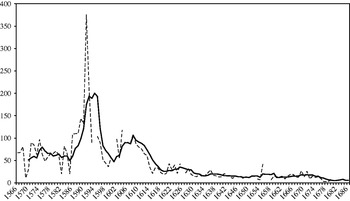
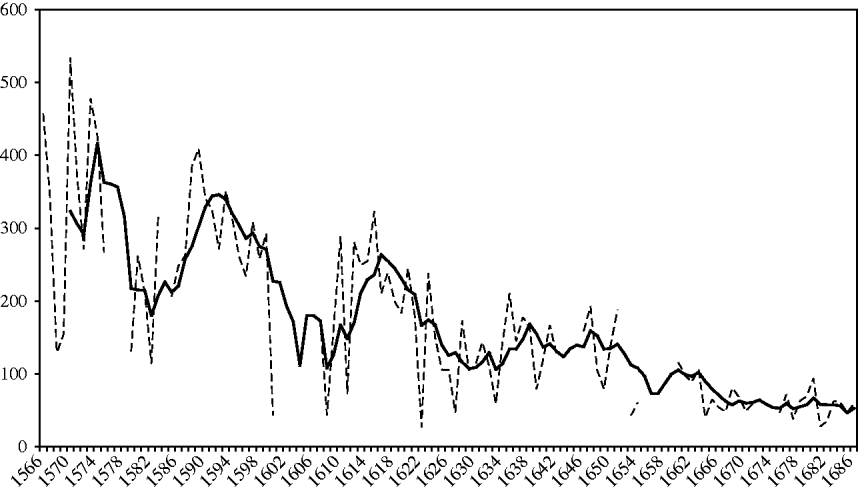
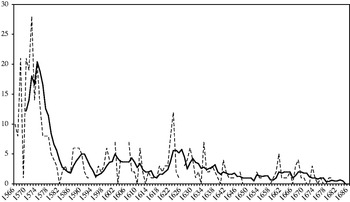
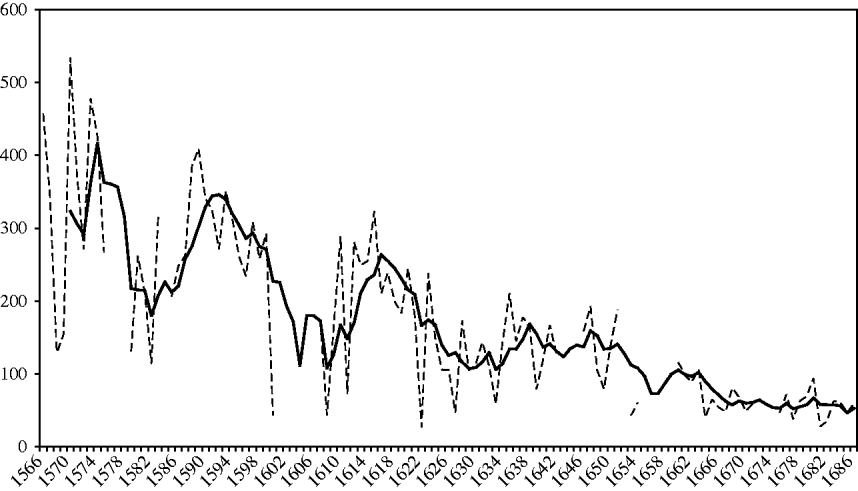
If we turn to the general activity of these courts, both were more active in the sixteenth century than in the seventeenth. Figures 1 and 2 show the numbers of all trials for the Holy Office and the Justicia criminal in Valencia for the period from 1566 to 1686. The two courts show declining activity in the seventeenth century, broadly coinciding with the Kingdom of Valencia's slumping economic fortunes and population loss, though the expulsion of the Moriscos in 1609–1614 was an important factor for the Inquisition. These formally baptised descendants of Spain's earlier Muslim population were central to the activities of the Holy Office in Valencia.Footnote 10 Moriscos and other baptised Christians accused of Islamic practices made up 64.5 per cent (3,206 of 4,972) of all trials recorded in the relaciones from Valencia, and 76.7 per cent (2,988 of 3,897) of those up to and including the final year of the expulsion, 1614. The wholesale removal of the population group that appears in three-quarters of all trials obviously reduced subsequent activities and severely diminished the tribunal's case load.Footnote 11 The most evident course of action for the tribunal was to look for new likely suspects, such as heretic foreigners. The figures also show that the Justicia was noticeably busier than the Holy Office throughout the period, just as earlier research has shown that the Inquisition accounted for only a small part of the executions in Valencia.Footnote 12Figure 3 indicates that the Inquisition did not in fact compensate for the expulsion of the Moriscos by prosecuting more Frenchmen. While the Holy Office is routinely called xenophobic and is denounced for having expanded its jurisdiction in order to generate more trials and confiscations,Footnote 13 no such tendency is in evidence for the French population observed. The phase of the most intense prosecution was the 1560s and 1570s, with a few smaller increases later that generally coincided with periods of tension between France and Spain. We should not forget that the Inquisition was a religious court, and it dealt with religious matters. The highest number of trials of Frenchmen coincided not just with Philip II's religious preoccupation but also with open warfare between Protestants and Catholics in France.
The Inquisition in Valencia, 1556–1686, all trials by year and five-year moving average (solid line). (Source: Case summaries (relaciones de causas) preserved in the section Inquisición in the Archivo Histórico Nacional, Madrid.)

Court of criminal justice (Justicia criminal) in Valencia, 1556–1686, all trials by year and five-year moving average (solid line). (Source: Fiscal accounts in the section ‘Maestre Racional’ in the Archivo del Reyo de Valencia.)
The Inquisition in Valencia, 1556–1686, French defendants by year and five-year moving average (solid line). (Source: As in Figure 1.)

According to the records, the Justicia never tried many French people at all. Given that the total number of trials was 78 in 121 years, there was also little reason to expect any period to have had a concentration of trials, and so it turns out. The most intensive period, if in fact it may be called so, was the years 1593 and 1594, with four and five trials, respectively. The cases are so few that they hardly even register on a graph and, in 66 of the 104 years for which we have data, there was not a single French defendant in the court of criminal justice. There is, however, no reason to believe that these figures represent the true extent of the French presence among Valencia's underworld, let alone among those brought to trial. First of all, in the majority of cases there is no information about the defendants' origins. This is in marked contrast to the Inquisition, where this information was recorded for every trial. Secondly, there is a great variation in the quality of the information in the 2,150 out of 18,069 cases in which something is noted about the defendants' origins. For example, seven were called ‘outsiders’ (forasteros), and two were called ‘foreigners’ (estranjeros). Even with such a small number, only 3.6 per cent of all defendants were French, a figure which seems unlikely when considered in comparison with the number of French inhabitants.
It is noteworthy that the Holy Office took particular care to identify all foreigners with exact information about their origin, even in its fiscal records, while the Justicia did not. This practice, combined with the fact that there was no noted concurrent increase in the prosecutions of Frenchmen in the two jurisdictions, indicates that these judicial systems were not systematically manipulated jointly by local and central authorities to harass the French in times of war or international tension. It is important to record the distinction between the centrally controlled Holy Office and the locally controlled court of criminal justice. That the Inquisition took such great care in noting the origin of the defendants is an expression of its preoccupation with foreign influence. This practice in turn may be taken as a sign of xenophobia, but the simple fact was that Protestantism was a foreign phenomenon without Spanish roots.
There remains the possibility that periods of xenophobia or war with France would lead ordinary Valencians to bring the French into court, in the same way that they caused anti-French riots.Footnote 14 These actions may be regarded as an indication of latent xenophobia in the Valencian population. To this end, the Inquisition was a much more attractive proposition, since a few careless words might be all that was needed for a denunciation as a suspected Protestant, blasphemer or simple deviant from the faith. The Holy Office routinely punished people for renouncing God when they lost at cards, for claiming that simple fornication was not a mortal sin or for voicing doubts about the Pope's power. One Frenchman, Pedro Baxera, was flogged and banished in 1571 for having said ‘that what the pope does on earth was not made in heaven because he was a man like us’. When brought to court, he ‘confessed the fact but denied the intention and belief’.Footnote 15 Seven years later his unfortunate compatriot Guillem Barreter was arrested on the testimony of a single witness who claimed that he had said that ‘since hell did not exist there was no reason to speak of mortal sin’. He denied the charge and was acquitted, but since he had attempted to escape from jail during the course of his trial he was sentenced to three years in the galleys.Footnote 16 Prosecution in the criminal court, on the other hand, would have to be based on information about a much more concrete crime, corroborated by several witnesses. The Inquisition did prosecute and punish false denunciations and witnesses but it was liberal in accepting denunciations of suspicions or information that might be construed as indicators of heresy.
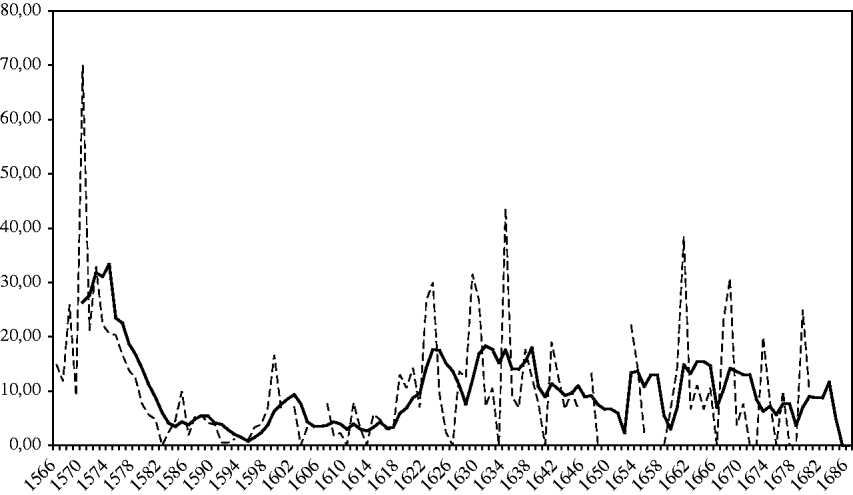
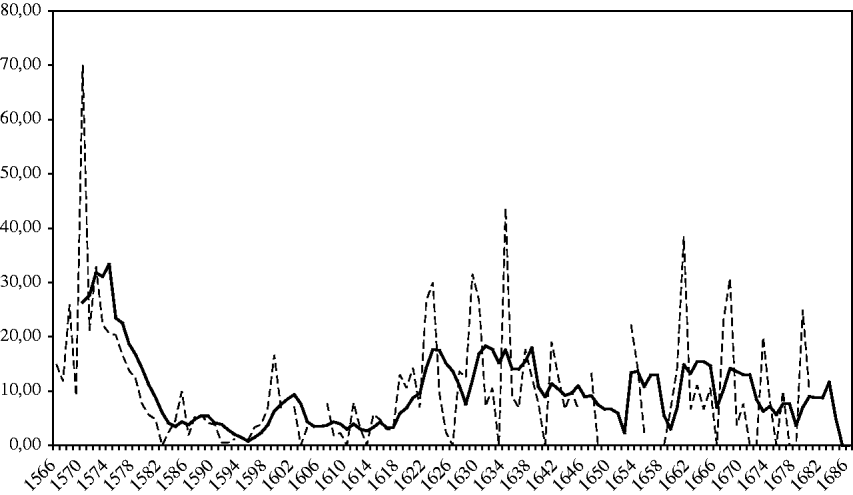
Figure 4 shows that the French always made up an important part of the Inquisition's business in Valencia. For much of the time they represented between 10 and 20 per cent of the total, sometimes dropping lower and at other times going much higher. This correlated with both their large presence in the kingdom and with the likelihood that they had come into contact with Protestant ideas. What really needs to be explained is the spike in the number and percentages of trials against the French from 1568 to 1575, and the subsequent decline of prosecutions through 1580–1620.Footnote 17
The Inquisition in Valencia, 1556–1686, percentages of French defendants by year and five-year moving average (solid line). (Source: As in Figure 1.)
III. THE DEFENDANTS
That the vast majority of the defendants in both jurisdictions should have been men is not very surprising. Women are systematically underrepresented in all criminal justice systems in early modern Europe for all types of offences apart from witchcraft and infanticide. They also make up a minority of the defendants in the Inquisition. Among all trials in the Holy Office in Valencia, women account for 20.7 per cent (997 of 4,813 trials) where the defendant's gender can be deduced. The corresponding figure for the court of criminal justice is 26.6 per cent (11,066 of 41,577 trials).
The figures for French female defendants are much lower. For the Justicia, there are only 2, a prostitute convicted of concubinage in 1566 and a married woman charged with banditry on Christmas eve in 1621.Footnote 18 The Inquisition tried 3 French women, 2 as Protestants in 1567 and 1599 and 1 for heretical propositions in 1590.Footnote 19 One of the reasons why there were few female defendants may be the absence of trials for demonic witchcraft in Valencia. Unlike in neighbouring Catalonia, trials for crimes of magic in Valencia were almost exclusively for sorcery (also dominated by women) and they were handled by the Holy Office.Footnote 20
As Table 1 indicates, prosecution of French defendants fell disproportionately upon men.Footnote 21 This in fact part of a larger pattern, since women made up 2.2 per cent (13 out of 588) of all foreign defendants before the Inquisition in Valencia. Indeed, the majority of the French immigrants were men, and Poitrineau regards the French immigration to Valencia exclusively masculine.Footnote 22 While most of the massive French immigration to Spain went to Catalonia, thousands of Frenchmen went further south to Valencia. If the French made up 7 per cent of the population, as suggested earlier, this would mean that they comprised 14 per cent of the male residents. Perhaps the most significant conclusion that can be drawn is simply that prosecution of French defendants consisted of trials of French men.
Genders of defendants in courts in Valencia, 1566–1686

Sources: Fiscal accounts in the section ‘Maestre Racional’ in the Archivo del Reyno de Valencia, in Valencia, and case summaries (relaciones de causas) preserved in the section ‘Inquisición’ in the Archivo Historico Nacional, in Madrid.
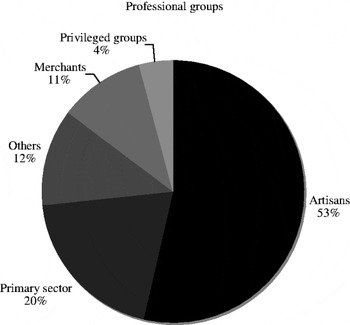
In terms of social status, those prosecuted generally belonged to the lower orders of society. French claims that the Inquisition went after French merchants in order to confiscate their property seem unlikely since there are only 5 merchants among the 142 cases for which data exist on occupation.Footnote 23 Given that they were tried for religious offences, low status does not suggest that the individuals were not seen as a threat by the authorities. The majority were in fact various kinds of agricultural workers, labourers or artisans. Figure 5 shows the occupational groups among the French defendants prosecuted by the Holy Office in Valencia. The poverty of the defendants allowed the tribunal in Valencia to complain to Madrid that the French were a liability:
The French who are prisoners because of things pertaining to Luther's sect are all poor and eat at the tribunal's cost, and since nobody will post bail for them it is impossible to avoid the great expenses they cause.Footnote 24
Later letters pick up the same theme: that the French defendants were poor and could not pay for their own upkeep. This lack of finance was a problem for the Inquisition, which used its victims' property as one of its principal sources of income. The Inquisition had its own finances and was not dependent on the crown for paying the cost of its ordinary operations after the initial years of its existence. The property of defendants was an important part of this equation, and was a central point in contemporary criticism of the institution. Once arrested, the property of the defendant was sequestered and sold off as needed to pay for his imprisonment; after a conviction, whatever was left was confiscated. When the accused was destitute this principle was reversed, and the prisoner became a source of expense rather than income. The Inquisition in Valencia felt this burden to be the case with the French, in particular during the time when so many were prosecuted in a few years. The poverty of the defendants prompted the inquisitors in Valencia to expedite the autos de fe in order to reduce costs.Footnote 25 They chose to accelerate the punishment rather than reduce the number of prosecutions. Economic issues were not permitted to impede the trials of Frenchmen at the height of the monarchy's fears about foreign religious contagion.
Occupational groups of French defendants before the Inquisition in Valencia, 1556–1686. (Source: As in Figure 1.)

The accounts for 1570 appear to confirm these letters. According to these, the Frenchmen prosecuted at the auto de fe that year had little or no income and represented a significant expense for the Holy Office. For instance, Anton del Rio had no other property than the five Castilian reales his master owed him, while Ramon Negres only had the ten pounds his uncle owed him as wages. Both debts were collected by the Holy Office.Footnote 26
Ages are noted for 172 of the defendants before the Holy Office, and they range from 10 to 70. As Table 2 shows, the majority were in their most lucrative working years: 129 were between 18 and 39 years old. Only by the last decades of the seventeenth century did the Inquisition start to note information such as the marital status of men (that of women was noted much earlier) in the relaciones, and we therefore have no means of knowing how socially integrated these men actually had become.Footnote 27 Relatively young age and lowly occupations may perhaps be taken as an indication that many of those brought to trial were in fact fairly recent arrivals without local roots and social networks, and were perhaps even lacking judgement regarding the proper comportment for a French national in the jurisdiction of the Spanish Inquisition. Of course, it also accords well with the information that they were without substantial economic means.
Ages of French defendants before the Inquisition in Valencia, 1566–1686

Source: Case summaries (relaciones de causas) preserved in the section ‘Inquisición’ in the Archivo Historico Nacional, in Madrid.
IV. CHARGES AND SENTENCING
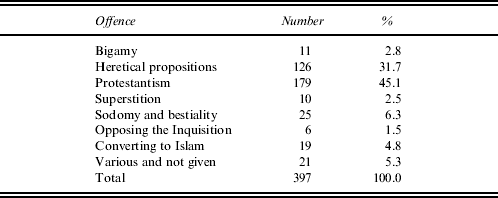
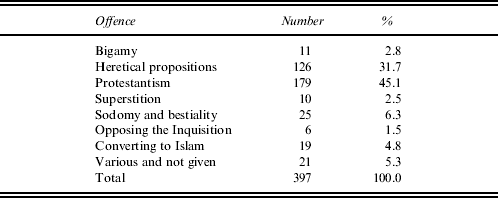
The charges levelled at the French before the Holy Office ran the full spectrum of the offences that fell under the jurisdiction of the Inquisition, from sodomy and bigamy to the formal heresies of Protestantism.Footnote 28 As shown in Table 3, the two most common accusations were those of being a Protestant or of having made heretical propositions. The latter were frequently also cause for suspicion that the accused was a Lutheran or a Calvinist by, for example, refusing to acknowledge saints or the supremacy of the Pope. But the charges might also be initiated when somebody renounced God in anger after losing a game of cards or some other misfortune. A curious example is the weaver Marçal de la Torre, who was convicted of renouncing God and his mother when the thread broke as he was weaving.Footnote 29 Together these two case types constitute almost 80 per cent of all accusations. A number of trials were also initiated against men who had been captives in North Africa and who at some point had converted to Islam. A few alleged bigamists and sorcerers also appear as well as men accused of sodomy and bestiality. The accusations that spiked in the 1570s are not significantly different from those of the period as a whole.
Accusations against French defendants before the Inquisition in Valencia, 1566–1686
Source: As in Table 2.
Another interesting finding is the high number of acquittals. No fewer than 57 of the 397 trials before the Inquisition ended in acquittals. But while 7.3 per cent of the trials ended in acquittals before 1582, the number thereafter rose to 20.9 per cent. Another 26 cases were suspended, all but 3 of which were commenced after 1582. This tendency suggests that the reduction in the number of trials after the 1570s was accompanied by a reduction in conviction rates. Fewer Frenchmen were prosecuted, and fewer of those were convicted.
In part, the high number of acquittals was caused by the Inquisition's role in facilitating conversion to Catholicism. Gradually over the course of the seventeenth century it became routine for the Holy Office to receive the confessions of Protestants who wished to become Catholics, and it was routine to absolve them or sentence them to reconciliation without punishment.Footnote 30 The two main motivations for appearing voluntarily were a desire to convert to Catholicism and also to receive less severe punishment by pre-empting a hostile accusation by others. In 1570, the Valencia tribunal reported that after the auto de fe, which featured a number of French protestants, ‘some French Lutherans have come spontaneously to confess their Lutheran errors to this Holy Office’.Footnote 31 Thus self-accusation was a primary way in which Protestants came before the Holy Office. However, while ‘spontaneous heretics’ account for a number of the absolutions, they do not explain all the cases. As the number of suspended cases indicates, a significant number of trials ended without a conviction because the inquisitors did not find sufficient evidence against the accused. This ‘acquittal rate’ shows that prosecutions were not invariably successful. Nevertheless, the fact that their belongings were confiscated and sold off to pay for the cost of their incarceration meant almost certain ruin for the accused even when they were absolved.
Only 7 of the 397 Frenchmen were put to death, or ‘relaxed’ in the Inquisition's parlance, which is in line with the overall numbers (98 out of 4,972). Another 4 were burned in effigy because they had fled. The latter were all condemned as Protestants, while only 2 were put to death for that offence. The other 5 were actually burned for sodomy and bestiality. The charges of sodomy and bestiality resulted more frequently in a death sentence than did Protestantism; while a Protestant might save his life by repenting and reconciling with the Catholic Church, no such option was available to those convicted of sodomy or bestiality.
V. PROSECUTION OR PERSECUTION?
The data presented above show that while the Justicia has not left records of intense prosecution of Frenchmen, the Holy Office in Valencia prosecuted French suspects throughout the period under study, but at a certain point in time both the absolute and relative numbers of defendants increased sharply. Two questions arise, the first about how this period of more numerous trials might be explained, and secondly whether this increase marks a period of persecution of Frenchmen rather than one of increased prosecution of heretics.
We shall turn to the latter question first. The years following the outbreak of the second French war of religion in 1567 saw a huge influx of refugees who fled from southern France into Spain. This influx, like normal immigration, was not limited to the border areas and a number of refugees made their way to Valencia. The increases in the absolute numbers of trials and of the relative numbers of Protestants in these years also reflected the reality of a greater presence of heterodox Frenchmen, and not just an increased political or popular desire to prosecute them. In March 1569 the inquisitors in Valencia received a witness who told of a Frenchman who had informed him of the ‘great treasons’ of the ‘Lutherans’ in France, and warned of the possible collusion between Moriscos and Huguenots. In the opinion of the Frenchman, ‘it was important to follow more closely the French who came from France than the Moors of the land’.Footnote 32 This second-hand story of possible treason and collusion was seen by the inquisitors as important and plausible enough for them to send it on to Madrid. Perhaps it was made more believable by the number of Frenchmen who voluntarily came before the Inquisition after seeing others penanced (receiving a light sentence because they were not judged to be formal heretics) in the public autos de fe. The fear of treason was corroborated in letters from Madrid warning that French Protestant ministers were coming to Spain in disguise.Footnote 33 These letters were sent to Valencia as well as to the tribunals of areas directly bordering France. Thus there appears to have been real apprehension about Protestant contagion, rather than simply anti-French or xenophobic motives behind the high number of trials in 1568–1575. Philip II was not the only one to fear Protestant influence or penetration, and those fears may not have been completely unfounded.
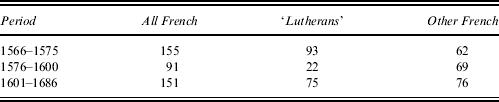
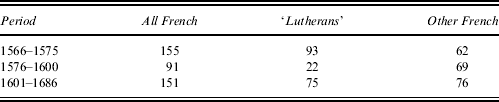
If we follow this line of reasoning and turn to the question of whether this was a persecution of French immigrants and not just of Protestants, we find an important clue in the relative number of charges of Protestantism that were made. In the decade 1566–1575, 60 per cent of the French defendants were charged with being ‘Lutherans’. In the following 25 years, only 24 per cent of the French tried by the Holy Office in Valencia were brought up on this charge. It is unlikely that the religious proclivities of the French community changed that much from one decade to the next. Rather, the thrust of the Inquisition moved from viewing the French as a Protestant threat to seeing them as a Catholic community, and then they were charged with the same range of offences as Spaniards.
The absolute numbers of trials before the Inquisition, as shown in Table 4, are also telling. They fell from 93 in the decade 1566–1575 to 22 in the rest of the century, from 1576 to 1600. Or, to put it another way, the number of trials fell from more than 9 a year to less than 1. Likewise, those prosecuted for other offences than Protestantism was also higher in the decade 1566–1575 than in the rest of the century. Thus these years were clearly a period of increased prosecution of Frenchmen, not just of French Protestants. William Monter may be right that the Inquisition at this time conflated ‘French’ and ‘Lutheran’ – though it certainly did prosecute Protestants of other nationalities in these years – but clearly the French were more vulnerable to other charges as well during this period.Footnote 34
French defendants before the Inquisition in Valencia, 1566–1686, absolute numbers
Source: As in Table 2.
However, the period 1568–1575 did not coincide with any outbreak of plague or famine in Valencia that might have led to casting the French as scapegoats. While there were concerns about the sizeable Morisco population joining the Alpujarras uprising in Granada in 1568, there are no signs of tension or fear in Valencia that might explain why more Frenchmen were tried for heresy.Footnote 35 As Figures 1 and 2 show, this was not a period of unusually large numbers of trials in general, neither in the Justicia nor before the Holy Office.
An obvious choice to explain the increased number of trials of French defendants by the Inquisition would be to look for political interest and international tensions. The problem with this explanation, based on foreign policy, is that the period 1559–1596 was one of peace with France (or at least with the French monarchy). Yet the increase in trials did coincide with the period of Philip II's greatest apprehensions about perfidious outside influences. Broadly centred on 1568, this period encompasses the Dutch revolt, the second war of religion in France, the Alpujarras revolt in Granada and political turmoil in Catalonia. All of these conflicts had religious significance, which led to fears for the future of Catholicism in Philip's domains just a few years after the conclusion of the Council of Trent in 1563. This tension led to what Joan Reglà termed Philip's ‘volte-face’, transforming Spain from his father's humanistic cosmopolitan kingdom to a Hispanic one based largely on the defence of Catholicism against Islam and Protestantism. This movement entailed attempts to close off the border to French Huguenots, as well as the decision to hunt for the bandits hiding in the Pyrenees and the cessation of all communications between the Moriscos and the Ottomans.Footnote 36 Ricardo García Carcel connects the Inquisition's subsequent activities in Valencia to these political currents: ‘the dominant note in this period is the xenophobia clearly connected with Philip's volte-face in 1568’.Footnote 37 It is not immediately clear which ‘period’ he refers to here – his book covers the years 1530 to 1609 – but this transition to fear of foreign influence is a likely explanation for the increase in trials of Frenchmen by the Holy Office in the 1570s. The Inquisition was always sensitive to the monarchy's political needs. An increased prosecution of Frenchmen during the period in which the monarchy was preoccupied with outside influences is likely to have been a response to the political ‘mood’ by the Holy Office, as much as a reaction to political demand. The Justicia was not subject to the same influence from Madrid, and this in part explains why we see no similar development there. Returning to the question of whether this increase in prosecutions was the result of xenophobia or of fear of heresy, it really is impossible to separate the two in these years simply because the heretics were foreigners. In fact, we may conclude that in these years xenophobia in Valencia found its expression in the persecution of French Protestants.
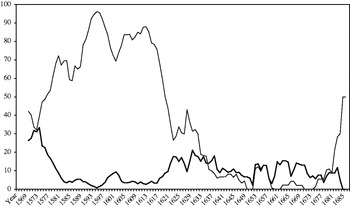
The period after 1575 when fewer Frenchmen were brought to trial by the Holy Office coincides with a new preoccupation, that of the Moriscos. Figure 6 indicates that the decline in the prosecution of Frenchmen coincided with an increase in the number of trials against Moriscos. In the years around 1570, there were as many trials against French as against Moriscos, even though the latter were seven times as numerous in the Kingdom of Valencia. This movement illustrates how the trials of the Inquisition mirrored the current political worries of the central government in Madrid. Letters from la Suprema, the supreme council of the Inquisition in Madrid, to the tribunals bordering France were also sent to Valencia. On 1 June 1568 it wrote to Barcelona, Zaragoza, Calahorra and Valencia, warning them to be on their guard against Protestant influence from France. A copy of an earlier letter from the Barcelona tribunal about heretical books coming from France was sent to Valencia from la Suprema.Footnote 38 Even though Valencia was far from the actual border, the city received these and similar letters because of the large French presence there.
Percentages of trials before the Inquisition of French people (lower line) and Moriscos (upper line), five-year moving averages. (Source: As in Figure 1.)

One might expect the number of trials against Frenchmen to have increased again during the wars against France in the seventeenth century. However, by that time the context was very different from that of 1568. In the seventeenth century, it was the expansive policies of the French monarchy that were the danger, while in the final decades of the sixteenth century it was the Huguenot rebels against the French monarchy who formed the threat. As religious fears diminished in the seventeenth century, there were also new sovereigns and other ways of repressing the French in Valencia seem to have been preferred.Footnote 39 Possessions were routinely confiscated, the French were disarmed and in one case unmarried men were forced to leave.Footnote 40 With such measures also available against faithful Catholics, the use of the Inquisition may have been less attractive. The Spanish monarchy had moved from using religious institutions to developing political and administrative measures against the French presence in Spain. Accordingly, conflicts with France were seen in more secular terms by the Spanish monarchy.
VI. CONCLUSION
Trials against Frenchmen accused of some form of heresy or of simple religious deviation were a constant in the Spanish Inquisition's tribunal in Valencia, which took careful note of the origin of all defendants. The secular court of the Justicia does not show the same care in noting down the origin of the accused. This difference allows us to see a sharp increase in the number of trials against the French in Valencia before the centrally controlled Holy Office at the same time as the political authorities were most concerned with French influence, while the locally controlled court has not left records of any such activity. The best explanation for this increase is political influence over the Inquisition, both directly and in the political sensitivities of the inquisitors themselves, which allowed the Holy Office in Valencia to align itself with the politics of Philip's ‘volte-face’. This has been obscured in previous studies by the great importance of the Moriscos in Valencia, and the preoccupation with French Protestantism has traditionally been seen as affecting primarily Catalonia.
Although nearly half of all the trials against Frenchmen involved charges of Protestantism, that number declined significantly after 1575. The spectre of Protestantism did not disappear, but it did not look as threatening as it had for a few years around 1568. While there is no doubt that the Holy Office tried the cases for which it was established, it is equally obvious that Inquisition and monarchy worked together, as they did when the Moriscos became the next preoccupation of Philip II after the French. During the next century or so the monarchy and the Inquisition came to accept the existence of Protestants not just abroad but also in Spain, as long as they were foreigners.Footnote 41
The debate about the relationship between the monarchy and the Inquisition dates almost back to the establishment of the tribunal. The central question has always been the extent to which the Inquisition was independent of the monarchy and acted out of its own interests. What the prosecutions of Frenchmen in Valencia show is that during the last decades of the sixteenth century the Holy Office in Valencia was very much attuned to the interests of the monarchy, while the locally controlled Justicia showed no similar alignment.
ACKNOWLEDGEMENTS
We are grateful to Pablo Pérez Garcia and Gustav Henningsen for their kind generosity in allowing us to use their databases and card file indexes from earlier research. This has allowed us to go directly to the sources to refine their data to find and study the Frenchmen among the defendants in a way which would otherwise be impossible. We also wish to thank Jorge Catalá Sanz and Sølvi Sogner for reading and commenting earlier drafts of this article.