Introduction
The global population, including Colombia's, is aging, and the consumption of health resources is increasing. This is associated with an increase in the prevalence of chronic diseases and the use of drugs, which may generate risks that can affect older adults (King and Lipsky, Reference King and Lipsky2015; Yayla et al., Reference Yayla, Yavuz, Bilge, Keskin and Binen2015). One of the most common problems in older adults is falls, and an estimated one-third of those over 65 years old and approximately 50% of those over 80 suffer from falls each year (Tinetti et al., Reference Tinetti, Speechley and Ginter1988; O'Loughlin et al., Reference O'Loughlin, Robitaille, Boivin and Suissa1993; Ministerio de Salud y Protección Social, Reference de Salud and Social2013).
Drugs with sedative properties are frequently used in older adults, who may also suffer from multiple diseases and are subjected to polypharmacy. Polypharmacy increases the risks to which they are exposed (Willcox et al., Reference Willcox, Himmelstein and Woolhandler1994; Berdot et al., Reference Berdot2009; Onda et al., Reference Onda, Imai, Takada, Fujii, Shono and Nanaumi2015; Machado-Alba et al., Reference Machado-Alba, Castro-Rodriguez, Alzate-Piedrahita, Hoyos-Pulgarin and Medina-Morales2016). Some studies have shown the association that can exist between falls, hip fracture, hospitalizations, or mortality, and the use of a combination of benzodiazepines, opioids, other psychotropic drugs, and anticholinergics (Vestergaard et al., Reference Vestergaard, Rejnmark and Mosekilde2007; Fraser et al., Reference Fraser2014; Aizenberg et al., Reference Aizenberg, Weizman, Weiss, Akopian, Amitai and Beloosesky2015; Ping et al., Reference Ping2017). To a large extent, this is explained by their sedative effects, which predisposes older adults to falls and increases their risk of hip fractures.
Some meta-analyses have shown that the risk of hip fracture in older adult opioid users increases between 54% and 88% compared to non-users (Teng et al., Reference Teng2015; Ping et al., Reference Ping2017), and in those with benzodiazepines, the increase ranges from 50% to 90% (Herings et al., Reference Herings, Stricker, de Boer, Bakker and Sturmans1995; Passaro et al., Reference Passaro, Volpato, Romagnoni, Manzoli, Zuliani and Fellin2000; Landi et al., Reference Landi2014). The relationship between the use of drugs with sedative effects, particularly psychopharmaceuticals, and hip fractures, has not been established in Colombia and in Latin American countries, only one study in Uruguay with 29 cases was developed (Danza et al., Reference Danza2015). The objective of this study was to determine the association between the use of benzodiazepines and opioids and the risk of falls with hip fracture in a population older than 65 years in Colombia.
Patients and methods
A case-control study was performed, defining the cases as all persons of any sex, over 65 years of age, affiliated with the General System of Social Security in Health of Colombia (Sistema General de Seguridad Social en Salud de Colombia – SGSSS), served by 25 different service providers, with a diagnosis of hip fracture (S72.0 – according to the International Classification of Diseases version 10-ICD10) registered in a drug dispensing database between January 1 and December 31, 2015. Two controls were obtained for each case without substitution (one control could not serve more than one case) and were matched based on age, sex, and date of the fall of the cases, but without the diagnosis of hip fracture, and who also had prescriptions for any drug.
The information was obtained from a population database of Audifarma S.A., which dispenses drugs to 6.5 million affiliates of the SGSSS, corresponding to 13.2% of the country's population. Patients with a diagnosis of hip fracture were included, and all drugs dispensed within 30 days prior to the fracture were identified. An equivalent search was performed for the selected controls.
The following variables were taken into account:
1. Sociodemographic: age, sex, city of origin, health promoting entity (insurer or entidad promotora de salud – EPS), and health provider institution (clinic or institución prestadora de salud – IPS).
2. Diagnostic: reported in the dispensation formula according to the International Classification of Diseases (ICD-10). In addition, some patient comorbidities were determined.
3. Pharmacological: complete history of drugs prescribed in the previous month. Subsequently, the drugs were categorized by pharmacological groups, including selectively (1) opioids and (2) benzodiazepines.
4. Polypharmacy: the total number of drugs was identified in each case and each control. Polypharmacy was defined as those who received five or more drugs and excessive polypharmacy as those who were given ten or more drugs (Jyrkka et al., Reference Jyrkka, Enlund, Korhonen, Sulkava and Hartikainen2009).
This study was endorsed by the bioethics committee of the Technological University of Pereira (Universidad Tecnológica de Pereira) in the category of research without risk, and the principles of confidentiality of information established by the Declaration of Helsinki were respected.
Outline of the analysis
A database was designed that was analyzed using the statistical program SPSS version 24 for Windows (IBM, USA). Frequencies and proportions were obtained for the categorical variables and measures of central tendency and dispersion for the continuous variables. Normality was assessed using the Kolmogorov–Smirnov test. Contingency tables were used to calculate the odds ratios (ORs) between the cases and the controls versus the dependent variable (fracture); the other categorical variables were analyzed with X2 to evaluate their statistical significance. Non-parametric tests were used for differences in continuous variables that deviated from a normal distribution. A multivariate analysis was performed using a conditional logistic regression, including the dependent variable hip fracture (yes/no). A value of p < 0.05 was established as significant.
Results
We identified 287 patients older than 65 years with a diagnosis of hip fracture during the observation period and 574 controls distributed in 60 different cities of the country. There was a female predominance (72.1%) and a mean age of 82.4 ± 8.0 years.
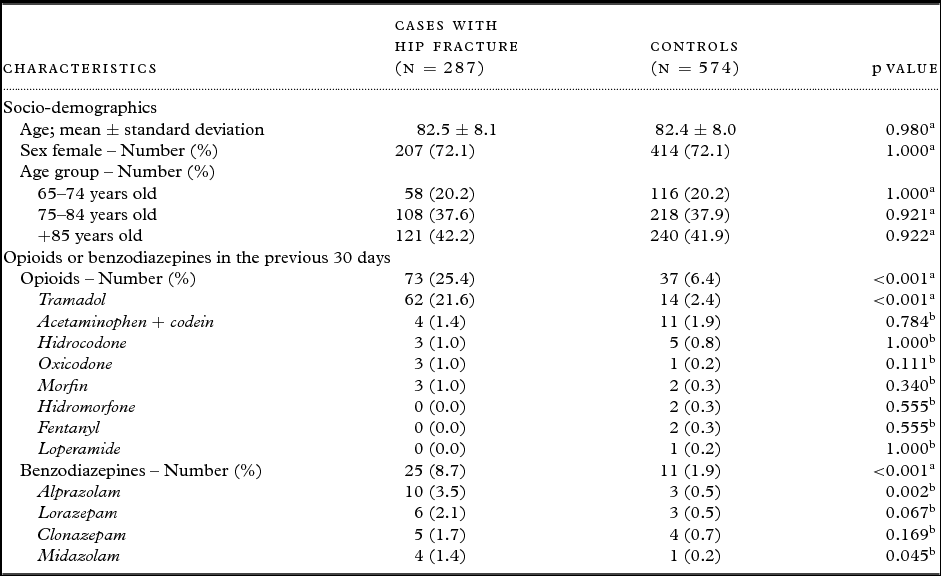
When comparing the baseline state between the cases and controls, there were no differences in age and sex, but when comparing the medication received 30 days prior to the hip fracture, statistically significant differences were found between the proportion of benzodiazepine and opioid use between the cases versus the controls (see Table 1).
Socio-demographic, pharmacological risk characteristics of patients older than 65 years and their controls with hip fracture, Colombia 2015

a Using χ 2 test; bUsing Fisher exact test.
The opioid used most frequently was tramadol (n = 76; 8.8%), followed by codeine+ acetaminophen (n = 15; 1.7%); hydrocodone, hydromorphone, morphine, fentanyl, loperamide, and oxycodone were used in less than 1% of the patients. The most commonly used benzodiazepines were alprazolam (n = 13; 1.5%), lorazepam (n = 9; 1.0%), clonazepam (n = 9; 1.0%), and midazolam (n = 5; 0.6%). Table 1 shows the frequencies and differences in the opioid and benzodiazepine use between the cases and controls.
Multivariate analysis
The conditional logistic regression model was adjusted for age, sex, use of drugs, polypharmacy, cities of treatment, and osteoporosis therapy showed that receiving opioids or benzodiazepines in the month prior to the event was associated in a statistically significant way with a greater probability of having a hip fracture as the outcome (see Table 2).
Multivariate analysis of the variables associated with falls and hip fracture in adults older than 65 years, Colombia 2015

Notes: Conditional logistic regression adjusted for age, sex, use of antihypertensive drugs, Proton Pump Inhibitors, antidepressants, antipsychotics, antiparkinsonians, antidementials, corticosteroids, polypharmacy, cities of treatment and therapy for osteoporosis with calcium and bisphosphonates.
Discussion
The results of this study demonstrate an association between the use of opioids and benzodiazepines with the risk of hip fracture in patients over 65 years of age affiliated with the SGSSS of Colombia. These findings permit establishing the risk of fractures after exposure in this population and determining the need to establish surveillance and prevention measures in the care of older adult patients. Additionally, strategies oriented toward greater knowledge and promoting the rational use of drugs with the potential risk of adverse events in susceptible populations must be implemented (Morales-Torres and Gutierrez-Urena, Reference Morales-Torres and Gutierrez-Urena2004).
This series included patients older than 65 years, whose mean age was 82.4 years; this population is similar to that in a study by Danza et al. (Reference Danza2015) in Uruguay (82.8 years) and in the meta-analysis of Donnelly et al. (Reference Donnelly, Bracchi, Hewitt, Routledge and Carter2017) who reported an age range between 72.0 and 84.3 years. A higher percentage of women, similar to that found in Uruguay, can be explained from the reports of different studies worldwide, which estimate that the risk of osteoporosis is 17% in women over 65 years of age compared to 6% in men of the same age (Melton, Reference Melton2000; Orces, Reference Orces2009; Dhanwal et al., Reference Dhanwal, Dennison, Harvey and Cooper2011).
Benzodiazepines are psychoactive drugs that act on the gamma-aminobutyric acid (GABA) receptor producing sedation, muscle relaxation, anxiolytic, and antiepileptic effects. Their association with hip fractures has previously been studied with variable results (Swift et al., Reference Swift, Swift, Hamley, Stevenson and Crooks1984; Eto et al., Reference Eto, Saotome, Furuichi and Ogasawara1998; Chang et al., Reference Chang, Wu, Chang and Lin2008). Research performed by Eto et al. in Japan documented that benzodiazepines have effects on spatial and temporal gait parameters such as pace length, velocity, balance, and postural stability, which are determinant components in the mechanism of falls. Moreover, according to different authors, these effects are frequent and of greater importance in the first days to weeks of use (Swift et al., Reference Swift, Swift, Hamley, Stevenson and Crooks1984; Eto et al., Reference Eto, Saotome, Furuichi and Ogasawara1998; Chang et al., Reference Chang, Wu, Chang and Lin2008). In this sense, the same authors explain that their prolonged use generates tolerance to their sedative effects (Swift et al., Reference Swift, Swift, Hamley, Stevenson and Crooks1984; Eto et al., Reference Eto, Saotome, Furuichi and Ogasawara1998); thus, the relationship between their consumption the previous month and the development of the index event found in our study (OR: 3.73; 95% CI: 1.60–8.70) can be explained. These findings are similar to those reported by Wagner et al. (Reference Wagner2004), who determined that the use of benzodiazepines carries greater risk within the first 15 days compared to continuous use (RR: 1.74, 95% CI: 1.07–2.82). In this respect, the most recent meta-analysis shows that the use of benzodiazepines carries an increased risk of fracture, but this risk is determined by the period of use: short term (less than 15 days, RR: 2.40, 95% CI: 1.88–3.05, I 2 = 27%), medium (15–30 days, RR: 1.53, 95% CI: 1.22–1.92, I 2 = 0%), and long term (>30 days, RR: 1.20, 95% CI: 1.08–1.34, I 2 = 0%) (Donnelly et al., Reference Donnelly, Bracchi, Hewitt, Routledge and Carter2017).
The results of this study show that the risk of hip fracture in patients treated with benzodiazepines is slightly lower than that found in a recent case-control study in a South American population (OR: 4.5; 95% CI: 1.7–11.6), but it was greater than that described in the meta-analysis by Xing et al., who reported a (RR:1.26; 95 % CI: 1.15–1.38) increase in risk in patients who received these drugs compared to those who did not (Xing et al., Reference Xing, Ma, Ma, Wang, Yang and Chen2014; Danza et al., Reference Danza2015).
Two previous studies demonstrated an increased risk of fracture with the use of long-acting benzodiazepines (≥24 h), including diazepam and flurazepam. This result differs from the present investigation in which the drugs associated with increased risk of falls had an ultra-short (midazolam) and short (alprazolam, lorazepam) half-life (Ray et al., Reference Ray, Griffin and Downey1989; Cummings et al., Reference Cummings1995). In this same order, Chang et al. documented that short-acting benzodiazepines were associated with an increased risk of hip fracture (OR: 1.8; 95% CI: 1.3–2.7). This was also reported by Passaro et al. in Italy, who reported that short and ultra-short half-life benzodiazepines increase the risk of falls and consequently fractures (OR: 1.8; 95% CI: 1.2–2.8); this result was further corroborated in a recent meta-analysis (Passaro et al., Reference Passaro, Volpato, Romagnoni, Manzoli, Zuliani and Fellin2000; Chang et al., Reference Chang, Wu, Chang and Lin2008; Xing et al., Reference Xing, Ma, Ma, Wang, Yang and Chen2014). Contrary to these findings, the study by Wagner et al. (Reference Wagner2004) found no difference in assessing safety between ultra-short half-life benzodiazepines compared to those with a long half-life (Wagner et al., Reference Wagner2004). Further studies should be performed to identify the actual risk of falls according to the benzodiazepine elimination half-life. It is possible that short half-lives confer a false sense of security against the lack of residual effects hours after consumption.
Conversely, the use of short-term opioids has been associated with an increase in the risk of fractures due to their action on the μ receptor, predisposing the patient to sedation, dizziness, and falls (Vestergaard et al., Reference Vestergaard, Rejnmark and Mosekilde2006; Tello et al., Reference Tello, Arribas, Martínez and Pérez2007). Other authors have reported an association between long-term use of opioids and reduction in bone mineral density, which is attributed to the suppression of sex hormones (release of prolactin and growth hormone and hypogonadism) and according to Ensrud et al. (Reference Ensrud2003), a possible effect on neuromuscular function (Kinjo et al., Reference Kinjo, Setoguchi, Schneeweiss and Solomon2005).
In this series of Colombian patients, the use of opioids increased the risk of hip fracture 4.5 times, which is similar to that described by Solomon et al. (Reference Solomon, Rassen, Glynn, Lee, Levin and Schneeweiss2010), who found that in older adult patients treated with opioids, the relative risk of fracture was 4.47 times (95% CI: 3.12–6.41) greater than in those receiving non-steroidal anti-inflammatory drugs, irrespective of their selectivity or non-selectivity (Solomon et al., Reference Solomon, Rassen, Glynn, Lee, Levin and Schneeweiss2010). In this study, the outcome was possibly determined by the use of tramadol (p < 0.001) since no differences were found with the use of other opioids. Studies by Vestergaard et al. (Reference Vestergaard, Rejnmark and Mosekilde2006) and by Takkouche et al. (Reference Takkouche, Montes-Martinez, Gill and Etminan2007) documented that exposure to morphine (OR: 1.47, 95% CI: 1.37–1.58) and opioids such as tramadol (OR: 1.54, 95% CI: 1.49–1.58) increased the overall risk of hip fracture.
One limitation of this work is that the diagnoses were obtained from a database and not from medical records. In addition, their relationship with mortality could not be established. It should also be noted that the medicines were dispensed, but there is no guarantee that the patient took them nor is there confirmation of the dose consumed.
Conclusions
In conclusion, there is a relationship between the use of benzodiazepines or opioids with the risk of experiencing a fall with hip fracture in patients over 65 years of age in Colombia. The findings are particularly related to the use of tramadol, alprazolam, lorazepam, and midazolam in the prior month.
Strategies that promote the rational and appropriate use of drugs in older adults must be established. In addition, it is necessary to advance new studies that seek to establish the association of causality between drug use and fractures in the geriatric population.
Conflict of interest
The authors declare that they have no conflict of interest.
Description of authors’ roles
MEMD participated in the drafting, data collection, data analysis, description of results, discussion, critical revision of the article, and evaluation of the final version of the manuscript. JPCM participated in the drafting, data collection, data analysis, and description of results and discussion. DAMM participated in the drafting, data collection, data analysis, and description of results and discussion. ACR participated in the drafting, data collection, data analysis, and description of results and discussion. AGM participated in the drafting, data collection, data analysis, and description of results and discussion. JEMA participated in the drafting, data collection, data analysis, description of results, discussion, critical revision of the article, and evaluation of the final version of the manuscript.
Acknowledgments
This study received funding from the Universidad Tecnológica de Pereira and Audifarma S.A.