INTRODUCTION
Radiocarbon dating of bones is an important tool in the archaeological sciences for investigations of human history (Hedges and van Klinken Reference Hedges and van Klinken1992). The physical and chemical treatment of bones has been identified as crucial for achieving correct dating results (Ambrose Reference Ambrose1990; van Klinken Reference van Klinken1999; Collins et al. Reference Collins, Nielsen-Marsh, Hiller, Smith, Roberts, Prigodich, Wess, Csapò, Millard and Turner-Walker2002). Current routine methods enable collagen extraction and gelatinization after removal of contaminating organic and carbonate material from the surrounding environment using an acid-base-acid (ABA) treatment (Brock et al. Reference Brock, Higham, Ditchfield and Bronk Ramsey2010; Fülöp et al. Reference Fülöp, Heinze, John and Rethemeyer2013). In spite of the agreement on the principles of this procedure among many accelerator mass spectrometry (AMS) laboratories, the details may vary substantially. The process involves selection and physical preparation of the bones, concentrations of chemicals, temperatures and durations of the ABA as well gelatinization steps, the filtration of bone residues from the solution of the gelatin (i.e. the hydrolyzed collagen), and the application or omission of an additional cleaning by ultrafiltration before lyophilization of the peptide-containing solution, combustion, and graphitization.
In this work, we present the evaluation of individual steps of bone treatment for 14C dating and the validation of the method for the Laboratory for the Analysis of Radiocarbon with AMS (LARA) at the University of Bern. This lab opened in 2013 and similar method optimization and validation procedures have been carried out since then for the analysis of wood, plant remains, macrofossils, bulk sediment, and charcoal samples (Szidat et al. Reference Szidat, Salazar, Vogel, Battaglia, Wacker, Synal and Türler2014). For the validation of bone dating, materials from different origins were used, which have previously been dated within the interlaboratory comparisons VIRI and SIRI (Scott et al. Reference Scott, Cook and Naysmith2010, Reference Scott, Cook and Naysmith2014), by archaeological methods and/or by 14C analysis of other AMS laboratories.
MATERIALS AND METHODS
For the evaluation of individual preparation steps and validation of the final procedure, in total 33 bones and 3 teeth (dentin) were selected from Pleistocene to post-bomb eras:
-
∙ Four bone samples from the interlaboratory comparison VIRI (i.e. VIRI-E/F/H/I) with uncalibrated consensus ages of 2.5–39.3 kyr BP (Scott et al. Reference Scott, Cook and Naysmith2010).
-
∙ Two bone samples from the interlaboratory comparison SIRI (i.e. SIRI-B/C) with estimated ages of origin of ~40 kyr and >>60 kyr (Marine Isotope Stage 7), respectively; however, consensus values have not been reported yet (Scott et al. Reference Scott, Cook and Naysmith2014).
-
∙ 27 bones and 3 teeth (dentin), courtesy of ADB and/or IRM (Archaeological Service of the Canton of Bern and Institute of Forensic Medicine of University of Bern, repsectively), from the Middle Neolithic to the post-bomb era as dated by archaeological methods (stratigraphy, typology) and/or 14C analysis of two other AMS laboratories; sites of provenance are anonymized.
Prior to the chemical treatment, the presumed collagen preservation of the samples is sporadically checked by determination of the nitrogen and the carbon content as well as the C/N ratio of the original bone material using an elemental analyzer. Brock et al. (Reference Brock, Wood, Higham, Ditchfield, Bayliss and Bronk Ramsey2012) defined thresholds for bones with acceptable quality of >0.76% nitrogen by weight and an atomic C/N ratio <17, based on which they decide if a sample is selected for the time-consuming procedure or not. Nevertheless, we often continue sample preparation even for bones with very low anticipated gelatin yields in order to gain at least an age estimation (even though such a case did not occur in this study). On the other hand, a critical evaluation of the parameters of sample processing is relevant after the treatment and the 14C analysis is finished. Here, the nitrogen and the carbon content as well as the C/N ratio of the extracted gelatin and the gelatin yield should be examined (van Klinken Reference van Klinken1999; Moghaddam et al. Reference Moghaddam, Müller, Hafner and Lösch2016). In principle, we follow the recommendations of van Klinken (Reference van Klinken1999) and accept dating results only if the atomic C/N ratio of the gelatin falls into the range 3.1–3.5 and if the gelatin yield is higher than a certain threshold; extracted and lyophilizied gelatin with >1% in proportion to the dry bone weight is regarded as suitable, whereas measurements are rejected for gelatin yields <0.5% and carefully examined for yields between 0.5 and 1% (van Klinken Reference van Klinken1999). In this study, however, we omitted rejection of samples based on low gelatin yields in order to study age offsets of such cases (see discussion of Table 2).
The sample preparation was investigated based on literature methods (Fülöp et al. Reference Fülöp, Heinze, John and Rethemeyer2013 and references therein; Brock et al. Reference Brock, Higham, Ditchfield and Bronk Ramsey2010 and references therein; Brock et al. Reference Brock, Higham and Bronk Ramsey2013; Hajdas et al. Reference Hajdas, Cristi, Bonani and Maurer2014) using analytical-grade chemicals and ultrapure water [ELGA Purelab flex, Veolia Water Technologies, Paris; 18.2 MΩ·cm at 25°C, TOC<3 ng/g as detected by ultraviolet (UV) light absorption at 254 nm]. This involves the individual following steps:
-
∙ Surface cleaning by sandblasting or abrasion, then ultrasonication in water and drying at room temperature;
-
∙ Grinding bone material to 0.5–1 mm using a ball mill (MM 400, Retsch, Haan);
-
∙ (Removal of organic contaminants by Soxhlet extraction with 1-hr treatments each in hot hexane, acetone, and ethanol was tested for selected samples);
-
∙ Removal of soil contamination
-
° ABA procedure at room temperature: 0.5 mol/L HCl for 60 hr (alternatively tested: 1 hr), 0.25 mol/L NaOH for 1 hr, 0.5 mol/L HCl for 1 hr;
-
° (An acid-only procedure was tested as an option: 0.5 mol/L HCl for 1 hr);
-
-
∙ Gelatinization: Adjust to pH 3, shaking at 60°C overnight, warming to 70°C for 10 min; then filtration of the warm solution with precleaned Ezee-FiltersTM;
-
∙ (Ultrafiltration of the filtered gelatin solution at room temperature using Vivaspin 15–30kD MWCO was tested as an option); and
-
∙ Lyophilization (Alpha 2-4 LSC, Martin Christ Gefriertrocknungsanlagen GmbH, Osterode am Harz) of the filtered gelatin solution overnight.
For the production of solid targets with carbon masses between 0.1 and 1 mg from the hydrolyzed collagen, the automated graphitization equipment (AGE) with an elemental analyzer for ample combustion was used (Wacker et al. Reference Wacker, Němec and Bourquin2010). 14C measurements were performed with the accelerator mass spectrometry (AMS) system MICADAS (Synal et al. Reference Synal, Stocker and Suter2007) at the LARA laboratory at the University of Bern (Szidat et al. Reference Szidat, Salazar, Vogel, Battaglia, Wacker, Synal and Türler2014). 14C-free sodium acetate (Sigma-Aldrich, No. 71180) and the primary NIST standard oxalic acid II (SRM 4990C) were used for blank subtraction, standard normalization, and correction for isotope fractionations (Szidat et al. Reference Szidat, Salazar, Vogel, Battaglia, Wacker, Synal and Türler2014).
RESULTS AND DISCUSSION
The first part of the study focused on the choice of the sample preparation procedure, which is mainly based on the thorough investigation of Fülöp et al. (Reference Fülöp, Heinze, John and Rethemeyer2013) comparing methods from nine different AMS facilities. For most of the individual steps, procedures from the different laboratories varied only marginally. A surface cleaning is carried out to prevent possible contamination derived from the burial, exposition to soil and groundwater, excavation, and subsequent storage of the bones (Brock et al. Reference Brock, Higham, Ditchfield and Bronk Ramsey2010). Depending on the former environmental conditions surrounding the bone, surface cleaning may require more effort (Collins et al. Reference Collins, Nielsen-Marsh, Hiller, Smith, Roberts, Prigodich, Wess, Csapò, Millard and Turner-Walker2002). On the other hand, some obvious contaminations may not be relevant for 14C dating, as we observed for a bone with green staining from funerary goods made of bronze, which did not bias the measurement result compared to unaltered parts. If possible, bones with signs of archaeological significance, such as cut marks, evidence for trauma and disease, or preservation should be avoided for dating (Brock et al. Reference Brock, Higham, Ditchfield and Bronk Ramsey2010). However, one bone (Site 2, see Table 1) with a barely visible conservation layer was investigated within the validation, which caused an age offset for this sample (for details see below) and raised our awareness for the choice of the sample material in the future. Production of bone powder is a crucial step, as chunks that are too large may result in limited interaction of the material with the chemicals and, thus, lead to incomplete removal of contaminants, whereas too harsh treatment may reduce collagen yields substantially. Grinding to 0.5–1 mm is regarded as a good compromise (Fülöp et al. Reference Fülöp, Heinze, John and Rethemeyer2013).
Effect of the treatment on the 14C dating results of eight selected Holocene samples. The total procedure blank of 2.9±0.5 µg C with an F14C of 0.64±0.12 is considered. Parameters of collagen extraction are given as carbon (C) contents in weight percent and as atomic C/N ratios of the untreated bone and the extracted gelatin as well as gelatin yields in weight percent. “n.d.” means not determined. Uncertainties refer to 1σ (68.3%) confidence.

* Entries of the ABA treatment refer to the time of the individual steps.
# UF: with ultrafiltration; w/o SC: without initial surface cleaning by sandblasting or abrasion; Soxhlet: with Soxhlet extraction before the ABA treatment.
$ Origin of reference value: (a) from VIRI/SIRI intercomparisons, (b) from another AMS laboratory, (c) by archaeological interpretation (stratigraphy and/or typology of associated artifacts).
& After excavation, the samples were treated on the surface for conservation (see text); sample BE-5001.2.1 included the top 3 mm of the surface only.
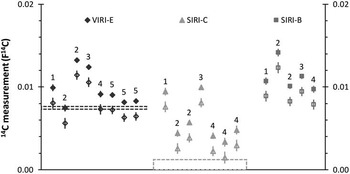
For the ABA treatment, two durations (i.e. 1 and 60 hr) of the first acid step were checked against each other, as this parameter varies in this range between published methods of different AMS laboratories (Fülöp et al. Reference Fülöp, Heinze, John and Rethemeyer2013 and references therein). Furthermore, an acid-only procedure was tested. Figure 1 suggests that ABA with longer duration of the first acid step removes modern contaminations better for samples >35 kyr compared to ABA with a short first acid step or even simplified acid-only procedures, so that we regard this measure as necessary for bone processing. Collagen losses due to the longer treatment were not observed: gelatin yields amounted to 5.7% and 6.4% (VIRI-E), 5.3% and 3.3% (VIRI-F), as well as 2.3% and 3.1% (Site 3, BE-3560) for the short and the long first acid step, respectively, thus indicating no clear trend. Similar results were already shown by Beaumont et al. (Reference Beaumont, Beverly, Southon and Taylor2010). On the other hand, an additional Soxhlet extraction neither improved the removal of contaminations further for samples >35 kyr (see Figure 1) nor for Holocene samples (see Table 1 below), so we will reserve this step only for samples with suspect surfaces, e.g. from conservation measures. For gelatinization of the collagen, we followed the recommendation of Fülöp et al. (Reference Fülöp, Heinze, John and Rethemeyer2013) and used only 60°C in order to minimize alteration of the protein. However, we increased the temperature of the solution shortly to 70°C in order to facilitate the filtration. Ultrafiltration was applied at room temperature to eight samples (three of which are >35 kyr and five from the Holocene) according to the practice of the Oxford Radiocarbon Accelerator Unit (Brock et al. Reference Brock, Higham, Ditchfield and Bronk Ramsey2010, Reference Brock, Higham and Bronk Ramsey2013). Whereas an influence of this step was not observed for any of the Holocene samples (see Table 1), the very old samples even tended to enhanced instead of reduced contamination (Figure 1), which may have been introduced by improper handling of the filtration units, so we will omit this step in the future. Similar results were reported by Fülöp et al. (Reference Fülöp, Heinze, John and Rethemeyer2013). By lyophilization, the gelatin is recovered from solution. Although this is a standard procedure, it should be noted that the quality of the lab water is crucial for dating of old bones, as even traces of soluble organic components from the water add up in the sample material. Even for ultrapure water systems, actual total organic carbon (TOC) concentrations may easily reach levels of 0.1 µg C/mL, although the TOC monitoring of these systems typically report values that are more than one order of magnitude lower due to the detection of UV-active substances only. The TOC may originate from incomplete UV oxidation of the water, surface contamination of lab ware, or atmospheric uptake of semivolatile organic substances, which would cause an age offset of 1000 yr for very old bones, a level that we actually observed as discussed in the following.
Comparison of the measured F14C value and corresponding reference results with 1σ uncertainties (68.3% confidence) for bones >35 kyr using these treatments: (1) acid only, (2) ABA with short first acid step, (3) ABA with short first acid step and ultrafiltration, (4) ABA with long first acid step, and (5) ABA with long first acid step after Soxhlet extraction. Filled symbols include a subtraction of the blank for a normal ABA treatment including target production of 2.3±0.5 µg C with an F14C of 0.55±0.08. Open symbols represent an additional blank for bone treatment of 0.6±0.1 µg C with an F14C of 1.00±0.15 as discussed in the text. Reference F14C values are indicated as dashed areas. They are based on the consensus values for VIRI-E and the limit of detection according to the preliminary information for the background sample SIRI-C, whereas such a reference is still missing for SIRI-B (Scott et al. Reference Scott, Cook and Naysmith2010, Reference Scott, Cook and Naysmith2014).

Interpretation of the analysis of the samples >35 kyr from Figure 1 is not straightforward. On the one hand, we gain ~1500 yr younger ages (corresponding to an F14C offset of ~0.002) than the reference for VIRI-E, which we regard as the most reliable background standard classified with an accepted consensus value (Scott et al. Reference Scott, Cook and Naysmith2010). On the other hand, a similar offset (i.e. with F14C of ~0.002) seems to be evident for the background sample SIRI-C. This outcome is less reliable than for VIRI-E, however, as the final evaluation of the SIRI intercomparison has not been published yet, so that our interpretation can only refer to the preliminary data (Scott et al. Reference Scott, Cook and Naysmith2014). The same case applies to SIRI-B, which has only been characterized as “approx. 40,000 years” (Scott et al. Reference Scott, Cook and Naysmith2014) so that a further interpretation of this sample within our evaluation is not possible at the moment. As a consequence of this situation mainly considering VIRI-E, we currently apply an additional procedural blank for bones corresponding to constant contamination of 0.6±0.1 µg C with an F14C of 1.00±0.15 on top of our blank for a normal ABA treatment including target production (which is based on fossil wood and charcoal) of 2.3±0.5 µg C with an F14C of 0.55±0.08, resulting in a total procedure blank of 2.9±0.5 µg C with an F14C of 0.64±0.12. As mentioned earlier, we hypothesize that this additional blank mainly originates from traces of dissolved organic components from the ultrapure water that remain in the sample during lyophilization. A further source may be vessels that have been contaminated by laboratory air during handling. We will investigate the blank source further in order to reduce it and reevaluate this measure when the SIRI consensus values are published. Until then, we omit dating bones older than 30 kyr.
Table 1 shows 14C results of a selection of Holocene bones for different treatments. They confirm the outcome of Figure 1 for the acid-only and ABA treatment with a short acid step, which produce less reliable data than ABA with a long first acid step. Moreover, analysis of the Holocene bones reveals ultrafiltration neither as clearly advantageous nor disadvantageous. As a consequence, we excluded this step for the choice of the final preparation method. This method has already been described in the section “Materials and Methods” without consideration of the optional steps shown in parentheses.
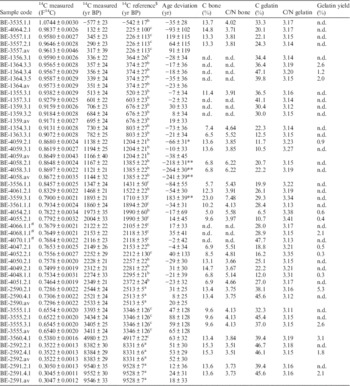
After the definition of the final preparation method, the second part of the study aimed to validate the bone dating as a whole. For this, 33 predated samples from the Holocene were analyzed in a blind test, 30 of which were bones and 3 dentin parts of teeth. Whereas Figure 2 presents an overview of all materials and Table 1 shows details for all VIRI bones as well as five other samples, which were analyzed using different preparation techniques, Table 2 compiles individual data for all samples shown in Figure 2. For the samples younger than 10,000 BP, the comparison of the measured and the reference age matched within 95.5% confidence for 39 out of 43 individual measurements and, after averaging, for 31 out of the 33 bones. In particular, our measurements agreed well for the samples VIRI-F/H/I, whose reference ages are the most reliable of all bones. The average age offset between expected and measured 14C age of all 33 samples amounts to –6 yr, i.e. with measured values slightly younger than expected on the average. The standard deviation of the age offsets is ±69 yr, calculated referring to the single analysis. This scatter is higher than the average uncertainty of the individual age offsets of ±47 yr, which includes both uncertainties from our 14C measurements and the determination of the reference 14C age. After exclusion of the two samples that were confirmed as outliers by repeated analysis, the average age offset slightly changes to –4 yr with a standard deviation of ±44 yr, which reproduces well the average uncertainty of the individual age offsets of ±48 yr for this subset of data. This outcome suggests that our laboratory is able to date Holocene bones correctly and the outlier cases require closer examination. It should further be emphasized that the measured 14C ages even matched reasonably well with the reference values for cases of low gelatin yields between 0.2 and 0.6%, which may have required at least further examination for yields >0.5% or rejection for yields <0.5% according to van Klinken (Reference van Klinken1999). Consequently, lower thresholds for acceptance of samples with low collagen preservation may be justified. Due to lacking gelatin yields for many bones in this study, more investigation will be necessary in order to evaluate reliable acceptance/rejection criteria for our laboratory for the future.
Deviation of the measured 14C age of the bones from the reference 14C age for the Holocene samples with 1σ uncertainties (68.3% confidence). Reference 14C ages are based on consensus values for VIRI samples (Scott et al. Reference Scott, Cook and Naysmith2010) or other age determinations including 14C analysis of another AMS laboratory or archaeological methods of the calendar age, the latter converted to a 14C age using the IntCal13 data set (Reimer et al. Reference Reimer, Bard, Bayliss, Beck, Blackwell, Bronk Ramsey, Grootes, Guilderson, Haflidason, Hajdas, Hatté, Heaton, Hoffmann, Hogg, Hughen, Kaiser, Kromer, Manning, Niu, Reimer, Richards, Scott, Southon, Staff, Turney and van der Plicht2013). The total procedure blank of 2.9±0.5 µg C with an F14C of 0.64±0.12 is considered. Table 2 compiles the individual analyses and shows details of the uncertainties of the age deviations. See text for details of the outlier samples.

Chronological compilation of the individual analyses of all Holocene samples shown in Figure 2. The total procedure blank of 2.9±0.5 µg C with an F14C of 0.64±0.12 is considered. Parameters of collagen extraction are given as carbon (C) contents in weight percent and as atomic C/N ratios of the untreated bone and the extracted gelatin as well as gelatin yields in weight percent. “n.d.” means not determined. Uncertainties refer to 1σ (68.3%) confidence. Uncertainties of the age deviation are determined by error propagation of the uncertainties of the measured and the reference 14C ages. For repeated analyses of the same bone, the average (av) age determination is shown as in Figure 2. For these averages, the larger value of either the standard deviation of the repetitions or the average uncertainty of the individual measurements is given as the uncertainty of the average referring to the single analysis (i.e. not as the uncertainty of the mean).

* Outlier based on 95.5% confidence (2σ);
** Outlier based on 99.7% confidence (3σ).
# Teeth (dentin).
$ Origin of reference value: (a) from VIRI/SIRI intercomparisons, (b) from another AMS laboratory, (c) by archaeological interpretation (stratigraphy and/or typology of associated artifacts).
As mentioned earlier, two statistically significant outliers were observed in the 33 samples younger than 10,000 BP. For one of these outliers, the reference age was determined by archaeological methods. The sample from Site 2 stems from a tomb with a number of grave goods, which allow a reliable assignment to the mid-4th century AD, corresponding to a 14C age of 1710±33 BP. Several different treatments regarding more or less harsh surface cleaning of the bone and carbonate removal by acidification resulted all in dates that are several centuries too old (Table 1). Although the definite method with the long first acid step yielded the closest age to the archaeological reference, confirming its superiority to the tested alternative methods, its value is still 183±39 yr too old, which cannot be explained by the archaeological context. Although a freshwater reservoir effect (Philippsen Reference Philippsen2013) may be hypothesized due to the vicinity of the site to large lake, we assume the most likely explanation is bias from conservation treatment of the skeleton. The sample has a slightly lustrous surface (Horie Reference Horie2010), which was not noticed initially. Cleaning of the surface for this and another bone from the same individual by applying different organic solvents using a Soxhlet apparatus (Hajdas et al. Reference Hajdas, Cristi, Bonani and Maurer2014) could not remove this contamination. As an example, Table 1 presents the attempt using the surface top 3 mm only (BE-5001.2.1), which shows the strong fossil component from the conservation material that was mainly enriched on the surface, but also permeated into the depth, so that it most probably also affected the bones even after intensive surface abrasion. The hypothesis of a contamination is corroborated for the surface sample BE-5001.2.1 by the atomic C/N ratio of the gelatin of 4.10, which is the only value from all investigated samples that is out of the acceptable range of 3.1–3.5 according to van Klinken (Reference van Klinken1999).
For the other outlier (Site 4A), the reference age was determined by 14C dating of another AMS laboratory. Our analysis gave a younger age than the reference by 241±39 yr. However, the bone from Site 4B from the same excavation did not show such a large difference so that the reason for the offset for Site 4A remains unclear.
CONCLUSION AND OUTLOOK
A method was evaluated for 14C dating of bones at the Laboratory for the Analysis of Radiocarbon with AMS (LARA) at the University of Bern. The finally defined preparation method comprises these steps: surface cleaning by sandblasting or abrasion, ultrasonication in water and drying, grinding of bone material to 0.5–1 mm, ABA procedure at room temperature (0.5 mol/L HCl for 60 hr, 0.25 mol/L NaOH for 1 hr, 0.5 mol/L HCl for 1 hr), gelatinization at 60°C overnight, filtration of the warm solution with precleaned Ezee-Filters, lyophilization of the solution, graphitization using AGE, and 14C measurement with MICADAS. Analysis of bones >35 kyr revealed a procedural blank of 2.9±0.5 µg C with an F14C of 0.64±0.12, which is slightly higher than for other sample materials. Validation of the method was performed with 33 Holocene samples of known age, producing two outliers, for which causes and implications were discussed. The average age offset of all Holocene samples without the outliers is –4±44 yr, which confirms the quality of bone dating at the LARA lab.
ACKNOWLEDGMENTS
We acknowledge E Marian Scott and Philip Naysmith for providing VIRI and SIRI bone material. We are grateful to the assistance of Negahnaz Moghaddam and Inga Siebke from the Department of Physical Anthropology, IRM, University of Bern.