INTRODUCTION
Intertidal organisms are interesting model species for understanding adaptation in terms of morphology, physiology and phenotypic plasticity mainly due to the considerable stress that the intertidal environment imposes on organisms both in terms of vertical zonation and across environmental gradients at biogeographical scales (Helmuth et al., Reference Helmuth, Broitman, Blanchette, Gilman, Halpin, Harley, O'Donnell, Hofmann, Menge and Strickland2006). In addition, intertidal gastropods are interesting models because, as they grow, they construct their shell using calcium carbonate, CaCO3, the mineralized component of the shell (de Paula & Silveira, Reference Paula and Silveira2009), which provides protection and enhances their probability of survival (Walker & Grahame, Reference Walker and Grahame2011), and truly represents the actual interface between the gastropod and the surrounding environment.
Variations in the shell shape of gastropods have been interpreted as a response to environmental restrictions or phenotypic plasticity along environmental gradients (Caley et al., Reference Caley, Grahame and Mill1995; Trussell, Reference Trussell2000; Trussell & Smith, Reference Trussell and Smith2000). For instance, abiotic factors such as thermal stress and wave forces (Trussell et al., Reference Trussell, Johnson, Rudolph and Gilfillan1993; Denny, Reference Denny2000; Harley et al., Reference Harley, Denny, Mach and Miller2009) and biotic factors such as population density and predation (DeWitt, Reference DeWitt1998) are commonly invoked in order to explain plasticity in the shell shape of gastropods. The study of adaptive values of shell morphology has been carried out with respect to the relationship with reproductive effort (Walker & Grahame, Reference Walker and Grahame2011), tenacity and shell thickness that confer increased survival due to resistance to wave action (Vermeij & Covich, Reference Vermeij and Covich1978; Trussell et al., Reference Trussell, Johnson, Rudolph and Gilfillan1993), and shell modifications (Lowell et al., Reference Lowell, Fletcher, Grahame and Mill1994; DeWitt, Reference DeWitt1998; Trussell & Smith, Reference Trussell and Smith2000) including changes in shell colour that increase survival against visual predators (Manríquez et al., Reference Manríquez, Lagos, Jara and Castilla2009).
Temperature variations have been proposed as a selective agent in natural populations modifying the distribution and abundance of ectotherms such as intertidal organisms (Helmuth et al., Reference Helmuth, Broitman, Blanchette, Gilman, Halpin, Harley, O'Donnell, Hofmann, Menge and Strickland2006). Several studies have also indicated that temperature influences shell morphology and pigmentation (Sokolova & Berger, Reference Sokolova and Berger2000), developmental and growth rates that determine the age at which a given body size is attained (Atkinson & Sibly, Reference Atkinson and Sibly1997) and shell shape and/or thickness (Trussell, Reference Trussell2000; Trussell & Smith, Reference Trussell and Smith2000). In general, these studies suggest that plasticity in phenotypic traits is a response to geographical variability in seawater surface temperature (SST). However, SST changes are only one of a set of possible interacting climatic variables that could drive the expression of phenotypic plasticity in marine gastropods.
Rising atmospheric carbon dioxide (CO2) also leads to increased CO2 concentrations in seawater, producing chemical changes in seawater such as decreased pH, which leads to more corrosive conditions for calcifying shell-forming organisms, making it more difficult for them to build their carbonate skeletons (Vezina & Hoegh-Guldberg, Reference Vezina and Hoegh-Guldber2008). This ocean acidification (OA), has been proposed as a new selective agent for marine calcifying organism in the near future, mainly due to the effect of reduced pH in seawater upon biological processes such as metabolism, growth rates, calcification (Byrne, Reference Byrne2011) and shell or skeletons mineralization (Ries, Reference Ries2011). In particular, decreasing pH, leads to a decreased concentration of carbonate ions (CO3 2-), reducing the saturation states (Ω) for aragonite and calcite, the two major forms of CaCO3 used to construct the shells by marine organisms (Ries, Reference Ries2011). Seawater characterized by an Ω < 1, is corrosive, resulting in net shell dissolution in marine organisms (Fabry et al., Reference Fabry, Seibel, Feely and Orr2008), which in turn may influence their body size and shell shape of the organism in question. In general, it is well established that reduced shell mass in molluscs, can compromise the structural integrity and shell strength, which has important ecological and economic implications (Welladsen et al., Reference Welladsen, Southgate and Heimann2010).
In the field and at local scales, the influence of increased levels of CO2 partial pressure (pCO2) in seawater leads to shell corrosion and significant shell dissolution in gastropods (Rodolfo-Metalpa et al., Reference Rodolfo-Metalpa, Houlbrèque, Tambutte, Boisson, Baggini, Patti, Jeffree, Fine, Foggo, Gattuso and Hall-Spencer2011). However, morphological variations in the shells of marine gastropods due to environmental changes in pCO2 levels in seawater have not been studied either at the regional or biogeographical scales. To our knowledge, the potential role of spatial variation in carbonate system parameters over shell morphology variations in marine gastropods has not received attention. This is an important issue because, along the eastern boundaries of many oceans, coastal upwelling (Feely et al., Reference Fabry, Seibel, Feely and Orr2008) and river discharges (Salisbury et al., Reference Salisbury, Green, Hunt and Campbell2008) may introduce corrosive waters into the coastal ocean that resemble reduced levels of carbonate saturation state for calcite and aragonite (Ω ≈ 1) projected for the near future OA.
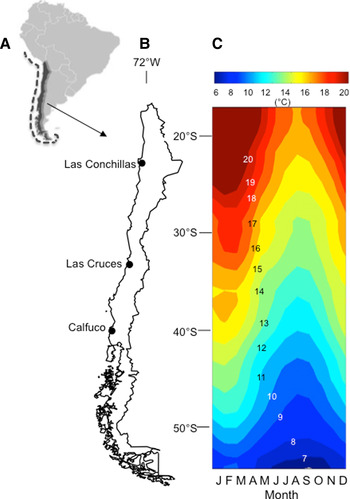
The marine snail Concholepas concholepas (Bruguière, 1789) (Gastropoda, Muricidae) inhabit exposed rocky shores of the South-eastern (SE) Pacific coastal ecosystem of Chile and Peru (Figure 1A). Across the geographical range of this species, there is a gradual decrease in SST with increasing latitude, and a corresponding strong environmental gradient in upwelling intensity that modulates geographical variations in SST (Strub et al., Reference Strub, Mesías, Montecino, Rutllant, Salinas, Robinson and Brink1998; Lagos et al., Reference Lagos, Navarrete, Véliz, Masuero and Castilla2005, Reference Lagos, Castilla and Broitman2008). Upwelling and freshwater input into the coastal ocean also interact with geographical variations in air–sea CO2 fluxes along the Chilean coast, leading to low levels in the Ω parameter for calcite–aragonite (Torres et al., Reference Torres, Pantoja, Harada, González, Daneri, Frangopulos, Rutllant, Duarte, Rúiz-Halpern, Mayol and Fukasawa2011; Mayol et al., Reference Mayol, Ruiz-Halpern, Duarte, Castilla and Pelegrí2012). Thus, across this physical–chemical gradient, it is expected that individuals of C. concholepas inhabiting geographically distant locations may show variations in the expression of phenotypic traits sensitive to SST and pCO2 changes. In this study, and using a geometric morphometry approach, we attempted: (a) to identify regional differences in shell morphology of juvenile individuals of the marine snail C. concholepas inhabiting along the Chilean coast of the SE Pacific; (b) to evaluate if variations in shell shape may be ascribed, at least in part, to geographical variability in SST and pCO2 levels in seawater; and (c) to asses if variations in shell shape are associated with inter-population variations in the proportion of aragonite and calcite precipitated in their shells.
Concholepas concholepas: (A) distribution along the coast (dashed line) of the south-eastern Pacific Ocean; (B) location of sampling sites in the northern (Las Conchillas), central (Las Cruces) and southern (Calfuco) regions of the Chilean coast; (C) gradient in sea surface temperature along the Chilean coast. Numbers indicate temperature isolines (historical dataset available at http:www.podacc.gov).

MATERIALS AND METHODS
Study regions and environmental variables
We selected three main regions of the Chilean coast between 22° and 39°S (~2200 km) that differ in their physical and chemical properties (Figure 1B, C). The SST, which is mainly dominated by wind-induced upwelling (Strub et al., Reference Strub, Mesías, Montecino, Rutllant, Salinas, Robinson and Brink1998), decreases from north to south. Large upwelling areas are located northward of 37°S (in northern (18–30°S) and central Chile (30–37°S)) and have SST anomalies varying between 4 and 7°C, whereas in latitudes above 37°S, SST varies between 2 and 4°C (Lagos et al., Reference Lagos, Navarrete, Véliz, Masuero and Castilla2005, Reference Lagos, Castilla and Broitman2008). Additionally, parameters of the carbonate system exhibit a step gradient in air–sea CO2 fluxes, changing from CO2-outgassing in coastal upwelling areas (20–37°S) to CO2-sink in non-upwelling areas (37–42°S) (Torres et al., Reference Torres, Pantoja, Harada, González, Daneri, Frangopulos, Rutllant, Duarte, Rúiz-Halpern, Mayol and Fukasawa2011). As such, our study area encompasses major transitions in SST and pCO2 along the Chilean coast, thus providing an adequate environmental template to test for environmental influences on the shell morphology of Concholepas concholepas at biogeographical scales.
Complementary environmental data were collected from the study sites in central and southern Chile during November 2009 and January 2010 and processed as suggested for best practices in OA studies (Riebesell et al., Reference Riebesell, Fabry, Hansson and Gattuso2010). The CTD cast performed at shallow waters (2–3 m depth) in each study were used to measure SST and salinity. Three water samples were taken and analysed within 60 min of collection, using a Metrohm 713 pH meter connected to a combined electrode (double juncture), calibrated using buffers Tris (pH = 8.089) y 2–Aminopiridine (pH = 6.786) at 25°C using a thermoregulable water bath. Discrete water samples for total alkalinity (AT) analysis were collected using borosilicate glass bottles (Corning 500 ml), and poisoned using mercuric chloride (0.2 cm3 of a 50% saturated solution); the stopper was; sealed with Apiezon® L grease for transportation to the laboratory where samples were stored in cool, dark conditions until analysis. Three to five seawater subsamples of each bottle were used to estimate measurement of AT using automated potentiometric titration (Haraldsson et al., Reference Haraldsson, Anderson, Hassellöv, Hulth and Olsson1997). The CO2SYS software, pCO2 and saturation states for calcite (Ωc) and aragonite (Ωa) were estimated from the averaged values of pH, AT and SST for each study site (Lewis & Wallace, Reference Lewis and Wallace1998). For the northern Chile site (Las Conchillas), using in situ measurements of SST, the rest of the parameters were estimated from empirical relationships described for Antofagasta bay (salinity, S = 0.0835 SST + 32.963; r 2 = 0.75; pCO2 = −13616 + 413.8 S–18.3 SST + 0.6 Chlorophyll–a; r 2 = 0.65; Lefèvre et al., Reference Lefèvre, Aiken, Rutllant, Daneri, Lavender and Smyth2002). In this case, AT was assumed to be proportional to salinity and thus Ω parameters were estimated as described above (see Torres et al., Reference Torres, Pantoja, Harada, González, Daneri, Frangopulos, Rutllant, Duarte, Rúiz-Halpern, Mayol and Fukasawa2011 for further details about CO2 systems parameters estimations).
Collection of shell samples
In December 2009 and January 2010, a total of 253 juveniles of C. concholepas were collected from three populations distributed along the Chilean coast: northern (Las Conchillas, 23°31′S); central (Las Cruces, 32°43′S); and southern (Calfuco, 39°46′S) regions. Collected individuals were healthy and small in size (<11 mm maximum valve length, Table 1) with no evidence of shell erosion. The search for individuals was performed at low tide and across exposed rocky habitat types (boulders, platforms) to integrate possible sources of shell morphology variations associated with local topographical and hydrodynamics factors. Individuals were transferred to the laboratory and stored at −20°C for later processing including the removal of soft tissues and epibionts. All individual shells were characterized measuring peristomal length, PL (mm), dry weight, W (mg) and further photographic characterization for shell morphology analysis.
Shell sample sizes (N), peristomal length (PL) and centroid size (CS) of juvenile individuals of Concholepas concholepas collected in the study region and sites. Different superscripts indicate significant differences in CS between local populations using Tukey as post hoc test.

Shell morphology procedures
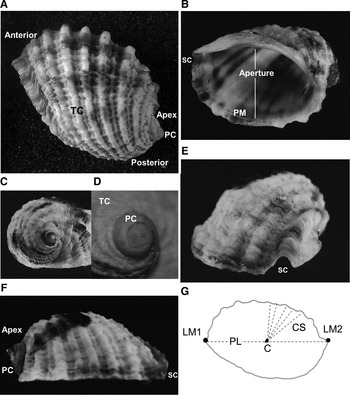
Shells were photographed using a Nikon digital camera (Coolpix 4500). Using tpsDig© software (v. 1.40, Rohlf, Reference Rohlf2004) the outlines of the shell were digitized using 1000 points on a 2-D map, each with its x–y coordinates. Two additional landmarks situated at the siphonal canal (LM1) and at the protoconch on the shell apex (LM2) were included (Figure 2A, B). The distance between those landmarks correspond to the PL of C. concholepas (Manríquez et al., Reference Manríquez, Lagos, Jara and Castilla2009). The resulting 2-D representation of the shell outlines was processed using elliptic Fourier analysis (Kulh & Giardina, Reference Kulh and Giardina1982) in order to decompose a closed curve (outlines) into several components of a given frequency or harmonic. Using an adapted version of the software MAO v. 1.0 (available via author, on request), we selected 20 harmonics from each shell outline, each one composed of four Fourier coefficients (increasing the number to 40 harmonics produced same results). Analytical properties of the Fourier coefficients demonstrated that: (a) the original contour could be reconstructed based on these coefficients; (b) that similar contours produce similar Fourier coefficient; and (c) that they could be normalized allowing for comparison between individuals with different body sizes (Crampton, Reference Crampton1995). Contour coordinates were also used to calculate the centroid size (CS) (Table 1), the square root of the quadratic distance from each contour point to the shell centre (Figure 2G). For comparison between populations, Fourier coefficients of each individual where normalized by size, initial point, and rotated in order to allow for the x-axis of the 2-D coordinate map to coincide along the PL axis defined by as the line between the LM1 and LM2 (Figure 2G). Similar outline analyses have been applied to organisms with a broad variety of morphological patterns such as foraminifera (Lohmann, Reference Lohmann1983), fish (Cadrin, Reference Cadrin2000), ostracods (Baltanás et al., Reference Baltanás, Alcorlo and Danielopol2002) and molluscs (Krapivka et al., Reference Krapivka, Toro, Alcapan, Astorga, Presa, Pérez and Guiñez2007) and are particularly appropriate for species, such as C. concholepas, with poor ornamentation and few significant shell landmarks (Baltanás et al., Reference Baltanás, Brauneis, Danielopol and Linhart2003). Our data set (each specimen described by a total of 80 elliptic Fourier coefficients) was then ordered using principal components analysis (PCA). The PCA was performed on the covariance matrix to keep weights of different harmonics proportional to their variances. In that way, lower order harmonics that describe general features of the shape have a larger influence on the final ordination than higher order harmonics describing structures of small magnitude (Baltanás, 2007). Although normalizing for individual size makes shape descriptors independent of size, such transformation does not fully remove the influences due to allometry (Klingenberg Reference Klingenberg1998; Zelditch et al., Reference Zelditch, Swiderski, Sheets and Fink2004). Allometric influence can be ignored either if samples are composed of individuals of similar size or if allometric signal is low (Monteiro Reference Monteiro1999; Zelditch et al., Reference Zelditch, Swiderski, Sheets and Fink2004). Because individuals from different localities differ significantly in CS (analysis of variance (ANOVA), F = 21.65, P < 0.0001, see Table 1), PCA scores were then regressed on CS values in order to identify the magnitude of the allometric signal, demonstrating that less than 2% of total shape variability was explained by size and thus was small enough not to be considered. Accordingly, the first ten PC scores, accounting for 95.6% of total variance, were used as shape descriptors to assess for differences between-populations in subsequent statistical analyses.
Concholepas concholepas: (A) outer view of the shell depicting the imbricated sculpture pattern (radial ribs crossed by co-marginal ribs) over the teloconch (TC); remnant of the protoconch (PC) is located in the apex, at the posterior area of the shell; (B) inner view showing the siphonal canal (SC), highlighting the wide aperture and the pallial margin (PM) of the shell; (C) posterior view showing the apex; (D) close-up of the apex pesenting the PC and the TC; (E) anterior view showing the SC; (F) lateral view along the PC to SC axis; (G) coordinate outline representation of the shell. C, centroid; CS, centroid size; LM1, landmark 1 at the SC position; LM2, landmark 2 at the PC position; PL, peristomal length.

Shell mineralization
Finally, we characterized patterns of CaCO3 mineralization in order to measure the proportion of calcite and aragonite forms of CaCO3 in shells of C. concholepas via powder X-ray diffraction (XRD) analysis (see Ries, Reference Ries2011). Five shells collected in northern and southern regions, representing the extremes of morphotypes (see Results below), were crushed, approximately 30 mg of shell material were gently ground for 30 s into a fine powder using a 95% ethanol-cleaned agate mortar and grinder. This was then injected into a 1 cm × 1 cm × 10 μm container on a glass slide and then subjected to XRD analysis for a period of 20 min. In addition, we explored, in a preliminary form, XRD pattern across sections of the shell (apex, teloconch, and pallial margin, see Figure 2A–D) in a single individual collected in central Chile. A powder XRD pattern of the prepared material was generated with a PANalytical X-ray diffractometer using the facilities at the Mineralogy and Petrology Department of Granada University (Spain).
Statistical analyses
The first ten PC scores were used as shape descriptors in multivariate analysis of variance (MANOVA) and discriminant function analysis (DFA) to assess for shape differences between-populations and to examine the reclassification success of the snail to the regions where they were collected (northern, central and southern Chile). The PCA and DFA analyses where done using an R routine (R Development Core Team, 2009). Because DFA regards an a priori classification scheme (the region from where the snail comes from), the resulting discriminant function (DF1 and DF2) provides shell information (either concerning the overall shape or tiny details) that can be reliably used to discriminate among regions. Thus, we used linear correlation (r-Pearson) and multiple regression analysis to explore the relationship between morphological descriptor DF1 and DF2 with environmental variables. Diagnostic analysis indicates that salinity and AT could be excluded because of redundancy with respect to SST and pCO2 variations. The relative influence of SST and pCO2 over shell morphology was estimated as the type III semi-partial correlation (sr 2 ) (Freckleton, Reference Freckleton2002, see also Lagos et al., Reference Lagos, Castilla and Broitman2008; Vargas et al., Reference Vargas, Martinez, Escribano and Lagos2013) in a multiple regression model assuming that environmental variables were measured without error using the GLM proceduce (SAS Institute, 1996).
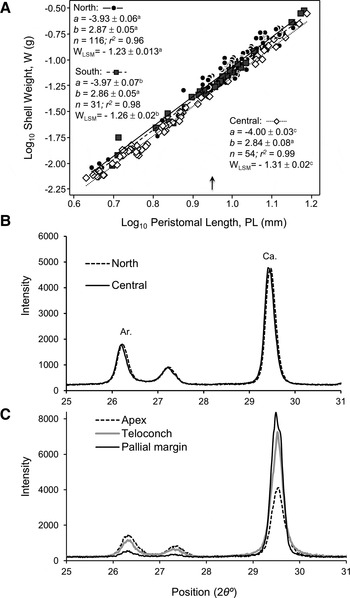
For a subset of 201 shell samples having comparable peristomal length (4.3–15.2 mm), we test for differences in dry shell weight (W) between regions using analysis of covariance (ANCOVA), with the peristomal length (PL) of the shell as covariate. We tested for differences in slopes (b), intercepts (a) and least square means (LSM) for the scaling relationship PL = Wb. Although the intercept a is omitted in this equation, it represents the normalizing constant for the scaling relationship and LSM correspond to the fitted value of W (dry shell) at the mean value of the covariate (PL). These analyses were done using Proc GLM (SAS Institute, 1996). Finally, we tested for differences between northern and central Chile populations in the proportion of calcite and aragonite (%) in the shells using one-way ANOVA. These proportional data were square-root transformed to meet ANOVA assumptions (SAS Institute, 1996).
RESULTS
The study regions exhibited a clinal variation in SST (Figure 1B, C). However, this latitudinal pattern was not properly characterized by our in situ discrete sampling measures of SST (Table 2). Higher values of AT and pCO2 were recorded in central Chile, also with no clinal variation along the coast. Saturation states Ω for calcite and aragonite exhibited their highest values in northern Chile and their minimum, very near to corrosive levels, in central Chile. Southern Chile locations exhibited intermediate values for these carbonate systems parameters (Table 2).
Study sites latitudes, historical SST averages, and summary of carbonate systems parameters measured in situ. SST, sea surface temperature; S, salinity, pH levels (mean ± SD); AT, total alkalinity (mean ± SD); pCO2, partial pressure of CO2; Ω, saturation state for calcite and aragonite.

1, available at http:www.podacc.gov; 2, total alkalinity was assumed to be proportional to salinity using the empirical relationship provided by Lefebvre et al. (1992); SD, standard deviation.
Shell sculpture patterns in juvenile Concholepas concholepas were characterized as a thick and round shell, patulous (wide aperture), with a reduced spiral that is observed ventrally. The outer surface of the shell, lacking periostracum, was either white-grey or darkish with patterning (Figure 2), and sculptured features included radial ribs and axial ridges that added variation to the crenulated shell outline at the pallial margin (Figure 2A). The inner shell was white in colour, smooth and glossy (Figure 2B). The remnant of the larval protoconch was still present at the shell apex (Figure 2C, D).
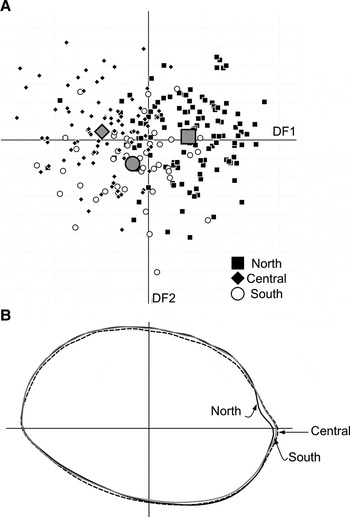
The MANOVA/DFA performed on PC scores (first ten components account for 95.6% of total variance) indicates significant spatial segregation in shell outlines among regions (Wilks' λ = 0.4314; DF = 20, 480; F = 12.54; P < 0.0001) (Figure 3A). Cross-validated DFA showed a relative high success in the correct assignation of individual snails to the region where they were collected (72.2% in average for all regions), with increased reclassification success in individuals collected at the northern and central regions (Table 3) with respect to snails collected at the southern region. These regional differences in shell outlines of C. concholepas were more evident in the apex area, with extreme morphotypes presented by juvenile snails inhabiting at northern and central regions, while the shape of snails from the southern region lay at intermediate levels with respect to these extreme morphotypes (Figure 3B).
Concholepas concholepas: (A) discriminant function analysis based on shape descriptors (first ten PC scores) of the individual shells collected at three regions. Oversized grey-filled symbols indicate the average position for each population; (B) overlapped averaged shell outlines for three populations depicting changes in shell morphology mainly at the apex area. Northern, black line; central, dashed line; southern, grey line.

Concholepas concholepas. Results of cross-validated assignations using discriminant function analysis (DFA—see text for details). In bold are shown the number of individuals of C. concholepas correctly assigned to the region (site) where they were collected.

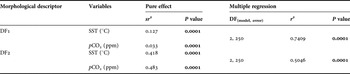
Morphological descriptors DF1 and DF2 were significantly correlated with SST (DF1: r = −0.84; DF2: r = −0.15, P < 0.01 in both cases), pCO2 (DF1: r = 0.79, DF2: r = −0.29, P < 0.001 in both cases), and salinity (DF1: r = −0.21, DF2: r = −0.68, P < 0.001 in both cases). However, AT was significantly associated only with DF2 (r = –0.71, P < 0.0001). The multiple regression model including only SST and pCO2, indicate that the pure effects of pCO2 (sr 2 = 0.033) over DF1 were relatively lower in importance compared to SST (sr 2 = 0.127; Table 4). In the case of DF2, both environmental variables showed similar relative influences (sr 2 ≈ 0.4). Differences between the additive pure influence of each environmental variable (sr 2 ) with respect to the joint influence of both variables (r 2 ) (Table 4), indicated a case of shared variance between variables that may result from the synergistic effects of SST and pCO2 over shell outlines descriptors.
Concholepas concholepas. Relative influences (sr 2 ) of environmental variables on the discriminant functions DF1 and DF2 as proxy variables of snail shell morphology. The squared semi-partial correlation (sr 2) measures the pure effect of each environmental variable upon morphological factors; r 2 is the determination coefficient of the corresponding multiple regression models. Significant P values are shown in bold.

Dry shell weight (W) of C. concholepas exhibited a significant scaling relationship with the shell peristomal length (PL) (Figure 4A). However, this scaling relationship showed no significant differences in slope between regions (ANCOVA, F(2,195) = 0.11; P = 0.893), but significant differences between intercepts (F(2,197) = 39.7; P < 0.001). When dry shell weight was compared among-region at the mean value of the covariate (PL; mean = 0.947 ± 0.01 E.E.), the least square estimation indicated that northern populations of C. concholepas have their shells more heavily calcified than central and southern populations (WLSE in Figure 4A). The different intercepts represent the normalizing constants for the overall scaling equation of the form: W = PLb, where the slope b = 2.98 (± 0.03 E.E.; N = 253; P < 0.001), representing the increase in dry shell weight as an increase in the PL of C. concholepas (Figure 4A).
Concholepas concholepas: (A) scaling relationship between peristomal length (PL) and dry shell weight (W) for individuals collected from the three studied populations with comparable size ranges between 4.23 and 15.4 mm. For each population is shown the estimated parameters (±1 standard error) of the fitted power regressions, where: a = intercept, b = exponent, r 2 = determination coefficient, WLSM = fitted value of W at the mean value of the covariate PL (indicated by the arrow) and N = sample size; different superscripts indicate significant differences among region for the corresponding parameters; (B) averaged (N = 5 shells) X-ray diffraction patterns for the complete shell representing extreme morphotypes from central and northern Chile; (C) across the apex, teloconch, and pallial margin of a single shell from central Chile. Ca and Ar represent the position for the pure calcite primary peak at 2θ = 29.4–29.5° and the pure aragonite primary peak at 2θ = 26.2°, respectively. Intensity in the y-axis is in arbitrary units.

The X-ray diffraction patterns in shells of C. concholepas juveniles collected from northern and central Chile populations were similar (Figure 4B). In both regions, powder of complete shells showed a significant large increase in the proportion of calcite (56.64% ± 3.32 SD) with respect to aragonite (43.36% ± 3.32 SD) (ANOVA: F(1,18) = 79.8; P < 0.0001). Proportion of aragonite content in shells of individuals collected in central and northern Chile was 43.12% (±4.5 SD) and 43.6% (±2.1 SD), respectively, with non-significant differences between regions (ANOVA: F(1,8) = 0.051; P = 0.834). Proportion of calcite in shells of C. concholepas was also similar between regions, 56.8% (±4.5 SD) and 56.4% (±2.1 SD) in central and northern Chile, respectively (ANOVA: F(1,8) = 0.052; P = 0.833). Powdered portions of the single shell analysed for a central Chile individual, showed an increase in the proportion of calcite (Ca), and a corresponding decrease in aragonite (Ar) from the apex (Ca = 58.2%; Ar = 41.8%), to teloconch (Ca = 75.8%; Ar = 24.2%), to the pallial margin (Ca = 88.8%; Ar = 11.2%). These changes in mineralization across the shell were evident by the peaks of aragonite and calcite revealed in the X-ray diffraction patterns of each shell section (Figure 4C).
DISCUSSION
Our study along the Chilean coast encompasses locations separated by almost 2200 km, where substantial latitudinal variation in environmental variables such SST, salinity and sea–air CO2 flux (Strub et al., Reference Strub, Mesías, Montecino, Rutllant, Salinas, Robinson and Brink1998; Torres et al., Reference Torres, Pantoja, Harada, González, Daneri, Frangopulos, Rutllant, Duarte, Rúiz-Halpern, Mayol and Fukasawa2011; Mayol et al., Reference Mayol, Ruiz-Halpern, Duarte, Castilla and Pelegrí2012) may impose challenges for the resident marine populations. Across this environmental gradient, we found that the shell shape of Concholepas concholepas showed consistent patterns of geographical variation for the studied populations: juvenile individuals collected in northern and central regions of the Chilean coast may represent the extreme morphotypes, evidenced by the higher level in reclassification success for the snail collected in these regions (>75%). The southern populations represent intermediate shell morphology in the multidimesional morphospace (DFA). These differences in shell morphology cannot be ascribed to allometric variability between populations because shell centroid sizes showed extreme values at southern and central Chile populations, the northern population being the intermediate population (see Table 1). The rank of extreme morphotypes is also supported by the changes in the shell apex depicted by the averaged model of shell outlines. This is also supported by the lack of clinal latitudinal variation in SST, AT, pCO2 levels, and Ω for aragonite and calcite in seawater recorded by our discrete sampling, instead presenting extreme values in northern and central Chile. These results suggest that, at least in proportional terms, the geographical variability in shell morphology of C. concholepas may be explained by the joint influence of SST and pCO2. As discussed below, these shell changes, mostly in the apex of C. concholepas, may correspond to phenotypic plasticity induced by the environmental gradient in SST and pCO2 occurring along the Chilean coast.
The observed geographical changes in the shell shape of C. concholepas showed a significant relationship with the physical–chemical properties describing the collection sites. Thus, these changes may be related to environmentally-induced phenotypic plasticity. This was the case recently demonstrated for the diet-induced changes in shell colour of C. concholepas during early ontogeny including northern and central Chile populations (Manríquez et al., Reference Manríquez, Lagos, Jara and Castilla2009). If changes in shell shape of C. concholepas represent another case of phenotypic plasticity, regional differences described here do not provide information about the possible role of larval dispersal and genetic flow among populations of C. concholepas. In particular, this species lays egg capsules on exposed rocky shores, from which after ~1 month, veliger larvae hatch and spend ~3 months in the water column until settlement (DiSalvo, Reference DiSalvo1988; Manríquez et al., Reference Manríquez, Galaz, Opitz, Hamilton, Paradis, Warner, Castilla, Labra and Lagos2012). Thus C. concholepas has a high potential for spatial larval dispersal, which is in agreement with the genetic homogeneity described for the species along the SE Pacific coast (Cardenas et al., Reference Cárdenas, Castilla and Viard2009, see also Sanchez et al., Reference Sánchez, Sepúlveda, Brante and Cárdenas2011 for genetic homogeneity along the Chilean coast in an intertidal gastropod with direct development). However, recent population connectivity studies inferred from the trace elemental composition of statoliths, suggest that the same regions as studied here encompass geographically separate stocks (Manríquez et al., Reference Manríquez, Galaz, Opitz, Hamilton, Paradis, Warner, Castilla, Labra and Lagos2012). In spite of the genetic homogeneity, this geographical segregation of C. concholepas stock is also supported by the high success rates in reclassification of individuals to the site where they were collected based on the Fourier coefficients of the shell shape used in our study.
Along the northern and central Chilean coast, wind-induced upwelling is the main coastal process leading to changes in SST, influencing the benthic populations and communities (Lagos et al., Reference Lagos, Navarrete, Véliz, Masuero and Castilla2005, Reference Lagos, Castilla and Broitman2008). These meso-scale fluctuations in SST are imposed over the influence of subtropical waters and the Humboldt Current, leading to a well established clinal variation in SST along the SE Pacific Chilean coast (Strub et al., Reference Strub, Mesías, Montecino, Rutllant, Salinas, Robinson and Brink1998). This environmental cline has been related to corresponding clinal variability in the shell morphology of mussels (Kaprivka et al., Reference Krapivka, Toro, Alcapan, Astorga, Presa, Pérez and Guiñez2007) and gastropods (Sanchez et al., Reference Sánchez, Sepúlveda, Brante and Cárdenas2011; Sepúlveda & Ibañez, Reference Sepúlveda and Ibáñez2012) inhabiting between 28°S and 53°S. These studies suggest that spatial variation in mollusc shells may be ascribed to environmental variability and habitat discontinuities operating both at local and biogegraphical scales. However, in this study, we do not find a corresponding latitudinal cline in the shell shape of C. concholepas because the extreme morphotypes were collected in northern and central Chile regions. Our results indicate significant semi-partial correlations between descriptors of shell shape (DF1 and DF2) and variations in pCO2 and SST across the study regions. These results could be associated with two coastal processes that interrupt the clinal variability in SST described above: (1) the abrupt changes in the direction of carbon flux at the ~37°S latitude, from CO2-outgassing in the northern and central Chile upwelling regions to CO2-sequestering in non-upwelling areas in southern Chile (Torres et al., Reference Torres, Pantoja, Harada, González, Daneri, Frangopulos, Rutllant, Duarte, Rúiz-Halpern, Mayol and Fukasawa2011; Mayol et al., Reference Mayol, Ruiz-Halpern, Duarte, Castilla and Pelegrí2012); and (2) the corresponding increase in river discharge into coastal areas located south of ~37°S (Davila et al., Reference Dávila, Figueroa and Müller2002). A possible third explanation, that requires further research, may be the geographical distribution of C. concholepas predators such as seastars and crabs, because plasticity in shell colour changes is an adaptive response to these sources of mortality (Manríquez et al., Reference Manríquez, Lagos, Jara and Castilla2009). For instance, Trussell (Reference Trussell2000) found differences in the shell form of Littorina obtusata snails, body mass, and suggest that this may be induced by of geographical differences in both water temperature and the abundance of crab predators.
Regarding only the studied environmental parameters, it is possible that individuals of C. concholepas collected in the southern region may have been exposed to stress by both the input of acidic freshwaters (e.g. Salisbury et al., Reference Salisbury, Green, Hunt and Campbell2008) and reduced carbonate saturation state (Ω) due to increased pCO2 sequestration (Torres et al., Reference Torres, Pantoja, Harada, González, Daneri, Frangopulos, Rutllant, Duarte, Rúiz-Halpern, Mayol and Fukasawa2011). In addition, coastal upwelling is strong and persistent in the central Chile region compared to the northern region, and with significant seasonal variability towards southern regions (Strub et al., Reference Strub, Mesías, Montecino, Rutllant, Salinas, Robinson and Brink1998). Thus, the potential penetration of corrosive waters (Ω < 1, e.g. Feely et al., Reference Fabry, Seibel, Feely and Orr2008) over the Chilean coastal ocean of the studied regions may also lead to low carbonate saturation states (Torres et al., Reference Torres, Pantoja, Harada, González, Daneri, Frangopulos, Rutllant, Duarte, Rúiz-Halpern, Mayol and Fukasawa2011; Mayol et al., Reference Mayol, Ruiz-Halpern, Duarte, Castilla and Pelegrí2012) making the shell mineralization by juveniles of C. concholepas in southern and central Chile more difficult compared to northern Chile populations. The use of experimental reciprocal transplants would help to disentangle the role of environmental variation on spatial variations of shell morphology of C. concholepas (Lagos et al., unpublished data).
Environmental processes affecting SST and carbonate systems parameters along the Chilean coast may influence the shell morphology of C. concholepas by promoting changes in shell mineralization, dissolution and/or calcification. They may also explain the subtle observed differences between study regions in the shell weight of C. concholepas. In particular, it is well established that CaCO3 content in marine gastropods exhibits a scaling relationship with dry shell weight and with slopes very similar to those reported here (b ≈ 3, see Palmer, Reference Palmer1982). In addition, under elevated pCO2 levels and ΩÂ ≈ 1) morphological changes due to shell dissolutions occurs in marine gastropods and mussels producing different forms of CaCO3 (Ries, Reference Ries2011), and in particular for those species, like C. concholepas, lacking the protective organic layers such as the periostracum (see Rodolfo-Metalpa et al., Reference Rodolfo-Metalpa, Houlbrèque, Tambutte, Boisson, Baggini, Patti, Jeffree, Fine, Foggo, Gattuso and Hall-Spencer2011).
Mineralization studies suggest that CaCO3 forms are differentially distributed across the shell of C. concholepas: inner aragonite layers and outer calcitic layers (Dauphin et al., Reference Dauphin, Guzmán, Denis, Cuif and Orlieb2003; Guzman et al., Reference Guzmán, Dauphin, Cuif, Denis and Orlieb2009). In molluscs, aragonite tends to be a mechanically strong material (de Paula & Silveira, Reference Paula and Silveira2009), but more susceptible to corrosion in sub-saturated waters (Ω < 1) such as those penetrating the coastal ocean via upwelling and river discharges (Feely et al., Reference Fabry, Seibel, Feely and Orr2008; Salisbury et al., Reference Salisbury, Green, Hunt and Campbell2008). Our analysis of mineralization in juvenile individuals of C. concholepas suggests a higher proportion of calcite than aragonite in their shells, which is similar for individuals collected from central and northern Chile populations. However, this apparently geographically invariant property in the calcification process between populations may show variability over ontogeny. Dauphin et al. (Reference Dauphin, Guzmán, Denis, Cuif and Orlieb2003) report that in adult individuals of C. concholepas, the thickness was variable over the shell: the aragonitic inner layer is thicker near the apex (1140 μm) but becomes thinner towards the pallial margin (120 μm) and near the growing edge of the shell. These results agree with our preliminary finding that suggests a corresponding reduction in the proportion of aragonite with respect to calcite from the apex to the pallial margin of the shell. This observation is also supported by recent mineralization studies in marine gastropods and bivalves that indicate that shells of early life stages (larval protoconch) and juveniles are mainly composed of aragonite (Auzoux-Bordenave et al., Reference Auzoux-Bordenave, Badou, Gaume, Berland, Helléouet, Milet and Huchette2010). This potential ontogenic shift in shell mineralization of C. concholepas requires more research because aragonite tends to be 1.5 times more soluble than calcite (Feely et al., Reference Fabry, Seibel, Feely and Orr2008; Salisbury et al., Reference Salisbury, Green, Hunt and Campbell2008). Recently, Welladsen et al. (Reference Welladsen, Southgate and Heimann2010) found that the bivalve Pinctada fucata exposed to acidified conditions (pH 7.6) showed signs of malformation and/or dissolution over the nacre (aragonite) lining of the shells. We found that a minimum saturation state for aragonite in seawater in central Chile (ΩA = 1.377), was very close to the net shell dissolution conditions (ΩA < 1). Thus, the significant relationship between geographical changes in the shell of C. concholepas with pCO2 and SST may be particularly associated with the observed changes in the apex, a potentially aragonite-enriched area in the shell of C. concholepas, which is more susceptible to shell dissolution.
Variability in carbonate system parameters along the coast may affect shell calcification and/or dissolution in marine calcifying organism (Feely et al., Reference Feely, Sabine, Hernandez-Ayon, Ianson and Hales2008; Rodolfo-Metalpa et al., Reference Rodolfo-Metalpa, Houlbrèque, Tambutte, Boisson, Baggini, Patti, Jeffree, Fine, Foggo, Gattuso and Hall-Spencer2011; Mayol et al., Reference Mayol, Ruiz-Halpern, Duarte, Castilla and Pelegrí2012). Thus, it is possible to suggest that, when comparing populations exposed to distinct level of corrosive waters, morphological changes in juvenile stages of C. concholepas, and related gastropods, will occur in shell areas where the proportion of aragonite is higher than calcite. From this perspective, the study of spatial variation in shell morphology and the mineralization patterns of marine organisms will become of crucial importance in tracking, under natural and laboratory conditions, contemporary and future changes induced by climate change at organismal level, and its populations and community implications.
ACKNOWLEDGEMENTS
We wish to thank Gabriela, Sergio, Belen, Pantoja, Tania, Sylvana, Dra. Paula Neill, P. Aravena and A. Espinoza for their kind support in the field and Labs Dra. Cecilia Osorio for suggesting the use of appropriate terminology for the shell description. This work is part of a Masters thesis of L.R. at Departamento de Ecología, Universidad Autónoma de Madrid, España and a PhD thesis (Global Change Program, UIMP). We also acknowledge the comments of an anonymous referee in improving the final version of this study.
FINANCIAL SUPPORT
This study was funded by grants FONDECYT–CONICYT 1090624 (TOA-SPACE), PIA–CONICYT–ANILLO ACT–132 to N.A.L., P.H.M. and R.T.; Fondecyt 1080023 to P.H.M. and N.A.L. and Project N000012742-UST to N.A.L. L.R. acknowledges BECAS CHILE–CONICYT for a graduate research fellowship.