Introduction
Observed in psychiatric patients for at least 200 years (Haslam, Reference Haslam and Porter1811), disruption of verbal communication is a cardinal feature of schizophrenia that was recorded by both Kraepelin (Reference Kraepelin1913) and Bleuler (Reference Bleuler1911). Factor-analytic studies confirm that disordered speech is a core feature of schizophrenia that, together with inappropriate affect and bizarre behavior, consistently reflects a disorganization dimension distinct from delusions, hallucinations, and negative symptoms (Liddle, Reference Liddle1987; Andreasen et al. Reference Andreasen, Arndt, Alliger, Miller and Flaum1995). Presence of communication disorder, further, predicts poor educational, occupational and social functioning (Harrow et al. Reference Harrow, Marengo and McDonald1986; Norman et al. Reference Norman, Malla, Cortese, Cheng, Diaz, McIntosh, McLean, Rickwood and Voruganti1999).
Traditionally (e.g. Bleuler, Reference Bleuler1911), speech disturbance has been seen as a reflection of underlying disturbance of thought. Thus, measures such as Andreasen's (Reference Andreasen1983) Scale for the Assessment of Positive Symptoms (SAPS) codify communication disturbance in terms of thought disorder. Other theorists have conceptualized communication disorder as arising from linguistic disorganization or deficits in neurocognitive abilities such as attention, memory and executive function (McKenna & Oh, Reference McKenna and Oh2005). We follow Docherty (Reference Docherty2005) in (i) conceptualizing communication disorder in functional terms as a disruption of successful conveyance of meaning, and (ii) regarding thought disorder, linguistic disorganization and neurocognitive deficits as overlapping causal factors of communication deviance.
There is evidence, however, that psychological factors such as concerns and dysfunctional beliefs also play a role in communication difficulties. Several researchers have reported that communication disorder is instigated or aggravated when emotionally charged topics are discussed (Shimkunas, Reference Shimkunas1972; Docherty et al. Reference Docherty, Evans, Sledge, Seibyl and Krystal1994; Haddock et al. Reference Haddock, Wolfenden, Lowens, Tarrier and Bentall1995). Criticism, specifically, has been shown to disorganize speech in patients with schizophrenia (Rosenfarb et al. Reference Rosenfarb, Goldstein, Mintz and Nuechterlein1995, Reference Rosenfarb, Nuechterlein, Goldstein and Subotnik2000). We have, in a similar vein, collected clinical data suggesting that pharmacologically stabilized patients diagnosed as ‘thought disordered’ who have concerns of being negatively evaluated experience exacerbation of communication problems, whereas feelings of being accepted mitigate these problems.
The research literature and clinical observations of this sort suggest to us that patients with communication deviance are highly sensitive to possible criticism and hold strong beliefs regarding the impact of being rejected by other people (e.g. ‘If others dislike you, you cannot be happy’). Such beliefs reflecting evaluation sensitivity are incorporated into cognitive schemas (Beck et al. Reference Beck, Freeman and Davis2004) and become activated in the context of potential negative evaluation. Beliefs about the consequences of not being accepted interact with memory and attention deficits (Kerns & Berenbaum, Reference Kerns and Berenbaum2002; Phillips & Silverstein, Reference Phillips and Silverstein2003) to produce the symptoms of disorganized communication. Thus, we hypothesize that patients diagnosed with thought disorder will endorse more dysfunctional beliefs regarding acceptance and rejection than non-thought-disordered patients with schizophrenia. We also predict that these dysfunctional beliefs will moderate neurocognitive impairment to predict the presence of thought disorder. These effects will be independent of other symptom dimensions (i.e. hallucinations, delusions, and negative symptoms). We specifically expect that neither general levels of anxiety nor depression will predict communication deviance because the effect should be confined to specific social situations that pose the threat of evaluation.
Method
Participants
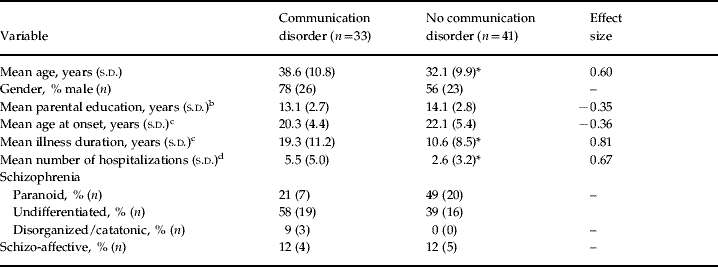
The sample included 74 adult out-patients (Table 1) recruited from a sample of potential participants at the Schizophrenia Research Center at the University of Pennsylvania who met Diagnostic and Statistical Manual of Mental Disorders 4th edition text revised (DSM-IV-TR; APA, 2000) criteria for schizophrenia or schizo-affective disorder. Patients were referred for a study of negative symptoms and poor functioning. Diagnosis was determined on a consensus best-estimate basis by an assessment team (M.D. and Ph.D.) based upon a structured interview (Nurnberger et al. Reference Nurnberger, Blehar, Kaufmann, York-Cooler, Simpson, Harkavy-Friedman, Severe, Malaspina and Reich1994) conducted by an assessor trained to criterion (intra-class correlation >0.80). All recruitment contacts were made blind to current patient symptomatology and level of functioning. Of the referred patients, 33 showed at least mild levels of communication disturbance; 41 manifested no communication deviance (see below for details).
Participant characteristicsFootnote a
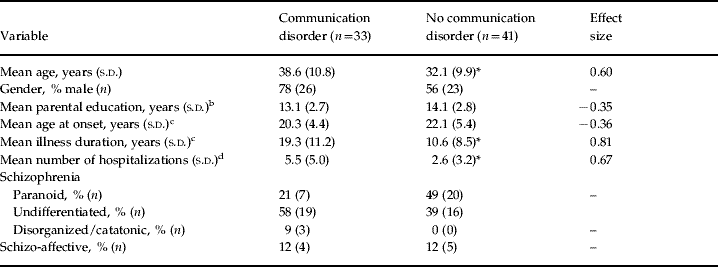
s.d., Standard deviation.
a Communication disorder=global positive formal thought disorder score of ‘mild’ or higher; no communication disorder=global positive formal thought disorder score of ‘questionable’ or lower; Scale for the Assessment of Positive Symptoms (Andreasen, Reference Andreasen1983).
b Parental education is average of father's and mother's education level; data missing from eight patients, four in each condition.
c Data missing from two communication disorder patients.
d Data missing from 12 patients, six in each condition.
* Mean value was significantly different from that of the Communication disorder group (p<0.05).
Procedure
All participants attended a single research session lasting between 2 and 4 h. A masters-level or Ph.D. interviewer trained to criterion (inter-class correlation >0.80 for ratings of positive and negative symptoms) administered symptom and attitude measures that included interviewer-rated and self-report instruments. Collateral information from family members and treating psychiatrists was factored into clinician ratings of symptoms and functioning, which were made blind to attitude endorsements and neurocognitive performance. Cognitive impairment was assessed via two computerized tasks selected to test abstraction, verbal memory and working memory, domains related to communication disturbance in schizophrenia (Kerns & Berenbaum, Reference Kerns and Berenbaum2002). After the procedure was fully explained, written informed consent was obtained from all participants. This procedure was approved by the Institutional Review Board at the University of Pennsylvania. All participants were compensated for completing study assessment procedures.
Materials
Symptoms and functioning
Speech disorder was assessed using the global rating [i.e. ‘absent’ (0), ‘questionable’ (1), ‘mild’ (2), ‘moderate’ (3), ‘marked’ (4), ‘severe’ (5)] of the positive formal thought disorder subscale of SAPS (Andreasen, Reference Andreasen1983). Patients rated ‘mild’ or higher were classified as communication disordered; patients rated as ‘questionable’ or lower were classified as not having communication disorder. Global ratings of the SAPS hallucinations and delusions subscales, respectively, indexed severity of psychotic symptoms. The total score (excluding attention subscale items, inappropriate affect and poverty of content) of the Scale for the Assessment of Negative Symptoms (Andreasen, Reference Andreasen1984) assessed negative symptom severity. Depression and anxiety were self-reported on the Beck Depression Inventory II (BDI-II; Beck et al. Reference Beck, Steer and Brown1996) and the Beck Anxiety Inventory (BAI; Beck & Steer, Reference Beck and Steer1990) respectively. All symptom ratings reflect the previous week. Functioning was determined by Strauss–Carpenter Levels of Function (LEV; Strauss & Carpenter, Reference Strauss and Carpenter1974), a nine-item interviewer-scored instrument that indexes the previous month, with higher scores being indicative of better functioning. In the present sample, Cronbach's α was 0.94 for the BDI-II, 0.93 for the BAI and 0.85 for the LEV.
Belief endorsement
Evaluation sensitivity was assessed with a subscale of the Dysfunctional Attitude Scale (DAS; Weissman, Reference Weissman1978). The DAS consists of 40 statements to be rated on the following seven-point scale: ‘agree totally’ (7), ‘agree very much’ (6), ‘agree somewhat’ (5), ‘neutral’ (4), ‘disagree somewhat’ (3), ‘disagree very much’ (2) and ‘disagree totally’ (1). For each of the 40 items, participants were instructed to select the option that describes how they think most of the time. The DAS can be reliably administered (Blankstein & Segal, Reference Blankstein, Segal and Dobson2001) and its use in out-patient samples diagnosed with schizophrenia has been validated (Rector, Reference Rector2004; Grant & Beck, Reference Grant and Beck2008). The six items that compose the evaluation sensitivity subscale (see Appendix) were identified by factor analysis of responses in a large (n=2023) clinical sample (Beck et al. Reference Beck, Steer, Brown and Weissman1991)Footnote †. While Beck et al. labeled the subscale ‘need for approval’, the scale is better termed evaluation sensitivity, as the statements exaggerate the importance of being accepted and, correspondingly, the impact of being rejected by other people (e.g. ‘If others dislike you, you cannot be happy’). Cronbach's α was 0.70 in the present study.
Neurocognitive assessment
In the Penn Word Memory Test (Gur et al. Reference Gur, Jaggi, Ragland, Resnick, Shtasel, Muenz and Gur1993), participants first sequentially view 20 target words and then complete a recognition task in which 20 distracters (matched for frequency, word length, concreteness and imagibility) are interleaved with the targets. The recognition task is repeated after 20 min with 20 new and equated distracter words. Each trial of the Abstraction and Working Memory Test (Glahn et al. Reference Glahn, Cannon, Gur, Ragland and Gur2000) consists of five stimuli: a single target stimulus appears at the bottom center of the computer screen and a pair of stimuli appears in both the upper-right and upper-left corner of the screen. The participant's task is to choose which pair of stimuli the target stimulus best matches. Match judgments are made on the basis of shape and color, guided by feedback. On half of the trials the target disappears before the match pairs are displayed. Neurocognitive tests were programmed in Flash media, presented in a window within a web browser (mozilla firefox) on either a laptop or desktop computer, and presented in a fixed order across participants. Following previously established procedures (Gur et al. Reference Gur, Nimgaonkar, Almsay, Calkins, Ragland, Pogue-Geile, Kanes, Blangero and Gur2007), (i) accuracy was computed from raw scores of each test and converted to z-scores using normative data, (ii) verbal memory and abstraction/working memory domain scores were computed by averaging the appropriate standardized values, (iii) accuracy domain scores were reversed by subtracting the maximum value from each score, and (iv) these scores were averaged to form the variable ‘cognitive impairment’. Higher scores indicate worse performance.
Data analysis
Because a majority of the sample (n=39) scored zero on communication deviance, and because our hypothesis is that cognitive impairment and evaluation sensitivity are trait-like factors that combine to disorganize speech in specific situations, we employed a moderated logistic regression analytic strategy (Jaccard, Reference Jaccard2001; Agresti, Reference Agresti2007). Specifically, controlling for demographic variables (age and gender), we estimated two models: one in which the main effects of cognitive impairment and evaluation sensitivity predict the presence of communication disorder; a second model in which the interaction term alone predicts the presence of communication disorder. Thus, we follow the strategy of comparing alternative maximum likelihood models to see which fits the data the best (Fienberg, Reference Fienberg1991), utilizing the Hosmer–Lemeshow test, in this instance, as our index of fit (Agresti, Reference Agresti2007). We predict that the Wald χ2 statistic will be significant for the interaction term, and that the model that includes the interaction will fit the data best.
Results
Table 1 contains the sample summary statistics. The patients with communication disorder are, on average, in their mid-thirties, male, and diagnosed with undifferentiated schizophrenia. The control patients are in their early thirties, evenly split between male and female, and have equal numbers diagnosed with paranoid and undifferentiated schizophrenia. It is notable that the two groups do not differ statistically either for average age of onset [t=−1.4, degrees of freedom (df)=70, p>0.10] or parental education (t=−1.5, df=65, p>0.14). The communication disorder group has a longer illness duration (t=3.8, df=70, p<0.01) and more hospitalizations (t=2.6, df=54, p<0.05), differences consistent with these patients being, on average, older than participants in the non-communication disorder group. Of the patients, 19% in both the communication disorder (6/31) and the non-communication disorder (8/41) groups were taking typical antipsychotic agents (e.g. Haldol, Thorazine and Prolixin) at the time of testing. Zyprexa is the most common atypical agent (32% communication disorder patients v. 27% of the non-communication disorder patients), followed by Risperdal (26% v. 20%) and Abilify (16% v. 17%). All patients were taking medications at the time of study.
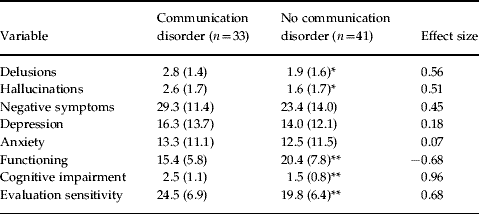
Both groups evidence (Table 2) comparable depression (t=0.77, df=71, p>0.4), anxiety (t=0.31, df=71, p>0.9) and a trend-level difference in negative symptoms (t=1.9, df=72, p>0.05); the communication disorder group, however, manifests more severe delusions (t=2.7, df=72, p<0.01) and hallucinations (t=2.3, df=71, p<0.05), demonstrates a greater cognitive impairment (t=4.7, df=72, p<0.001), endorses evaluation sensitivity to a greater degree (t=3.1, df=72, p<0.01) and has poorer functioning (t=−3.0, df=71, p<0.01) than the group without communication deviance. Group differences are all medium to large effect sizes. For example, the five-point difference in functioning means that, on average, the communication disorder group has fewer social contacts, fewer close relationships, and fewer vocational experiences than the group without communication disorder.
Group differences in psychopathology, neurocognition and attitudesFootnote a
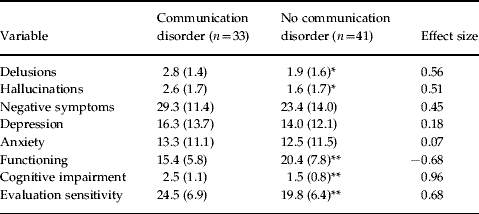
Values are given as mean (standard deviation).
a Communication disorder=global positive formal thought disorder score of ‘mild’ or higher; no communication disorder=global positive formal thought disorder score of ‘questionable’ or lower; Scale for the Assessment of Positive Symptoms (Andreasen, Reference Andreasen1983). Delusions=global rating (scale 0–5); Scale for the Assessment of Positive Symptoms. Hallucinations=global rating (scale 0–5); Scale for the Assessment of Positive Symptoms. Negative symptoms=total score (scale 0–90); Scale for the Assessment of Negative Symptoms (Andreasen, Reference Andreasen1984). Depression=total score (scale 0–63); Beck Depression Inventory II (Beck et al. Reference Beck, Steer and Brown1996). Anxiety=total score (scale 0–63); Beck Anxiety Inventory (Beck & Steer, Reference Beck and Steer1990). Functioning=total score (scale 0–36); Strauss–Carpenter Levels of Functioning (Strauss & Carpenter, Reference Strauss and Carpenter1974). Cognitive impairment=average standardized score. Evaluation sensitivity=subscale (6–42); Dysfunctional Attitude Scale (Weissman, Reference Weissman1978).
Mean value was significantly different from that of the Communication disorder group:
* p<0.05, ** p<0.01.
Correlations
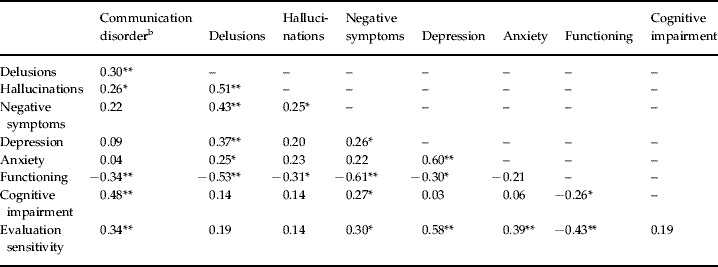
Table 3 presents the correlations between the study variables for the entire sample. Germane to the moderation hypothesis, presence of thought disorder correlates significantly both with cognitive impairment and evaluation sensitivity. Greater communication disorder severity is associated with worse neurocognitive performance and greater agreement with evaluation sensitivity statements. Communication disorder also correlates significantly with positive symptom levels. However, hallucinations and delusions do not correlate reliably with either cognitive impairment or evaluation sensitivity. Negative symptom levels correlate significantly with both verbal memory and evaluation sensitivity; however, the partial correlation between thought disorder and both cognitive impairment (r=0.42, df=71, p<0.001) and evaluation sensitivity (r=0.29, df=71, p<0.05) are significant when negative symptoms are statistically controlled. Depression and anxiety, finally, are significantly associated with evaluation sensitivity, but not significantly associated with either thought disorder or cognitive impairment (p>0.44 for both). This pattern of data suggests that evaluation sensitivity, cognitive impairment and communication disorder are linked in a manner independent of hallucinations, delusions, negative symptoms and negative affect. It is worth observing that cognitive impairment and evaluation sensitivity both correlate significantly with poor functioning.
Correlations between study variables (n=74)Footnote a
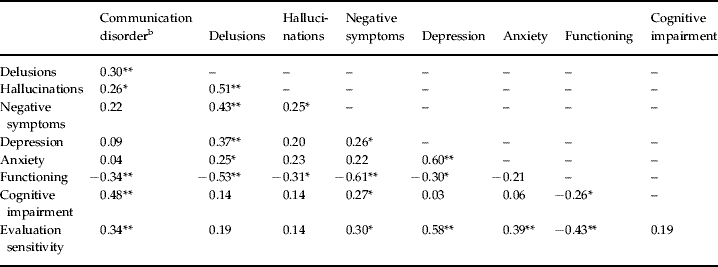
a Communication disorder=binary split (mild and above versus questionable/none) of global rating of positive formal thought disorder; Scale for the Assessment of Positive Symptoms (Andreasen, Reference Andreasen1983). Delusions=global rating; Scale for the Assessment of Positive Symptoms. Hallucinations=global rating; Scale for the Assessment of Positive Symptoms. Negative symptoms=total score; Scale for the Assessment of Negative Symptoms (Andreasen, Reference Andreasen1984). Depression=total score; Beck Depression Inventory II (Beck et al. Reference Beck, Steer and Brown1996). Anxiety=total score; Beck Anxiety Inventory (Beck & Steer, Reference Beck and Steer1990). Functioning=total score; Strauss–Carpenter Levels of Functioning (Strauss & Carpenter, Reference Strauss and Carpenter1974). Cognitive impairment=averaged standardized domain scores. Evaluation sensitivity=subscale; Dysfunctional Attitude Scale (Weissman, Reference Weissman1978).
b Point biserial correlations.
* p<0.05, ** p<0.01.
Moderation
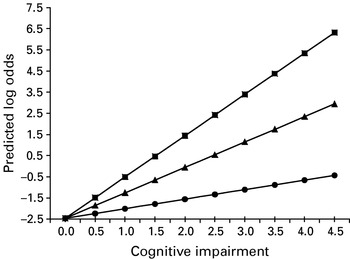
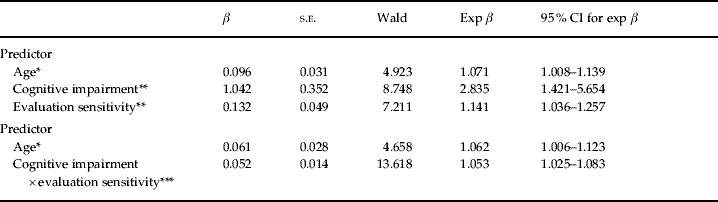
Both age and gender are potential confounders and were included in the logistic models in addition to the variables of interest. Gender was not a significant predictor (p>0.16) in either and was trimmed. Table 4 contains the results of the logistic regressions. In the model that includes the main effects, age, cognitive impairment and evaluation sensitivity are all significant predictors of the presence of communication disorder. The model correctly classifies 74% of the patients and the Hosmer–Lemeshow test indicates a reasonably good fit (χ2=8.7, df=8, p=0.41). In the logistic model of the interaction, both the age term and the cognitive impairment by evaluation sensitivity term are statistically significant predictors of the presence of thought disorder. This model also correctly classifies 73% of the sample. The Hosmer–Lemeshow test indicates a better fit (χ2=2.8, df=8, p=0.95) than the model that just contains the main effects of cognitive impairment and evaluation sensitivity. An elevation of one point in the interaction term increases the likelihood that a patient will be classified as having thought disorder by a factor of 5% (95% confidence interval 2.5–8.1%). These data are consistent with moderation (Kraemer et al. Reference Kraemer, Stice, Kazdin, Offord and Kupfer2001): evaluation sensitivity moderates the relationship between cognitive impairment and speech disorder. Fig. 1 represents this interaction graphically.
Predicted log odds of communication disturbance as a function of the interaction of cognitive impairment and evaluation sensitivity scores. Cognitive impairment is indexed by an average standardized score; higher values reflect more severe impairment. Evaluation sensitivity is a subscale of the Dysfunctional Attitude Scale (Weissman, Reference Weissman1978). –▪–, High evaluation sensitivity; –▴–, medium evaluation sensitivity; –•–, low evaluation sensitivity. Log odds rather than odds are employed here to illustrate the linear trend (Jaccard, Reference Jaccard2001). Age has been set to the mean value.

Logistic regression models of communication disturbance
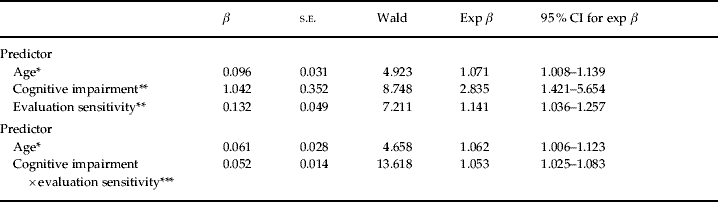
s.e., Standard error; CI, confidence interval.
* p<0.05, ** p<0.01, *** p<0.001.
Discussion
Our findings are consistent with the hypothesis that sensitivity to evaluation moderated the relationship between cognitive impairment and communication disorder in schizophrenia. Specifically, patients with thought disorder showed greater deficits in verbal memory, abstraction and working memory, as well as greater evaluation sensitivity than patients without thought disorder. Logistic regression, further, indicates that the interaction of cognitive impairment and concern about evaluation predicts thought disorder, and that the interaction fits the data better than either factor considered singly or additively. These results are independent of the severity of delusions, hallucinations, negative symptoms, depression, anxiety, as well as medications. Patients who have cognitive impairment and place a premium upon being accepted and not rejected are at elevated risk for communication disturbance relative to patients with either cognitive impairment or rejection sensitivity alone.
The significance of this finding can be explored within the framework of information processing theory (Phillips & Silverstein, Reference Phillips and Silverstein2003; Knudsen, Reference Knudsen2007). Speech production entails a complex interaction of cognitive and motor processes (Levelt, Reference Levelt1989). Many of these processes (e.g. semantic access and memory representations) are executed automatically, placing little demand on overall resources, whereas other processes (e.g. responding to context), so-called controlled processing, require effort and can impose considerable cognitive demand. Analogue studies demonstrate that increasing cognitive load upon working memory and attention produces speech disturbance in healthy samples (Kerns & Berenbaum, Reference Kerns and Berenbaum2003; Kerns, Reference Kerns2007a). Patients with schizophrenia, further, show impairment on controlled language-processing tasks but not tasks tapping automatic processes (Titone et al. Reference Titone, Levy and Holzman2000, Reference Titone, Libben, Niman, Ranbom and Levy2007; Titone & Levy, Reference Titone and Levy2004; Kerns, Reference Kerns2007b). We assume that individuals with attention and memory deficits have limited resources for controlled language processing. Accordingly, we theorize that evaluation sensitivity competes for resources with the controlled processes of speech production. The expectation of rejection allocates scarce resources to interpersonal cues and raises stress level: memory of what was just said is affected and leads to reference failures. Attentional selection amongst competing responses may also be impaired, allowing irrelevant material to slip into the speech stream.
Evaluation sensitivity is also germane to the emotional reactivity of communication disorder. As first reported by Shimkunas (Reference Shimkunas1972), ‘hot’ topics (i.e. those eliciting negative affect) more readily disorganize the speech of patients with schizophrenia (Docherty et al. Reference Docherty, Evans, Sledge, Seibyl and Krystal1994; Haddock et al. Reference Haddock, Wolfenden, Lowens, Tarrier and Bentall1995) than topics that produce positive emotions (Cohen & Docherty, Reference Docherty2005), the degree of emotional reactivity of speech varying both across time and across patients (Docherty, Reference Docherty1996; Docherty et al. Reference Docherty, Hall and Gordinier1998). Of interest, patients have been shown to produce aberrant verbalizations to proverbs when instructions stress personal involvement, an effect that goes away when instructions do not entail personalizing (Nahor & Vanicelli, Reference Nahor and Vanicelli1976). We propose that evaluation beliefs, when activated, would give rise to ideas (e.g. ‘He won't like me’) that elevate arousal and disorganize speech. Differences in the strength of activation of these beliefs would explain both the variability across patients, as well as temporal variability within a particular patient. Thus, dysfunctional beliefs in schizophrenia serve as a source of stress reactivity and moderate day-to-day thought disorder in a manner similar to stress responses in other psychiatric disorders (Beck, Reference Beck1976).
A question arises as to why speech production is specifically sensitive to the combination of evaluation sensitivity and cognitive impairment. The susceptible individuals evidently have a diathesis for communication disorder, which appears in their relatives (parents and siblings) who demonstrate attenuated communication disturbance (Docherty et al. Reference Docherty, Gordinier, Hall and Cutting1999, Reference Docherty, Gordinier, Hall and Dombrowski2004). Further, individuals with disorganized schizotypy simultaneously demonstrate attenuated communication deviance and attenuated neurocognitive impairment (Kerns & Becker, Reference Kerns and Becker2008), as well as reduced ability to integrate visual information (Uhlhaas et al. Reference Uhlhaas, Silverstein, Phillips and Lovell2004). It has been suggested, accordingly, that the diathesis for thought disorder entails a disruption of cognitive coordination (Phillips & Silverstein, Reference Phillips and Silverstein2003). Within this framework, evaluation sensitivity would impact upon the diathesis to produce communication deviance.
A principal limitation of this study is the employment of cross-sectional methodology, which constrains causal inferences. Thus, it is possible that thought disorder causes evaluation sensitivity or cognitive impairment. Another limitation is our use of stable out-patients referred for negative symptoms or poor functioning, which limits generalizability. It remains for future research to determine if the rejection sensitivity is present at other points during the disorder. It is also of note that we did not employ a general measure of communication disturbance, such as the Communications Disturbances Index (Docherty et al. Reference Docherty, DeRosa and Andreasen1996), nor utilize laboratory tasks (Blankstein & Segal, Reference Blankstein, Segal and Dobson2001) to measure rejection sensitivity. If confirmed by such methods, the present findings suggest a role of appraisal in eliciting the communication disturbance observed in schizophrenia.
Appendix
Evaluation sensitivity statements
1. I cannot be happy unless most people I know admire me
2. My value as a person depends greatly on what others think of me
3. If others dislike you, you cannot be happy
4. I do not need the approval of other people to be happy
5. I can be happy even if I miss out on many of the good things in life
6. What other people think about me is very important
Acknowledgements
We express our considerable gratitude to the patients who took the time to participate in this research and thereby make it possible. Thanks also to Raquel and Ruben Gur, N. Stolar, G. Brown, A. Wenzel, D. Perivoliotis, S. Riggs, C. Kohler, S. Siegel, M. Bahti, J. Greene, L. Ralph, J. Richard, M. Tabit, M. Endres, H. Hodges, L. Travaglini, G. Huh, J. Blanchard, S. Silverstein, and, especially, B. Steer. Research was funded, in part, by the Foundation for Cognitive Therapy and Research and the National Alliance for Research on Schizophrenia and Depression.
Declaration of Interest
None.