1 Introduction
Occupational pension schemes, in the UK and worldwide, have come under increasing scrutiny in recent years amidst growing concerns about ageing populations, lower expected real investment returns and unstable financial markets. All of these factors have contributed to the increasing concern over the true cost and security of defined benefit (DB) pension schemes.
An apparent lack of formal research on the stochastic and multivariate nature of the true risks underlying DB pension schemes has resulted in their true costs perhaps having been underestimated. As these true costs have started to become better understood, this has led to the closure of many DB pension schemes, with a clear trend of switching to defined contribution (DC) pension schemes. According to The Purple Book 2009 (The Pension Protection Fund and the Pensions Regulator 2009), as on 31 March 2009, only 27% of all UK DB pension schemes were open to new members and future accruals.
The financial crisis of 2007 highlighted the increasingly interconnected nature of the global financial markets and the need for an effective unifying framework to monitor and manage risk across the entire financial services sector. Banking and insurance sector supervisors should be applauded for having introduced risk-based economic capital supervisory approaches like Basel 2, 3 and Solvency 2.
In this paper, we demonstrate that the principles of economic capital can also be applied to quantify and help manage the risks of DB pension schemes. This brings the DB pension sector under the same unifying economic capital framework that we believe is applicable to the entire financial services sector. Successful implementation of economic capital frameworks will help supervisors to ensure that all financial services entities are treated on a broadly equal footing, so helping to eliminate inefficiencies in financial markets and regulatory capital arbitrage.
Although the risks that DB pension schemes collect and manage are essentially the same as those collected and managed by insurance firms, their risk management and regulatory treatments have been somewhat different. While insurance firms have made explicit use of asset and liability management (ALM) techniques to stress and test the robustness of their balance sheets, and have been subject to hard regulatory solvency requirements, the DB pension model has focused more on funding levels and contribution rates, with the sustainability of employer contributions now subject to considerable uncertainty.
In other words, DB pension schemes have tested the adequacy of the funding of their scheme benefits and risks with the focus being that, over the medium to longer terms, funding levels should be set at appropriate levels to finance the benefits.
It is not the purpose of this article to argue in favour of either approach. Our aim is to illustrate the results of applying a general economic capital approach to DB pension schemes. A very good discussion of the issues is provided by Barrie (Reference Barrie2010) who also covers the potential application of Solvency 2 to DB pensions schemes that is suggested by the European Commission Green Paper (European Commission 2010) on the future of pensions. The recent European Commission Call for Advice (European Commission 2011) request to the European Insurance and Occupational Pensions Authority (EIOPA) for advice on the Commission's review of the Institutions for Occupational Retirement Provision (IORP) Directive also sets out the issues very clearly.
For the purposes of this article, we have chosen to model the UK's Universities Superannuation Scheme (USS), one of the largest open public sector DB pension schemes currently operating in the UK. To demonstrate the usefulness of the economic capital techniques described here, we model, at a fairly high level, the USS and estimate its risks and solvency. We investigate possible approaches to manage and mitigate these risks.
The structure of the paper is as follows. In Section 2, we provide a very brief background to the UK pension sector, including recent regulatory developments. In Section 3, we propose a general definition of economic capital which is applicable to DB pension schemes and, in Section 4, we set out the underlying stochastic model of economic and demographic variables required for modelling economic capital for a pension scheme. In Section 5, we focus on the USS, in particular, and specify the USS-specific assumptions. In Section 6, economic capital for USS is quantified to demonstrate the usefulness of economic capital as a risk management tool. In Section 7, we draw our conclusions.
2 Background
2.1 General background
UK DB pension schemes, in their earliest and most rudimentary form, date back to the late 16th century. Their survival for many centuries was proof of their value to employees, as providers of retirement income, and also to employers, as a means of attracting and retaining high-quality staff. Sweeting (Reference Sweeting2008a), and the references therein, discuss reasons for the previous success of DB pension schemes.
DC schemes, being more flexible and more easily transferable between employers, are sometimes favoured by employees who want greater control over their investments and who expect to change jobs frequently. Firms prefer DC schemes as they transfer most DB pension scheme risks away from the scheme/sponsor to employees and they are therefore cheaper and lower risk. DC schemes are also administratively easier to operate.
Sweeting (Reference Sweeting2008a) investigates the cost and value of UK DB pension provision and proposes a combination of increasing retirement age and lowering post-retirement incomes as possible solutions to deal with the increasing cost of DB schemes. Sweeting (Reference Sweeting2008a) concentrated on expected costs and their sensitivities, but we believe that an economic capital approach, incorporating the full stochastic and multivariate nature of the economic and demographic variables that affect DB pension schemes, is needed to provide greater insight into the risks associated with DB pension schemes.
Economic capital type supervisory frameworks have been introduced into global banking markets with the advent of Basel 2 and Basel 3 and are being introduced into European and some global insurance markets with Solvency 2. Following the financial crisis, Basel 2 is now being strengthened in certain areas, especially in respect of the quality and amount of capital required and liquidity requirements. Solvency 2 is expected to be implemented on 01/01/2014 and will introduce risk-based supervision into non-UK European markets for the first time.
2.2 Solvency 2
Solvency 2 requires insurance companies’ assets and liabilities to be valued on market consistent bases, with capital held to cover economic capital based on a 1-year Value-at-Risk (VaR) measure at the 99.5th percentile level. Pension products offered by European insurance firms will come within the scope of Solvency 2, therefore ensuring that an insurance firm's pensions customers will benefit from the protections offered by the Solvency 2 regime. These protections also include the qualitative governance and risk and capital management requirements of Solvency 2, as well as the hard capital requirements.
Within Europe, the IORP Directive sets out the broad principles that IORPs should follow in respect of capital buffers and technical provisions. However, the UK has been granted a carve out from the capital buffer according to Article 17 of the IORP Directive, and this Article refers to the existing Solvency 1 rules for insurance firms. At least in the short term, we can expect that this carve out will continue and so UK DB pension schemes will not be required to comply with Solvency 2, when it replaces Solvency 1, and therefore not hold economic capital to cover the risks they are running. However, note that one aim of the European Commission Call for Advice (European Commission 2011) to EIOPA in reviewing the IORP Directive is most clearly the introduction of a Europe wide risk-based solvency regime for DB pension schemes based on Solvency 2.
DB pension schemes, and other types of occupational pension schemes, not held on insurance firms’ balance sheets are likely to remain outside of the scope of Solvency 2, at least for the moment. In the UK, DB pension schemes are not required to value their assets and liabilities on market consistent bases nor, perhaps more importantly, to hold capital to protect their members from scheme insolvency. As explained earlier, DB pension schemes focus on funding adequacy. As a consequence, UK DB pension scheme members are not subject to the same strong regulation and protection that apply to customers of life insurance firm pensions products.
2.3 Pensions change
The UK pensions industry has been subject to a very large amount of regulatory change over recent years. While it is not the purpose of this article to summarise that change, the Pensions Act 2004 is worth briefly noting.
This act brought into being the Pensions Protection Fund (PPF), described below, and also the Pensions Regulator. The Pensions Regulator has some powers to help it regulate DB pensions schemes, in particular it can require scheme sponsors to put in place funding plans to eliminate scheme deficits. It has to be said, however, that these powers seem fairly weak, as compared to those of the Financial Services Authority, for example.
Current UK DB pension scheme regulations require triennial valuations of assets and liabilities. If liabilities exceed assets, a recovery plan from the sponsor must be put in place to eliminate the deficit, typically over a period of 10–15 years. This crucially depends on the ongoing financial health of the sponsor and this is obviously not guaranteed. In the event that the sponsoring employer of a DB pension scheme in deficit becomes insolvent, the scheme will be taken over by the PPF and a certain minimum level of pension benefits guaranteed. The PPF itself has, however, experienced some funding difficulties in recent years.
In this article, we determine the amount of economic capital that would be needed to provide DB pension scheme members with the same level of protection as insurance firm pension customers. Scheme members would then not have to rely entirely on the scheme sponsor to support the scheme in times of trouble.
As evidenced by the recent European Commission Green Paper (European Commission 2010) on the future of pensions, there does appear to be momentum gathering in Europe supporting the application of a risk-based regime, like Solvency 2, to DB pensions schemes. The recent European Commission Call for Advice (European Commission 2011) of the IORP Directive confirms this and Barrie (Reference Barrie2010) also provides some useful commentary.
3 DB pension scheme economic capital and liabilities
3.1 Economic capital
Although widely used within the industry, there is still no commonly accepted standard definition of economic capital. Basel 2 defines economic capital as the amount of self-assessed capital that is needed to cover the risks on a bank's balance sheet under a stress event and to a specified percentile level. Solvency 2 defines economic capital with reference to a 1-year VaR measure, calibrated to the 99.5th percentile level.
A general definition, applicable to any financial services firms, is provided by Porteous and Tapadar (Reference Porteous and Tapadar2008b) as:
Definition 1: Economic capital is the amount of capital required to ensure that the realistic balance sheet of a financial services firm remains solvent, over a specified time horizon, with a prescribed high probability.
This approach is similar to the mathematical formulation of economic capital described in Olivier and Pitacco (Reference Olivier and Pitacco2003) and appropriate for a life insurance firm selling immediate annuities. The focus of Olivier and Pitacco (Reference Olivier and Pitacco2003) was primarily on analysing longevity risk in pensions annuities and they used a simple Vasicek interest rate model to reflect fluctuations in investment markets. However, the aggregate effect of longevity and financial risks were not fully reflected in their economic capital as a consequence of the simplicity of their assumed modelling. As the complexity of DB pension schemes is not captured by just pensions annuities, we provide a more comprehensive analysis by considering all types of scheme member in our study – active, deferred, pensioners and dependants.
Liu and Tonks (Reference Liu and Tonks2009) have developed models to quantify the risks of financial distress for UK Higher Education Institutions contributing to the USS and compared them with the annual risk-based levy imposed by the PPF. The authors found that the USS is paying less than a fair risk-based levy and there are significant levy cross-subsidies between participating USS institutions.
It can be argued that the security of DB pension scheme's members, in respect of their accrued benefits, should be provided by resources controlled by the scheme itself. There should not be a dependency on the scheme sponsor to provide support in times of stress as the sponsor may themselves not be in a position to provide this support. We have followed this principle throughout the paper.
However, it is worth noting, that for most UK DB pension schemes, it might be possible for the sponsor to alter benefit terms and contribution rates, particularly in times of financial stress. But the outcome of such a restructuring of large pension schemes is not certain, with the possibility of industrial action, staff disengagement and protracted negotiations over many years. We, nevertheless, illustrate the impact of some of these options in our results section.
In this article, we are interested in the amount of economic capital that is required to protect DB pension scheme benefits already accrued by members in respect of their past service. Future benefits that have not yet been accrued are of less interest because, in practice, sponsors can close the scheme at any point.
We therefore propose the following alternative, but equivalent, definition of economic capital that may be a more natural fit to DB pension schemes:
Definition 2: Economic capital is the excess of assets, valued on a market value basis, over best estimate liabilities in respect of accrued benefits, required to ensure that assets exceed liabilities on all future valuation dates over a specified time horizon, with a prescribed high probability.
This definition uses market values of assets which are consistent with the approaches proposed in Financial Reporting Standard FRS 17 issued in 2005 and the Solvency 2 regime.
For liabilities, we use best estimate liabilities in respect of accrued benefits and do not include a risk margin, as proposed by Solvency 2. This is because we are most interested in economic capital net of such a margin. In other words, we are interested in how much economic capital is needed to ensure that the balance sheet has enough assets to cover best estimate liabilities, rather than market consistent liabilities, following a stress event. Here market consistent liabilities are defined to be the sum of best estimate liabilities and the risk margin. We refer to this approach as a pure balance sheet solvency approach.
We are of the opinion that the Solvency 2 approach may be prudent as we believe that economic capital should be adequate to protect best estimate liabilities and not necessarily also the risk margin, and so the cost of holding this capital over the lifetime of the insurance business. Our economic capital measure, therefore, assesses the amount of surplus assets required to ensure that best estimate liabilities in respect of accrued benefits, rather than market consistent liabilities in respect of accrued benefits, can be covered following a stress event. A risk margin can, however, be easily included, if deemed appropriate.
The use of a generic time horizon keeps the definition flexible. A short 1-year time horizon is consistent with Basel 2 and Solvency 2, although, we prefer taking a longer term view by requiring assets to exceed best estimate liabilities over the future lifetime of the scheme, until the last scheme member exits, either through withdrawal or death.
However, it is important to note that the run-off approach adopted in this paper will produce a higher economic capital requirement than the shorter 1-year time horizon approach required for Basel 2 and Solvency 2. Under Solvency 2, a shorter time horizon may be more appropriate when used in conjunction with Solvency 2's market consistent liabilities, rather than best estimate liabilities, as market consistent liabilities include a risk margin.
In Section 6, we show economic capital results for both short- and longer-term time horizons.
3.2 DB pension scheme liabilities
Regulation 5(2) of the Occupational Pension Schemes (Scheme Funding) Regulations 2005 (http://www.legislation.gov.uk) requires that a scheme's technical provisions must be calculated using an accrued benefits funding method. We will employ the Projected Unit method (PUM), which satisfies this requirement, to calculate pension scheme accrued benefit liabilities and this is also consistent with the latest USS Actuarial Valuation. Moreover, in conjunction with best estimate assumptions, the PUM provides a best estimate liability assessment, consistent with our definition of economic capital.
The PUM estimates the accrued benefit actuarial liability of a DB pension scheme for each member based on past service accrued at the valuation date and taking into account future salary inflation. It therefore requires assumptions for future salary inflation, the risk discount rate, withdrawal and mortality rates. As mentioned above, we base these assumptions on best estimates so that the PUM then provides a best estimate liability assessment in respect of accrued benefits consistent with our definition of economic capital.
The discount rate assumption for accounting purposes, according to accounting standard FRS17, is based on yields on available AA-rated corporate bonds, interest rate swaps and other fixed interest or index-linked bonds. Therefore, if a pension fund has substantial equity investment, the disconnect between liability valuation and actual assets can create an artificial asset–liability mismatch. In times of market stress, liability values can become decoupled from actual backing assets, so artificially increasing balance sheet volatility.
The IORP Directive simply states that the maximum rate of interest should be chosen prudently and determined in accordance with the relevant rules of the home Member State. Prudent rates should be determined taking into account the yields and future investment returns on the assets held by the DB pension scheme and also the market yields of high-quality government bonds.
Our method of estimating accrued benefit best estimate liabilities uses PUM in conjunction with a risk discount rate equal to the yield on the scheme assets, as generated by the stochastic model, e.g. the scheme liability at duration t uses a risk discount rate calculated using the asset yields and growth rates generated by the stochastic model at duration t.
If we discount liabilities using the scheme asset yield, rather than a risk-free rate, this better reflects the reality that scheme contributions and benefits are invested in, or paid out of, scheme assets, respectively, and that scheme profits are invested in scheme assets, as they emerge, rather than in risk-free assets.
Using any other yield would result in an asset–liability mismatch that would lead to an artificial economic capital requirement and would not be aligned with our realistic balance sheet approach.
3.3 Literature review
There has been much recent research carried out on this very topical area of pension scheme risk management. A brief summary of the latest research relevant to our work is given below.
Hari et al. (Reference Hari, De Waegenaere, Melenberg and Nijman2008) have investigated the effect of longevity risk, both in isolation and in conjunction with market risk, for pension annuities based on Dutch population experience. The authors used a generalised two-factor Lee–Carter model for longevity risk, a mean-reverting process for interest rates and a simple random walk with drift for excess equity returns. They observed that when market risk is perfectly hedged, longevity risk economic capital, at 97.5th percentile level for 5-year time horizon, is 10% of market consistent liabilities, if the age and gender distribution reflects the entire Dutch population. When market risk is included, with 50% equity content, the combined market and longevity risk economic capital substantially increases to 33% of market consistent liabilities.
However, the authors take a short-term approach to their economic capital calculation, with the maximum time horizon investigated being 5 years. In our paper, we take the view that risks inherent in pension funds can take a longer time to manifest themselves and advocate a run-off approach for analysing assets and liabilities, until the last existing member leaves the scheme. Our long-term approach implies a significant increase in risk as we consider the impact of extreme events, or tail risk, over this longer period of time. Moreover, as USS has 90% equity exposure, this also increases the volatility of the fund's balance sheet. We find that for the full USS scheme, time zero economic capital at 99.5th percentile level is approximately 60% of best estimate liabilities using a run-off approach.
Boerger (Reference Boerger2010) investigates the adequacy and appropriateness of longevity risk capital in the Solvency 2 Standard Solvency Capital Requirement (SCR), defined as a flat 25% reduction in mortality rates in annuity portfolios, and tested in the Quantitative Impact Study 4 exercise. The author compares the Standard model results with a 99.5th percentile VaR approach, based on a modified version of the forward mortality model introduced by Bauer et al. (Reference Bauer, Boerger, Rub and H-J2008, Reference Bauer, Boerger, Rub and H-J2010). The assets were assumed to be invested in risk-free assets. For a representative portfolio of annuities, the Standard SCR produces SCR of 5.7% of best estimate liabilities.
Our economic capital approach differs from the Solvency 2 approach, as our approach requires that economic capital is sufficient to ensure that assets cover best estimate liabilities, rather than market consistent liabilities, over the entire duration of the lifetime of in-force contracts, rather than Solvency 2's one year Own Funds VaR movement requirement. This difference, along with our significant additional market risk exposures, explain the much higher economic capital amounts observed in our paper.
Stevens et al. (Reference Stevens, De Waegenaere and Melenberg2009) analysed longevity risk in a portfolio of annuity products again based on the Dutch population. This is on a run-off basis and they find that joint-life annuity economic capital at 97.5th percentile can range from 20% of best estimate liabilities, for a cash flow matched hedging strategy using zero-coupon bonds, to as high as 88% of best estimate liabilities if assets are invested solely in 1-year default-free zero-coupon bonds. The authors also report a significant increase in economic capital if assets are heavily invested in equities. These results are consistent with our findings in this paper.
Olivieri and Pitacco (Reference Olivier and Pitacco2008) investigate solvency requirements for immediate annuities based on the Heligman and Pollard (Reference Heligman and Pollard1980) law for mortality rates and a fixed annual interest rate of 3%. The authors find that, for 65 year olds, the solvency requirement at the 99.5th percentile level is 10% of best estimate liabilities, on a run-off basis. For shorter time horizons, the requirements are lower. For USS pensioners aged 70, we find that economic capital is 31% of best estimate liabilities, where economic capital takes into account both market and longevity risk. For the full scheme, economic capital is around 60% of best estimate liabilities as there are a large number of active and deferred members that expose the scheme to longer-term market and longevity risks. We have checked (not shown) that, if we use deterministic asset yields, economic capital for USS is around 7% of best estimate liabilities. In essence, market risk exposure adds significantly to overall risk and more so for a relatively young scheme like USS.
4 Stochastic model
As discussed above, there are many stochastic models available in the actuarial literature, and elsewhere, which can be used to help quantify risk in financial services entities. In this paper, we adopt the stochastic model proposed in Porteous and Tapadar (Reference Porteous and Tapadar2005, Reference Porteous and Tapadar2008a, Reference Porteous and Tapadar2008b) used in conjunction with the stochastic mortality model of Sweeting (Reference Sweeting2008b). These models are relatively straightforward, while still capturing the key features of the systems they are modelling. Porteous and Tapadar (Reference Porteous and Tapadar2005) also provide evidence that their model generates economic capital amounts similar to those determined by an equivalently calibrated Wilkie (Reference Wilkie1995) model, which has been very extensively tested and used for modelling economic variables, in many circumstances, over many years.
4.1 Economic variables
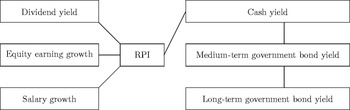
The main economic random variables of our stochastic model are depicted in Figure 1, which is a subset of the model used in Porteous and Tapadar (Reference Porteous and Tapadar2005, Reference Porteous and Tapadar2008a, Reference Porteous and Tapadar2008b) and with the inclusion of an additional variable for salary growth. The stochastic model is a standard multivariate Normal first-order autoregressive time series model, used to model yields and growth rates, where the multivariate dependency structure of the variables is handled using a graphical model.
Graphical model of the economic variables

The individual economic random variables, Zits, are modelled as
 $$Z_{it} \equals \mu _{i} \plus Y_{it} \comma \;{\rm where}\;Y_{it} \equals \beta _{i} Y_{i\lpar t \minus \setnum{1}\rpar } \plus \varepsilon _{it}.$$
The error terms ∊it∼N(0, σi 2) are assumed to be independently distributed across time t.
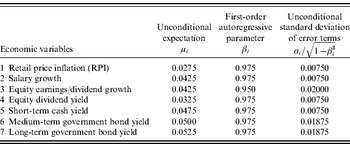
Table 1 shows the parameterisation of the individual economic random variables, the annual expected values, μis, and the annual unconditional standard deviations,  ${\textstyle{{\sigma _{i} } \over {\sqrt {\lpar 1 \minus \beta _{i}^{\setnum{2}} \rpar } }}}$s. The model variables, except for salary growth, have been parameterised using an analysis of the global historical financial data provided by Dimson et al. (Reference Dimson, Marsh and Staunton2002).
Economic model parameterisation

For UK salary growth, we have used the average earnings index published by Office for National Statistics UK (http://www.statistics.gov.uk), to determine the relevant parameters and have ensured that this assumption is consistent with the other assumptions.
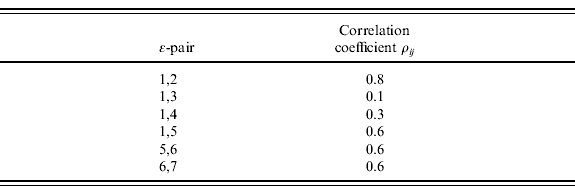
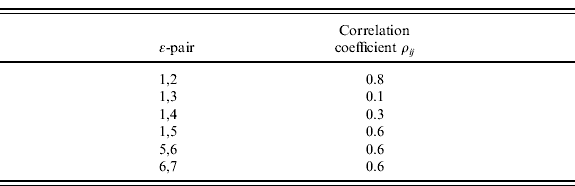
The correlation structure of the error terms is modelled using a graphical model, as displayed in Figure 1. In this figure, economic random variable error terms that are directly connected to each other are dependent, with the assumed constant correlation coefficient values ρij s set out in Table 2. Economic random variable error terms that are indirectly connected in Figure 1, via other directly connected error terms, are still statistically dependent, but more weakly so. Such error terms are, however, conditionally independent of each other, given the error terms that connect them, this being a property of graphical models.
Correlation coefficients of error terms
Graphical models, fully described in Lauritzen (Reference Lauritzen1996) and Porteous and Tapadar (Reference Porteous and Tapadar2005), are useful dimension reduction tools that can be used to explain very-high-dimensional dependency relationships among random variables using low-dimensional clusters, or cliques.
4.2 Demographic variables
A key component of the stochastic model is the rate of mortality improvement. Mortality studies in the UK have extensively documented the cohort, age-related and period-related improvement effects for both males and females; see for example Willets et al. (Reference Willets, Gallop, Leandro, Lu, MacDonald, Miller, Richards, Robjohns, Ryan and Waters2004) for a detailed analysis. However, actual experienced mortality improvement rates have been much higher than expected, particularly in older age groups, leading to a major uncertainty in determining DB pension scheme costs.
Our approach to modelling mortality improvement is to start with the base mortality tables PMA92Base and PFA92Base, for males and females, respectively, published by the UK Actuarial Profession in their Continuous Mortality Investigation (CMI) papers. We then project the base tables forward to 2008 using middle cohort improvement factors for these tables published in CMI Working Paper 1 (Institute and Faculty of Actuaries 2002). Although more recent mortality tables are available from the CMI, our approach is consistent with the mortality assumptions used in the USS 2008 valuation.
Future stochastic mortality is then handled using the approach of Sweeting (Reference Sweeting2008b), who has developed a pragmatic method of modelling stochastic uncertainty around the central mortality projection above. We have not, however, considered trend uncertainty for the purposes of this paper.
Specifically, if qx,f denotes the central projection of mortality rate for future year f and age x, the logit of central mortality rate is defined as
 $$lq_{x\comma f} \equals {\rm ln} \, \lpar q_{x\comma f} \sol \lpar 1 \minus q_{x\comma f} \rpar \rpar.$$
Then the logit of the stochastic mortality rate, modelling future uncertainty, is given by
 $$LQ_{x\comma f} \equals lq_{x\comma f} \plus A_{x\comma f} \comma \quad {\rm where}\;A_{x\comma f} \equals \mathop {\sum}\limits_{k \equals \setnum{0}}^{\hskip 2 f} \lpar 0.262 \minus 0.00358x\rpar Z_{k} $$
and Zks are independent standard normal variables. See Sweeting (Reference Sweeting2008b) for further details.
Sweeting's (Reference Sweeting2008b) proposed stochastic mortality fluctuations are based on UK males aged between 50 and 90 and we have used the same approach for all of the model points in our USS model.
As evidenced in Cairns et al. (Reference Cairns, Blake, Dowd, Coughlan, Epstein, Ong and Balevich2009), and references therein, there is a very rich literature on stochastic mortality models and any of these models could have been used in our modelling work. However, it is not the purpose of this article to compare and contrast different stochastic mortality models, but rather to investigate DB pension scheme economic capital. We defer analysis of the effect of mortality models on DB pension scheme economic capital until a future paper.
4.3 Economic capital calculations
The stochastic model described above is used to generate simulations of possible future economic and demographic scenarios. For each particular scenario generated, we project cash flows for the modelled DB pension scheme and economic capital is calculated according to Definition 2 set out in Section 3.
Porteous and Tapadar (Reference Porteous and Tapadar2008b) provide the detailed steps involved in calculating economic capital for a life insurance annuity firm. These steps, suitably modified to be applicable to a DB pension scheme, are set out below:
Step 1: We first define the scheme's capital requirement, M(s,t), at time t as the amount of excess assets with respect to the best estimate liability that are required to be injected at time t to ensure that the pension scheme is solvent, under a single projection of the stochastic model starting from time s⩽t. By solvent, we mean that market value assets at least equal best estimate liabilities.
In mathematical terms:
 $$M\lpar s\comma t\rpar \equals {\rm max}\lcub {\rm Best}\;{\rm estimate}\;{\rm liability}\lpar s\comma t\rpar \minus {\rm Market}\;{\rm value}\,{\rm of}\,{\rm assets}\lpar s\comma t\rpar \comma 0\rcub \comma $$
where Best estimate liability (s,t) is the projected value of the best estimate liability at time t projected forward from time s. Market value of assets (s,t) is defined similarly.
Step 2: We next define the scheme's discounted capital requirement, C(s,t), at time s for s⩽t, in respect of the scheme's time t position. We discount the time t capital requirement, M(s,t), from t to s using the rates of return earned on the assets backing economic capital, under the specific single projection of the stochastic model and where the assets backing economic capital are assumed to be invested as per the scheme assets. This discounted capital requirement at time s, plus the returns earned on the assets backing economic capital over the period from s to t, is then sufficient to ensure that the scheme is solvent at time t, under this particular projection of the stochastic model.
In mathematical terms:
$$C\lpar s\comma t\rpar \equals M\lpar s\comma t\rpar D\lpar s\comma t\rpar \comma $$where D(s,t) is the discount rate based on the returns earned on the assets backing economic capital over the period s to t using the specific single projection of the stochastic model and where the assets backing economic capital are assumed to be invested as per scheme assets.
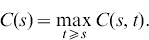
Step 3: The scheme's discounted solvency capital requirement, C(s), at time s, is defined as the maximum of the discounted capital requirements C(s,t) over all times t⩾s. As a consequence, the discounted solvency capital requirement at time s, plus the returns earned on the assets backing scheme economic capital from s to t, is then sufficient to ensure that, for all times t⩾s, the scheme is always solvent, again under this particular projection of the stochastic model.
In mathematical terms:
$$C\lpar s\rpar \equals \mathop {{\rm max}}\limits_{t \geqslant s} C\lpar s\comma t\rpar.$$Step 4: Finally, the scheme's economic capital requirement, EC(s, p), at time s and for confidence level p, is defined as the amount of capital that is required to ensure that, at all times t⩾s, the DB pension scheme remains solvent with a prescribed probability level, p, under multiple projections of the stochastic model. We estimate this economic capital using the percentiles of the scheme's discounted solvency capital requirements, C(s) as described in Step 3 above, under 10,000 projections of the stochastic model.
In mathematical terms, our estimate of EC(s, p) is the pth percentile of the 10,000 realisations of C(s).


The steps set out above describe how we estimate economic capital according to Definition 2 in Section 3.1.
5 USS and modelling assumptions
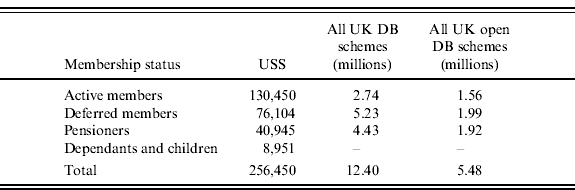
The USS was established in 1974 to administer the principal pension scheme for academics and administrative staff in UK universities and other higher education and research institutions. It is now one of the largest open DB pension schemes in the UK. Based on the information available from the latest full triennial actuarial valuation on 31 March 2008, and associated published financial reports and accounts, USS is a multi-employer scheme covering 391 participating employers. Membership statistics are provided in Table 3.
Membership statistics of USS, all UK DB pension schemes and all UK open DB pension schemes
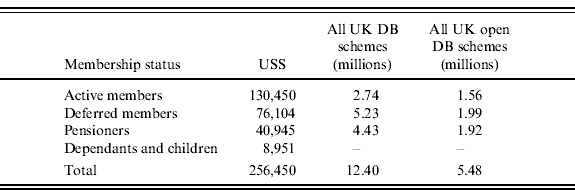
For comparison purposes, in Table 3 we have also included membership statistics for all UK DB pension schemes and open DB pension schemes from The Purple Book 2008 (The Pension Protection Fund and the Pensions Regulator 2008). These figures show that USS has more than 8% of all active members of open UK DB pension schemes, but only 2% of pensioners (<1% if closed schemes are also considered).
In the following subsections, we will outline the broad structure of USS. The detailed scheme rules are available on the USS web site: http://www.uss.co.uk/.
5.1 Benefit structure
Normal retirement age is 65, for both males and females, with pensions and cash lump sum benefits on retirement calculated using an accrual rate of 1/80th as follows:
 $$\eqalign{ \tab {\rm Annual}\;{\rm pension} \equals {\rm Accrual}\;{\rm rate} \times {\rm Pensionable}\;{\rm service} \times {\rm Pensionable}\,{\rm salary}\comma \cr \tab {\rm Lump}\;{\rm sum}\;{\rm payment} \equals 3 \times {\rm Annual}\,{\rm pension}. \cr} $$
Pensionable service denotes the duration of employment in one or more USS participating employers. Pensionable salary is the highest revalued annual salary during the last 3 years, or the highest revalued salary averaged across any three consecutive ‘best years’ over the last 13 years, whichever is higher. For the sake of modelling simplicity, we have made the assumption that pensionable salary is the salary in the very last year of a member's employment, which will be true for a member with no unusual fluctuations in salary in the last few years prior to retirement. The annual pension is increased in line with RPI every year.
Although the scheme allows for both early and late retirement, we have not modelled these explicitly, but have assumed a modelled retirement age of 62 years and this is consistent with 2008 actuarial valuation report assumption.
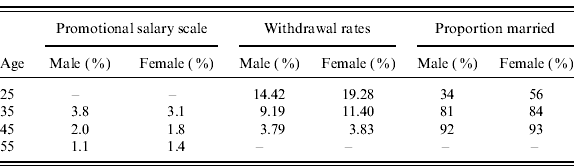
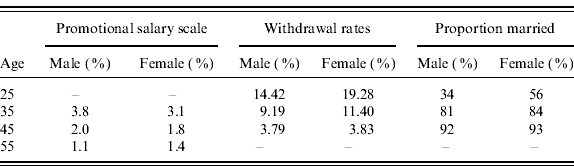
In addition to salary inflation, an explicit age-based promotional salary increase scale is assumed in the USS 2008 valuation, as shown in Table 4.
For members who have withdrawn from the scheme, deferred RPI-linked pension benefits are provided based on accrued service on withdrawal. RPI indexation of salaries between the date of leaving and retirement is provided. Annual scheme withdrawal rates, as extracted from the 2008 valuation report, are reproduced in Table 4.
Key USS 2008 valuation assumptions
Scheme death benefits are as follows:
• For active members, death in service benefits comprise a lump sum payment of three times annual salary and a spouse's pension of half the pension the member would have received if the member had survived until normal retirement.
• On the death of a deferred pensioner, a lump sum equal to the present value of the deferred lump sum payable at normal retirement age is provided along with a spouse's pension of half the amount of the deferred pension at date of death.
• On the death of a pensioner, a spouse's pension equal to half the member's pension is paid to the surviving spouse.
The 2008 valuation report assumes that wives are, on average, three years younger than their husbands. Assumed proportions of married members are provided in Table 4, again extracted from USS scheme data.
Other benefits, like dependants’ pensions, are also provided and we have also modelled these. As they are not material, we have not presented our results explicitly in this article.
5.2 Contributions
USS is a contributory scheme, with the 2008 actuarial valuation report recommending an employers’ contribution of 16% and members’ contribution of 6.35% of annual salary.
Currently, negotiations are ongoing over a proposed increase of member contribution rate to 7.5% along with some other changes to the scheme rules, but we have not considered these in this article.
In our modelling work, where we model future contributions, we assume that these are constant. In practice, future contributions will tend to vary in line with actuarial advice, as it is received.
5.3 Investment
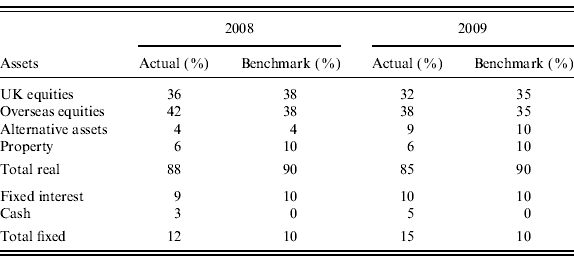
Given the relatively young active membership profile of the scheme, with a low proportion of pensioners, USS currently pursues a fairly expansive investment strategy, with a high proportion of equity investment. Table 5 provides a summary of the USS current investment mix, as extracted from the USS Annual Reports and Accounts for 2008 and 2009.
USS investment mix
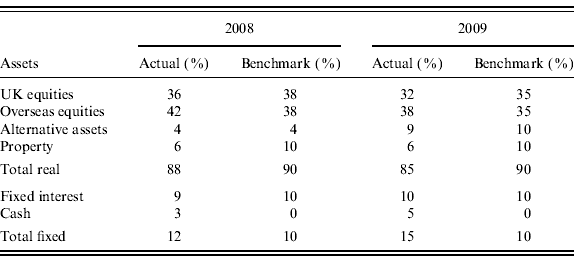
From Table 5, it can be seen that a 90:10 asset split between real and fixed interest type investments is being followed and we will use this as our base assumption in our modelling work.
5.4 Expenses
We have assumed a per member administrative expense of £60 per annum increasing in line with RPI. The investment expenses are assumed to be 0.1% p.a. of the fund under management. These figures are consistent with the expenses reported in the USS Annual Reports and Accounts.
6. Economic capital results
In this section, we set out our economic capital assumptions and results determined using a simple model of the USS.
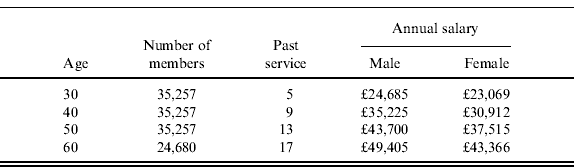
We have represented the active member group using four model points as shown in Table 6. For simplicity, we have an assumed uniform distribution of active members across ages for the age groups 25–35, 36–45, 46–55 and 56–62 represented by ages 30, 40, 50 and 60, respectively.
Model points representing USS active members
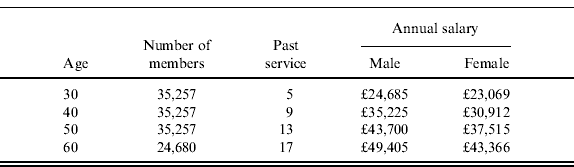
The deferred members, pensioners and dependents groups are represented by single model points of ages 44, 70 and 73, respectively.
The model points assume a 50:50 split between males and females.
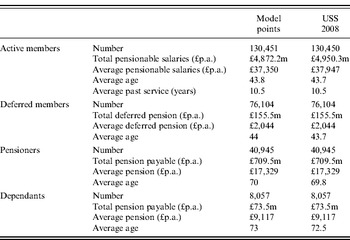
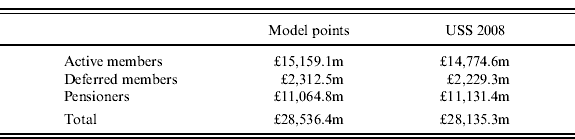
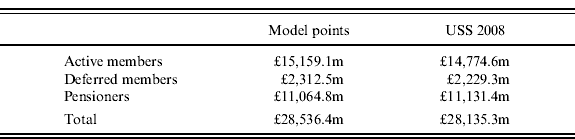
Tables 7 and 8 compare the fit of the model points to the USS scheme and it can be seen from these tables that it is very good. In Table 8, accrued benefit PUM liabilities are calculated on the USS 2008 valuation basis. Dependents are not included in Table 8 as there is no USS data to compare our model point results against.
Comparison of model points data with USS 2008 valuation data

Comparison of accrued benefit PUM liabilities between model points and USS valuation report 2008 based on the USS 2008 valuation basis
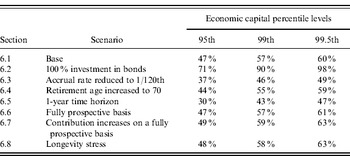
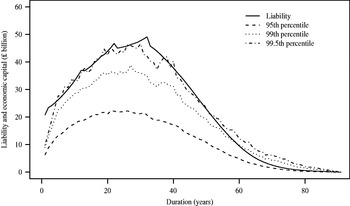
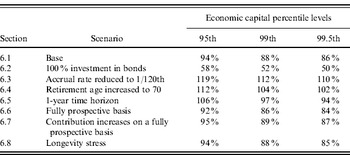
In the rest of the section, we quantify economic capital of USS under various scenarios. The results are shown in a series of graphs with Table 9 summarising these results as the amount of economic capital required as a percentage of best estimate liabilities at time zero, for different scenarios. Unless otherwise stated, we value accrued benefits only. It can be seen from this table that economic capital requirements are very large indeed.
Ratio of economic capital to best estimate liabilities at time zero

6.1 Base results
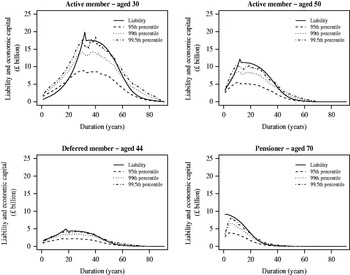
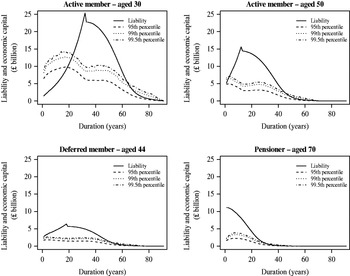
Our results are shown in Figures 2 and 3. Figure 2 shows economic capital, and the corresponding best estimate liability, for four model points: the active member aged 30 model point, the active member aged 50 model point, the deferred member model point and the pensioner model point. We have not shown the dependents model point as economic capital requirements are always generally very low for this category of member. Economic capital is calculated over the remaining lifetime of the member at each duration.
Base scenario: best estimate liability and economic capital at 95th, 99th and 99.5th percentile levels for active members aged 30 and 50, deferred member and pensioner model points

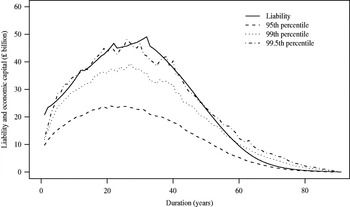
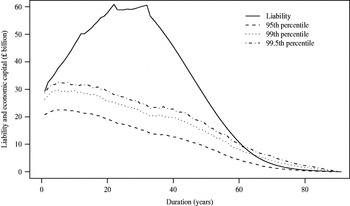
Base scenario: best estimate liability and economic capital at 95th, 99th and 99.5th percentile levels for the full scheme

From the four graphs shown in Figure 2, it can be seen that economic capital for each class of member is large relative to the corresponding best estimate liability. In other words, the amount of capital that is required to back these risks is very large. The economic capital amounts and best estimate liabilities tail off to zero because the member benefit reduces over time as each member ages and eventually dies. Note also that the spikes in the best estimate liability curves correspond to the cash lump sum paid on retirement.
Figure 3 next shows economic capital and the best estimate liability for the full USS model, constructed from all USS model points. Figure 3 shows that USS economic capital is extremely large, starting at close to £13 billion, for 99.5th percentile economic capital, and peaking close to £48 billion. This is relative to best estimate liabilities that start at around £21 billion and which peak at just over £49 billion.
The main conclusion that can be drawn from these base case results, therefore, is that the amount of economic capital required to protect USS members is very large indeed.
6.2 100% Investment in bonds
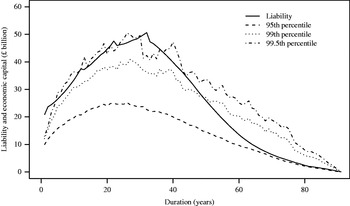
In this section, we recalculate the base case results on the assumption that all USS assets are invested in government bonds. Throughout this article we always assume that the scheme invests only in 15-year government bonds and that the bond portfolio is sold and reinvested each month to preserve the 15-year duration assumption. Results are shown in Figures 4 and 5.
100% investment in bonds: best estimate liability and economic capital at 95th, 99th and 99.5th percentile levels for active members aged 30 and 50, deferred member and pensioner model points

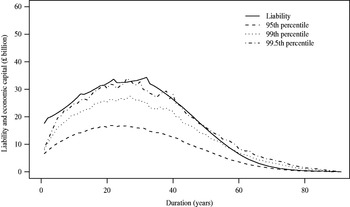
100% investment in bonds: best estimate liability and economic capital at 95th, 99th and 99.5th percentile levels for the full scheme

The main observations that we can make from Figure 4, relative to base case results, are that best estimate liabilities increase fairly materially, but have broadly the same shape, whereas the economic capital results look very different.
Liabilities increase because they are discounted at a lower discount rate relative to the base case results, reflecting the lack of equity investment, and so increasing best estimate liabilities.
The main differences in the economic capital results are that active and deferred member economic capital is much higher at the shorter durations and has a flatter shape, relative to the base case results. Pensioners’ economic capital is generally lower, but with the same shape. For active and deferred members this pattern is explained by the 15-year bonds being too short to match liabilities in the early years, and so increasing economic capital. For pensioners with shorter liabilities, the bonds are less volatile than equities, so reducing economic capital.
However, as can be seen from Figure 5, which shows results for the whole scheme, it remains the case that the economic capital amounts required to protect USS members are extremely large.
We have also prepared results (not shown here) on the assumption that assets are invested in a mix of equities and bonds, as per the base case, but best estimate liabilities are calculated using a bond risk discount rate, as generated by the stochastic model. This approach is similar to a Solvency 2 approach for DB pension schemes. As expected, results are intermediate between those for the base case and those for 100% investment in bonds.
We have also checked the results for a gradual shift from a high equity content to more bonds as the scheme matures. As expected, the results are intermediate between the base case and 100% bond investment scenarios.
In this paper, we have considered a passive investment strategy as, traditionally, UK DB pension schemes have followed this approach in conjunction with relatively high exposures to equities. A more dynamic investment strategy, although not typical of current practice, might reduce a DB scheme's economic capital requirement, however, and this would be an interesting topic for future research.
6.3 Sensitivity to accrual rates
In this section, we recalculate the base case results on the assumption that the accrual rate for active members is reduced to 1/120.
Relative to the base case results, the deferred member and pensioners’ best estimate liabilities and economic capital amounts are unaltered as the accrual rate assumption does not affect the benefits of these classes of scheme members. For active members, both best estimate liabilities and economic capital requirements fall, relative to the base case results, because the value of their benefits fall due to the reduced accrual rate assumption. Again, this is as expected.
However, as can be seen from Figure 6, which shows results for the whole scheme, although best estimate liabilities and economic capital fall materially from the base case results, the amount of economic capital required to protect USS members, compared to best estimate liabilities and also in absolute terms, remains significant.
Accrual rate reduced to 1/120th: best estimate liability and economic capital at 95th, 99th and 99.5th percentile levels for the full scheme

6.4 Sensitivity to retirement age
In this section, we recalculate the base case results on the assumption that the retirement age is increased to 70.
Relative to the base case results, the pensioners’ best estimate liabilities and economic capital amounts are unaltered. This is as expected as the increased retirement age assumption does not affect the benefits of this class of scheme members.
For deferred members, both best estimate liabilities and economic capital amounts decrease because members have to wait longer to receive their benefits, which are unaltered, and their benefits are not adequately protected in deferment to preserve the value of these benefits. As a consequence, scheme risks fall.
For active members, both best estimate liabilities and economic capital commence lower than base case results, before growing relatively larger. This is because the increased retirement age allows active members to accrue larger benefits, although these are paid later from the higher age.
At the early durations, the increased retirement age reduces best estimate liabilities and economic capital because of the delay in receiving the benefits. At the later durations, best estimate liabilities and economic capital increase because the higher accrued benefits are worth more once they start being paid.
Figure 7, which shows aggregate results for the whole USS scheme, shows a similar pattern of results as for the active members. In particular, it can be seen that increasing the scheme retirement age does not in general reduce scheme economic capital requirements. In fact, at later durations, economic capital requirements actually increase.
Retirement age increased to 70: best estimate liability and economic capital at 95th, 99th and 99.5th percentile levels for the full scheme

6.5 Sensitivity to time horizon
In this section, we recalculate the base case results on the assumption that the time horizon used to calculate economic capital is reduced to one year, rather than the expected future lifetime of each member. With reference to the economic capital calculation steps given in Section 4.3, the maximum of the discounted capital requirements in Step 3 is taken over a 1-year duration rather than all future durations. Results for the whole USS scheme are shown in Figure 8.
1-year time horizon: best estimate liability and economic capital at 95th, 99th and 99.5th percentile levels for the full scheme

Generally speaking, best estimate liabilities are unaltered and economic capital falls slightly, relative to the base case results. Economic capital falls because capital requirements are considered over a shorter time period and so are smaller as a consequence.
However, as can be seen from Figure 8, USS scheme economic capital requirements remain substantial.
6.6 Fully prospective best estimate liability
In this section, we recalculate the base case results using a more traditional life insurance approach to estimating scheme best estimate liabilities, rather than the PUM. In what we call the fully prospective liability method, we estimate scheme best estimate liabilities by estimating the value of all scheme future cash flows, taking into account all future benefits, as well as accrued benefits, and all future contributions. As the resulting graphs are very similar to those of the base scenario, we have not shown them here.
The main observation is that it is only the active member aged 30 and 50 results that are much different from the base case results. At the shorter durations the fully prospective best estimate liability tends to be higher than the PUM best estimate accrued benefit liability, because future contributions are slightly too low to pay for future benefits, but with economic capital amounts generally fairly similar.
For the USS scheme in total, both best estimate liabilities and economic capital are very similar to base case results. In other words, the assumed future contribution rate is broadly adequate to pay for future benefits, but not economic capital requirements.
6.7 Sensitivity to contribution increases on a fully prospective best estimate liability basis
The employer currently pays 16.00% of salary per annum into the USS scheme and employees 6.35% p.a., giving a total of 22.35% p.a. In this section, we investigate best estimate liability results on the assumption that the total contribution amount is increased by 3% to 25.35% p.a. Again as the resulting graphs are very similar to those of the base scenario, we have not shown them here.
We found that, at the earlier durations, before benefits become payable, active member best estimate liabilities and economic capital fall relative to the base case fully prospective best estimate liabilities scenario. This is as expected because the future contribution rate has increased. Once benefits are deferred, or are in payment, the contribution increase makes no difference to our results, again as expected.
Once again, the economic capital requirements of the USS scheme remain substantial.
6.8 Longevity stress
In Figure 9, we show the impact of doubling the size of the volatility, or standard deviation, parameter in our stochastic mortality model. As expected, economic capital increases everywhere, especially at the later durations, and is very large relative to best estimate liabilities. This is especially concerning given the lack of success that actuaries and others have had in estimating future improvements in longevity.
Longevity stress at twice the base scenario volatility: best estimate liability and economic capital at 95th, 99th and 99.5th percentile levels for the full scheme

Best estimate liabilities also increase very slightly, although this is a feature of the stochastic mortality model that we have used, where increasing volatility causes the distribution of mortality rates to become more negatively skewed.
6.9 Open schemes and stable membership profile
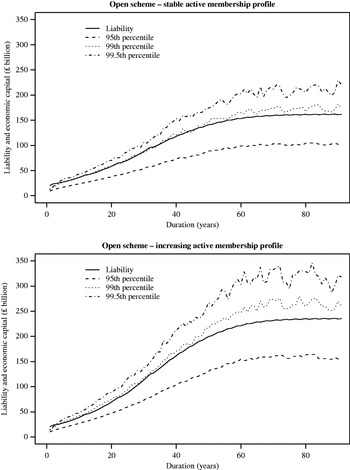
In the previous subsections, we considered economic capital ignoring future new members to the USS.
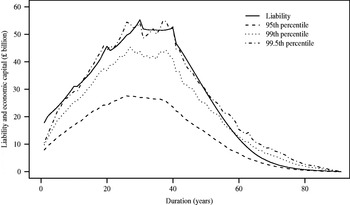
Figure 10, in the first graph, shows best estimate liabilities and economic capital for the USS scheme on the assumption that new members join at a rate that is sufficient to maintain scheme active members at current levels, with current deferred, pensioner and dependant members allowed to run off. As expected, economic capital reaches extremely high levels and also takes many years to stabilise.
Open scheme results: best estimate liability and economic capital at 95th, 99th and 99.5th percentile levels for the full scheme

Figure 10, in the second graph, shows the case where active members are assumed to increase at 5% p.a. from current levels. It can be seen, as expected, that economic capital increases on a rising trend to reach alarmingly high levels.
6.10 Solvency level
In Table 10, we compare USS scheme assets at time zero to the sum of scheme best estimate liabilities and economic capital for each of the scenarios considered in this section. Based on 99.5th percentile economic capital, for example, it can be seen that the USS scheme might be considered to be in reasonable health only if the retirement age is increased to 70, or if the accrual rate is reduced to 1/120th. This is clearly not a good outcome, especially as the situation still deteriorates at later durations, as was seen from the figures presented earlier in this section.
Ratio of USS scheme assets at 2008 actuarial valuation (£28,842.6m) to the sum of scheme best estimate liabilities and economic capital at time zero

7 Conclusion
In this article, we have determined the amount of economic capital that a DB pension scheme needs to cover the risks that it is running, using an insurance firm balance sheet ALM approach, rather than a pension scheme funding level adequacy approach. As expected, economic capital requirements are very large, about 60% of the best estimate liability at the 99.5th percentile level for the base scenario. This reflects the risks inherent in providing such generous, guaranteed benefits while, at the same time, backing the associated liabilities with the volatile assets expected to generate the returns needed to support these benefits.
We also saw that, apart from explicitly hedging scheme risks such as longevity risk, the most effective short-term measures that schemes can adopt to improve their positions are to reduce benefits, either by increasing retirement ages, or by reducing accrual rates. However, such measures are only effective in the shorter term because, as time goes by, scheme risks still accumulate faster than assets and leading to future economic capital deficits. Reducing scheme benefits will also obviously be extremely unpopular with scheme members.
In this article, our primary focus has been to model the economic capital of a real UK DB pension scheme and based on the way the scheme is actually run and managed in practice. We have not considered conditional indexation techniques used in the Swiss and Dutch pensions markets to transfer risk from DB pension schemes to their members. By conditional indexation, member benefits are altered dynamically in response to the financial condition of the scheme and in accordance with a prescribed schedule e.g. scheme indexation benefits are reduced when the scheme is in poor financial health and reinstated once the scheme recovers. This technique is generally not used in other pensions markets and, in particular, is not used in the UK market where a change in pensions legislation is likely to be required to allow its use. The real UK scheme that we have modelled therefore does not use conditional indexation. Conditional indexation fundamentally changes the characteristics of a DB scheme and moves it substantially in the direction of a DC scheme, where member benefits are no longer known with certainty and are not guaranteed. Although, we have not considered the use of conditional indexation in this article, it might make a worthwhile topic for further research, especially if its use becomes more widespread.
As mentioned by one of the referees, the amount of economic capital presented in this article might be considered to be on the high side for three reasons:
(a) as a consequence of determining economic capital over the lifetime of the scheme, rather than over a one year period – our results in Section 6.5 quantify the impact of this assumption and show that the difference is not that large;
(b) a more dynamic investment strategy might help to mitigate risk and so reduce economic capital – we believe, nevertheless, that the approach modelled in this article is reflective and representative of how DB pensions schemes currently manage their assets, particularly for schemes that remain open with a stable membership profile. The impact of a more dynamic investment strategy on economic capital is, however, an interesting topic for future research;
(c) availability of the option to the sponsor to restructure benefit terms and modify contribution rates in times of financial stress – our results in Section 6 do confirm that actions like reducing the scheme accrual rate can reduce economic capital fairly materially, although this is likely to result in major staff disengagement.
Notwithstanding these points, the main conclusions and results set out in this article still apply – that DB pension scheme economic capital is generally very large. As a consequence, scheme sponsors will, we believe, be significantly challenged if they are required to set capital aside to match economic capital. Alternative, more practical, choices are to reduce scheme benefits and, subject to cost, to de-risk DB pension schemes using explicit hedging tools.
We expect that hedging will become more popular in pensions schemes, as a consequence of the economic capital results illustrated in this and similar papers, and also because the European Commission and EIOPA are likely to introduce Solvency 2 type solvency regimes for European occupational pension schemes.
Although the improved understanding of DB pension scheme risks that can be gained through the economic capital lens may seem like bad news for DB pension schemes and their members, the good news is that we now have much greater clarity of the embedded risks and costs of these schemes. What matters most going forward is that we use a risk sensitive economic capital framework, as illustrated in this article, to help manage DB pension schemes, in a transparent manner. This will help to ensure that benefits provided are not unrealistic and that schemes are not taking inappropriate levels of risk that could hurt their members.
We believe that there will be significant de-risking of DB pension schemes in future years and the economic capital approach will be of great assistance in ensuring that this activity is as effective as possible.