People's capacity to imagine what might have been, as described by Byrne (Reference Byrne2005), is governed by rational principles that are identical to other forms of thinking. On the one hand, this is a particularly intriguing idea because prior theory has been at odds in suggesting that imagination is somehow irrational, or that imagination and rational thought are directed by incompatible rules. Byrne demonstrates this is not so by delineating common principles whereby “fault lines” in reality – where counterfactual thinking is most probable – produce thoughts of an “if only” nature. Her book provides a lucid integration of diverse literatures, the major points of which I am in agreement with. Byrne is to be commended for a highly thoughtful and readable book, which serves as a welcome breakthrough in conceptualizing imaginative reasoning.
On the other hand, my main point is to focus greater attention on the mostly neglected but critically important role of people's metacognitive experiences in influencing imaginative (and rational) thinking. This includes various subjective experiences that accompany the imaginative process, such as ease or difficulty of thought generation or recall, processing fluency, or emotions like surprise (Sanna & Schwarz Reference Sanna and Schwarz2006; Reference Sanna and Schwarz2007; Schwarz et al. Reference Schwarz, Sanna, Skurnik and Yoon2007). To fully understand imagination, metacognitive experiences must also be accounted for, because they are informative in their own right and can qualify or even reverse the implications that people draw from what they are imagining.
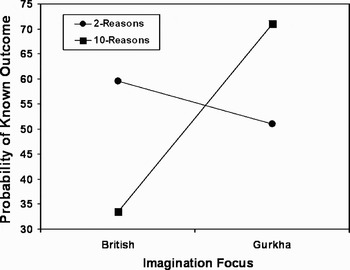
A hindsight bias example illustrates this (Sanna et al. Reference Sanna, Schwarz and Small2002a). Hindsight bias, people's belief that they knew it all along (Fischhoff Reference Fischhoff1975), results from thinking about known outcomes but it may be eliminated – or lessened – by thinking about counterfactuals (Guilbault et al. Reference Guilbault, Bryant, Posavac and Brockway2004; Hawkins & Hastie Reference Hawkins and Hastie1990). After reading about a British–Gurkha war that the British won, some people were asked to imagine 2 or 10 reasons supporting this outcome, whereas others were asked to imagine 2 or 10 reasons supporting the counterfactual outcome (Sanna et al. Reference Sanna, Schwarz and Small2002a, Experiment 1). If only content mattered, hindsight bias should be greater when imagining 10 than 2 reasons supporting the known outcome (British victory); the bias should be lessened when imagining 10 than 2 reasons supporting the counterfactual (Gurkha victory). But exactly the opposite happened (Fig. 1): Imagining more reasons favoring the known outcome decreased hindsight bias, whereas imagining more reasons favoring the counterfactual outcome increased hindsight bias (see also Sanna et al. Reference Sanna, Schwarz and Stocker2002b) (Fig. 1).
Mean probability of known outcome (British victory) on a 0–100% scale. British focus represents imagining the known outcome; Gurkha focus represents imagining the counterfactual outcome. All people were asked, “If we hadn't already told you who had won, what would you have thought the probability of the British winning would be?” Adapted from Sanna et al. (Reference Sanna, Schwarz and Small2002a, Experiment 1).

Thus, it is not just what people imagine that counts. A key to understanding these results is that people's self-reports indicated that imagining 2 reasons was experienced as easy and 10 reasons was difficult, irrespective of whether they focused on known or counterfactual outcomes. Known outcomes were seen as unlikely when it was difficult to think of reasons for a British victory – after all, if there were many reasons for a British victory, it should not be so hard to think of 10. Conversely, people inferred that counterfactual outcomes were unlikely when it was difficult to think of reasons for a Gurkha victory. In each case, people's inferences were consistent with imagination content only when reason generation was easy, whereas inferences were opposite to the implications of imagination content when reason generation was difficult.
Other examples of metacognitive experiences include processing fluency – that is, ease or difficulty with which new information is processed – and emotions like surprise. People presented with general knowledge questions and answers (e.g., “How high is the Eiffel Tower?” – “300 meters”) more likely imagined that they knew the outcome (answer) all along when questions and answers were presented in easy-to-read rather than difficult-to-read colors (Werth & Strack Reference Werth and Strack2003); and people who first identified faces more likely imagined that naive others would identify the faces sooner than they themselves just did (Harley et al. Reference Harley, Carlsen and Loftus2004). Emotions such as high surprise can inform people that outcomes were unexpected, and low surprise, that outcomes were expected (Ortony et al. Reference Ortony, Clore and Collins1988); and moods can inform people that things are fine or problematic (Sanna et al. Reference Sanna, Turley-Ames and Meier1999). Each of these experiences has implications for imagining what happened and what might have been in ways not predicted by the content of imagination alone (Sanna & Schwarz Reference Sanna and Schwarz2006; Reference Sanna and Schwarz2007; Schwarz et al. Reference Schwarz, Sanna, Skurnik and Yoon2007).
Consistent with the simulation heuristic (Kahneman & Tversky Reference Kahneman, Tversky, Kahneman, Slovic and Tversky1982) and norm theory (Kahneman & Miller Reference Kahneman and Miller1986), Byrne's principles and corollaries (summarized on pp. 200 and 203) recognize that features like actions, controllable events, and so on, more easily bring to mind counterfactuals, and that, when two (or more) possibilities are available from the outset, counterfactuals are more likely. Byrne's synthesis greatly enriches the field by providing a framework in which to understand disparate findings that span various literatures. But metacognitive experiences encompass much more than this (Sanna & Schwarz Reference Sanna and Schwarz2007). In this sense, Byrne's analysis did not go far enough. Metacognitive experiences are part and parcel of the imaginative process. In fact, the principles outlined in Byrne's book (e.g., actions are more mutable) may exert their influences precisely because of the information people derive from metacognitive experiences. And the accompanying metacognitive experiences can actually change the meaning and inferences drawn from thinking counterfactually.
Because people may truncate thought generation early (Bodenhausen & Wyer Reference Bodenhausen, Wyer, Hippler, Schwarz and Sudman1987), in many real-life circumstances counterfactuals could be imagined before any experienced difficulty, under ease or fluency.Footnote 1 But it would be erroneous to conclude that reactions can thus be predicted on the basis of content alone. For example, one potential irony is that difficulty or disfluency might occur precisely when thinking about alternatives is most needed, as when people are particularly motivated to understand what went wrong and wind up searching for many counterfactuals. This may leave people less able to learn from past mistakes, and unlikely to take steps to improve. Thus, only by considering metacognitive experiences along with the content of what people imagine can we fully understand imagination. In short, following through with Byrne's analogy, when fault lines in reality fissure, metacognitive processes may provide the seismic waves that ripple through the imagination to give meaning to the whole experience.
ACKNOWLEDGMENT
I thank the Imagination, Goals, and Affect (IGoA, or ego) laboratory group members at the University of North Carolina at Chapel Hill for their comments.