When governments cancel elections or hold them without any opposition – as many did during the Cold War – the use of elections to distinguish between authoritarianism and democracy is relatively straightforward. But with the end of the Cold War, scholars increasingly observed that the quality of democratic elections varies and that a growing number of autocrats allow voters to choose among alternatives at the ballot box. These developments have had two effects. First, there is increasing scepticism about the use of solely electoral criteria to differentiate between democracies and dictatorships. Second, scholars are paying greater attention to elections under authoritarianism, going so far as to claim that new regime types are emerging that can be categorized by electoral outcomes. Elections, then, appear less useful in distinguishing between democracies and dictatorships but more so in characterizing different types of autocracy.
Elections in authoritarian regimes with some degree of contestation are not solely a post-Cold War phenomenon, however (Miller Reference Miller2013; Posada-Carbó Reference Posada-Carbó1996). Throughout the nineteenth and twentieth centuries, authoritarian regimes held elections for the executive with frequencies approaching those of their democratic counterparts. The use of elections to fill legislatures was also common. Taking a longer historical view reveals the distinction, not of multiparty elections in authoritarian regimes after the Cold War, but rather the dearth of them during the 1945–89 period.
Given their prevalence, elections under authoritarianism are increasingly the subject of scholarly investigation. One important question is whether elections – even those held under autocratic conditions – can facilitate political change, and democratization in particular. In studying this question, scholars frequently rely on regime classifications, but this practice has a number of analytical pitfalls. Regime types may not accurately proxy the processes that researchers assume they are capturing, or they may reveal little about how elections facilitate or impede political change. Moreover, in autocratic regimes, elections often cannot be understood as fixed rules of the game. The holding of elections or the degree to which they are allowed to be contested are endogenously determined by some set of factors that may be more critical (than elections themselves) in determining the extent or pace of political liberalization. The conclusion is not to abandon the project of regime classification, but to reflect more critically on its use, particularly in attempts to study processes of political change in autocracies.
One alternative to the use of regime types is more specific information on actors, behaviours and events related to elections that may help in assessing whether and how elections influence political change. The collection of systematic information for multiparty elections during not only the post-Cold War period, but also the interwar period and the late nineteenth century would enable scholars to trace more precisely the relationship between government and opposition over successive elections, a relationship that often influences how these institutions either facilitate change or consolidate authoritarian rule. Moreover, more detailed data on the actors, behaviours and events surrounding elections would enable more accurate testing of existing theories.
To make these arguments, this article proceeds as follows. The next section briefly discusses the use of elections to distinguish among regime types and shows how common elections under dictatorship have been throughout the nineteenth and twentieth centuries. The third section examines the use of regime type in empirical studies of the link between elections and democratization. It highlights some of the analytical difficulties of using regime classifications to study this issue, and the following section offers a brief discussion of the Kenyan case to make some of these ideas more concrete. The penultimate section suggests some alternatives to regime type which would enable a better assessment of how elections contribute to political change. The final section concludes the article.
The Use of Elections to Classify Regimes
The most minimalist conception of political regime relies on the notion that the process by which the ruled select their rulers is a critical characteristic of the relationship between the state and society.Footnote 1 Hence, the focus on elections (Dahl Reference Dahl1972; Schumpeter Reference Schumpeter2010 [1943]). When leaders do not hold elections or cancel them, their regimes easily fall into the category of non-democracy. During his 36-year reign in Spain, Franco never allowed elections for the national-level executive or parliament. Similarly, Muammar Qaddafi ruled in Libya for 39 years without ever subjecting himself or his cronies to popular contests. When elections are cancelled or stolen, citizens no longer play a role in the selection of those who govern. After the unexpected victory of the Islamic Salvation Front (FIS) in first-round legislative elections in Algeria, for example, the military stepped in and cancelled the second round. In these cases, and others like them, there is little doubt that rulers rule as dictators.
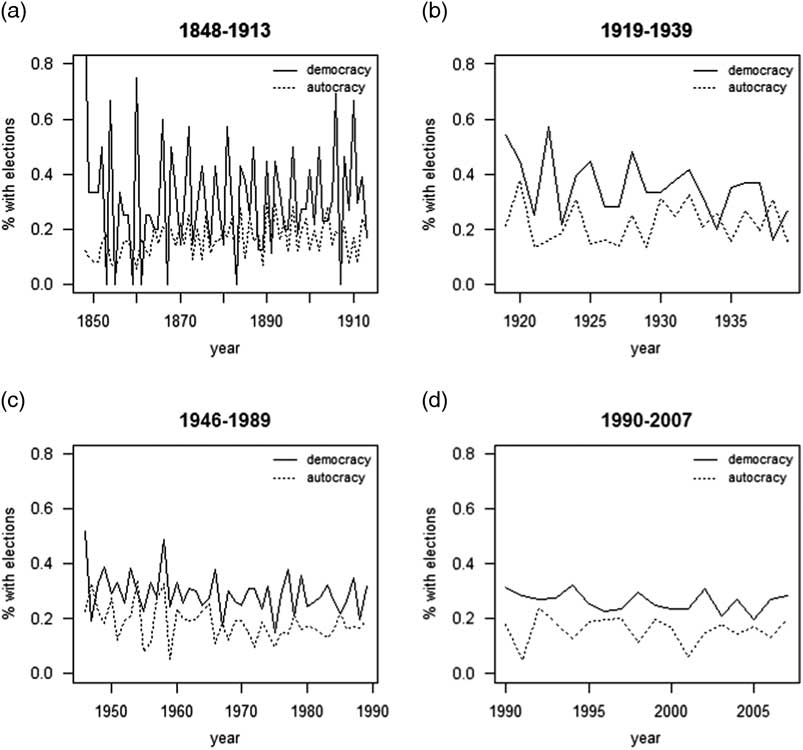
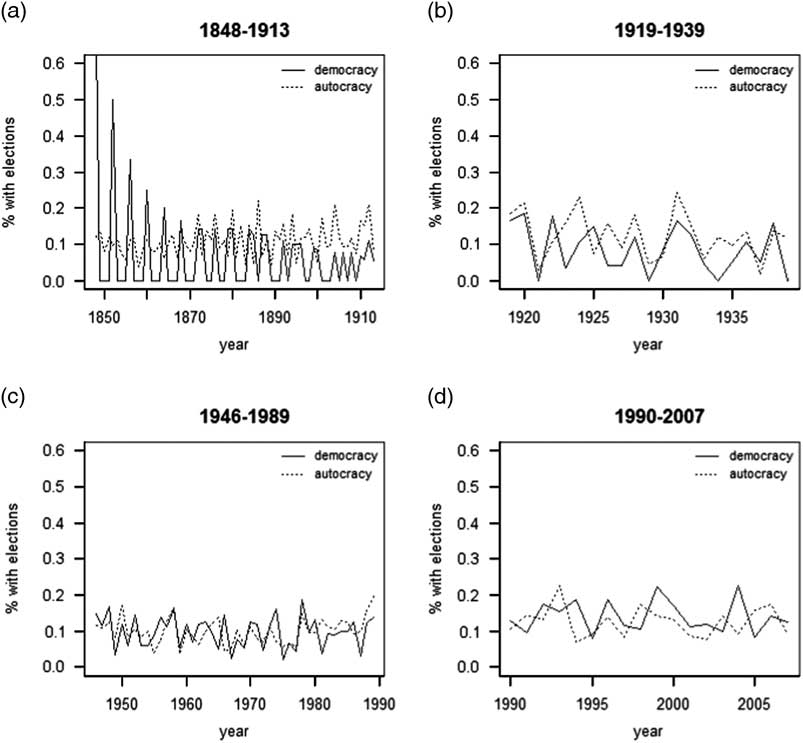
There are arguably valid reasons for focusing on the role of elections when distinguishing between democracies and dictatorships (Cheibub et al. 2010). The problem, of course, is that many non-democracies actually hold elections. Figures 1 and 2 show the frequency with which democracies and dictatorships held legislative and presidential elections, respectively.Footnote 2 Elections are any event in which citizens cast ballots for candidates to national-level office. Regimes are categorized according to Dahl’s (Reference Dahl1972) conception of polyarchy in which both participation and competition are necessary components of democracy. Elections in democracies are competitive, but elections in autocracies include all types of elections irrespective of the degree of competition. For legislative elections, this includes races in which candidates could present themselves only as independents, as members of a single party or government-sponsored front, or as partisans. In presidential elections, this includes both plebiscitary elections in which voters marked yes or no for a single candidate and multi-candidate elections. The sample begins in 1848 both due to the seminal importance of the European revolutions of that year and due to the marked improvement in the quality of the data after this year. The data are broken down into four periods to avoid the two world wars and to capture the end of the Cold War.Footnote 3
Frequency of Legislative Elections

Frequency of Presidential Elections

First, democracies hold legislative elections more frequently than autocracies. This is true for every time period and is probably due to the frequency of parliamentarism under democracy in which the chief executive (the prime minister) is chosen by the legislature rather than by direct election. Except under monarchies (which itself is somewhat rare), this arrangement is uncommon in non-democracies (Singapore being a notable contemporary exception).
Second, before the Second World War, autocracies held presidential elections with somewhat greater frequency than democracies. Again, the comparison is affected by the frequency of parliamentary regimes in democracies (which deflates the frequency of presidential elections in democracies). But it is curious to see just how often autocratic leaders hold some type of electoral event to ratify their power publicly. For autocracies, the frequency of presidential elections has been quite stable throughout time.
While the combination of autocracy and elections is common, these elections are ‘autocratic’ (that is, they fall short on polyarchy’s two dimensions) for distinct reasons. The data for the broader historical period show that prior to the Second World War, elections in autocracies generally experienced medium to high levels of contestation but did not offer wide participatory opportunities. This, of course, is an artefact of the many restrictions on suffrage that remained in place – often until the middle of the twentieth century. Elites were willing to allow for some measure of competition amongst themselves as long as ordinary citizens could be kept out of the arena (either as voters or as candidates).
The picture looks very different for elections in autocracies after the Second World War. These elections were increasingly characterized by low levels of contestation and high levels of participation. Increasing participation was driven by the demise of suffrage restrictions rather than increases in turnout (Przeworski Reference Przeworski2009). Requirements on the basis of property, income and literacy succumbed to the revolutionary threat posed by lower-income groups (Acemoglu and Robinson Reference Acemoglu and Robinson2006). Full participation also was the norm among newly independent countries in the developing world. After having fought to remove colonial overlords, leaders in Sub-Saharan Africa and Asia were in no position to call for restrictions on participation.
These same countries – especially those in Sub-Saharan Africa – however, were also responsible for the aggregate decline in electoral contestation. After founding elections that included multiple candidates and parties, many of them began increasingly to restrict political competition. Miller (Reference Miller2013) shows that many of these low contestation–high participation elections appear in Africa. In Sub-Saharan Africa alone, 38 countries (80 per cent of countries in the region) legally became one-party states at some point during the post-war period. It was mostly in Africa where leaders in countries such as Kenya and Zimbabwe embraced the Leninist party-state, not only to reduce competition, but also to mobilize the population for elections, plebiscites and other ways of affirming loyalty to the regime. In contrast, in Latin America, the proportion of elections that were uncontested declined rapidly after the end of the Second World War (Przeworski Reference Przeworski2011: Figure 2, 10). This was due in part to the emergence of more democracies after the war, replacing the dominant and oligarchic party systems that had been historically more prevalent.
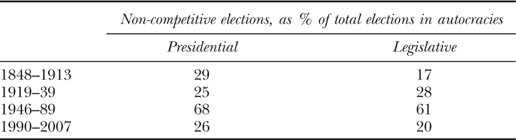
This notable lack of contestation, however, is mostly a Cold War phenomenon. Table 1 shows the frequency of non-competitive elections under autocracy where competitive contests are those in which more than one candidate or party presents itself to voters.
Non-competitive Elections in Autocracies

After the end of the Cold War, autocracies continued to hold elections, but with much less frequency did they resort to non-competitive plebiscites. The dramatic decline in non-competitive elections in autocracies meant that dictators often held elections with many of the trappings of democracy, such as parties, campaigns and opposition.
In fact, the marked increase in multi-candidate and multiparty elections in non-democracies after the demise of one-party rule in the Soviet Union and its client states led to the identification of new autocratic regime types based on electoral criteria. Schedler (Reference Schedler2006) was perhaps the first to distinguish a subset of authoritarian regimes on the basis of elections. His category of ‘electoral authoritarian’ regimes are those which ‘play the game of multiparty elections . . . for the chief executive and a national legislative assembly. Yet they violate the liberal-democratic principles of freedom and fairness so profoundly and systematically as to render elections instruments of authoritarian rule.’ Electoral authoritarian regimes differ from closed authoritarian states in that ‘elections stop being shams and start playing “enough of a role in the constitution of power” to compel both rulers and opposition forces “genuinely to care” about them’ (Schedler Reference Schedler2006: 38). In a similar vein, Levitsky and Way (Reference Levitsky and Way2002) offer ‘competitive authoritarianism’ as a subset of electoral authoritarian regimes. In competitive authoritarian regimes, elections are bitterly contested, characterized by considerable uncertainty, and generally free of massive fraud because ‘formal democratic institutions are widely viewed as the principal means of obtaining and exercising political authority’ (2002: 52). Yet incumbents violate institutional rules ‘so often and to such an extent . . . that the regime fails to meet conventional minimum standards for democracy’ (Levitsky and Way Reference Levitsky and Way2002: 52).
Electoral authoritarianism is the most general label for any authoritarian regime that holds multi-candidate/multiparty elections. Hegemonic and competitive authoritarian regimes both allow multi-candidate/multiparty elections but differ as to the degree of regime party dominance. In practice, regimes in which the government party wins upwards of 70 or 75 per cent of the vote are usually considered hegemonic while electoral results lower than this threshold indicate the presence of competitive authoritarianism. All of these types of autocratic regimes stand in contrast to closed regimes that do not allow for any electoral competition or that force candidates to belong to a single party or a regime-sponsored front.
At the same time, scholars increasingly noted that democracies vary in their ‘quality’ or the degree to which they have been consolidated. It may be that democracy comes in various subtypes in that at least one component attribute of democracy is missing (Collier and Levitsky Reference Collier and Levitsky1997). Or democratic countries may lie on some continuum of ‘quality’, usually related to the degree of competition or participation evident in elections. This may be because of particular institutional features of the polity. ‘Oligarchical’ democracies do not have universal suffrage, while ‘electoral’ or ‘illiberal’ democracies do not offer complete protection of civil liberties (Diamond 2002). Alternatively, democracy may be ‘diminished’ in some sense because of some behavioural features of the polity. When voters and candidates cannot take for granted that future elections will be inclusive, fair and competitive, democracy is ‘incomplete’ (O’Donnell Reference O’Donnell1996). Or when effective participation is low due to poverty or voter apathy, a country’s democracy is not living up to its potential (Altman and Pérez-Liñán Reference Altman and Pérez-Liñán2002). Most importantly, however, is that this variance most obviously appears in the way that elections are conducted (for example, Lindberg Reference Lindberg2004).Footnote 4
Due to the heterogeneity in the electoral quality in democracies and in the institutional structure of dictatorships, elections in what are formally called ‘democracies’ and ‘non-democracies’ sometimes bear uncomfortably large degrees of resemblance. This is most evident when we examine the behaviour of incumbents. We can find cases of electoral manipulation and fraud in both democracies and non-democracies. Donno and Roussias (Reference Donno and Roussias2012) find that while the frequency of flawed elections is correlated with Polity scores, a non-negligible percentage of democracies experience pre-electoral or election-day misconduct. Using a dichotomous classification of regimes, they also find that incumbent governments manipulated 60 per cent of legislative elections in non-democracies and 20 per cent in democracies. As a result, it would appear that elections are not capturing important differences related to political regimes as warnings about the ‘electoralist fallacy’ caution (Schmitter and Karl Reference Schmitter and Karl1991).
The end of the Cold War undoubtedly influenced the way in which scholars think about political regimes. The emergence of partisan elections in non-democracies led to the use of elections to classify different types of autocracies – a practice that has attracted little controversy and, in fact, has been embraced by scholars. In contrast, the practice of using minimalist electoral criteria to distinguish between democracies and dictatorships has become more controversial – driven in part by the variation in the degree of competition in non-democratic and democratic elections.
These developments, however, are driven by the set of data that scholars usually examine. As Table 1 shows, the frequency of competitive elections in autocracies after the end of the Cold War is startling – if we compare it only to its frequency during the Cold War period. If we make comparisons to other historical periods, then what appears anomalous is not the decades after the fall of communism, but rather the Cold War period itself. In all periods except for the Cold War, the percentage of presidential elections that contain one candidate ranges from 25 to 29 per cent, while during the Cold War this share was almost 70 per cent. Similarly for legislative elections – in 17 to 28 per cent of these elections, voters cast ballots for slates of candidates who were entirely either independent or part of the government party or government-sponsored front. During the Cold War, the share of these non-competitive elections for the legislature was almost three times as large. The Cold War period appears to be notable as well for the proportion of autocracies that did not hold regular elections, reaching its peak in the 1970s (around 35 per cent) (Przeworski Reference Przeworski2011: Figure 1, 8). If the competitiveness of elections is a critical feature of the maintenance and development of autocracies, then the results of empirical studies based mostly on the Cold War period may be subject to significant scope conditions. All the same, the historical frequency of elections under authoritarianism suggests that these institutions should be important in determining how autocracies function and change.
How Regime Classifications Link Elections and Democratization
The occurrence of elections under autocracy has prompted scholars to investigate whether elections themselves exert any influence on processes of political change or stability. A large, recent literature argues that elections contribute to authoritarian survival (for example, Lust-Okar 2005; Magaloni 2006; Simpser Reference Simpser2013).Footnote 5 Yet it also may be that elections as a form of liberalization under autocracy constitute a ‘halfway house that cannot stand’ (Huntington Reference Huntington1991).
Recent comparative case analyses attempt to identify the conditions under which elections may lead to either authoritarian consolidation or regime change. Well-organized and cohesive regime parties may promote authoritarian stability (Levitsky and Way Reference Levitsky and Way2010), but under the right conditions may also provide autocrats with the security to democratize (Slater and Wong Reference Slater and Wong2013). Bunce and Wolchik (Reference Bunce and Wolchik2010: 47) emphasize, however, that divergent electoral outcomes are ‘less a matter of whether regimes were ready to depart than of whether the opposition was ready to defeat them’. When opposition forces unify and devise novel ways to challenge the regime not only on the ballot, but also before and after polling day, elections can contribute to the demise of authoritarian incumbents. External factors play a role as well: linkages to the West provide incentives for autocrats to democratize (Levitsky and Way Reference Levitsky and Way2010).
The findings of several large-N studies provide reasons for optimism about the potential for democratic development induced by elections. Howard and Roessler (Reference Howard and Roessler2006) show that in autocratic regimes with competitive elections, electoral coalitions among opposition parties are more likely to lead to some form of political liberalization. Similarly, Donno (Reference Donno2013) observes that opposition coalitions and externally imposed conditionality are more likely to lead to democratization in autocratic regimes that have more competitive elections. Focusing on Sub-Saharan Africa, Lindberg (Reference Lindberg2006) finds that repeated experience with elections is associated with improvements in a country’s political and civil liberties. More generally, Brownlee (Reference Brownlee2009) finds that competitive elections are not associated with the breakdown of autocratic regimes. But once an authoritarian regime has fallen – due to coups, revolutions, wars or elections – its successor is more likely to be democratic if it had competitive elections. Miller (Reference Miller2013) shows for a large sample (1815–2004) that the degree of contestation allowed in autocratic elections is positively associated with democratic transition and survival.
Regime classifications are critical for many of these findings. Brownlee (Reference Brownlee2009) compares the propensity of closed, hegemonic and competitive authoritarian regimes to break down and to be replaced by a democracy. Donno (Reference Donno2013) interacts her key independent variables with regime type (competitive or hegemonic) to conclude that the likelihood of democratization increases with the degree of electoral competition. In the same vein, Teorell (Reference Teorell2010) shows that multiparty autocracies are more likely to transition to democracies than other forms of non-democracy (for example, military, monarchy, party regimes).
In empirical work more generally, scholars frequently use regime types to proxy important conditions or mechanisms. In large-N studies of the role of autocratic elections in democratization, there are three ways in which regime type plays an important role. Its use, however, is not without difficulties. Selection bias is one problem, but a more general issue is whether or not the evidence tells us much about how elections facilitate or retard processes of political change.
First, regime categorizations are sometimes used to delimit the sample of countries under examination. The effect of opposition behaviour on democratization, for example, is examined only in competitive authoritarian regimes. But if the goal is to evaluate the importance of autocratic elections for political stability or maintenance, then it is necessary to consider the full range of elections that can be potentially lost. Otherwise, the analysis, in effect, selects on the dependent variable, resulting in bias in our results (Brownlee Reference Brownlee2009, Hyde and Marinov Reference Hyde and Marinov2012).
Second, in these studies, the explanandum is democratic transition or survival, and so some measure of democracy is usually employed as the dependent variable. The issue is how much such regime measures can inform us about what aspect of a sequence of complicated events is changing. If an election (or experience with multiple elections) makes countries more democratic, is it because the quality of the election has improved, the opposition has a higher likelihood of winning, the incumbent is willing to step down, the replacement government is democratic, or the population (and other actors) are more willing to play by the democratic rules of the game? As Donno (Reference Donno2013) cautions, not all of these things go together. Elections, for example, may produce alternation in executive power, but they do not guarantee that new incumbents will be any more democratic than their predecessors. But a categorical coding of regime based on multiple dimensions does little to help identify or confirm the nature of the critical changes.
Finally, for some of these studies, equally important is the classification of authoritarianism into closed, hegemonic or competitive regimes. Indicators of this regime classification are included as independent variables to capture critical conditions that provide incentives for actors to engage in behaviour that promotes political change. In competitive authoritarian regimes, the opposition is supposed to be stronger and more democratic than in hegemonic regimes. Parties have had more opportunities to compete and elections have primed them to be more attentive to their constituents. The incumbent government, in turn, is assumed to be weaker since its own party can no longer dominate elections. These assumptions then set in motion entire causal chains. Because opposition parties have had electoral experience, if they win and come to power, they should be more likely to govern as democrats. As a result, conditional on breaking down, competitive authoritarian regimes (in contrast to closed and authoritarian regimes) should be more likely to be followed by democracy (Brownlee Reference Brownlee2009). Similarly, because the regime is weak, it should be more vulnerable to domestic and international pressures. Consequently, opposition coalitions and international conditionality should increase the likelihood of democratization in competitive authoritarian regimes, but not hegemonic ones (Donno Reference Donno2013).
The critical issue is whether or not autocratic regime types, used as independent variables, accurately map onto the theoretical concepts at hand. These regime types are distinguished by election outcomes, so for them to be valid indicators, we must believe that electoral outcomes are good proxies for opposition strength and regime weakness. In addition, we must reconcile the notion that competitive authoritarian regimes proxy opposition strength when much of the contemporary literature views these elections as tools of incumbent power (for example, Simpser Reference Simpser2013). Indeed, to assume that opposition strength is a characteristic of these regimes would seem to neglect a significant part of the story. The processes – related to the strength of the opposition and the weakness of the incumbents – that underlie a transition from competitive authoritarianism to democracy may be the same ones that motivated earlier transitions from hegemonic to competitive regimes. If that is the case, then to focus on only the former may overstate the significance of competitive authoritarianism in impacting political change.
Identifying the Importance of Elections for Political Change
To fix some of these ideas more concretely, it is useful to consider them in the context of an illustrative case. Here I consider the case of Kenya. Its experience with elections and political change reveals the challenge of matching regime categorizations to concepts of opposition and incumbent strength or weakness. The case also illustrates the difficulty of assessing the relative importance of different causal factors in the face of rich historical details.
Kenya gained formal independence from Great Britain in December 1963, but an election in May established the dominant position of the Kenya African National Union (KANU) and its leader, Jomo Kenyatta. Multiparty politics was legal, but opposition was severely limited. The principal opposition party at the time of independence, the Kenya African Democratic Union (KADU), in fact, merged with KANU in 1964. A split within the ruling party led to the emergence of a new opposition party, the Kenya People’s Union (KPU), in 1966 under the leadership of Oginga Odinga. Odinga had been vice president under Kenyatta, but had been forced out of his position due to policy and personal differences. From its inception, the Kenya People’s Union and its supporters were subject to state harassment and fraud at the polls, culminating in the party’s proscription three years later (Widner Reference Widner1993).
From this point on, Kenya was a de facto one-party state. In five legislative elections – 1969, 1974, 1979, 1983 and 1988, the Kenya African National Union won 100 per cent of the seats. Kenyatta had been prime minister from December 1963 to December 1964, when he became president of Kenya. In 1969 and 1974, he ran unopposed for the presidency. After his death in 1978, the National Assembly elected his hand-picked successor, vice president Daniel arap Moi, to succeed him. Moi was re-elected unopposed by the National Assembly in 1979, 1983 and 1988 although a one-party system was not legally enshrined in the constitution until 1982.
The de jure party-state ended when the constitution was amended to legalize political opposition in December 1991. Prior to this change, all candidates to the National Assembly were required to be members of the ruling party. What led the Kenya African National Union to abandon the one-party system? The linkages and pressures exerted by the West certainly account for some of the change (Levitsky and Way Reference Levitsky and Way2010). The US ambassador, Smith Hempstone, publicly announced to Kenya in May 1990 that for the first time, US aid would go only to countries that ‘nourish democratic institutions, defend human rights, and practice multi-party politics’ (quoted in Hornsby Reference Hornsby2012: 467). Hempstone would soon go on to meet with opposition leaders, offering some of them asylum within the US embassy. European countries expressed similar demands for political and economic changes such that by the Paris Club Meeting of donors in November 1991, Kenya’s aid partners agreed to suspend balance of payments and rapid disbursement aid. Formally, the criteria for renewing aid would be economic, but demands for political reforms were implicitly present. ‘It was one of the first (near-) united uses of aid to drive political reform in Africa’ (Hornsby Reference Hornsby2012: 486).
There, however, are two points to keep in mind. First, reforms had commenced at least one year earlier, and their pathway was by no means straight or inevitable. In June 1990, Moi had appointed a commission to reform the Kenya African National Union’s electoral procedures whose major reform was to introduce secret balloting within primaries. Some months later, a constitutional amendment was passed, restoring the security of tenure of judges, the attorney-general and the auditor-general. Yet simultaneous with reforms, the Kenya African National Union did not hesitate to employ repression against its critics, with the police infiltrating student groups, professional organizations and non-governmental organizations as well as arresting opposition figures on charges of treason and sedition. It seems that at several moments, Moi either changed his mind or took positions (either for or against reform) that surprised even his closest allies (Hornsby Reference Hornsby2012).
Second, as important as the international dimension in propelling change, was the domestic one. Ten months before the legalization of political opposition, Odinga had already announced that he would form a party to oppose the Kenya African National Union. Other opposition figures decided to launch a new non-party organization, the Forum for the Restoration of Democracy (FORD), to spearhead efforts against the regime. The creation of the forum was a conscious effort to emulate non-partisan movements that had played such a crucial role in the fall of communism in Eastern Europe (for example, Civic Forum in Czechoslovakia). The emergence of these organizations suggests that the opposition may have been strong enough to constitute an important push for political liberalization. Indeed, once the opposition was legally allowed to contest elections, Kenya became a competitive, rather than a hegemonic, authoritarian regime. With the 1992 and 1997 elections, the Kenya African National Union remained in power but with just barely a majority of seats in the Assembly and with no more than 40 per cent of the vote for the presidency. Yet the fact that the Kenya African National Union was able to maintain power with solely a plurality suggests that the opposition was divided and weak. So, on the one hand, the opposition seems to have been strong enough to help propel the move from a hegemonic to a competitive authoritarian regime. On the other hand, the opposition was sufficiently weak that it could not mount a successful electoral challenge to the regime. The mapping of characterizations of the opposition onto distinctions among closed, hegemonic and competitive authoritarian regimes is somewhat unclear.
When opposition parties did finally form an electoral coalition, they succeeded in bringing about dramatic political change. In 2002, almost all parties in the opposition came together to form the National Rainbow Coalition (NARC) which coordinated candidates for both the legislative and presidential elections. To ensure that the ruling party would not win again because of a divided opposition, the coalition sponsored only one candidate against the Kenya African National Union in each legislative constituency as well as a single presidential candidate, Mwai Kibaki. The coalition made political change possible not only by preventing the incumbent from dividing and conquering the opposition, but also by increasing the perceived costs of repression among state actors and the perceived benefits of turnout among voters. For these reasons, opposition coalitions may play a critical role in determining how elections can bring about democratic development (Donno Reference Donno2013; Howard and Roessler Reference Howard and Roessler2006).
Although the 2002 coalition was important, it is worth noting that there had been earlier attempts to create a cohesive opposition. Before both the 1992 and 1997 elections, opposition leaders had attempted to coordinate their electoral strategies, but could never resolve the issue of who would become the opposition standard bearer for the presidency. The Forum for the Restoration of Democracy, which eventually transformed from a non-partisan movement to a political party, ultimately split over this question before the 1992 election. Similar problems prevented the formation of a coalition five years later.
Why was the attempt in 2002 successful? There may have been several factors. First, the increasing militancy of non-governmental organizations, the Church, student groups and other civil society organizations for political change may have been an encouraging signal to opposition elites. These groups were critical in protesting against the regime and forming the National Convention Assembly, a constitutional reform movement (Hornsby Reference Hornsby2012). Second, since 1992’s contest, the increasing electoral success of the opposition Democratic Party may have signalled who a winning standard bearer could be (that is, Kibaki). Finally, the decision of a key Kenya African National Union ally, Raila Odinga, to defect and join the opposition coalition also was vital for its success. Odinga was secretary-general of the Kenya African National Union, with expectations of becoming Moi’s successor. When Moi ended up endorsing Uhuru Kenyatta as the Kenya African National Union’s presidential candidate, Odinga led the defection of an entire faction from the ruling party, started his own party (the Liberal Democratic Party), and later agreed to join NARC. Odinga’s participation in the National Rainbow Coalition guaranteed the electoral support of the Luo, the third largest ethnic group in Kenya, for the opposition (Mutua Reference Mutua2008). In other words, the formation and victory of a coalition formation may be endogenous to other factors that may be the real drivers of change (van de Walle Reference van de Walle2006).
Studying Autocratic Elections
The case of Kenya illustrates a few points worth emphasizing for the study of elections and political change more generally.
Qualitative accounts of democratic development emphasize the importance of process and sequencing, but over-determination is a common obstacle in identifying causal effects. As the case of Kenya illustrates, democratization – in the form of political liberalization of the one-party state and ultimately, turnover of the executive – may have been due to external pressure, the defection of regime insiders, the coordination of opposition efforts, or any combination of these factors.
The degrees-of-freedom problem can be mitigated by larger samples, but only if data collection efforts amass the relevant information. Scholars tend to lean heavily on regime classifications to serve as noisy proxies for their arguments. But the case of Kenya illustrates why this may be problematic. Elections are a double-edged sword for authoritarian regimes. Allowing opposition parties to compete in elections often means allowing them to also criticize the regime, appeal to fence-sitters and mobilize their supporters – all actions that potentially threaten the incumbent government’s future in power. But dictators also want to win these elections. The result is that, with elections, regimes often both engage in reforms and deploy repression, as Moi did in Kenya. But the simultaneous use of these strategies makes it difficult to characterize the actual strength of the regime (or the opposition, which usually claims victory with reforms but suffers from repressive activity). Regime classifications on the basis of electoral results, therefore, may not be good proxies of regime and opposition strength.
Moreover, while competitive elections may mark the beginning of a democratic regime, they are usually part of a larger sequence of events that, in turn, are manifestations of underlying processes. Many of the factors that appear critical in making the transition likely during the Kenyan elections in 2002 – the ability of the opposition to mount a unified challenge, the divisions within the ruling party and the pressure exerted by the international community – were themselves the product of what had occurred in previous periods and at previous electoral moments. In addition, there were shifting coalitions from one election to the next, making neither the government nor the opposition monolithic. In other words, there are political trajectories that are influenced by structural factors, but that also consist of actual political actors who have preferences, respond to incentives, and behave strategically. As a result, the long-run development of any political regime ‘itself was created in a chain of episodes of institutional changes that deserve closer scrutiny in their own right’ (Capoccia and Ziblatt Reference Capoccia and Ziblatt2010: 934).
Regimes, like institutions more generally, either function as the incentives that influence behaviour and outcomes (regimes as rules) or are themselves the product of factors that influence their emergence and change (endogenous regimes). When examining their effects on behaviour and outcomes, classifications continue to be useful for the empirical validation of theoretical claims. But when examining how democracy or autocracy dies, emerges or survives, what we may need to do is rely less on regime classifications.Footnote 6 This seems especially necessary given how ambiguous is the relationship between elections and regimes historically.
What may be useful, then, is to have more detailed information on the actors, behaviour and events surrounding elections for as many contemporary and historical cases as possible. At a minimum, the basic events surrounding an election and its aftermath are important to document: who ran, who won, whether the winner was allowed to take office, and whether the loser accepted defeat. We also need information on the actors and behaviours that influence what occurs in elections. For example, the opposition: splits or mergers among opposition parties; coordination of electoral strategy; concessions to the regime; organization of protests. Similar information can be collected for the ruling party to track its evolution from one election to the next. Moreover, it would be helpful to have information on actors who do not compete in elections, but whose actions are critical for their success. For example, the military: its sponsorship of or opposition to certain candidates; its willingness (or unwillingness) to repress protests; its acceptance or rejection of the results. In addition, we should collect more information on actors and behaviours that influence the quality of elections. Assessments by monitors and experts can describe the degree of manipulation and fraud in elections (van Ham and Lindberg Reference van Ham and Lindberg2015, in this issue). The actions of electoral commissions, the press, domestic and international monitors also influence the quality of elections (Hyde and Pallister Reference Hyde and Pallisterforthcoming).
Having detailed information from one election to the next on critical actors and their behaviour surrounding elections would enable scholars to trace the iterative interactions between the government and the opposition and move away from the notion that elections are independent and identically distributed. In addition, it would allow empirical testing to more closely match some of the causal processes identified in mostly small- and medium-N studies. The ability of the opposition to unify – both in mounting an electoral front and in organizing protest in the case of fraud – seems an important factor in some cases (Bunce and Wolchik Reference Bunce and Wolchik2010). The ability of external actors to monitor elections and pressure governments also seems to influence incumbent behaviour and electoral quality (Hyde Reference Hyde2011; Levitsky and Way Reference Levitsky and Way2010).
Scholars have been systematically collecting some of these types of information for the post-Cold War period (for example, Schedler Reference Schedler2015) and even going back to the end of the Second World War (Hyde and Marinov Reference Hyde and Marinov2012). But it is only more recently that the study of elections and democracy is taking a more historical turn, collecting data that extend to the early nineteenth century (for example, Miller Reference Miller2013). Przeworski (Reference Przeworski2015), for example, examines the likelihood of a first alternation in power due to elections, using data based on events (that is, when the opposition takes power as the result of an election) and eschewing any distinctions across regimes. The Varieties of Democracy project holds the promise of being able to examine elections over a long historical period with hundreds of indicators on events and institutional development (Lindberg et al. Reference Lindberg, Coppedge, Gerring and Teorell2014).
Conclusion
The Cold War and its end had a profound effect on how we think about elections and regime types. In the post-Cold War period, the relative scarcity of cancelled and 99 per cent elections has resulted in greater scrutiny of the quality of democratic elections and in the recognition of nominally democratic institutions in dictatorships. These developments have led scholars to question the use of elections in distinguishing between democracies and non-democracies and to embrace the use of elections to distinguish between authoritarian regimes.
The post-Cold War frequency of elections under autocracy in which opposition parties are allowed to compete – albeit on an uneven playing field – has prompted scholars to investigate whether elections under autocracy facilitate or impede political change, including democratization. The question is an important one, not only in academic circles, but also among policymakers. Whether manpower, material resources and international will should be invested in the encouragement of electoral processes around the world should depend on whether these institutions prolong or curtail autocratic rule. Yet democracy-promotion efforts appear largely driven by either belief in the transformative power of elections or perceptions about the intrinsic value of elections.
The paucity of evidence is the result of a few developments. Large-N research generally yields sanguine conclusions about the prospects of regime change after elections in autocracies. They uncover systematic patterns, but these findings rely rather heavily on the use of regime classifications – a practice that can be problematic for a number of different reasons. In addition, they often treat individual elections as isolated events and, as a consequence, reveal little about how elections facilitate political change – a process that usually unfolds over several elections. Comparative case studies, in turn, call attention to two important things. First, the government and the opposition are not monolithic entities. Political elites may defect from the regime party; leaders of opposition parties may enter into the government; and regime softliners may reach out to opposition moderates. It is precisely these kinds of movements that make political change possible. Second, the regularity of elections under autocracy means that regime and opposition elites repeatedly interact with each other, as leaders do with their followers. These two types of interactions influence each other. If the regime breaks down or changes, no set of actions around one election are solely responsible. At a minimum, the behaviour of actors during a critical election is usually shaped by their interactions in previous elections. As a result, the iterated nature of elections can influence if and how political change occurs. The details from comparative case studies, however, also suggest a variety of different factors and conditions that may connect elections to regime change. Determining the primacy and generality of causal factors would require more systematic empirical testing.
For this reason, a useful next step in this research agenda would be to collect more systematic historical data on the actors and behaviours that determine the quality and outcome of elections in both democracies and autocracies. This would enable researchers to more precisely test arguments about how elections can influence political developments. And, since elections held by governments that came to power through un-democratic means are a common phenomenon throughout the nineteenth and twentieth centuries, we have many electoral moments for which to collect these data and need not confine our analysis to the post-Cold War period.