Introduction
The diagnosis of perilymphatic fistula is not without controversy. There are excellent reviews that address questions concerning its diagnosis and symptoms.Reference Hornibrook 1 Many otolaryngologists agree that it is a distinct clinical entity, despite the lack of a definitive test. It presents with hearing loss, tinnitus, disequilibrium or a combination of these symptoms, following either otic barotrauma or cranial trauma associated with scuba diving, air travel, water sports, slaps to the face, coughing, straining, blunt head trauma and so on. Cases have also been described that result from internal increases of pressure, such as coughing or straining.Reference Hornibrook 1 Whatever the aetiology, this barotrauma is thought to lead to an abnormal communication between the inner ear and middle ear, allowing the leak of perilymph from the bony labyrinth and enabling air bubbles to enter.
Management of this disease has generally followed a conservative approach of bed rest, steroids, stool softeners and avoidance of Valsalva pressures, to allow the fistula to heal, followed by middle-ear exploration and fistula repair as a salvage treatment.Reference Hornibrook 1 An alternative method of treatment has been previously proposed that involves the intratympanic injection of the patient's own blood into the middle-ear space.Reference Markou, Rachovitsas, Veros, Tsiropoulos, Tsalighopoulos and Psillas 2 This paper reports on a cohort of patients diagnosed with perilymphatic fistulas between 2009 and 2015 and treated by this method in a private practice setting.
Materials and methods
Patients
Electronic medical records from the author's own practice, from 2009 to 2015, were reviewed to identify a cohort of patients with a diagnosis of perilymphatic fistula who were treated with intratympanic blood patching. Demographic information, method of injury, time to treatment, ancillary evaluations and treatments, the presence of a positive fistula test result, and audiometric data were collected when available, as well as post-procedure symptomatic and audiometric evaluation data.
Perilymphatic fistula was diagnosed based on: suggestive history, such as antecedent barotrauma or head trauma; and the presence of otological symptoms, such as hearing loss, aural fullness, dizziness or disequilibrium, vertigo, or tinnitus. A positive fistula test result, defined as an exacerbation of otological symptoms with a pressure challenge to the suspected ear, was used as additional clinical criteria, but was not necessary for the diagnosis to be considered. Audiometric data were also used to support the diagnosis.
Surgical technique
The intratympanic blood injection technique has been previously described.Reference Markou, Rachovitsas, Veros, Tsiropoulos, Tsalighopoulos and Psillas 2 In brief, the tympanic membrane is visualised under a binocular microscope. The anterior superior tympanic membrane is anaesthetised with phenol. The patient's blood is drawn intravenously and transferred to a 1 cc syringe with a 25-gauge needle, which is then used to first create a ventilating hole. The blood is subsequently injected through a second perforation next to the first until the middle ear is filled, making sure that both the oval and round windows are covered with the blood. The patient is kept at a 45-degree angle for 10–20 minutes to allow for coagulation. Dry ear precautions are prescribed, and the patient is warned to avoid nose blowing or the Valsalva manoeuvre. Follow up is scheduled for one week. A repeat audiogram, when indicated, is performed after the perforation has closed.
Results
Patients
Eleven patients were identified. One patient had 2 episodes several months apart in the same ear, for a total of 12 ears. Patient ages ranged from 36 to 55 years, with 5 females and 6 males. Six ears were on the left and six were on the right. Average follow up was 32 days, ranging from 7 to 165 days.
Trauma type
Trauma was associated with air travel in nine ears, water sports in two ears and a strong nose blow in one ear.
Signs, symptoms, investigations and treatments
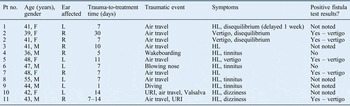
Ten of the 12 cases had some hearing loss, and 6 had vestibular symptoms (Table I). Four cases had audiological and vestibular symptoms, while two had vestibular symptoms only and six had audiological symptoms only. Vestibular symptoms included disequilibrium or dizziness (n = 5) and vertigo (n = 3). Fistula test results were positive in five cases, and absent or not noted in the remaining cases. Time-to-treat varied widely, ranging from 1 day to 30 days. Audiometric data were obtained initially for all patients, but were not subsequently recorded if no hearing loss was found on presentation. Magnetic resonance imaging was performed in five cases – all findings were negative. Ten cases received steroids; two did not.
Clinical characteristics

Pt no. = patient number; F = female; L = left; HL = hearing loss; R = right; M = male; URI = upper respiratory infection
Audiometric data
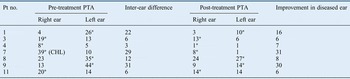
Audiometric data were available for comparison on seven patients before and after treatment. The results are shown in Table II. Six of the seven patients with data available showed an improvement or resolution of their hearing loss. Interestingly, one patient had a purely conductive hearing loss, a phenomenon described previously in the literature.Reference Markou, Rachovitsas, Veros, Tsiropoulos, Tsalighopoulos and Psillas 2 The remainder had a sensorineural hearing loss.
Audiometric data

Values represent decibels. *Indicates diseased ear. Pt no. = patient number; PTA = pure tone average of air conduction at 0.5, 1, 2 and 4 kHz; CHL = conductive hearing loss
Fistula test
Five cases had a positive fistula test result, as evidenced by subjective worsening of dizziness with either the Valsalva manoeuvre or tympanometry. Of those five, four had documented resolution; the results for the fifth case were not documented.
Symptom resolution
Seven cases had full resolution of all symptoms, four had improvement or near-full resolution, and one had no improvement.
Complications
There were no complications of the procedure, including no persistent perforations.
Example
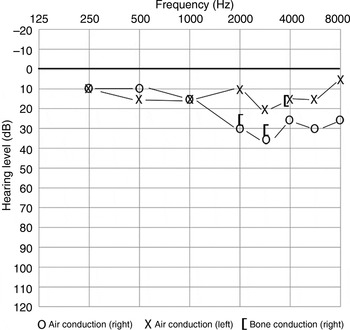
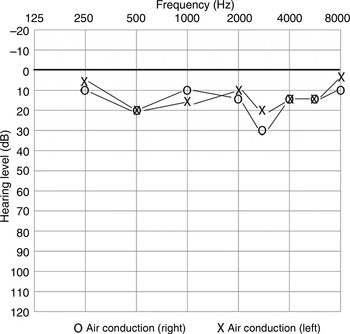
A clinical example of pre- and post-treatment audiometric data are provided (Figures 1 and 2).
Pre-treatment audiometric data demonstrating asymmetry in the mid to high frequencies in patient number 11. A positive fistula test was elicited during tympanometry.

Post-treatment audiometric data 21 days after intratympanic blood injection in patient number 11. Resolution of asymmetry was accompanied by full resolution of the initial presenting signs of subjective hearing loss and dizziness.

Discussion
Many physicians advocate aggressive management of perilymphatic fistulas that they feel are straightforward and diagnostically clear. Early surgical intervention for these cases has been recommended, keeping the limitations and costs of bed rest in mind, as well as the potential benefits to both hearing and balance function from an earlier resolution of pathology.Reference Park, Byun, Moon, Hong, Cho and Chung 3 Middle-ear exploration is a low-risk procedure, with a good therapeutic result for this disease. However, it is not without any risk. Surgical risks include chord tympani dysfunction, tympanic membrane perforation, and inadvertent damage to the middle-ear and inner-ear structures. There is also the inevitable delay from diagnosis to treatment in order to arrange for the operative intervention.
Traditional conservative treatment has previously centred on a period of observation, with bed rest. This allows the fistula to heal spontaneously, and prevents behaviours such as straining, lifting, or even Valsalva with bowel movements, in order to prevent the flow of perilymph through the pathological opening. For many physicians and patients, this poses extraordinary challenges, with both physical and psychological costs. Aside from the exceedingly difficult task of staying in bed for a week while avoiding significant effortful movement, there are financial burdens and strains on social networks as the patients and their families deal with the unexpected disruption to their lives.
Garg and Djalilian shared their experience with the intratympanic injection of blood to the middle ear, in which the resultant blood clot is used to seal any and all potential perilymphatic fistulas.Reference Garg and Djalilian 4 As they pointed out, blood has been used intra-operatively in various middle-ear procedures to seal fistulas or potential fistulas, with good results.Reference House 5 The combination of a mechanical tamponade and the promotion of healing through endogenous factors in the blood are proposed mechanisms for this treatment.
Intratympanic blood injection has several advantages over more traditional methods of treatment for perilymphatic fistula. First, as demonstrated by the above cohort of patients, it is effective at sealing the pathological fistula. Resolution or improvement of audiometric abnormalities was found in the majority of patients for whom data were available. Most hearing loss was sensorineural, with only one case of a mixed hearing loss. This phenomenon has been described in previous publications,Reference Markou, Rachovitsas, Veros, Tsiropoulos, Tsalighopoulos and Psillas 2 but appears to be the less common presentation of fistula-associated hearing loss. Resolution of a positive fistula test result, when reported, was found in four of five cases documented. Subjective improvement was demonstrated in 11 of 12 cases. As noted many times in previous publications, the fistula is repaired to prevent further loss of hearing and balance function, with a positive result being determined by resolution of balance symptoms, cessation of worsening hearing loss and the occasional improvement of hearing loss.
Second, an intratympanic blood injection has the advantage of time. There is virtually no delay between diagnosis and treatment, as the injection is performed in the office setting. This prevents further damage and allows for earlier commencement of healing and potentially improved outcomes, as could be determined by a larger, prospective study.
-
• Patients with perilymphatic fistulas typically present after otic barotrauma
-
• Otological symptoms include dizziness or disequilibrium, vertigo, hearing loss, aural fullness, or tinnitus
-
• Traditional management involves bed rest, steroids and, frequently, middle-ear exploration
-
• Autologous intratympanic blood injection, a minimally invasive, low-risk office procedure, is effective for patching suspected perilymph leaks
-
• The decrease in financial and logistical costs allows this treatment to be used more liberally, especially when the diagnosis is in doubt
Third, the cost of treatment is much lower as compared to operative treatment and conservative treatment with bed rest, both in terms of lost wages and opportunity costs. The costs to the patients’ social support system are, of course, immeasurable.
Lastly, intratympanic blood injection provides the physician with an additional treatment for those cases where the diagnosis of perilymphatic fistula has equivocal evidence. Some patients may present with good supportive historical elements but vague subjective symptoms associated with barotrauma, and may lack the objective audiometric data or positive fistula test results to definitively indicate the diagnosis. By lowering the costs (financial and logistical) and risks of treatment, blood injection provides an opportunity for definitive treatment when the clinical scenario may not support intervention under general anaesthesia.
Conclusion
Autologous intratympanic blood injection for the treatment of perilymphatic fistulas can be an effective tool for the practising otolaryngologist. As an office procedure, it provides a simple, low-cost alternative to bed rest or middle-ear exploration, with the added benefit of decreased time between diagnosis and treatment. It can be a definitive intervention, with minimal disruption to patients’ lives. The lower financial and psychosocial impact of this treatment also allows its use in those patients with a less certain diagnosis.
Acknowledgements
The author would like to thank Peter Volsky and Richard Vivero for their assistance in preparing this manuscript.