

Introduction: human rights and Italy’s role conception
The aim of this article is to assess Italy’s behaviour in the framework of the Universal Periodic Review (UPR) mechanism of the United Nations Human Rights Council (UN HRC).
This is deemed to be a relevant topic in a study on Italy’s foreign policy, since the promotion of human rights, multilateralism, and the international system governed by the rule of law represents a genetic component of the Italian democracy and its foreign policy, as set out in the Italian Constitution (arts. 10 and 11). However, as claimed by Salleo and Pirozzi (Reference Salleo and Pirozzi2008), these guiding principles do not denote a legitimization of an intransigent pacifism, but rather epitomize a concrete political choice dictated by the realism suited to a middle-sized power indicating the community of nations as the frame of reference for Italy’s place in the world and singling out diplomacy as the instrument to be used when dealing with crises. The United Nations, in particular, have traditionally been perceived, not only by the Italian diplomacy but also by the political establishment and, to a certain extent, by the Italian public opinion, as the organization with primary responsibility for dealing with human rights, development, and international security (Belotti and Cofelice, Reference Belotti and Cofelice2010).
In multilateral contexts, Italian highest-level political representatives and diplomats do not miss opportunities to reaffirm this ‘national role conception’, along with more specific human rights goals of Italy’s foreign policy, which appear to be rather steady over time. This attitude is well outlined by the following excerpt from a speech delivered by the former President of the Italian Republic Giorgio Napolitano, addressing the Human Rights Council during its 16th ordinary session (Geneva, 4 March 2011):
[…] The Human Rights Council is built on the same foundations of our Constitution: human rights and international peace, to be sought through dialogue among peoples of different cultures. […] It is no coincidence that, after the tragedy of World War Two, Italy’s democratic Constitution entered into force in very same year as the Universal Declaration of Human Rights. Same time, same principles, same spirit. […] I would like to take this opportunity to highlight some main priorities that, among others, have consistently inspired Italy’s active engagement in enhancing human rights protection over the years. […] Vulnerable groups, such as Christian communities in some countries, need special protection. Special protection is also needed for women and girls, as well as for all minors. […] Italy also attaches the utmost priority to issues related to the Rights of the Child. We must eliminate the scourge of children involved in armed conflicts and of forced recruitment of children. Finally, we remain committed to abolition of the death penalty. […]
It has to be stressed that in most of the priority issues mentioned in the above speech, Italy has often adopted the role of catalyst and facilitator in the United Nations (Cooper, Reference Cooper1997), by taking the lead in proposing and sponsoring relevant resolutions, especially in relation to the moratorium on capital punishment,Footnote 1 children’s rights,Footnote 2 fighting violence against women,Footnote 3 and freedom of religion or belief.Footnote 4
As a consequence, understanding how Italy behaves in the HRC – the main multilateral forum dealing with human rights at the global level – allows to shed light on a relevant component of Italy’s foreign policy. Moreover, although voting in the HRC may be perceived by some observers as mainly symbolic, it is the only forum in which a large number of states meet and vote on a regular basis on issues concerning human rights. Hence, studying the political interaction of member states over a long period of time and across different issue areas may be useful to assess states’ behaviour and reveal changes in the dimensionality of global cleavages as far as human rights are concerned (Voeten, Reference Voeten2000).
Accordingly, this article is structured as follows. First section provides an overview of the UPR mechanism and defines the leading research questions. Second section introduces the data set used in the empirical analysis, which is carried out in third and fourth sections. Those parts, respectively, deal with Italy’s behaviour in the UPR diplomatic phase in Geneva [where it acts both as a recommending state and a state under review (SuR)] and the implementation phase at the domestic level. Fifth section offers a possible explanation of Italy’s behaviour in the UPR, with particular reference to role theory, liberal, and constructivist institutionalism and the two-level game approach. The final section wraps up the main arguments and provides some general conclusions on both Italy’s behaviour and the UPR as such. The time-span of the analysis covers the first 19 UPR sessions (2008–14), broadly coinciding with Italy’s first two membership terms at the HRC.
Setting the framework: the UPR as a two-level game
The HRC was established on 15 March 2006 by the UN General Assembly (Res. UN/A/RES/60/251Footnote 5 ) in place of the former Commission on Human Rights, which had come under heavy criticism, not least by former UN Secretary General Kofi Annan, for being an extremely politicized and rather ineffective body. This was especially the case after countries with despicable human rights records gained membership, and Libya was elected as the chairmanship of the Commission in 2003. The HRC is now a subsidiary body of the General Assembly; it has an intergovernmental natureFootnote 6 and is responsible for promoting worldwide respect for all human rights and fundamental freedoms for all. To perform this task, the Council has established several mechanisms,Footnote 7 including the UPR.
Since the beginning Italy has supported the strengthening of the UN human rights machinery, both by voting in favour of the establishment of the HRC in 2006 and by facilitating the adoption of its institution-building package in 2007. Moreover, it has been a member of the Council between June 2007 and June 2010, and, for a second mandate, between June 2011 and December 2014.
To a large extent, the UPR represents the key innovation of the HRC and it is what makes it distinct from its predecessor. Indeed, it was planned essentially to overcome the criticisms over ‘naming and shaming’, as well as the politicization and selectivity syndrome in targeting and punishing gross human rights violators, since all this was causing a ‘shadow to be casted on the reputation of the United Nations system as a whole’ (United Nations General Assembly, 2005: para. 182). Accordingly, since it represents a new global approach in the promotion of human rights, the UPR experiment is critical to the fate of the HRC: how it performs and how credibly its work is viewed will considerably impact on the perceptions of the HRC more broadly (McMahon et al., Reference McMahon, Busia and Ascherio2013).
Basically, the UPR is a peer review mechanism through which all UN member states can make recommendations to each other regarding human rights practices. Under this mechanism, the human rights situation of the UN member states is reviewed every 4.5 years: 42 states are reviewed each year during three sessions, each one dedicated to 14 states. The UPR mechanism entails, in particular, two distinct phases. The first phase consists in the review at the HRC, where a 3.5-hour interactive dialogue for each SuR takes place, during which all the UN member states can take the floor to ask questions and make recommendations on the human rights situation in the SuR. At the end, the SuR presents its concluding remarks and has the choice to either accept the recommendations received or not.Footnote 8 This diplomatic and political dialogue occurring in Geneva (which can be labelled as the ‘level of the symbolic politics’) is followed by the implementation phase at domestic level, where the SuR is expected to enforce the recommendations received over a period of 4.5 years (i.e. the ‘level of the actual decisions’).
Since the UPR entails a clear demarcation of the different levels of political activity (i.e. international and domestic), it represents per se a suitable case in order to test the validity of the functional and two-level game assumptions on the Italian foreign policy, as outlined in the theoretical framework of this special issue (Isernia). The subsequent empirical analysis will initially follow this demarcation, in order to answer partially different (although inter-related) research questions.
First, Italy’s behaviour will be evaluated in relation to its diplomatic performance in Geneva (both as a recommending state and a SuR: third section). The goal here is to assess the degree of consistency between Italy’s national role conception (i.e. a promoter of human rights, multilateralism, and the rule of law, as constantly reiterated by Italian policy-makers and diplomats) and its role enactment in the multilateral forum of the HRC (Harnisch, Reference Harnisch2011). Accordingly, the analysis will include the following aspects: the overall level of Italy’s commitment towards the UPR; which objectives Italy pursues within the HRC; how coherent the country is in pursuing its human rights agenda.
Subsequently, the domestic implementation phase of the UPR will be considered (fourth section), with the purpose of assessing the extent to which Italy has enforced the recommendations received, and detecting which prevailing strategy is adopted by Italian decision-makers to fulfil this task, whether cooperation or inactivity (Isernia in this issue).
The two perspectives will be finally reconciled in fifth section, where a possible explanation about the Italian overall behaviour in the UPR framework is offered. Does Italy show a similar level of commitment towards UPR while playing its game in Geneva and at home? Or, does Italy’s behaviour follow two distinct logics and, eventually, reveals ‘double-standard’ attitudes?
The UPR Info database of recommendations
The analysis of Italy’s performance in the UPR mechanism can benefit from the existence of a publicly available database containing, as of June 2015, 38,298 recommendations made in the first 19 UPR sessions which took place between 2008 and 2014.Footnote 9 The database was designed by the Geneva-based NGO UPR Info to yield insights on state and regional behaviour in the UPR. Recommendations are organized according to eight main variables, most of which are nominal (including ‘SuR’, ‘recommending state’, ‘regional group’, ‘responses provided by the SuR’, and ‘issue contained in recommendation’).
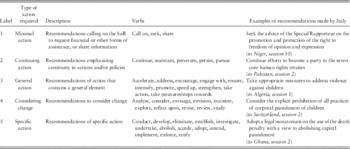
Worth mentioning is the only ordinal variable labelled as ‘action category’: on the basis of the kind of verbs used in the recommendations, these are coded by the level of action requested. In particular, the proposed scale ranges from 1 to 5, where 1 requires the least cost and effort to the SuR, while 5 represents the greatest potential cost since specific and tangible actions are requested. The main hypothesis, based on rational choice theory, is that the proportion of recommendations accepted (and then implemented) tends to decline as their perceived associated cost increases. Accordingly, states should find category 1 recommendations the easiest to accept and those from category 5 the hardest to embrace. Even though these latter generally tend to be the farthest reaching and most important.
However, the original action category variable has been recoded, by swapping categories 3 and 4. Indeed, recommendations inviting governments to adopt changes and reforms (originally coded as 3 and here recoded as 4) may contravene deeply held beliefs or policy positions of member states. As a consequence, their acceptance and implementation may entail serious potential costs.Footnote 10 By contrast, recommendations containing general goals (here recoded as 3 instead of 4) are more likely to be accepted, since they lack specificity and thus leave states free to define what constitutes evidence of their fulfilment. Table 1 contains a brief explanation of the recoded ‘action category’ variable, followed by an example of a real recommendation made by Italy for each category.
Recoded ‘action category’ variable, UPR Info database

SuR=state under review.
UPR in Geneva: the level of the ‘symbolic politics’
As already recalled in the introduction, Italian policy-makers and diplomats constantly reiterate country’s commitment to human rights, multilateralism, and the rule of law in a number of international contexts. Is this national role conception consistently enacted in the multilateral phase of the UPR which takes place at the HRC in Geneva? To answer this question, this section explores Italy’s behaviour both as a recommending state and a SuR during the first 19 UPR sessions (2008–14). In particular, the following five dimensions are considered: the overall number of recommendations made; the main target states; the strength of recommendations (according to the recoded ‘action category’ variable); the most recurrent human rights issues; Italy’s replies, as a SuR, to the recommendations received.
Number of Italy’s recommendations
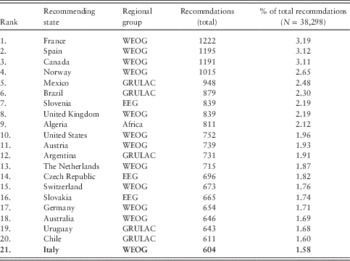
During the first 19 UPR sessions, Italy has made a total of 604 recommendations to 142 states (73% of all UN member states). According to these data, Italy is ranked at the 21st position among the 194 UN member states for number of recommendations made (i.e. close to the top 10% of states: see Table 2), and occupies middle-high positions both in its Western regional group (12th position out of 27 member states) and among EU states (10th position out of 28 states). This relatively good performance is an initial, prima facie indicator of the Italian interest and willingness to use this mechanism to promote human rights (although, of course, it does not clarify the efficacy of the recommendations).
Top recommending states, sessions 1–19

WEOG=Western European and other states; GRULAC=Latin America and Caribbean; EEG=Eastern Europe.
Target states
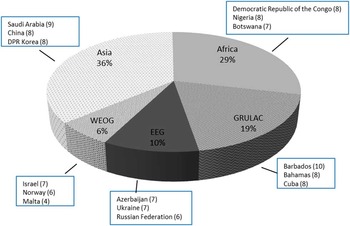
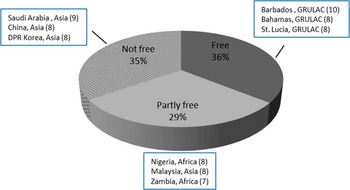
Almost two-thirds of Italy’s recommendations targeted Asian and African countries, which received, respectively, 36 and 29% of recommendations. By contrary, only 6% of recommendations targeted Western countries, where Israel is the top recipient state (Figure 1: the boxes indicates the top three recipient states for each regional group). On the one side, this may reveal a ‘politicized’ approach to the UPR: Italy appears to be more inclined to put pressure on states of other regional groups (i.e. Asia, Africa, and Latin America), while adopting a softer approach when dealing with its regional allies (European and Western states).Footnote 11 After all, a certain degree of politicization is unavoidable in peer review mechanisms. However, this interpretation can be at least partially attenuated by the analysis of the breakdown of Italy’s recommendations according to the recipient countries’ state of freedom, as assessed by Freedom House.Footnote 12 Figure 2 shows, indeed, that almost two-thirds of recommendations targeted partly free and not free countries (respectively, 35 and 29%), that, at least in principle, need to make more progress on human rights. Since the broad majority of these states (up to 80% in some years) belongs to the African and Asian groups, this may at least in part explain the reason why Italy’s preferred targets are Asian and African countries.Footnote 13
Italy’s recommendations by recipient regions, sessions 1–19. The boxes indicates the top three recipient states for each regional group. Own elaboration on data from UPR-Info, Database of UPR Recommendations (www.upr-info.org/database).

Italy’s recommendations by countries’ state of freedom, sessions 1–19. The boxes indicates the top three recipient states for each category. Own elaboration on data from UPR-Info and Freedom House.

How demanding are Italy’s recommendations?
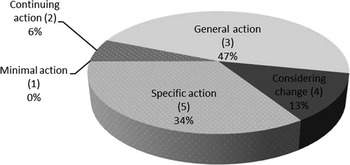
Almost all Italian recommendations (94%) are action oriented (Figure 3): nearly half of them, indeed, falls into categories 4–5; another 47% falls into category 3 (which generally facilitates states’ acceptance, as governments have considerable margin to define how to reach the goal set by the recommendations), with a mean of 4.09, compared with a global mean of 3.76. This confirms that Italy is taking UPR seriously, in that it is using it to ask other states to take reform actions.
Action categories of recommendations made by Italy, sessions 1–19. Own elaboration on data from UPR-Info, Database of UPR Recommendations (www.upr-info.org/database).

Human rights issues raised by Italy
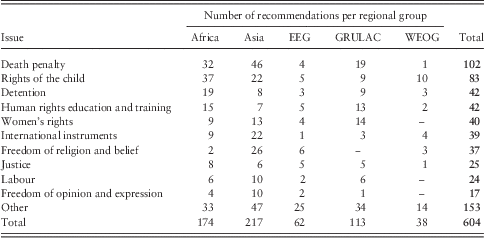
Table 3 provides a list of the 10 most frequently raised issues, with regional breakdowns, accounting for almost 75% of all Italy’s recommendation. The majority of these issues refers to the broader family of civil and political rights, including: death penalty (the top issue when Italy targets Asian and Latin American countries), detention conditions, freedom of religion and belief, justice matters and freedom of opinion, and expression. ‘Human rights education and training’ and ‘Labour’ can be classified as economic, social and cultural rights issues, and represent slightly more than 10% of Italy’s recommendations. Other two frequent issues address the rights of specific social categories, namely children (the top issue when Italy targets African and Western countries) and women. Finally, ‘international instruments’ is rather a procedural human rights issue.
The ten most frequently raised issues

EEG=Eastern Europe; GRULAC=Latin America and Caribbean; WEOG=Western European and other states.
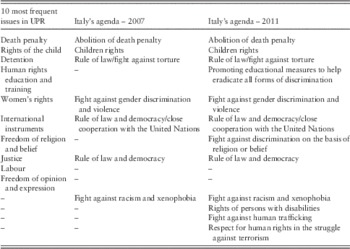
What should be highlighted is that the issues raised in Italy’s recommendations appear to be highly coherent not only with the priorities delineated in policy-makers’ and diplomats’ speeches, but also with a more formal human rights agenda, as set by the Italian government in the two candidacy letters for its election to the HRC, addressed to the President of the General Assembly in 2007 (United Nations General Assembly, 2007) and 2011 (United Nations General Assembly, 2011). These letters provide useful information on the strategic priorities of Italy’s diplomatic activities concerning human rights at the UN level (Table 4).
Correspondence between issues raised in the Universal Periodic Review (UPR) and Italy’s human rights agenda

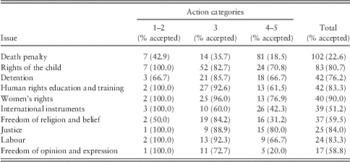
Despite the Italian diplomatic efforts, however, some issues have an intrinsic controversial nature, and produce a great resistance among states. This is particularly the case of the moratorium on death penalty, freedom of religion and belief, and the ratification of international instruments. Italy considers these issues at the top of its agenda to such an extent that very often it asks other states to take reform actions on them. These issues are indeed associated with stronger action recommendation levels: 79.4% of death penalty, 66.6% of international instrument, and 43.2% of freedom of religion and belief recommendations fall under categories 4–5. However, since they contravene deeply held beliefs and governments’ policy positions, they face the highest rejection rates: almost 80% of all recommendations on death penalty and 50% of those on international instrument have not been accepted by states from all regional groups (Table 5), while the majority of rejections to resolutions on freedom of religion and belief comes from Asian states belonging to the Organisation of Islamic Cooperation. By contrast, children and women rights appear to be less controversial and show a rather high acceptance rate, even when promoted under categories 4 and 5.
Issues cited by Italy, by action category and acceptance rate

Italy as a SuR
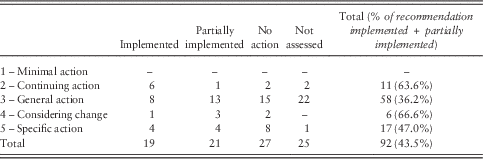
Italy underwent its first review in February 2010 (7th UPR session),Footnote 14 by receiving 92 recommendations from 51 countries (especially from other Western states and Asian states), concerning 18 different human rights issues (UN HRC, 2010a). The absolute majority of them (58) falls under action three category (general actions); 23 are more demanding (six under category 4 and 17 under category 5), while the remaining 11 ones emphasize continuity in Italy’s actions (category 2).
More than 80% of the recommendations received focusses on eight thematic areas:Footnote 15 the rights of migrants, refugees, and asylum-seekers (20% of the recommendation received);Footnote 16 racial discrimination (17%);Footnote 17 the rights of national minorities, with particular reference to the need to improve the conditions of the Roma, Sinti, and travellers communities (12%); the rights of children (9%);Footnote 18 ratification of international instruments (8%);Footnote 19 trafficking in human beings (7%);Footnote 20 lack of human rights structures at the national level (7%);Footnote 21 independence of the media and freedom of the press (5%).Footnote 22
A first interesting observation can be drawn from comparing these subjects with the list of issues that Italy frequently raises when it acts as a recommending state (Table 3). What emerges is a rather marked disconnection between what Italy recommends and the actions it is requested to enact at domestic level, since only two issues are present in both lists, namely the rights of the child and international instrument (which is a procedural issue, though).
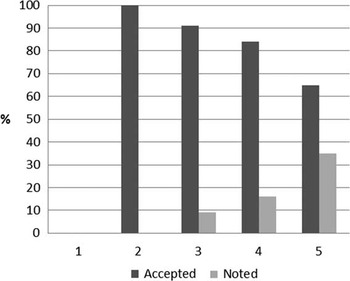
Of the 92 recommendations received, Italy accepted 80 and noted 12. Thus, Italy’s overall acceptance rate stands at 87%, which is significantly higher than the global mean registered during the first 19 UPR sessions (74%).Footnote 23 On the other hand, according to a more global trend, the inversely proportional relation between acceptance rate and action category is confirmed (Figure 4). While Italy accepted all category 2 recommendations (i.e. the ‘cheapest’ recommendations to comply with), most of rejections refer to the most costly category 5 recommendations.Footnote 24
Italy’s response to recommendations, by action category. Own elaboration on data from UPR-Info, Database of UPR Recommendations (www.upr-info.org/database).

The analysis carried out so far allows to draw some preliminary conclusions on Italy’s behaviour in the UPR diplomatic phase in Geneva. The UPR remains first and foremost a political and consensus-driven mechanism, as it is evident from the disproportionately high acceptance rate of recommendations – which globally amounts to 74% –; and states’ inclination (including Italy) to adopt a ‘softer’ approach towards their regional allies, while putting more pressure on states from other regional groups.
However, within the (to a certain extent unavoidable) limits of such a political process, Italy appears to be truly committed to the well-functioning of the UPR, in line with its perceived identity of a liberal democratic country supporting human rights and multilateralism. This is demonstrated by: the overall number of recommendations made (604, 21st position in the rank of all UN member states); their typology, emphasizing action and reform-oriented recommendations (categories 3–5); the fact that two-thirds of Italian recommendations target partly free and not free countries; the acceptance rate of the recommendations received as a SuR, which is significantly higher than the global mean. Moreover, Italy has so far exploited UPR to strategically and consistently promote its human rights agenda. As a result, when an issue is judged particularly relevant (such as death penalty and freedom of religion), Italy seeks to push it through stronger action category recommendations. However, the impact of its recommendations is not always in line with expectations: due to the highly sensitive nature of the issues raised, some of them display high non-acceptance rates.
Is this positive commitment towards the UPR also confirmed during the domestic implementation phase of the received recommendations?
UPR at the domestic level: the moment of the actual decisions
Italy was expected to implement at domestic level, over a 4.5-year period, the recommendations received at the HRC in February 2010, and to report on this process to the HRC in October 2014, on the occasion of its second periodic review.
In general, assessing the level of implementation of UPR recommendations is not an easy task, especially because the UPR itself does not entail any mechanism for systematic assessment (once again confirming its political nature), thus impeding any meaningful comparison among states’ practices. Consequently, in order to assess the extent to which Italy has enforced the 92 recommendations received between February 2010 and October 2014, I chose to rely on three different sources: an academic independent source, that is, the Italian Yearbook on Human Rights;Footnote 25 international institutions’ reports (adopted by the HRC Special Procedures and UN Treaty Bodies); and civil society organizations’ reports (particularly by UPR Info and the Italian Committee for the Promotion and Protection of Human Rights).
On the basis of these information sources it is possible to determine that, as of October 2014, Italy has fully implemented 21% of the recommendations received,Footnote 26 including an initially rejected recommendation, that is ‘striking out the aggravating factor connected to the status of irregular immigrants’ (the Constitutional Court declared this circumstance unconstitutional in judgment no. 249 of 8 July 2010).
In addition, 23% of the recommendations have been partially implemented, that is certain positive actions have been undertaken towards implementing them, but these are still not sufficient to ensure the fully achievement of the established goals.Footnote 27 In fact, some of the recommendations include long-term objectives which require the activation of a complex legislative process or several cycles of public policies, very difficult to complete in a timeframe of only 4.5 years. For instance, Italy has not yet introduced the crime of torture into the national legal order, nor it has established the independent National Commission for Human Rights. Yet, several bills have been presented on these issues and currently they are under discussion in Parliament. Another example refers to prison conditions: the Prison Administration Department estimated that between December 2012 and April 2014, the ratio between detainees and number of places available in prison has moved from 1.4 (140 detainees/100 places) to 1.2 (~120 detainees/100 places), but these improvements still appear insufficient to systematically and permanently resolve the serious problem of prison overcrowding. Finally, steps have been taken also towards decriminalizing migrants’ irregular entry in Italy: this recommendation, too, was initially rejected by Italy.Footnote 28
On the other hand, no action has been taken concerning 29% of the recommendations received.Footnote 29 Expectedly, the recommendations associated with the most specific actions (category 5) received the highest rate of inaction (47%), due to either their high political or financial costs (Table 6).
Implementation rate of recommendations received by Italy, by action category

Finally, it is impossible to assess the situation of 27% of the recommendations because the terms in which they are formulated are so generic to make it impossible to clearly establish whether the objectives set have been achieved.Footnote 30 As shown in Table 6, these recommendations overwhelmingly belong to category 3 (general actions): this reveals the inherently flawed nature of these recommendations, whose lack of specificity turns any assessment into an extremely difficult task.
Overall, then, at the end of the domestic implementation cycle, Italy has fully enforced only one out of five recommendations. If the partially implemented recommendations are also considered, it can be concluded that Italy has made progress on less than half of the 92 recommendations received (about 44%). This relatively low level of action at domestic level appears to be sharply in contrast with the activism and positive commitment towards the UPR showed by Italy when it acts at the HRC in Geneva.
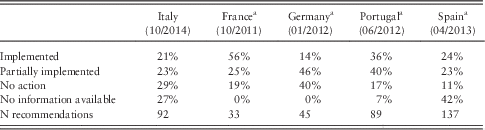
Moreover, even though valid data to make full comparison with other countries are lacking, there is another source that can reinforce, at least partially, this perception of passivity at domestic level. In October 2014, UPR Info issued an analysis on the extent to which states have been implementing recommendations by the mid-term point, that is between their first and second assessments in the established 4.5-year cycle (UPR Info, 2014). This report, which is based on compliance data provided by governments and civil society organizations from 165 countries, determines that almost half of the 11,527 considered recommendations had already resulted in full (18%) or partial action (30%) by the mid-term point of assessment, while another 48% of recommendations had not been implemented. Table 7 compares Italy’s implementation rate at the end of the 4.5-year cycle with data for a selected group of EU countries at their mid-term point. Obviously, these data have only limited utility and cannot be used for a rigorous comparative analysis, since both the time-span and the methodology implied are different. Nevertheless, the impression they convey, however, superficial, is that other EU countries took roughly half of the time to reach Italy’s same results (or even better ones).
Implementation rate of Universal Periodic Review (UPR) recommendations: Italy and other four EU countries

As to Italy: compiled from data available from Italian Yearbook on Human Rights, OHCHR, UN Treaty Bodies, UPR Info, Italian Committee for the Promotion and Protection of Human Rights; as to other countries: UPR Info Follow Up Programme.
a Mid-term implementation.
How to explain the gap? Legitimacy and status seeking vs. policy of inactivity
The empirical analysis carried out in third and fourth sections allows to identify a sort of behavioural gap affecting Italy in the framework of the UPR mechanism. During the review phase in Geneva, Italy displayed a remarkable activism and willingness to consistently promote, through the UPR, its own human rights foreign policy agenda. This attitude can be inferred by the high overall number of recommendations made; their typology (emphasizing action and reform-oriented recommendations) and preferred targets (not-free and partly free countries); the consistency between Italy’s formal human rights agenda and the issues raised in the recommendations; and the acceptance rate of the recommendations received, which is higher than the global mean. On the contrary, Italy denotes a more passive attitude during the implementation phase at domestic level: over the 4.5-year cycle, only one out of five recommendations has been fully enforced, and in general some progress has been made on less than half of the 92 recommendations received. How to explain this gap?
What appears rather evident is that, during the review phase in Geneva, Italy made considerable diplomatic effort to seek legitimacy both for its policies and for its identity as an international actor. Both liberal and constructivist views agree that politics, especially at the UN, is ‘not merely a struggle for power but also a contest over legitimacy’ (Claude, Reference Claude1966: 368). In this sense, the UN is largely used by member states as a source of legitimacy (Smith, Reference Smith2013), that is, ‘as a dispenser of politically significant approval and disapproval of the claims, policies, and actions of states, including, but going far beyond, their claims to status as independent members of the international system’ (Claude, Reference Claude1966: 367). More specifically, the HRC is arguably the world’s premier site of contestation over legitimacy on human rights politics. Thus, a plausible role for the UPR emerges as a contributor to, and evaluator of, reputations for good and bad human rights behaviour (Lebovic and Voeten, Reference Lebovic and Voeten2006).
Which is then the rationale behind Italy’s legitimacy-seeking efforts at the UPR? This is where liberal and constructivist views actually diverge. Constructivists focus on the interaction between national role conceptions and the social pressure exerted within international organizations (Schimmelfennig et al., Reference Schimmelfennig, Engert and Knobel2006; Folz, Reference Folz2011). Currently, the UPR probably represents the multilateral political forum where the social conformity pressures to ensure states to abide by human rights (i.e. to ‘behave well’) are most concentrated, for at least two reasons. First of all, unlike the traditional UN machinery (the so-called Treaty Bodies), the UPR is the only global forum where public scrutiny on states’ human rights policies is carried out among peers, which are directly responsible for both bestowing legitimacy and distributing social punishments (e.g. a loss in social status). Second, as already explained in first section, the UPR represents the key innovation of the HRC, and thus its success is critical to the fate of the whole Council. However, according to a constructivist view, it is much easier for this social pressure to have an impact if the target state wants to be a ‘member of the club’. As claimed by Flockhart, ‘the agent being socialized must identify positively with the social group to which the norm promoter belongs and have a desire for inclusion in that group; it is not possible to socialize agents who do not wish to belong to the group of the socializer’ (Reference Flockhart2006: 97). This assumption perfectly fits the Italian case. As it appears evident from the speech reported in the introduction, not only Italy included human rights norms in its self-definition, but it has always striven to be recognized by others as a liberal democratic country committed to the promotion of human rights and the rule of law. Consequently, it can be concluded that the degree of social pressure exerted within the UPR in favour of human rights commitments pushed Italy to consistently enact its national role conception through the diplomatic activity.
On the other hand, liberal institutionalists consider reputation on human rights not only important by itself, but also because it can help (or hurt) efforts by states to secure or improve their reputation in other perhaps more consequential areas of interest (Axelrod and Keohane, Reference Axelrod and Keohane1985; Downs and Jones, Reference Downs and Jones2002; Farber, Reference Farber2002). In this sense, according to Romero, Italy’s foreign policy is shackled by two features: a focus (defined as ‘obsessive’) on rank and prestige, and a faith in the multilateral arrangements it belongs to, in the belief that multilateralism may offer Italy ‘not only a tool for its security, growth and modernisation, but a shortcut to transcending the limits of its international power and influence’ (Reference Romero2016: 8). Hence, demonstrating a strong commitment to human rights could help Italy to pursue its key national interests, such as, for instance, its case for Security Council membership.Footnote 31
In empirical terms, however, these two theoretical arguments can reasonably be viewed as complementary influences that induce Italy to seek legitimacy in the review phase in Geneva both for its policies and, ultimately, for its identity.Footnote 32
Which are the prevailing strategies and tools used by Italy to pursue these goals? Essentially those of ‘niche diplomacy’, particularly suited to a middle-sized power country (Cooper, Reference Cooper1997).Footnote 33 As it clearly emerges from the analysis on Italy’s recommending behaviour (third section), on the one hand, Italy seeks to increase the credibility of its recommendations by focusing on few issues over which it has a relatively good reputation in other multilateral contexts and/or at the domestic level (such as death penalty, freedom of religion, children rights); on the other, it tends to remain rather silent on subjects regarding which it is itself the object of recommendations (such as rights of migrants and refugees, racial discriminations).
However, at domestic level, Italy’s reputation and identity as a ‘human rights friendly country’ are not at stake, and the international social pressure ‘to behave well’, exerted by peers through the UPR, is not directly perceived. At this level, the concern of national decision-makers is different, and consists mainly in minimizing the impact of the most costly (both in political and material terms) recommendations, thus protecting to the greater extent possible the dynamics of domestic politics from any shock or external challenge (Putnam, Reference Putnam1988; Isernia, 2017).
As a result, the main strategy chosen by Italian decision-makers to pursue this goal is not cooperation, but inactivity. According to Isernia, a cooperative solution would have called for ‘a set of institutional structures, rules and strategies’ to manage the implementation process, ‘debates and conflicts among the social groups on the preferred solution’ to adopt and, inevitably, ‘adjustment’ to the peers’ recommendations.
None of the above has been actually implied; on the contrary, a broad array of inactivity strategies has been adopted (see Isernia, 2017). First of all, the UPR implementation has been largely subtracted to the public debate. Not only the debate on UPR has never reached public opinion and the direct attention of citizens; but, unlike other European countries,Footnote 34 Italy has neither actively involved civil society organizations in the implementation process, nor it has prepared a public medium-term follow-up report, in order to promote wider knowledge of the recommendations and the UPR mechanism in the country. There has also been a low parliamentary engagement. The UPR has never been debated in plenary sessions. In fact, most of the parliamentary work on the review has been carried out by the Permanent Committee on Human Rights of the Chamber of Deputies (a sub-committee of the Commission for Foreign Affairs) and the Special Commission for the Protection and Promotion of Human Rights of the Senate (an ad hoc, non-permanent commission), mainly through hearings of Italian diplomats involved in the process in 2010 and 2014.
In general, the government delegated the responsibility for the coordination of the implementation of low-level conflict recommendations to the Inter-Ministerial Committee for Human Rights (operating within the Office of the Minister for Foreign Affairs), which is composed of highly skilled diplomats, public officials, and academic members, but no high-level political actors. Moreover, this Committee received few instructions from national decision-makers on how to perform this task, and generally found little cooperation from the ministries involved.
Finally, cases of non-compliance with the most politically and materially costly recommendations were justified by mainly recurring a ‘stalemate’ or ‘tied hands’ strategy, that is invoking (alleged) institutional or financial impediments that prevented the government from taking actions. A first example refers to the introduction of the crime of torture, which is a highly sensitive issue for many political forces and continues to generate transversal opposition within the parliament (and government). After a failed attempt during the 16th legislature, under national and international pressure (including at the UPR), 12 different (sometimes conflictual) bills were presented in 2013 alone, but the parliamentary discussion is still underway as of October 2016. In light of this situation, the Italian government merely made it clear that ‘in accordance with the principle of the separation of powers, the Government is not in a position to commit the Parliament to act within a specific deadline’ (UN HRC, 2010b: 3), and that, nonetheless, torture is already punishable ‘under various offences and aggravating circumstances’ (UN HRC, 2010b: 2). Another example refers to the setting up of national human rights institutions: the government committed to submit a bill on this to the Parliament, ‘as soon as the required budgetary resources are made available’ (UN HRC, 2010b: 3). A final example refers to the ratification of the UN Convention on the protection of the rights of migrant workers: according to the government, Italy is not in a position to ratify this instrument because ‘the signature and ratification could only be planned jointly with the other European Union partners since many provisions of the Convention fall within the European Union domain’ (UN HRC, 2010b: 2).
Overall, this passive domestic strategy resulted, in a slow advancement in some of the most sensitive issues, while several progresses can be ascribed to low-profile political actors (such as the Inter-Ministerial Committee for Human Rights), or even non-political actors (such as the courts).
Conclusion
Using the metaphor of the two-level game as suggested by Putnam (Reference Putnam1988), the analysis on Italy’s behaviour in the framework of the UPR revealed that Italian decision-makers played parallel games both at domestic and international tables of the UPR, and managed to adapt country’s human rights foreign policy goals according to the different social contexts where they operated.
During the review phase in Geneva, Italy used niche diplomacy tools (especially by focussing its recommendations on few issues over which it has a relatively good reputation in other multilateral contexts and/or at domestic level) to seek legitimacy both for its policies and for its identity as an international ‘human rights friendly’ actor. Whereas at domestic level, where Italy’s reputation is not at stake and the international social pressure is not directly perceived, a deliberate policy of inactivity was chosen, mainly consisting in subtracting the UPR implementation phase to the public and parliamentary debate, delegating the responsibility for the implementation of low-level conflict recommendations to low-profile or non-political actors, and adopting a strategy of the ‘tied hands’ to justify a low level of compliance with some of the most sensitive recommendations. Indeed, the goal was to minimize the impact of the most costly (both in political and material terms) recommendations, and to protect the dynamics of domestic politics.
Moreover, this gap between international activism and domestic passivity also resounds in Italian decision-makers’ discourses. In multilateral contexts, indeed, Italian highest-level representatives and diplomats do not miss opportunities to reaffirm, in a steady and coherent manner, the country’s foreign policy human rights aims (see Introduction: human rights and Italy’s role conception). At domestic level, by contrast, as demonstrated by the analysis of Foreign Ministers discourses carried out by Caffarena and Gabusi, human rights promotion represents rather ‘a mere narrative for the domestic audience’, since it is ‘neither grounded in any scientific idea or directly linked to any operational idea’ (Caffarena and Gabusi, 2017). Thus, the findings of these two studies appear rather consistent and concur to convey the idea that, in its foreign policy, Italy tends to adopt an instrumental approach towards human rights promotion in order to gain international reputation.
Overall, was this strategy successful? If assessed from the point of view of the Italian diplomacy, the answer is by and large affirmative, since Italy payed no price for its domestic behaviour within the United Nations. By contrary, by boosting its human rights commitment, Italy actually managed to win re-election at the HRC in 2011, as well as a seat at the UN Security Council in the 2015 elections (although in co-ownership with the Netherlands). Whereas, a greater deal of cooperation and adaptability would be required from the Italian domestic political system, including a better timing and effectiveness in addressing sensible human rights challenges, a more transparent participatory decision-making process, and a greater coordination among the different branches of government and of them with the international actors. ‘All of this is needed but, at the same time, in short supply’ (Isernia, 2017).
Yet, it has to be stressed, that the success of the Italian strategy depends also on the intrinsic demarcation between the two phases of the UPR: despite the original intention behind this mechanism, the practice revealed low interaction between the international and domestic tables. As a result, Italian decision-makers did not have to make extra efforts to keep the level of symbolic politics (UPR in Geneva) and the domestic level of actual decisions separated. Thus, when Italy underwent its second review in Geneva in October 2014, its representative claimed that 84% of the recommendations received in 2010 had been implemented (UN HRC, 2014: para. 8), and this statement remained totally unchecked.Footnote 35
Accordingly, in order to avoid that states’ two-level game turns into a ‘double-standard’ game, the two UPR levels have to be reconciled through the setting-up of systematic follow-up or monitoring mechanisms aiming at assessing states’ implementation rate of UPR recommendations at domestic level. Otherwise, as showed by the Italian case, the UPR mechanism as a whole could be jeopardized.
Acknowledgements
The authors would like to thank the members of the research team for the project on the Italian Foreign Policy, whose comments and continuing support contributed to improve the quality of this work. The authors also thank the anonymous reviewer for his/her valuable remarks.
Financial Support
This research received financial support from the project “The Italian Foreign Policy in front of the new challenges of the international system: actors, institutions and policies” (PRIN 2010-2011, grant n. 201032T8ZE) funded by the Italian Ministry of Education, University and Research (MIUR).
Data
The replication data set is available at http://thedata.harvard.edu/dvn/dv/ipsr-risp.