Introduction
In many parts of the developed world, an ageing population (Ofori-Aseno et al., Reference Ofori-Asenso, Zomer, Curtis, Zoungas and Gambhir2018) has coincided with increasing reliance on digital devices and the internet for basic services and social connection. Yates et al. (Reference Yates, Kirby, Lockley, Foster, Brunton, Deeming and Haux2015a) use the evocative term ‘digital by default’ to highlight the threat posed to some by the societal shifts that see crucial government, health and financial services moving online first, with ‘bricks and mortar’ or even phone contact becoming increasingly restricted (see also Williams et al., Reference Williams, Philip, Farrington and Fairhurst2016; Schou and Pors, Reference Schou and Pors2019). These changes have been accelerated by restrictions brought about by the COVID-19 pandemic. They are more likely to affect older adults and those without adequate internet access, skills and literacy.
While access to digital technologies and the internet continues to increase globally, there is evidence of persistent inequalities and differential use and benefit (Hunsaker and Hargittai, Reference Hunsaker and Hargittai2018; Hargittai et al., Reference Hargittai, Piper and Morris2019). In this paper, we contribute to evidence of the digital exclusion faced by many older adults, and we highlight the differences within this cohort as they engage with a national digital skills and literacy programme targeting people aged 50 years and older. The national programme, Be Connected (beconnected.esafety.gov.au), was funded by the Australian Government and rolled out across the country through a network of more than 3,500 partner organisations, reaching over 580,000 learners (1 million at the time of writing), between 2017 and 2020 (extended to 2024). The programme has the broad aim of supporting all older Australians to benefit from using the internet and digital devices, and involves both online learning resources and funded digital skills and mentoring services across the partner network. This study offers a rare opportunity to account for the impact of a large-scale digital literacy intervention with this cohort.
Our findings not only help to inform future programme design but provide additional insights into the challenges older adults face in using digital technologies and the internet in their everyday lives. We emphasise differences in digital skills and internet use among older people, and variation in the way they benefit from digital skills learning through online and face-to-face support and mentorship. A range of measures – digital skills, confidence, attitudes and activities (participation) – are used to examine the impact of the programme. Baseline and follow-up surveys (Time 1 and Time 2) with a representative sample of programme participants (N = 337) measured change over time. In combination with a statistical latent class analysis (LCA), interviews with programme participants (N = 58) helped identify who benefited from the programme (and who did not) and the salient aspects of their socio-economic and cultural context. These differences can be accounted for through conceptual approaches to situated digital literacies (drawing on Barton and Hamilton, Reference Barton, Hamilton, Barton, Hamilton and Ivanič2000), which is a way of identifying the lifecourse (Settersten, Reference Settersten2018) and demographic factors associated with digital ability and skills learning. Digital inequalities, we show, are embedded within lifecourse and social contexts, and are not easily addressed by interventions that focus on the individual, disregarding that context.
Background
Despite increases in internet access and use, digital inequalities – the disparities in the benefits gained through the use of digital technologies and the internet – persist and there is evidence that among some population segments they are deepening. This has been reported for some time in relation to older adults, including in wealthy countries (Selwyn et al., Reference Selwyn, Gorard, Furlong and Madden2003; Hunsaker and Hargittai, Reference Hunsaker and Hargittai2018). Early accounts emphasised the impact of digital exclusion for older adults with the pejorative notion of the ‘grey digital divide’ (Millward, Reference Millward2003). There is little question that the digital divide has reflected and contributed to persistent social inequality (van Dijk, Reference van Dijk2005; Helsper, Reference Helsper2021); and while access has improved in most developed countries, older adults consistently fall behind, with poor digital abilities and literacies persisting (Anderson and Perrin, Reference Anderson and Perrin2017; Thomas et al., Reference Thomas, Barraket, Wilson, Rennie, Ewing and MacDonald2019; van Deursen and van Dijk, Reference van Deursen and van Dijk2019). In Australia, while 98 per cent of 25–34-year-olds regularly access the internet, only 83 per cent of those aged 55–64 years do so, and this drops significantly to 55 per cent for people aged 65 years and over (Australian Bureau of Statistics, 2018). One problem with these statistics is that they represent a low bar and a blunt measure of internet ‘use’ (considered to have accessed the internet in the last three months). Our study challenges these broad categorisations and adds needed detail. Numerous empirical studies continue to show the effects of demographic factors such as race, gender, age, education, employment and socio-economic status, but also the outcomes and benefits of internet use (e.g. van Deursen and Helsper, Reference van Deursen and Helsper2015). Also age proves to be one of the strongest predictors of online participation including the more active forms of engagement such as social media use and content creation (Lutz, Reference Lutz2019).
To better account for differences across and within population segments, empirical studies have moved from disparities in internet access in ‘first-level’ digital divide research, to examine a broader set of questions about variation in skills, uses, and the range of personal and social outcomes across international contexts (Hargittai, Reference Hargittai2002; DiMaggio et al., Reference DiMaggio, Hargittai, Celeste, Shafer and Neckerman2004; van Deursen and van Dijk, Reference van Deursen and van Dijk2011; Ragnedda and Muschert, Reference Ragnedda and Muschert2013). Digital inequalities and exclusion tend to mirror social inequalities along the lines of gender, race and ethnicity, education and age (Yates et al., Reference Yates, Kirby and Lockley2015b). While exacerbated by age, in the United Kingdom (UK), the longitudinal cohort study by Matthews et al. (Reference Matthews, Nazroo and Marshall2019: 1914) showed that factors such as poor health, education and occupation are important mediators of internet use over time, and ‘rates of internet use are consistently lower for women than men and for those in poorer financial circumstances, independently of age’. As Helsper (Reference Helsper2012: 405) puts it, ‘digital inclusion should always be seen as embedded in a person's offline circumstances’. Social and personal disadvantages associated with ageing are also associated with digital exclusion. This includes physical and cognitive factors, reduced wealth, reduced mobility, and number of years since participating in professional activities and work or learning contexts in which digital technologies are more readily available (e.g. Hargittai and Dobransky, Reference Hargittai and Dobransky2017).
Differences within older adult cohorts matter just as much. A range of measures have been used to categorise differences, recognising the diversity of experiences and the range of factors that impact on digital inequalities. Research examining older internet users in Australia nominates ‘digitally disengaged’ (8%) or non-internet users as those who ‘never perform online activities’, against ‘low-’ (26%), ‘moderate-’ (31%) and ‘high-’ (35%) level internet users (those who perform online transactions once a week or more) (eSafety Commissioner, 2018). Such classifications help to break down the prevailing stereotypes of age-related digital exclusion. Likewise, drawing on 41 in-depth interviews, Quan-Haase et al. (Reference Quan-Haase, Williams, Kicevski, Elueze and Wellman2018) cluster their participants as non-users (10%), reluctant users (17%), apprehensive users (17%), basic users (27%), go-getters (22%) and savvy users (7%). As well as varying in their use and ability, older adults are often ambivalent about the empowering and disempowering aspects of digital technologies (Hill et al., Reference Hill, Betts and Gardner2015). This reflects important mediating factors such as motivational and attitudinal patterns, priorities and preferences that influence differences in device and internet use.
Improving older adults’ digital skills and literacies
In recognition of these disparities, it is important to examine diversity of attitudes, skills, confidence and use in the context of programmes aiming to support and improve older adults’ digital inclusion. Such programmes have been in operation across developed and developing countries for decades; and with the rapid pace of technological change, their need persists. In the early 2000s, for instance, the UK government put in place measures to ‘widen older adults’ access to ICT [information and communication technology]’ through a pledge to achieve ‘“universal access” to the Internet by 2005’, with initiatives collated under the umbrella UK Online programme (Selwyn et al., Reference Selwyn, Gorard, Furlong and Madden2003: 564–565). Research studying the outcomes of programmes like these for older adult participants are often localised and qualitative. A number of studies point to the benefits of targeted and tailored models offering workshops on specific skills and internet activities, such as social media use, to address loneliness and improve social connection (Quinn, Reference Quinn2021). Approaches that are able to address the specific needs of local communities with sufficient participant buy-in (Baker et al., Reference Baker, Warburton, Hodgkin and Pascal2017), as in the adoption of ‘living lab’ models, have been highly successful (Hughes et al., Reference Hughes, Foth, Dezuanni, Mallan and Allan2018). Also with older adults, there is strong evidence to show the importance of taking an interests-based approach to skills, literacies and digital participation (Beh et al., Reference Beh, Pedell and Mascitelli2018; Davis et al., Reference Davis, McCosker, Bossio and Schleser2018), as well as adopting a ‘blended’ approach (both in-person and online learning) to digital literacy workshops (Martínez-Alcalá et al., Reference Martínez-Alcalá, Rosales-Lagarde, Alonso-Lavernia, Ramírez-Salvador, Jiménez-Rodríguez, Cepeda-Rebollar, López-Noguerola, Bautista-Días and Agis-Juárez2018).
Addressing digital inequalities at a national scale while building on the lessons of small, localised studies requires further information about the factors affecting older adults’ digital inclusion and inequalities. We approach these questions in the context of a government-funded, nation-wide digital literacies programme in Australia called Be Connected. With reference to the existing research and associated gaps in understanding large-scale interventions, and in relation to the Be Connected programme, we address the following research questions:
-
RQ1: Who did the digital literacies programme benefit and how?
-
RQ2: What are the demographic and lifecourse characteristics associated with programme outcomes?
-
RQ3: Why do some learners benefit more than others from programme involvement?
Answers to these research questions contribute to a growing empirical evidence base focusing on older internet users and provide more detail about the impact of internet inequalities for this cohort. The research aims to add nuance to understanding those experiences to show that they are far from homogenous. Finally, we discuss how these findings can help to inform future digital skills and literacies interventions.
Conceptual approach
While population studies consistently show that age remains a key barrier to digital inclusion and a predictor of non-use or limited internet use, those findings stand at odds with the more nuanced experiences of many older adults (Hill et al., Reference Hill, Betts and Gardner2015; Neves et al., Reference Neves, Waycott and Malta2018). To move beyond instrumental questions of digital access and address the digital skills, literacies and participation objectives of policy approaches to digital inclusion, we draw on the concept of situated digital literacies.
The ‘new literacies’ and ‘situated literacies’ movements sought to understand literacy practices – defined as the cultural ways of using written language, and later ICTs, in people's everyday lives – ‘as located in particular times and places’ (Barton et al., Reference Barton, Hamilton and Ivanič2000). Street and Street (Reference Street and Street1984) contrasted the ‘autonomous model of literacy’, which prioritises cognitive development and individual capability or deficit, with social contexts and practices that account for the diversity of literacies situated in their social settings. This approach has been applied to digital and data literacies in the social contexts of new technologies (e.g. Pangrazio, Reference Pangrazio2016; McCosker, Reference McCosker2017), and aligns with socio-ecological and co-constitutional understandings of ageing with technology (Vroman et al., Reference Vroman, Arthanat and Lysack2015; Peine and Neven, Reference Peine and Neven2021) and approaches that account for diversity in the lifecourse (Settersten, Reference Settersten2018). In this vein, our research contributes to understanding the characteristics of older adults seeking to improve their digital inclusion, skills and literacies, with implications for how best to address digital inclusion among what we see as a disparate cohort with varied life circumstances and learning needs.
Methods
With the stated aim of improving the confidence, skills and online safety of people aged 50 years and over, there are two core components to the programme's design: online learning modules presented through a government Web portal, and face-to-face support provided by a network of community-based organisations. The online learning portal offers resources and activities that participants can complete either as registered users (to track progress) or as unregistered guests. Modules cover a variety of topics (with 12 modules at the time of the study and 23 at the time of writing) covering, for example, device and operating systems, online safety, email, social media, and some interest areas such as online videos and genealogy. The skill-sets targeted are broad-ranging, including ‘the very basics’, along with mobile data management and e-safety, and interest areas for more experienced users. Modules include supporting text, videos and practice exercises. Key to the programme, however, face-to-face support is provided through a network of more than 3,500 community-based organisations, funded by a series of grants managed by a non-profit network manager (Good Things Foundation). Peer educators, or ‘digital mentors’, either employed casually through the partner organisations or acting as volunteers, came to play a significant role in the delivery of Be Connected, with more than 9,800 contributing to the programme during the study period, and 14,000 at the time of writing (McCosker et al., Reference McCosker, Tucker, Critchley, Hiruy, Walshe, Suchowerska and Barraket2020).
To address RQ1 and RQ2, we conducted a mixed-methods study that involved a pre- (N = 626) and post- (N = 337) survey between August 2018 and May 2019. This was supported and contextualised (addressing RQ3) with semi-structured interviews (N = 58) with learners (N = 38) and digital mentors (N = 20), conducted between August 2019 and January 2020, in person or by phone to accommodate geographical diversity.
Survey instrument and measures
The survey instrument was designed to combine measures of participants’ online confidence, attitudes, digital skills and digital activities in a way that would provide holistic indicators of digital participation, and pinpoint key aspects of situated digital literacies. Where possible, established survey item subsets were used, with some questions adjusted to better address older adults’ internet use.
The survey measured confidence on 12 items of internet and device use, ranging from general confidence in using a computer, tablet or mobile phone or ‘being safe online’, to confidence with aspects of internet use such as email, buying things online and online banking or using social media. An exploratory factor analysis (EFA) of the 12 confidence questions at both times consistently revealed two main confidence factors relating to general confidence (with device and computer use) and technical confidence (with specific applications and internet use). Two composite scores were created by averaging the factor indicators for each at both times.
To measure attitudes, the survey drew on the Media and Technology Usage and Attitudes Scale (Rosen et al., Reference Rosen, Whaling, Carrier, Cheever and Rokkum2013) with minor adjustments to shorten question items and ensure questions were relevant for older adults based on current research (Hill et al., Reference Hill, Betts and Gardner2015). A mix of five positive and negative attitude questions were included, with a focus on attitudes to access, usefulness and social impact of internet technologies. Two EFAs for each time indicated that all attitude items were represented by one overall attitude factor, except for the question ‘Internet technologies make people more isolated’. Given that the factor only explained 0.09 per cent of this item's variance at both Times 1 and 2, it was removed from the overall attitude composite scores.
Digital skills were measured using questions adapted from the Internet Skills Scale (ISS) (van Deursen et al., Reference van Deursen, Helsper and Eynon2016) and the Digital Skills to Tangible Outcomes (DiSTO) study (van Deursen et al., Reference van Deursen, Helsper and Eynon2014). The ISS avoids ranking skills from ‘low’ to ‘high’, as many digital skills questionnaires do. Our measures drew on the questions posed and tested in the ISS, grouping skills into operational skills (including technical, navigational and mobile skills) and strategic skills (social, critical, safety and creative). Online safety skills were measured separately through five questions. EFAs suggested the 20 skills questions were represented by five factors (at both times), which were: operational, navigation, social, creative, critical and safety skills. Five skill composite scores were created by averaging the indicators.
Digital participation measures drew on the DiSTO study ‘Measuring Types of Internet Use’ (Helsper et al., Reference Helsper, van Deursen and Eynon2016). This groups internet use into economic (online buying and selling), social (personal and formal communication networks), cultural (identity and belonging) and personal uses (leisure, health and lifestyle). EFAs at both times suggested that internet participation items were best represented by three factors: banking, finance and social uses of the internet. Indicators were averaged to create three composite scores representing these areas of participation.
Survey recruitment
The research team contacted programme participants within one month of their registration on the Be Connected Learning Portal (Time 1), and then again four months after that (Time 2). The survey relied on a voluntary response sample, with programme participants self-selecting to form a single cohort. The research team reached out to all programme participants who consented and provided their contact details across a six-month period of data collection. Eighty per cent of respondents completed the survey within three call attempts. The Time 1 and Time 2 surveys garnered 626 and 337 valid responses, respectively. This article draws on the paired data from the 337 learners who completed both surveys. Of these, 78.0 per cent completed the surveys via computer-assisted telephone interviewing (N = 263) and 21.9 per cent completed them online (N = 74). Respondents’ ages ranged from 50 to 94 (mean = 70.42, standard deviation = 8.46) and the majority of respondents were women (66.0%; men = 32.1%; prefer to self-describe = 1.9%). Around three-quarters of our sample are retirees (73%), with 16 per cent in paid employment. The Time 1 survey shows that Be Connected participants are more likely than the Australian population (aged 50 and over) to have a university degree (both undergraduate and postgraduate), but are fairly representative in terms of those with a Certificate III, IV or Diploma; 19.3 per cent of the sample was culturally and linguistically diverse (defined as born overseas or Indigenous and do not read English ‘very well’).
Latent class analysis
We first analysed survey data by establishing change between Time 1 and Time 2 to then develop a latent class model, addressing RQ1 and RQ2 regarding for whom the programme worked best. LCA was used to determine whether there are and, if so, how many distinct groups of participants that demonstrate a similar pattern of responses across the variables. For example, there may be some participants who did not improve over time on any of the variables, some that improve in terms of all variables or some that improve on only certain aspects (e.g. confidence but not skills) or to a certain degree (small change compared to a large change).
The LCA model focused on patterns in confidence in the use of digital technology, attitudes towards digital technology, digital skills, safety and participation in online activities. Mplus version 7.1 was used to explore the pattern of means across 12 confidence, attitude, skills, safety experience and participation composite scores from both Time 1 and Time 2 (N = 337). Missing (unsure) values were estimated using Mplus's Bayesian analysis (Muthén and Muthén, Reference Muthén and Muthén2012). SPSS version 25 was used to compute all descriptive statistics, EFAs, logistic regression analyses and analyses of variance (ANOVAs). EFA was used to examine the factor structure of the confidence, attitudes, skills, safety and participation measures at both times. Bartlett's test of sphericity was significant for all analyses, and Kaiser-Meyer-Olkin Measure (KMO) values were all >0.70, indicating that factor analysis was suitable for all measures.
To examine who demonstrated a particular pattern of change, the classes were compared across a range of demographic variables, including age, gender, education, employment status, financial comfort, English reading skill (the ‘self-assessed literacy index’; Olson et al., Reference Olson, Smyth, Wang and Pearson2011), indigenous status, occupation class and the number of Be Connected modules completed at the baseline survey. Between-groups ANOVA was used to calculate differences in means across time and classes, applying Bonferroni adjustments to p < 0.05 for 22 comparisons.
Multinomial logistic regression was used to predict class membership from a series of demographic variables. Due to sample size, categorical variables were collapsed into binary categories. Education was dichotomised into ‘tertiary education’ and ‘less than tertiary education’, employment status into ‘in current paid employment’ and ‘not in current paid employment’, perceived prosperity into ‘financially comfortable’ (reasonably comfortable, very comfortable, prosperous) and ‘less than comfortable’ (very poor, poor, just getting along), English reading skill into ‘very well’ and ‘less than very well’ (well, not well, not at all) and occupation class into ‘professional’ (professional, manager, clerical or administrative, sales) and ‘manual labour’ (technician or trade worker, community or personal service worker, machinery operator or driver, labourer).
Interview recruitment and analysis
A total of 58 interviews were conducted with learners (N = 30), digital mentors (N = 12), and combined learners and network partner manager or mentor (N = 16). A purposive sample was constructed to ensure diversity interview participants, building off criteria developed through the survey phases of the research, where three classes of learners were identified. An even mix of gender and a proportional spread of state, regional, rural and metro location was also sought.
Qualitative analysis of interview data aimed to address RQ3, accounting for why some types of learners benefit more than others from programme involvement. Interviews explored the social and lifecourse factors of different groups of participants to help explain varied programme outcomes. Thematic analysis was employed using an abductive approach (Tavory and Timmermans, Reference Tavory and Timmermans2014), drawing on conceptual understandings of digital skills and exclusion while also seeking to further develop those concepts in relation to the data. Analysis focused on learner characteristics and socio-economic and cultural or lifecourse contexts, helping to advance concepts associated with the situated literacies approach to digital inequality.
Findings
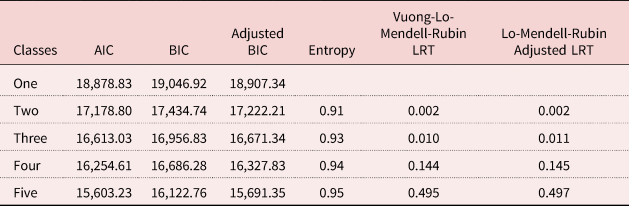
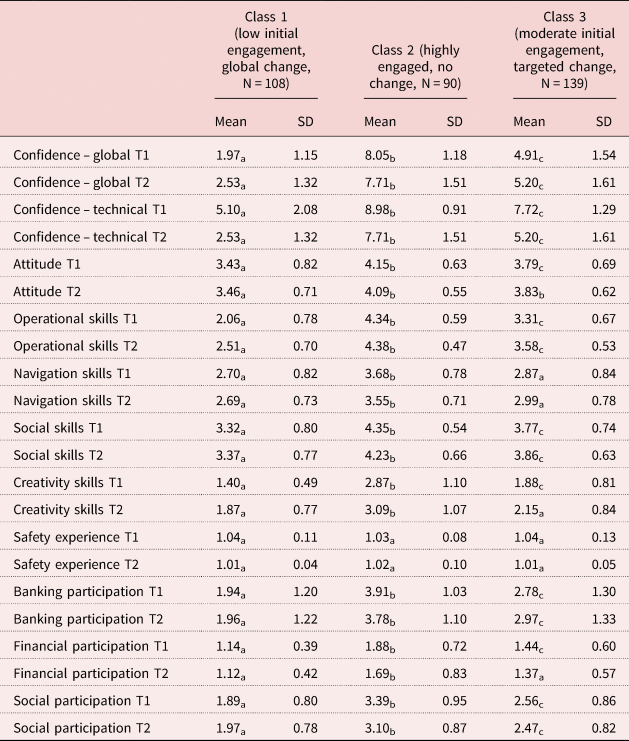
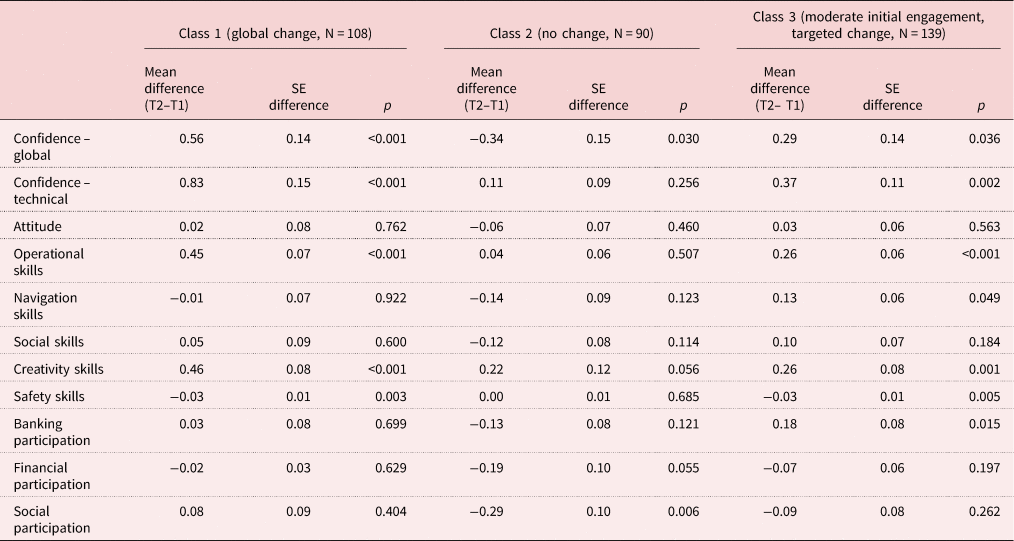
The first aim of LCA is to identify whether there are in fact distinct groups of respondents and, if so, how many. This is achieved by examining model fit indices, in addition to the interpretability and utility of the models. Fit indices provide statistical methods to compare models to determine which best fits the data. The results in Table 1 show that the three-class solution was best in explaining the pattern of scores across the ten confidence, attitude, skills, safety experience and participation composite scores from both Time 1 and Time 2 (N = 337). The Vuong-Lo-Mendell-Rubin and Lo-Mendell-Rubin Adjusted log likelihood ratio tests are both not significant at p < 0.05 for the four-class but are for the three-class solution. The largest reduction in the Bayesian Information Criterion (BIC) and adjusted BIC values are between the one- versus two-class and two- versus three-class solutions compared to the three- versus four-class and four- versus five-class solutions – also indicating the three-class solution as the better-fitting model. Informing the model, the means and standard deviations for each class across time are shown in Table 2 and the difference in means across time for each class derived from the ANOVA results are shown in Table 3.
Latent class fit statistics for one- to five-class solutions

Notes: AIC: Akaike Information Criterion. BIC: Bayesian Information Criterion. LRT: log likelihood ratio test.
Means and standard deviations (SD) of all variables across class membership

Notes: T1: Time 1. T2: Time 2.
Significance level: Values in the same row not sharing the same subscript for means are significantly different at p < 0.002 (two-sided).
Mean difference over time for all variables across class membership

Note: N = 337.
As Table 2 shows, Class 2 means were significantly higher on all variables at both times than Classes 1 and 3. The only exceptions were safety skills, where all classes demonstrated statistically equal means, and attitudes at Time 2 where Class 2 means were not statistically different from Class 3 means. Overall, therefore, Class 2 demonstrated relatively high levels of confidence, more positive attitudes towards the internet, a high level of all digital skills and higher participation rates. As Table 3 also shows, Class 2 did not significantly change in relation to all variables at Time 2 relative to Time 1 of the survey. Class 2 were therefore labelled highly engaged, no change.
Classes 1 and 3 demonstrated a number of significant differences in relation to confidence, attitude (at Time 1 only), most skills and most indicators of participation. Specifically, Class 1 showed lower global and technical confidence, less-positive attitudes, lower operational, social and creativity (at Time 1 only) skills, and lower participation in relation to banking, financial transactions (at Time 1 only) and social interactions (see Table 1). Table 3 shows that while both Class 1 and Class 3 demonstrated improvement in their technical confidence, and operational and creativity skills (as well as a significant decrease in safety experiences), only Class 1 experienced an increase in global confidence over time. Thus, the change experienced by Class 1 was arguably more global than Class 3. Class 2 were highly engaged and showed no change over time. The main difference between Classes 1 and 3 was the level of their initial (and in some cases follow-up) digital confidence, attitude, skills and participation rates. Class 1 were therefore labelled the low initial engagement, global change class (global change), and Class 3 were labelled the moderate engagement, more targeted change (targeted change) class.
Describing the classes
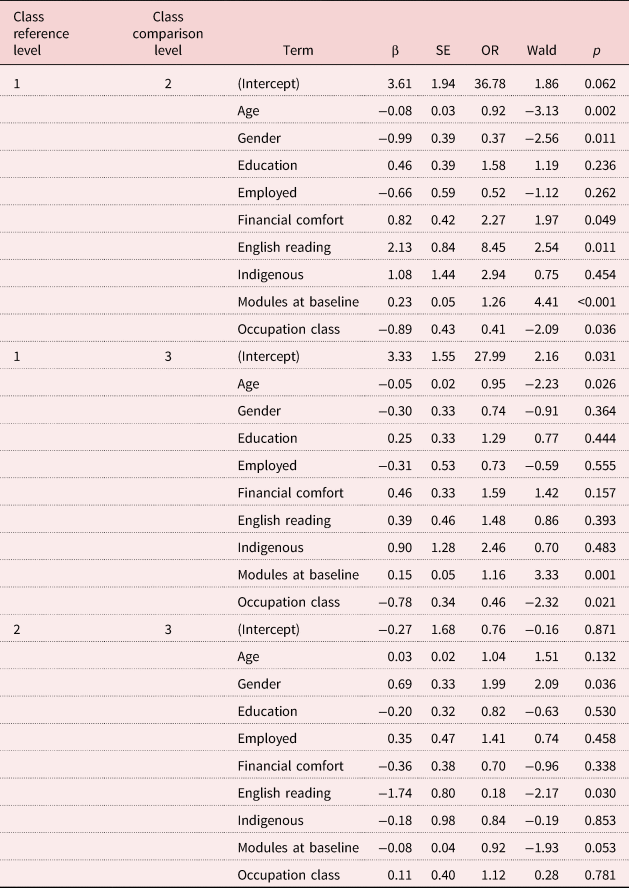
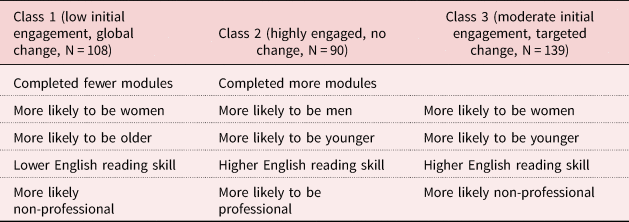
LCA is useful when there are complex and overlapping factors that characterise the differences among a heterogeneous cohort (Wraith and Wolfe, Reference Wraith and Wolfe2014). For internet skills, attitudes and use, broad demographic factors alone are not the best way to account for differences in the way older adults engage with digital technologies and skills learning. We highlight several key demographic indicators of class membership: age, gender, English-language ability and previous occupation (see Table 4). These variables act independently of each other to explain class membership.
Multinomial logistic regression estimates for predicting class membership

Notes: SE: standard error. OR: odds ratio.
Summary of differences found between the three classes of Be Connected participants

Holding all other variables in the model constant, a one-year increase in age increased the likelihood that a programme participant would be in Class 1 versus Classes 2 and 3 by 8.3 and 5.2 per cent, respectively. Gender was also related to class membership, whereby men were 169 per cent more likely to be in Class 2 relative to Class 1 compared to women, and women were 99 per cent more likely than men to be in Class 3 relative to Class 2. English reading skill was also a significant predictor of class membership. Programme participants who rated their English reading skill as ‘very well’ were 745 and 470 per cent more likely to be in Class 2 than Classes 1 or 3, respectively, compared to participants who rated their English reading skill as less than very well.
There was also a significant difference found amongst occupation classes. Programme participants who (formerly) held manual labour-type jobs were 143 and 118 per cent more likely to be in Class 1 than Classes 2 and 3, respectively, compared to participants who held professional-type jobs. Finally, the Be Connected modules that participants had completed at the Time 1 survey also significantly predicted class. For every module completed, participants were 26 and 16 per cent more likely to be Class 2 or Class 3, respectively, relative to Class 1. No significant effects were found for education, indigenous status, financial comfort or current employment status.
The characteristics of the three classes identified through the LCA model (see Table 5) provide useful insights into the different lifecourse experiences and demographics of older adults aiming to improve their digital skills and literacy.
Accounting for the three classes of learners: qualitative findings
Through qualitative analysis we sought to address the question of why some learners benefit more than others from programme involvement (RQ3), and provide further insight into the sub-groups identified in the LCA modelling. Interviewees highlighted significant differences in contextual and lifecourse factors such as support networks, prior education and work, socio-economic and cultural context, and personal factors, particularly confidence. On the basis of these differences, interview participants could be grouped similarly to the statistical class model. We refer to the intersecting groups identified through the two data sources and analyses as emerging learners (Class 1), accomplished learners (Class 2) and evolving learners (Class 3), and explain the differences with reference to the life and digital technology experiences of interviewees. It is important to note that variables that indicate inclusion in a class can work independently of others. Education and work history, for example, were more significant factors than age for some of the emerging learners with whom we spoke. Similarly, some of the older participants could be described as accomplished, but described work and life circumstances that included greater opportunity or interest using digital technologies.
Emerging learners
Emerging learners spoke about having limited opportunities in their past for becoming conversant and confident with computers, particularly in their work contexts. This is not to say they had never used computers or smartphones, and in line with population-level statistics, most had mobile phones with internet access. However, lower opportunity for engaging with digital technologies was tied to low digital confidence and skills. As Jock (73, learner, New South Wales) explains: ‘it's just a lack of education on them because I never, when I was at work, I never used a computer at all, so it made it a lot harder’. Harry (75, learner, Victoria) first used a computer around ten years ago, but notes that this was ‘strictly business, it was strictly typing invoices and things like that’. He does not associate these activities with wider use of the internet outside his pre-retirement working life.
Without the benefit of foundational workplace-based experience, many emerging learners found themselves relying instead on the goodwill of often time-poor family members to provide support and advice, often with limited success:
My daughter was trying to teach me. Honestly, bloody useless. She's now 25 so probably when she was 18, something like that. Yeah, because I never really used it. She did. I didn't because I didn't understand it. (Debbie, 55, learner, New South Wales)
It is particularly in their non-professional work history and lower level of education that this group relates to Class 1 in the LCA model, with age often reinforcing missed opportunities to learn at key lifecourse moments. For the younger learners who are also part of this group, reluctance, or ‘shying away’ from computers, has kept these learners in a double bind, often resulting in not knowing where to go to get started. Sid, a 54-year-old learner from New South Wales, acknowledged that ‘in this modern age you need a computer for everything’. He notes that he shied away from it all ‘because I didn't really know where to go’. His reluctance was also driven by ‘a lot of fear’ regarding exposure of his personal information if he took the wrong steps. Debbie is in her fifties and has been looking for work. She felt she had to learn to use the internet to do so. She had to do an introductory course as part of retraining at a local Technical and Further Education (TAFE) college. While Debbie sees the increasing need to learn, activities as ‘simple’ as a Google search to find new sliding doors ‘scared the crap out of me’, as she put it.
This group of emerging learners were the least likely to refer to any sort of participation in the online economy, including online banking. Linda (71, learner, New South Wales) explained that while her husband uses online banking and shopping, she does not: ‘Generally I prefer face-to-face talking with people and things like that; I don't do any shopping online or any of that sort of thing.’ Like many others with little opportunity to learn through work or other avenues, she saw herself as ‘not very internet savvy’ and left a lot of that to her husband.
Accomplished learners
Accomplished learners described themselves as already highly engaged with digital technology, relatively confident and with diverse digital skills built over the course of their working life in which digital technology played a role. While there is always ‘more to learn’ with this group of participants, their work and lifestyles have always been accompanied by computers, software and internet use. Hilary (63, digital mentor, Tasmania) is a semi-retired graphic designer who has been using computers for work ‘pretty much since they were introduced since the late 1980s’. Being self-employed she ‘had to become reasonably proficient at using digital technologies – the internet, computers, being able to fix various problems’, and compared to ‘the average person my age’, she sees herself as ‘probably more proficient’.
For accomplished learners, the programme provided an opportunity to ‘brush up’ on their existing skills and knowledge, and also gain some social connection while supporting others. They recognised the potential for learning more and were less anxious about participating:
Well, there was still lots to learn and I really wanted to learn more about my mobile phone. And about my computer as well. (Maggie, 73, learner, Victoria)
Unlike most other accomplished learners, Maggie expressed low confidence with her digital skills and literacy, but nonetheless described an engaged and strategic level of use. While she was frustrated with not being able to learn more about her smartphone through Be Connected, Maggie is connected online to a national network of poets and has submitted poetry to online journals. Through Be Connected she explored Facebook as a means for circulating and engaging with poetry. Maggie professed being ‘bored’ with the introductory level of Be Connected's online resources, and represents a more competent participant with targeted online needs and interests.
Many, but by no means all, accomplished learners came to volunteer as digital mentors within the programme, providing a valuable support to others. While this cohort brought with them a diverse digital skill-set, in interviews they too acknowledged the challenge of remaining abreast of rapid technological change during retirement. Anthea (73, digital mentor, Queensland) noted she had ‘high-level skills in some of the software’ needed in the publishing business, ‘But I was still frightened of the whole computer business when I left work. And the other thing is it moves so fast.’ Similar to Anthea, Alistair (74, digital mentor, South Australia) talked about feeling confident himself, and being keen to ‘lend a hand’ to help others in his community, while ‘keeping up with technology and my own learning’.
Evolving learners
Complicating the distinction between emerging and accomplished learners, evolving learners often brought some prior experience with computers, gained often in the latter part of their working life. This group did not conform to the ‘disconnected’ stereotype, nor were they highly engaged. Invariably they had low confidence with computers and the internet despite their life experiences and relatively competent use. As with our statistical Class 3, this group were usually targeted in their needs and motivation for improving their digital skills and literacy. The further they moved into retirement, the more difficult it had become to stay digitally connected. Emma (79, learner, Northern Territory), for example, worked for the Australian Bureau of Statistics and recalled the early computers they used being ‘about as big as a truck’. Workplace training was common over the years, but since retirement the systems, devices and requirements for digital technologies have changed significantly, alienating her little by little.
The majority of evolving learners described their pre-retirement use of digital technology as limited to a relatively narrow range of work-related purposes. Ian, a 71-year-old learner from New South Wales, described the shift. He was familiar with ‘computer work because I'd used computers – I worked for an airline, so I'd used computers for reservations, but I hadn't used them for personal stuff – banking, or even personal emails, I never sent personal emails’. His abilities do not match his current needs for personal use and organising social groups. Many others spoke of the need to update their existing skills and keep pace with technological change – especially the emergence of mobile technology. They described their ‘digital anxiety’ and sense of ‘frustration’ associated with feeling ‘left in the wake’ of rapid technological change. Former statistician Emma noted that there were a lot of things she could not do:
So, I really wanted to know how to do things quicker and easier and more efficiently – and use all your shortcuts and stuff like that. Not knowing is very frustrating and makes you anxious and you can't do anything when you're frustrated and anxious. (Emma, 79, learner, Northern Territory)
For many evolving learners, the need to improve their online social and economic participation provided the impetus for programme participation. Aligning with the statistical findings of a group who showed targeted change (Class 3), evolving learners were more intentional in the skills or steps needed to make ‘better’ use of digital technologies.
Discussion
Our findings emphasise the heterogeneity of abilities and motivations of older adult learners in relation to their life circumstances and digital literacy requirements. Responding to RQ1 and RQ2, the findings showed clear evidence of difference in programme outcomes among the three identifiable classes of learners. As confirmed in interviews (and responding to RQ3, regarding why different outcomes occurred), these differences are situated in life circumstances. Workplace experiences played a major role in the level of access to digital technologies. The kind of technology access, opportunities for use, learning and adaptability that accompany these contexts matters. Focusing only on the most disconnected as if this were a binary proposition fails those evolving technology users whose low confidence, varied life experiences and more targeted needs are crucial for widening participation and improving benefits. Likewise, more accomplished learners not only see the value of learning more, but have the capacity to support less-capable peers when brought together through programmes such as Be Connected.
These findings confirm the need to disaggregate older adults as a cohort and account for variation in life circumstances and demographics in order to better address digital inclusion and literacy gaps on a national scale (Hunsaker and Hargittai, Reference Hunsaker and Hargittai2018; Hargittai et al., Reference Hargittai, Piper and Morris2019). Little has changed in the impact of a lack of access and exposure to digital technologies through employment or everyday use as reported by Selwyn et al. (Reference Selwyn, Gorard, Furlong and Madden2003) nearly two decades ago. This is not likely an issue that will disappear as software, operating systems, applications and devices continue to transform rapidly. But situated interests and cohort differences are as important as findings that show that digital exclusion increases with age. Our findings point to the socio-ecological, lifestyle and lifecourse aspects of digital learning, skills, literacies and participation. They show the situated character of digital literacies in the way digital learning and technology use connect with life circumstances. Hence we argue for the need to avoid a one-size-fits-all or deficit model of digital literacy that looks to fix missing skills.
Addressing the heterogeneity of the lifeworlds counters over-generalisation of digital exclusion among older adults. Many ‘active older internet users’, as Kania-Lundholm and Torres (Reference Kania-Lundholm and Torres2015) refer to their study participants, differentiate themselves from other reluctant or non-users, pushing back against stereotypes of age as a ‘barrier’ to digital technology and internet use. In Australia, as in other developed countries, broad demographic measures are used to distinguish population differences. Single-figure indexes like the Australian Digital Inclusion Index provide an indicator for population segments, with older adults rated the least digitally included (Wilson et al., Reference Wilson, Thomas and Barraket2019). On the basis of these global measures, governments allocate resources to inclusion interventions. The Be Connected programme represents such an investment. However, as our findings show, there is a need to shift the focus from inclusion as access, to understand the significant variation in needs, uses and abilities, and the situated qualities of digital literacies.
Situated digital literacies raise the prospect of digital inequalities being embedded in social and lifestage contexts, helping to shift the common misperception that once a generation of ‘digital natives’ reaches retirement, age will no longer be a factor in digital exclusion. Focusing on literacy practices and the different domains in which they occur offers a way of connecting digital skills and confidence to ‘the social structures in which they are embedded and which they help to shape’ (Barton and Hamilton, Reference Barton, Hamilton, Barton, Hamilton and Ivanič2000: 7). The associated ecological understanding of the structural conditions and contexts co-shaping literacy practices and learning has also helped to identify the levers of change that can improve digital literacy outcomes for particular groups (Vroman et al., Reference Vroman, Arthanat and Lysack2015; Peine and Neven, Reference Peine and Neven2021).
The variation we saw in the older adults’ learning outcomes also highlights the need to stop trying to ‘improve’ older adults’ digital inclusion without involving them in the digital transformations affecting more aspects of social life than ever. Older adults often do not see the same relative advantages of digital technology and internet use as younger cohorts (Siren and Knudsen, Reference Siren and Knudsen2017). Successful interventions, then, enable varied modes of programme participation, including offering peer-based support for emerging and evolving learners, helping them to adapt to circumstance in their lives with digital technologies.
The evidence of situatedness, demographic and lifecourse context that we have identified offers a useful starting point for disaggregating older adults as a cohort, but future research and interventions need to build on this to (a) better understand how older adults’ needs and interests differ, (b) consider how this can be incorporated into platform, application and online service design to improve digital inclusion, and (c) adapt digital inclusion interventions and programmes to target differential situated relevance and needs. For future programme design, the goal should be to ensure wide targeting, addressing the needs of diverse cohorts, and seeing the importance of multiple programme components and avenues for digital inclusion support, most notably the role of the digital mentors who are able to identify and mediate the needs of these diverse digital learners.
Conclusion
In the context of a national intervention seeking to address digital inequalities affecting older adults, this study accounts for differences in the approach to learning digital skills and literacies through the observed impacts of this national community-based intervention. We found three distinct groups of digital learners, differentiated on the basis of their life circumstances and the way they engaged with the programme. Stronger outcomes were observed for emerging learners (Class 1) – participants who were more likely to be women, older, completed fewer online learning modules and have lower English-language literacy. For some more accomplished learners (Class 2), there were minimal changes to skills, confidence, participation activities and attitudes. However, qualitative analysis showed that their involvement in the programme was no less significant. They were motivated to continue to learn but also to support others. Complicating stereotypical accounts of older internet users, however, were the evolving learners (Class 3), who saw targeted change, and who would not normally be considered at risk.
There is no easy and unified solution to better enabling older people to access relevant online content and improve social connection and communication, or participate in increasingly ‘digital by default’ online services. Our findings emphasise the need to disaggregate older adult internet users, and account for differences in life experiences, needs and motivations in the design and delivery of digital inclusion interventions at scale.
Financial support
This work was supported by the Australian Government, Department of Social Services (D17 1150982).
Ethical standards
Ethical review and clearance were provided by Swinburne University's Human Research Ethics Committee (R/2018/234).