Introduction
About 8% of 14- to 15-year-olds in New Zealand (NZ) in 2009 smoke at least weekly, and a further 3% smoke at least monthly (Paynter, Reference Paynter2010). These levels of smoking are similar to young adolescents in other developed countries (Australian Institute of Health and Welfare, 2008; Currie et al., Reference Currie, Gabhainn, Godeau, Roberts, Smith, Currie, Pickett and Organization2008). While the proportion of young people smoking in NZ has decreased over time (Paynter, Reference Paynter2010), this has been mainly through a reduction in smoking initiation rather than an increase in successful smoking cessation (Ponniah & Bloomfield, Reference Ponniah and Bloomfield2008). Furthermore, among young people symptoms of nicotine dependence appear relatively quickly after initiation (Guo, McGee, Reeder, & Gray, Reference Guo, McGee, Reeder and Gray2010), although many do not think they are addicted to nicotine. This in turn can influence motivation and intention to quit (Amos, Wiltshire, Haw, & McNeill, Reference Amos, Wiltshire, Haw and McNeill2006).
Most people who start smoking want to quit (U.S. Centers for Disease Control and Prevention, 2001); 69% of 15- to 19-year-olds in NZ regret their decision to start smoking (Ministry of Health, 2009), consistent with findings from the Global Youth Tobacco Survey (Warren et al., Reference Warren, Jones, Peruga, Chauvin, Baptiste, de Silva and Asma2008). Marsh and colleagues (Reference Marsh, McGee, Gray, Newcombe and Li2012) examined trends in the perceptions of smoking cessation among young NZ smokers since 2002, and found little change in the proportion of young smokers making quit attempts over a six-year period from 2002. A possible contributing factor to this lack of increase in young people wanting or attempting to quit smoking may be the lack of success among adolescents who attempted to quit (Garrison, Christakis, Ebel, Wiehe, & Rivara, Reference Garrison, Christakis, Ebel, Wiehe and Rivara2003). NZ research has also shown that some young people believe they are capable of quitting smoking, but do not make any quit attempts (Marsh et al., Reference Marsh, McGee, Gray, Newcombe and Li2012). Perhaps this group of young people does not believe that they are addicted to smoking (Amos et al., Reference Amos, Wiltshire, Haw and McNeill2006), or they overestimate their ability to quit smoking as other research has found (Grimshaw et al., Reference Grimshaw, Stanton, Blackburn, Andrews, Grimshaw, Vinogradova and Robertson2003). Recent research by Borland and colleagues (Reference Borland, Yong, Balmford, Cooper, Cummings, O'Connor and Fong2010) found that motivation alone may prompt a quit attempt, but is not enough to maintain cessation in the long term.
Despite wanting to quit, many young people are unable to successfully do so (Ministry of Health, 2010). For example, callers to the NZ Quitline aged under 18 years were significantly less likely to have quit at 3-weeks and 6-months follow-up than those aged 25 years and over (Gravitas Research & Strategy Ltd, 2009). Nevertheless, the motivation of young people to quit may be high, with 60% of those who relapsed reporting they would try quitting again (Burt & Peterson, Reference Burt and Peterson1998). NZ research also found that those who wanted to quit were more likely to have made a quit attempt (Marsh et al., Reference Marsh, McGee, Gray, Newcombe and Li2012), a finding consistent with international research (Borland et al., Reference Borland, Yong, Balmford, Cooper, Cummings, O'Connor and Fong2010).
Given the differences in lifestyle and attitudes between adults and young people (Ministry of Health, 2008), it is unlikely that smoking cessation services aimed at adults are necessarily going to be effective at increasing the quit rate among young people (Amos et al., Reference Amos, Wiltshire, Haw and McNeill2006). The majority of smoking cessation research to date has focused on the adult population, but this is starting to change. A recent systematic review by the Cochrane Collaboration concluded that there is insufficient evidence to recommend widespread implementation of any one model of smoking cessation for young people (C. Grimshaw & Stanton, Reference Grimshaw and Stanton2006), and more investment in research is needed to define the most successful smoking cessation approaches for young people (Sussman, Lichtman, Ritt, & Pallonen, Reference Sussman, Lichtman, Ritt and Pallonen1999). Current recommendations in NZ suggest offering young people interventions that incorporate known effective components currently used for adults (McRobbie, Bullen, Glover et al., Reference McRobbie, Bullen, Glover, Whittaker, Wallace-bell and Fraser2008). For example the NZ Smoking Cessation Guidelines state there is insufficient evidence to confirm the effectiveness of nicotine replacement therapy (NRT) in young people, but the guidelines suggest considering its use for nicotine dependent adolescents who want to stop smoking (Ministry of Health, 2007). In addition, the NZ Guidelines conclude that interventions aimed at young people will most likely need to be different from those developed for adults (McRobbie, Bullen, Walker et al., Reference McRobbie, Bullen, Walker, Whittaker, Glover and Fraser2008).
Currently, few young NZ smokers appear to be accessing available products and services, with only one-third of 15- to 19-year-olds reporting accessing any cessation support, quitting products or advice during their last quit attempt (Ministry of Health, 2010). This may be due to the ‘lack of fit between the needs of teens and the setting and manner in which these programs are typically delivered’ (Vuckovic, Polen, & Hollis, Reference Vuckovic, Polen and Hollis2003). It is also important to consider what support young people themselves would like when quitting smoking. Smoking and quitting are heavily influenced by the social environment of the young smoker, including friends, family and school (Balch et al., Reference Balch, Tworek, Barker, Sasso, Mermelstein and Giovino2004). As well as the social environment, the context in which the cessation support is given is salient. There is a need for communication to be directed specifically at the youth audience, using the appropriate communication channels for this group (Poynter, Bullen, Whittaker, & Grigg, Reference Poynter, Bullen, Whittaker and Grigg2008). The person who communicates with young people throughout the quitting process and the way in which information is presented is also important.
The NZ government has set the goal of making NZ smokefree by 2025 (NZ Government, 2011). For this goal to be achieved the number of smokers quitting needs to increase significantly and smoking initiation will need to fall considerably. Therefore the government has emphasised the need for improved smoking cessation support. The aim of this study was to examine young NZ smokers’ views of what would help them quit smoking.
Methods
Focus groups were used to generate qualitative data for a deeper understanding of young people's perceptions of quitting smoking. Previous research has successfully used this methodology with young people and smoking cessation (Balch et al., Reference Balch, Tworek, Barker, Sasso, Mermelstein and Giovino2004; Patten et al., Reference Patten, Enoch, Renner, Offord, Nevak, Kelley and Kaur2009). Focus groups also constitute a way for youth to communicate experiences and perspectives in a more natural context, and as they acknowledge young people as experts, focus groups have high face validity (Heary & Hennessy, Reference Heary and Hennessy2002).
Ten focus groups with a total of 66 participants, with between 5 and 10 participants in each, were conducted among young people in urban areas and small towns throughout NZ; one-half in the South Island and one-half in the North Island.
Focus group discussions were held with participants who had pre-existing friendships with each other to facilitate discussion, as the general consensus is that homogeneity in focus groups is best for the successful functioning of the focus group (Heary & Hennessy, Reference Heary and Hennessy2002). The participants were current smokers aged between 15 and 17 years. There were separate groups for boys and girls, reflecting the differences between the two in prevalence of smoking. Participants were recruited through youth and training organisations within the identified geographic locations, particularly those with high Māori and Pacific young people. These ethnic groups were specifically included as they have the highest rates of smoking in NZ. The organisations were rewarded with vouchers suitable for their organisation. Informed consent was obtained from each participant prior to participation. Each participant received a retail voucher and a petrol voucher for travel. The study received ethical approval from the University of Otago Human Ethics Committee. The participants were required to complete an informed consent form; parental consent was not required by the University of Otago Human Ethics Committee for this project as all the participants were 15 years or older.
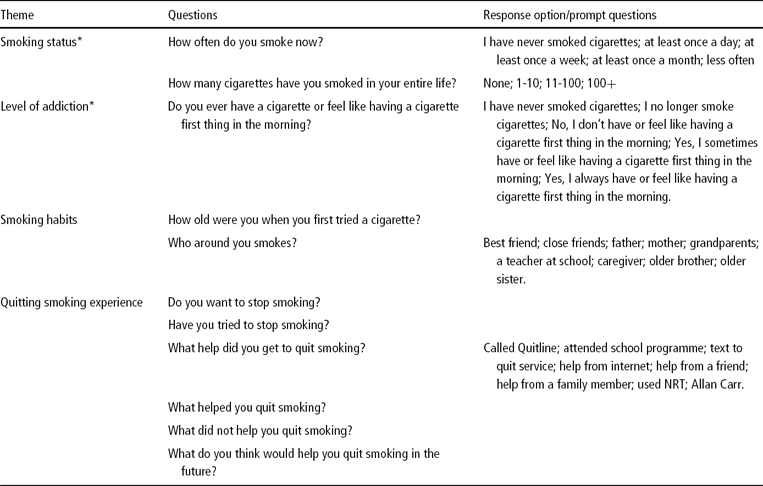
The number of groups was determined using the notion of ‘saturation’, i.e. on-going monitoring of themes over the course of the study indicated that later groups offered the same themes as earlier groups. Ten 60-minute sessions took place between October 2011 and December 2011. They were moderated by one of the authors (AD) who is experienced at conducting focus group discussions and could converse in Te Reo Māori and English. Each focus group began with the moderator introducing herself, where she came from and the background to the study. This was followed by some simple ground rules and a fun ‘ice-breaker’ introductory game to allow the group to share a little about themselves prior to the discussion on smoking cessation. A short survey of participants was undertaken at the start of the focus groups to determine demographics such as age, gender and ethnicity, and questions about their current smoking status (Health Sponsorship Council, 2010) and level of addiction were also asked in order to describe the study participants (Table 1). The level of addiction to smoking was examined through the question: ‘Do you ever have a cigarette or feel like having a cigarette first thing in the morning?’ Those who responded ‘Yes, always’ were considered to have a high level of addiction to nicotine. Time to first cigarette has been shown to be an indicator of increased nicotine dependence in adults (Muscat, Ahn, Richie, & Stellman, Reference Muscat, Ahn, Richie and Stellman2011). Personal details of participants including their name or contact details were not collected to preserve the anonymity of the participants and survey data collected was aggregated on collection of data from each group.
Questions asked during initial questionnaire and in focus group

*Asked in questionnaire
In the first part of the focus group, the moderator asked participants key questions about their smoking habits and their previous experience with quitting smoking (Health Sponsorship Council, 2010), such as: did they want to stop smoking, had they ever tried to stop smoking, how did it go and what did they think would help them quit smoking? (Table 1). Some of these questions have been adapted from the print version of a survey to a verbal question in the focus group e.g. the question Please indicate whether you have done any of the following in the past year (a list of smoking cessation response options is given), was asked in the focus group as ‘what help did you get to quit smoking’?
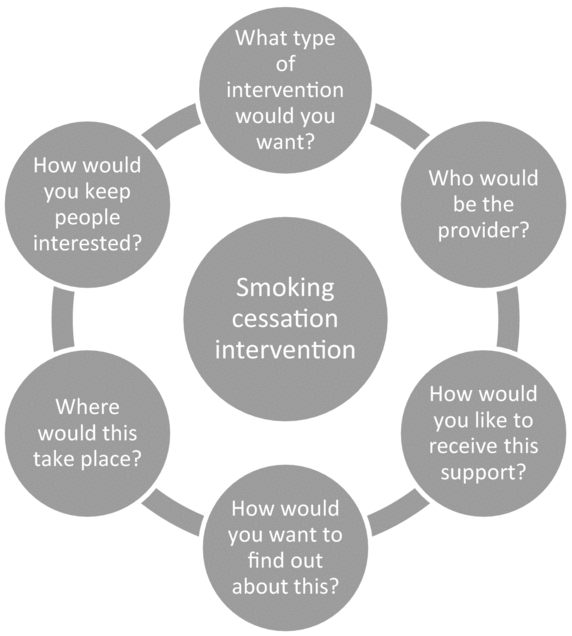
In the second part of the focus group, which lasted approximately 45 minutes, the moderator proposed a challenge to the group asking them to imagine themselves creating a new intervention that would help young NZ people quit smoking. Focus groups have been used successfully with young people for informing the development of interventions in the area of health, for example interventions to improve adolescent food choices (Neumark-Sztainer, Story, Perry, & Casey, Reference Neumark-Sztainer, Story, Perry and Casey1999), a physical activity intervention for children (Haerens et al., Reference Haerens, Bourdeaudhuij, Eiben, Lauria, Bel, Keimer and Maes2010), and self-care intervention for young people with chronic disease (Kime, McKenna, & Webster, Reference Kime, McKenna and Webster2013). The purpose of this current focus group was to help inform the development of an intervention to assist young people to quit smoking. To enhance the likelihood of an intervention meeting these young people's needs and improving the chances of young people quitting, it was important to ensure that the intervention was participant-oriented. For the purpose of this research an ‘intervention’ means an action or process to assist young people to quit smoking. The participants were asked to consider what type of support young people would want, how they would want this delivered, where this would take place, how would they want to find out about it, who would provide this intervention, and how would they keep people interested. The moderator then placed reminder notes of these questions on the table (Figure 1), with a large piece of paper and coloured pens and left the group to work on a solution together. Following this they returned to the moderator to present their ideas for further discussion.
Prompt cards used for focus group discussion
After the first two focus groups, one with boys and one with girls, the conversations were reviewed by LM and AD before subsequent focus groups were undertaken. Some changes were made to procedures and content. Literature on working with adolescent boys in a focus group situation with a female facilitator was also examined to better understand how to interact with the boys, and to get the best responses from the groups (Lashlie, Reference Lashlie2007). Literature suggested conducting focus groups in shorter segments to help keep boys engaged. Further changes were made to the content in terms of the organisation of the physical props used to engage the participants in the topic.
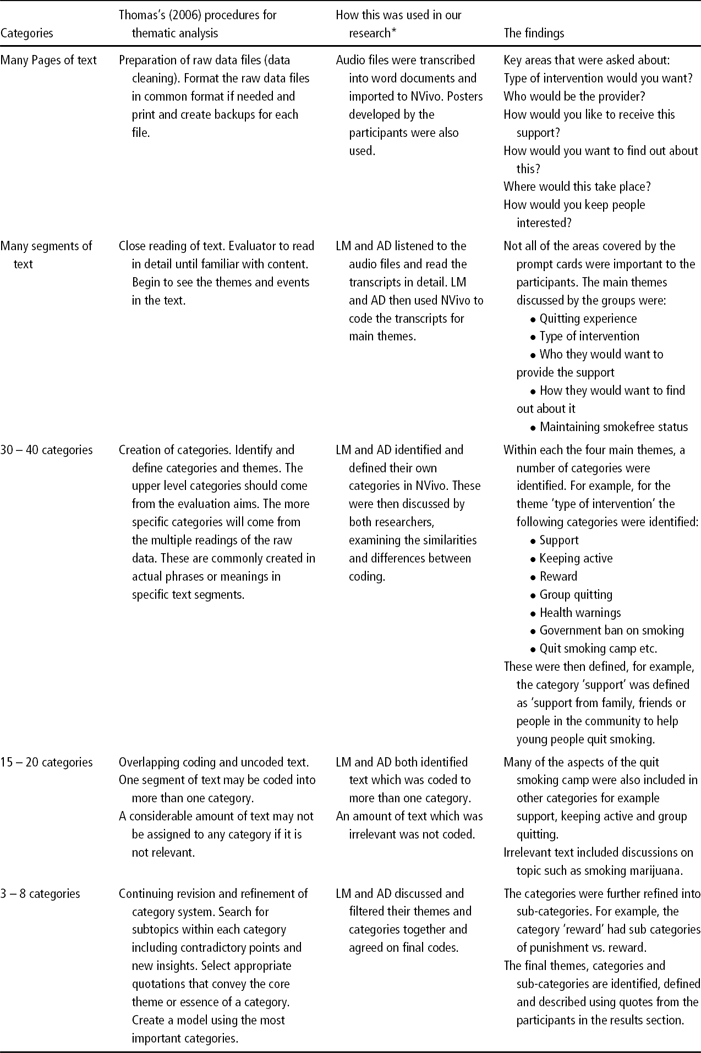
The conversation in each focus group was audiotaped and the tapes transcribed. Initially the study used a deductive approach through the literature review, questions and analysis being determined by the research objectives. Two of the researchers (LM and AD) both coded three of the ten focus groups transcripts and compared coding, prior to the lead research (LM) coding the remainder of the transcripts. The general inductive approach was applied to the analysis facilitated by NVIVO software, to: condense raw data into a summary format; establish clear links between the research objectives and the summary of findings; ensure these links were both transparent and secure; and to develop a model about the underlying structure of experiences or process (Thomas, Reference Thomas2006). Thomas's (Reference Thomas2006) procedures for thematic analyses were followed and this is shown in Table 2.
Thematic analysis using Thomas's (Reference Thomas2006) procedure
*LM and AD followed this process when analysing three focus groups and then agreed on the final categories, descriptions, and quotes at the conclusion of the analysis.
Results
Participants
The 10 focus groups, 5 male and 5 female, had a total of 66 participants with an average of 6 to 7 participants in each group. Approximately half the participants were male (53.0%) and half female (47.0%), with an average age of 16 years and 4 months. The majority of the participants were Māori (57.6%), one-third (31.8%) were NZ European, and 10.6% were Pacific peoples. Most of the participants attended training organisations (62.1%), with the remaining participants enrolled at school (37.9%).
Most of the participants smoked on a daily basis (89.4%), with 4.6% smoking weekly, and 6.1% smoking less than monthly. The majority (83.3%) reported having smoked more than 100 cigarettes in their lifetime, and many had a high level of addiction to tobacco, with 89.4% of participants stating that they either always or sometimes felt like having a cigarette first thing in the morning.
The letters in brackets after each quote indicates the group, the G or B on the end indicates if it was a girls or boys group and the number represents geographic location.
Quitting experiences
There were mixed views on whether the participants wanted to quit; in general boys wanted to quit more than girls. Two of the girls groups talked about quitting in the future ‘Maybe in the future. . .when I'm 18’ (4G). The main reasons participants wanted to quit was the monetary cost of smoking to themselves and their families, to be healthier and fitter, and because they do not want to die young. Another benefit of quitting smoking, mainly mentioned by boys, was that they were better able to play sport when they were smokefree. One female participant discussed quitting for her mum: ‘Because our Nan passed away from cancer because of smoking so that's why me and my cousins and that, we don't really like smoking in front of our parents but we do it anyway, but half the time our parents aren't outside cos they don't smoke so we try and keep it away from them as much as we can.’ (1G).
Around half the participants described quitting at some point, ranging from a few days to a year; some had tried multiple times and described how hard it is to quit smoking both mentally and physically. The participants had tried a range of methods to help them quit smoking. General consensus among the participants was that the NRT lozenges and gum had a bad aftertaste ‘That's disgusting, it's like 11 smokes in one little tab, it's just tastes like ash’ (1G). The patches are more acceptable to these young people but some side effects meant they stopped using them, such as itchy skin, headaches and nightmares. They also had problems using them effectively: ‘. . .just got sick of putting them on and taking them off’, and patches falling off so they leave them off: ‘And they fall off if you don't have plastic shit over it. But I guess if you, if you're committed to quitting. . .’ (5G). They had also tried calling Quitline (NZ's national telephone quit service), going cold turkey, being paid to stop smoking, and stopping smoking while in prison; all of which have failed for these young people. They described the difficulties of quitting when their friends around them are smoking: ‘Yeah I've tried heaps aye, it's just the same thing though, just coming back here, just seeing everybody smoking, just being around heaps of smokers’ (1G). However, another female participant stated: ‘. . .you can do it anytime you want whether you're around smokers 24/7 or not. It's all in your head’ (3G).
Type of support or intervention
The focus group participants developed an array of ideas for how to help young people quit smoking. These encompassed a range of options including legislative changes, having supportive people around you, making personal changes, and adopting alternative behaviours to smoking. Many of these suggestions were interlinked and not separate ideas, but for the purpose of this research the ideas are described individually. Seven categories emerged from the analysis of the focus group transcripts. These were: support from family; friends and community; keeping active; reward or payment; group quitting; health warnings; government ban on smoking; and ‘Quit Smoking’ camp. The groups also discussed ideas about who would want to provide the support, how they would want to find out about the support, and how they would maintain their smokefree status. Each category is described below and comments or quotes have been provided which support each of the categories discussed.
Support from family, friends and community
Nine of the ten groups identified support, either from family, friends or people in the community such as teachers, as being most helpful for young people to quit smoking: ‘You need family support to quit smoking’ (4G). Linked with this is having friends and family around you who are either non-smokers, or who would not smoke around you: ‘hang with people that don't smoke ‘cause that's the only way I could quit’ (2B). The pressure of smoking when their group of friends all smoke was also discussed ‘it's not like your mates like forced you in to it, it's just when they do it in front of you’ (3B). Although their friends may not be pressuring them into smoking, the temptation when they smell the smoke makes it difficult to quit.
Keeping active
Part of the reason young people said they smoked was due to boredom, that there was nothing to do where they lived. This involved physical activities such as sport, mainly the boys groups, as well as recreational activities like confidence courses, and other activities that would help take their minds off smoking. Activities were considered important for re-focusing away from smoking ‘when I'm occupied and I'm doing sports or something, I don't feel like smoking’ (1B).
Reward or payment
Some groups discussed being rewarded for quitting smoking. One idea was that a payment be given to someone at the end of a time period if they have remained smokefree. One group debated punishment vs. reward; they don't want to be punished for smoking, but want to be rewarded for quitting. The second idea was that the money saved from not buying tobacco over this smokefree time period could be used for a goal they were focused on e.g. saving for a car.
Group quitting
Over half the groups discussed the idea of quitting in groups, either family or friends, so that they would have more support: ‘I reckon if a whole group of us got together and tried it, so you knew you're not alone with your cravings and whatever’ (1G). Also discussed the idea of having a ‘champion’ within the family who had already quit smoking and who could motivate and support the whole family to quit. There were also a few downsides to this, including not being with your group of friends or family all the time, not everybody agreeing to take part, and having a lot of frustration and fighting between people: ‘I'd get frustrated probably, your emotions would all go out there and I'd be snappy I reckon’ (1G).
Health warnings
There were a range of discussions around health warnings about cigarettes. Young people know that cigarettes are bad for them; what they want is more information that is personalised to them: ‘I think it would help if people could like see what it's actually doing inside their own bodies. Like you see pictures and things on TV on what it does to other peoples bodies but if we could see for ourselves what our lungs and what's happened to us. . .’ (2G). For example, what their lungs will look like after certain time periods of smoking, information on exactly what is in their smokes, what actually happens to their body when they smoke, and visit people who are dying from smoking related cancer: ‘Get them to go and talk to a person who's been through smoking and has had things happen to them’ (3G). While all this information is available, it needs to be tailored to each young person. One group of girls had a discussion about being lectured about health warnings. They talked about knowing that smoking is bad for their health, but wanted more information about the benefits of not smoking: ‘You're gonna die, clearly I know I'm gonna die from smoking but I wanna know what's gonna happen if I don't smoke’ (1G).
Government ban on smoking
Participants in half the groups thought that the easiest way to quit smoking would be for the government to ban the sale of tobacco or make it illegal to smoke: ‘I think the government should just take ciggies away’ (4G). However, not everyone in these groups agreed. Some thought that by banning tobacco smoking it would go underground like marijuana; that a ban would not happen because the government makes too much income from the tax on tobacco; and that people will grow their own tobacco and continue to smoke.
‘Quit smoking’ camp
Six of the ten groups talked about the idea of a ‘quit smoking’ camp, which integrates many of the ideas already reported including support from family and friends, group quitting, activities, and rewards. Generally this idea involved a group of young people who want to quit smoking going away on a camp for 6–8 weeks. The group may be a group of existing friends who want to quit together, or a group of people who are unknown to each other. The camps have leaders who facilitate activities over the time period, and provide support and help to the young people quitting. This would also include learning new skills to be able to cope when they leave the camp and being involved in evening counselling/talking sessions about smoking. At the end of the time period, if they have maintained a smokefree status they would be rewarded; others felt that completing it and being smokefree was reward enough: ‘the biggest thing would be I can say I've finished it and I've accomplished it’ (1G).
The importance of the camp was that you would be away from your family and social environment where smoking occurs. The time period was linked to what the young people felt was the biggest temptation period, if they could get through 6 weeks without smoking, they would be able to remain smokefree. They also discussed going back to their family and social environments where they would be faced with smoking – having learnt new skills on their camp.
Further ideas for quitting smoking which participants mentioned were using alternative cigarettes or e-cigarettes which do not have the harmful ingredients that cigarettes have in them, having better tasting NRT lozenges or gum, counselling, willpower and determination, keeping motivated through setting goals, learning new skills, increasing the price of tobacco, restricting access to purchasing tobacco, increased smokefree outdoor areas, reality TV show where participants stop smoking, an underage helpline for quitting smoking, video diaries, and a youth centre that provides activities to do instead of smoking.
Who would they want to provide the support?
Most of the groups discussed having someone, a tutor, leader or counsellor, who had experienced successfully quitting smoking: ‘people who have smoked and then quit so they've been through what these people would be going through at the same time’ (1G), or a role model: ‘Someone famous that did smoke and doesn't anymore’ (2B). There was no preference for ethnicity, but they did discuss young adults as being a good age for helping them quit smoking.
How they would want to find out about it?
Young people would want to find out about interventions that would help them quit smoking through advertisements on Facebook and other social media websites, the internet, through text messages, radio stations like Mai FM, and TV advertisements during their favourite programmes, e.g. Shortland Street, Home and Away, and Three and a Half Men. The message needs to be targeted at young people, but must not be preachy. They suggested using young people in the adverts who have quit successfully using the intervention being promoted. One group suggested advertising the intervention on cigarettes packets.
Maintaining smokefree status
Many of the groups identified that once they had quit smoking it was difficult to go back to their home, social environments and normal activities which involved smoking. Participants thought that continued support following a camp or intervention was required to remain motivated to maintain their smokefree status. It was important to have activities to do such as sports days, writing in a journal or replacing usually smoking habits with other activities. One group also identified that having a family meeting to discuss making the home smokefree would help them.
Discussion
This research explored young people's experience with quitting and what they felt would help young people quit smoking. Around half the participants had made a quit attempt in the past, some had tried multiple times using a range of methods; all were unsuccessful. They described the difficulties, both mentally and physically, for young people quitting. The participants developed an array of ideas for how to help young people quit smoking, encompassing social support, making personal changes and adopting alternative behaviours to smoking, legislative changes, and ideas that were unique to young people. They also made suggestions around the provision of quitting support.
The themes raised by these young people touch on the importance of social context in terms of both the act of smoking and provision of services to quit. Smoking behaviours are heavily influenced by the social environment of the young smoker, including friends, family, and school. This social environment can hinder or facilitate the cessation process and may be important points of intervention for smoking cessation communication and support (Balch et al., Reference Balch, Tworek, Barker, Sasso, Mermelstein and Giovino2004). It is important that any cessation intervention is part of the young person's ‘natural environment’ and capitalises on their peer networks when helping a young person quit (Mermelstein, Reference Mermelstein2003). The general consensus in the literature is that quitting with the support and help of friends or wider social network is the most common form of support mentioned (Balch et al., Reference Balch, Tworek, Barker, Sasso, Mermelstein and Giovino2004; Sanchez del Mazo, Reference Sanchez del Mazo2005), and was more popular than seeking professional help (Balch et al., Reference Balch, Tworek, Barker, Sasso, Mermelstein and Giovino2004; Sanchez del Mazo, Reference Sanchez del Mazo2005). Quitting with a group of friends was also a popular method described by the participants, and addresses one of the challenges for young people of having their friends around them smoking. Young people in this current study report that some of their friends were very encouraging and supportive of their quit attempt. Joining together with friends and quitting as a group was also a common theme (Balch et al., Reference Balch, Tworek, Barker, Sasso, Mermelstein and Giovino2004).
Although families can be the source of cigarettes for young people (Marsh, Dawson, & McGee, Reference Marsh, Dawson and McGee2013), they can also help young people quit smoking. One of the challenges young people face when quitting smoking is when people around them continue to smoke. Families can help their children quit and remain smokefree, through introducing and being committed to a smokefree home. Clark and colleagues (Reference Clark, Schooley, Pierce, Schulman, Hartman and Schmitt2006) found the quit ratio was twice as high in households which were smokefree, and provides a great incentive for families to introduce smokefree homes. Parental smoking cessation has also been shown to be associated with children's smoking behaviour. Parents who quit while their children are younger than 9 years old, increase the chances of their young adult child quitting, providing strong evidence to encourage parents to quit while their children are young (Bricker, Rajan, Anderson, & Peterson, Reference Bricker, Rajan, Anderson and Peterson2005). If parents continue to smoke into their child's adolescent years they could help their children quit smoking by quitting as a family group. Having family support to quit smoking was important for the participants in this study; quitting as a family would provide support for everybody as well as creating a smokefree environment. A NZ intervention using group quitting within communities where teams compete against each other has been shown to be effective at increasing successful quitting (Glover et al., Reference Glover, Cowie, Paton, Kira, Moetara, Ruke and Setu2012). This type of group quitting intervention may also be useful for young people within communities.
While many of these ideas are not new and have been discussed by young people before, they do provide support for developing and trialling these methods further. Quitting with the support of people around you is commonly mentioned by young people (Balch et al., Reference Balch, Tworek, Barker, Sasso, Mermelstein and Giovino2004), quitting with groups of friends including having a contract with friends is a very prevalent method mentioned in research with young people (Lawrance, Reference Lawrance2001), and financial incentives have been shown to be popular with youth (Stanton, Lowe, Fisher, Gillespie, & Rose, Reference Stanton, Lowe, Fisher, Gillespie and Rose1999). In many respects these are the same issues raised by older smokers. For example, one suggestion was that the government should ban smoking, an idea also expressed by low socio-economic smokers in NZ (Glover, Fraser, & Nosa, Reference Glover, Cowie, Paton, Kira, Moetara, Ruke and Setu2012). Health warnings have also been discussed (Glover, Fraser et al., Reference Glover, Fraser and Nosa2012). However, young people stressed the need for such warning to be personalised.
However, these participants also developed uniquely young people solutions. The idea of a ‘quit smoking’ camp was introduced by a number of the groups, and such camps have been successfully used for dealing with other health behaviours such as obesity (Lobstein, Baur, Uauy, & IASO International Obesity Tasforce, Reference Lobstein, Baur and Uauy2004). While the provision of actual quit smoking camps may be a very expensive option for helping young people, the provision of ‘virtual health camps’ may be a realistic opportunity. Australia is harnessing social technologies for alcohol addiction through ‘Hello Sunday morning’ (hellosundaymorning.com.au) a peer-led program which encourages individuals to take responsibility and change their drinking behaviour. NZ evidence to date has found innovative and successful ways of reaching young people. Social marketing campaigns such as Smoking Not Our Future has generated inquiries and registrations to the Quit Group services (Li, Reference Li2009). Txt2Quit, a Quit Group service designed for young people, has also generated a number of registrations from young people (Milne, Bowler, Li, & Salmon, Reference Milne, Bowler, Li and Salmon2009). The use of this new media to communicate with young smokers shows the potential for its use in tobacco control, but could also be broadened and provide an alternative to face-to-face interventions in the future (Poynter et al., Reference Poynter, Bullen, Whittaker and Grigg2008).
The person who communicates with young people throughout the quitting process is also important. The focus group participants felt it was important that the person communicating with them had been through the quitting experience themselves; consistent with previous research with young people (Balch et al., Reference Balch, Tworek, Barker, Sasso, Mermelstein and Giovino2004; Vuckovic et al., Reference Vuckovic, Polen and Hollis2003). Participants in this current study discussed the possibility of other adolescents providing cessation support and advice, which could increase the appeal of this approach (Balch et al., Reference Balch, Tworek, Barker, Sasso, Mermelstein and Giovino2004). Research has also found that it is not necessary that counsellors are of the same age, as long as they can connect with young people and take an interest in them as a person and not just a smoker (Vuckovic et al., Reference Vuckovic, Polen and Hollis2003).
Earlier research has indicated that many young people are unaware of the support that is available to them, and few are accessing any of the currently available services (Ministry of Health, 2010). The main way participants in this current study want to find out about cessation opportunities is through social media. Social marketing is important for letting young people know what help is available, but also that it is acceptable to seek help out (Mermelstein, Reference Mermelstein2003). The NZ ‘Smoking Not Our Future’ campaign shows that this can be successful (Li & Grigg, Reference Li and Grigg2007), and provides support for this work to continue in the future.
Ours was a qualitative study using a non-representative sample of young high risk smokers throughout NZ, so the findings may not necessarily be generalisable to all young smokers in NZ or beyond, or apply well to non-Māori or non-Pacific young people. However, a strength of this research is that these harder to reach groups of smokers were involved, including young people, Māori and Pacific peoples. The focus groups were valuable for providing a better understanding of what young people think would help them stop smoking. While a potential limitation is that participants may not be willing to contribute as much as they may during an individual interview (Heary & Hennessy, Reference Heary and Hennessy2002), one of their main strengths ‘is the possibility for research participants to develop ideas collectively’(Smithson, Reference Smithson2000). Future research might consider using other qualitative methods, such as individual interviews (Patten et al., Reference Patten, Enoch, Renner, Offord, Nevak, Kelley and Kaur2009).
The dynamics of an individual focus group can affect the response of participants in problematic ways. Firstly, young people may agree with themes already raised, rather than offering new ideas which they may feel are against the ‘norm’ (Heary & Hennessy, Reference Heary and Hennessy2002; Kitzinger, Reference Kitzinger1995). Secondly, interaction within the group may be inhibited by issues of group dynamics such as intimidation, power imbalances and conflict, although this did not seem to be an issue in the focus groups in the present study as participants were recruited with pre-existing friendships (Heary & Hennessy, Reference Heary and Hennessy2002; Robinson, Reference Robinson1999). Lastly, participants in a focus group are speaking within a specific context, and it needs to be recognised that the ideas they bring to the research emerge from that cultural or social context (Smithson, Reference Smithson2000). The quality of the research findings from focus groups are a direct result of the skills of the facilitator (Heary & Hennessy, Reference Heary and Hennessy2002), and highlights the considerable expertise required (Robinson, Reference Robinson1999). This research involved an experienced facilitator who was able to communicate in Te Reo Māori and within the cultural context of youth and Māori. The authors recognised the need for such experience to overcome the limitations which may exist with the presence of a number of participants.
A clear strength of this kind of research is the involvement of young people in the process, and their willingness to participate. Further research will involve the active involvement of young people in the design, development, implementation, and evaluation of smoking cessation interventions which have been put forward in this current research. Being active and productive members of society may also support quit attempts by young people. One of the girls groups were so enthusiastic about their ‘quit smoking camp’ idea that they wanted to begin developing this for young people in their community. As researchers, we need to provide the opportunity for young people to take part in research in meaningful ways, and support them in developing and implementing their ideas. One way we are doing this is through disseminating the results back to the participants in a form which is consistent with their way of communicating. We intend to send the groups a contemporary designed ‘Thank you – Certificate of Participation’ that on the reverse will briefly describe the results of the study, which they will be able to display.
For NZ to achieve the goal of a smokefree Aotearoa by 2025 smoking cessation is a key tobacco control approach. Cessation strategies which reach high risk smokers such as young people, Māori and Pacific peoples, is going to be vital for realising this goal. The young people involved in these focus groups have offered innovative ways and ideas to improve the appropriateness and successfulness of quitting smoking, while respecting the unique challenges and difficulties young people face in this process.
Acknowledgments
The authors wish to acknowledge the time and effort volunteered by the young people taking part in this research, and wish to thank the youth and employment leaders who co-ordinated the groups in each location.
Financial support
The Cancer Society Social and Behavioural research unit was supported by the Cancer Society of NZ and the University of Otago. This research was also funded by the Dunedin School of Medicine, University of Otago Dean's Bequest Fund.
Statement of interest
None
Ethical standards
The authors assert that all procedures contributing to this work comply with the ethical standards of the University of Otago Human Ethics Committee.