1. Introduction
Throughout Europe, Furongian (late Cambrian) echinoderms are extremely poorly known, with only two localities where very rare complete specimens have been recorded (Zamora et al. in press). These are: (i) Montagne Noire (France) where a fauna including rhombiferans, rare stylophorans and a questionable edrioasteroid have been reported (Ubaghs, Reference Ubaghs1999) and, (ii) Holy Cross Mountains (Poland) where only the primitive eocrinoid Cambrocrinus has been described (Orłowski, Reference Orłowski1968; Dzik & Orłowski, Reference Dzik and Orłowski1993).
Different causes have been proposed to understand why Furongian echinoderms are rare, including global sea level regression (Smith, Reference Smith1988), which resulted in a scarcity of rocks from this time interval, reducing potential preservation of echinoderm-Lagerstätte. Taphonomy, sampling bias and anoxia are also important causes that affect the rarity of echinoderms described from this time interval (Zamora et al. in press).
Here I report an assemblage of echinoderms from the Furongian of Britain coming from the Maentwrog Formation in central Wales (see Allen, Jackson & Rushton, Reference Allen, Jackson and Rushton1981 for more details on stratigraphy). This find is noteworthy because, after decades of sampling in Britain, these are the first articulated echinoderms ever reported from the Furongian. It is a primitive pelmatozoan and has a thecal and stem organization that places it between Cambrian eocrinoids with columnals in the stem and more derived glyptocystitid rhombiferans. This is also remarkable because the age of these levels is Paibian and only two other localities in the world, one in North America (Laurentia) and the other in Poland (Baltica), have yielded echinoderms from this time interval (Zamora et al. in press).
2. Palaeobiogeographic implications of British Cambrian echinoderms
The inclusion of Avalonia in the supercontinent Gondwana (McKerrow, Scotese & Brasier, Reference McKerrow, Scotese and Brasier1992; Cocks & Fortey, Reference Cocks, Fortey and Bassett2009) or as an independent terrane (Landing, Reference Landing, Nance and Thompson1996, Reference Landing2005) in the Cambrian is controversial. Echinoderms easily disarticulate after death and are thus a good indicator of endemicity, suffering little or no post-mortem transport.
Only a few localities in Britain have reported Cambrian echinoderms. The oldest remains are isolated plates with calcite composition and a distinct stereom structure from the lower Cambrian (Cambrian Series 2) Fucoid beds in Scotland (McKie & Donovan, Reference McKie and Donovan1992) and from the Comley Limestone of England (Donovan & Paul, Reference Donovan and Paul1982). In both cases these records are of disarticulated ossicles assigned to an eocrinoid of uncertain affinities, and thus provide no useful information.
The classic middle Cambrian (Cambrian Series 3) from Wales provides a more diverse and richer fauna that includes cinctans, stylophorans and ctenocystoids. Cinctans are represented by two species, Davidocinctus pembrokensis and Elliptocinctus barrandei (Friedrich, Reference Friedrich1993, Reference Friedrich1995). Stylophorans are represented by the single armoured stylophoran Protocystites meneviensis (Jefferies, Lewis & Donovan, Reference Jefferies, Lewis and Donovan1987) and ctenocystoids by Pembrocystis gallica (Domínguez-Alonso, 1999). The latter, although included in a different genus, is very similar to Ctenocystis from France, Australia and North America and to Etoctenocystis from Bohemia, all three belonging to the family Ctenocystidae (Domínguez-Alonso, 1999). These middle Cambrian (Series 3) echinoderm faunas show clear Gondwanan affinities as was previously noted (Cocks & Fortey, Reference Cocks, Fortey and Bassett2009). Armoured stylophorans are endemic to Gondwanan margin assemblages (Lefebvre, Reference Lefebvre2007; Rahman, Zamora & Geyer, Reference Rahman, Zamora and Geyer2010), and cinctans are largely confined to Gondwana, although there are rare occurrences from Siberia (Friedrich, Reference Friedrich1993; Rozhnov, Reference Rozhnov2006; Smith & Zamora, Reference Smith and Zamora2009; Zamora & Álvaro, Reference Zamora and Álvaro2010). Ctenocystoids are biogeographically widespread, being present in Laurentia (North America and Canada), Baltica (Poland) and Gondwana (Spain, Bohemia and Australia) (Robison & Sprinkle, Reference Robison and Sprinkle1969; Jell, Burrett & Banks, Reference Jell, Burrett and Banks1985; Ubaghs, Reference Ubaghs1987).
The new Furongian pelmatozoan is thus important, as pelmatozoans of this age are strongly differentiated palaeobiogeographically. In Laurentia, the assemblages are dominated by trachelocrinids, a group endemic to this area (Sprinkle, Reference Sprinkle1973; Sumrall, Sprinkle & Guensburg, Reference Sumrall, Sprinkle and Guensburg1997), and are accompanied by other endemic forms with a much-reduced stem, such as Eustipocystis (Sprinkle, Reference Sprinkle1973). The assemblages of Gondwana and Baltica are composed of columnal-bearing pelmatozoans, including primitive glyptocystitids (Velieuxicystis and Barroubiocystis) from France (Ubaghs, Reference Ubaghs1999) and eocrinoids, such as Cambrocrinus, from Poland (Dzik & Orłowski, Reference Dzik and Orłowski1993) and Ridersia from Australia (Jell, Burrett & Banks, Reference Jell, Burrett and Banks1985). The eocrinoid Pareocrinus is the only pelmatozoan described from the Furongian of Siberia (Yakovlev, Reference Yakovlev1956) but its morphology is poorly known. There are also unpublished occurrences of glyptocystitids in Spain, Korea and China. The presence of ?Cambrocrinus in Wales thus indicates Baltic affinities in the Furongian, as indeed do many trilobites (Olenids) from this area (Rushton, Reference Rushton, Basset and Dean1982; Álvaro et al. Reference Álvaro, Elicki, Geyer, Rushton and Shergold2003).
Cambrian echinoderm faunas therefore support a Gondwanan placement for Avalonia rather than as an independent terrane with its own endemic fauna, as proposed among others, by Cocks & Fortey (2009).
3. Systematic palaeontology
Specimens are housed in Lapworth Museum of Geology in Birmingham, England, under repository number Bu 5247.
Phylum ECHINODERMATA Bruguière, Reference Bruguière1791
(ex Klein, Reference Klein1734)
Class EOCRINOIDEA
Order and Family uncertain
?Cambrocrinus sp.
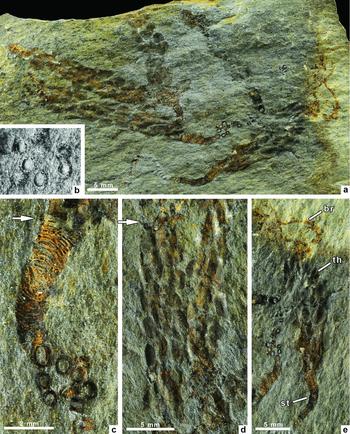
Figure 1
Material. A single slab with five partially complete specimens showing brachioles, theca and stem (Fig. 1a). They are preserved in dark shales as natural moulds and occur with the trilobites Olenus micrurus Salter and the agnostoid Homagnostus obesus (Belt).
?Cambrocrinus sp. from the Maentwrog Formation, Paibian (Furongian Series, Cambrian) 7 km north of Bronaber, near Trawsfyndd, in North Wales. (a) General view showing five specimens preserved as natural moulds. (b) Latex cast of proximal columnals showing large lumen and wide external flange. (c) Detail of proximal stem; arrow indicates the transition from the theca to the stem. (d) Detail of thecal plating in two specimens; arrow indicates the summit from where brachioles arise. (e) Complete specimen preserving stem (st), theca (th) and brachioles (br). All photographs were taken directly from the natural fossil with the exception of (b), which is a latex cast whitened with NH4Cl sublimate.

Locality. Furongian, O. cataractes Zone, Maentwrog Formation, Mawdach Group, at Ffrid Dol y Moch, 7 km north of Bronaber, near Trawsfyndd, in North Wales. See locality details in Allen, Jackson & Rushton (Reference Allen, Jackson and Rushton1981, fig. 4). These levels correlate with the Paibian Stage (Rushton, Reference Rushton, Rushton, Brück, Molyneux, Williams and Woodcock2011).
Description. The theca is elongate (up to 24 mm in height) with an expanded summit and a narrow base (Fig. 1e). It is composed of multiple circlets (between eight to ten circlets) of polygonal, roughly hexagonal plates that are smooth, slightly raised towards their centre and lack epispires or any other respiratory structure (Fig. 1d). The majority of the plates are similar in size (2 mm in length/1 mm in width) but they become slightly smaller towards the base where they articulate with the stem.
The transition between the stem and the theca is abrupt (Fig. 1c). The stem is differentiated into proximal and distal parts but is missing its distalmost part. Proximal columnals are wider that tall, have a large circular lumen (Fig. 1b, c) and are alternately flanged and probably non-flanged, although sutures are difficult to indentify in the specimens. The external flange on the columnals is very wide and very sharp compared with the inner one (Fig. 1b). Distal columnals are more cylindrical and lack any obvious flange. They are slightly wider than tall and have a small lumen.
The feeding appendages are partially preserved in several specimens (Fig. 1e). They are very thin, non-spiralated and at least as long as the theca. Brachiolars are as wide as tall and have a rectangular outline.
The oral area and apertures of the theca (anal pyramid, hydropore, gonopore) cannot be observed in the studied specimens. However, the periproct probably opens in the oral surface because thecal plates are not modified (i.e. showing invaginated borders) to house this structure.
Discussion. This specimen is tentatively assigned to Cambrocrinus based on the arrangement of thecal plates into more than four circlets, lack of epispires or any other respiratory structures, and construction of the stem. Cambrocrinus regularis Orłowski, Reference Orłowski1968 has thecal plates that are ornamented with ridges, but the absence of such ornamentation in ?Cambrocrinus sp. could be due to the poor state of preservation in the available material.
Primitive glyptocystitid rhombiferans (i.e. Velieuxicystis and Barroubiocystis) have a similar stem to ?Cambrocrinus and also lack rhombs. However, these taxa can easily be distinguished as they have a more derived thecal plating composed of just four circlets. In addition, Velieuxicystis has its periproct opening in a lateral position and framed by thecal plates.
The primitive eocrinoids Ubaghsicystis and Akadocrinus are also easy to distinguish as they have an undifferentiated stem with columnals and have epispires in the theca.
The comparison of ?Cambrocrinus with other pelmatozoans shows that it retains the primitive multiplated thecal arrangement of primitive eocrinoids (i.e. Akadocrinus) but has the derived stem differentiated into proximal and distal parts that characterize glyptocystitids. In having a large number of organized circlets of thecal plates, ?Cambrocrinus is intermediate between primitive eocrinoids (which have only irregular thecal plating) and glyptocystitids (which have just four circlets).
Acknowledgements
This is a contribution to the project CGL2006–12975/BTE funded by the Spanish Ministry of Science and Education MEC-FEDER-EU. SZ holds a post-doctoral grant from MEC (EX2009–0815). Special thanks are due to the amateur collector Ms Ffion Carrington-Roberts who found the specimens and made them available for study. Andrew Cox provided invaluable fieldwork assistance. One anonymous referee provided useful comments to an earlier version of this manuscript. I am indebted to Adrian Rushton (NHM, London) for his comments on the Cambrian of Wales and to Andrew Smith (NHM, London) for field assistance and for improvements to a previous draft of this paper.