Background
Anxiety disorders are estimated to have a 1-year prevalence of 10.6% and a lifetime prevalence of 16.6% (Somers et al. Reference Somers, Goldner, Waraich and Hsu2006), with many people experiencing anxiety disorders on a continuing or recurrent basis. Treatment is generally in primary care and few patients are referred to specialized mental healthcare (Bijl & Ravelli, Reference Bijl and Ravelli2000; Wang et al. Reference Wang, Aguilar-Gaxiola, Alonso, Angermeyer, Borges, EJ Bromet Bruffaerts, de Girolamo, de Graaf, Gureje, Haro, Karam, Kessler, Kovess, Lane, Lee, Levinson, Ono, Petukhova, Posada-Villa, Seedat and Wells2007). Of the patients who receive any type of care for their anxiety disorder, 31.9% receive care in a primary care setting (Bijl & Ravelli, Reference Bijl and Ravelli2000). Panic disorder, social phobia, agoraphobia and generalized anxiety disorder (GAD) are encountered most frequently in primary care. Medication can be an effective treatment option (Baldwin et al. Reference Baldwin, Anderson, Nutt, Bandelow, Bond, Davidson, den Boer, Fineberg, Knapp, Scott and Wittchen2005) but there are many patients who prefer psychological therapies (van Schaik, Reference van Schaik, Klijn, van Hout, van Marwijk, Beekman, de Haan and van Dyck2004).
Recent guidelines are changing in favor of psychological treatment. The National Institute for Clinical Excellence (NICE) clinical guideline for anxiety disorders covers the care of adults who have panic disorder (with or without agoraphobia) or GAD (NICE, 2009). The recommended psychological treatments include self-help or cognitive behavioral therapy (CBT) delivered in individual or group settings. The American Psychological Association (APA) guidelines also suggest CBT as the initial psychological treatment for panic disorder (APA, 2009).
Although evidence-based clinical guidelines are available for the treatment of anxiety disorders in primary care, both the initiation of and the adherence to effective treatment are usually poor (Andrews, Reference Andrews1999; Andrews et al. Reference Andrews, Issakidis, Sanderson, Corry and Lapsley2004; Wang et al. Reference Wang, Aguilar-Gaxiola, Alonso, Angermeyer, Borges, EJ Bromet Bruffaerts, de Girolamo, de Graaf, Gureje, Haro, Karam, Kessler, Kovess, Lane, Lee, Levinson, Ono, Petukhova, Posada-Villa, Seedat and Wells2007). Given this problem and the fact that anxiety disorders have a high burden of disease, there is a need for better managed and structured treatment in primary care. Studies on treating depression and anxiety in primary care have proposed several models of disease management (Hunter & Fairfield, Reference Hunter and Fairfield1997), collaborative care (Katon et al. Reference Katon, Von Korff, Lin, Simon, Walker, Bush and Ludman1997) and stepped care (Bower & Gilbody, Reference Bower and Gilbody2005), all using evidence-based psychological treatments. Evidence-based treatments for anxiety, such as brief problem-solving therapy (PST) or CBT, are effective for treating anxiety disorders (Mynors-Wallis, Reference Mynors-Wallis2005; Hofmann & Smits, Reference Hofmann and Smits2008) and are suitable for treatment in primary care settings. The use of online or computer-assisted CBT has also been proven to be efficacious for anxiety disorders (Craske et al. Reference Craske, Rose, Lang, Welch, Campbell-Sills, Sullivan, Sherbourne, Bystritsky, Stein and Roy-Byrne2009). For most general practitioners (GPs), it is too timeconsuming to provide treatment and most are not fully trained to treat psychiatric illness, but it is possible for such treatments to be performed effectively by other primary care workers, such as nurses or social workers. There is evidence that nurses can be successfully trained to provide psychological treatments. Nurses have, for example, used behavioral methods to treat phobic patients (Ginsberg et al. Reference Ginsberg, Marks and Waters1984) and provide PST in primary care (Mynors-Wallis, Reference Mynors-Wallis2005). With psychological therapies such as CBT and PST and recent developments on internet-delivered self-help, the treatment of anxiety disorders in primary care has potential. However, psychological treatments for anxiety disorders have not yet been thoroughly studied in primary care settings.
So far, reviews of psychological treatments have combined primary care and specialized mental healthcare studies (Fonagy et al. Reference Fonagy, Roth and Higgitt2005; Hofmann & Smits, Reference Hofmann and Smits2008), anxiety disorders with depression (Brown & Schulberg, Reference Brown and Schulberg1995; Cape et al. Reference Cape, Whittington, Buszewicz, Wallace and Underwood2010), and focused on a specific type of intervention (Bower et al. Reference Bower, Rowland and Hardy2003; van Boeijen et al. Reference van Boeijen, van Balkom, van Oppen, Blankenstein, Cherpanath and van Dyck2005a) or on treatment of a specific anxiety disorder in non-in-patient settings (Hunot et al. Reference Hunot, Churchill, Silva de Lima and Teixeira2007). In the current study we conducted a meta-analysis to examine the effectiveness of psychological therapies in primary care for anxiety disorders. In addition, we examined several aspects of treatment (e.g. type of treatment or treatment provider) that can be related to effect sizes.
Method
Search strategy
Studies were identified by searching the Cochrane Central Register of Controlled Trials (CENTRAL), EMBASE, Medline, PsycINFO and Pubmed databases from 1963 to July 2010. We used a search string involving the MeSH term for anxiety disorders and combinations of ‘anxiety disorder’ (‘anxiety disorder’ or ‘anxiety’), ‘primary care’ terms (‘primary care’ or ‘general practice’ or ‘primary health care’ or ‘community care’ or ‘family practice’ or ‘community health services’ or ‘family physician’ or ‘family medicine’) and the MeSH term for ‘treatment’ and combination of terms (‘therapy’ or ‘treatment’ or ‘psychol*’ or ‘behavior therapy’ or ‘behaviour therapy’ or ‘relaxation’ or ‘exposure’ or ‘*feedback’ or ‘counseling’ or ‘psychotherapy’ or ‘cognitive analytic therapy’ or ‘debriefing’) to maximize identification of relevant studies. Additional papers were identified from reference lists. We did not contact study authors for additional data, unpublished studies or studies in press.
Inclusion and exclusion criteria
For this meta-analysis we included (a) published randomized controlled trial (RCTs) (b) of psychological therapies (c) for adult patients (d) with an anxiety disorder based on DSM criteria (or any other diagnostic instrument) or an increased level of symptoms on an anxiety questionnaire (e) provided in general practice (f) compared with a control condition.
Psychological treatments were defined as interventions in which verbal communication between a therapist and a client was the core element or in which a psychological treatment was written down in a book format or a computer program (guided self-help or bibliotherapy) that the client worked through more or less independently, but with some kind of personal support from a therapist (by telephone, email, or otherwise) (Cuijpers et al. Reference Cuijpers, van Straten, van Schaik and Andersson2009). We included studies in which a DSM diagnosis was used to establish the presence of anxiety disorders or increased levels on anxiety symptoms questionnaires.
Studies were excluded if they focused on children or adolescents (<18 years of age), in-patients or patients who were both anxious and depressed, when the psychological treatment could not be discerned from a care program (for example disease management, collaborative care, stepped care or combined use of psychological treatment with pharmacotherapy), and when a standardized effect size could not be calculated. No language restrictions were applied.
Data extraction
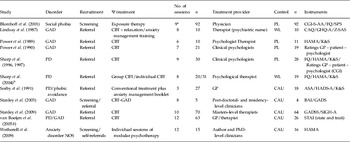
Studies were coded on several domains to examine the effects of the most probable and useful modifiers. We coded (1) the recruitment method (recruitment by referral or screening) because a meta-analysis demonstrated that recruitment through systematic screening caused lower effect sizes that other types of recruitment (Cuijpers et al. Reference Cuijpers, van Straten, van Schaik and Andersson2009); (2) the type of therapy (CBT or other therapies) because CBT is effective for the treatment of anxiety disorders and also suitable for primary care (Marchand et al. Reference Marchand, Roberge, Primiano and Germain2009; Stewart & Chambless, Reference Stewart and Chambless2009); (3) the number of treatment sessions (⩽7 or ⩾8) because a recent analysis demonstrated that brief therapies are effective for treating anxiety disorders in primary care (Cape et al. Reference Cape, Whittington, Buszewicz, Wallace and Underwood2010); (4) professional background of the therapist (clinical psychologist or other providers) because studies have demonstrated that the background of the therapist is relevant to treating depression in primary care (den Boer et al. Reference den Boer, Wiersma, Russo and van den Bosch2005; Cuijpers et al. Reference Cuijpers, Van Straten, Warmerdam and Smits2008) and (5) the type of control group [care as usual (CAU) or other control groups] because lower effect sizes were found when psychological treatment was compared to CAU (Andersson & Cuijpers, Reference Andersson and Cuijpers2009). When psychological treatment was compared to pharmacotherapy we only used the data of the psychological treatment and the pill-placebo groups. An overview of the studies considered is presented in Table 1.
Randomized controlled trials on psychological treatment for anxiety in primary care

ASA, Analogue Scales for Anxiety; BAI, Beck Anxiety Inventory; CAQ, Cognitive Anxiety Questionnaire; CAU, care as usual; CBT, cognitive behavioral therapy; CGI-AA, Clinical Global Impression – Anxiety Attacks; FQ, Fear Questionnaire; GADS, generalized anxiety disorder severity, based on the GAD section of the SCID; GADSS, Generalized Anxiety Disorder Severity Scale; GHQ-A, General Health Questionnaire – Anxiety; GP, general practitioner; HADS-A, Hospital Anxiety and Depression Scale (Anxiety); HAMA, Hamilton Rating Scale for Anxiety; K&S, Kellner and Sheffield Symptom Rating Test; NOS, not otherwise specified; PD, panic disorder; PL, placebo; SIGH-A, Structured Interview Guide for the HAMA; SPS, Social Phobia Scale; STAI, Spielberger State–Trait Anxiety Inventory; WL, waiting list; Z-SAS, Zung Self-rating Anxiety Scale.
a The exact number of sessions is unclear, but is estimated at 9.
b This manuscript reported two psychological treatments and the data were used in two comparisons.
Quality assessment
We assessed the quality of the studies using basic criteria suggested by the Cochrane Handbook (Higgins & Green, Reference Higgins and Green2011). W.S. and R.K. assessed the quality independently of one another using the six criteria set out in the Cochrane Collaboration's tool for assessing risk of bias: adequate sequence generation; allocation concealment; blinding of outcome assessors; completeness of follow-up data; no selective outcome reporting; and no other problems that could put the study at risk of bias. Disagreements were discussed until a consensus was reached. Because of the (interpersonal) nature of psychological treatment, blinding of participants and personnel (treatment providers) is not possible. However, we did check for blinding of the post-treatment assessor. We assessed whether incomplete data were adequately addressed by checking whether outcome data were assessed using intention-to-treat (ITT) analyses.
Analyses
Effect sizes (standardized mean difference, d) were calculated by subtracting (at post-test) the average score of the psychological treatment group from the average score of the comparison group and dividing the result by the pooled standard deviations of the two groups. A d value of 0.5 indicates that the mean of the experimental group is half a standard deviation larger than the mean of the control group. Values of d ranging from 0.56 to 1.2 can be assumed to be large, from 0.33 to 0.55 moderate, and from 0 to 0.32 small (Cohen, Reference Cohen1988; Lipsey & Wilson, Reference Lipsey and Wilson1993). Only those instruments that explicitly measure symptoms of anxiety were used in the calculations of the effect sizes. If more than one measurement of anxiety symptoms was used, they were combined and the mean effect sizes were calculated so that each study only contributed one effect size. When means and standard deviations were not reported, other statistics (e.g. t value, p value, number of patients) were used to calculate the effect sizes.
The standardized mean difference (d) is difficult to interpret from a clinical perspective and therefore the numbers needed to treat (NNT) were also calculated, using the formulae provided by Kraemer & Kupfer (Reference Kraemer and Kupfer2006) . The NNT is defined as the number of patients who would need to be treated with a psychological treatment to have one more successful outcome than the same number of patients in the control group.
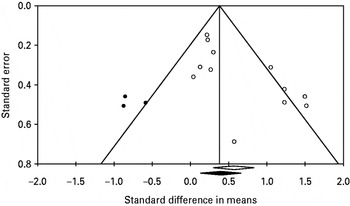
The computer program comprehensive meta-analysis (CMA) version 2.2.021 (Borenstein et al. Reference Borenstein, Hedges, Higgins and Rothstein2007) was used to calculate pooled mean effect sizes and a random effects model was used to conduct all analyses because considerable heterogeneity was expected. We calculated the Q statistic as an indicator of heterogeneity and the I 2 statistic as an indicator of heterogeneity in percentages. A value of 0% indicates no observed heterogeneity and larger values indicate greater heterogeneity (25% = low, 50% = moderate, 75% = high). We tested for publication bias by inspecting the funnel plot of the meta-analysis and by using Egger's test (Egger et al. Reference Egger, Davey-Smith, Schneider and Minder1997). The analyses of funnel plots provide a test for the likely presence of bias in the meta-analysis. Egger's linear regression method quantifies the bias captured by the funnel plot. Egger's method uses the actual values of the effect sizes and their precision. To yield an estimate of the effect size after publication bias we used the Duval & Tweedie (Reference Duval and Tweedie2009) ‘trim-and-fill’ procedure. This procedure is based on the expectation that, if no publication bias is present, the effect sizes will be dispersed equally on either side of the overall effect. The funnel plot is expected to be asymmetric when there is an indication for publication bias. The trim-and-fill procedure allows imputation of these missing studies. This method determines where the missing studies are likely to fall, adds them to the analysis and recomputes combined effect sizes.
Subgroup analyses were conducted in CMA using mixed-effects analyses that pooled studies within subgroups with the random effects model but tested for significant differences between subgroups with the fixed effects model.
Results
Description of studies
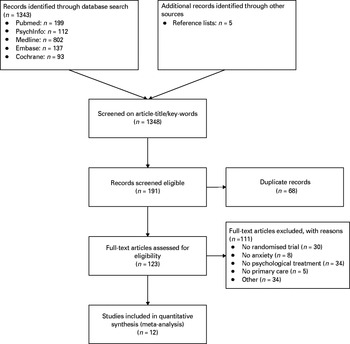
Searching the databases yielded 1343 manuscripts and, after reading the titles, 191 manuscripts were retained. Five manuscripts were retrieved from reference lists. After removing the duplicates, there were 123 manuscripts left, of which we retrieved the full articles (Fig. 1). In total, 111 studies were excluded: 30 were not randomized trials, eight did not focus on anxiety, 34 did not contain a psychological treatment, five were not conducted in primary care, and 34 for other reasons (i.e. outcome of cost-effectiveness, psychological treatment combined with pharmacotherapy, no control group, or evaluations of other research). Twelve manuscripts (Lindsay et al. Reference Lindsay, Gamsu, McLaughlin, Hood and Espie1987; Power et al. Reference Power, Jerrom, Simpson, Mitchell and Swanson1989, Reference Power, Simpson, Swanson and Wallace1990; Sorby et al. Reference Sorby, Reavley and Huber1991; Sharp et al. Reference Sharp, Power, Simpson, Swanson, Moodie, Anstee and Ashford1996, Reference Sharp, Power, Simpson, Swanson and Anstee1997, Reference Sharp, Power and Swanson2004; Blomhoff et al. Reference Blomhoff, Haug, Hellström, Holme, Humble, Madsbu and Wold2001; Stanley et al. Reference Stanley, Hopko, Diefenbach, Bourland, Rodriguez and Wagener2003, Reference Stanley, Wilson, Novy, Rhoades, Wagener, Greisinger, Cully and Kunik2009; van Boeijen et al. Reference van Boeijen, van Oppen, van Balkom, Visser, Kempe, Blankenstein and van Dyck2005b; Wetherell et al. Reference Wetherell, Ayers, Sorrell, Thorp, Nuevo, Belding, Gray, Stanley, Areán, Donohue, Unützer, Ramsdell, Xu and Patterson2009) met all inclusion criteria, in which 13 psychological treatment conditions were compared to a control group. Two manuscripts (Sharp et al. Reference Sharp, Power, Simpson, Swanson, Moodie, Anstee and Ashford1996, Reference Sharp, Power, Simpson, Swanson and Anstee1997) described different outcomes for one study. One study (Sharp et al. Reference Sharp, Power and Swanson2004) described two psychological treatment conditions (group CBT and individual CBT) with a control group. We treated these two comparisons as two different studies. However, these comparisons are not independent because they are compared with the same control group. Therefore, we used half of the control group as a comparison for the group CBT and the other half as a comparison for the individual CBT. This resulted in a total of 12 comparisons, in which a total of 759 patients participated (424 in the psychological treatment conditions and 335 in the control conditions). Selected characteristics of the studies included are presented in Table 1.
Flow chart.

Five comparisons included patients with GAD, five included panic disorder, one included social phobia and two included both GAD and panic disorder. Nine comparisons had adults (aged 18–65 years) as their target group and three comparisons were focused on older adults (>65 years). In nine comparisons, CBT was used as the psychological treatment and in the other comparisons other treatments were used (i.e. exposure therapy, individual sessions of modular psychotherapy or anxiety management booklet). The treatment was provided by psychologists in seven comparisons and by GPs or trained psychology students in the remaining comparisons. Patients were recruited by referral by the GP in nine comparisons, through screening in one comparison, and a combination of referral and screening was used in two comparisons.
Quality assessment
The quality of studies was not optimal; only one manuscript met all quality criteria. Seven of the 12 manuscripts gave insufficient information about whether the allocation sequence was adequately generated and eight manuscripts gave insufficient information about whether the allocation was adequately concealed. Because blinding of participants and treatment providers is not possible in psychological treatment, we checked for blinding of the post-treatment assessor. In two studies, the outcome was rated by the GP and the psychologist, neither of whom were blinded. In the remaining studies, self-reports were used as post-assessment. We assessed whether incomplete data were adequately addressed by checking whether outcome data were assessed using ITT analyses. This was the case in four of the 12 manuscripts. Clinical effectiveness may be overestimated if an ITT analysis is not carried out (Hollis & Campbell, Reference Hollis and Campbell1999). In one manuscript, referral of patients with long-standing anxiety problems was particularly encouraged. The lack of quality in these studies might have caused bias (e.g. selective drop-out) that might have led to higher effect sizes than were present in reality.
Effects of psychological treatments
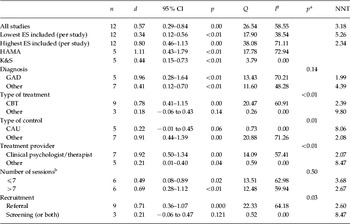
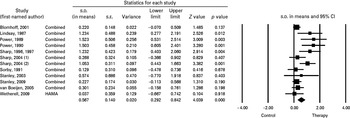
In each of the 12 comparisons (Fig. 2), a psychological treatment was compared with one of the following types of control group: waiting list (WL), care as usual (CAU) or placebo (PL). The random effect model showed an overall effect size of d = 0.57 [95% confidence interval (CI) 0.29–0.84], which is considered to be a medium effect (Table 2). However, the fixed-effect model showed that heterogeneity was significant and moderate to high (I 2 = 58.55). In our analysis, we included one study (Lindsay et al. Reference Lindsay, Gamsu, McLaughlin, Hood and Espie1987) in which two psychological treatments were compared with a waiting list. Both comparisons were included in the same analysis. However, these comparisons are not independent, which might have resulted in an artificial reduction of heterogeneity. When we include only the comparison with the largest effect size, because this is considered to be the most conservative approach in estimating heterogeneity, the random effect model showed an overall effect size of d = 0.61 (95% CI 0.31–0.90). This analysis indicates that the heterogeneity increased but was still moderate to high (I 2 = 62.01).
Results of the meta-analysis

CAU, Care as usual; CBT, cognitive behavioral therapy; CI, confidence interval; d, standardized mean difference; ES, effect size; GAD, generalized anxiety disorder; HAMA, Hamilton Rating Scale for Anxiety; I 2, indicator of heterogeneity in percentages; K&S, Kellner and Sheffield Symptom Rating Test; NNT, numbers needed to treat.
a The p value indicates whether the difference between subgroups is significant.
b In one study the number of sessions was unclear.
Subgroup analyses
An attempt was made to identify subgroups of studies that could explain differences in effect and heterogeneity. The comparisons of these modifiers are shown in Table 2. We found a significant difference (p < 0.01) between CBT (d = 0.78, 95% CI 0.41–1.15) and other treatments (d = 0.18, 95% CI −0.06 to 0.43). We also found significant effects for type of control group (p = 0.01), with a lower effect size for CAU (d = 0.22, 95% CI −0.01 to 0.45) compared with other controls (WL or PL; d = 0.91, 95% CI 0.44–1.39). The difference between treatment providers was also significant (p < 0.01). If the treatment was given by a clinical psychologist, the effect size was significantly higher (d = 0.92, 95% CI 0.50–1.34) compared with other treatment providers (e.g. GPs or trained master level students; d = 0.21, 95% CI 0.01–0.40). The difference in effect size between screening (or both screening and referral) (d = 0.21, 95% CI −0.06 to 0.47) and referral by GP (p = 0.71, 95% CI 0.36–1.07) in the recruitment phase was also significant (p = 0.03) in favor of referral by GP. In the subgroup analyses, we found no significant differences between the type of disorder (p = 0.14) or the number of treatment sessions (p = 0.50). For the number of sessions we also performed a meta-regression but this showed no significant results (slope = −0.05, 95% CI −0.12 to 0.02).
Publication bias
Funnel plots showed significant asymmetry in the studies (Egger's test, two-tailed p = 0.02). The Duval & Tweedie trim-and-fill approach suggests that three studies were potentially missing (Fig. 3) and, if imputed, the overall effect size would drop to d = 0.37 but would still be significant (95% CI 0.08–0.67).
Effect sizes of psychological treatment versus control group per study. s.d., Standard difference; CI, confidence interval.

Funnel plot with imputed studies adjusting for publication bias.

Longer-term follow-up
Three studies (Sharp et al. Reference Sharp, Power, Simpson, Swanson, Moodie, Anstee and Ashford1996; van Boeijen et al. Reference van Boeijen, van Oppen, van Balkom, Visser, Kempe, Blankenstein and van Dyck2005b; Stanley et al. Reference Stanley, Wilson, Novy, Rhoades, Wagener, Greisinger, Cully and Kunik2009) report data on a 6-month follow-up. Psychological treatment versus control on a 6-month follow-up resulted in an effect size of d = 0.29 (95% CI 0.07–0.52, p = 0.01) and zero heterogeneity. Two studies (van Boeijen et al. Reference van Boeijen, van Oppen, van Balkom, Visser, Kempe, Blankenstein and van Dyck2005b; Stanley et al. Reference Stanley, Wilson, Novy, Rhoades, Wagener, Greisinger, Cully and Kunik2009) report data on a 12-month follow-up. When psychological treatment was compared with the control after 12 months, the effect size was d = 0.14 (95% CI −0.11 to 0.38, p = 0.27) with zero heterogeneity.
Discussion
Summary of main findings
The psychological treatment of anxiety disorders is effective in primary care patients, especially when patients receive CBT provided by psychologists, compared to a placebo control and when patients were referred to treatment. Somewhat lower effect sizes were found at 6-month follow-ups and the difference in effect between treatment group and control group disappeared after 12 months between treatment group and control. However, these findings are based on just a few studies.
Strengths and limitations
One strength of this study is that we only included research in which psychological treatment was provided in primary care. Another strength is that several aspects of treatment (e.g. treatment provider, number of sessions, type of treatment) were assessed as modifiers. Some of these aspects of treatment are strongly linked to effect size. Therefore, it is important to take these aspects into account for future research or when psychological treatment or care models are implemented in primary care.
This study also has several limitations. The number of studies included is relatively low and might not be a fair representation of the actual treatment of anxiety in primary care. The differences between the studies regarding the types of anxiety disorder constitute another limitation. For example, panic disorder and GAD have different characteristics and their treatment might lead to different outcomes. However, we chose to combine these studies because treatment of these disorders in primary care is mostly short term and aimed at anxiety symptom reduction. Furthermore, CBT has been proven to be effective and is advised in the guidelines for most anxiety disorders. Another limitation lies in the fact that there is considerable heterogeneity in most analyses, which suggests that the effect of therapies might be associated with, or confounded by, characteristics other than those examined in the subgroup analysis. Furthermore, CAU is poorly described in most studies, and therefore the contrast with the effect of psychological treatment is difficult to interpret because it might contain a variety of treatments or even no treatment at all, which might have affected the outcomes of this meta-analysis. Few studies reported data on follow-up measurements. We have reported some calculations on the 6- and 12-month follow-ups along with some conclusions but these should be interpreted with caution. In addition, the studies lack blinding of the participants, which is unavoidable for the patients who are included in the psychological treatment (experimental) group. However, this might have an effect on the expectations of the participants regarding the received treatment. Finally, the results show that there is significant publication bias in studies on psychological treatment for anxiety in primary care, although the effect size remains significant after imputation.
Comparison with existing literature
The effectiveness of CBT for treating patients with anxiety disorders has been well established (Marchand et al. Reference Marchand, Roberge, Primiano and Germain2009; Stewart & Chambless, Reference Stewart and Chambless2009). Together with the development of effective CBT self-help courses or treatment for anxiety disorders using the internet (Schneider et al. Reference Schneider, Mataix-Cols, Marks and Bachofen2005; Kiropoulos et al. Reference Kiropoulos, Klein, Austin, Gilson, Pier, Mitchell and Ciechomski2008), this could provide an opportunity for effective and evidence-based treatment of anxiety disorders in primary care. They can be used as (low-intensity) treatment for primary mental healthcare models such as stepped care or collaborative care provided by a practice nurse or psychologist. The (short-term) psychological treatment of anxiety in primary care is important, not only for reducing waiting lists for specialized mental healthcare but also to meet the preferences of the patient. As mentioned previously, it is possible for such treatments to be performed effectively by primary care workers, such as nurses or social workers.
As expected, the modifiers analyzed showed results corresponding to prior research, either conducted in other settings or focused on depression instead of anxiety. When psychological treatment is compared with CAU, smaller effect sizes are found than when they are compared with other groups, such as waiting lists or placebo. A meta-analysis on internet-based and other computerized psychological treatments for adult depression (Andersson & Cuijpers, Reference Andersson and Cuijpers2009) also found that waiting-list control resulted in higher effect sizes than comparisons with CAU or other control groups. This seems self-evident because the therapy offered in CAU is an active treatment, as opposed to waiting lists or placebo.
Therapists and clinical psychologists are more effective than other treatment providers (e.g. GPs or trained students). A meta-analysis of paraprofessionals treating anxiety and depressive disorders found that interventions conducted by professional therapists were more effective than those conducted by paraprofessionals. The term paraprofessional refers to a broad category of mental health professionals who are not qualified as psychiatrists, psychologists, social workers or nurses and who are below a master's degree level of education (den Boer et al. Reference den Boer, Wiersma, Russo and van den Bosch2005). Cuijpers et al. (Reference Cuijpers, Van Straten, Warmerdam and Smits2008) also found that interventions conducted by students had lower effect sizes than those conducted by psychologists or other health professionals. However, these studies (den Boer et al. Reference den Boer, Wiersma, Russo and van den Bosch2005; Cuijpers et al. Reference Cuijpers, Van Straten, Warmerdam and Smits2008) were not conducted in primary care settings.
Treatment of patients recruited through screening seems to be less effective than when the patients treated are referred by their GP. Cuijpers et al. (Reference Cuijpers, van Straten, van Schaik and Andersson2009) performed a meta-analysis on psychological treatment for depression in primary care and found that studies in which patients were referred by their GP resulted in significantly higher effect sizes (d = 0.43, NNT = 4.20) than studies in which patients were recruited through systematic screening (d = 0.13, not significantly different from zero; NNT = 13.51). The difference may be caused by patient factors (severity of the anxiety and motivation for treatment) and GP-related factors. However, such screening is applied in primary care outside of research projects.
We found a moderate effect size for the treatment of anxiety in primary care; follow-up analysis show a decrease of this effect at 6 months and the effect disappeared at 12 months. Given the chronicity of anxiety disorders, the lack of enduring effects is to be expected. The Netherlands Study of Depression and Anxiety (NESDA) recently presented data for the 2-year diagnostic and symptom trajectory outcome for depressive and anxiety disorders (Penninx et al. Reference Penninx, Nolen, Lamers, Zitman, Smit, Spinhoven, Cuijpers, de Jong, van Marwijk, van der Meer, Verhaak, Laurant, de Graaf, Hoogendijk, van der Wee, Ormel, van Dyck and Beekman2011). The course of pure anxiety disorders was less favorable than for pure depression. Therefore, treatment of anxiety disorders in primary care is effective but probably not sufficient for most patients, given that the effect had disappeared at 12 months. If psychological treatments for anxiety disorders are implemented in primary care, it is important to monitor the patient at intervals during the year. This could be achieved when psychological treatment is part of a stepped care or collaborative care model. More research is needed on the follow-up of psychological treatment of anxiety in primary care.
Conclusions
Despite limitations and publication bias, we found a moderate effect size for the psychological treatment of anxiety disorders in primary care. This effect still remained after imputation for ‘missing’ studies. Psychological therapies show larger effect sizes when the treatment is CBT, when therapy is delivered by a (clinical) psychologist, when the patients are referred to therapy by their GP, and when it is compared with another control group rather than CAU. The chronicity of anxiety disorders can lead to a lack of enduring effects. Therefore, it is advisable to provide the least intensive treatment to those with low chronicity risk and more intensive treatment for those with high chronicity risk. It is also important to monitor chronic patients after their treatment in primary care.
Psychological treatment of anxiety disorders in primary care is effective but shows lower effect sizes compared with psychological treatment in specialized mental healthcare. More studies are needed to evaluate long-term effects given the chronicity and recurrent nature of anxiety.
Declaration of Interest
None.