Non-technical Summary
The Middle Ordovician Oil Creek Formation in the Arbuckle Mountains of southern Oklahoma is well known for its echinoderm-rich limestone beds interbedded with shale. However, despite the abundance of well-preserved separate skeletal plates, complete specimens are rare. This study is derived from Ph.D. dissertation research done by the senior author. Many of the specimens were collected in the 1970s. Construction of Interstate Highway 35 in the late 1960s provided rare access to relatively fresh exposures at that time. The site now is largely overgrown. Unpublished echinoderms collected in the 1970s are supplemented by additional specimens and reappraised in light of subsequent research, in particular the findings of Sprinkle, Guensburg, and Sumrall in Lower Ordovician units in the American West.
A companion paper describes the blastozoan elements of the fauna: parablastoid, rhombiferan, diploporitan, and paracrinoid taxa. Crinoids described in this paper include a new genus and species of a hybocrinid that is apparently intermediate between an Early Ordovician form and the Late Ordovician genus Hybocrinus. Also described are early representatives of the genera Palaeocrinus, Carabocrinus, and Reteocrinus.
Introduction
The Oil Creek Formation was among the first units to be deposited above a major sequence boundary at the Sauk-Tippecanoe junction (Sloss, Reference Sloss1963) as epicontinental seas returned to the Laurentian craton. For many groups, this was a pivotal time in the great Ordovician radiation. Although species-level diversity patterns for echinoderms (Sprinkle and Guensburg, Reference Sprinkle, Guensburg, Webby, Paris, Droser and Percival2004) do not reflect a major change until the Upper Ordovician, important changes were taking place in benthic ecosystems (Guensburg and Sprinkle, Reference Guensburg and Sprinkle1992). As explained by Wilson et al. (Reference Wilson, Palmer, Guensburg, Finton and Kaufman1992) for the laterally equivalent Kanosh Shale in Utah, Cambrian eocrinoid-rich faunas in the hardground ecosystem were being replaced by crinoid and bryozoan communities in the transition from the Cambrian Fauna to the Paleozoic Fauna. In both the Kanosh Shale and the Oil Creek Formation, storm concentrations of lithic clasts and rapid sea-floor calcite cementation of echinoderm plates yielded abundant attachment sites for stemmed echinoderms and bryozoans.
The upper member of the Oil Creek Formation in southern Oklahoma consists of relatively thin limestone beds interbedded with shale. Echinoderm remains are abundant in many of the skeletal biosparites and biomicrites but are largely represented by separate plates: complete specimens of echinoderms are very rare. In this paper, we address the systematics of the crinoid component of the Oil Creek echinoderms based on complete specimens and unique separate plates. Individual plates and holdfasts treated as morphotypes can be found in Additional Material at https://www.morphobank.org/permalink/?P6417. The formation’s blastozoans will be described in a second manuscript, currently in preparation.
Materials and methods
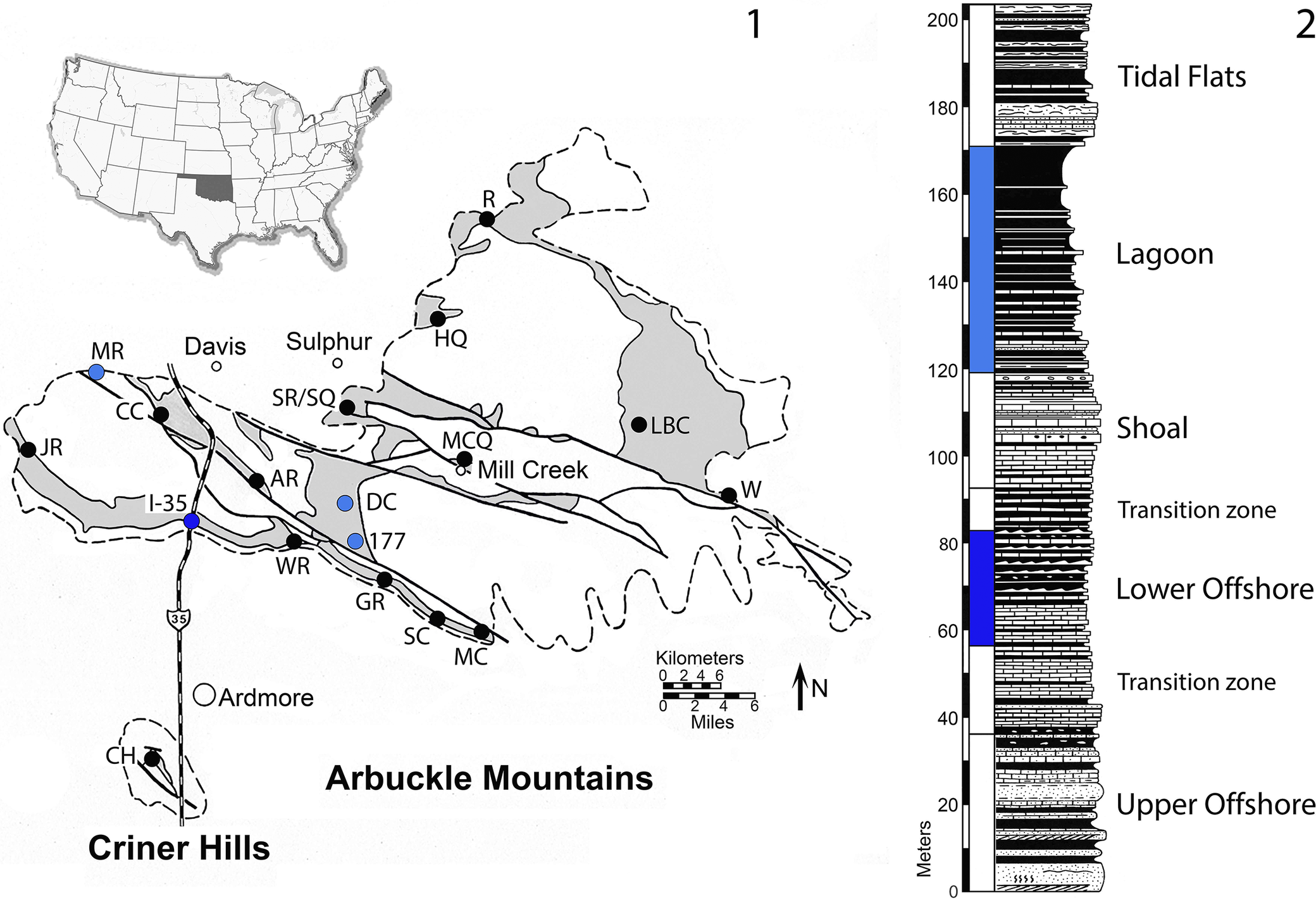
This paper is based on a Ph.D. dissertation (Lewis, Reference Lewis1982), with additional material and insight accumulated in the years since. Most of the dissertation field work was done in the summers of 1975 through 1977 at 18 localities in the Arbuckle Mountains and Criner Hills uplift (Fig. 1.1). Interstate Highway 35 was constructed through the Arbuckle Mountains in the late 1960s (Ham, Reference Ham1969; Fay, Reference Fay1969, Reference Fay1989), so the exposures were fresh enough that the shale was still in place to support the fractured limestone beds of the unit, and the echinoderms were not as damaged by weathering as they were in most natural exposures. Some important specimens were found at other localities, but the majority of echinoderms illustrated herein were found at locality I-35 (Interstate Highway 35 and State Highway 77, roadcut exposures ~11 mi [18 km] north of Ardmore; center SE 1/4 sec. 24, T. 2 S., R. I E., Springer Quadrangle, Carter County, Oklahoma; 34°21’51.64"N, 97°08’49.66"W). The most productive facies were the lower offshore facies, where storm deposition is evident, and the lagoonal facies (Fig. 1.2) A detailed measured section made at this site along with other site descriptions and a discussion of sedimentary facies can be found in the companion paper on the blastozoan fauna.
Study area and principal measured section: (1) sites studied in the Arbuckle Mountains and Criner Hills, southern Oklahoma, showing localities of major specimens discussed herein (blue dots) and other collecting localities (see Supplemental data for site descriptions and measured sections); (2) measured section at locality I-35 and State Highway 77, showing subtidal facies as exposed on the interstate plus the tidal facies, which is exposed at Highway 77; basal sandstone unit not shown. The most productive facies are highlighted in blue. 177, U.S. Highway 177; AR, Amis Ranch; CC, Colbert Creek; CH, Criner Hills Uplift; DC, Denmark Creek; GR, Goddard Ranch; HQ, Hickory Quarry; I-35, Interstate Highway 35 and State Highway 77; JR, Johnston’s Ranch; LBC, Little Blue Creek; MC, Mill Creek; MCQ, Mill Creek Quarry; MR, Meyer’s Ranch; R, Roff; SC, Sycamore Creek; SR/SQ, Sulphur Roadcut and Quarry; W, Wapanucka; WR, Washita River.

Figure 1. Long description
Panel 1 is a geological map of southern Oklahoma. An inset map of the United States shows Oklahoma highlighted in dark gray. The main map shows the Arbuckle Mountains and Criner Hills with various localities marked by dots. Blue dots indicate major specimens at M R, I dash 35, D C, and 1 77. Black dots mark other localities including J R, C C, A R, W R, G R, S C, M C, S R forward slash S Q, M C Q, H Q, R, L B C, and W. The I dash 35 highway runs North to South through the western portion of the map. A scale bar indicates kilometers and miles, and a North arrow points upward.
Panel 2 is a stratigraphic column with a vertical axis labeled Meters, ranging from 0 to 200. The column shows various rock layers with different textures. From the base upward, the facies are labeled:
* 0 to 35 meters: Upper Offshore.
* 35 to 55 meters: Transition zone.
* 55 to 82 meters: Lower Offshore, highlighted in blue on the left side of the column.
* 82 to 105 meters: Transition zone.
* 105 to 118 meters: Shoal.
* 118 to 170 meters: Lagoon, with the sections from 120 to 150 and 160 to 170 highlighted in blue.
* 170 to 200 meters: Tidal Flats.
Specimens were prepared by hand using brushes and a pin vise with needle and a binocular microscope (Nikon SMZ645). Larger items were coated by applying a sublimate of ammonium chloride and photographed with a Nikon D7100 camera and a Sigma 50 mm macrolens. Images were enhanced to correct depth-of-field problems by use of Helicon Focus software (https://www.heliconsoft.com/heliconsoft-products/helicon-focus/). Smaller specimens were photographed uncoated using a Motorola edge 5G UW cellular telephone camera through the binocular microscope.
Repository and institutional abbreviation
All type specimens and related material are reposited at the Non-vertebrate Paleontology Laboratory (NPL), The University of Texas at Austin.
Systematic paleontology
Subphylum Crinozoa Matsumoto, Reference Matsumoto1929
Class Crinoidea Miller, Reference Miller1821
Subclass Cladida Moore and Laudon, Reference Moore and Laudon1943
Order Hybocrinida Jaekel, Reference Jaekel1918
Family Hybocrinidae Zittel, Reference Zittel1879
Occurrence
Early Ordovician (early Floian) to Late Ordovician (late Katian); southern Canada, eastern, central, and western USA, Sweden, and Estonia.
Remarks
The family diagnosis stipulates five relatively short arms, one in each ray. All evidence, including the morphology of isolated radial plates, indicates that the Oil Creek hybocrinids had five erect arms: no radial plates were found that lacked radial articular facets or bore recumbent ambulacra, as in related hybocrinids, e.g., Baerocrinus Volborth, Reference Volborth1864, or Tripatocrinus Sprinkle, Reference Sprinkle1973.
The family Hybocrinidae contains five genera, two of which were described recently (Guensburg and Sprinkle, Reference Guensburg and Sprinkle2022). Hybocrinus Billings, Reference Billings1857, is a well-known genus represented by numerous species in the Late Ordovician of North America (e.g., Sprinkle and Moore, Reference Sprinkle, Moore and Pitrat1978; Sprinkle, Reference Sprinkle1982a). It is distinguished from other members of the family by having the anal X on the side of the cup alongside the C-ray radial and of approximately the same size (Sprinkle, Reference Sprinkle1982a). Oral plates (circumorals of Guensburg and Sprinkle, Reference Guensburg and Sprinkle2022) are relatively large, occupying the entire interambulacral area (see also Kammer et al., Reference Kammer, Sumrall, Zamora, Ausich and Deline2013, fig. 4H). In Hoplocrinus Grewingk, Reference Grewingk1867, the radianal plate (RA) reaches the summit of the cup. The anal X is relatively small and is confined to the cup’s rim or lies above it. The C-ray radial is located obliquely above the radianal and has a subtriangular outline in lateral view. The oral surface lacks recognizable oral plates and instead is made up of very small plates in what appears to have been a plate-studded integument (Guensburg and Sprinkle, Reference Guensburg and Sprinkle2022). All 12 described species of Hoplocrinus are from the Middle Ordovician of Estonia and Sweden (Rozhnov, Reference Rozhnov1985). Lane (Reference Lane1970) tentatively identified a basal plate and a radial plate from the Kanosh Shale of west-central Utah as belonging to Hoplocrinus based on plate shape and surface ornament. However, plates from the posterior side of the cup are necessary for genus-level identification. Revalocrinus Jaekel, Reference Jaekel1918, is also known from the Middle Ordovician of Estonia. The C-ray radial is relatively large and rests directly on the radianal with the mutual suture being nearly horizontal. The anal X is small and lies above the C-ray radial.
Guensburg and Sprinkle (Reference Guensburg and Sprinkle2022) described the only known hybocrinids from the Early Ordovician (Floian) based on specimens that they found in Nevada and Utah. Syndiasmocrinus Guensburg and Sprinkle, Reference Guensburg and Sprinkle2022 was named for the fact that it displays morphologic characters of both Hybocrinus and Hoplocrinus; it has the cup plating of Hybocrinus but the oral-surface features of Hoplocrinus. Specifically, it lacks the large oral plates found in Hybocrinus. In Parahybocrinus Guensburg and Sprinkle, Reference Guensburg and Sprinkle2022, the C-ray radial and radianal are approximately equal in size and two small anal-series plates lie above the anal X. The only known specimen lacks details on the tegmen and arms. The genus proposed below could be intermediate between these Floian taxa and Hybocrinus. See remarks below for further discussion because the genus is monotypic.
Genus Guensburgocrinus new genus
Type species
Guensburgocrinus lineatus new genus new species.
Diagnosis
Monotypic; see diagnosis below.
Occurrence
Oil Creek Formation, lower Middle Ordovician (Whiterockian/Darriwilian), Arbuckle Mountains and Criner Hills, Oklahoma.
Etymology
The genus name is coined to honor Thomas E. Guensburg, Field Museum, Chicago, Illinois, in recognition of his contributions to research on hybocrinids and other early Paleozoic crinoids.
Remarks
Guensburgocrinus n. gen. is proposed primarily on the basis of its tegminal morphology and its distinct arm structure. The stem lumen is also unique. Because the genus is monotypic, details are discussed below under the species.
Guensburgocrinus lineatus new genus new species
Figures 2–5, Supplemental Figure 1.54, 1.58; Table 1
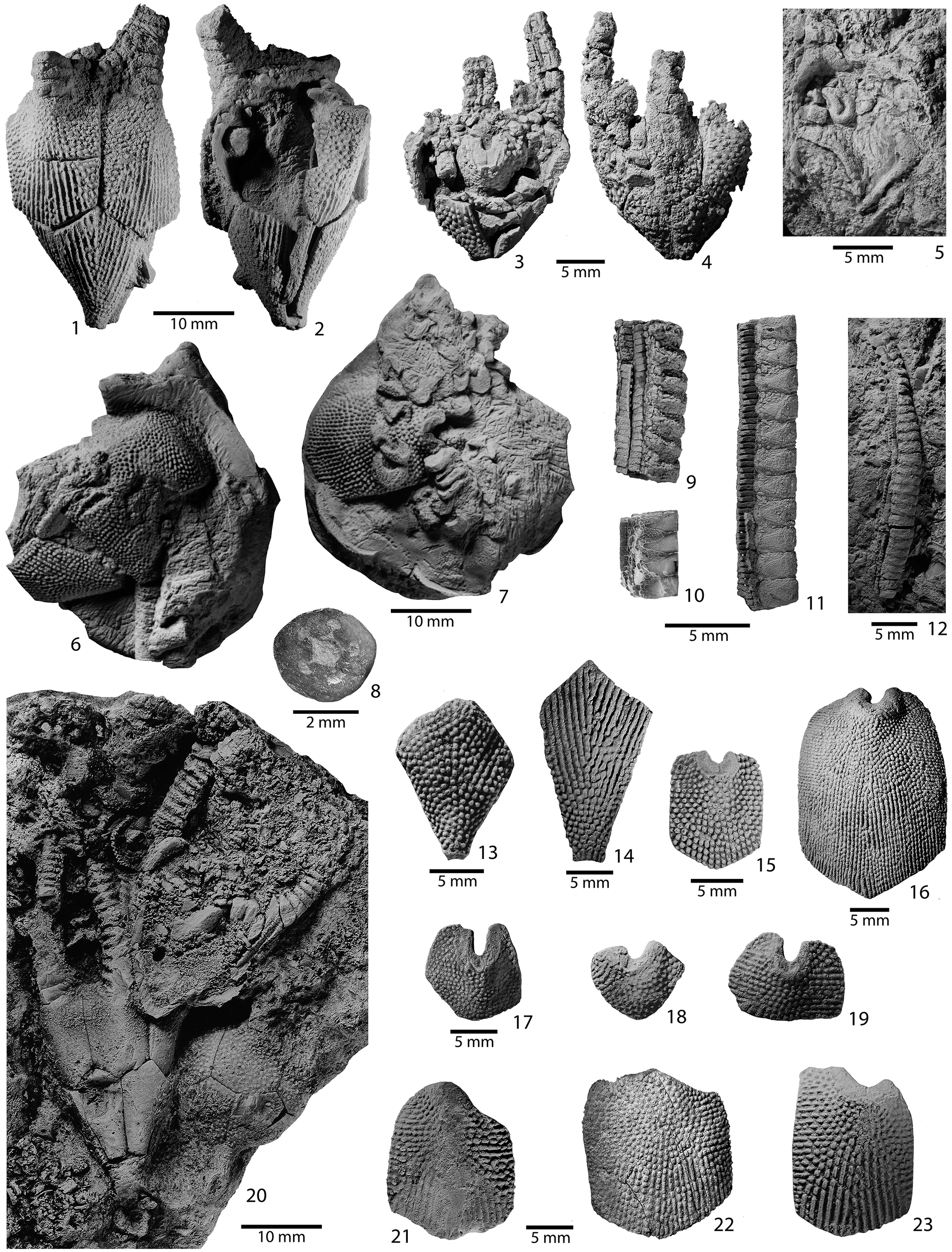
Guensburgocrinus lineatus n. gen. n. sp., all from the lower offshore facies at locality I-35 unless otherwise noted. (1, 2) Holotype NPL00113031. (3, 4) Paratype 1408TX13, D-ray view of a juvenile, shown in detail in Figure 9. (5) Paratype NPL00113032, flattened partial crown with dissociated plates that might or might not belong to the calyx. (6, 7) Paratype 1408TX12, base of a disarticulated, flattened cup with proximal stem attached; (8) Paratype 1408TX12, stem cross section. (9) Paratype NPL00113033, well-preserved arm segment found separately, showing all types of small plates: equidimensional lateral plates covering the pouches in notches between brachials, minute elongated lateral platelets bordering ambulacral cover plates, and ambulacral floor plates, which are exposed at top where cover plates are absent. (10) Paratype NPL00113034, a second well-preserved arm segment found separately, showing lateral plates particularly well; immersed in water. (11) Paratype NPL0011303, a separate arm segment lacking ambulacral cover plates and elongate lateral platelets but showing ambulacral floor plates with pores (all the way through plate and matrix at bottom left) and equidimensional lateral plates between brachials; scale bar applies to (9–11). (12) Paratype NPL00113036, separate arm segment. (13, 14) NPL00113037 and NPL00113038, respectively, basal plates illustrating various degrees of pustule alignment and fusion. (15) NPL00113039, small radial; pustule lineation not yet developed in this juvenile. (16) NPL00113040, largest radial plate in the hypodigm. (17–19) NPL00113041, NPL00113042, and NPL00113043, respectively, C-ray radial plates; scale bar applies (17–19). (20) Three crowns partly buried in a biosparite matrix, locality MR; crowns with conical cups (left and top center) apparently belong to Guensburgocrinus lineatus, although the ornament is poorly preserved; note notches between brachial plates identical to those of other specimens; short, globular cup at right (NPL00113051) is probably Hybocrinus nanobrachiatus n. sp., but neither arms nor radial articular facets are exposed. (21, 22) NPL00113044 and NPL00113045, radianal plates; scale bar applies to (21–23). (23) NPL00113046, B-ray radial. All specimens except (10) coated with ammonium chloride.

Figure 2. Long description
The figure contains 23 numbered panels of fossilized Guensburgocrinus lineatus and related species.
* Panels 1 and 2: Holotype N P L 0 0 1 1 3 0 3 1, showing a conical calyx with vertical ridges and pustules. Scale bar is 10 mm.
* Panels 3 and 4: Paratype 1 4 0 8 T X 1 3, a juvenile crown in D-ray view. Scale bar is 5 mm.
* Panel 5: Paratype N P L 0 0 1 1 3 0 3 2, a flattened partial crown with dissociated plates. Scale bar is 5 mm.
* Panels 6 and 7: Paratype 1 4 0 8 T X 1 2, showing a disarticulated cup base with an attached proximal stem. Scale bar is 10 mm.
* Panel 8: A circular stem cross-section. Scale bar is 2 mm.
* Panels 9, 10, and 11: Arm segments showing lateral plates and ambulacral floor plates. Panel 11 shows pores through the plate. Scale bar for this group is 5 mm.
* Panel 12: A separate arm segment. Scale bar is 5 mm.
* Panels 13 and 14: Basal plates with varying pustule alignment. Scale bar is 5 mm.
* Panel 15: A small juvenile radial plate. Scale bar is 5 mm.
* Panel 16: The largest radial plate, showing dense vertical lineation. Scale bar is 5 mm.
* Panels 17, 18, and 19: C-ray radial plates with notched tops. Scale bar is 5 mm.
* Panel 20: Three crowns embedded in a rocky matrix. The left and top center crowns are conical, while the right cup is globular. Scale bar is 10 mm.
* Panels 21 and 22: Radianal plates. Scale bar is 5 mm.
* Panel 23: A B-ray radial plate.
Most specimens exhibit a textured surface of small bumps or pustules, often organized into linear patterns on larger plates.
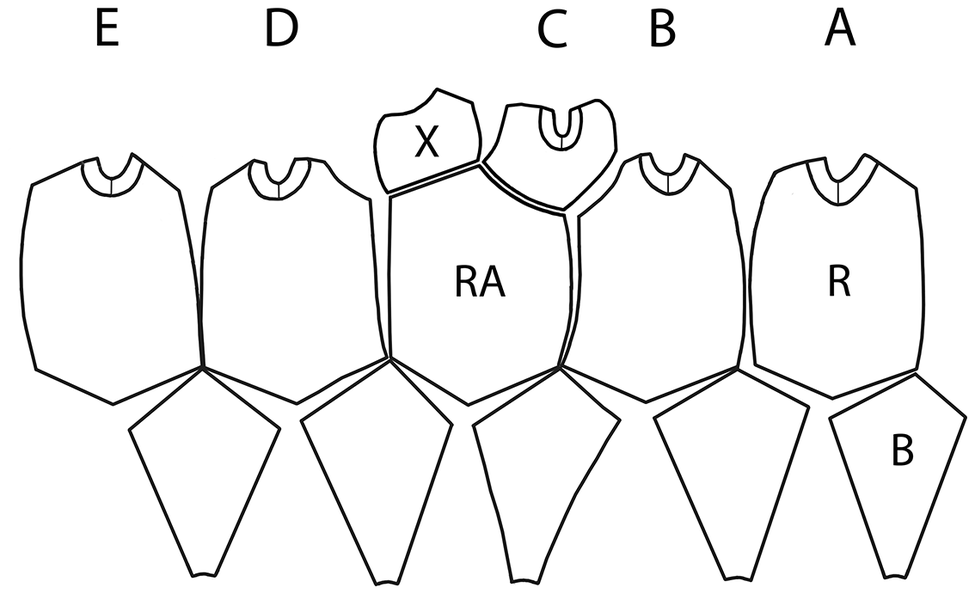
Guensburgocrinus lineatus n. gen. n. sp., side-layout plating diagram, based on holotype NPL00113031 and typical separate plates, showing basal (B), radial (R), radianal (RA), and anal x (X) plates. Rays (E, D, C, B, A) identified by letter symbols of Carpenter system.

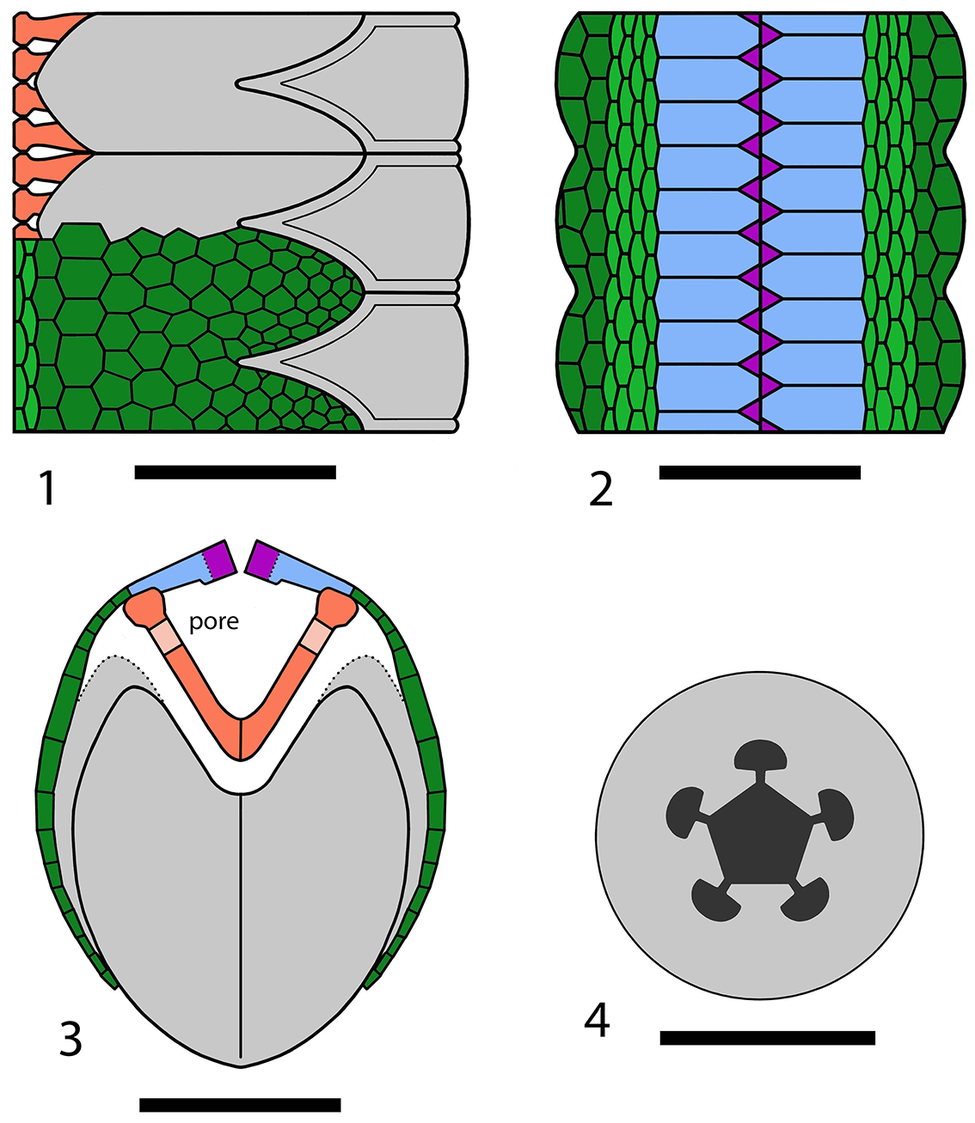
Guensburgocrinus lineatus n. gen. n. sp., diagrammatic details of arm plating based on paratypes NPL00113033, NPL001130340, and NPL00113035: (1) side view as seen in fossil specimens; (2) adoral view; (3) transverse view in life; (4) columnal with distinctive lumen as shown in Figure 6.8. Gray, brachial plate; dark green, lateral plates; light green, elongated lateral platelets; orange, floor plates; blue, lateral cover plates; purple, medial cover plates (colors mirror those used by Guensburg et al., Reference Guensburg, Sprinkle, Mooi, Lefebvre, David, Roux and Derstler2020 to facilitate comparison). Scale bars = 2 mm.

Figure 4. Long description
Panel 1 shows a side view of three stacked brachial plates in gray. The left side features orange floor plates. A section of the lower brachial is covered by a dark green honeycomb pattern representing lateral plates. Panel 2 displays an adoral view with a central vertical purple line flanked by small purple triangular medial cover plates. Moving outward are blue rectangular lateral cover plates, followed by light green elongated lateral platelets and dark green lateral plates at the perimeter. Panel 3 is a transverse cross-section. At the base is a large gray brachial plate with a V-shaped notch. Inside the notch sits an orange V-shaped floor plate. Above the floor plate are blue lateral cover plates tipped with purple medial cover plates, leaving a central gap. A label ‘pore’ identifies the space between the floor plate and the brachial wall. The outer curved surface is lined with dark green lateral plates. Panel 4 is a circular gray columnal with a central dark gray lumen shaped like a five-pointed star with rounded lobes at each point. Each panel includes a black scale bar representing 2 mm.
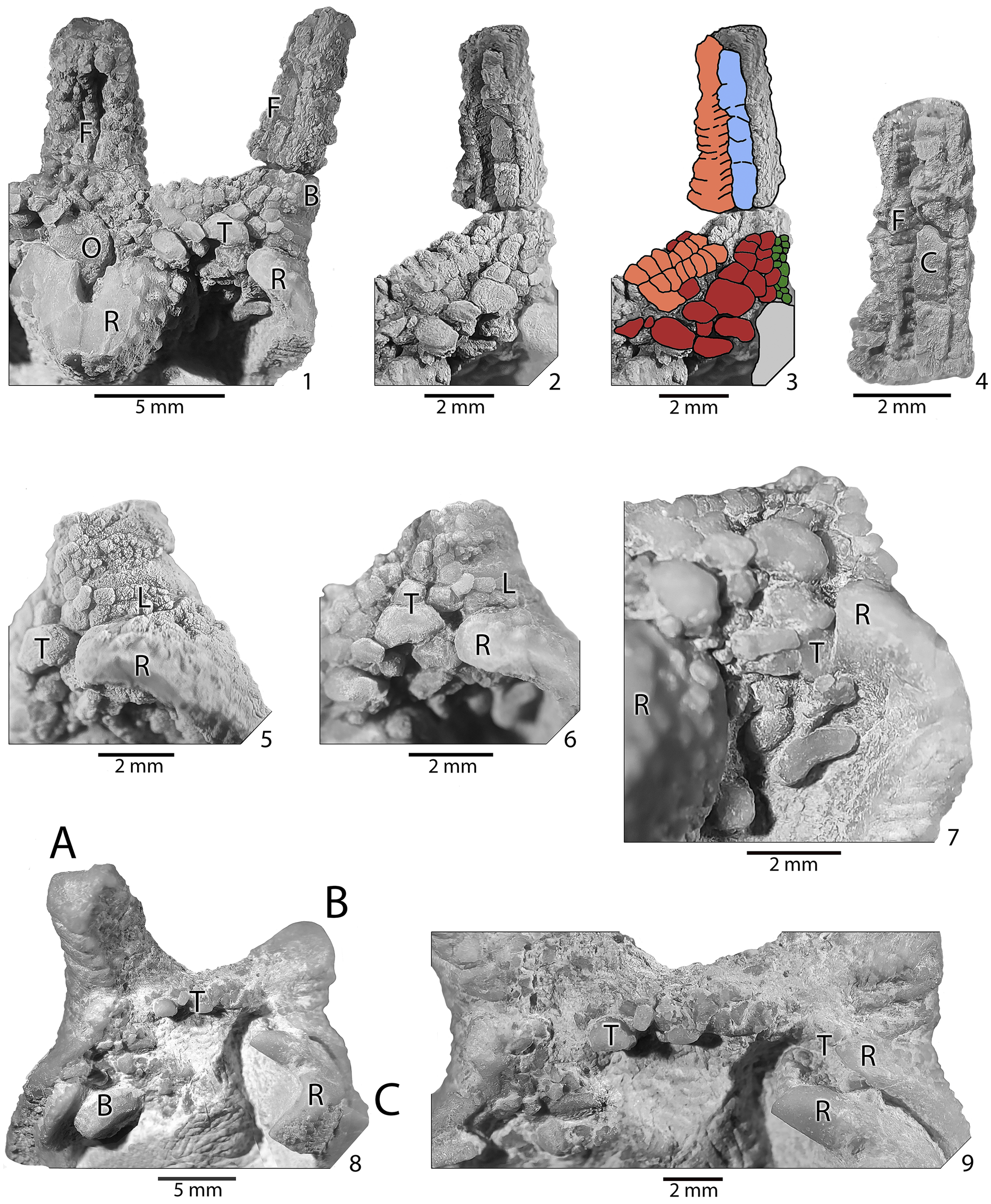
Guensburgocrinus lineatus n. gen. n. sp.; details of the tegmen; all from lower offshore facies at locality I-35; photographs taken using Motorola edge 5G UW cellular telephone camera and Nikon SMZ645 binocular microscope. (1–7) Paratype 1408TX13: (1) detail of portion of oral surface of calyx with proximal arm segments attached; (2) detail taken from a different angle to show ambulacral side of arm and transition to tegmen; note relatively large plate T; (3) colorized version of (2) to differentiate between radial (gray), floor (orange), ambulacral cover plates (blue), tegmen/interambulacral (maroon), and lateral (green) plates; (4) arm segment of (2) enlarged; individual plating of cover plates C obscured by diagenetic growth of calcite; (5) side view of base of arm showing the difference in size between lateral plates (L) at right and tegmen/interambulacral plates (left), coated with ammonium chloride; (6) side view from a slightly different angle, not coated; (7) side view taken from below; note plate T, which appears to be sutured to radial plate R at the place where an oral plate would be located in Hybocrinus; (8, 9) holotype (NPL00113031); (8) oblique view of the oral surface of calyx; (9) detail of (8), showing what appears to be tegmen plates T adjacent to the radial plate at right. B, brachial plate; F, floor plate; O, possible oral plate; R, radial plate; T, tegmen/interambulacral plate.

Figure 5. Long description
A collection of nine grayscale and color-coded macro-photographs of crinoid fossils.
Panel 1: A wide view of the oral surface of the calyx. Labels include R for radial plate, O for possible oral plate, T for tegmen or interambulacral plate, B for brachial plate, and F for floor plate. A 5 millimeter scale bar is at the bottom.
Panel 2: A 2 millimeter close-up of an arm segment showing the transition to the tegmen.
Panel 3: A colorized version of panel 2. Radial plates are gray, floor plates are orange, ambulacral cover plates are blue, tegmen or interambulacral plates are maroon, and lateral plates are green.
Panel 4: An enlarged arm segment with labels F for floor plate and C for cover plates.
Panel 5: Side view of the arm base coated in ammonium chloride to highlight texture. Labels show T for tegmen plates, R for radial plate, and L for lateral plates.
Panel 6: The same view as panel 5 but uncoated, showing natural fossil coloration.
Panel 7: A view from below the arm base, highlighting the suture between plate T and radial plate R.
Panel 8: Oblique view of the holotype calyx oral surface. Labels include B for brachial plate, T for tegmen plates, and R for radial plate. A 5 millimeter scale bar is present.
Panel 9: A 2 millimeter detail of panel 8, focusing on the arrangement of tegmen plates T adjacent to the radial plate R on the right side.
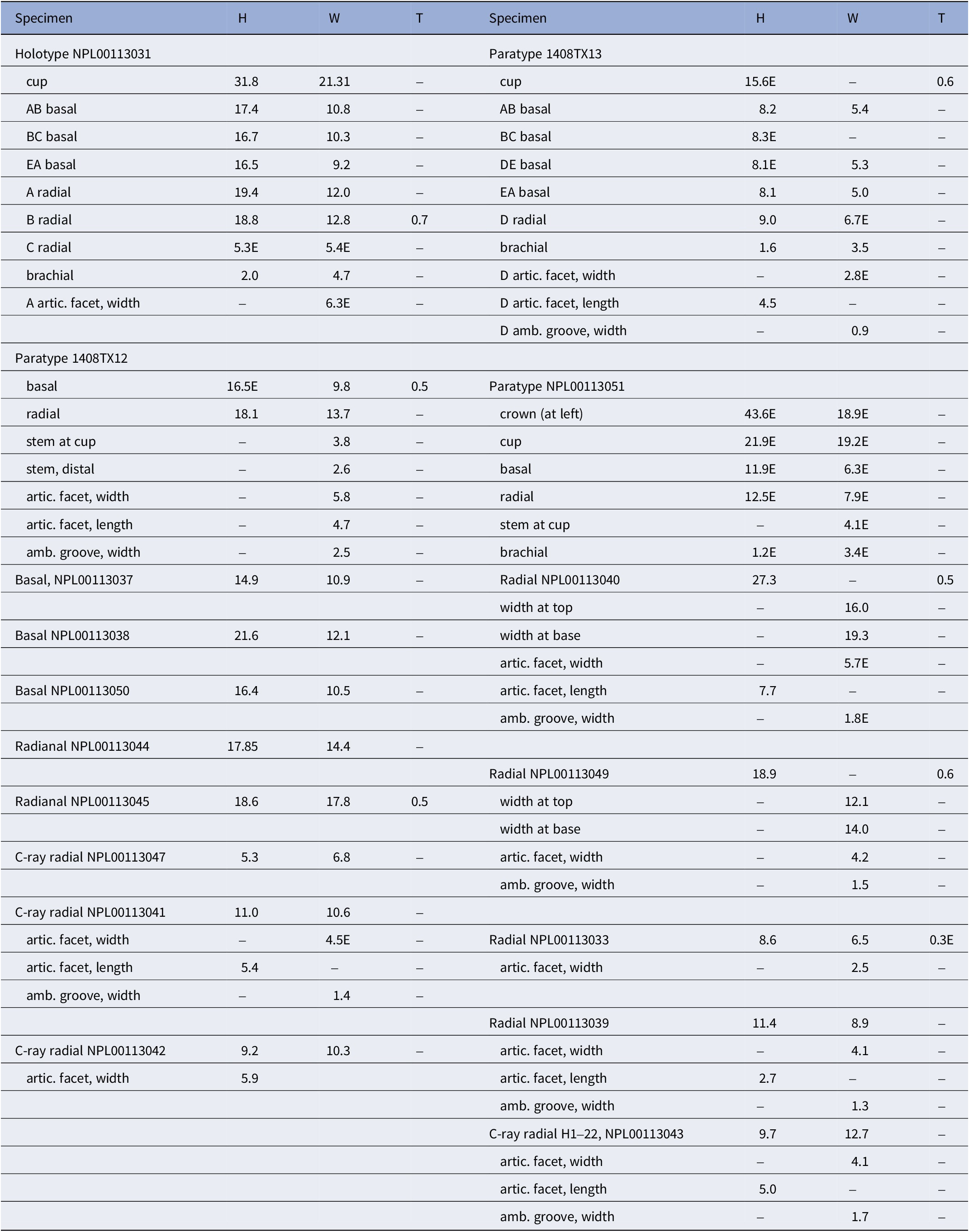
Guensburgocrinus lineatus n. gen. n. sp., measurements (mm). amb., ambulacral; artic., articular; E, estimated; H, height; I, incomplete; T, thickness; W, width

Table 1. Long description
The table is organized into two main columns, each containing sub-columns for Specimen, H (height), W (width), and T (thickness).
Key specimens and measurements include:
* Holotype N P L 0 0 1 1 3 0 3 1: Cup height 31.8, width 21.31. A radial height 19.4, width 12.0.
* Paratype 1 4 0 8 T X 1 3: Cup height 15.6 E, thickness 0.6. D radial height 9.0, width 6.7 E.
* Paratype 1 4 0 8 T X 1 2: Basal height 16.5 E, width 9.8, thickness 0.5. Radial height 18.1, width 13.7.
* Paratype N P L 0 0 1 1 3 0 5 1: Crown height 43.6 E, width 18.9 E. Cup height 21.9 E, width 19.2 E.
Individual anatomical components listed include:
* Basal N P L 0 0 1 1 3 0 3 7: Height 14.9, width 10.9.
* Radial N P L 0 0 1 1 3 0 4 0: Height 27.3, thickness 0.5, with a width at top of 16.0 and width at base of 19.3.
* Radianal N P L 0 0 1 1 3 0 4 5: Height 18.6, width 17.8, thickness 0.5.
* C-ray radial N P L 0 0 1 1 3 0 4 1: Height 11.0, width 10.6, with an articular facet length of 5.4 and ambulacral groove width of 1.4.
Abbreviations used: amb. for ambulacral, artic. for articular, E for estimated, H for height, I for incomplete, T for thickness, and W for width. All measurements are in millimeters.
Type specimens
Partial crowns: holotype NPL00113031, paratypes 1408TX13, NPL00113032, and 1408TX12, all from the lower offshore facies at locality I-35; and paratype NPL00113051.000 from the Meyer’s Ranch locality, Oil Creek Formation, lower Middle Ordovician (Whiterockian/Darriwilian), Arbuckle Mountains, Oklahoma.
Diagnosis
Cup large, conical, nearly symmetrical; radianal large, supporting subequal anal X (left) and C-ray radial (right), located side-by-side above level of other radials; radial articular facets U-shaped, 0.3–0.5 × width of radial plate; arms wide, composed of short brachials; depressions at interbrachial sutures covered by small plates (lateral plates), ambulacral grooves lined by floor plates that support single row of cover plates; surface of cup and proximal brachials ornamented with relatively coarse pustules, commonly elongated and fused to form radiating ridges; stem round, columnals unipartite with pentagonal lumen bearing mushroom-shaped side branches.
Occurrence and preservation
Oil Creek Formation, lower Middle Ordovician (Whiterockian/Darriwilian), Arbuckle Mountains and Criner Hills, Oklahoma. With the exception of the somewhat problematical Meyer’s Ranch specimens, all collected material is from the lower offshore facies at locality I-35. However, this is largely a consequence of preservation quality and collection bias. Field data (Lewis, Reference Lewis1982) show that cup plates are also common in the stratigraphically adjacent facies (lagoonal facies and transition zone 1) at locality I-35 and at many other localities.
The description below is based on six crowns, 22 separate cup plates, and four arm segments. The proximal parts of the arms are preserved in four specimens, and the proximal portion of the stem is attached in two specimens. None of the crowns are complete, notably none of the specimens show the posterior side or oral surface well, but the surface ornamentation is sufficiently distinct in this species to allow recognition of the radianal, anal X, and C-ray radial as separate plates. No oral plates were found as separate ossicles. Two very weathered specimens collected at the Meyer’s Ranch (locality MR) are included in the hypodigm although they do not show the characteristic plate ornamentation because they have the interbrachial depressions found only in this species (Fig. 2.20).
Although all specimens in the hypodigm consist of somewhat flattened crowns, crowns partially embedded in matrix, or separate plates, the proportionately tall conical shape of the cup is shown by the holotype and by the two Meyer’s Ranch specimens, which could be a variant of Guensburgocrinus lineatus n. gen. n. sp. that lacked pronounced ornamentation. Also, the similarity in height of the basal plates in the holotype and in the juvenile paratype 1408TX13 (Table 1) indicates a symmetrical cup. In asymmetrical hybocrinid cups, e.g., Hybocrinus nitidus Sinclair, Reference Sinclair1945 from the Bromide Formation, the EA basal is significantly smaller than the other basals (Brower and Veinus, Reference Brower and Veinus1975; Sprinkle, Reference Sprinkle1982a, fig. 40.E).
Description
Cup relatively large, steeply conical, nearly symmetrical (Figs. 2, 3). Basals (BB) five, tall, mean height (H) to width (W) ratio 1.66 in holotype, and nearly equal in size (Table 1). Radials (RR) tall (height/length ([L] ratio 1.5, 1.6 in holotype), hexagonal with nearly parallel lateral sides. Radials in holotype pinched distally producing a cup with pentagonal outline in cross section. Radial articular facets U-shaped, 0.3–0.5 × width of radial plate for most specimens (0.5 for holotype specimen). Radianal (RA) large, hexagonal, relatively wide (H/L ratio 1.0, 1.2) with nearly equal-sized facets for anal X and C-ray radial above; RA-C radial suture nearly straight to concave orally. Anal X large, symmetrical. Oral plates, if present at all, not well known. Possible oral plate in paratype 1408TX13 but small and partly buried under radial plate. Large plate in paratype NPL00113032 with arc-shaped depression, but this plate might or might not belong to the calyx. Oral surface best-preserved on paratype 1408TX13, although calyx is partly dissociated and is compacted (see Discussion). Ornamentation of cup plates and proximalmost brachials coarsely pustular; most pustules 0.35–0.45 mm in diameter and spaced ~0.6 mm apart; linear ridges produced by alignment, elongation, and fusion of pustules.
Arms relatively wide, atomous (nonbranching), uniserial, and nonpinnular. Brachials U-shaped with closed adoral ends (proximal parts of arms) to opened ends (distal arms); short (H/W ratio 0.4) with sculpted sides laterally near interbrachial sutures in oral two-thirds of plate and ridge at midline. Width of ambulacral groove 1.5–2.5 mm. Numerous small plates (lateral plates) covering sutural notches in well-preserved specimens (Figs. 2.9–2.11, 4.1–4.3). Arm segments and separate brachials distinctive enough to be recognized to species level. Floor plates line ambulacral groove, alternate, and with pore at suture between adjacent plates (Figs. 2.11, 4.1, 4.3). Ambulacral cover plates rectangular, one at each floor plate (Figs. 6.9, 8.2). Minute triangular platelet (medial cover plates) at each side of oral end of cover plates (Fig. 4.2). Cover plates bordered aborally by three or four rows of minute elongate platelets (lateral platelets) and larger equidimensional plates decreasing in size aborally covering interbrachial depressions (Figs. 2.11, 4.1).
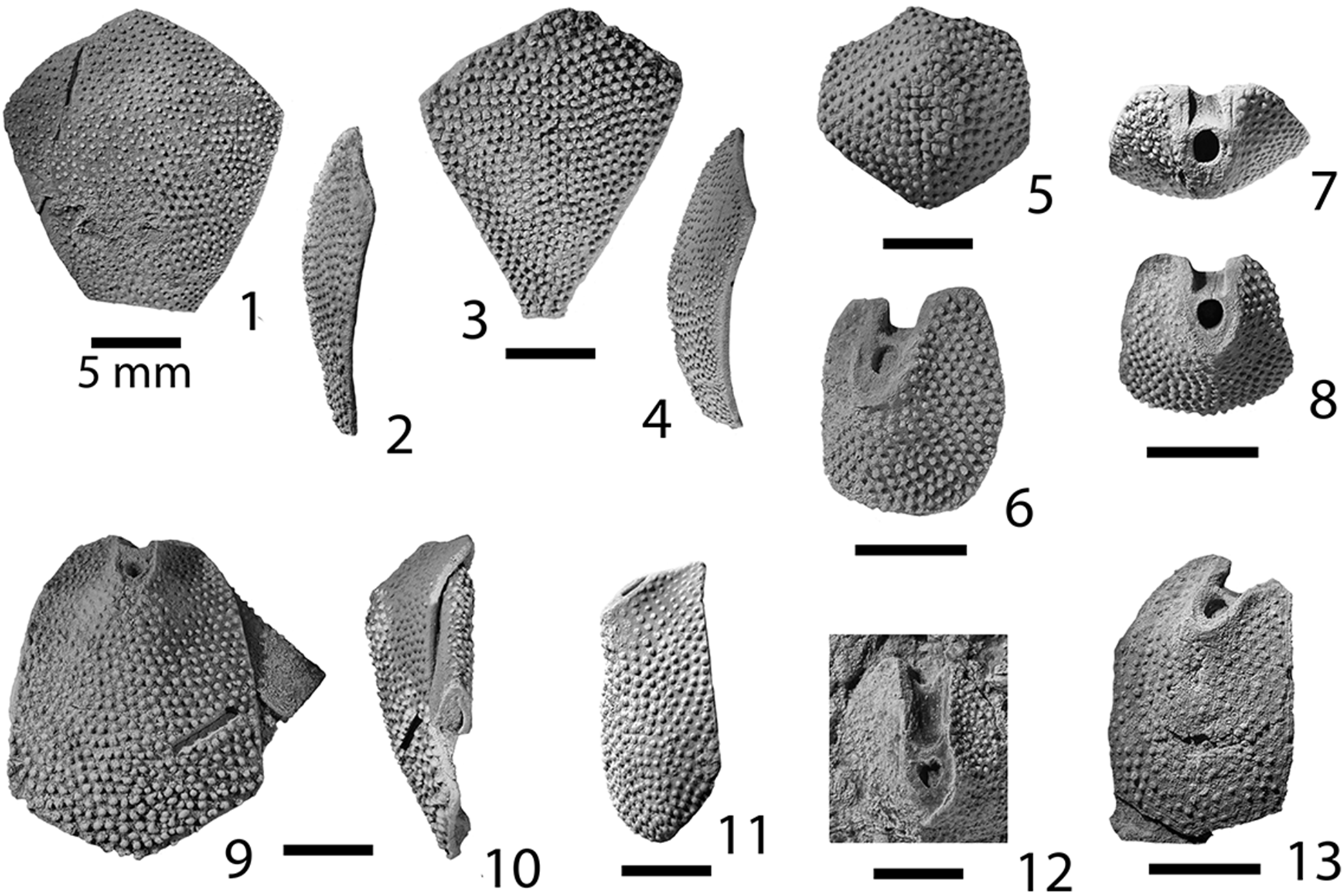
?Hybocrinus nanobrachiatus n. sp. from the lower offshore facies at locality I-35: (1, 2) NPL00113052, a basal plate with a broken tip and unusually small pustules for the species, in lateral view (1) and side view (2), showing moderate curvature; (3, 4) NPL00113053, a large, proportionately wide basal plate, indicating a cup that is widest near the middle, in lateral view (3) and side view (4), showing marked degree of curvature; (5) NPL00113054, a radianal plate with large facets at upper left and upper right for approximately equal-sized anal X and C-ray radial plates; (6) NPL00113055, a small C-ray radial with pustules more closely spaced than normal; (7) paratype NPL00113056, oral view of radial articular facet, showing rectangular shape with a slightly rounded ambulacral groove; (8) NPL00113057, radial articular facet of plate; note wide, nearly flat articular groove; (9, 10) holotype NPL00113058, a large radial plate with brachial that might not belong to this species, in lateral view with broken slot (9), and side view showing two planes of the facet intersecting at an angle of 37° (10); (11) paratype NPL00113056, side view showing facet planes intersecting at 38°; (12) paratype NPL00113059, a C-ray radial with a long facet and an unusual heart-shaped canal; (13) NPL00113060, B-ray radial as shown by the large facet at upper left where this plate attached to C-ray radial. Scale bars = 5 mm.

Figure 6. Long description
A collection of 13 fossil plates arranged in two main rows.
Top row from left to right:
- Panels 1 and 2: A wide, fan-shaped basal plate in lateral view (1) and a thin, curved side view (2).
- Panels 3 and 4: A larger, triangular basal plate in lateral view (3) and a side view (4) showing a more pronounced curve.
- Panel 5: A pentagonal radianal plate with a dense, bumpy surface.
- Panel 6: A small, oval C-ray radial plate with a deep notch at the top.
- Panels 7 and 8: Two views of radial articular facets, showing rectangular shapes with central circular openings and ambulacral grooves.
Bottom row from left to right:
- Panels 9 and 10: A large radial plate in lateral view (9) and a side view (10) showing the intersection of facet planes at a 37 degree angle.
- Panel 11: A side view of a paratype radial plate showing a 38 degree facet intersection.
- Panel 12: A close-up of a C-ray radial plate featuring a distinct heart-shaped canal within the facet.
- Panel 13: A B-ray radial plate with a large facet on the upper left side.
All plates exhibit a pustulose texture consisting of small, raised bumps. Black scale bars representing 5 mm are placed throughout the figure to indicate size.
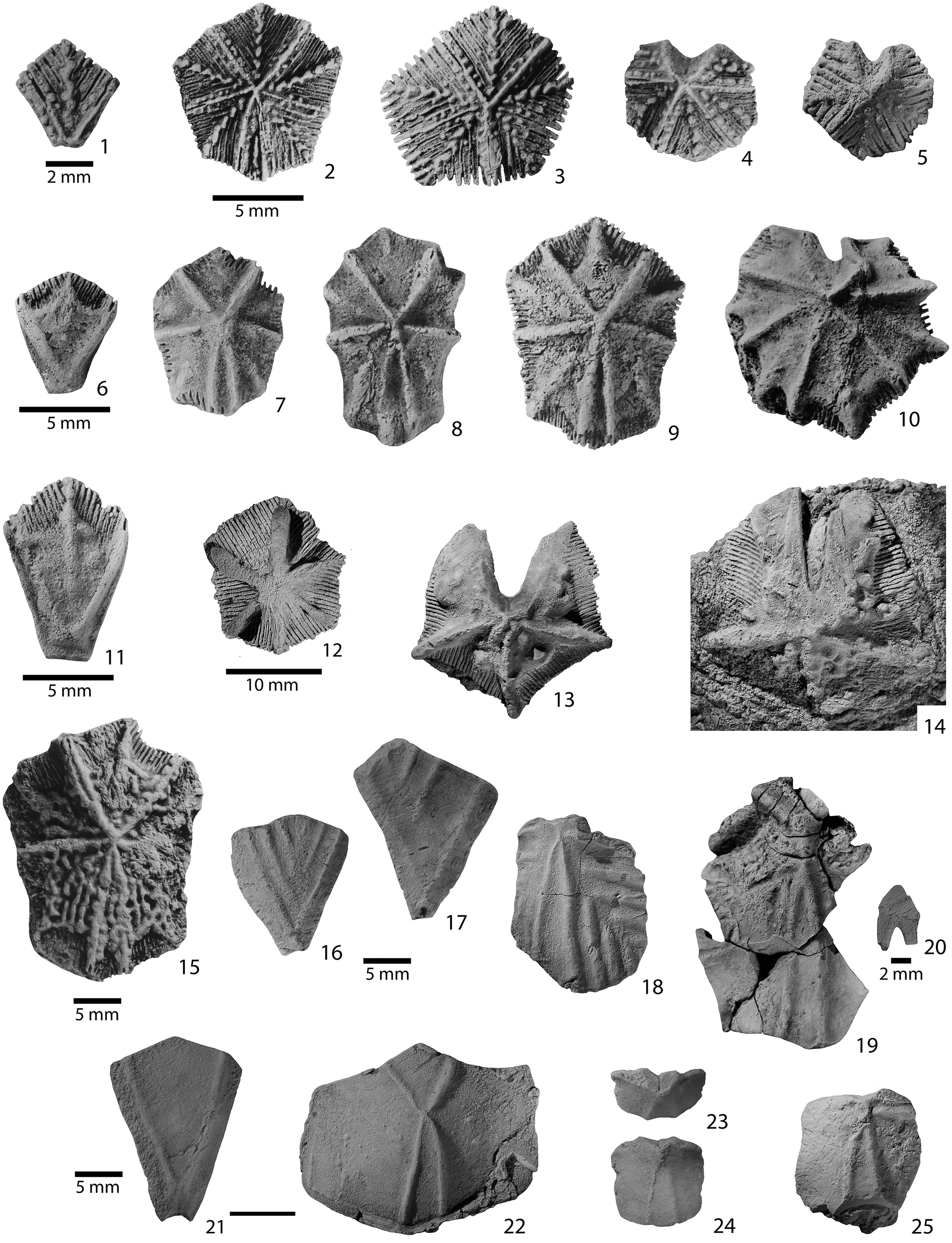
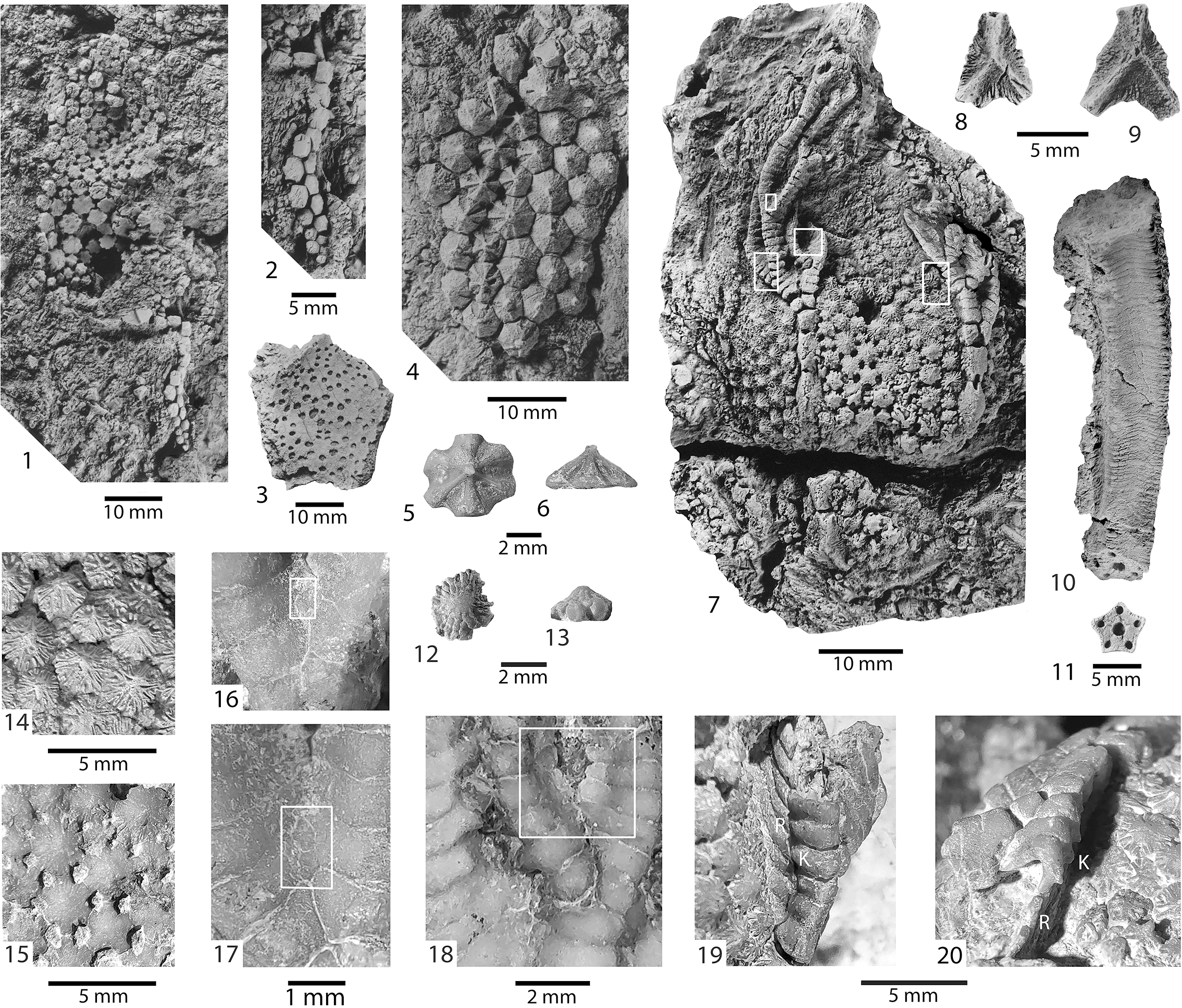
?Palaeocrinus and ??Carabocrinus from the Oil Creek Formation, Arbuckle Mountains, Oklahoma; all from the lower offshore facies at locality I-35 unless otherwise noted. (1–5) ?Palaeocrinus sp. indet. A: (1) NPL00113071, small infrabasal plate with marginal ridges and ‘zig-zag’ ridge at midline; (2, 3) NPL00113072 and NPL00113073, respectively, basal plates showing straight major ridge going to each plate side and ‘zig-zag’ ridges going to plate corners, long exothecal slits, and scattered pustular ornamentation; scale bar applies to (2–5); (4) NPL00113074, well-preserved radial plate; (5) NPL00113084, weathered radial plate with rounded, horseshoe-shaped articular facet and well-exposed, long exothecal slits. (6–10) ?Palaeocrinus sp. indet. B: (6) NPL00113075, infrabasal plate with well-preserved exothecal slits in depressed areas at top; scale bar applies to (6–10); (7) NPL00113076, relatively wide basal plate with smooth surface, weathered; (8) NPL00113077, basal plate with elongate shape and thin plate margin bearing exothecal slits destroyed by weathering; (9) NPL00113078, large basal plate, weathered, but with strong ridges and well-preserved exothecal slits; (10) NPL00113079, large radial plate with many strong, radiating ridges and radial articular facet with lateral projections. (11–15) ??Palaeocrinus sp. indet. C: (11) NPL00113080, infrabasal plate provisionally assigned because of its nodular ornamentation and moderately long exothecal slits; (12) NPL00113081, basal plate showing large, clavate ridges and long exothecal slits; scale bar applies to (12–14); (13) NPL00113082, radial plate with strong ridges running to plate corners, nodular ornamentation, and moderately long exothecal slits at depressed areas along margins; (14) NPL00113083, large radial plate similar to NPL00113082 but with narrow articular facet, from transition zone 2, locality I-35. (15) NPL00113069, very large, highly ornamented basal plate of uncertain affinity. (16–20) ??Carabocrinus sp. indet. A: (16, 17) NPL00113099 and NPL00113100, respectively, basal plates with several strong ridges per plate side and narrow columnar facet; scale bar applies to (16–19); (18) NPL00113101, partial radial plate with absence of respiratory structures and many strong ridges; (19) partial radial plate with proximal part of arm attached, showing absence of respiratory structures and presence of two diverging longitudinal ridges with additional ridges laterally on left side; (20) NPL00113102, brachial facet; (21–25) ??Carabocrinus sp. indet. B: (21) NPL00113105, infrabasal plate with only one ridge on each side; scale bar applies to (21–25); (22) NPL00113106, large, wide basal plate with smooth surface except for one major ridge per plate side and minor ridge at plate margin; note crumpling of plate at bottom; (23, 24) NPL00113107, side and oral view, respectfully, of small (juvenile) radial with only the two diverging ridges, one ridge per plate side; (25) NPL00113108, poorly preserved partial radial showing no additional ridges with growth, from locality I-35, transition zone 2. All specimens coated with ammonium chloride.

Figure 7. Long description
The plate contains 25 black and white photographs of fossilized crinoid plates, each labeled with a number.
Row 1 (1-5): Specimens of Palaeocrinus species indet. A.
- 1: Small infrabasal plate with a 2 mm scale bar.
- 2 and 3: Basal plates with prominent star-shaped radiating ridges and long exothecal slits, sharing a 5 mm scale bar.
- 4 and 5: Radial plates, with 5 showing a horseshoe-shaped articular facet.
Row 2 (6-10): Specimens of Palaeocrinus species indet. B, sharing a 5 mm scale bar.
- 6: Infrabasal plate with slits at the top.
- 7, 8, and 9: Basal plates ranging from wide to elongate, showing varying degrees of weathering and ridge strength.
- 10: Large radial plate with many radiating ridges.
Row 3 (11-14): Specimens of Palaeocrinus species indet. C.
- 11: Infrabasal plate with nodular texture and a 5 mm scale bar.
- 12: Basal plate with clavate ridges and a 10 mm scale bar.
- 13 and 14: Radial plates with strong ridges and nodular ornamentation.
Row 4 (15-20):
- 15: A very large, highly ornamented basal plate with a 5 mm scale bar.
- 16-20: Specimens of Carabocrinus species indet. A. 16 and 17 are basal plates; 18 and 19 are partial radial plates showing longitudinal ridges; 20 is a small brachial facet with a 2 mm scale bar. A 5 mm scale bar applies to 16-19.
Row 5 (21-25): Specimens of Carabocrinus species indet. B.
- 21: Infrabasal plate with a single ridge per side and a 5 mm scale bar.
- 22: Large, wide basal plate with a major ridge and marginal crumpling.
- 23 and 24: Side and oral views of a juvenile radial plate.
- 25: Partial radial plate showing growth patterns.
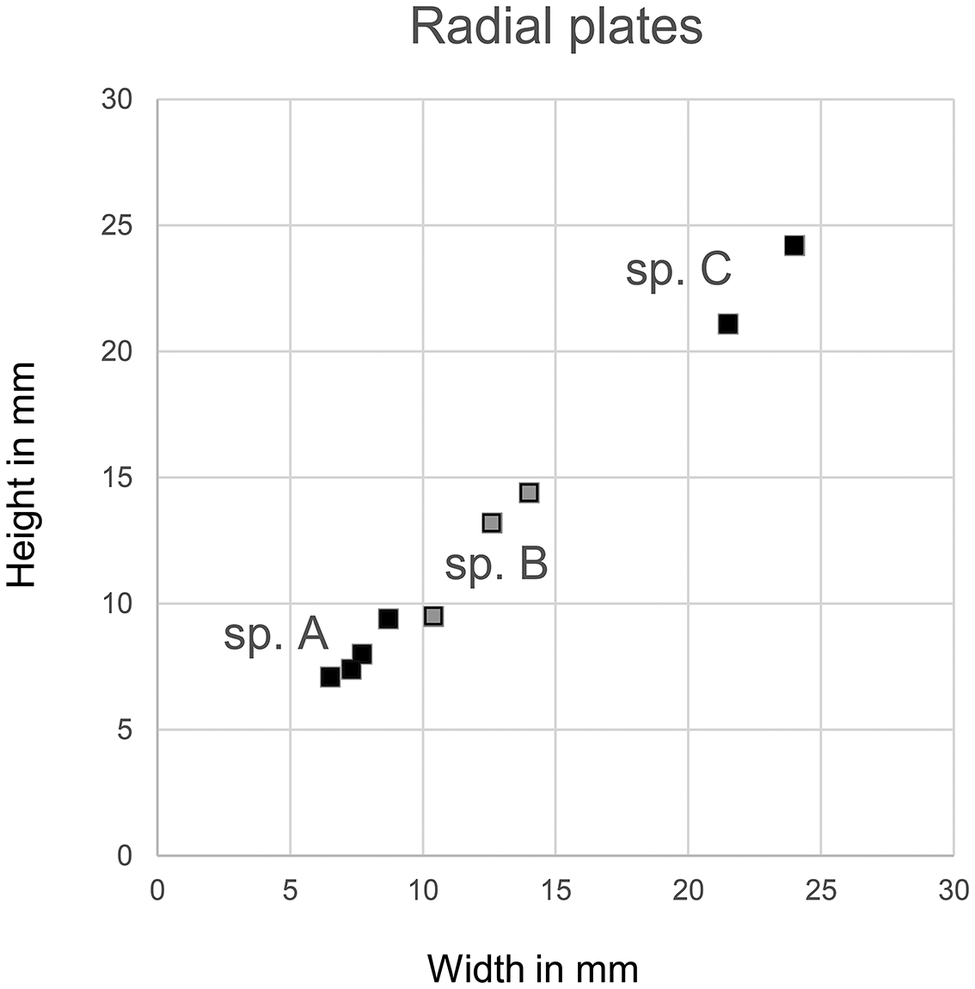
Relative sizes of the three ?Palaeocrinus spp. indet. found in the Oil Creek Formation, as measured on radial plates.

Figure 8. Long description
The scatter plot features an x-axis labeled Width in m m and a y-axis labeled Height in m m, both ranging from 0 to 30 with increments of 5. The data points are organized into three distinct clusters moving diagonally from the bottom-left to the top-right.
* Cluster sp. A: Located at the bottom-left, consisting of five solid black square markers. These points are concentrated between 6 and 9 m m on the x-axis and 7 and 10 m m on the y-axis.
* Cluster sp. B: Located in the center, consisting of three gray square markers with black outlines. These points are positioned between 10 and 14 m m on the x-axis and 9 and 15 m m on the y-axis.
* Cluster sp. C: Located at the top-right, consisting of two solid black square markers. One point is at approximately 21 m m width and 21 m m height, while the other is at approximately 24 m m width and 24 m m height.
The overall trend shows a strong positive linear correlation where height increases proportionally with width across all three species groups.
Plate arrangement on oral surface known only from paratype 1408TX13 (Figs. 2.3, 2.4, 5.1–5.7). Floor plates on arms appear to continue on oral surface, bordered by interambulacal plates (herein called tegmen plates). Tegmen plates range from ~0.6–1.7 mm in maximum dimension, significantly larger than lateral plates (~0.25–0.8 mm). One possible rather small oral plate (2.3 mm W, ~2.8 mm L) lacks expected pustular ornamentation (Fig. 5.1). Possible tegmen plates also found on holotype 1408TX13 (Fig. 5.8, 5.9). Primary peristomial cover plates (PPCP) and ambulacral cover plates (ACP) could not be differentiated (Kammer et al., Reference Kammer, Sumrall, Zamora, Ausich and Deline2013).
Stem circular in cross section, enlarged proximally; tapering from 4.1 mm W at base of cup to 2.6 mm over distance of 14.5 mm in paratype 1408TX12 (Fig. 2.6). Distal stem and holdfast unknown. Columnals very thin (~0.25–0.27 mm in proximal segment and ~0.15–0.17 mm in distal segment) and appear monomeric but coud be pentameric with cryptic sutures; columnal articulations symplectial. Axial canal pentagonal in cross section with small mushroom-shaped auxiliary canal adjacent to each corner of pentagon and connected to it by minute channel (Figs. 2.8, 4.4).
Etymology
The specific name lineatus is Latin (of a line, linear) and refers to the linear arrangement of the pustular ornament on the plates of the cup.
Remarks
Early Ordovician hybocrinids, e.g., Syndiasmocrinus, have the cup plating of Hybocrinus but lack its large ‘circumoral’ plates, which fully occupy the interambulacral area (Guensburg and Sprinkle, Reference Guensburg and Sprinkle2022). Instead, the oral surface of Syndiasmocrinus is covered primarily by very small plates with the exception of the hydropore plate. The oral-surface plating in Guensburgocrinus n. gen. is not well known, but it is clear that it had multiple small irregular platelets in the interambulacral rather than a single large plate filling each interambulacrum as in Hybocrinus. Figure 6.7 shows one of these plates attached to a radial plate rather than the oral-radial suture seen in Hybocrinus. It could be that Guensburgocrinus also had oral plates; but if so, they must have been relatively small. On the holotype specimen, the 19.0 mm long A-ray radial has a R-O suture of ~2.5 mm and thus would have been sutured to an oral plate < 5 mm W (Figs. 2.1, 5.8, 5.9; Table 1). In contrast, the loose plates on paratype NPL00113032 (16.5 mm cup H) include a plate 3.6 mm across with a long, arc-shaped depression/opening. If this plate does belong to the specimen and if the depression is the hydropore, it is strikingly different from the posterior oral (PO) of Hybocrinus with its small, circular hydropore (e.g., Sprinkle, Reference Sprinkle1982a). We conclude that the early Middle Ordovician Guensburgocrinus is intermediate in tegmen morphology between Syndiasmocrinus (Early Ordovician) with its tegmen made up primarily of very small plates, and the Middle-Late Ordovician Hybocrinus, in which the relatively large oral plates occupy all of the interambulacral space at the expense of all other plates.
The arms of Guensburgocrinus lineatus n. gen. n. sp. are especially notable because the brachials are short and have conspicuous notches at the sutures between consecutive brachials (Fig. 2.20). The sculpted sides of the brachials allow them to be recognized to species even when they occur as separate ossicles (Supplemental Fig. 1.54, 1.58). The interbrachial depressions are covered with equidimensional small plates bordered by minute, elongate platelets adjacent to the ambulacral cover plates (Fig. 4.1, 4.2). Beneath these, the ambulacral groove is lined with plates (floor plates) that support the ambulacral cover plates and contact the elongate lateral platelets (Fig. 4.3). Pores between consecutive ambulacral floor plates provide communication between the ambulacral grooves and the interior arm cavities below. Modern comatulid crinoids have two coelomic canals (adoral coelom) located just below the ambulacral groove and somewhat lateral to it but still within the soft tissue of the arm (Hyman, Reference Hyman1955; Breimer, Reference Breimer, Moore and Pitrat1978). A similar coelomic system might have been housed in the arms of Guensburgocrinus lineatus, and might have served as an auxiliary respiratory system, assisting the tube feet of the unbranched, nonpinnulated arms. Figure 4.3 shows the arm anatomy in life with the floor plates lying above the soft tissue and coelomic cavities not shown. In fossil material (Fig. 2.9), the collapse of the floor plates into the ambulacral notch in the brachial plate upon death is reflected by the bulging of the lateral plates and slight overlapping of the minute, elongate lateral platelets.
Interbrachial notches covered with small lateral plates are not known in other hybocrinids but are present in Carabocrinus treadwelli Sinclair, Reference Sinclair1945, from the Bromide Formation (Sprinkle, Reference Sprinkle1982b); Cupulocrinus jewetti Billings, Reference Billings1857 from the Middle Ordovician of Canada (Springer, Reference Springer1911; Ubaghs, Reference Ubaghs, Moore and Pitrat1978b); and Carabocrinus huronensis Foerste, Reference Foerste1924 from the Upper Ordovician of Quebec (Foerste, Reference Foerste1924; Ubaghs, Reference Ubaghs, Moore and Pitrat1978b). Hybocrinus crinerensis Strimple and Watkins, Reference Strimple and Watkins1949 lacks interbrachial depressions but does have a parallel ridge that appears to have cover plates on each side of the brachial groove (Sprinkle, Reference Sprinkle1982a).
In terms of crinoid arm evolution, Guensburgocrinus lineatus has features seen in the earliest crinoids, which have been elucidated in recent years particularly by the work of Guensburg and Sprinkle (e.g., Guensburg et al., Reference Guensburg, Sprinkle, Mooi, Lefebvre, David, Roux and Derstler2020). Floor plates have not previously been reported from the arms of other hybocrinids but were illustrated in the tegmen of Hybocrinus nitidus (see Sprinkle, Reference Sprinkle1982a; Guensburg et al., Reference Guensburg, Blake, Sprinkle and Mooi2016, fig. 2F). Floor plates are prominent in the Tremadocian crinoids Apektocrinus ubaghsi Guensburg and Sprinkle, Reference Guensburg and Sprinkle2009; Titanocrinus sumralli Guensburg and Sprinkle, Reference Guensburg and Sprinkle2003; and Athenacrinus broweri Guensburg et al., Reference Guensburg, Sprinkle, Mooi, Lefebvre, David, Roux and Derstler2020. In the earliest of these crinoids, the floor plates are separated from the brachials by fields of lateral plates. The brachial plate arrangement in Guensburgocrinus lineatus is comparable with that of Apektocrinus ubaghsi and Titanocrinus sumralli (Guensburg et al., Reference Guensburg, Sprinkle, Mooi, Lefebvre, David, Roux and Derstler2020, fig. 7.1, 7.2). The lateral plates of Guensburgocrinus lineatus overlie the sides of the arms covering the interbrachial notches. Medial plates, which formerly played a role in Tremadocian arm morphology as the inner row of cover plates, have apparently been reduced to small triangular platelets on the corners of the ambulacral cover plates in Guensburgocrinus lineatus and appear to be firmly joined to the cover plates in mature individuals.
The stem of Guensburgocrinus lineatus is notable in that it appears to be monomeric and has a distinct lumen. Whereas the lumens of Syndiasmocrinus and Hybocrinus are pentagonal, pentalobate, or star-shaped cross sections of single axial canals (e.g., Sprinkle, Reference Sprinkle1982a; Guensburg and Sprinkle, Reference Guensburg and Sprinkle2022), in Guensburgocrinus lineatus, five additional canals, hemispherical in outline, are located at the corners of the pentagonal main channel.
Genus Hybocrinus Billings, Reference Billings1857
Type species
Hybocrinus conicus Billings, Reference Billings1857.
Occurrence
Middle to Late Ordovician (Darriwilian to Katian): widespread in Laurentia, ranging from eastern Canada to eastern to west-central USA.
?Hybocrinus nanobrachiatus new species
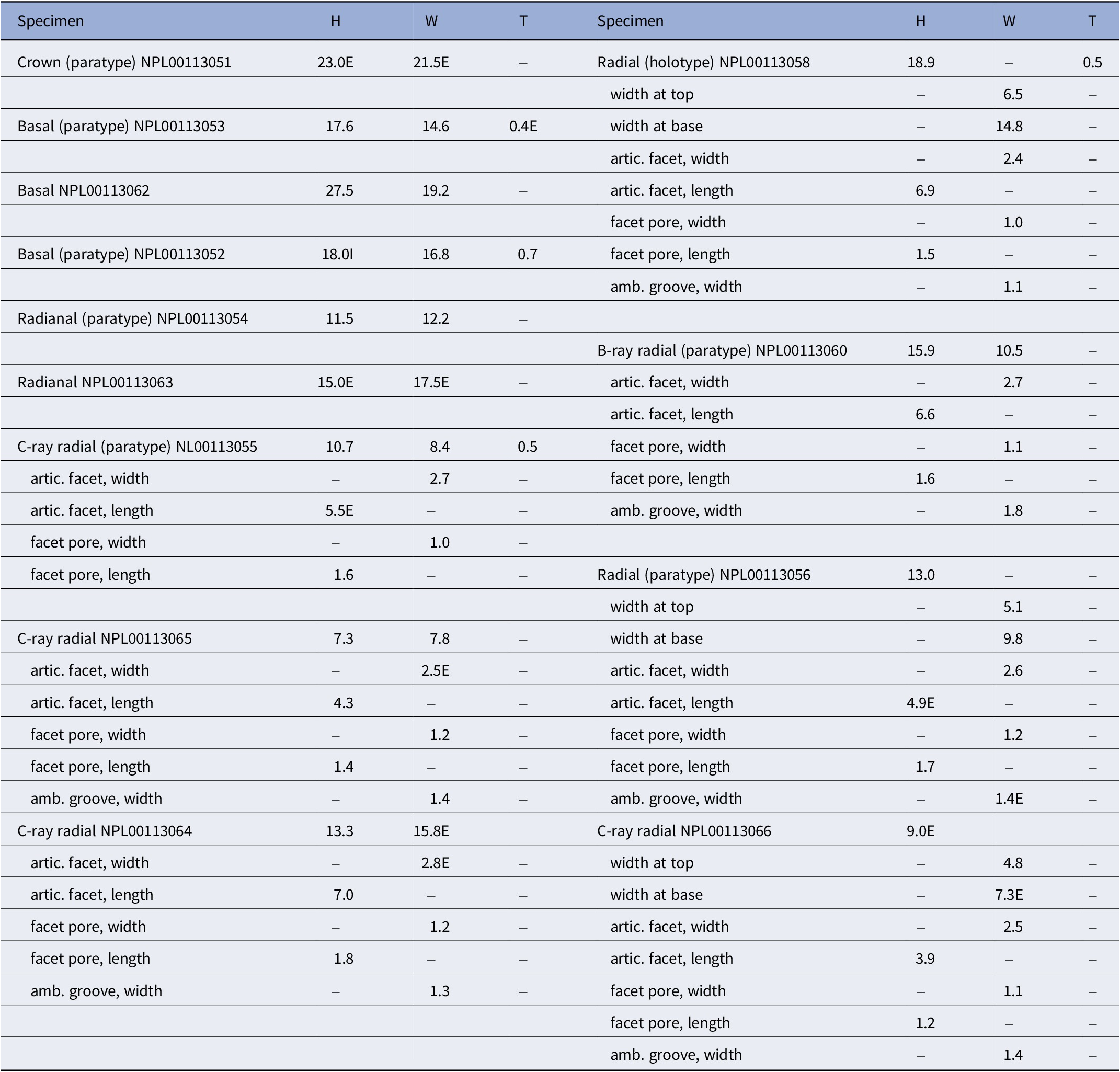
?Hybocrinus nanobrachiatus n. sp., measurements (mm). amb., ambulacral; artic., articular; E, estimated; H, height; I, incomplete; T, thickness; W, width.

Table 2. Long description
The table is organized into two main vertical sections, each containing columns for Specimen, H (height), W (width), and T (thickness). Measurements are in millimeters (mm) with notations E for estimated and I for incomplete.
Left Section Data:
* Crown (paratype) N P L 0 0 1 1 3 0 5 1: H 23.0 E, W 21.5 E.
* Basal (paratype) N P L 0 0 1 1 3 0 5 3: H 17.6, W 14.6, T 0.4 E.
* Basal N P L 0 0 1 1 3 0 6 2: H 27.5, W 19.2.
* Basal (paratype) N P L 0 0 1 1 3 0 5 2: H 18.0 I, W 16.8, T 0.7.
* Radianal (paratype) N P L 0 0 1 1 3 0 5 4: H 11.5, W 12.2.
* Radianal N P L 0 0 1 1 3 0 6 3: H 15.0 E, W 17.5 E.
* C-ray radial (paratype) N L 0 0 1 1 3 0 5 5: H 10.7, W 8.4, T 0.5. Sub-measurements: artic. facet width 2.7, length 5.5 E; facet pore width 1.0, length 1.6.
* C-ray radial N P L 0 0 1 1 3 0 6 5: H 7.3, W 7.8. Sub-measurements: artic. facet width 2.5 E, length 4.3; facet pore width 1.2, length 1.4; amb. groove width 1.4.
* C-ray radial N P L 0 0 1 1 3 0 6 4: H 13.3, W 15.8 E. Sub-measurements: artic. facet width 2.8 E, length 7.0; facet pore width 1.2, length 1.8; amb. groove width 1.3.
Right Section Data:
* Radial (holotype) N P L 0 0 1 1 3 0 5 8: H 18.9, T 0.5. Sub-measurements: width at top 6.5, width at base 14.8; artic. facet width 2.4, length 6.9; facet pore width 1.0, length 1.5; amb. groove width 1.1.
* B-ray radial (paratype) N P L 0 0 1 1 3 0 6 0: H 15.9, W 10.5. Sub-measurements: artic. facet width 2.7, length 6.6; facet pore width 1.1, length 1.6; amb. groove width 1.8.
* Radial (paratype) N P L 0 0 1 1 3 0 5 6: H 13.0. Sub-measurements: width at top 5.1, width at base 9.8; artic. facet width 2.6, length 4.9 E; facet pore width 1.2, length 1.7; amb. groove width 1.4 E.
* C-ray radial N P L 0 0 1 1 3 0 6 6: H 9.0 E. Sub-measurements: width at top 4.8, width at base 7.3 E; artic. facet width 2.5, length 3.9; facet pore width 1.1, length 1.2; amb. groove width 1.4.
Type specimens
The holotype NPL00113058 is a large radial plate recovered from the lower offshore facies at locality I-35. Other separate plates include paratypes NPL00113052–00113060. Paratype NPL00113051, from the Meyer’s Ranch locality (MR), is the only partial crown referable to this species. However, the radial facets are not preserved, so identification to species is uncertain.
Diagnosis
Hybocrinid with large, apparently nearly globular cup; arms narrow; radial articular facet one-fourth to one-fifth of radial plate width and perforated by large, elliptical nerve(?) canal; surface of cup ornamented with fine pustules showing no elongation or fusion.
Occurrence and preservation
Oil Creek Formation, lower Middle Ordovician (Whiterockian/Darriwilian), Arbuckle Mountains, Oklahoma. All cup plates in the hypodigm were found in the lower offshore facies at locality I-35, but plates also occur in other facies, especially the lagoonal facies, and at other localities. One articulated crown from the Meyer’s Ranch (locality MR) likely also belongs to this species.
The description below primarily relies on separate cup plates: three basals, 15 radials, and four possible radianals. A distinctive articular facet allows the radials to be recognized to species, and the shape of the basals and lack of pustule lineation sets them apart from basals belonging to Guensburgocrinus lineatus n. gen. n. sp. The upper portion of the crown from the Meyer’s Ranch locality is imbedded in the biosparite matrix, so the radial articular facets are not visible, but the basals are proportionately wide, and the ornamentation and stem characteristics are compatible with the species.
Description
Cup large, nearly globular: H/W ratio 1.05; possibly asymmetrical (Table 2). Basals (BB) wide (Fig. 6.1, 6.3), mean H/W ratio 1.23; arched in longitudinal cross section reflecting subglobular shape of cup (Fig. 6.2, 6.4) in contrast to flat basals of Guensburgocrinus lineatus n. gen. n. sp. Radials (RR) five, rounded hexagonal, widest at base. Articular facets narrow, ~0.2–0.25 × width of radial plate. In several specimens, articular facet composed of two planar surfaces meeting at angle of ~140° (Fig. 6.10, 6.11). Large, elliptical hole in facet (~1.1 mm W and ~1.5 mm L) below subrectangular ambulacral groove, 1.4 mm W, and separated by a low bar. Radianal (RA) large, slightly wider than tall (H/W ratio 0.90), arched in cross section with nearly equal-sized facets for junction with anal X and C-ray radial above (Fig. 6.5). Anal X unknown. Surface ornamentation of all plates: relatively fine pustules 0.25–0.35 mm in diameter and spaced ~0.6 mm apart; pustules not aligned or fused together as in Guensburgocrinus lineatus n. gen. n. sp. Arms unknown but quite narrow based on size of radial articular facets, probably uniserial, atomous, and nonpinnular. Stem, known only from Meyer’s Ranch specimen, circular in cross section, somewhat enlarged proximally, apparently unipartite; axial canal pentalobate (Fig. 2.20).
Etymology
The name nanobrachiatus is derived from the Greek words nanos (a dwarf) and brachios (arm), and refers to the small size of the arms as shown by the narrow width of the articular facets on the radial plates.
Remarks
Although this species is known primarily from isolated cup plates, the diagnostic morphologic characters are sufficiently distinct and constant to allow the definition of a new species; namely, the narrow radial articular facet with a large canal and subrectangular ambulacral groove and the fine pustular ornamentation that does not form lines or ridges as in Guensburgocrinus lineatus n. gen. n. sp. ?Hybocrinus nanobrachiatus n. sp. had five normal arms as shown by the normal articular facets on asymmetrical radial plates recognizable as belonging to the B ray (Fig. 6.13). In three-armed hybocrinids (Baerocrinus, Hybocystites Wetherby, Reference Wetherby1880, Tripatocrinus, and Cornucrinus Regnell, Reference Regnéll1948), the B- and E-ray radials are armless (Sprinkle and Moore, Reference Sprinkle, Moore and Pitrat1978; Sprinkle, Reference Sprinkle1973). The symmetrical radianal plate, bearing nearly equal-sized facets at the contacts with the anal X and C-ray radial, justifies provisional assignment to Hybocrinus rather than Hoplocrinus or Revalocrinus. Indirect evidence of the arm structure suggests that the species is not Guensburgocrinus n. gen. Because the oral surface is unknown, assignment of the species to Hybocrinus is tentative.
?Hybocrinus nanobrachiatus has the narrowest arms of any known species in the genus. The distinctive radial articular facet either lies in one plane or in two planes intersecting at an angle of ~140° and are separated by a bar across the facet. This bar is apparently analogous to the transverse ridge of other crinoid facets and served as a fulcrum for the extension and retraction of the arm. The angle between the two areas of the facet would have allowed the arms more flexibility. The large pore in the facet probably housed the main brachial nerve. Brachial plates of this species might lack the bar that separates the nerve canal from the ambulacral groove because no separate brachials have been found that are shaped like the radial articular facets. A narrow brachial attached to the holotype NPL00113058 (Fig. 6.9, 6.10) might or might not belong to this species; the narrow width and surface ornamentation are compatible, but it lacks the distinctive hole-and-bar configuration. A few specimens of a crinoid brachial with a large canal and bar but with a very shallow ambulacral groove (Supplemental Fig. 1.39, 1.40) have been found in the same facies but are of a different shape and are not considered to be Hybocrinus nanobrachiatus This plate type is also known from the Antelope Valley Limestone (Sprinkle, Reference Sprinkle1971, figs. 1, 77, 78). No plates referable to this species have been reported from the Antelope Valley Limestone.
Sublass Cladida Moore and Laudon, Reference Moore and Laudon1943
Superorder Porocrinoidea Wright, Reference Wright2017
Order Porocrinida Miller and Gurley, Reference Miller and Gurley1894
Family Porocrinidae Miller and Gurley, Reference Miller and Gurley1894
Genus Palaeocrinus Billings, Reference Billings1859
Type species
Palaeocrinus striatus Billings, Reference Billings1859.
Occurrence
Middle to Upper Ordovician (Whiterockian/Darriwilian to Mohawkian/Katian); eastern, north-central, south-central, and probably western USA, and eastern Canada.
Remarks
For higher-level taxa, we follow classifications suggested by recent phylogenetic studies, especially those of Brower (Reference Brower1995), Ausich (Reference Ausich1998), and Wright et al. (Reference Wright, Ausich, Cole, Peter and Rhenberg2017, Reference Wright, Cole and Ausich2020). The net result is that genera having thecal slits or folds are now placed in the same family, the Porocrinidae (Wright et al., Reference Wright2017). Included genera are Palaeocrinus, Carabocrinus Billings, Reference Billings1857 , Porocrinus Billings, Reference Billings1857, and Triboloporus Kesling and Paul, Reference Kesling and Paul1968 (Ausich, Reference Ausich1998). The respiratory structures of Palaeocrinus are present at all cup-plate sutures except those between infrabasals. In this respect, they differ from those of Carabocrinus (family Carabocrinidae), which are confined to the summit area. Also, the respiratory slits of Palaeocrinus are linear, i.e., focused on the sides of plates where the longest slits are found, whereas in Carabocrinus, they are three-cornered and centered on plate corners (Sprinkle, Reference Sprinkle1982b). In Porocrinus and Triboloporus, the respiratory structures are restricted to plate corners and are endothecal not exothecal as in Palaeocrinus and Carabocrinus. For both Palaeocrinus and Carabocrinus, specimens from the Oil Creek Formation and lateral equivalents are the oldest known representatives.
Even though no cups of Palaeocrinus are known from the Whiterockian/Darriwilian Stage, the well-preserved cup plates described below and very similar silicified plates from the Antelope Valley Limestone (Sprinkle, Reference Sprinkle1971, fig. 1.38–1.44) almost certainly belong to this genus. The plates from the Oil Creek Formation clearly have the distinct type of respiratory structure that characterizes Palaeocrinus. Holdfasts that could belong to Palaeocrinus have been found attached to biosparite beds in the lower offshore facies; these are discussed and illustrated below. Also, one partial arm (Supplemental Fig. 1.27) might belong to one of the species of Palaeocrinus found in the Oil Creek Formation. This arm has a well-developed keel as do the arms of Palaeocrinus angulatus (Billings, Reference Billings1857) shown by Brower and Veinus (Reference Brower and Veinus1978, p1. 16, fig. 3), and its ornamentation is comparable to that of ?Palaeocrinus sp. indet. A. However, the cross-sectional shape of the proximal brachials of the arm fragment is not similar to the radial articular facets of Palaeocrinus sp. indet. A, so the arm cannot be confidently assigned to that species. Stems and holdfasts that might belong to Palaeocrinus or Carabocrinus or both of these genera have also been found in the Oil Creek Formation, as illustrated and discussed in Supplemental data.
?Palaeocrinus sp. indet. A
Figures 7.1–7.5, 8, 9.1; Table 3
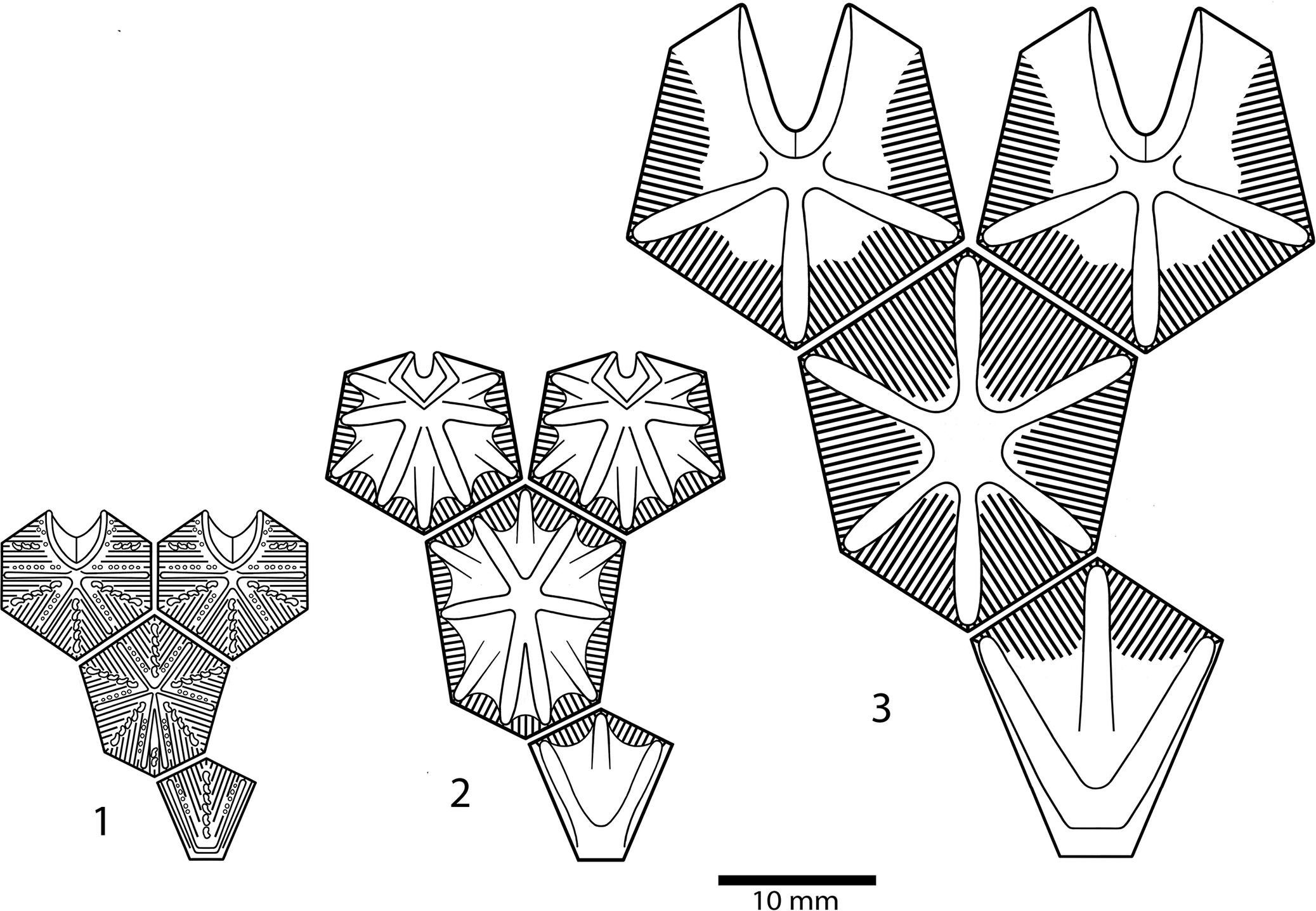
Graphic representation of the relative size and salient morphologic features Oil Creek ?Palaeocrinus: (1) ?Palaeocrinus sp. indet. A; (2) ?Palaeocrinus sp. indet. B; and (3) ??Palaeocrinus sp. indet. C. Shown from bottom to top are sample infrabasal, basal, and radial plates. Characters of note are strength and position of ridges and length of slits. Scale bar applies to all.

Figure 9. Long description
The diagram consists of three numbered panels arranged horizontally, increasing in size from left to right. A 10 mm scale bar is located at the bottom center.
Panel 1, labeled at the bottom left, shows the smallest specimen. It features a bottom infrabasal plate, a central basal plate, and two top radial plates. The plates are covered in dense, fine ridges and small circular pores or slits along the ridges.
Panel 2, in the center, shows a medium-sized specimen. The arrangement of infrabasal, basal, and radial plates is similar to panel 1. The ridges are more pronounced and spaced further apart, radiating from the center of each plate toward the edges. The top radial plates have a distinct V-shaped notch at the upper margin.
Panel 3, on the right, shows the largest specimen. The ridges are thick and highly defined, creating a star-like pattern on the basal and radial plates. The infrabasal plate at the bottom is elongated. The radial plates at the top feature deep, wide V-shaped notches and long, parallel slits filling the areas between the primary star-shaped ridges.
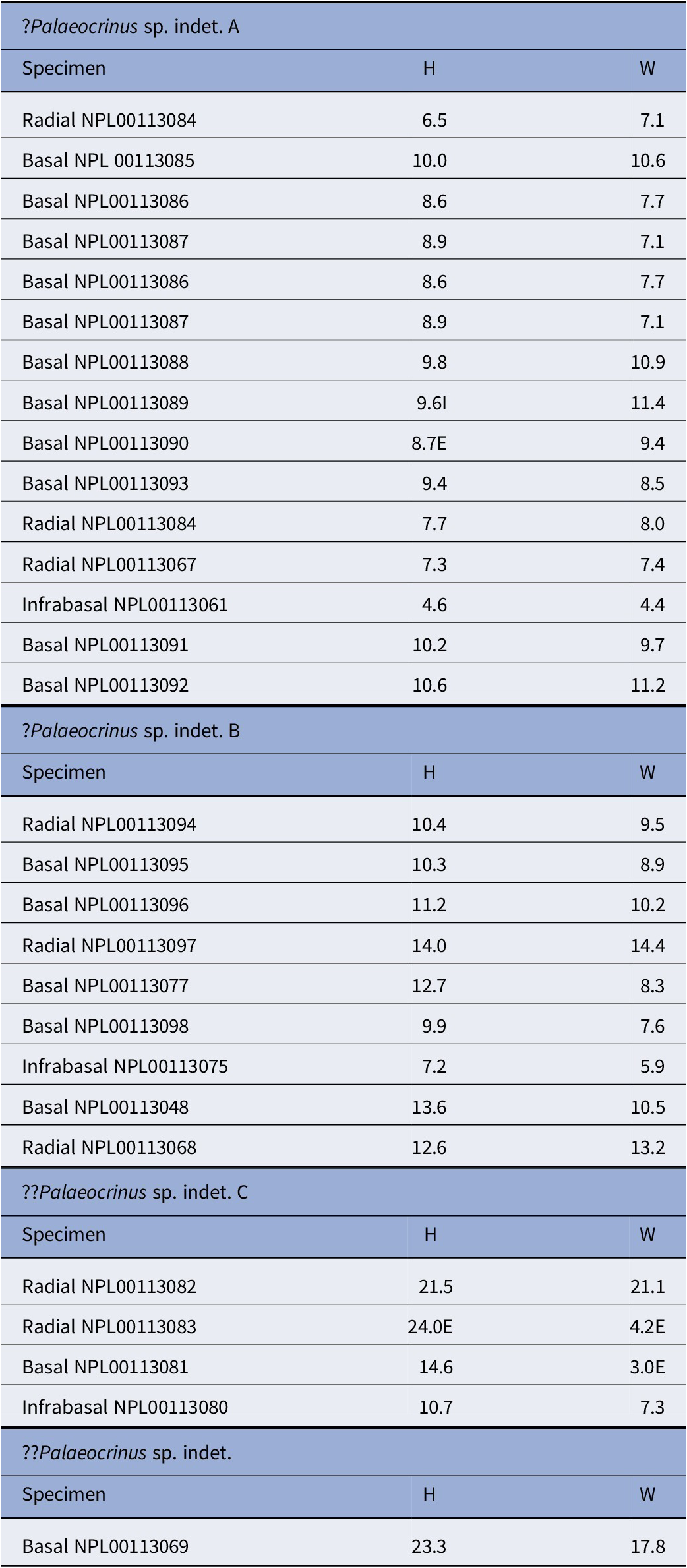
Palaeocrinus spp., measurements (mm). E, estimated; H, height; I, incomplete; W, width.

Table 3. Long description
The data is divided into four sections based on specimen classification.
Section 1: Palaeocrinus species indet A.
* Radial N P L 00113084: H 6.5, W 7.1.
* Basal N P L 00113085: H 10.0, W 10.6.
* Basal N P L 00113086: H 8.6, W 7.7.
* Basal N P L 00113087: H 8.9, W 7.1.
* Basal N P L 00113088: H 9.8, W 10.9.
* Basal N P L 00113089: H 9.6 I, W 11.4.
* Basal N P L 00113090: H 8.7 E, W 9.4.
* Basal N P L 00113093: H 9.4, W 8.5.
* Radial N P L 00113084: H 7.7, W 8.0.
* Radial N P L 00113067: H 7.3, W 7.4.
* Infrabasal N P L 00113061: H 4.6, W 4.4.
* Basal N P L 00113091: H 10.2, W 9.7.
* Basal N P L 00113092: H 10.6, W 11.2.
Section 2: Palaeocrinus species indet B.
* Radial N P L 00113094: H 10.4, W 9.5.
* Basal N P L 00113095: H 10.3, W 8.9.
* Basal N P L 00113096: H 11.2, W 10.2.
* Radial N P L 00113097: H 14.0, W 14.4.
* Basal N P L 00113077: H 12.7, W 8.3.
* Basal N P L 00113098: H 9.9, W 7.6.
* Infrabasal N P L 00113075: H 7.2, W 5.9.
* Basal N P L 00113048: H 13.6, W 10.5.
* Radial N P L 00113068: H 12.6, W 13.2.
Section 3: Palaeocrinus species indet C.
* Radial N P L 00113082: H 21.5, W 21.1.
* Radial N P L 00113083: H 24.0 E, W 4.2 E.
* Basal N P L 00113081: H 14.6, W 3.0 E.
* Infrabasal N P L 00113080: H 10.7, W 7.3.
Section 4: Palaeocrinus species indet.
* Basal N P L 00113069: H 23.3, W 17.8.
Note: E indicates estimated, H indicates height, I indicates incomplete, and W indicates width.
Occurrence and preservation
This species, recognized by its small, thin plates with long exothecal slits and complex ornamentation, is found throughout the study area. At locality I-35, it is a fairly common member of the echinoderm fauna in the lower offshore, shoal, and lagoonal facies. The hypodigm consists of four radial plates, nine basals, and one infrabasal; preservation is good to fair, although the thin stereom covering slits is not completely preserved on most specimens.
Description
Cup relatively small (Figs. 8, 9.1), subglobular as indicated by individual plate measurements (Table 3); infrabasals short, H/W ratio 1.05; basals short, H/W ratio 0.90–1.25; radial plates nearly equidimensional, H/W ratio 0.91–0.98; radianal and anal X plates unknown. Plate thickness 0.7 mm–1.1 mm as measured on basal plates NPL00113086, NPL00113087, and NPL00113088. Radial articular facet rounded, an elongated horseshoe shape.
Slits ~0.16 mm W, spaced ~0.3 mm apart as measured on NPL00113086 and NPL00113089. Slits penetrating plates at plate periphery but might be only shallow grooves toward plate center. Major ridge (covering an exothecal slit) narrow, extending from plate center to middle of each side. Secondary ridges running to each plate corner, formed by overlapping irregular nodes, some peanut-shaped, resulting in a zigzag (saw-tooth) pattern shape in most specimens; these lack underlying exothecal slits. Minor ridges apparently composed of very thin stereom because they are not preserved in most specimens except for minute ridges bordering the slits in some places. Surface ornamentation of scattered small pustules between ridges.
Remarks
The species can be distinguished from other ?Palaeocrinus spp. in the Oil Creek Formation by its narrow ridges and long exothecal slits, which reach from the plate sides almost to the center of the plates, and by its complex ornamentation. These plates undoubtedly represent a species of Palaeocrinus or some closely related, undescribed genus. The Palaeocrinus(?) cup plates from the Antelope Valley Limestone (Sprinkle, Reference Sprinkle1971, fig. 1.38–1.40) differ from this species in having prominent, straight slits extending to the plate corners as well as to plate sides and apparently lacked the zigzag ornamentation. Also, the radial articular facet of the Antelope Valley radials has an open V shape.
?Palaeocrinus sp. indet. B
Figures 7.6–7.10, 8, 9.2; Table 3
Occurrence and preservation
The large, thick plates of this species are known from several localities, but the most complete and best-preserved material is from the lower offshore and lagoonal facies at locality I-35. This species could be conspecific with plates illustrated by Sprinkle (Reference Sprinkle1971) from the Antelope Valley Limestone in Nevada. This description is based on three radial plates, six basals, and one infrabasal plate. Most specimens are moderately to very weathered.
Description
Cup relatively tall (Fig. 9.2) as shown by separate plate measurements (Table 3): infrabasals rather tall, H/W ratio 1.22; basals tall, H/W ratio 1.10−1.53, mean 1.28; radial plates nearly equidimensional: H/W ratio 0.95−1.09; radianal and anal X plates unknown. Plate thickness 1.3 mm as measured on basal plate NPL00113095. The radial articular facet wide with lateral projections; ambulacral groove U-shaped.
Slits ~0.18 mm W, spaced 0.20−0.24 mm apart as measured on basal plate NPL00113096. Primary ridges run to middle of plate sides and cover exothecal slits. Wide but incomplete secondary ridges extend to plate corners and apparently lack slits. Radial plates with as many as nine prominent ridges (NPL00113094; Fig. 7.6). Except for slits under primary ridges, exothecal slits restricted to depressed embayments at plate margins, where they were probably covered by tertiary radial ridges. Plate surfaces smooth except for low-profile nodes. The radial articular facet has lateral projections and is bordered by ridges, resulting in a diamond shape.
Remarks
?Palaeocrinus sp. indet. B is characterized by relatively large, thick plates with exothecal slits confined to depressed embayments at the plate margins. It is easily distinguished from ?Palaeocrinus sp. indet. A because of its thick plates with thin margins bearing relatively short exothecal slits and because of its smooth surface. Its large ridges give the plates much more relief than the plates of ?Palaeocrinus sp. indet. A. ?Palaeocrinus sp. indet. B is also significantly larger than ?Palaeocrinus sp. indet. A (Figs. 8, 9), and, judging from the proportionately tall basal plates, it had a more elongate cup. The same species or a very closely related one is known from the Antelope Valley Limestone (Sprinkle, Reference Sprinkle1971, fig. 1.41−1.44). Infrabasal, basal, and radial plates have the same shapes as in the Oil Creek material, are thick, and have short slits but might not have depressed embayments along plate margins, because such details are not well preserved.
Plate NPL00113069 (Fig. 7.15) does not fit easily in any of the species described herein. It is a basal plate similar in many ways to ?Palaeocrinus sp. indet. B, but at 23.3 mm H it is much larger (Table 3). Its ornamentation is conspicuous, consisting of pustules of varying sizes and discontinuous ridges as well as the ridge arrangement in ?Palaeocrinus spp. indet. A and B; the largest ridges run from the plate center to plate edges and house exothecal slits; lesser ridges extend to plate corners. Other exothecal slits are of medium length and are confined to depressed areas, numbering 8 or 9 per embayment. Small, discontinuous ridges on the plate surface possibly cover tertiary exothecal slits. It might be a variant of ?Palaeocrinus sp. indet. B, or it might be a distinct species.
??Palaeocrinus sp. indet. C
Figures 7.11–7.14, 8, 9.3; Table 3
Occurrence and preservation
Found in the lower offshore facies and transition zone 2 at locality I-35. This is a rare species, known from very large, thick plates—two radial plates, one basal, and one infrabasal plate. All specimens are moderately weathered.
Description
Cup very large compared with other Oil Creek Palaeocrinus spp. (Figs. 8, 9). Radial plates pentagonal; nearly equidimensional, H/W ratio 0.99–1.02; three prominent ridges and moderately developed ridges ~5 mm from articular facet in NPL00113083 at lateral edges of R-O contacts. Ridges lack slits internally. Slits exothecal, long, to 4.0 mm in NPL00113082 (40% of distance to plate center), numerous, 25 or 26 per side in NPL00113082; spaced ~0.46−0.54 mm apart. Slits ~0.1 mm wide, penetrating plates at periphery but appearing to be only shallow grooves toward the plate center. Area bearing exothecal slits is confluent with plate’s profile, as opposed to lying in depressed embayments as in ?Palaeocrinus sp. indet. B. No stereom observed covering the exothecal slits but this is likely a matter of preservation. Radial articular facets long, narrow (~2 mm) shelves with a wide (NPL00113082) to narrow (NPL00113083) V shape with a rounded base.
Basals rather short, H/W ratio 1.12. Only specimen, NPL00113081 (Fig. 7.13), a six-sided plate with prominent, clavate, flat-topped ridges running to each plate corner. Radianal and anal X plates unknown. As in the radial plates, ridges do not house slits. Exothecal slits similar to those in radials but proportionately longer; maximum length 5.5 mm (64% of distance to plate center), and 11–18 slits per side, occupying nearly all of area between ridges; the remaining plate center appears unornamented but is badly weathered. Infrabasal NPL00113080 (Fig. 7.11) is relatively large (10.7 mm H; H/W ratio 1.47) with at least nine relatively long epithecal slits; strong ridges along plate margins laterally and at midline; surface ornamented with large nodes.
Remarks
??Palaeocrinus sp. indet. C is considerably larger than ?Palaeocrinus spp. indet. A and B (Figs. 8, 9); based on the size of the radials, the complete cup would have been ~4 cm wide. Unlike ?Palaeocrinus spp. indet. A and B, ??Palaeocrinus sp. indet. C has smooth surfaces except for large nodes and relatively long exothecal slits not confined to thin, depressed embayments at the plate margins. Importantly, the very large ridges extend to the plate corners, not the plate centers as in ?Palaeocrinus spp. indet. A and B; ridges of smaller size are not present. Because of these differences, it is possible that these specimens are not Palaeocrinus but belong instead to an undescribed related genus.
Genus Carabocrinus Billings, Reference Billings1857
Type species
Carabocrinus radiatus Billings, Reference Billings1857.
Occurrence
Middle Ordovician (Whiterockian/Darriwilian, Chazian) to Upper Ordovician (Richmondian/Katian); eastern, north-central, and south-central USA, eastern Canada, and Estonia.
Remarks
Carabocrinus has respiratory structures in its cup like other members of the family Porocrinidae (see above). It is distinguished from Palaeocrinus, Porocrinus, and Triboloporus by having two radianal plates, and heterotomously branched arms. In addition, in Carabocrinus, the respiratory structures are restricted to the summit area, whereas they are found at the plate sutures over most of the cup in Palaeocrinus and Porocrinus. The respiratory structures are exothecal in Carabocrinus as opposed to being endothecal in Porocrinus, and they differ from those of Palaeocrinus by being three-cornered instead of linear. Sprinkle (Reference Sprinkle1982b) clarified the differences in the cup respiratory structures of Carabocrinus, Palaeocrinus, and Porocrinus, and suggested that these genera evolved from a hypothetical ‘rhombless’ common ancestor. We tentatively assign 10 cup plates from the Oil Creek Formation to the genus Carabocrinus. If these specimens are properly assigned, they are among the oldest known members of Carabocrinus. However, there are several problems with this assignment, as discussed below.
??Carabocrinus sp. indet. A
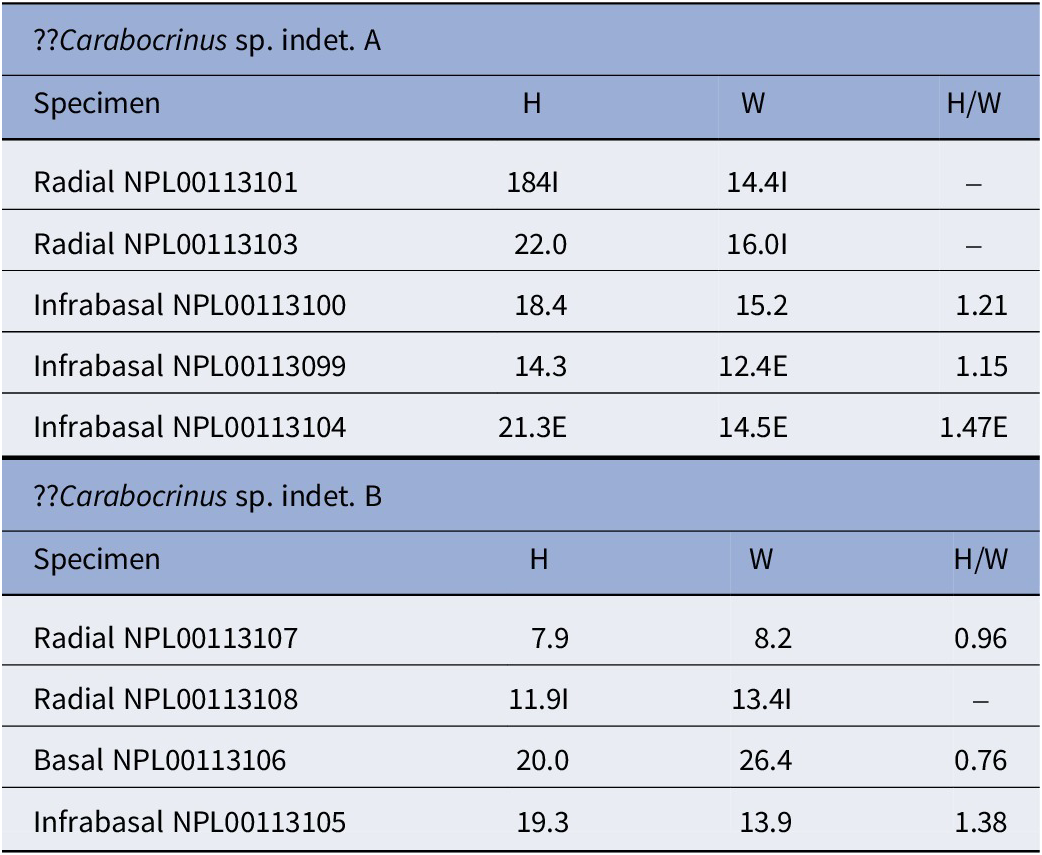
Carabocrinus spp., measurements (mm). E, estimated; H, height; I, incomplete; W, width.

Table 4. Long description
The first table lists measurements for Carabocrinus species indeterminate A. It contains five specimens.
* Radial N P L 0 0 1 1 3 1 0 1 has a height of 184 I and a width of 14.4 I.
* Radial N P L 0 0 1 1 3 1 0 3 has a height of 22.0 and a width of 16.0 I.
* Infrabasal N P L 0 0 1 1 3 1 0 0 has a height of 18.4, a width of 15.2, and a H over W ratio of 1.21.
* Infrabasal N P L 0 0 1 1 3 0 9 9 has a height of 14.3, a width of 12.4 E, and a H over W ratio of 1.15.
* Infrabasal N P L 0 0 1 1 3 1 0 4 has a height of 21.3 E, a width of 14.5 E, and a H over W ratio of 1.47 E.
The second table lists measurements for Carabocrinus species indeterminate B. It contains four specimens.
* Radial N P L 0 0 1 1 3 1 0 7 has a height of 7.9, a width of 8.2, and a H over W ratio of 0.96.
* Radial N P L 0 0 1 1 3 1 0 8 has a height of 11.9 I and a width of 13.4 I.
* Basal N P L 0 0 1 1 3 1 0 6 has a height of 20.0, a width of 26.4, and a H over W ratio of 0.76.
* Infrabasal N P L 0 0 1 1 3 1 0 5 has a height of 19.3, a width of 13.9, and a H over W ratio of 1.38.
Note: E stands for estimated, H for height, I for incomplete, and W for width.
Occurrence and preservation
Oil Creek Formation, lower Middle Ordovician (Whiterockian/Darriwilian), Arbuckle Mountains, Oklahoma; the lower offshore facies, locality I-35. Carabocrinus is relatively rare, much less abundant than Palaeocrinus. This species is known from three radial plates, one with proximal arm segment attached, and three infrabasal plates. Surface preservation is good, but several plates are fractured and incomplete.
Description
Infrabasal plates proportionately tall, H/W ratio 1.15–1.21 (Table 4), long ridges paralleling plate sides ~2–3 mm from plate edges with two shorter ridges running to each IB-B contact. Radials relatively tall, estimated H/W ratio 1.2–1.4 with wide ridge running from below articular facet to each R-B contact. Progressively shorter ridges three to five in number located lateral to major ridge, arranged in chevron pattern extending to R-R and R-B contacts (Fig. 7.18). Radial plates lacking respiratory structures. Radial articular facet narrow, V-shaped. Arm with V-shaped brachials; bifurcation on the second primibrachial (Fig. 7.20). Cup plate and brachial surfaces smooth.
Remarks
The shape of the cup was apparently a low cone, taller than wide. The species is characterized by many (three to five) relatively wide ridges on cup plates. The major ridges do not run to plate centers, rather they parallel the plate edges. This is shown also and more clearly in ??Carabocrinus sp. indet. B.
??Carabocrinus sp. indet. B
Occurrence and preservation
Oil Creek Formation, lower Middle Ordovician (Whiterockian/Darriwilian), Arbuckle Mountains, Oklahoma; the lower offshore facies, locality I-35, and from the same facies at Tulip Creek (locality TC). ??Carabocrinus sp. indet. B is represented by two fairly well-preserved radial plates, one large thin basal plate, and one infrabasal plate.
Description
Infrabasal plates much taller than wide, H/W ratio 1.38, with single strong ridge parallel to each lateral side (Fig. 7.21). Basal plate (Fig. 7.22) very large and wide, H/W ratio 0.76, with two strong ridges near midline of plate running to infrabasal plates below; beveled edge with very small ridge parallel to plate margin.
Radials somewhat taller than wide, estimated H/W ratio 1.16 for NPL00113108 (Fig. 7.25), an incomplete specimen, and 0.99 for NPL00113107 (Fig. 7.24), likely a juvenile. No exothecal slits at the summit. Ridges strong, one from below articular facet to adjoining radial near the cup’s summit, and a second running from below articular facet, near midline of plate to basal below; no ridges at basal-basal contacts. Plates smooth except for ridges.
Remarks
The smaller radial plate, NPL00113107, seems to be a juvenile. This is indicated by its proportionately shorter plate shape and by R-R ridges that are not well developed. Adult specimens can be recognized as a distinct species by the presence of no more than one strong radial ridge per plate side. Thus, ??Carabocrinus sp. indet. B differs from ??Carabocrinus sp. indet. A by having fewer ridges on the cup plates. The number of ridges seems to be a species-specific character because in most known species of Carabocrinus, the number of ridges per plate side is fairly constant; e.g., in the large collection from the Bromide Formation, adult specimens of Carabocrinus treadwelli have five to seven major ridges per plate side (Sprinkle, Reference Sprinkle1982b, pl. 12).
With regard to generic assignment, we confronted three issues: (1) the Oil Creek plates lack respiratory structures, (2) the radial plates are taller than wide, and (3) the position of the ridges is unlike that of Carabocrinus. Both ??Carabocrinus spp. indet. A and B lack respiratory slits on the radial plates, but Brower and Veinus (Reference Brower and Veinus1974, Reference Brower and Veinus1978) described four species of Carabocrinus from the Upper Ordovician in the midcontinent that also lack respiratory structures (Brower, Reference Brower1995, Group 2): Carabocrinus stellifer Brower and Veinus, Reference Brower and Veinus1974 and Carabocrinus micropunctatus Brower and Veinus, Reference Brower and Veinus1974 from the Benbolt Formation, Blackriverian/Sandbian, eastern Tennessee; and Carabocrinus dicyclicus (Sardeson, Reference Sardeson1899) Brower and Veinus (Reference Brower and Veinus1978) and Carabocrinus magnificus Sardeson, Reference Sardeson1939 (see Brower and Veinus, Reference Brower and Veinus1978) from the Decorah Shale, Rocklandian/Sandbian, St. Paul and Canon Falls, Minnesota.
Carabocrinus stellifer has a flattened globose cup with ridges unlike those of any other species in that a single, very large, and very wide ridge runs from plate centers to the middle of plate edges. Carabocrinus micropunctatus has a subglobular cup slightly wider than tall with 10 or more closely-spaced fine ridges per side on the basals and a pitted surface, which gives the species its name. Radials are much wider than tall. Its shape and numerous closely spaced fine ridges differentiate it from the Oil Creek species. Carabocrinus dicyclicus has a complex ornamentation pattern with discontinuous, nodular, medium-sized and small ridges; radials are wider than high and basals are taller than wide, H/W ratio 1.11. Carabocrinus magnificus has numerous strong to medium-sized ridges; radials are wider than tall, H/W ratio 0.81; basals are much taller than wide, H/W ratio 1.28. Thus, previously described Carabocrinus spp. that do not have respiratory structures differ significantly from the Oil Creek species in both shape and ornamentation.
Alternately, a separate but closely related genus, Illemocrinus Eckert, Reference Eckert1987 from the Bobcaygeon Formation, Upper Ordovician (Katian), Ontario, also lacks respiratory structures. The genus was placed in the family Porocrinidae by Wright et al. (Reference Wright, Cole and Ausich2020) on the basis of phylogenetic analyses (e.g., Brower, Reference Brower1995; Ausich, Reference Ausich1998). Considered a more primitive lineage by Ausich (Reference Ausich1998), Illemocrinus has a single radianal and an anal X above and to the right of the radianal supporting three plates of an elongate anal sac.
We do not have a clear sense of cup shape in either of the Oil Creek Carabocrinus species. ??Carabocrinus sp. indet. A appears to have been taller than wide based on separate infrabasal and radial plates, but no basals were found. ??Carabocrinus sp. indet. B has taller than wide infrabasals and radials but an extremely wide basal plate. Radial plates in Carabocrinus are typically wider than tall or are nearly equidimensional (e.g., Sprinkle, Reference Sprinkle1982b, fig. 45B, in which the radial plate H/W ratio for Carabocrinus treadwelli is 0.96; Wright et al., Reference Wright, Cole and Ausich2020). The same is true for Illemocrinus (Wright et al., Reference Wright, Cole and Ausich2020, fig. 4.7, 4.8).
Ornamentation varies widely in Carabocrinus (e.g., Brower and Veinus, Reference Brower and Veinus1978) with most species having many ridges, including across B-B junctions. The strongest ridges run to the middle of plate sides, as in Carabocrinus treadwelli (see Sprinkle, Reference Sprinkle1982b, pl. 12, fig. 15). Illemocrinus has only a few very strong ridges, making it more like the Oil Creek species, but the longest ridges on radial plates run to the middle of plate sides at the R-B and R-R contacts (Wright et al., Reference Wright, Cole and Ausich2020, fig. 4.7, 4.8), whereas in the Oil Creek species, the longest ridges lie close to the plate midline on both radial plates and on the one known basal plate. It is likely that the Oil Creek material represents a new genus that could be closely related to Carabocinus and Illemocrinus.
Subclass Cladida Moore and Laudon, Reference Moore and Laudon1943
‘Domed ridged plates’
‘Domed ridged plates’ and Reteocrinus oklahomensis n. sp. from the Oil Creek Formation, Arbuckle Mountains, Oklahoma, from the lower offshore facies at locality I-35 unless otherwise designated. (1–6) ‘Domed ridged plates’: (1) 1408TX16, largest known partial calyx, interior view except at bottom; (2) detail of lower(?) part of (1), side to exterior views, note solid, slightly convex plates lacking ridges or openings at plate corners; (3) NPL00113109, interior of partial calyx, curved, from locality 177, showing plate sutures and openings at plate corners; opposite side (not shown) is encrusted by bryozoan colony; (4) 1408TX17, exterior of very well-preserved partial calyx showing thin layer of stereom ornamented with very small pustules (these plates are unusually large); (5, 6) NPL00113110, lateral and profile views, respectively, of a rather small individual plate, showing six prominent ridges and lacking the outer thin stereom layer. (7–20) Reteocrinus oklahomensis: (7) holotype 1408TX14, a large, proportionately wide calyx with numerously branched, nonpinnulated arms and large interradial plates; (8, 9) NPL00113111.000 and NPL00113112.000, respectively, separate radial plates that probably belong to this species; note the serrated margins on the lateral and lower sides where these plates probably contacted small plates similar to the interray plates shown in (7); (10) 1408TX15, partial stem that might belong to Reteocrinus oklahomensis; note stellate cross section and complex arrangement of small plates; (11) NPL00113113.000, separate columnal consistent with stem specimen; scale bar applies to (10, 11); (12, 13) holotype 1408TX14, interradial plate, side and profile views, respectively, for comparison with ‘dome-ridged plate’ shown in (5, 6); (14–20) holotype 1408TX14, detail views: (14) well-preserved interradial plates showing numerous, small radiating ridges; (15) worn interradial plates revealing the openings at plate corners; (16, 17) two very small interbrachial plates located at the base of the arm branchings shown by the white frames at left in (7); scale bar applies to both; (18) paddle-shaped, flared sides to brachials in the left arm; see middle frame in (7) for location; (19, 20) details of right arm with distal parts removed and side cleaned to reveal details, showing knobs (K) and rib-like extensions (R) of brachial walls; see frame at right in (7) for location; scale bar applies to both figures. All specimens coated with ammonium chloride except for (5), (6) and (12–20), which were photographed uncoated through a binocular microscope.

Figure 10. Long description
The image consists of 20 panels labeled 1 through 20.
Panels 1 to 6 focus on Domed ridged plates:
1. A large partial calyx showing an interior view with a 10 mm scale bar.
2. A vertical detail of the lower part of panel 1 showing solid, convex plates with a 5 mm scale bar.
3. Interior of a partial calyx showing plate sutures and corner openings with a 10 mm scale bar.
4. Exterior of a well-preserved partial calyx with pustule ornamentation and a 10 mm scale bar.
5 and 6. Lateral and profile views of a single small plate with six prominent ridges and a 2 mm scale bar.
Panels 7 to 20 focus on Reteocrinus oklahomensis:
7. The holotype specimen showing a wide calyx and branched arms with a 10 mm scale bar. White boxes indicate locations for detail views in panels 16 to 20.
8 and 9. Separate radial plates with serrated margins and a 5 mm scale bar.
10. A partial stem with a complex arrangement of small plates.
11. A separate columnal with a stellate cross-section and a 5 mm scale bar shared with panel 10.
12 and 13. Side and profile views of an interradial plate for comparison with panels 5 and 6, featuring a 2 mm scale bar.
14. Detail of interradial plates with radiating ridges and a 5 mm scale bar.
15. Worn interradial plates showing corner openings and a 5 mm scale bar.
16 and 17. Microscopic views of very small interbrachial plates with a 1 mm scale bar.
18. Detail of paddle-shaped brachials with a 2 mm scale bar.
19 and 20. Close-up views of the right arm showing knobs labeled K and rib-like extensions labeled R, accompanied by a 5 mm scale bar.
Occurrence and preservation
This plate type (probably representing one species) consists of polygonal, low-cone-shaped plates with a knob at the center and wedge-shaped ridges from the center to plate sides; the thin stereom has minute pustules. It is known from three partial calyces and numerous isolated plates. One partial calyx, found at locality 177 in what probably is the lagoonal facies, was held together by an encrusting bryozoan (Fig. 10.3). The two other partial calyces were found in the lower offshore facies at locality I-35. One of these (Fig. 10.4) is so well preserved that the outer, thin layer of stereom with its delicate ornamentation is intact. Separate plates are widely distributed geographically and stratigraphically in the study area. At locality I-35, ‘domed ridged plates’ are abundant in the lower offshore, shoal, and lagoonal facies.
Description
Plates polygonal, five- to seven-sided (most are hexagonal), 3–5 mm in diameter. Weathered plates with angular, wedge-shaped ridges, radially disposed from rounded knob at plate center to each side (Fig. 10.5, 14.6); circular to elliptical opening or epispire located at each corner of plate (Fig. 10.3). In profile, plates low to high, inverted cone-shaped (Fig. 10.6); external surface covered with thin layer of stereom, studded with minute, radially arranged pustules (Fig. 10.4). Partial calyces flat (Fig. 10.4) to convex externally (Fig. 10.1, 14.3), composed of plates of various sizes and heights in profile.
Remarks
Almost all plates found as separate elements are weathered, exposing the knob and ridge construction. When the thin shell of stereom is preserved, the underlying ridges are hidden from view, and the plates are reminiscent of carousel/circus tents. In one specimen of the partial calyx, what appears to be the lower part is made up of plates that are slightly convex externally but not cone-shaped, and which are solid rather than composed of a ridge-and-epispire system (Fig. 10.1, 10.2).
Almost identical plates were described and given the name ‘domed ridge plates’ by Sprinkle (Reference Sprinkle1971, fig. 1. 20–1.23, 1.61–1.67) on the basis of separate, silicified plates from the Antelope Valley Limestone in Nevada. The external layer of stereom is not preserved in any of these plates. Sprinkle (Reference Sprinkle1971) distinguished between plates with slightly domed profiles in the lower echinoderm fauna and ‘flat-topped ridged plates’ and ‘high-domed ridged plates’ in the upper echinoderm fauna (Sprinkle, Reference Sprinkle1971). The specimens from the Oil Creek Formation range from low cones to high cones with no clear-cut stratigraphic zonation of these plate types.
The interradial plates (iRR) and tegmen plates of the camerate crinoid Reteocrinus oklahomensis n. sp. (described below) also have ridged plates with epispire-like openings at plate corners, but these plates are fundamentally different in structure and are nearly half the size; thus, the Oil Creek ‘domed ridged plates’ cannot be assigned to this species. Thecal plates of the paracrinoid Bistomiacystis Sprinkle and Parsley, Reference Sprinkle and Parsley1982 from the Upper Ordovician Lexington Limestone in Kentucky (Sumrall and Deline, Reference Sumrall and Deline2009) are also hexagonal with radiating ridges, but the ridges extend to the plate corners, not to plate sides, and are not cuneiform. In addition, the calyx of Bistomiacystis is nearly spherical. Although the taxonomic position is still unknown, the Oil Creek material described above could represent the remains of an anal sac of a cladid crinoid. Some Ordovician cladid crinoids, e.g., Grenprisia Moore, Reference Moore1962, had a large, inflated anal sac (Springer, Reference Springer1911, pl. 4). This would explain the elongated shape of the most complete specimen (Fig. 10.1) and the large number of plates making up the partial calyces. It would also explain the different type of plate shown in Figure 10.1 and 10.2 because this part of the specimen could be remains of the anal series leading from the cup to the anal sac.
Subclass Camerata Wachsmuth and Springer, Reference Wachsmuth and Springer1885
Order unassigned
Family Reteocrinidae Wachsmuth and Springer, Reference Wachsmuth and Springer1885
Diagnosis
We follow Cole et al. (Reference Cole, Ausich, Wright and Koniecki2018).
Remarks
Reteocrinoids have long been viewed as problematic in terms of classification (Guensburg, Reference Guensburg1984). The stems are variable; in the type species, Reteocrinus stellaris Billings, Reference Billings1859, for example, the proxistele is holomeric (Guensburg, Reference Guensburg1984). The apinnulate arms are plesiomorphic. A recent phylogenetic analysis including the related genera Cnemecrinus Guensburg and Sprinkle, Reference Guensburg and Sprinkle2003 and Quechuacrinus Guensburg and Waisfeld, Reference Guensburg and Waisfeld2015 did not resolve a reteocrinid clade within the camerates (Guensburg et al., Reference Guensburg, Mooi and Koch2023).
Genus Reteocrinus Billings, Reference Billings1859
Type species
Reteocrinus stellaris Billings, Reference Billings1859.
Diagnosis
We follow Cole et al. (Reference Cole, Ausich, Wright and Koniecki2018).
Occurrence
Early Middle Ordovician (Darriwilian to Sandbian/Katian); western, central, and eastern USA, and eastern Canada.
Remarks
Three genera—Reteocrinus, Gaurocrinus Miller, Reference Miller1883, and Traskocrinus Kolata, Reference Kolata1975—were formerly recognized in the family Reteocrinidae in the Treatise of Invertebrate Paleontology (Ubaghs, Reference Ubaghs, Moore and Pitrat1978a). Gaurocrinus, known from the Upper Ordovician (Cincinnatian/Katian) is very distinct. It has a small crown with a relatively compact cup that has interbrachial depressions, but no openings in the cup except for deep interradial notches. First arm branching is on the second primibrachial and the arms are pinnulate. It has since been removed from the family. Traskocrinus was considered a junior subjective synonym of Reteocrinus (Guensburg, Reference Guensburg1982, Reference Guensburg1984). Reteocrinus mahlburgi (Kolata, Reference Kolata1975), formerly the type species of Traskocrinus, is known from one crown, complete except for the infrabasals, from the Grand Detour Formation, Platteville Group (Blackriverian/Sandbian). It is a large, elongate crown with disproportionately large interbasal spaces occupied by small plates similar to the interradial plates, and it has many-branched, nonpinnulate arms. It is compared to the Oil Creek species below.
Quechuacrinus, from the Acoite Formation, early late Floian, northwestern Argentina, extends the geologic range of the family to the Early Ordovician. Like Reteocrinus, it has depressed interray fields with small, irregularly arranged plates but differs in posterior morphology and in having relatively smaller interbasal fenestrae (apical pits). In Reteocrinus, the anal series consists of arm-like plates extending from a basal plate and bisecting the CD interray, whereas in Quechuacrinus, the anal series is offset (not sagittal) and joins the C-ray first primibrachial. In this respect, it is similar to Cnemacrinus, a closely related genus from the Fillmore Formation (Floian), western Utah (Guensburg and Sprinkle, Reference Guensburg and Sprinkle2003), which has thinly plated depressed areas (pockets) at cup-plate corners rather than openings as in Reteocrinus and Quechuacrinus.
Reteocrinus oklahomensis new species
Holotype
One partial crown, 1408TX14.
Materials
In addition to the holotype, this species is represented by a few separate plates and (possibly) a separate stem fragment (1408TX15).
Diagnosis
Reteocrinid with large, wide, conical calyx (maximum width of calyx approximately equal to calyx height); interray areas large, nearly flat, causing pentagonal to hexagonal outline of calyx in transverse section; interradials large, polygonal, fairly uniform in size; primibrachials four or five; arms free above first to second secundibrachial, isotomous, with brachials flaring orally, free arms appearing to have been relatively short.
Occurrence and preservation
The holotype is a somewhat flattened crown, and the cup below the radials is missing or buried (Fig. 10.7). It was found by RDL in the upper part of the lower offshore facies at locality I-35. The crown was largely covered with micrite and shale, which protected it from weathering, but a large fracture cuts through the lower half of the calyx causing some loss of plates. The partial stem found separately is fairly well preserved and shows plate arrangement and the nature of the axial canals. The stem and most of the separate plates were also found in the lower offshore facies at locality I-35. One cup plate was collected from the lower offshore facies at locality MCQ; all other material is from the same facies at locality 1-35. No interradial plates, which are easily distinguished from ‘domed ridge plates,’ were found as separate plates indicating that this was a relatively rare species.
Description
Crown large (~75 mm when complete), conical with nearly flat interray areas producing pentagonal to hexagonal outline in transverse section; maximum width (35.6 mm) at summit (Fig. 10.7). Cup plates below radial plates not preserved; radial plates inverted Y-shaped (Fig. 10.7) with notches in lower as well as lateral margins as seen in separate plates (Fig. 10.8, 10.9). Primibrachial plates four in one ray; one more apparently lost to erosion; elongate, approximately twice as tall as wide, tapering at both ends with large U-shaped notches at sutures between consecutive primibrachials and first secundibrachial plate. Tegmen apparently low, vaulted, without anal tube.
Interradial plates (iRR) in calyx and tegminal plates numerous, relatively large for a reteocrinid, most 2.5–3.0 mm in diameter, ~1.5–1.8 mm thick, nearly uniform in size and shape; most five- to seven-sided with many radiating ridges and grooves, preserved in parts of calyx protected from weathering. Large gaps at plate corners appear to have been covered by thin subtriangular plates during life.
Arms free above IIBrr1–2, uniserial, fundamentally isotomous, branching five times (on IBr4–5, IIBr4, IIIBr4–8, IVBr9, and VBr9–10) to produce 160 arms. Interbrachial plates two or more, very small, smooth, located at base of first three bifurcations (Fig. 10.16). Arms nonpinnulate, but brachials in proximal parts of arms bearing lateral processes ranging from small ear-shaped projections to larger rounded knobs on sides of brachials; sides diverging orally to form thin, paddle-shaped blades (left arm) or rib-shaped structures (Fig. 10.17–10.19). Primibrachial plates approximately twice as tall as wide, other brachials short and wide, approximately twice as wide as tall. Free arms incomplete but probably approximately as long as calyx height. Arm on right in Figure 10.7 appears malformed given its small size and the fact that arms merge, and some are compressed laterally. Brachials lacking surface ornament.
Separate stem segment and columnal multiplated and stellate in cross section. Main axial canal in center circular to rounded-pentagonal in cross section; five additional, smaller canals, apparently elliptical in cross section, each located in corners of column (Fig. 10.10, 10.11).
Etymology
The specific name refers to the fact that the species was discovered in Oklahoma and is presently known only from the Oil Creek Formation exposed there.
Remarks
Reteocrinus oklahomensis n. sp. most closely resembles Reteocrinus mahlburgi. Both species have elongate calyces with ~5 primibrachials and numerous interray plates. Judging from the shape of the radials and the notches on their lower margins, Reteocrinus oklahomensis probably had large interbasal openings filled with small plates, as did Reteocrinus mahlburgi. Whether or not Reteocrinus oklahomensis had interinfrabasal openings is unknown because the lower part of the cup is missing; apparently Reteocrinus mahlburgi did not because the lower margin of each basal is a thin-plated corner confluent with the plate’s surface (Kolata, Reference Kolata1975; Guensburg, Reference Guensburg1982, Reference Guensburg1984). However, the ‘multilimb fold plates’ described by Sprinkle (Reference Sprinkle1971), which are probably closely related to these two species, show that relatively large openings could have existed between the infrabasals, and sculpturing on the plate margins suggests the existence of interbasal and interinfrabasal plates (Sprinkle, Reference Sprinkle1971, fig. 1.59, 1.60).
Reteocrinus oklahomensis differs from Reteocrinus mahlburgi by having a wider crown and by having larger, more pentagonal interradials (and presumably interbasals). Also, these plates are not as deeply sculptured as in Reteocrinus mahlburgi and seem to have been more firmly sutured to each other than in most other species of Reteocrinus. The interradial and tegminal plates of Reteocrinus oklahomensis are distinct from the ‘domed ridged plates’ (described above), which typically have six large, wedge-shaped, flat-topped ridges, visible only in weathered specimens (Fig. 10.5). In contrast, the Reteocrinus oklahomensis interradial plates have 15–30 sharp-edged ridges arranged in up to three orders as in coral septa, visible only in complete specimens (Fig. 10.12, 10.13). ‘Domed ridged plates’ have a well-defined rounded knob at the top; Reteocrinus oklahomensis plates do not, and they appear to have lacked a thin stereom outer layer. Whereas ‘domed ridged plates’ are much larger and are common in the Oil Creek Formation, separate iRR plates referable to Reteocrinus oklahomensis were not found. Plates similar to Oil Creek’s ‘domed ridged plates’ have been found in the Antelope Valley Limestone (Sprinkle, Reference Sprinkle1971), but no plates resembling the interradial plates of Reteocrinus oklahomensis have been reported.
Reteocrinus oklahomensis brachials have lateral processes and flange-like expansions of the sides of the brachials. Lateral projections are not uncommon in the genus; in a comparative study of known Reteocrinus spp., Guensburg (Reference Guensburg1982, Reference Guensburg1984) reported that more than half have wedge-shaped to subhemispherical brachial lateral processes. (Despite the many similarities between Reteocrinus mahlburgi and Reteocrinus oklahomensis, Reteocrinus mahlburgi does not have this character.) The expanded sides of the brachials seen in Reteocrinus oklahomensis have not been reported in the genus in prior studies. However, Kolata (Reference Kolata1975, p. 47) illustrated “web-like extensions on the sides and ventral surfaces” of the arms in Reteocrinus mahlburgi that connect the arms to the tegmen. Kolata (Reference Kolata1975) interpreted these to have been flexible, thick integuments forming the walls of the food grooves. In a similar way, the rigid brachial flanges/ribs (particularly in the arm on the right in Fig. 10.18, 10.19) expand the food groove and seem to have connected or at least touched the tegmen in the proximal part of the arm. These structures might have served to enhance the food-gathering ability of the crinoid in lieu of the presence of pinnules.
Conclusion
The Oil Creek fauna helps to fill a knowledge gap between Early Ordovician taxa and the well-known diverse faunas in the upper Middle and Late Ordovician. Field studies of Early Ordovician units in the western USA in recent decades have been especially important in clarifying early crinoid evolution, in particular Guensburg and Sprinkle (Reference Guensburg and Sprinkle2001, Reference Guensburg and Sprinkle2003, Reference Guensburg and Sprinkle2009, Reference Guensburg and Sprinkle2022), and Guensburg et al. (Reference Guensburg, Sprinkle, Mooi, Lefebvre, David, Roux and Derstler2020). The Early-to-Middle Ordovician transition includes the Oil Creek hybocrinid Guensburgocrinus n. gen., judged to be intermediate between the earliest known hybocrinid, Syndiasmocrinus, from the Floian/Ibexian of Utah (Guensburg and Sprinkle, Reference Guensburg and Sprinkle2022), and the well-known genus Hybocrinus from the Chazyan/Sandbian of the midcontinent. Guensburgocrinus lineatus n. gen. n. sp. and ?Hybocrinus nanobrachiatus n. sp. are among the most abundant members of the crinoid fauna.
The genus Palaeocrinus is also well represented in the fauna but is known only from separate plates. Three distinct species can be inferred from the material at hand based on differences in plate size and morphology. One of these, ?Palaeocrinus sp. indet. B, is also known from the Antelope Valley Limestone in Nevada (Sprinkle, Reference Sprinkle1971), making the Oil Creek specimens among the oldest known members of the genus Palaeocrinus. The third species, ??Palaeocrinus sp. indet. C, likely represents a different undescribed genus.
Separate plates include those tentatively assigned to Carabocrinus. If the assignment is correct, these are the oldest known members of the genus; however, the specimens lack respiratory structures, the radial plates are taller than wide, and the ridges are located differently than those seen in Carabocrinus. The Oil Creek material could represent a different but closely related genus; resolution of this problem awaits the discovery of more complete specimens. Reteocrinus oklahomensis n. sp., the earliest known member of a very diverse genus, is closely related to Reteocrinus mahlburgi from the Blackriverian/Sandbian of Illinois.
Acknowledgments
A few complete specimens were donated at the beginning of the study. R.O. Fay of the Oklahoma Geological Survey turned over the Survey’s small collection of echinoderms from the Oil Creek Formation. These included a cluster of three hybocrinid crinoid crowns from locality MR (Meyer’s Ranch). Lewis’ then wife, Kathy, assisted with field work and library research. We thank T.G. Guensburg (Field Museum, Chicago, Illinois) for his assistance in interpreting hybocrinid morphology, and we are grateful for comments on the text made by two anonymous reviewers.
Competing interests
The authors declare none.
Data availability statement
Individual plates described as morphotypes, partial stems, and holdfasts are described as Additional Material at https://www.morphobank.org/permalink/?P6417.