Implications
While selection focuses on improving milk production at the expense of reproduction, the study of the sources of variation and the associations between milk production and fertility in Sicilo-Sarde dairy breed can permit to consider both reproductive efficiency and milk production in the objectives of selection.
Introduction
Sheep farming has an important role in the context of food security in Tunisia and its contribution to agricultural GDP is slightly below 10%. However, milk production from sheep represents a small, yet locally important activity which provides only 2% to 5% of national milk production (Djemali and Kayouli, Reference Djemali and Kayouli2000). The Sicilo-Sarde breed, basis of this production, is a very heterogeneous population resulting from a long-term crossing process between Sarda and Comisana breeds realized by Italians in the early 20th century in Northern Tunisia (Djemali et al., Reference Djemali, Bedhiaf-Romdhani, Iniguez and Inounou2009). The Sicilo-Sarde population is concentrated in two sub humid bioclimatic regions: Béjà and Bizerte. In both areas, rainfall allows abundant fodder production and development of natural grassland. In addition, there is a tradition of sheep milk processing and cheese consumption. The Sicilo-Sarde population currently represents about 0.7 % of the sheep population in Tunisia (Office de l’Elevage et des Pâturages, 2012) and it is mainly concentrated in privatized large state farms and to lesser extent by private farmers. The performance of this population remains quite limited: average milk yield varies from 60 to 120 kg per year (Moujahed et al., Reference Moujahed, Jounaidi, Kayouli and Damergi2009). At the farm level, individual productivity is low as a result of low genetic potential, inadequate nutrition, insufficient health coverage, and in some farms, low reproductive performance (Rekik et al., Reference Rekik, Aloulou and Ben Hammouda2005). Other structural constraints related to low sheep milk price and low quality of marketed transformed product hamper the development of this activity and can have negative repercussions on the productivity of the flocks.
For breeds thriving under harsh environments and benefiting of low inputs, there has been little focus on genetic improvement and enhancement of management practices (i.e. feeding, health care, housing). In few examples, within the large area of West Asia and North Africa (Pollot and Gootwine, Reference Pollot and Gootwine2000; Rekik et al., Reference Rekik, Aloulou and Ben Hammouda2005), selection schemes of dairy sheep or dual purpose breeds dealt only with milk yield. Milk quality has been neglected and furthermore, reproductive traits were not properly considered for improvement.
Few studies have focused on the relationships between female fertility and milk production in dairy sheep. Pollot and Gootwine (Reference Pollot and Gootwine2000) found that total milk yield was associated with longer postpartum interval in Awassi dairy ewes. This result is in agreement with those obtained in the Assaf and the Awassi sheep by Eyal et al. (Reference Eyal, Lawi, Folman and Morag1978) and Kassem et al. (Reference Kassem, Owen and Fedel1989), respectively. In 2004, Pollot and Gootwine added that milk production was negatively associated with subsequent reproductive performance in Assaf sheep raised in an intensive management system. It should, however, be noted that Assaf and to a lesser extent Awassi are high yielding sheep for milk. While Barillet (Reference Barillet2007) suggested that there cannot be such antagonism in sheep, David et al. (Reference David, Robert-Granié, Manfredi, Lagriffoul and Bodin2008) reported that the genetic correlation between standardized milk yield and AI fertility in adult Lacaune ewes was significantly different from zero (−0.23).
This study aimed to investigate milk production and reproductive performances of the Sicilo-Sarde ewe in Tunisia. First, milk production and reproductive traits were quantified and their sources of variation were identified. Then, phenotypic interactions between these two groups of traits were studied.
Material and methods
Management
The production system of the Tunisian Sicilo-Sarde sheep is traditionally characterized by a long suckling period (3 to 5 months) and a short period of milking (4 months on average) (Moujahed et al., Reference Moujahed, Jounaidi, Kayouli and Damergi2009). The production system of flocks providing data for this study is considered as semi-intensive. Generally, mating is scheduled once per year and coincides with the natural breeding season during late-summer and autumn. However and in order to synchronize the milking period with the green season (Djemali et al., Reference Djemali, Ben M’Sallem and Bourawi1995), the mating season in flocks included in this study is advanced to spring, out of the natural breeding season (Lassoued et al., Reference Lassoued, Rekik, Khenissi and Merai2014). It lasts from 2 to 3.5 months (Rouissi et al., Reference Rouissi, Ben Souissi, Dridi, Chaieb, Tlili and Ridene2001). Lambing occurs from August to December with a peak in September to October (Djemali et al., Reference Djemali, Ben M’Sallem and Bourawi1995; Rouissi et al., Reference Rouissi, Ben Souissi, Dridi, Chaieb, Tlili and Ridene2001). After weaning, ewes are milked twice daily from January to June. The diet is based on grazing (stubble, barley and course) with a frequent use of hay, straw and concentrates during dry periods (Rouissi et al., Reference Rouissi, Rekik, Selmi, Hammami and Ben Gara2008).
Data and edits
Data were collected with the support of the Tunisian Livestock and Pasture Office (OEP). They were obtained from the A4 official milk recording which occurs every 4 weeks in the flocks incorporated in this study. Information used was obtained from eight flocks of Sicilo-Sarde breed during six successive productive years (2004/2005, 2005/2006, 2006/2007, 2007/2008, 2009/2010) in three farms in Northern Tunisia: Gnadil Farm in the governorate of Béjà raising five flocks (flocks1 to 5), Frétissa with one flock (flock 6), and Ghezala-Mateur farm which had two flocks (flocks 7 and 8) in the governorate of Bizerte.
Initially, milk production records were available for 6024 lactations of 2694 ewes. Abnormal records were either corrected or eliminated. Records from lactation above seven were grouped with records from 7th lactation. Records from ewes aged 1 year and those from ewes aged over 8 years, given their limited number, were grouped with records of ewes aged of 2 years and 8 years, respectively. Litter sizes of three and four lambs were grouped with litter sizes equal to 2.
Milking-only length was defined as the number of days between the last and first test-days plus 28 days which is the average number of days between two successive test-days. Suckling length was the number of days between lambing and the first test-day. Total milked milk (TMM) was calculated for each ewe by the Fleishmann method using the following formula:
 $$y=\left( {y_{1} {\times}14} \right){\plus}\mathop \sum\limits_{i\,=\,2}^{I\,=\,n} I_{i} {{y_{{i{\minus}1}} {\plus}y_{i} } \over 2}{\plus}(y_{n} {\times}14)$$
where y is the total milked milk during the milking-only period, n the total number of test-days, y i the milk yield of ith test-day, I i the number of days between test-day i-1 and test-day i and 14 the half of the interval between two successive test-days.
Two reproduction parameters were studied: the interval between the start of mating period and the subsequent lambing (IML) and the lambing status (LS) (0=the ewe did not give birth; 1=the ewe did give birth), which was obtained from barren ewes list provided by each farm.
Analyses
First, the major factors influencing milk production and reproductive traits were determined using the GLM procedure in SAS (Version 9.2). Type IV expected mean squares were computed.
For TMM, the following model was used:
 $$\eqalign{y_{{ijklmn}} =\,\mu {\plus}b_{{\rm 1}} {\rm MOP}{\plus}b_{{\rm 2}} {\rm MOP}^{2} {\plus}{\rm F}_{i} {\plus}{\rm ML}_{j} {\plus}{\rm YL}_{k} {\plus}{\rm P}_{l} {\plus}{\rm SL}_{m} \cr {\plus}{\rm LiS}_{n} {\plus}e_{{ijklmn}} $$
where µ is the overall mean; F i the flock i (i=8); MOP the milking-only length included in the model as a covariate; b 1 and b 2 the regression coefficients of MOP and MOP², respectively; ML j the month of lambing (j=August, September, October, November and December); YL k the year of lambing (k=7); P l the parity (l=6); SL m the suckling length (m=<60, 61 to 77, 78 to 89, 90 to 99, 100 to 109, 110 to 120, 121 to 128, >128 days) and LiS n the litter size (n=2).
The model used for IML and LS was the following:
 $$y_{{ijklm}} =\mu {\plus}{\rm FMM}_{i} {\plus}{\rm P}_{j} {\plus}{\rm YM}_{k} {\plus}{\rm LiS}_{{l{\rm }{\plus}}} e_{{ijklm}} $$
where µ is the overall mean; FMM j the interaction between the flock and the month of start of mating (i=flock 1×April, flock 2×April, flock 3×April, flock 4×April, flock 5×April, flock 6×April, flock 6×June, flock 7×April and flock 8×April); YM k the year of mating (k=6). In this analysis, LiS l referred to the previous lambing.
Second, the relationships among the three traits were studied. The objective was to study the effect of the level of TMM during the productive year i on the fertility during the productive year i+1. The following mixed model was used to perform the analysis:
 $${\rm y}={\rm X\beta }{\plus}{\rm Za}{\plus}{\rm e}$$
where y was the vector of observations for TMM, IML and LS; β was the vector of the following fixed effects: (1) flock and parity for all traits, (2) suckling length for TMM and (3) milking-only length as a covariate for TMM; a was the vector of the following random effects for all traits: (1) flock combined with year of lambing and (2) animal effect.
Estimation of (co)variance components were obtained by a Bayesian approach via Gibbs sampling with the THRGIBBSF90 program (Misztal et al., Reference Misztal, Tsuruta, Strabel, Auvray, Druet and Lee2002), which allows estimation of (co)variance components in threshold mixed models with combinations of categorical (i.e. LS) and continuous traits (i.e. TMM and IML). The program POSTGIBBSF90 (Misztal et al., Reference Misztal, Tsuruta, Strabel, Auvray, Druet and Lee2002) was used for post-Gibbs analysis. A single chain of 200 000 cycles with a burn-in of the first 50 000 iterations was run for the analyses. Every 10th sample was retained to compute mean and s.d. of the posterior distribution.
Results and discussion
Data
After edits, 5935 lactations of 2644 ewes, including 5572 lactations with complete milk information, were retained. Average age of ewes was 4.8 (±1.9) years. Average lactation number was 3.4 (±1.9). A total of 2480 observations for IML and 3008 observations for LS were used.
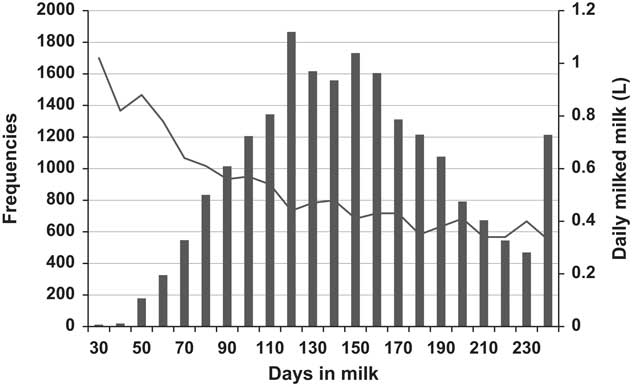
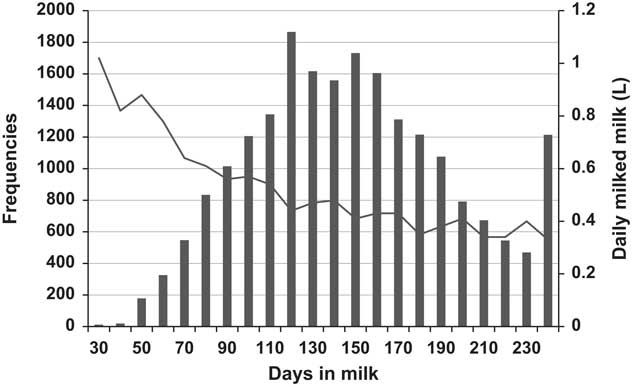
The average lactation curve after weaning was calculated from test-day milk yield selected from all lactations (Figure 1). The lactation curve did not show the presence of a lactation peak since the first test-day yield occurred on average at 30 days after lambing during the peak of production in dairy sheep as Macciotta et al. (Reference Macciotta, Cappio-Borlino and Pulina1999) indicated that lactation peak is expected around the 3rd to 4th week after parturition. Furthermore, the lack of observations for the first classes could distort the average obtained.
Lactation curve of Sicilo-Sarde breed.
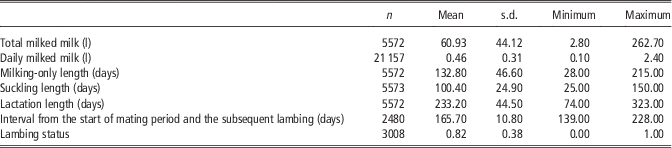
The studied population of Sicilo-Sarde sheep had an average daily milk yield of 0.46 l which varied from 0.10 to 2.40 l (Table 1) and TMM of 60.93 l (±44.12) during a milking-only period of 132.8 days (±46.6). The suckling length and lactation length were 100.4 days (±24.9) and 233.2 days (±44.5), respectively (Table 1). The TMM was lower than those reported by Moujahed et al. (Reference Moujahed, Jounaidi, Kayouli and Damergi2009) and Djemali et al. (Reference Djemali, Bedhiaf-Romdhani, Iniguez and Inounou2009) who reported that Sicilo-Sarde breed produced respectively between 60 and 120 kg per year and 89±47 l per lactation. This result indicated that the producing ability of the studied Sicilo-Sarde population has been declining over the last years. The disparity may also indicate differences in the databases used in the previous studies.
Descriptive statistics of milk production and reproductive parameters of Sicilo-Sarde sheep population analyzed in this study

Lengths of milking-only and suckling periods were similar to previous values reported by Djemali et al. (Reference Djemali, Bedhiaf-Romdhani, Iniguez and Inounou2009) for both milking-only length (139±47 days) and suckling length (104±22 days). The low production performances observed in this study for the Sicilo-Sarde breed comparatively to Lacaune breed (on average 290 l of milk during 165 days; Carta et al., Reference Carta, Casu and Salaris2009) and Sarda breed (on average 203 l and 162 days for milk yield and milking period; Carta et al., Reference Carta, Casu and Salaris2009) could be due to the orientation of farmers to manage the Sicilo-Sarde breed as a dual-purpose or meat sheep. Also, it has been suggested that random crossing with other breeds could threaten the genetic integrity of the studied breed and partly explains the low milking performances (Rekik et al., Reference Rekik, Aloulou and Ben Hammouda2005).
Considering an average gestation length of 150 days in sheep, mating occurred on average 15.7 days after the start of mating period (Table 1).
Sources of variation in milk production
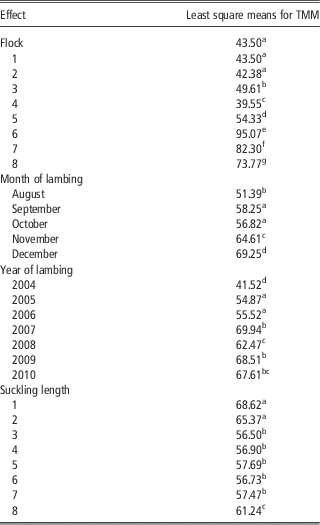
TMM was affected by flock, month and year of lambing, suckling and milking-only length (P<0.001) but also by parity and litter size (P<0.05). The model fitted the data with R 2 value of 76.2%. Least square means indicated that TMM was higher for lactations in flock 6 with 95.07 l (Table 2). This production exceeded the mean value reported by Djemali et al. (Reference Djemali, Bedhiaf-Romdhani, Iniguez and Inounou2009): 89±47 l. The lowest value was observed for lactations in flock 4 (39.55 l). The significant effect of the flock (P<0.001) can be explained by different management practices applied in each farm mainly the nutrition component. It should be also noted that Fretissa Farm had the best milk performances with the flock 6 which could be considered as a good model to be followed by Sicilo-Sarde farmers to improve the production of their dairy sheep.
Effect of flock, month of lambing, year of lambing and suckling length on total milked milk (TMM) in Sicilo-Sarde dairy sheep

a–gMeans within each effect with different superscripts differ significantly at P>0.05.
TMM production varied from a month of lambing to another (Table 2). While there was no significant difference between September and October, December was the best month of lambing for milk production (69.25 l). August seemed to be the most unfavorable month of lambing for milk production with an average of 51.36 l. These results are not consistent with findings of Djemali et al. (Reference Djemali, Ben M’Sallem and Bourawi1995) who showed that lambing in October was more favorable for milk production than lambing in September with a difference that reached +10 kg of milk. Furthermore, Saadoun et al. (Reference Saadoun, Romdhani, Darej and Djemali2004) reported higher average milk yields reaching 75 and 80 kg for ewes lambing in August and September to October, respectively. Such differences could be due to interannual climatic fluctuations characterizing the potential area where Sicilo-Sarde breed is raised.
Milk production was also affected by year of lambing (Table 2): values of least square means varied from 41.52 l in 2004 and 69.94 l in 2007. This difference could be attributed to the improvement of the feeding system related to the climatic variations especially precipitation and milking period duration that were different from 1 year to another (Moujahed et al., Reference Moujahed, Jounaidi, Kayouli and Damergi2009).
Suckling length was found as an important source of variation of milk production. Least square means indicated that highest TMM was observed for classes 1 and 2 corresponding to suckling lengths ⩽77 days. As expected, decreased suckling period was associated with increased milk production. This is supported by the results of Djemali et al. (Reference Djemali, Ben M’Sallem and Bourawi1995) on the existence of a negative correlation between milk production and duration of suckling and those of Moujahed et al. (Reference Moujahed, Jounaidi, Kayouli and Damergi2009) showing that milk yield was penalized by a long period of suckling. Short suckling periods <50 days yielded more milk than longer suckling periods (Saadoun et al., Reference Saadoun, Romdhani, Darej and Djemali2004).
Sources of variation in interval from the start of mating period to the subsequent lambing
Interval from the start of mating period to the subsequent lambing was affected by the combination between flock and month of the start of the mating period (P<0.001), parity (P<0.05), year of mating (P<0.001) and litter size (P<0.05). The model fitted the data with R 2 value of 12.4%.
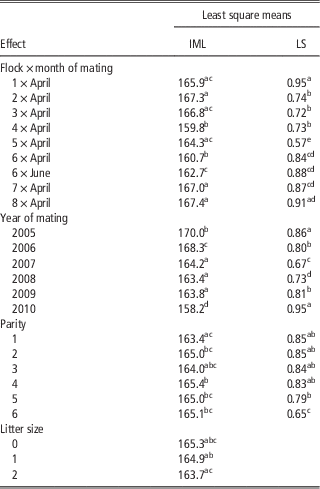
Least square means indicated that shorter IML was observed in flock 4 during April with 159.8 days as shown in Table 3. Even though raised on the same farm, flocks are managed differently, also explaining observed differences of IML between flock 4 and flocks 1, 2, 3 and 5. These differences could be related to distribution of food quantity affecting the body condition of ewes: the higher the ewe BW and body condition score at the beginning of the mating period, the earlier is the lambing date (Atti et al., Reference Atti, Thériez and Abdennebi2001). In flock 6, IML was slightly higher in June (162.7 days) than in April (160.7 days). This result confirmed finding of Atti (Reference Atti2011) who suggested summer mating to ameliorate reproductive performances of sheep. Indeed in June, more ewes are spontaneously cycling than in previous months (Lassoued et al., Reference Lassoued, Rekik, Khenissi and Merai2014). The IML varied between years of mating from 158.2 days in 2010 to 170 days in 2005 as shown in Table 3.
Effect of flock×month of the start of the mating period, year of mating, parity and litter size on the interval from the start of mating period to the lambing (IML) and on the lambing status (LS) in Sicilo-Sarde dairy sheep

a–dMeans within each effect with different superscripts differ significantly at P>0.05.
Least square means indicated that parity and litter size had less effect on the IML. The shorter IML was observed for parities of 1 and 3 which are not significantly different with 163.4 and 164 days, respectively. This confirmed the decrease of fertility with parity for many species (Anel et al., Reference Anel, Alvarez, Martinez-Pastor, Garcia-Macias and Anel2006; Grimmard et al., Reference Grimmard, Freret, Chevallier, Pinto and Ponsart2006). As to litter size, the longest IML corresponded to a litter size of 1 with 164.9 days. This result was in accordance with those of Osinowo et al. (Reference Osinowo, Abubakar and Trimnel1993) revealing the significant role of the fetus in its initiation.
Sources of variation in lambing status
Lambing status was significantly affected (P<0.001) by the combination between flock and month of the start of the mating period, parity and year of mating. The model fitted the data with R 2 value of 12.4%.
Least square means (Table 3) indicated that ewes of flock 1 mated in April were the most likely to become pregnant with a least square mean equal to 0.95. Within flock 6, there was a little difference in the ability of the ewe to be pregnant if mated in April or in June (0.84 v. 0.88). In Tunisia, fertility rates of sheep in mating season or out of season mating were still high and showed no significant effect (Khaldi and Farid, Reference Khaldi and Farid1981). The low least square mean for LS in 2007 (0.67) can be explained by an outbreak of ‘Border disease’ which is a viral disease accompanied by abortion (Nettleton et al., Reference Nettleton, Gilray, Russo and Dlissi1998).
Least square means indicated that parity was highly significant for LS (P<0.001). The ability of the ewe to become pregnant was higher in the first four lactations with least square means varying from 0.83 to 0.86. It is interesting to note that this parameter of fertility decreased over time. This decline was associated with the age of ewes: the best fertility rates were recorded in ewes between 1.5 and 4.5 years old; beyond this age, fertility declined remarkably (Anel et al., Reference Anel, Kaabi, Abroug, Alvarez, Anel, Boixo, de la Fuente and de Paz2005).
Association between milk production and fertility
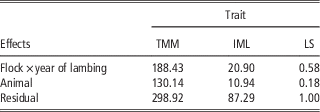
Variance components of the effects included in the model for TMM, IML and LS are presented in Table 4. The variance associated with the effect of flock×year of lambing reflects the variation due to the management within flock across years. The variance associated with the animal effect reflects the variation due to sum of the genetic and the permanent environmental effects. Higher values were observed in residual variances for all traits.
Variance components for total milked milk (TMM), interval between the start of mating period and the subsequent lambing (IML), and lambing status (LS)

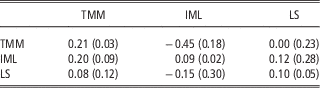
Results from Table 5 indicate that TMM repeatability was low (0.21±0.03) in comparison to estimates obtained for Lacaune sheep by David et al., (Reference David, Robert-Granié, Manfredi, Lagriffoul and Bodin2008; 0.55). Repeatability estimates were 0.09 (±0.02) for IML, and 0.10 (±0.05) for LS and were in accordance with estimates obtained for adult fertility of Lacaune sheep after artificial insemination (David et al., Reference David, Robert-Granié, Manfredi, Lagriffoul and Bodin2008).
Repeatability estimates for total milked milk (TMM), interval between the start of mating period and the subsequent lambing (IML), and lambing status (LS) on the diagonal, correlations among traits for the flock×year of lambing effect (above diagonal) and for the animal effect (below diagonal)

Correlation between TMM and IML for the flock×year effect was found to be favorable (−0.45) indicating that good management practices permitted higher milk production which was associated with shorter interval and therefore good fertility. This association was in contrast with results presented by Pollott and Gootwine (Reference Pollot and Gootwine2004) who found that early conception was phenotypically associated with lactations having less persistency and smaller peak yields. However, these last results were obtained for Assaf sheep raised in an intensive management system (Pollott and Gootwine, Reference Pollot and Gootwine2004). Correlation between TMM and IML for the animal effect was unfavorable (0.20±0.09; Table 5). This was in accordance with the results presented by David et al. (Reference David, Robert-Granié, Manfredi, Lagriffoul and Bodin2008) who showed that the genetic and the permanent environmental correlations between milk yield and adult fertility (expressed as pregnancy rate after artificial insemination) were respectively −0.23 and of −0.15. It is worth noting that there is lack of information for the estimation of the genetic association between fertility and milk production in Sicilo-Sarde breed.
Conclusion
The results obtained in this study established an antagonistic animal correlation between female fertility and milk production in Sicilo-Sarde breed. However, phenotypic associations suggest that high milk production permitted by practice of good management may lead to good fertility. Understanding the physiological bases for this association may improve milk production and reproductive performance of the dairy Sicilo-Sarde ewe and would be basis to better define selection criteria for dairy sheep breeds under a dual purpose production system.
Acknowledgements
The financial support provided by the Tunisian Ministry of Higher Education is gratefully acknowledged. Hedi Hammami, as a postdoctoral researcher, acknowledges the support of the National Fund for Scientific Research (Brussels, Belgium). Thanks are also expressed to Office de l’Elevage et des Pâturages (Tunisian Ministry of Agriculture) for providing the database support for the present study.