Introduction
Eradication of the Aedes aegypti mosquito is one of the major measures taken to control the spread of arboviruses. Malathion is a compound used worldwide for this purpose and in agriculture. 1 This organophosphate can be broadly found in the environment Reference Nash, Kime and Van der Ven2 and is known to have low toxicity in humans compared to other compounds in this class. Reference Maroni, Colosio, Ferioli and Fait3
The World Health Organization has indicated that the continuous use of malathion, especially during epidemic periods of diseases caused by dengue and Zika viruses, may have severe implications. 4 The Food and Drug Administration and Environmental Protection Agency stipulated that the maximum residue quantity allowed in food crops is 8 mg/L of malathion to avoid possible complications due to exposure to this compound. For adult rats, the LD50 of malathion is 5400 mg/kg and the no observed adverse effect level (NOAEL) for the underdeveloped reproductive system is 130 mg/kg in rats. 5 Our previous studies showed that exposure to low doses of malathion, when compared to the NOAEL and the lethal dose 50% (LD50) of rats, was prejudicial to the morphological postnatal development of the testis and epididymis. Reference Erthal, Siervo and Staurengo-Ferrari6–Reference Erthal, Staurengo-Ferrari and Fattori7
Children and teenagers are constantly growing and developing during periods of mosquito eradication; therefore, they are exposed to malathion through the inhalation of particles or ingestion of food contaminated during the spraying process of the compound in endemic areas. Reference Nash, Kime and Van der Ven2 During development, the organism is plastic and gene expression and cell signaling pathways are more susceptible to external agents. Reference Gluckman, Hanson and Pinal8 The hypothesis that environmental factors during early life favor the development of diseases in later life is called the Developmental Origins of Health and Disease (DOHaD). It has been proposed that the discrepancy between the predicted and developmental environment can negatively affect an individual’s health and increase the risk of disease. Reference Hanson and Gluckman9
Juvenile and peripubertal periods are critical windows for sexual development, in which individuals are highly susceptible to the action of toxic compounds. This susceptibility is due to alterations that occur in this period, involving the production of primary androgens, which occurs in rats between PND 8–35 Reference Podestá, Rivarola and Jyujo10 and differentiation of Leydig cells, between PND 28–56. Reference Benton, Shan and Hardy11
During the period known as peripuberty, in rats (PND 35–65), the determining factors of puberty installation occur: maturation of the hypothalamic–pituitary–testicular axis and the production of high concentrations of testosterone. Reference Golub, Collman and Foster12 Androgens produced in high concentrations act on androgen receptors (AR), which trigger intracellular cascades, stimulating spermatogenesis and hormonal biosynthesis through converter enzymes, such as 17-β-HSD. Reference De Jonge and Barratt13 Given these circumstances, juvenile and peripubertal periods are more sensitive to the action of toxic agents, and exposure during these periods can result in temporary or permanent damage to the male reproductive system.
A mature male reproductive system produces functional sperm cells for oocyte fecundation. For this, the testis may produce viable sperm cells with adequate morphology, involving adequate distribution of mitochondria for mitochondrial sheath formation and enzymatic organization for acrosome formation during spermiogenesis in the testes. Reference Stival, del C. Puga Molina, Paudel, Buffone, Visconti and Krapf14 After sperm formation during testicular spermiogenesis, these cells acquire the sperm capacitation necessary for oocyte fertilization, such as acrosome reaction and motility, depending on the energy provided by the mitochondrial sheath. Reference Stival, del C. Puga Molina, Paudel, Buffone, Visconti and Krapf14
The authors emphasize that, at physiological levels, reactive oxygen species (ROS) regulate intracellular cascades that enable hyperactivation, capacitation, and acrosomal reactions in sperm cells. Reference Agarwal, Aitken and Alvarez15 However, the quality of human semen is directly related to sufficient levels of antioxidants and low levels of ROS. Reference Eskenazi, Kidd, Marks, Sloter, Block and Wyrobek16 It is interesting to note that the destructive role of intracellular oxidative stress is well known and recognized, while the physiological role of this event in spermatic capacitation is not as well known.
Studies have shown that rats exposed to malathion develop organ damage through alterations in the oxidative profile. Reference Erthal, Staurengo-Ferrari and Fattori7–Reference Lasram, Lamine and Dhouib17 An in vitro study showed that the testes of goats exposed to malathion for 8 h (100 ng/ml) impaired the activities of the antioxidant enzymes catalase (CAT) and superoxide dismutase (SOD). Reference Sharma and Alka18 However, no studies have evaluated the spermatic oxidative profile of rats exposed to low doses of malathion during the juvenile and peripubertal periods.
In addition, studies have pointed to malathion’s ability to function as an endocrine disruptor by altering the concentration of steroid hormones involved in the regulation of sexual development. Reference Erthal, Staurengo-Ferrari and Fattori7–Reference Guo, Liu and Yao19 Endocrine disruptors are exogenous chemical compounds that interfere with hormone synthesis, secretion, metabolism, receptor binding, and elimination by altering and impairing the homeostasis of the endocrine system. Reference Nohynek, Borgert, Dietrich and Rozman20–Reference De Coster and Van Larebeke21
Studies addressing the DOHaD hypothesis have shown that exposure to endocrine-disrupting agents such as environmental contaminants during important periods of development impairs the important parameters involved in the establishment of sexual maturation. In addition, most of these studies involving the DOHaD concept assessed the exposure of animals during the prenatal/gestational period. Reference Scully, Estill and Amodei22–Reference Shi, Lv and Hu24
Few studies have evaluated the sperm functionality post malathion exposure and mechanism of impairment due to malathion exposure during juvenile and peripubertal periods, which are critical for sexual development. In addition, exposure to toxics during postnatal development of the male reproductive system has rarely been explored from the perspective of DOHaD. The present study aimed to evaluate if exposure to malathion at 10 and 50 mg/kg during the postnatal period could impair the spermatic physiology and the possible mechanisms involved in this impairment.
Material and methods
Animals and experimental conditions
Twenty-four juvenile male Wistar rats from different litters at postnatal day 21 (PND21) were supplied by the Animal House of Biological Sciences Centre, State University of Londrina (CCB - UEL), and were acclimated to the new environment at the Laboratory of Toxicology and Metabolic Dysfunction of Reproduction for 4 d right before the beginning of the experimental period. The animals were kept under recommended conditions at the local animal house. The animals were allocated into polypropylene cages (43 × 30 × 15 cm) (3 animals/cage) with laboratory-grade pine shavings as bedding during the entire experiment. The temperature and lighting were controlled (∼23 °C; 12L, 12D photoperiod, lights switched off at 07:00 pm). Rat chow and filtered tap water were provided ad libitum. Animal care and handling procedures were in accordance with the National Institutes of Health guide for the care and use of Laboratory animals (NIH Publications No. 8023, revised 1978) and with the approval of the Ethics Committee on Animal Use of State University of Londrina (CEUA/UEL protocol number 12305.2016.65).
Experimental design
The animals were randomly assigned to three experimental groups of eight animals each: control (C), malathion 10 mg/kg body weight (b.w.) (M10) and malathion 50 mg/kg b.w. (M50). We used malathion at doses lower than the subchronic NOAEL (no observed adverse effect level) dose (130 mg/kg b.w.) for the reproductive system in rats in relation to developmental toxicity. 5 In addition, the average of doses used in the present study represents the dosimetric adjustment Reference Foureman and Kenyon25 of the AOEL dose of 0.03 mg/bw/d in humans (European Commission) with an added security factor of 10 considering intraspecies variability. Reference Nielsen and Grete Ostergaard26 So, these doses are considered low and relatively safe in relation to these parameters and previous studies. Reference Welshons, Nagel and Vom Saal27
The malathion doses were administered according to Geng et al., Reference Geng, Shao, Zhang, Ng and Peng28 which demonstrated reproductive disorders in Wistar rats that were exposed to 54 mg/kg b.w. malathion during adult life. However, in the current study, the experimental period was modified to PND 25 to 65, to reach the juvenile and peripubertal periods established according to Ojeda et al.. Reference Ojeda, Andrews, Advis and White29 The animals were exposed to malathion via oral gavage with 10 or 50 mg/kg b.w. diluted in 0.9% saline as vehicle or were vehicle-treated for the control group. All groups were treated daily for 40 consecutive days.
Preparation of malathion solution
Malathion (dietil-dimetoxitiofosforiltio; CAS no. 121-75-5; Cheminova) was obtained from Dominus Quimica (Jandaia do Sul, Brazil). The compound was diluted in 0.9% saline daily as vehicle.
Testis and sperm collection
At the end of the experimental period, the rats were intraperitoneally anesthetized with a combination of ketamine 75 mg/kg b.w. (Sedomin® 10%, Avellaneda, Argentina) and xylazine 10 mg/kg b.w. (Anasedan®, Paulínia, Brazil), weighed and euthanized via cardiac puncture. The testes were removed and the right testes weights were determined (n = 10 rats per group) and used for gene expression by RT-qPCR. Spermatozoa from the tail of epididymis were used for sperm functional analysis (n = 06 per group) and evaluation of oxidative stress (n = 08 per group).
Mitochondrial activity
The mitochondrial activity of the sperm (n = 06) was determined as described by Silva et al. Reference Silva, Vendramini, Restelli, Bertolla, Kempinas and Avellar30 with adaptations. Sperm obtained from the tail of the epididymis were added in microtubes containing 1 mg/ml of 3-30-diaminobenzidine (DAB) dissolved in phosphate-buffered saline (PBS, 137 mM NaCl, 2.68 mM KCl, 8.03 mM Na2HPO4, KH2PO4 1.47 mM, pH 7.4) in a 1:3 (v/v) ratio and incubated at 37 °C for 1 h in the dark. Smears were prepared under histological slides and fixed with 10% formaldehyde for 10 min. Two hundred cells were evaluated with a phase-contrast microscope and classified as: DAB-I (stained intermediate piece, indicating that the cells maintain a complete mitochondrial activity or little loss of mitochondrial activity, which may not lead to severe impairment of motility and capacity fertilization); DAB-II (absence of staining in the intermediate part, indicating dead cells or cells that maintain minimal energy production through oxidative phosphorylation).
Acrosome integrity
Sperm acrosome status was evaluated as described previously by Silva et al.. Reference Silva, Vendramini, Restelli, Bertolla, Kempinas and Avellar30 Smears were prepared onto microscope slides using fresh sperm suspension (obtained from cauda epididymis) and fixed with methanol (n = 6/group). Slides were then stained with 40 μg/ml fluorescein-labeled PNA (FITC-PNA; Sigma- Aldrich, St Louis, MO, USA) in PBS and covered with Fluoromount-G with DAPI (EMS, Hatfield, PA, USA). Two hundred cells per slide were analyzed under a fluorescence Axio Zeiss microscope (Zeiss®, Thornwood, NY) equipped with appropriated excitation/emission filters, and cells were classified as Intact acrosome (intensively bright fluorescence of acrosome cap) and disrupted acrosome (disrupted fluorescence of acrosome cap).
Oxidative profile of sperm cells
The sperm collected from epididymis tail were homogenized in 1 ml of phosphate buffer (pH 7.4) and centrifuged at 9500 g for 10 min at 4°C. The protein quantification of the samples was determined by the Bradford method, using bovine serum albumin as a standard. Reference Bradford31 Samples were then normalized to 1 mg/mg protein and used for the following analyzes. The analysis of the oxidative profile will be performed through the quantification of lipid peroxidation (LPO) and other antioxidant substances.
Lipid peroxidation
The LPO was measured to indirectly quantify the peroxides produced. The result reflects the intensity of LPO. Reference Lushchak, Kubrak, Lozinsky, Storey, Storey and Lushchak32 Measurements were performed using the method of reactive substances to thiobarbituric acid (TBARS) with an absorbance of 535 nm and 572 nm Reference Buege and Aust33 compared to the standard curve for malondialdehyde (MDA), the main by-product of cellular LPO. To prepare the test, 50 μl of each normalized sample was pipetted in duplicate in a microplate, followed by the addition of FeCl3 (1M), ascorbic Sshaked and placed in a water bath at 90 °C for 15 min. The plate was then cooled to stop the reaction, and then read at 535 and 572 nml. LPO was estimated correcting for the amount of protein, and the results are expressed in nmol of TBARS per mg of protein.
Reduced gluthatione
Reduced glutathione (GSH) levels were determined as proposed by Rahman et al., Reference Rahman, Kode and Biswas34 with some modifications. For this, 5,5-dithiobis (2-nitrobenzoic acid) NBT was used in the testis homogenate supernatant and evidenced by a yellow color formation. GSH levels were measured at 412 nm and results expressed as micromols/mg protein.
Catalase activity
The enzymatic activity of catalase (CAT) was be determined by the degradation of hydrogen peroxide into oxygen and water. After determining the protein concentration (normalized 1.0 mg/ml in PBS), 297 μl of reaction medium was be placed in a UV4 microplate (in triplicate) at 240 nm for 60 s. Reference Aebi35
Superoxide dismutase activity
The evaluation of the activity of the enzyme SOD was performed as described by Senthilkumar et al. (2021) Reference Senthilkumar, Amaresan and Sankaranarayanan36 with some changes. The enzyme comes from homogenates normalized to 1 mg/ml. A reaction mixture was prepared containing sodium carbonate buffer (50 mM, pH 10.2), nitroblue tetrazoilium (NBT) (96 uM) and Triton X-100 (0.6%), which was incubated for 2 min with sodium hydrochloride. hydroxylamine (NH2OH·HCl) (20 mM, pH 6.0). The final volume was adjusted to 200 µl. The reaction consists of the quantification of complexes formed by superoxide anions with the addition of NBT and NH2OH·HCl of yellowish color with the reduction of NBT, forming a bluish color read at 560 nm for 2 min at intervals of 15 s.
Glutathione S-transferase activity
The enzymatic activity of glutathione S-transferase (GST - EC 2.5.1.18) of the sperm was determined through the formation of a thioether from the interaction of GSH with CDNB, the increase in absorbance through the formation of the thioether was monitored at 340 nm (RS: 100 mM potassium phosphate buffer pH 6.5; 1.5 mM GSH; 2 mM CDNB) for 5 min at 40 s intervals, as described by Keen et al.. Reference Keen, Habig and Jakoby37 Values were expressed in μM Thioether formed min/mg/protein.
Quantitative and real-time polymerase chain reaction (RT-QPCR)
RT-qPCR was performed as previously described by Manchope et al. Reference Manchope, Calixto-Campos and Coelho-Silva38 Collected testis samples were homogenized in Trizol reagent and total RNA was extracted using the SV Total RNA Isolation System kit (Promega). The purity of total RNA was measured with a spectrophotometer with the wavelength absorption ratio (260/280 nm) being between 1.8 and 2.0 for all preparations. Reverse transcription of total RNA to cDNA, and qPCR were carried out using GoTaq® 2-Step RT-qPCR System (Promega) following the manufacturer’s instructions.
All reactions were performed in triplicate using the following cycling conditions: 50°C for 2 min, 95°C for 2 min, followed by 40 cycles of 95°C for 15 s, and 60°C for 30 s. qPCR was performed in a LightCycler Nano Instrument thermocycler (Roche, Mississauga, ON, USA) by sequence detection system using Platinum SYBR Green RTqPCR SuperMix UDG (Invitrogen, USA). β-actin mRNA levels were used as a control method to assess tissue integrity in all samples. The relative gene expression was measured using the comparative 2−(ΔΔCq) method.
The primers used were to evaluate the expression of genes for AR, sense: 5′’ GGAGAACTCTTCAGAGCAAG-3′, antisense: 5′-AGCTGAGTCATCCTGATCTG-3′; and 17-b-HSD, sense: 5′-AATATGTCACGATTGGAGCTGA-3′, antisense: 5′-AAGGAATCAGGTTCAGAATTATCG-3′ being respectively involved in the action and synthesis of testosterone. The primers used for β-actin gene were: sense: 5′- GCCATGTACGTAGCCATCCA -3′, antisense: 5′- GAACCGCTCATTGCCGATAG-3′
Statistical analysis
One-way analysis of variance (ANOVA) with post hoc Dunnett’s test or the non-parametric Kruskal–Wallis test with the Dunn’s post hoc test was used to compare the results between the experimental groups. The Barttlett’s test was performed to evaluate the variance among the experimental groups and the normal distribution was compared using Shapiro–Wilk test. Data are presented as the mean ± s.e.m. Differences were considered significant when p < 0.05. The statistical analyses and graph design for the results were performed using GraphPad Prism for Windows (version 7.01 – GraphPad Software, La Jolla, CA, USA).
Results
Sperm function: mitochrondrial activity and acrosome integrity
Although the mitochondrial activity was not affected by the exposure to both doses of malathion, the major dose of the compound was sufficient to increase the percentage of non-intact acrosome of sperm form rats (Table 1).
Effects of juvenile and peripubertal exposure to low doses of malathion on sperm functional parameters

M10 – rats treated with 10 mg kg−1 malathion; M50 – rats treated with 50 mg kg−1 malathion. DAB I – total mitochondrial active; DAB II – mitochondrial partially active; DAB III – total mitochondrial inactive.
Data are presented as the mean ± s.e.m. *p < 0.05.
a One-way ANOVA test with a posteriori Dunnett’s test.
b Kruskal–Wallis test with the post hoc Dunn’s test.
Oxidative profile of sperm cells
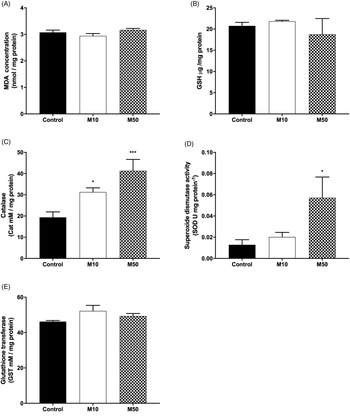
The biomarkers of oxidative stress are shown in Fig. 1. The MDA levels were not altered by the different doses of malathion, as well the antioxidant GSH or the activity of the enzyme GST. On the other hand, the activity of CAT enzyme was increased in rats exposed to malathion 10 or 50 mg/kg. The same occurred with SOD enzyme, which increased in group M50, but not at M10 in relation to control group.
Oxidative profile in the sperm cells from rats exposed to vehicle or malathion at 10 mg/kg or 50 mg/kg. (A) Lipid peroxidation assay. (B) Reduced glutathione (GSH) levels. (C) Catalase (CAT), (D) superoxide dismutase (SOD) and (E) glutathione-S-transferase (GST) activity, in the supernatant of the sperm cells. ANOVA test followed by Dunnett’s test. Data are represented as the mean ± s.e.m. ***p < 0.001 compared with control. *p < 0.05 compared with control. M10 – rats treated with 10 mg kg−1 malathion; M50 – rats treated with 50 mg kg−1 malathion.

Quantitative and real-time polymerase chain reaction (RT-qPCR) in testis
Fig. 2 shows that the minor dose of malathion decreased the gene expression of both AR and 17-ß-HSD genes in testicle rats exposed during juvenile and peripubertal periods. The M50 group did not differ from control group.
Gene expression of (A) androgen receptor and (B) 17-b-HSD in testis from animals exposed to vehicle or malathion at 10 mg/kg or 50 mg/kg. Values are expressed as the mean ± s.e.m. *p < 0.05. **p < 0.01. One-way ANOVA test, with post hoc Dunnett’s test. M10 – rats treated with 10 mg kg−1 malathion; M50 – rats treated with 50 mg kg−1 malathion.

Discussion
The present study highlights the possible mechanisms involved in the alteration of sperm quality after exposure to malathion during juvenile and peripubertal periods. Our previous studies showed that exposure to low doses of malathion during the juvenile and peripubertal periods was sufficient to alter testicular integrity and spermatic Reference Erthal, Staurengo-Ferrari and Fattori7 and epididymal Reference Erthal, Siervo and Staurengo-Ferrari6 morphology. Observing sperm physiology is as important as its morphology in inferring an individual’s fertility potential. Therefore, the decrease in acrosomal integrity reported in this study is crucial for spermatic function and oocyte fertilization.
Defects in spermiogenesis after exposure to toxic agents can be related to low sperm counts, increased proportion of abnormal sperm, reduced acrosome integrity, and impaired motility. Reference O’Donnell39 In corroboration with O’ Donnell, Reference O’Donnell39 previous studies have highlighted the impairment of spermiogenesis following exposure to low doses of malathion, Reference Erthal, Siervo and Staurengo-Ferrari6–Reference Erthal, Staurengo-Ferrari and Fattori7 which manifested in morphological and sperm motility alterations. The same impairment in this process was observed in the present study after a decrease in acrosomal integrity was observed in rats exposed to low doses of malathion during the juvenile and peripubertal periods.
The acrosome is an organelle formed during spermatogenesis situated in the apical region of the spermatozoan and is composed of enzymes from lysosomes, peroxisomes, and the cytoplasm. Reference Moreno and Alvarado40–Reference Clermont41 Its protein components are synthesized before the development of male gametes. The formation of this organelle is a complex and highly regulated phenomenon compared to other organelles. Reference Zhao, Burkin, Shi, Li, Reim and Miller42–Reference Kang-Decker, Mantchev, Juneja, McNiven and Van Deursen43
The liberation of acrosome enzymes after the sperm cell binds itself to the oocyte’s zona pellucida is known as an acrosomal reaction, and the result is the creation of pores in the oocyte membrane, necessary for penetration of the extracellular coat of the oocyte. Reference Marshall, Cramer and Lockhead44 In this process, ROS have been identified as facilitators via the phosphorylation of tyrosine proteins that allow calcium influx and subsequent fusion of sperm cells to oocyte for fertilization. Reference Dutta, Majzoub and Agarwal45–Reference Bansal and Bilaspuri46
In this study, we did not observe any alterations in sperm peroxidation levels between the experimental groups. However, this does not mean that there was no oxidative stress caused by malathion in the sperm cells, given that low doses of this pesticide were responsible for increasing the activity of antioxidant enzymes SOD and CAT. Altering the antioxidant profile is a compensatory mechanism for the disturbance by oxidative stress in these cells. The goal of these molecules and antioxidant enzymes is to neutralize ROS and prevent oxidative damage Reference Kim and Parthasarathy47 in sperm cells.
Corroborating our results, Kocabaş et al. Reference Kocabaş, Kutluyer, Benzer and Erişir48 showed that sperm cells exposed to malathion in an in vitro model (75, 100, and 125 µg/L) showed increased antioxidant enzyme CAT activity and reduced SOD activity, even though MDA and GSH levels were unaltered. Thus, we confirmed that malathion alters the oxidative status of sperm cells, regardless of the model used.
Reforcing malathion’s destructive role on spermatic functioning, our previous study showed that exposure to low doses of malathion during peripuberty compromised spermatic motility. Reference Erthal, Siervo and Staurengo-Ferrari6 However, owing to new data, we concluded that this motility alteration was not a result of alterations in the spermatic mitochondrial sheath, once this structure was unaltered after exposure to this insecticide.
Once sperm cells are produced in the testis, some of the spermatic impairment observed in our previous studies, such as in sperm production and morphology, Reference Erthal, Staurengo-Ferrari and Fattori7 can be justified by the alterations in the hormone synthesis and signaling pathway observed, evidenced by the downregulation of AR receptors and 17-β-HSD enzyme after rats were exposed to malathion.
Previous studies showing impairment in testosterone production after malathion exposure Reference Erthal, Staurengo-Ferrari and Fattori7,Reference Bansal and Bilaspuri46–Reference Kim and Parthasarathy47 are now justified by the downregulation of 17-β-HSD observed in this study. This gene is related to the final stages of the synthesis of the steroidal hormone and is the enzyme responsible for catalyzing the conversion of androstenedione to testosterone. Reference Miller51
The binding between androgens and AR and its regulation are crucial for the regulation and establishment of spermatogenesis. Reference Collins, Chang and Norwell52 Therefore, disturbance in the expression of this receptor compromises spermatogenesis. Qiu et al. Reference Qiu, Wang and hui Zhang53 reported that doses of bisphenol A, another toxic compound broadly found in the environment beneath the NOAEL, were sufficient to downregulate AR and 17-β-HSD expression, consequently compromising spermatogenesis and sperm quality. A similar correlation was observed in the present study. Interestingly, the reduction in the number of Sertoli cells observed in a previous study using the same experimental model Reference Erthal, Staurengo-Ferrari and Fattori7 was also directly related to the downregulation of AR reported in the present study. Impairment to Sertoli cells compromises the integrity of the seminiferous epithelium, spermatogenesis, and, consequently, sperm quality. Reference Chen and Liu54
A point to be highlighted is that genetic expression was only downregulated in the M10 group, the lowest experimental dose, compared to the control group. Interestingly, another study showed that the lowest dose (10 mg/kg) of malathion compromised sperm motility, Reference Erthal, Siervo and Staurengo-Ferrari6 which is another important parameter for sperm function evaluation. It is a curious observation that the highest dose used in the present study did not cause the same alterations, however, it is not the first time this has been reported in the literature. Reference Vandenberg55 The toxic agent bisphenol S is one of the most commonly used agents to impair spermatogenesis and sperm quality at low or very low doses. Reference Vandenberg55 Darghouthi et al. Reference Darghouthi, Rezg, Boughmadi and Mornagui56 reported that low doses of bisphenol S impaired sperm quality, altered the conformation of the StaR protein involved in the production cascade of steroidal hormones, and impaired antioxidant species with oxidative profile alterations in rats. The same occurs with dichlorodiphenyltrichloroethane (DDT), where lower doses alter intermediate proteins involved in the production of steroidal hormones. Reference Yaglova, Tsomartova and Obernikhin57 However, there are no studies on the effects and mechanisms of damage after exposure to low doses of malathion on sperm quality. Thus, a novel characteristic is presented regarding this insecticide that is widely used in underdeveloped tropical countries.
Although alterations in both sperm integrity and the expression of genes involved in endocrine signaling were observed, these results were not correlated because they were triggered by different doses of malathion exposure. Therefore, the observed impairment in sperm integrity is related to other mechanisms reported in previous studies, such as oxidative stress induced in the testes. Reference Erthal, Siervo and Staurengo-Ferrari6–Reference Erthal, Staurengo-Ferrari and Fattori7 This confirms that malathion has different mechanisms of aggression towards the testes and spermatozoa.
Similar to the aforementioned studies, our study shows that malathion, at low doses, induces alterations that act as endocrine disruptors, downregulating the expression of the testosterone converter enzyme, 17-b-HSD. Moreover, AR. Chaturvedi et al. Reference Chaturvedi, Kumar, Negi and Tyagi58 emphasized that endocrine disruptors involve not only hormone-like compounds but also those capable of impairing the synthesis and/or modulators of ARs.
In the present study, we addressed the critical period for tissue reprograming during sexual development through the DOHaD hypothesis. Reference Guintivano and Kaminsky59 Although adaptations are beneficial to the body, when an individual is exposed to a different environment than anticipated during development, there is an increased risk of disease. Reference Zhang and Ho60 Moreover, according to this hypothesis, the early life environment has a prominent influence on an individual’s health in later life.
This exposure involves the introduction of chemicals and pollutants that require adaptation. In this context, studies have confirmed that the influence of these toxic agents on epigenetics during critical periods of development can modulate hormone signaling through period gene plasticity, corroborating our data. Reference Zhang and Ho60
To our knowledge, this is the first study to evaluate sperm function through sperm integrity parameters, mitochondrial activity, sperm cell oxidative profile, and genetic expression in the testis of rats exposed to low doses of malathion, during the juvenile and peripubertal period. Our data indicates that animals exposed to malathion during critical periods of sexual development might have compromised reproductive health, even during adulthood.
Although population studies are needed to evaluate the effects of malathion and apply the newly gained knowledge to clinical practice, the approach through DOHAD principals achieved by the present experimental model allows for the establishment of causal associations through the mechanisms addressed and illuminates new strategies for the prevention, prognosis, and intervention of idiopathic infertility. Reference Angel Sánchez-Garrido, Garc Ia-Galiano and Tena-Sempere61
Conclusion
The present study showed that low doses of malathion that are considered to be inoffensive are capable of impairing sperm quality and function through the downregulation of testicular genic expression of AR enzyme 17-β-HSD, and damage to the spermatic antioxidant profile during these critical periods of development. Therefore, we conclude that juveniles and adolescents exposed to malathion unintentionally during periods of A. aegypti mosquito eradication may have compromised sperm quality and reproductive health upon reaching adulthood.
Acknowledgements
The authors are grateful to CAPES (Coordinating Body for the Improvement of Postgraduate Studies in Higher Education) for providing a Doctoral’s scholarship to R. P. Erthal and partially financial support (Finance Code 001). This paper forms a part of the doctoral thesis of R. P. Erthal (State University of Londrina), supervised by G. S. A. Fernandes. We would like to thank Editage (www.editage.com) for English language editing.
Conflict of interest
The authors declare that there are no conflicts of interest.
Ethical standards
The authors assert that all procedures contributing to this work comply with the ethical standards of the relevant national guides on the care and use of laboratory animals and has been approved by the Ethics Committee on Animal Use of State University of Londrina (CEUA/UEL protocol number 12305.2016.65).
Declaration of interests
The authors declare that they have no known competing financial interests or personal relationships that could have appeared to influence the work reported in this paper.