One of the most remarkable features of children's development lies in their rapidly growing vocabularies. During elementary school, for example, children learn thousands of new words each year (Anglin, Reference Anglin1993; Nagy & Anderson, Reference Nagy and Anderson1984). Although instruction is an effective way to promote vocabulary acquisition (Stahl & Fairbanks, Reference Stahl and Fairbanks1986), only about 10% of words appear to be learned as a result of intentional tuition (Baumann & Kame'enui, Reference Baumann, Kame'enui, Flood, Lapp and Squire1991), and instruction alone is not sufficient to explain individual differences in vocabulary acquisition (Penno, Wilkinson, & Moore, Reference Penno, Wilkinson and Moore2002). This leads us to consider the cognitive and linguistic skills that might contribute to the development of vocabulary knowledge.
One skill that may be particularly relevant to vocabulary acquisition is morphological awareness, which refers to an appreciation of the morphemic structure of words and the ability to reflect on and manipulate that structure (Carlisle, Reference Carlisle and Feldman1995). Morphemes are minimal meaningful units of language that can be productively combined to create new, related words; often, the meaning of these morphologically complex words can be deduced based on the meanings of their component morphemes. For example, the word imaginable can be broken down into the base morpheme imagine and the suffix –able. Children's metalinguistic ability to recognize and manipulate this word structure allows them to apply morphological relationships to a wide variety of morphologically complex words. Herein lies the potential power of morphological awareness in children's vocabulary acquisition: a child's awareness of morphological structure might support the acquisition of words like imaginable, despite imaginable itself being a relatively infrequent word. Morphological awareness could be a powerful tool for vocabulary acquisition, given that morphologically complex words are very common in English. It is notable that morphologically complex words comprise an estimated 60% to 80% of the new vocabulary acquired by elementary school-aged children (Anglin, Reference Anglin1993; Nagy & Anderson, Reference Nagy and Anderson1984). The possibility that morphological awareness drives vocabulary development was noted by Carlisle (Reference Carlisle, Wagner, Muse and Tannenbaum2007). She suggested that morphemes might serve as reusable building blocks that facilitate children's learning of new morphologically complex words. This has been the interpretation of studies demonstrating that children are able to infer word meaning by analyzing the morphological components of words. For example, Wysocki and Jenkins (Reference Wysocki and Jenkins1987) found that, after having been taught a series of word meanings, children in Grades 4, 6, and 8 were better able to define words that were morphologically related to a taught word than words that were unrelated to a taught word. Other studies have suggested that children make reference to component morphemes in their definitions of morphologically complex words (e.g., Carlisle, Reference Carlisle2000; Lewis & Windsor, Reference Lewis and Windsor1996; Tyler & Nagy, Reference Tyler and Nagy1989). These studies point to the possibility that, at least in part, children rely on morphological analysis to determine word meaning.
Although this is a frequent interpretation, it is also possible that a relationship exists in the other direction: that vocabulary knowledge might help children to develop an awareness of the presence and meaning of morphemes. As an example, learning the words agreeable, readable, and imaginable might help children to detect the words’ shared morphological structure and to extract the meaning of their bases and the suffix –able. A large vocabulary might afford children more opportunities to pick up on morphological regularities in a language, thereby increasing their morphological awareness. With a large vocabulary comes increased exposure to morpheme use in a given language, and consequently, children have more exemplars from which they could extract morphological regularities. In order to clarify the nature of the relationship between morphological awareness and vocabulary, it is important that we consider the possibility of effects in both directions. Although such bidirectional relationships are common in language and reading development (e.g., Gathercole, Willis, Emslie, & Baddeley, Reference Gathercole, Willis, Emslie and Baddeley1992), we know relatively little about the direction of the relationship between morphological awareness and vocabulary in English. Examining the temporal relationship between morphological awareness and vocabulary is our goal in the present study.
We are motivated to examine this relationship by the abundance of evidence for a strong association between morphological awareness and general vocabulary knowledge. Correlations between the two have been well documented across studies of several languages and age groups (e.g., Fowler, Feldman, Andjelkovic, & Oney, Reference Fowler, Feldman, Andjelkovic, Oney, Assink and Santa2003; Fowler & Liberman, Reference Fowler, Liberman and Feldman1995; Ku & Anderson, Reference Ku and Anderson2003; Nagy, Berninger, & Abbott, Reference Nagy, Berninger and Abbott2006; Nagy, Berninger, Abbott, Vaughan, & Vermeulen, Reference Nagy, Berninger, Abbott, Vaughan and Vermeulen2003; Singson, Mahony, & Mann, Reference Singson, Mahony and Mann2000). Moreover, there is some evidence that this relationship persists with the inclusion of multiple controls (McBride-Chang, Wagner, Muse, Chow, & Shu, Reference McBride-Chang, Wagner, Muse, Chow and Shu2005). McBride-Chang et al. used compounding and inflectional tasks to assess the morphological awareness of English-speaking children in kindergarten and second grade. They found that morphological awareness scores were uniquely related to vocabulary knowledge after controlling for phonological processing, word reading, and age. Similarly, Kieffer and Lesaux (Reference Kieffer and Lesaux2012) found a strong relationship between derivational morphological awareness and vocabulary knowledge in English-speaking language minority students in Grade 4, even when controlling for phonological awareness and word reading ability. They also found that growth in morphological awareness between Grades 4 and 7 was correlated with growth in vocabulary in that same period. These findings support the existence of a unique relationship between morphological awareness and vocabulary knowledge.
The strength of the concurrent relationship between morphological awareness and vocabulary has led some researchers to suggest that, at least by the late elementary school years, the two constructs may overlap. Wagner, Muse, and Tannenbaum (Reference Wagner, Muse, Tannenbaum, Wagner, Muse and Tannenbaum2007) reported a correlation of .91 between latent morphological awareness and vocabulary measures based on several tasks completed by children in Grade 4. In their analysis, this relationship was not statistically distinguishable from a model in which there was a perfect correlation between the two variables (Wagner et al., Reference Wagner, Muse, Tannenbaum, Wagner, Muse and Tannenbaum2007). Others have suggested that this result could be the outcome of a reciprocal developmental relationship between morphological awareness and vocabulary knowledge (Muse, Reference Muse2005; Nagy, Reference Nagy, Wagner, Muse and Tannenbaum2007). In other words, the facilitation between the two skills in the early elementary school years might lead them to converge to the point where they become difficult to separate statistically in older children.
We seek to explore the temporal relationship between morphological awareness and vocabulary in young monolingual English-speaking children. We are motivated to do so by recent findings that early morphological awareness is associated with growth in vocabulary just as early vocabulary is associated with growth in morphological awareness for young monolingual children. McBride-Chang et al. (Reference McBride-Chang, Tardif, Cho, Shu, Fletcher and Stokes2008) assessed Mandarin-, Cantonese-, and Korean-speaking children longitudinally between kindergarten and Grade 1. The study focused on the children's awareness of compounding morphology (e.g., base + ball = baseball), which is prominent in the three languages under investigation. In all three language groups, children's morphological awareness in kindergarten was uniquely associated with vocabulary development between kindergarten and Grade 1. It is interesting that the reverse was also true: vocabulary knowledge assessed in kindergarten was uniquely associated with morphological awareness development between kindergarten and Grade 1. The authors suggest that there is a bootstrapping relationship between the two abilities, in which knowledge of morphemes aids vocabulary development, and in turn, a large vocabulary supports the development of morphological awareness.
Despite this suggestion of temporal relationships between morphological awareness and vocabulary development over time in young Mandarin-, Cantonese-, and Korean-speaking children, there is some suggestion that this relationship might not emerge for older children learning to speak English. Kieffer and Lesaux (Reference Kieffer and Lesaux2012) assessed Spanish-speaking children, who were being taught in English, between Grades 4 and 7 on their English derivational morphological awareness and general vocabulary. Using latent growth curve modeling, the authors identified children's growth trajectories for morphological awareness and vocabulary across the 3-year period. In the analysis that most closely parallels the cross-lagged analyses reported by McBride-Chang et al. (Reference McBride-Chang, Tardif, Cho, Shu, Fletcher and Stokes2008), Kieffer and Lesaux tested whether children's initial morphological awareness at Grade 4 was correlated with their vocabulary growth and, conversely, whether their Grade 4 vocabulary was correlated with morphological awareness growth. Neither of these correlations was significant, a finding that diverges from the bidirectional relationship reported by McBride-Chang et al. (Reference McBride-Chang, Tardif, Cho, Shu, Fletcher and Stokes2008).
The divergence between the results of these two studies highlights the need for further research and motivates our own investigation into the relationship between morphological awareness and vocabulary in young monolingual English-speaking children. It is possible that these relationships emerge for young monolingual children of a variety of languages (as in McBride-Chang et al., Reference McBride-Chang, Tardif, Cho, Shu, Fletcher and Stokes2008) but that such relationships are more difficult to detect for older second language learners, such as those studied by Kieffer and Lesaux (Reference Kieffer and Lesaux2012). In addition, it is possible that, given the relative morphological paucity of English in comparison to languages such as Mandarin, no such relationship will emerge for monolingual English speakers, as was the case for English second language learners in Kieffer and Lesaux's study. To evaluate these possibilities, our study addresses the nature of the relationship between morphological awareness and vocabulary development in young, monolingual English-speaking children.
Any examination of morphological awareness and vocabulary development will benefit from consideration of the morphological distinctions that are most relevant to a given language and age group (as noted by, e.g., McBride-Chang et al., Reference McBride-Chang, Tardif, Cho, Shu, Fletcher and Stokes2008). Languages vary in the emphasis that they place on different types of morphology. For example, Mandarin and Korean make extensive use of compounding morphology (McBride-Chang et al., Reference McBride-Chang, Tardif, Cho, Shu, Fletcher and Stokes2008), while English makes greater use of inflected and derived morphology (Anglin, Reference Anglin1993). Inflected words involve changing characteristics such as number or tense without altering a word's syntactic category (e.g., adding –ed to the base verb walk to form the past tense verb walked). Derived words, however, contain an affix that typically changes the word's syntactic category (e.g., adding –able to the verb imagine to form the adjective imaginable). An awareness of compound morphology might be particularly associated with vocabulary in languages like Mandarin, in which compounding is prevalent, whereas awareness of derivational morphology might be more closely associated with vocabulary in languages like English, which rely heavily on derivations. Children appear to be sensitive to the prominent morphological features of their language. Ku and Anderson (Reference Ku and Anderson2003) found that Chinese-speaking children had stronger compound awareness than English-speaking children in Grades 2, 4, and 6, and conversely, English-speaking children had stronger derivational awareness than Chinese-speaking children. In other words, both groups showed relative strength in awareness of the morphological features most salient in their respective languages. It seems important, then, to tailor morphological awareness measures to the morphological properties of the language under investigation. Both McBride-Chang et al. (Reference McBride-Chang, Tardif, Cho, Shu, Fletcher and Stokes2008) and Kieffer and Lesaux (Reference Kieffer and Lesaux2012) did so, using measures of compound awareness (in Mandarin, Cantonese, and Korean) and derivational awareness (in English), respectively. Similarly, in the current study, we use a combination of inflectional and derivational morphological awareness that is well suited to the developing abilities of young English-speaking children and the types of morphologically complex words to which they are being exposed (Anglin, Reference Anglin1993).
In the present study, we focus on children between Grades 2 and 3; at this point in their development children are beginning to gain a fuller awareness of different types of English morphology. Inflected and derived morphological awareness certainly follow different developmental trajectories. Awareness of inflected forms begins to develop at a relatively early age, as demonstrated in Berko's (Reference Berko1958) classic study in which children as young as 4 years were able to inflect simple novel words. In contrast, awareness of derived forms tends to appear later and continues to develop into the late elementary and high school grades (Anglin, Reference Anglin1993; Carlisle, Reference Carlisle2000; Mahony, Reference Mahony1994). Despite these differences, children continue to develop awareness for both types of morpheme during the early elementary school years. Anglin (Reference Anglin1993) reported that children's awareness of inflected and derived morphological forms increases between Grades 1 and 5, with a particularly sharp increase in derived morphological awareness. Furthermore, during this period, children's exposure to morphologically complex words is growing dramatically (Anglin, Reference Anglin1993). This makes it an ideal age range in which to explore English-speaking children's use of morphological awareness to expand their vocabularies as well as their use of vocabulary as a means of developing morphological awareness.
To reiterate, our goal with this study is to clarify the nature of the relationship between morphological awareness and vocabulary in English-speaking children by examining the direction of that relationship. We do so using language- and age-appropriate general measures of morphological awareness and vocabulary knowledge assessed longitudinally in children from Grades 2 to 3. This will allow us to investigate the temporal nature of the relationship between these two abilities in the early elementary school grades for monolingual speakers of English. We may find that each of the two abilities, morphological awareness and vocabulary development, supports growth in the other skill, in keeping with McBride-Chang et al.'s (Reference McBride-Chang, Tardif, Cho, Shu, Fletcher and Stokes2008) study of young monolingual children. However, given the conflicting results of previous studies, we cannot be sure how the temporal relationship between morphological awareness and vocabulary development will manifest in the young, monolingual English-speaking children being studied here. It is also possible that this reciprocal relationship will not emerge in our English-speaking sample (Kieffer & Lesaux, Reference Kieffer and Lesaux2012) or that we might observe more limited relationships. The current study will also allow us to confirm the within-grade association between morphological awareness and vocabulary knowledge that has previously been reported (McBride-Chang et al., Reference McBride-Chang, Wagner, Muse, Chow and Shu2005). We expect to find that, at each grade level, measures of morphological awareness are related to vocabulary at the same grade.
In order to examine the temporal nature of the relationship between morphological awareness and vocabulary, we used longitudinal cross-lagged regression analyses, which are often used in language and reading research (e.g., Bowey, Reference Bowey2001; Davis & Bryant, Reference Davis and Bryant2006), including research on the relationship between morphological awareness and vocabulary development (McBride-Chang et al., Reference McBride-Chang, Tardif, Cho, Shu, Fletcher and Stokes2008). These analyses stringently evaluate whether early measures of a skill are related to increases in another skill over time by controlling for the autoregressive effect of the outcome variable at Time 1. In doing so, we are able to determine whether morphological awareness at Time 1 is uniquely associated with change in vocabulary between Time 1 and Time 2, and likewise, whether Time 1 vocabulary is associated with change in morphological awareness during this time period. These cross-lagged analyses allow us to specify whether there is a reciprocal developmental relationship between our target variables.
Although these analyses are quite useful in identifying temporal relationships between developing skills, any such relationship could of course be the result of extraneous variables. In order to minimize that possibility, the inclusion of appropriate controls is crucial to our correlational design. As such, we have included a number of control variables in all of our analyses, following closely on those included by McBride-Chang et al. (Reference McBride-Chang, Wagner, Muse, Chow and Shu2005). We included phonological awareness, given its well-documented links to both vocabulary and morphological awareness (e.g., Carlisle, Reference Carlisle and Feldman1995; Metsala, Reference Metsala1999). For the same reason, we also controlled for word and pseudoword reading (Carlisle & Nomanbhoy, Reference Carlisle and Nomanbhoy1993; Fowler & Liberman, Reference Fowler, Liberman and Feldman1995; Singson et al., Reference Singson, Mahony and Mann2000). Finally, nonverbal reasoning, assessed using matrix analogies, was included to account for the cognitive demands of our analogical morphological awareness task. The inclusion of a nonverbal reasoning measure also increases our confidence that any uncovered effects are not a function of general reasoning ability. Including these controls allows us to stringently evaluate the temporal nature of the relationship between morphological awareness and vocabulary development in English-speaking elementary school children.
METHOD
Participants and procedure
Participants were 100 children (53 girls, 47 boys) recruited from rural public schools in Canada; we followed these students from Grade 2 to Grade 3 as part of a larger study of reading development that began in Grade 1. We recruited seven schools that drew students from a wide region, reflecting a range of socioeconomic status. Within the participating schools, all students who were in Grade 1 when the study began were invited to participate; the study's only inclusion criteria were informed parental consent, student assent, and the ability to understand task instructions. The average participation rate across schools was 62%, with participation rates at individual schools ranging from 34% to 90%. There were no significant differences between students from different schools on any of the study's measures (described below; ps > .05).
The study's original sample consisted of 126 children in Grade 1. We focus here on Grades 2 and 3 only, because our measure of morphological awareness was first introduced in Grade 2. Of the original sample, 111 children remained in Grade 2, and 101 remained at the end of the study in Grade 3. Attrition was primarily due to participants moving out of the school board district in which the study took place. We compared participants who remained in the study with those who did not on all of the study's measures and found no significant differences between these groups of children (ps > .05). Among the 101 children who completed the study in Grades 2 and 3, one participant was identified as a multivariate outlier and was excluded from analyses. All analyses that follow were conducted with data from the 100 remaining children.
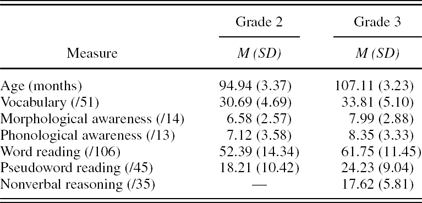
All of the children spoke English as a first language, and all parents reported that they read to their children only in English. Raw scores for the children's performance on standardized reading measures are shown in Table 1. Standard scores equivalent to these mean raw scores indicate that the participants performed within the normal range on measures of word reading (Grade 2: M = 107.30, SD = 12.00; Grade 3: M = 105.44, SD = 10.45) and pseudoword reading (Grade 2: M = 104.47, SD = 14.41; Grade 3: M = 103.74, SD = 12.31) as measured by the word identification and word attack subtests of the Woodcock Reading Mastery Test—Revised (Woodcock, Reference Woodcock1998). The children's mean (and SD) ages at each grade level are reported in Table 1. Census data indicate that over 90% of people in the area from which our sample was drawn identify as white, and the area has limited immigration (Statistics Canada, 2007), though we do not have data on the racial or ethnic backgrounds of the participants in our sample. All participants’ parents were given a questionnaire requesting educational and occupational information, to which 89 of the 100 responded. Based on this information, we calculated a two-factor index of socioeconomic status, accounting for both education and occupation (Hollingshead, Reference Hollingshead1957). The average socioeconomic status of the 89 parents who provided the relevant information was 4.17 (SD = 1.77), with scores ranging from 1 to 7. We present these data as descriptive information about our sample; however, the level of missing data for these questions is higher than what is considered missing at random (Tabachnick & Fidell, Reference Tabachnick and Fidell2007). As such, we have not included these data in our analyses.
Mean raw scores (standard deviations) for control variables, morphological awareness, and vocabulary measures by grade

Testing took place during the winter term (January to April) in both years. The tasks were administered individually by a trained researcher in a quiet area of each school. They were presented in the following order, consistent across all participants: vocabulary, word reading, pseudoword reading, phonological awareness, morphological awareness, and nonverbal reasoning.
Materials
Vocabulary
General receptive vocabulary was measured using the Peabody Picture Vocabulary Test—Third Edition (PPVT-III; Dunn & Dunn, Reference Dunn and Dunn1997) in a modified form (M-PPVT). Similar shortened versions of the PPVT-III have been successfully used in past research (e.g., Pasquarella, Chen, Lam, Luo, & Ramirez, Reference Pasquarella, Chen, Lam, Luo and Ramirez2011; Wang, Yang, & Cheng, Reference Wang, Yang and Cheng2009), and longitudinal comparisons in our sample reveal similar correlations between children's scores on the full PPVT-III and the M-PPVT.Footnote 1 The M-PPVT was administered and scored in the same way as the full PPVT-III; for each item, a word was read aloud to the child, who was then asked to identify one of four pictures that best corresponded to the word. In the modified version of the task, one quarter of the items in the PPVT-III were administered (for a maximum of 51 items), maintaining the progression of item difficulty found in the full PPVT-III. Approximately 35% of the items in the M-PPVT are morphologically complex. Testing was discontinued following six consecutive incorrect responses. The split-half reliability coefficients (with Spearman–Brown corrections) for Grades 2 and 3 were .86 and .84, respectively. These values are similar to the reported split-half reliabilities of the full PPVT-III for children of the same ages at .94 and .92, respectively (Dunn & Dunn, Reference Dunn and Dunn1997). Although the M-PPVT includes some morphologically complex items, they are not its focus; this makes the task ideally suited to capturing a broad measure of children's general vocabulary.
Morphological awareness
Morphological awareness was measured with a word analogy task that followed the form A:B::C:D (based on Nunes, Bryant, & Bindman, Reference Nunes, Bryant and Bindman1997). The analogy format lets us assess children's metalinguistic ability to recognize and manipulate morphological relationships, and evidence suggests that young children are capable of the type of analogical reasoning that this task format requires (e.g., Goswami, Reference Goswami1995). Previous research using similar versions of this task suggests that it is appropriate, reliable, and developmentally sensitive for use with children in Grades 2 and 3 (Kirby et al., Reference Kirby, Deacon, Bowers, Izenberg, Wade-Woolley and Parrila2012). The task was administered orally to children with the assistance of two puppets. The first puppet said a word, and the second puppet produced an inflected or derived form of that word (e.g., Puppet A, doll, followed by Puppet B, dolls). The first puppet then said another word (e.g., Puppet A, mouse), and the child was asked to make the same kind of change to this word as was made in the original pair. The child was given full points for an item if he or she accurately produced the target word according to the analogical pattern (e.g., mice). The task consisted of a total of 14 items (7 inflected, 7 derived); scores were based on the total number of items answered correctly. Cronbach alpha values fell within an acceptable range (DeVellis, Reference DeVellis2003) at 0.71 for Grade 2 and 0.76 for Grade 3. The items used were selected to include a variety of morphological transformations (e.g., changing from singular to plural nouns, present to past tense verbs, verbs to nouns, nouns to adjectives, adjectives to adverbs, etc.), with both regular and irregular changes. This variety was included in keeping with previous versions of the task (e.g., Nunes et al., Reference Nunes, Bryant and Bindman1997) in order to assess awareness for a wide range of morphological forms and to facilitate greater variability in children's scores. The items used in this task can be found in Appendix A.
Phonological awareness
Phonological awareness was assessed with an elision task adapted from Rosner and Simon (Reference Rosner and Simon1971). On each trial, an experimenter asked the child to repeat an orally presented word. The child was then asked to say that word again, this time without an identified phoneme (e.g., “Say cup without the /k/”). Items were graded in increasing difficulty, and testing was discontinued after four consecutive incorrect responses. This task contained 13 items in each grade; the total score was the sum of all correct responses. Split-half reliability (with Spearman–Brown correction) was good on this task, at .86 for both Grades 2 and 3.
Real word and pseudoword reading
The word identification subtest of the Woodcock Reading Mastery Test—Revised (Woodcock, Reference Woodcock1998) was used to assess real word reading. This task consists of 106 words of increasing difficulty (e.g., is, swim, beautiful) that participants were asked to read aloud. The word attack subtest (Woodcock, Reference Woodcock1998) was used to assess pseudoword reading; it consists of 45 pseudowords (e.g., dee, mancingful, cyr). Based on the Woodcock administration procedures, the word attack subtest was not administered if a child's word identification score was less than two. Both tasks were continued until the participant responded incorrectly to six consecutive items, ending with the last item on a page. Raw scores were calculated by subtracting the number of incorrect items from the number of the last item administered. Split-half reliability coefficients range from .91 to .98 for children in Grades 2 to 3 (Woodcock, Reference Woodcock1998).
Nonverbal reasoning
In Grade 3, nonverbal reasoning was assessed using the matrix reasoning subtest of the Wechsler Abbreviated Scale of Intelligence (Wechsler, Reference Wechsler1999). According to recommended practice for the Wechsler Abbreviated Scale of Intelligence, and given the consistency in its measurement (Weschler, Reference Wechsler1999), this task was only administered once during the short 1-year duration of our study. This task consists of 35 incomplete patterns, presented in a grid. Children were asked to complete each pattern by selecting one of a set of five possible choices. Testing was discontinued after four consecutive incorrect responses. The reported split-half reliability (with Spearman–Brown correction) is .94 for children in Grade 3 (Wechsler, Reference Wechsler1999).
RESULTS
Table 1 displays the raw score means and standard deviations for each variable, organized by grade. We examined the data for missing values (which accounted for less than 1% of all cases; across all tasks in the data set, only two item scores were missing); we replaced these missing values with the participant's mean score for the completed items on that task. One participant was identified as a multivariate outlier and was excluded from all analyses. We checked all variables for normality according to the guidelines given by Tabachnick and Fidell (Reference Tabachnick and Fidell2007), with skewness and kurtosis being defined as normal if the skewness or kurtosis value, divided by its standard error, yielded a quotient of less that |3.0|. All variables met these guidelines, with the exception of Grade 3 word reading, which had a moderate negative skew. We corrected for this normality violation with a reflected square root transformation (Tabachnick & Fidell, Reference Tabachnick and Fidell2007), which brought skewness and kurtosis values to within the normal range. The correlations and analyses reported below use the transformed score for Grade 3 word reading and raw scores for all other variables. Where applicable, we confirmed all reported analyses using untransformed scores; doing so did not change the pattern of significant results.
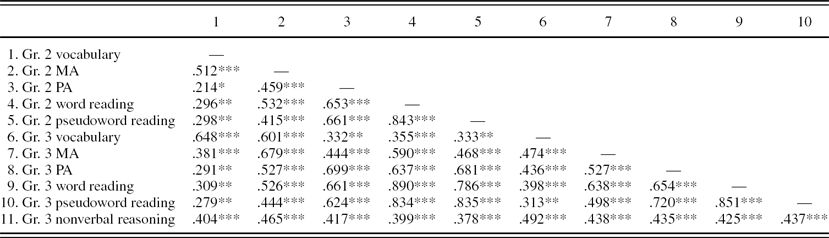
Table 2 shows Pearson correlations between variables. All of the predictor variables (phonological awareness, word reading, pseudoword reading, and nonverbal reasoning) were significantly positively correlated with each of the vocabulary and morphological awareness variables at each grade. Table 2 shows that some of our predictor variables were highly correlated with each other (r > .80); to address this, we examined multicollinearity statistics. In all analyses, variance inflation factors were smaller than 5, and tolerances were larger than 0.2, putting these indices of multicollinearity within an acceptable range for the use of linear regression (as outlined by, e.g., Bowerman & O'Connell, Reference Bowerman and O'Connell1990; Myers, Reference Myers1990).
Pearson correlations between variables
Note: MA, morphological awareness; PA, phonological awareness.
*p < .05. **p < .01. ***p ≤ .001.
To assess the developmental sensitivity of our morphological awareness and vocabulary measures, we used paired t tests to compare children's scores in Grade 2 with their scores in Grade 3 (means and standard deviations are shown in Table 1). Children's morphological awareness scores in Grade 3 were significantly higher than their morphological awareness scores in Grade 2, t (99) = –6.40, p < .001, Cohen d = –0.65. Likewise, children's vocabulary scores in Grade 3 were significantly higher than their vocabulary scores in Grade 2, t (99) = –7.57, p < .001, Cohen d = –0.76.
Confirming the association between morphological awareness and vocabulary
Concurrent associations
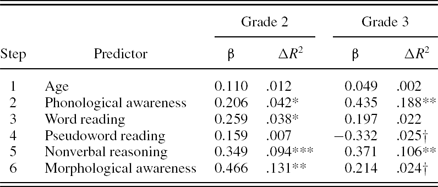
We conducted hierarchical regression analyses at each grade level to determine whether morphological awareness was associated with vocabulary when measured in the same grade. In these analyses, we included concurrent age, phonological awareness, word reading, pseudoword reading, and nonverbal reasoning as controls in Steps 1 through 5; these control variables were assessed at the concurrent grade level to maximize the spurious variance for which they might account. Together, these control variables accounted for 19.3% of variance in Grade 2 and 34.3% in Grade 3. We then entered the morphological awareness measure into the regression equation in the final step (Step 6). Vocabulary at the concurrent grade level was the outcome variable in both analyses.
The results of these analyses are shown in Table 3. In Grade 2, morphological awareness contributed unique variance to vocabulary knowledge, accounting for 13.1% of variance after controlling for the above-mentioned variables (f 2 = 0.19). In Grade 3, morphological awareness accounted for a marginally significant 2.4% of vocabulary knowledge (f 2 = 0.04). These findings indicate that morphological awareness and vocabulary are associated with each other at the same point in time.
Summary of concurrent hierarchical regression analyses showing the contribution of morphological awareness to vocabulary in Grades 2 and 3
Reported beta weights are from the step at which each variable was first entered into the model.
†p < .1. *p < .05. **p ≤ .001. **p < .01.
Longitudinal associations
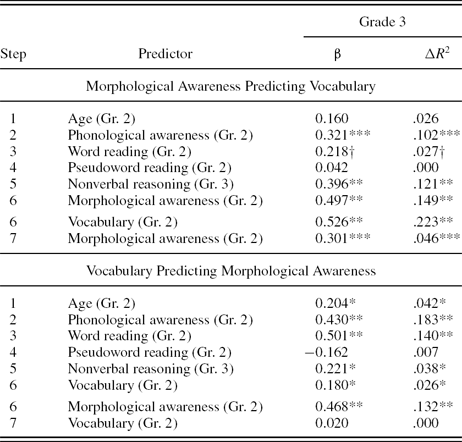
Next, in order to further confirm the association between morphological awareness and vocabulary over time, we conducted a series of longitudinal regression analyses. These analyses examined both whether Grade 2 morphological awareness is associated with Grade 3 vocabulary and, conversely, whether Grade 2 vocabulary knowledge is associated with Grade 3 morphological awareness. These analyses do not include the autoregressive controls. As before, to maximize the amount of spurious variance accounted for, we controlled for age, phonological awareness, word reading, pseudoword reading, and nonverbal reasoning in the first steps of these analyses (Steps 1 through 5), taking measures from the Time 1 grade level (Grade 2) where possible for each analysis. These control variables accounted for 27.6% of variance in Grade 3 vocabulary and 41.0% of variance in Grade 3 morphological awareness. In Step 6, we entered the predictor variable: Grade 2 morphological awareness in the first analysis, predicting Grade 3 vocabulary, and Grade 2 vocabulary in the second analysis, predicting Grade 3 morphological awareness.
The results of these analyses can be seen in Table 4. As shown in the upper portion of this table, Grade 2 morphological awareness accounted for a significant 14.9% of variance in Grade 3 vocabulary knowledge, beyond that accounted for by the control variables listed above (f 2 = 0.21). The lower portion of the same table shows the results of the analysis in which we looked for effects in the opposite direction, with vocabulary predicting subsequent morphological awareness. In that analysis, Grade 2 vocabulary is associated with a small but significant 2.6% of unique variance in Grade 3 morphological awareness (f 2 = 0.04). These results confirm that there is a longitudinal association between morphological awareness and vocabulary. Again, these analyses do not include the autoregressive controls that tell us about whether early skills are associated with change in other skills.
Summary of longitudinal hierarchical regression analyses showing the contribution of morphological awareness to vocabulary between Grades 2 and 3
Note: The reported beta weights are from the step at which each variable was first entered into the model. The results for the last two entries in each section control for the autoregressive effect of the outcome variable.
†p < .1. *p < .05. **p < .01. ***p ≤ .001.
Temporal relationship between morphological awareness and vocabulary
In order to address our primary question about the temporal order of the relationship between morphological awareness and vocabulary development, we conducted a series of longitudinal cross-lagged regression analyses (Davis & Bryant, Reference Davis and Bryant2006; McBride-Chang et al., Reference McBride-Chang, Tardif, Cho, Shu, Fletcher and Stokes2008; Ruffman, Slade, & Crowe, Reference Ruffman, Slade and Crowe2002). In these analyses, we added the autoregressive effect of the outcome variable as an additional control. For instance, in order to examine Grade 2 morphological awareness as a predictor of Grade 3 vocabulary, we entered Grade 2 age, phonological awareness, word reading, pseudoword reading, and nonverbal reasoning as controls in Steps 1 through 5. This was followed by Grade 2 vocabulary in Step 6 and, finally, by Grade 2 morphological awareness as the predictor in Step 7. By controlling for Grade 2 vocabulary, we are able to evaluate the contribution of morphological awareness to the change in children's vocabulary knowledge from Grade 2 to Grade 3. Similarly, we performed an analysis in the other direction, looking at Grade 2 vocabulary as a predictor of Grade 3 morphological awareness, after controlling for Grade 2 morphological awareness. Taken together, these cross-lagged analyses allow us to evaluate the temporal order of these constructs’ relationship in a way that our prior analyses could not.
The results of these analyses are shown in Table 4. We first examined Grade 2 morphological awareness as a predictor of change in vocabulary between Grades 2 and 3. The autoregressor (Grade 2 vocabulary) accounted for a significant 22.3% of variance; taken together with the controls described previously, control variables accounted for 49.9% of variance in this analysis. Under these stringent conditions, Grade 2 morphological awareness remained uniquely associated with change in vocabulary between Grades 2 and 3, contributing a unique 4.6% of variance (f 2 = 0.10). Finally, we conducted a similar analysis to examine effects in the opposite direction, looking at whether Grade 2 vocabulary is associated with change in morphological awareness between Grades 2 and 3. The autoregressor (Grade 2 morphological awareness) accounted for 13.2% of the variance, which combined with the other control variables amounts to a total of 54.2%. Grade 2 vocabulary did not contribute any additional variance beyond that of the control variables (f 2 = 0).
To recap, morphological awareness was correlated with concurrent vocabulary knowledge at Grade 2, with a similar, marginally significant effect at Grade 3. Longitudinally, the presence of this relationship was maintained: Grade 2 morphological awareness was associated with subsequent Grade 3 vocabulary, and likewise, Grade 2 vocabulary was associated with subsequent Grade 3 morphological awareness. However, after controlling for the autoregressive effect of the outcome variable at Grade 2, we found that Grade 2 morphological awareness was associated with change in vocabulary knowledge between Grades 2 and 3. Looking in the other direction, Grade 2 vocabulary was not a predictor of the same change in morphological awareness between Grades 2 and 3.
DISCUSSION
We report here on an investigation of the nature and temporal order of the relationship between morphological awareness and vocabulary development among monolingual English-speaking children between Grades 2 and 3. We found that these variables share unique concurrent and longitudinal associations after controlling for extraneous cognitive and language skills. These results confirm and extend existing evidence for a concurrent relationship between the two constructs (e.g., McBride-Chang et al., Reference McBride-Chang, Wagner, Muse, Chow and Shu2005). In a longitudinal sense, we found that initial morphological awareness was associated with subsequent vocabulary knowledge and that initial vocabulary knowledge was associated with subsequent morphological awareness. The main goal of this study was addressed through analyses that evaluated change in morphological awareness and vocabulary between Grades 2 and 3. After controlling for the autoregressive effect of the outcome variable, we found that morphological awareness in Grade 2 was associated with change in vocabulary between Grades 2 and 3. Conversely, Grade 2 vocabulary was not uniquely related to change in morphological awareness between Grades 2 and 3. Of course, as with any correlational design, we cannot infer that this is a causal relationship, nor can we exclude the possibility that the relationships were influenced by a spurious third variable. However, our analyses do offer suggestive evidence for a relationship between morphological awareness at Grade 2 and subsequent vocabulary development between Grades 2 and 3.
Our findings are in keeping with the suggestion that children use morphological analysis in order to infer word meanings (e.g., Carlisle, Reference Carlisle, Wagner, Muse and Tannenbaum2007; Wysocki & Jenkins, Reference Wysocki and Jenkins1987). Studies that have offered this interpretation suggest that children rely on morphemes and morphological awareness to aid their knowledge of morphologically complex words specifically. In our study, vocabulary was assessed more broadly and did not specifically target morphologically complex words. This suggests that perhaps morphological awareness plays a role in the development of general vocabulary knowledge, extending beyond just its contribution to children's knowledge of morphologically complex words. It is worth noting that, after including the autoregressive vocabulary control variable, morphological awareness was associated with a relatively small unique percentage of change in vocabulary, at 4.6%. However, when interpreting the quantity of this effect, we must bear in mind that it represents the amount of variance beyond that accounted for by the stringent controls (49.9%). Moreover, the 4.6% unique variance observed in this analysis represents a medium effect size (f 2 = 0.10; Cohen, Reference Cohen1988).
Another interesting outcome of the analyses reported here lies in what we did not find; vocabulary knowledge in Grade 2 was not associated with change in morphological awareness across Grades 2 to 3. Taken together, these findings differ from both of the previous studies that have addressed the temporal order of the relationship between morphological awareness and vocabulary. McBride-Chang et al. (Reference McBride-Chang, Tardif, Cho, Shu, Fletcher and Stokes2008) found that morphological awareness (evaluated with a compounding task) was associated with growth in vocabulary and that vocabulary was associated with growth in morphological awareness in monolingual Mandarin-, Cantonese-, and Korean-speaking children between kindergarten and Grade 1. In contrast, Kieffer and Lesaux (Reference Kieffer and Lesaux2012) did not find either relationship for morphological awareness and vocabulary growth between Grades 4 and 7 in English language-minority learners. Comparing our study with those of McBride-Chang et al. (Reference McBride-Chang, Tardif, Cho, Shu, Fletcher and Stokes2008) and Kieffer and Lesaux (Reference Kieffer and Lesaux2012) highlights differences that might contribute to the divergent results.
We will first consider how our study compares to that of McBride-Chang et al. (Reference McBride-Chang, Tardif, Cho, Shu, Fletcher and Stokes2008). Both studies found that initial morphological awareness was associated with subsequent increases in vocabulary among relatively young, monolingual children whose morphological awareness and vocabulary were measured in their native language. Our results differ in that McBride-Chang et al. found the reverse relationship (initial vocabulary associated with increases in morphological awareness) among Mandarin-, Cantonese-, and Korean-speaking children, whereas in our English-speaking sample, this was not the case. One possible reason for this difference lies in the measurement of vocabulary. Our study measured receptive vocabulary, in which children identified the meaning of a word in a four-option forced-choice task; in contrast, McBride-Chang et al. (Reference McBride-Chang, Tardif, Cho, Shu, Fletcher and Stokes2008) measured expressive vocabulary, in which children were asked to give open-ended word definitions. The receptive vocabulary task certainly requires some degree of knowledge about the meaning of a word in order to select the correct response from among the distractors; however, generating an accurate definition likely requires a deeper, more elaborated knowledge of word meaning. It may be the case that this more elaborated knowledge is particularly useful in helping children to identify and extract morphological regularities, making the expressive task a more sensitive measure of vocabulary knowledge as a facilitator of morphological awareness growth.
A second noteworthy difference between the two studies is that they examine very diverse languages with differing morphological features: compound morphology in Mandarin, Cantonese, and Korean, and inflected and derived morphology in English. This difference is in keeping with the most productive morphological features of the respective languages; however, there are differences among these languages in their formation of morphologically complex words. For example, when compared to morphologically complex English words, the morphemes in Chinese compound words tend to have more transparent, identifiable meanings (Hoosain, Reference Hoosain, Chen and Tzeng1992), and the resultant compounds are less likely to involve a change in phonology (Ku & Anderson, Reference Ku and Anderson2003). In contrast, morphologically complex English words vary in their semantic transparency; although many derived words have semantically transparent meanings, there are a large number of words whose meanings are not entirely predictable based on their component morphemes (Nagy & Anderson, Reference Nagy and Anderson1984). It seems reasonable to assume that any benefit of a large vocabulary in extracting morphological regularities from words would be contingent on the component morphemes being readily identifiable to children. This is one possible explanation for McBride-Chang et al.'s (Reference McBride-Chang, Tardif, Cho, Shu, Fletcher and Stokes2008) findings that a large vocabulary in compound-rich languages such as Mandarin, Cantonese, and Korean is associated with increases in compound awareness and for our finding that a large vocabulary in English, where the morphemes in words may not always be as identifiable, is not associated with increases in inflected and derived awareness.
Next, we compare our results to those of Kieffer and Lesaux (Reference Kieffer and Lesaux2012). Like Kieffer and Lesaux's study, and as discussed above, we found that initial vocabulary was not related to growth in morphological awareness among English-speaking children. Our results differ in that, unlike the current study, Kieffer and Lesaux did not find a relationship between initial morphological awareness and subsequent vocabulary growth. It is possible that the discrepant results were a function of the different analyses used to address the question. The cross-lagged analyses used in our study, which closely mirror those of McBride-Chang et al. (Reference McBride-Chang, Tardif, Cho, Shu, Fletcher and Stokes2008), differ from the latent growth curve modeling reported by Kieffer and Lesaux (Reference Kieffer and Lesaux2012). Although their approach is a useful one, we could not apply it to the current study, which only measured two time points; this limits the extent to which our results can be directly compared to those of Kieffer and Lesaux. It is also important to consider that the two studies involved different populations: monolingual English-speaking children in early elementary school compared with upper-elementary and middle school aged Spanish-speaking children who were receiving instruction in English. Both age and language background differences affect the amount of exposure that these children have had to oral English and have implications for the development of English morphological awareness and vocabulary; for instance, Kieffer and Lesaux demonstrate that, on average, their participants showed lower vocabulary knowledge than would be expected of monolingual English speakers based on national norms.
Strength of the associations between morphological awareness and vocabulary
Although this study's primary goal was to clarify the temporal nature of the relationship between morphological awareness and vocabulary development, we also explored the concurrent and longitudinal associations between the two skills. Doing so yielded interesting and unexpected results, which we turn to now. Examining the correlation coefficients in Table 2 shows that, although all of the associations between morphological awareness and vocabulary were significant, their strengths varied. For instance, the weakest relationship (r = .38) is between Grade 2 vocabulary and Grade 3 morphological awareness. Post hoc analyses showed that this correlation was not significantly different than the concurrent Grade 3 correlation between morphological awareness and vocabulary (r = .47; Steiger Z = –1.23, p = .22) and was only marginally lower than the concurrent Grade 2 correlation (r = .51; Z = –1.84, p = .07). Thus, although the longitudinal correlation between Grade 2 vocabulary and Grade 3 morphological awareness is somewhat low, it is not unreasonably so, and it is consistent with the intuitive idea that longitudinal relationships between two skills are likely to be somewhat weaker than concurrent relationships between those skills.
What is perhaps more surprising is that our other longitudinal association, between Grade 2 morphological awareness and Grade 3 vocabulary (r = .60), did not follow that expectation. Post hoc analyses show that it did not differ statistically from the concurrent Grade 2 correlation (Z = 1.31, p = .19) but that it was marginally stronger than the concurrent Grade 3 correlation (Z = 1.92, p = .056). This difference is made more striking when we consider the regression analyses predicting Grade 3 vocabulary. After several controls, Grade 2 morphological awareness predicted a unique 14.9% of variance in Grade 3 vocabulary. In contrast, concurrent Grade 3 morphological awareness predicted only 2.4% of unique variance in Grade 3 vocabulary. Despite the fact that the control measures accounted for similar amounts of variance in both the longitudinal and the concurrent analyses (27% and 34%, respectively; Z = –1.58, p = .11), earlier morphological awareness in the longitudinal analysis predicted far more unique variance in Grade 3 vocabulary than concurrent morphological awareness was able to predict (Z = 2.23, p < .05).
This substantial, unexpected discrepancy raises interesting theoretical questions about the relationship between the two constructs. Addressing these questions is beyond the scope of the current study, but they nonetheless warrant discussion. For instance, we might consider whether morphological awareness is equally useful to children's vocabulary acquisition across development or whether its utility diminishes as children age. It might be the case that strong early morphological awareness is particularly beneficial in helping children to build their vocabularies, whereas over time morphological awareness comes to play a less important role. Similar reasoning can be found in other areas of developmental research. For example, Wagner et al. (Reference Wagner, Torgesen, Rashotte, Hecht, Barker and Burgess1997) examined the influence of phonological processing abilities on subsequent word reading in young children (from kindergarten to Grade 2, Grades 1 to 3, and Grades 2 to 4). Earlier phonological naming made a unique contribution to later change in word reading in the first two age ranges, but this initial contribution had disappeared by the last age range, perhaps suggesting a limited developmental period during which this skill is useful to word reading. Of course, applying this explanation to our results is necessarily quite speculative. That being said, it is clear that important questions remain about the extent to which morphological awareness and vocabulary are related across development.
Limitations and future directions
The interpretation of our results must be based on an evaluation of the measures that we used to assess our central constructs. To that end, it is worth considering the features and limitations of our vocabulary and morphological awareness tasks. We measured vocabulary using a shortened version of the PPVT-III, a standardized measure (Dunn & Dunn, Reference Dunn and Dunn1997). Although we have some confidence in the validity of the shortened vocabulary task for our purposes (scores on the full and shortened tasks at Grade 1 correlate to a similar degree with subsequent Grades 2 and 3 scores), use of the full vocabulary measure would have been ideal. It is also worth noting that, consistent with prior studies (e.g., Kieffer & Lesaux, Reference Kieffer and Lesaux2012), we used a general measure of vocabulary in which morphologically complex items appear but are not the focus. This suited our goal of exploring the relationship between broad measures of morphological awareness and vocabulary, and allowed us to present a descriptive account of the statistical relationship between morphological awareness and subsequent change in vocabulary. That being said, the presence of this relationship raises interesting questions that are beyond the scope of the current study. Future research will be needed to determine what drives the observed relationship between morphological awareness and general vocabulary development; recognizing component morphemes may help children to infer the meaning of morphologically complex words (e.g., Carlisle, Reference Carlisle, Wagner, Muse and Tannenbaum2007), but the monomorphemic words that constitute much of our general vocabulary measure presumably do not benefit directly from such morphological analysis.
We must also consider our measurement of morphological awareness. A notable limitation of this task is that it includes a relatively small number of items, among which are morphological forms (particularly inflectional forms like the past tense) that children are typically able to use in oral language much earlier than Grade 2 (e.g., Nicoladis, Palmer, & Marentette, Reference Nicoladis, Palmer and Marentette2007). In light of this point, it is important to reiterate that our morphological awareness task should not be taken as a measure of children's knowledge or use of particular morphological forms. Instead, it is more usefully seen as a measure of children's metalinguistic ability to recognize morphological relationships between words and to manipulate the meaning of words by applying those relationships. Our participants’ performance on the morphological awareness task highlights the distinction between knowledge of morphological forms and awareness of morphological relationships. Despite the inclusion of several early developing morphological forms, there were no ceiling effects in children's performance on the task, even when examining only the inflected items (in Grade 3, for example, children's scores on the inflected items were 65% accurate on average, M = 4.55, SD = 1.42).Footnote 2 When creating our task, we deliberately chose a wide variety of morphological transformations, representing varying degrees of difficulty. However, there are clear challenges involved in measuring the full range of children's morphological awareness. Our broad morphological awareness task makes an initial step toward the creation of a representative measure of this metalinguistic ability, but certainly the use of a longer task that included a variety of complex morphological transformations would have been a benefit.
It is worth considering how the limitations in the scope of our morphological awareness task might have influenced our results. It is possible that the task became less useful for measuring children's growing morphological awareness in Grade 3 than it was in Grade 2. If that were the case, and the task was not able to detect subtle development in Grade 3 children's morphological awareness, it might have limited the relationships that we were able to observe in the data. There are two findings for which this would be particularly relevant. The first is that Grade 2 morphological awareness was a much stronger predictor of Grade 3 vocabulary than was Grade 3 morphological awareness; problematic measurement of Grade 3 morphological awareness is likely to limit concurrent relationships. The second finding is that Grade 2 vocabulary did not predict change in morphological awareness between Grades 2 and 3; an insufficiently sensitive Grade 3 task could artificially limit the amount of change that we measured in children's morphological awareness between Grades 2 and 3, which may then explain why vocabulary was not able to predict that change. However, examining the data suggests that the task was sufficient for the grade levels at which we used it. At both grade levels, children's scores had similar ranges, showed similar amounts of variance, and there were no indications of floor or ceiling effects in the data; the task seems to have been sensitive to individual differences. Although we contend that the task was adequate for the purpose of our analysis, it certainly remains possible that a longer and more varied task would have been able to measure children's growing morphological awareness skills more sensitively. Future measure development may help to ultimately create a more fine-grained account of the temporal nature of the relationship between morphological awareness and vocabulary development in a way that more fully represents the complexity of English morphology. Addressing this task limitation is likely to be particularly critical in any attempts to extend the current study to older age groups, given the rapid increase in both the prevalence of derived words (Anglin, Reference Anglin1993) and children's ability to apply derivational knowledge (Carlisle, Reference Carlisle1988; Wysocki & Jenkins, Reference Wysocki and Jenkins1987) in the upper elementary school years.
We must also consider statistical limitations when interpreting our pattern of temporal associations between morphological awareness and vocabulary development. Of the most importance, we must note the correlational nature of our study; as with any examination of associations between variables, we cannot rule out the possibility that the effects are due to spurious variables. Thus, although the autoregressive controls used here are a useful way to establish temporal relationships between variables, we cannot make causal claims based solely on our results. In order to confirm the temporal relationships found here, it will be useful to combine longitudinal research with intervention studies. It is encouraging that there is some evidence that interventions to improve morphological awareness can improve vocabulary for untaught morphologically complex words (Baumann, Edwards, Boland, Olejnik, & Kame'enui, Reference Baumann, Edwards, Boland, Olejnik and Kame'enui2003; Bowers & Kirby, Reference Bowers and Kirby2010). However, further intervention research will be needed to more fully explore the associations reflected in our analyses, particularly the association between morphological awareness and increase in general vocabulary knowledge. This would represent a valuable avenue of research in light of the potential instructional implications. If future research were to conclude that the relationships reported here are causal, our unidirectional effect would add to existing support for the use of morphological instruction (Bowers, Kirby, & Deacon, Reference Bowers, Kirby and Deacon2010). For one thing, the finding that morphological awareness predicted subsequent change in vocabulary would suggest that morphological instruction could have the added benefit of improving children's vocabularies. Moreover, the fact that vocabulary did not predict subsequent change in morphological awareness would suggest that instructors should not assume that children's vocabulary knowledge will itself help to improve their morphological awareness.
The results of the analyses reported here provide an initial step toward understanding the temporal nature of the relationship between morphological awareness and vocabulary development in young English-speaking children. Although it remains conceptually plausible for the two constructs to contribute reciprocally to each other's development, we observed that morphological awareness in Grade 2 was associated with subsequent vocabulary development between Grades 2 and 3, but vocabulary in Grade 2 was not associated with growth in morphological awareness between Grades 2 and 3. While preliminary, these results add to our understanding of the temporal nature of the relationship between morphological awareness and vocabulary.
APPENDIX A
Morphological awareness word analogy task items