Introduction
Community dementia care is growing due to a combination of patient choice to remain in their home and the relative savings in costs compared with residential care (Henderson and Caplan, Reference Henderson and Caplan2008). Despite the fact that the paid care workforce is one of the largest and fastest growing workforces worldwide (Hecker, Reference Hecker2005), in Australia alone, there will need to be an almost threefold increase in aged care workers over the period 2010–2050 (Department of Health and Ageing, 2012). Hence, it is entirely possible that there will be inadequate numbers of aged care workers to meet the increasing care needs of the aging population. Current human resource factors may exacerbate difficulties with the development of this occupational group. In particular, turnover was considered a “serious” or “very serious” direct care workforce issue by 97% of American states in 2007, a substantial increase from 76% in 2005 (PHI, 2009). The characteristics of care workforces may also pose a challenge for the development of this workforce. Internationally, the majority (91%) of care workers are female, have an approximate average age of 40 years, have low levels of education, qualifications, and remuneration (Martin and King, Reference Martin and King2008; Figueriredo, Reference Figueriredo2011). Finding ways to build the capacity of the existing workforce, while improving employee recruitment and retention rates in dementia care, is a paramount concern if we are to prepare for the predicted changes in the public health landscape.
Social interaction is a central part of community-based dementia care delivery, as services are provided through interpersonal interactions in the private domain of the care recipient's home. A gap exists in the literature on the social and relational aspects of dementia care delivery from the community-based workers’ perspective. A systematic review of rigorously tested dementia training interventions that focused on worker and organizational outcomes found that no training components adequately addressed aspects of the emotional regulation of workers and how they manage the intimacies of caring, particularly concerns of privacy and dignity of people with dementia (Elliott et al., Reference Elliott, Scott, Stirling, Martin and Robinson2012). Therefore, this study analyzes qualitative data on workers’ perceptions of their relationships with care recipients to deepen understanding of the social and interpersonal aspects of the paid community care role. By focusing on the community-based workforce in this way, the current research aims to fill an identified gap (Elliott et al., Reference Elliott, Scott, Stirling, Martin and Robinson2012) in this care setting.
Social psychology theory was chosen as a frame to analyze data from a sample of the dementia care workforce, due to the inherent social nature of job tasks and duties in the care role. A sense of communion (coined by Bakan, Reference Bakan1966) which refers to a person's desire to closely relate to, cooperate, and merge with others, where individual fulfillment is experienced through relationships, and a sense of belonging (Guisinger and Blatt, Reference Guisinger and Blatt1994) may form part of the characteristics of this workforce. While research about communion has occurred in the business context, such as its relationship with corporate social responsibility (Van Marrewijk, Reference Van Marrewijk2003), and found to be important for women in their careers generally (Ellery-Brown, Reference Ellery-Brown2011), little work has focused on the application of communion to the paid caring role. The organizational psychology literature also provided a useful theoretical framework in which to ground the research. The job demands and job resources (JD-R; Demerouti et al., Reference Demerouti, Bakker, Nachreiner and Schaufeli2001) model has been shown to influence workers’ experience of job stress. When job demands outweigh job resources, workers show burnout and disengagement from work. Most research on the JD-R has been applied to clerical employees and general health workers (De Jonge et al., Reference De Jonge, Le Blanc, Peeters and Noordam2008), but not dementia care workers in the community. A multidisciplinary approach was adopted in this study by applying the social and organizational psychology theories outlined above to investigate dementia care workers’ experiences. The current study aimed to identify themes that relate to the occupational experience of dementia care workers, and examine how the themes relate to capacity-building for community-based dementia care.
Methods
Research context
The study was conducted in Australia, where care workers operate within a three-tiered system including aged care nursing homes, hostels, and support programs for people living in the community (e.g. community care; Henderson and Caplan, Reference Henderson and Caplan2008). Care workers provide the practical care and personal assistance not only to people with dementia, but also the general older population or those living with disabilities.
Participants
Twenty-five paid community dementia care workers were recruited over a six-month period (April to October 2010) from aged care community service providers in Tasmania, Australia. The project was granted ethics approval from the Tasmanian Health and Medical Human Research Ethics Committee, EC00337 (reference number H10984) prior to recruitment.
Procedure
Participants were recruited from Home and Community Care (HACC) funded services in Tasmania, Australia. The HACC program is a Commonwealth initiative. It funds basic maintenance and support services to help frail older people and younger people with disabilities to continue living in their community. Employees were invited to participate if they provided care and assistance to people with dementia and worked in the community care environment. Employees working in residential care facilities were not included in the study.
Employees were invited to participate via use of flyers and brochures displayed in the work building. Potential participants registered their interest in the project via two methods: (a) a telephone call or (b) accessing a dedicated Web site where they completed a short form detailing their contact information. After registering their interest, participants were contacted by the first author to discuss the project in more detail. If workers agreed to participate, a face-to-face or telephone interview was scheduled. Ethical standards (National Health and Medical Research Council, 2007) for recruitment were followed to ensure informed consent and no risk for workers. In order to minimize the risk that participating in the project could have on workplace relationships, all interviews were conducted away from the care workers’ site. In addition, all participant information was confidential and the workplace was not informed of workers participating in the project.
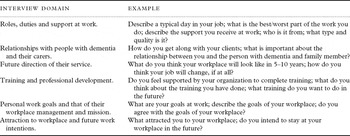
All participants completed a 40-minute standardized semi-structured interview. The interview comprised questions about socio-demographic and employment information followed by a set of 22 questions exploring their values and views on their work. Interview domains included job roles, duties and support at work, relationships, future direction of their service, training and professional development, personal and organizational goals, attraction to work, and intention to stay (see Table 1). The interview domains were influenced by identified gaps of knowledge in the aged and dementia care literature. For participants employed concurrently by two organizations, answers to interview questions related to their primary place of work. The interviews were conducted by the first author, who is a registered clinical psychologist. Interviews were recorded and later transcribed for coding analysis.
Summary of interview domains for the Work 4 Dementia Project

Design and data analysis
A qualitative multi-site exploratory–descriptive design was employed. A deductive approach to Interpretive Phenomenological Analysis (IPA; Smith et al., Reference Smith, Flowers and Larkin2009) was applied to identify how community dementia care workers’ experience several key areas of their vocation (e.g. relationships and job roles) and how these corresponded with theoretical concepts within social and organizational psychology. To achieve credibility, theory/perspective triangulation was used as suggested by Patton (Reference Patton1999), where multiple theoretical perspectives were applied to examine and interpret the data. This is consistent with best practice in conducting and reporting qualitative research as sourced in the Qualitative Research Guidelines Project (Cohen and Crabtree, Reference Cohen and Crabtree2006).
Demographic, occupational, and qualitative data were managed using computer software (SPSS Statistics 19.0: IBM, 2010; QSR International's NVivo.8: NVIVO, 2008) to facilitate greater consistency, rigor, and speed in the analytic process (Bazeley, Reference Bazeley2007). The study conformed to Bromley et al. (Reference Bromley2002) criteria for conducting and reporting qualitative research, in that all of the criteria were fulfilled to indicate that the conclusions of the study are very unlikely to alter.
Three coding stages occurred to refine and confirm the phenomena identified in the data. The first and second stages were conducted by a primary coder and the third stage by a secondary coder. The first stage of coding was to categorize interview comments into topics. These topics (see Table 1) were based on the interview domains raised by the interviewer through the semi-structured interviews and participants provided in-depth answers. The second coding stage included matching categories to theoretical concepts, while identifying qualitative themes coded as nodes on a family tree. As new dimensions or themes were identified during the investigation, the phenomena were highlighted by both discordant and converging themes (Robson, Reference Robson2002). The third stage of coding involved a secondary coder to determine rates of inter-reliability and account for potential coding bias. Once all textual data were coded, a set of tables was created to provide example quotes of each node, used by the secondary coder for analysis. Inter-coder reliability tests were conducted on the data. This process involved a secondary coder (who was blind to the concepts of the Work 4 Dementia Project) to code 10% of the data (cases selected by random number generator). Both coders had training in NVvivo.8 and the secondary coder was provided with clear definitions of the node system.
Results
Sample characteristics
Forty dementia care workers registered interest in the project, but eight of these could not be contacted and three did not meet study inclusion criteria. (reasons were: not currently working with people who have dementia, n = 1; worked in residential care, n = 1; and worked solely with carers of people with dementia, n = 1). Of the 29 eligible participants, three (10.4%) refused to participate. Reasons for refusal included: “too busy as moving house” (n = 1), “due to undergo surgery for a health condition” (n = 1), and thought the study “was about dementia and not so much about work” (n = 1). One worker failed to attend the interview and withdrew from the study.
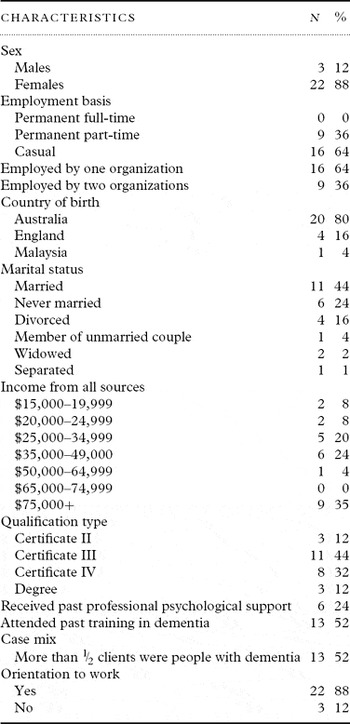
Thus, 25 dementia care workers participated in the study. Participants were recruited from seven organizations operating in the community care sector in Tasmania, one state of Australia. The participants were mostly middle-aged females (mean age = 53 years, SD = 9.6) and they were employed for an average of six years (SD = 4.3) at their current workplace. Table 2 shows the characteristics of the sample.
Community-based dementia care worker characteristics (n = 25)

Participants were also asked about what training they would like to attend in the future. Topics stated by participants included “dementia and dementia updates, palliative care, train the trainer [training and assessment], nutrition for the client, career options, diversional therapy to manage behavioral problems [of care recipient], medications, [care recipient] mental health, and caring for CALD patients and families.”
Qualitative themes
The semi-structured interviews were transcribed and coded for themes. On average, 57 coded sections of data were identified in each interview. The inter-coder reliability test across all these sections revealed high average κ coefficients of 0.9 and an agreement average of 99.5%. Further analysis was undertaken on the coded sections of data to create broad overarching commonalities with particular focus on theory-driven concepts (from social and organizational psychology). Thus, three superordinate themes were identified: (1) occupational communion, (2) job demands, and (3) job resources. Nineteen constituent themes were identified within the superordinate themes. The constituent themes are presented within each superordinate theme description. While the theories of communion and JD-R have been mentioned in the Introduction, these were not a predetermined focus. Rather, during the analysis stage, social and organizational psychology literature was examined and theoretical constructs were identified to match with the data, and informed the creation of the themes.
The overarching message from the community dementia care workforce was that they were highly satisfied in their jobs, showing a strong attachment to their clients. Workers also felt that more resources and training were needed to face the future. While workers enjoyed their jobs and the challenges of delivering support and care to people with dementia and their family members, they felt that they were “undervalued,” “underpaid,” and “under-resourced.” Within each of the three superordinate themes are themes that relate to suggestions for improvements in the sector, all of which have important implications for organizational intervention. The themes are described with relevance for a conceptual model for capacity-building and resilience.
Occupational communion
Theme description
The occupational communion theme included a sense of happiness and positivity in workers to participate in job tasks that were inherently based in social interaction, while having compassion for their clients and a desire for collegial interaction. Rewarding relationships, a strong sense of being suited to the job, a psychological need for social interaction, advocacy for clients, and motivation to help others, in some cases putting others needs above their own were all part of the occupational communion theme. Workers reported that strong social connection, reliability, familiarity, consistency, and stability through long-term relationships facilitated care recipients’ consent to receive care. The following are some illustrative samples in the workers’ own words:
. . .being invited into people's homes, and sort of talking to people, . . .I know that if I share a cup of tea with them, . . .they're going to sort of open up and talk and I find that's probably the best part of the work.
She trusts me and I think when you work in the way we do you develop a trust[ing] relationship and. . . they rely on you, they know that when you come, you'll fix the problem and you'll help do something, and that's a good feeling.
I know I'm good at what I do. It comes easy and naturally.
I had empty nest syndrome and this has just filled that void beautifully. I've got great clients. They're just like an extended family and I've got people I can spoil rotten now.
The worst part of work is not enough interaction with other [formal] carers, it's something that we really have to organize ourselves. . . to be able to share the ups and downs of life and also debrief. Talk about the tricks of the trade. That would be really very useful.
Job demands
Theme description
The job demands theme included the many challenges faced by dementia care workers in their job roles that varied with intensity. This theme shows that workers were constantly expected to rise to challenges such as being alert to changes in care recipients and the environment, diverse practical care tasks, communicating with clients and family members, dealing with strong emotions such as grief and loss, and isolation, as well as navigating the boundaries of the professional care relationship. Most workers also made reference to occasions in their work role where they publicly displayed certain types of emotions while hiding others, for the benefits of their clients (emotional labor):
Always listen and watch, you have to be alert the whole time with dementia clients . . .you have to think on your feet. . . . It's a real challenge.
Sometimes when I come out of somewhere I heave a beautiful sigh of relief that I'm finished for that shift. Depending on what they're like for the day, but you don't tell them that.
A lot of your role is very unofficial, and you have to bend the boundaries at times. . . The hardest thing is making sure it's a professional relationship.
The family, it's quite an important relationship, mutually. I need to talk to them, and they seem to need to talk to me. You can also get into tricky situations when the son and daughter disagree and they try and get me on side.
You can feel very isolated, when you are out there working alone.
Sad that people who have been judges and pilots, and doctors, are now just not able to dress themselves.
The driving is the worst part. . .I have to rush because another client is waiting for me, and because they like to talk, and then you only have five minutes to get to the other place.
Job resources
Theme description
The job resources theme included areas that are often associated with improving the workplace or workforce to reduce the negative effects or psychological costs of job demands. Overall, the job resources theme highlighted several ways workers perceived their work to be supported by both personal and organizational factors. While generally this theme shows that workers perceived good access to resources to support them in their care roles, they also acknowledged specific areas that needed improvement such as job conditions and resources which they considered worthy of organizational investment. Attraction to work was viewed as a type of job resource that contributed to participation in work and also related to work–life balance. In particular, this included being attracted to the flexible nature of the work. Strong organizational commitment and loyalty toward their employer was found to be part of the job resources theme. Workers reported personal goals similar to those of their employer and were also part of the job resources theme. Sound perceived organizational support was identified by workers, and included feeling supported to develop skills and knowledge via training activities. Having an awareness of change was considered a job resource, as workers were familiar with industry challenges. Having prior knowledge about a stressor predicts coping with the event. In this way, an awareness of challenges may add to workers’ knowledge and preparedness to aid coping. Being satisfied with training was identified as a job resource, and most workers displayed a sense that ongoing learning was valuable and helpful for their roles. Leadership was identified as another job resource, found to be sometimes inconsistent. Job security was a resource found to be lacking. Workers reported that they had poor pay and conditions and had felt undervalued. While congruence with organizational values and strong relationships at work appeared to be rewarding, maintaining these relationships made the job demanding, and were a potential source of distress:
The good thing about community work is the flexibility with children. You can pick what hours you want to work and they're not always long shifts.
I think my workplaces’ goals and organizations’ pretty much align with mine, or I wouldn't be working for them.
They've done the right thing by me, so I'm going to look after them.
I just think it will be more, um full on. . . . There will be need for my services and what I do ten-fold to what it is now. And whether or not you can find people who want to do that is the thing. . .I think in five or ten years time you are going to find you have more demented people and you will need to have more people skilled in therapies to deal with demented people.
[My supervisor's support] is not always good – most of the time it's fine.
I don't believe we are highly recognized or paid enough for what we do.
Conceptual model for capacity-building and resilience
The role of occupational communion in the conceptual model may be as a mediator in the work context that facilitates capacity-building and resilience for the workforce (see Figure 1). Workers perceived social interaction with colleagues as an adaptive way to cope with job demands such as isolation. Workers also remained engaged and committed to work due to the rewarding relationships with clients, despite feeling undervalued and underpaid. Thus, occupational communion may be a mediator between the effects of job demands and poor job resources on psychological well-being and retention. Job resources may follow the same pattern as occupational communion, as these factors may act as a buffer against the psychological costs of job demands. However, this model suggests that job resources alone may not be enough to mediate job demands in the social context of community care work. Figure 1 displays the relationships between three factors. The central factor is occupational communion, as the presence of this factor influences the effect on workers of both the job demands and resources factor on the left, and capacity and resilience factor on the right. The pathway in the figure is from left to right, and in this way, it shows how organizations may improve capacity and resilience for their care workforces.
Conceptual model of occupational communion for capacity-building and resilience.

Discussion
Dementia care work is one of the fastest growing occupational groups worldwide and international peak bodies (World Health Organization and Alzheimer's Disease International, 2012) advocate workforce preparedness to sustain and support this occupational group. The findings of the current study inform the design of interventions to build care workers’ capacity and resilience to face the challenges of the dementia health priority. The concept of occupational communion was identified and described in the current study and is defined as a sense of belonging based in social interaction at work that can assist adaptive coping. To our knowledge, this is the first study that identifies this construct in paid carers.
Occupational communion was found for a mainly female sample. While the sample of the current study is consistent with demographic characteristics of workers internationally (Martin and King, Reference Martin and King2008; Figueriredo, Reference Figueriredo2011), occupational communion may be particularly relevant for women. Underlying care workers’ high commitment to their clients appears to be a social need that may be important for women's careers (Ellery-Brown, Reference Ellery-Brown2011). Occupational communion may be a key factor to consider for interventions that aim to enhance the care workforce to deal with the dementia growth in the aged care sector.
There is less consensus in psychological literature as to the precise definition of social support (Kim et al., Reference Kim, Sherman and Taylor2008) than there is for the trait like construct communion, developed almost 50 years ago (Bakan, Reference Bakan1966). Social support is usually defined as the perception that there are people on whom we can depend, and that we are valued and loved (Cohen and Syme, Reference Cohen, Syme, Cohen and Syme1985). Research focuses on how either social networks (structure) or specific types of support behaviors (function) impact on health outcomes. Thus, the term occupational communion suggests communion specific to the work context and organizational or employment matters. In this regard, occupational communion may be a central process that influences the nature of social support processes and interactions. For example, people who are depressed and who also pose a highly communal orientation to social relationships do not derive pleasure or a sense of achievement from their support provisions or caring role (Jin et al., Reference Jin, Van Yperen, Sanderman and Hagerdoorn2010). Future quantitative research could explore whether occupational communion mediates the quality of the care or support workers provide people with dementia and their families.
Social support (particularly in the job demands–control–support model; Daniels, Reference Daniels1999) differs from the concept of occupational communion. Occupational communion accounts for the professional nature of relationships at work as they are not mutual or reciprocal. These interactions take into account the power structures that are found between employees and clients, employees and managers, as well as co-worker interactions. For example, workers feel that they cannot burden clients with their own personal worries or concerns. However, workers may give and receive support from co-workers, but the professional nature of these relationships means that workers are required to monitor their interactions to be appropriate for the work environment. For these reasons, the term occupational communion was chosen rather than “social connectedness,” as it specifically describes the care work context and the theoretical origins of the concept.
A small amount of prior research has explored aspects of communion and the workplace. The finding that occupational communion may play a mediating role in managing job demands and improve quality care is supported by previous research. Hansebo and Kihlgren (Reference Hansebo and Kihlgren2002) found that mutual togetherness and “deep communication for communion” (p. 225) changed care recipient refusal of care into consent to receive care. This involved a “deep relationship between nurse and patient” (Hansebo and Kihlgren, Reference Hansebo and Kihlgren2002, p. 230) and was based in the residential care setting and only for advanced dementia, however, may translate to community care. Furthermore, tentative evidence supports the current findings that occupational communion may serve as a protective factor at work. Employees in high-stress jobs were found to strive for communion as a coping strategy to deal with job stress (firefighters; Halbesleben and Bowler, Reference Halbesleben and Bowler2007) and perceived social relationships as integral to the ideal organizational culture (disability service workers; Hatton et al., Reference Hatton1999). Therefore, implications suggest that communion in the work context where there are high demands may serve to buffer against poor employee well-being and play a mediating role in job performance and be beneficial for organizational culture.
Capacity-building interventions may adopt components informed by the three main themes identified by the current study; namely occupational communion, job demands, and job resources. In particular, components that derive from the occupational communion theme may focus on social interaction at work, such as providing regular meetings between workers to reduce isolation. Components may also include training or group discussions about how to establish and maintain relationships with clients to facilitate quality care (e.g. care consent). Interventions informed by occupational communion that aim to improve recruitment may include components that focus on maintaining positive perceptions of work–life balance to attract potential employees by promoting the flexible nature of the work. These may also focus on matching the social need of potential employees to the supply of the job. This is supported by previous research in human resources, which shows that the extent to which a job's characteristics and rewards fulfill a person's psychological needs is important for successful recruitment of personnel (Kristof-Brown et al., Reference Kristof-Brown, Zimmerman and Johnson2005).
Components informed by the job demands theme may include a focus on several areas. Workers experienced emotional labor, which has previously been found to be particularly relevant for coping with the role of the helping professional (Hochschild, Reference Hochschild1983). Components informed by this job demand may focus on emotional regulation and stress management strategies to cope with emotional labor and grief and loss. Another component suitable for capacity-building interventions may include education about dementia to manage behavioral problems and improve workers capabilities of adjusting to changes in clients’ needs. Providing guidance and strategies on how to manage professional boundaries may also be part of interventions informed by the job demands theme. In contrast, organizational supportive functions informed by the job resources theme may include making improvements to perceived organizational support (POS; Rhoades and Eisenberger, Reference Rhoades and Eisenberger2002) where high POS has previously been found to be associated with job satisfaction and productivity. Providing financial and practical support to access training may be a way to improve POS of workers. In this respect, developing leadership capabilities to ensure quality and consistent supervision and mentorship may also form part of intervention components that aim to enhance capacity.
The job resources theme informs intervention components, particularly those that acknowledge and value workers’ efforts through incentive or recognition programs. Congruence between worker and employer values was identified as a job resource. Approaches that facilitate this match may be important to enhance worker productivity. Previous research supports this and has shown that attraction to work, as well as commitment and engagement at work, was influenced by the level of congruence between worker and employer values (Kristof, Reference Kristof1996). It may be that participation in orientation programs is essential for this type of congruence. Awareness of change was a job resource and may prepare workers to cope with future demands. This is supported by preparedness and self-efficacy research that has previously been applied to coping with natural disasters, where knowledge of risks and self-confidence improves resilience to cope (Paton and Johnston, Reference Paton and Johnston2001). Some other organizational support resources that may be suitable for intervention include improving job security, increasing practical resources that adhere to aging in place, and overall system improvements for better collaboration. However, these components may be more reliant upon funding structures and governmental policies.
Limitations of the current study include the generalizability of the findings to the broader dementia care worker population. This paper focuses on a small selection of the community-based dementia care workforce in Tasmania, an island state of Australia. Tasmania is the 26th largest island in the world but it has a relatively small population of just over 500,000 people (Australian Bureau of Statistics, 2012). There is expected to be a higher proportion of clients accessing home care in Tasmania than any other Australian state or territory (Access Economics, 2010). Furthermore, island communities, like Tasmania, and regional areas are particularly vulnerable to workforce shortage (Demographic Change Advisory Council, 2009). Despite the location of the study, comparable workforce characteristics were found to that of other national surveys in Australia and America, with the exception that most care workers had casual not part-time employment status. This may account for the lack of resources and access to funding experienced by HACC services to deliver support in an island state. Despite the findings being applicable to all community care workers, the current study only recruited care workers who cared for people with dementia. This influenced the ability of the research to distinguish the difference between dementia care workers and other community care workers. Furthermore, a convenience sample was employed whereby self-referral to the study occurred; therefore, most workers experiencing psychological distress or actively contemplating leaving the sector may not have participated.
Strengths of the current study included the rigor of coding and the application of multiple theoretical concepts. Most previous studies exploring communion in the work context did not have a dementia focus and were not set in the community, and had adopted the use of surveys. By applying a qualitative focus, the current study described in-depth the issues most pertinent for community dementia care workers. The relevance of social and organizational psychological theories for sustainability of the dementia care workforce was found to inform capacity-building strategies. This approach is unique in the formal care literature, and we argue that this multidiscipline approach provides a collective strength to determine the best ways to prepare the dementia care workforce for future demands.
Occupational communion may be particularly relevant for women's caring careers and future research is needed to explore the relevance of this concept for men in formal care. In addition, future research must address the under-representation of the community dementia care setting in the literature. To determine reliable change associated with interventions that target occupational communion, further investigation is required on measurement approaches of this concept. Developing assessment tools or adapting existing tools that measure communion for the work setting should be included in future research. Whether intervention components informed by occupational communion, job demands, and resources themes are effective in improving skills and capabilities for all workers or a subset of workers is also relevant for future research. In turn, whether outcomes from intervention research can be replicated through service implementation is of high priority to translate research into practice.
Community dementia care workers genuinely feel “at home” when working with clients. Workers have strong social ties that contribute positively to the continuity of quality care. Despite this, workers experience an overall imbalance in their sense of belonging at work, with particular regard to their professional identity and relationships with colleagues. While a physical base may not appear important for community care workers, a strong social vocational network may offer the foundations essential to a healthy and productive workforce. Providing equilibrium in occupational communion where employees feel a true sense of belonging at work may, in part, create the security the paid care workforce needs in order to attract, train, and retain carers to cope with the aging population.
Conflict of interest
None.
Description of authors’ roles
K.J. Elliott designed the study, collected and analyzed the data, and led the manuscript preparation. J.L. Scott, C.M. Stirling, and A.L. Robinson supervised the research and assisted with writing the paper. A.J. Martin also assisted with writing the paper.
Acknowledgments
This research was supported by a PhD scholarship jointly provided by TIME for Dementia (Tasmania and Victoria Dementia Training Study Centre, Australia), the Wicking Dementia Research and Education Centre and the University of Tasmania, Australia (045135, awarded to J.L.S and A.L.R; K.J.E stipend). The Work 4 Dementia Project was supported in part by Home and Community Care (HACC), a joint Commonwealth and State/Territory Program (030603, awarded to J.L. Scott et al., Reference Scott, Croft, Robinson, Vickers and Sanderson2009). We thank all those who participated in Work 4 Dementia including employees, managers, and project research staff. We thank Robyn Jacobson and Megan Woods for assistance with transcription and coding. We also thank participants for their time and valuable opinions.