Introduction
The management of neuropsychiatric symptoms of dementia poses a challenge to clinicians due to limited evidence regarding the effectiveness of available treatments and severe adverse events from antipsychotic drugs (Ballard and Corbett, Reference Ballard and Corbett2010). In addition to worsening cognitive function (Vigen et al., Reference Vigen2011), antipsychotic use by older adults with dementia is associated with a heightened risk of hip fractures (Pratt et al., Reference Pratt, Roughead, Ramsay, Salter and Ryan2011), pneumonia infections (Pratt et al., Reference Pratt, Roughead, Ramsay, Salter and Ryan2011), hospitalization (Aparasu et al., Reference Aparasu, Jano, Johnson and Chen2008), sudden cardiac death (Ray et al., Reference Ray, Chung, Murray, Hall and Stein2009), and mortality (Schneider et al., Reference Schneider, Dagerman and Insel2005; Wang et al., Reference Wang2005; Gill et al., Reference Gill2007). Nevertheless, antipsychotic use remains common, with approximately 20% of Finnish older adults with Alzheimer's disease (AD) prescribed antipsychotics in the community setting (Laitinen et al., Reference Laitinen, Bell, Lavikainen, Lönnroos, Sulkava and Hartikainen2011). Furthermore, compared to the general older adult population, antipsychotic use is six times more prevalent among individuals with AD (Laitinen et al., Reference Laitinen, Bell, Lavikainen, Lönnroos, Sulkava and Hartikainen2011) and antipsychotic users with dementia are more likely to use antipsychotics for prolonged periods (Guthrie et al., Reference Guthrie, Clark and McCowan2010).
Cardiovascular-related causes contribute to approximately half of the recorded deaths associated with antipsychotic use among community-dwelling adults aged 65 years and older during the first 180 days of initiation; the risk of death was higher among first-generation antipsychotic (FGA) initiators than second-generation antipsychotic (SGA) initiators (adjusted hazard ratio (HR) = 1.23, 95% confidence interval (CI) = 1.10–1.36) (Setoguchi et al., Reference Setoguchi, Wang, Brookhart, Canning, Kaci and Schneeweiss2008). Furthermore, death among FGA initiators due to respiratory causes resulted in the highest adjusted HR of 1.71 (95% CI = 1.35–2.17), followed by death due to nervous system causes, HR = 1.42 (95% CI = 1.01–1.86) (Setoguchi et al., Reference Setoguchi, Wang, Brookhart, Canning, Kaci and Schneeweiss2008). However, it is also possible that rather than a direct medication effect, underlying neuropsychiatric symptoms may explain part of the excess mortality associated with antipsychotic use (Musicco et al., Reference Musicco2011).
The association between antipsychotic use and mortality is well documented and mortality hazards are often adjusted for characteristic differences between individuals. However, less is known about the effect of specific diagnoses on the risk of mortality. Therefore, the objective of this study was to evaluate the risk of death associated with antipsychotic use among community-dwelling older adults with a range of comorbidities.
Methods
Study sample
The study sample comprised all community-dwelling people aged 65 years and older (N = 2,224) residing in the municipality of Leppävirta, located in the Northern Savo region of Eastern Finland, on 1 January 2000 (Gisev et al., Reference Gisev, Hartikainen, Chen, Korhonen and Bell2011). The municipality has a mixed rural and urban population, and is serviced by one pharmacy and one community health center that provides medical, nursing, and dental care.
Data sources
Data were obtained from the Finnish National Prescription Register (FNPR) and the Special Reimbursement Register maintained by the Social Insurance Institution of Finland (SII) (Furu et al., Reference Furu, Wettermark, Andersen, Martikainen, Almarsdottir and Sørensen2010). The FNPR contains records of reimbursed prescription drugs for all 5.3 million Finnish residents living in non-institutional settings. The FNPR does not include data relating to the purchase of non-prescription drugs and complementary and alternative medicines. Drugs dispensed in hospitals or residential facilities are also not included. Each Finnish resident is assigned a unique identification number that is used to track prescription drug purchases. The FNPR contains information about the dispensing date of each prescription, the number of packs dispensed, and the number of dispensed tablets/capsules. Each person's birth date, sex, and residential area are also included. The date of death was obtained from the SII. There is high concordance between self-reported medication use and medication use recorded in the FNPR (Haukka et al., Reference Haukka, Suvisaari, Tuulio-Henriksson and Lönnqvist2007). Diagnostic data were extracted from the Special Reimbursement Register. To be included in the Special Reimbursement Register, a person's disease or condition must meet predefined explicit criteria, and supporting written evidence must be provided to the SII by that person's clinician. Diagnoses extracted for each person included cancer, cardiovascular disease (heart failure, hypertension, coronary artery disease, arrhythmias), endocrine disorders (diabetes, hypothyroidism), mental and neurological disorders (depression, epilepsy, psychosis, Alzheimer's disease, Parkinson's disease), musculoskeletal disorders (rheumatoid arthritis, connective tissue disease), and respiratory diseases (chronic asthma, chronic obstructive pulmonary disease).
Measures and definitions
All drugs were categorized according to the Anatomical Therapeutic Chemical (ATC) classification system recommended by the World Health Organization (WHO Collaborating Centre for Drugs Statistics Methodology, 2010). Antipsychotic drugs were defined as those belonging to the category N05A, with the exception of lithium (N05AN01). The number of prescription drugs taken by each person at baseline was defined as the total number of different prescription drugs (according to the ATC code) reimbursed by the SII during the 2000 calendar year.
Antipsychotic use was defined as receipt of at least one antipsychotic prescription over the study period (1 January 2000 to 31 December 2008). After having been dispensed an antipsychotic, a resident was considered exposed to antipsychotics for the duration of the follow-up. This conservative approach to defining drug exposure has been used in other observational studies to replicate an intention-to-treat analysis employed in randomized clinical trials (Choi et al., Reference Choi, Hernán, Seeger, Robins and Wolfe2002; Musicco et al., Reference Musicco2011). Defining antipsychotic exposure in this manner also overcame the issue of apparent discontinuation when a resident was admitted to a long-term residential care facility and records of drug purchases were no longer captured in the FNPR.
Statistical analyses
All data analyses were conducted using the Statistical Package for the Social Sciences Version 18.0 (IBM® SPSS®, Chicago, IL, USA) and SAS® version 9.2 (SAS Institute Inc, Cary, NC, USA). Baseline characteristics of antipsychotic users and non-users were compared using χ2 tests of association for categorical variables and independent sample t-tests for continuous variables.
Initially, time-dependent Cox proportional hazard models were used to determine the unadjusted and adjusted HRs associated with antipsychotic use among all residents. Adjustments were made for baseline differences in age, sex, antidepressant (N06A) drug use, anxiolytic (N05B) or sedative and hypnotic (N05C) drug use, and number of prescription drugs. Adjustments were also made for baseline diagnoses of cancer, cardiovascular disease, endocrine disorders, mental and neurological disorders, musculoskeletal conditions, and respiratory diseases. The above unadjusted and adjusted analyses were then repeated by restricting the dataset to residents with baseline diagnoses of cardiovascular disease, endocrine disorders, mental and neurological disorders, musculoskeletal conditions, and respiratory diseases. This was carried out to evaluate the unadjusted and adjusted risk of death specifically among residents with each of the baseline diagnoses, with the exception of cancer because the sample size was not large enough.
The follow-up period commenced on 1 January 2000 and ended at the time of death or 31 December 2008, whichever occurred first. Individuals without a recorded death at the end of the follow-up period were censored. Unadjusted models were computed using the entry method and adjusted models were computed using the backward step-wise likelihood ratio approach. Hazard ratios and 95% CIs were reported and statistical significance was determined at the 0.05 level.
Ethical considerations
In accordance with Finnish law, ethics committee approval was not required because the research team only had access to de-identified data and individuals in the study sample were not contacted. The SII replaced the social security numbers of the study sample with user-specific identification codes prior to data analysis. The study protocol was approved by the SII.
Results
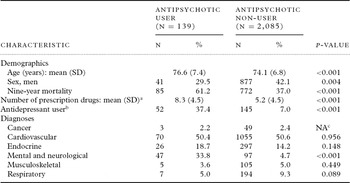
Of the 2,224 residents, 332 (14.9%) used an antipsychotic during the study period. There were 139 antipsychotic users at baseline (Table 1).
Baseline characteristics for antipsychotic users and non-users in 2000

a Defined according to number of different drugs by ATC code.
b Defined as drugs included in the ATC category N06A.
c χ2 test assumptions were not satisfied.
Of all 2,224 residents, 59 (2.7%) had persistent depression and/or psychosis, 34 (1.5%) had Parkinson's disease, 42 (1.9%) had epilepsy, and 11 (0.5%) had Alzheimer's disease. Multiple mental and neurological diagnoses were recorded for two residents.
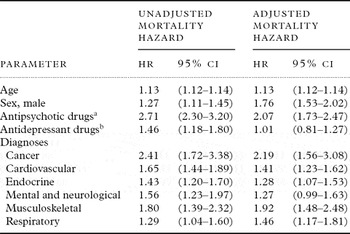
At the end of the study period, 857 deaths had occurred, representing 38.5% of residents. After adjusting for individual differences at baseline, the total number of prescription drugs and anxiolytic/hypnotic/sedative drug use were not found to contribute significantly to the risk of death. Parameters included in the final model are listed in Table 2.
Unadjusted and adjusted mortality hazards for parameters included in the time-dependent Cox proportional hazards model for all 2,224 residents

a Time-dependent variable. Defined as drugs included in the ATC category N05A, excluding lithium.
b Defined as drugs included in the ATC category N06A.
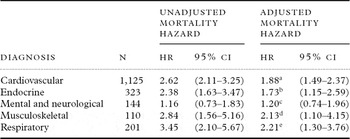
The overall unadjusted risk of death associated with antipsychotic use was approximately three times that of non-use (HR = 2.71, 95% CI = 2.30–3.20), and twice that of non-use after adjusting for baseline demographic and diagnostic differences and antidepressant use (HR = 2.07, 95% CI = 1.73–2.47). Antipsychotic users with a baseline diagnosis of respiratory disease were observed to have the highest adjusted risk of death (HR = 2.21, 95% CI = 1.30–3.76) (Table 3).
Unadjusted and adjusted mortality hazards associated with antipsychotic use for individual diagnoses

Parameters included in each model:
a Age, sex, antipsychotic drugs, antidepressant drugs, cancer, endocrine disorders, musculoskeletal conditions, and respiratory diseases.
b Age, sex, antipsychotic drugs, mental and neurological disorders, cardiovascular disease, and respiratory disease.
c Age, sex, antipsychotic drugs, antidepressant drugs, and endocrine disorders.
d Age, sex, antipsychotic drugs, antidepressant drugs, and respiratory diseases.
e Age, number of prescription drugs, antipsychotic drugs, musculoskeletal conditions.
Discussion
The main finding of our study was that the adjusted risk of death associated with antipsychotic use among community-dwelling older adults was similar across diagnostic categories, with the highest risk among antipsychotic users with baseline respiratory disease (HR = 2.21, 95% CI = 1.30–3.76). This is consistent with related research, which identified that despite a lower prevalence, death due to non-infective respiratory causes within 180 days of FGA initiation was associated with the greatest risk of death (HR = 1.71, CI = 1.35–2.17) (Setoguchi et al., Reference Setoguchi, Wang, Brookhart, Canning, Kaci and Schneeweiss2008). However, our results should be interpreted cautiously because of the overall small sample size of antipsychotic users.
Immediate death due to respiratory system disease is six times more common among older adults with dementia than the general Swedish population aged 65 years and older (Brunnström and Englund, Reference Brunnström and Englund2009). Furthermore, almost half of all immediate deaths (45.8%) among older adults with dementia are caused by respiratory system diseases, with pneumonia accounting for all but 0.8% of these deaths (Brunnström and Englund, Reference Brunnström and Englund2009). While we were unable to determine cause of death in our study, there is a growing body of evidence highlighting that antipsychotic use among older adults is related to increased hospitalizations (Pratt et al., Reference Pratt, Roughead, Ramsay, Salter and Ryan2011) as well as mortality (Setoguchi et al., Reference Setoguchi, Wang, Brookhart, Canning, Kaci and Schneeweiss2008) due to pneumonia infections. There is also evidence suggesting that the risk of pneumonia is the highest during the first week of antipsychotic initiation and among SGA users (Knol et al., Reference Knol, van Marum, Jansen, Souverein, Schobben and Egberts2008). Over-sedation with antipsychotics may be potentiated in older adults, and acute respiratory failure has been reported following the administration of a single dose of quetiapine to a 92-year-old female with chronic obstructive pulmonary disease (Jabeen et al., Reference Jabeen, Polli and Gerber2006). The risk of serious complications due to asthma is also increased among antipsychotic users (Joseph, Reference Joseph1997). However, the exact reasons that may contribute to excess mortality among antipsychotic users with respiratory disease remain unknown (Jackson et al., Reference Jackson2004).
The increased risk of death among antipsychotic users with baseline cardiovascular disease was also statistically significant in adjusted analyses (HR = 1.88, 95% CI = 1.49–2.37). Similarly, previous research has identified an increased risk of death due to cardiovascular-related causes following recent initiation of an FGA (HR = 1.23, 95% CI = 1.10–1.36) (Setoguchi et al., Reference Setoguchi, Wang, Brookhart, Canning, Kaci and Schneeweiss2008), as well as sudden cardiac death among all antipsychotic users (Ray et al., Reference Ray, Chung, Murray, Hall and Stein2009). Circulatory system diseases are one of the leading causes of death among older adults with dementia, accounting for 37.4% of immediate deaths in Sweden, of which 23.1% are due to ischemic heart disease (Brunnström and Englund, Reference Brunnström and Englund2009). Furthermore, older adults are particularly susceptible to cardiovascular-related adverse events from antipsychotics such as orthostasis, ischemia, QTc prolongation, and arrhythmias (Chahine et al., Reference Chahine, Acar and Chemali2010), potentiating the overall risk.
The adjusted risk of death was also high among antipsychotic users with a baseline musculoskeletal condition (HR = 2.13, 95% CI = 1.10–4.15). Antipsychotics are associated with an increased risk of falls (Chahine et al., Reference Chahine, Acar and Chemali2010) and hip fractures (Pratt et al., Reference Pratt, Roughead, Ramsay, Salter and Ryan2011), and older adults with chronic musculoskeletal pain have a greater risk of falls (Leveille et al., Reference Leveille2009), which may explain the increased propensity for death among antipsychotic users with a musculoskeletal condition.
A diagnosis of AD is a strong predictor of off-label antipsychotic use (OR = 8.34, 95% CI = 8.13–8.57) (Leslie et al., Reference Leslie, Mohamed and Rosenheck2009) and only 11 residents (0.5%) had a recorded diagnosis of AD in our study. In Finland, risperidone is now the only drug indicated for aggression in patients with moderate to severe AD; however, no drugs were officially indicated for neuropsychiatric symptoms of dementia in 2000. All diagnostic data extracted relied upon clinicians providing written evidence to verify these diagnoses. It is possible that the overall association between antipsychotic use and mortality observed in the analyses including all residents was due to residual confounding, and the possibility of confounding by indication can also not be excluded. Decreased cognitive function among community-dwelling older adults with dementia, as indicated by low Mini-Mental State Examination (MMSE) scores, is known to be an independent predictor of mortality (Strandberg et al., Reference Strandberg, Pitkala and Tilvis2009). Previous studies have also concluded that part of the excess mortality associated with antipsychotic use may be due to underlying neuropsychiatric symptoms (Musicco et al., Reference Musicco2011).
Strengths and limitations
The primary data source for this study was the FNPR, which provided access to a complete record of all reimbursed drugs purchased by the residents of Leppävirta for use in the community. This enabled a detailed analysis of antipsychotic use among older adults in a naturalistic setting with a long follow-up period. Furthermore, because this was an observational study, it was possible to evaluate the effects of antipsychotic use in a vulnerable population often excluded from randomized controlled trials. However, analysis of reimbursed drug purchases does not account for instances of medication non-adherence, although the validity of the FNPR as an indicator of antipsychotic drug exposure in older adults has previously been established (Rikala et al., Reference Rikala, Hartikainen, Sulkava and Korhonen2010).
As this was a population-based study of all older adult antipsychotic users residing in Leppävirta, the internal validity of the study is high; however, the results may not necessarily be generalizable to other populations of antipsychotic users. While adjustments were made for baseline demographic and diagnostic differences, as with many previous studies, time-varying covariates were not used (Schneider et al., Reference Schneider, Dagerman and Insel2005; Raivio et al., Reference Raivio, Laurila, Strandberg, Tilvis and Pitkälä2007). In addition, all diagnostic data were extracted from the Special Reimbursement Register and relied on the criteria in use during the year 2000. Consequently, not all diagnoses of dementia were likely to have been captured in the Special Reimbursement Register. This means that excess mortality associated with antipsychotic use in the analyses that included all residents may be partly attributable to residual confounding. This is a limitation that is consistent with previous studies (Musicco et al., Reference Musicco2011).
In summary, current evidence indicates that there are pronounced risks associated with the use of antipsychotics in older adults to manage neuropsychiatric symptoms of dementia. The results from our study suggest that the risk of death associated with antipsychotic use is similar for different diagnoses and that the risk appears to be the greatest among antipsychotic users with a baseline diagnosis of respiratory disease. This finding is consistent with earlier research identifying the short-term causes of death among antipsychotic initiators (Setoguchi et al., Reference Setoguchi, Wang, Brookhart, Canning, Kaci and Schneeweiss2008). Further research using a larger sample size is needed to confirm these findings.
Conflict of interest
None.
Description of authors’ roles
N. Gisev and J. S. Bell designed the study, conducted the data analyses, and prepared the first draft of the paper. S. Hartikainen and M. Korhonen assisted in the design of the study and participated in the data collection. T. F. Chen assisted in the design of the study. All authors critically revised the paper prior to submission.
Acknowledgments
The authors thank the SII for providing the de-identified data analyzed in this study and gratefully acknowledge the contribution made by Piia Lavikainen, a statistician at the University of Eastern Finland, in preparing the dataset for analysis, and to Jenni Ilomäki, a post-doctoral researcher at the University of South Australia, for her statistical advice. N. Gisev received financial assistance to undertake this study in the form of travel grants supported by DBL and the Society of Hospital Pharmacists of Australia, and The University of Sydney Grants-In Aid James King of Irrawang travelling scholarship and the James Kentley memorial scholarship.