

Introduction
The cognitive ability to plan goal-directed actions is the focus of much research regarding deficits following brain injury (Kennedy et al., Reference Kennedy, Coelho, Turkstra, Ylvisaker, Sohlberg, Yorkston and Kan2008). Several neuropsychological tests, such as the Tower of Hanoi (Goel & Grafman, Reference Goel and Grafman1995), Tower of London (Shum et al., Reference Shum, Gill, Banks, Maujean, Friffin and Ward2009), Six Elements Test (Shallice & Burgess, Reference Shallice and Burgess1991) and the Rey Complex Figure Test (Schwarz, Penna, & Novack, Reference Schwarz, Penna and Novack2009), are employed as diagnostic tools to assess these types of deficits. While it is not clear exactly what these tests measure (e.g., see Goel & Grafman, Reference Goel and Grafman1995; Sira, Reference Sira2009), there is general agreement that following a brain injury the ability to plan is significantly impaired (Driver, Haggard, & Shallice, Reference Driver, Haggard and Shallice2008). Indeed, capitalising on technology, research has demonstrated the efficacy of external memory aids (e.g., personal digital assistants, cell phone alarms) that provide cues for a survivor of brain injury to remember forward – what to do next (e.g., see Levine et al., Reference Levine, Schweizer, O’Connor, Turner, Gillingham, Stuss and Robertson2011). However, what is lacking is a practical method of assessing the ability of a survivor of brain injury to understand a plan before it is enacted. For many activities of daily life, it is critical to understand and evaluate a plan before attempting to carry it out. Consider financial planning, route planning and preparing a meal – such activities are critical to a person's livelihood following a brain injury and their success often relies on careful planning before undertaking action. This type of understanding requires appreciation of the temporal and sequential constraints of a planning situation and their relation to the sequence of actions (subgoals) proposed in the plan designed to achieve a superordinate goal. This mental phase of planning and how to assess it in survivors of brain injury is the focus of this study.
A plan is a sequence of intentional actions that support goal achievement (Rowe, Owen, Johnsrude, & Passingham, Reference Rowe, Owen, Johnsrude and Passingham2001). Planning is a complex, higher-level cognitive skill that is a pervasive aspect of everyday life. Distinct aspects of the planning process include constructing a plan, executing the actions in a plan so as to reach a goal state, and comprehending that someone else's actions are goal directed and planned out (Das, Kar, & Parrila, Reference Das, Kar and Parrila1996). Following a brain injury, a person may have one or more of these planning abilities disrupted and, therefore, understanding which of these aspects of planning are impaired is important for the rehabilitation of survivors of brain injury. Tasks that are relatively easy to use and can distinguish between these planning abilities would be advantageous in diagnosis and treatment. Unfortunately, current assessments largely concentrate on the ability of survivors to carry out a plan and do not address an individual's ability to comprehend the causal relationships among goal-directed, sequential actions before the plan is enacted.
The comprehension of planning, or planning knowledge, is an understanding of the planning process itself, whereas knowing how to implement or carry out a plan is plan execution. Planning knowledge involves the search for, and selection of, information that is used to organise and define a plan (Hayes-Roth & Hayes-Roth, Reference Hayes-Roth and Hayes-Roth1979). More specifically, it entails knowing that a sequence of actions is both necessary and sufficient to achieve a goal, and also includes consideration of efficiency, temporal ordering and pragmatic sequencing of these actions (Das et al., Reference Das, Kar and Parrila1996). Based on this understanding, planning knowledge allows a reader, for example, to know that efficiently sequenced actions are necessary to achieve an outcome or goal in a text passage (Graesser, Millis, & Zwaan, Reference Graesser, Millis and Zwaan1997). Such skills are also inherent to the microlinguistic processing needed to produce and comprehend sentences, which some research suggests may be impaired in survivors of brain injury (Peach, Reference Peach2013).
This study investigates the measurement of planning knowledge; that is, an individual's ability to comprehend the information in a plan and evaluate its effectiveness. Again, this aspect of planning is not a physical action; it does not involve the enactment of the steps of a plan. Rather, it is strictly a mental phase of planning, which includes the individual's ability to comprehend the required series of events, the appropriate sequencing of these events, and the mental agility to place these steps in a framework or plan to achieve a specified outcome. The task used in this study to assess planning knowledge involves a simulation of a regular, everyday activity – errand planning. It is based on prior research in which a spatial–temporal task was used to measure planning ability in non-injured adults (Hayes-Roth & Hayes-Roth, Reference Hayes-Roth and Hayes-Roth1979). Errand-planning tasks have been used to measure planning skills in normally functioning children and children with mental retardation (Perez & Gauvain, Reference Perez and Gauvain2005; Radziszewska & Rogoff, Reference Radziszewska and Rogoff1988; Szepkouski, Gauvain, & Carbery, Reference Szepkouski, Gauvain and Carbery1994). Some of the errand sequences in this task require ordering the individual errands based on ‘logical necessity’ (Trabasso, van den Broek, & Suh, Reference Trabasso, van den Broek and Suh1989), which taps into the comprehension of temporal and causal sequencing integral to plans (e.g., a person cannot deposit his paycheck in the bank until he has picked it up from the workplace). This understanding requires making inferences about why an activity is being carried out.
This study also assessed comprehension of planning knowledge contained in narrative, two-sentence texts. Narrative discourse is commonly employed to assess comprehension and can be studied by examining the processes involved in forming inferences drawn from a reader's general knowledge. Our narrative texts were constructed using implied content in order to measure the inference process. These texts will permit further examination of research findings that suggest survivors of brain injury commonly experience deficits in the type of sequential ordering inherent in planning comprehension relative to other forms of knowledge.
Neuroimaging studies have suggested that sequential processing related to event ordering, in contrast with sentence or word ordering, may be supported by a specific domain of knowledge that is unavailable or impaired among survivors of brain injury (Sirigu et al., Reference Sirigu, Cohen, Zalla, Vanechkout, Pillon, Dubois and Agid1998; Zalla, Plassiart, Pillon, Grafman, & Sirigu, Reference Zalla, Plassiart, Pillon, Grafman and Sirigu2001). By comparing across tasks (sentence or word ordering versus script or event ordering), Sirigu et al. (Reference Sirigu, Cohen, Zalla, Vanechkout, Pillon, Dubois and Agid1998) demonstrated that individuals with lesions in Broca's area were impaired on the sentence word-ordering task but not on the event-ordering task, while persons with prefrontal injuries demonstrated the reverse pattern. This finding was further supported in a non-injured population (Crozier et al., Reference Crozier, Sirigu, Lehericy, van de Moortele, Pillon, Grafman and LeBihan1999). These authors utilised the same task parameters in a functional magnetic resonance imaging (fMRI) study and found that event ordering was associated with unique prefrontal activation. Combined, these findings suggest that goal-directed action, or planning knowledge, is functionally different from syntactic knowledge involved in word- or sentence-order effects.
Zalla et al. (Reference Zalla, Plassiart, Pillon, Grafman and Sirigu2001) compared performance on a planning task between brain-injured and non-injured groups, matched for age and education levels. A group whose injuries involved prefrontal cortex areas was formed from diverse aetiologies, including vascular accidents, closed-head injuries and surgical removal of tumours. This diverse group of survivors all demonstrated impaired abilities to complete a planning task successfully, with impairments that included misunderstanding both at the conceptual level of intended action and at the execution level of the planned actions. The conceptual component of this planning-task involved verbalising the ordering of events in order to accomplish a goal. The execution component of this task was conducted in a virtual on-screen environment and involved manipulating a computer mouse to carry out the planned events (re-ordered from the presented list). These authors report that the non-injured group took more time to conceptualise the planned actions than the brain-injured group. Results indicated that the additional time spent in mental planning by the non-injured group supported significantly more successful plan execution than the brain-injured group. These results are consistent with the idea that survivors of acquired brain-injury (ABI) may have deficits in an area of general knowledge related to planning, including making knowledge-based inferences about future goal-directed actions. Consistent with this view, previous research at the discourse level, which examined ABI survivors, has shown the comprehension difficulties that these individuals commonly experience consist of reduced information content and problems with temporal ordering of cognitive events (Timmerman & Brouwer, Reference Timmerman and Brouwer1999).
These types of deficits may have serious repercussions for survivors in adjusting to everyday life following a brain injury. Knowledge-based inferences are necessary to integrate a reader's general knowledge into the ongoing comprehension of discourse (Trabasso et al., Reference Trabasso, van den Broek and Suh1989). Based on previous research, knowledge of physical cause and effect inferences may be more available in survivors of brain injury than inferences related to planning knowledge (Shears & Chiarello, Reference Shears and Chiarello2004). Thus, we propose that texts regarding goals and goal-directed behaviours, which require readers to use planning knowledge, may not be available to all survivors of brain injury. To assess this claim, this study compared comprehension of two-sentence texts that required an inference with two-sentence control texts from the same knowledge areas (physical cause and effect knowledge and planning knowledge) that did not require an inference. If survivors have impaired access to planning knowledge, the causal relation in these texts will not be detected because they will not form inferences in this knowledge domain. Conversely, the causal relationship in the physical knowledge texts should be unaffected and survivors of brain injury should be able to form these inferences.
To recapitulate, the main claim that underlies this research is that the comprehension or knowledge of planning and the execution of plans entail different cognitive processes, and that these processes may be differently affected in survivors of brain injury. If this is so, then it is important to understand and identify these differences and use them to support cognitive rehabilitation following acquired brain injury. Thus, we aim to identify whether survivors of brain injury have deficits in planning knowledge, using tasks that assess the temporal and causal aspects of plans. To this end, we examined the following hypotheses. First, if planning comprehension is impaired in survivors of brain injury relative to non-injured participants, then scores on the errand-planning task will discriminate between participants with brain injuries and non-injured participants. Second, if comprehension of planning knowledge is impaired relative to the comprehension of physical cause and effect following brain injury, then survivors of brain injury with low errand-planning scores (15 points or less), which would indicate poor comprehension of planning knowledge, will be impaired in making inferences from planning knowledge but not in making inferences from physical cause-and-effect knowledge. Non-injured participants (NI) and survivors of brain injury with high errand-planning scores (greater than 15 points) should show no differences in forming inferences from either knowledge domain.
Methods
Participants
Thirty students (16 females) with acquired brain injuries (ABI) enrolled in the Coastline Community College (CCC) Acquired Brain Injury Program. These individuals met the following requirements for inclusion in this study: (1) currently enrolled at Coastline; (2) at least 18 years of age, and had sustained a documented brain injury after the age of 13; (3) sufficient physical and mental functions to participate in the study.
All ABI participants were native English speakers, with a mean age of 32.5 years (SD = 7.14) and averaging 13.2 mean years of education (SD = 1.51). Fourteen of these participants were involved in motor vehicle accidents (MVA), which resulted in their acquired brain injury, described by neurological assessment at the time of hospitalisation as non-localised. An additional three participants were victims of a fall or other type of blow to the head and are also described as having non-localised brain injuries. Of the remaining participants, six had cerebral vascular accidents, and five participants had tumours or other insults. The mean time elapsed from date of injury to test date was 4.28 years, with a range of 9 months to 16 years post onset. ABI participants were given course credit or were paid approximately US$10.00 per hour.
The non-injured (NI) group consisted of 28 participants (17 females) with no history of brain injury. The NI participants were selected based on age and education levels to closely match the ABI group. NI participants volunteered from the community of Costa Mesa or were selected from a university Introductory Psychology subject pool. All participants were native English speakers with a mean age of 31.4 years (SD = 6.13) and 13.6 mean years of education (SD = 2.27). There were no significant differences (indicated by t-test comparisons) between the NI and ABI groups for mean age or education levels.
Procedure and Tasks
After obtaining informed consent, all ABI participants participated individually in the errand-planning task. This was the ABI participant's first session; these participants were then rescheduled for the reading comprehension task, which occurred on two successive later days. This was done to avoid fatigue between experimental tasks. NI participants partook in one session in which they completed informed consents, followed by the errand-planning task, and then the reading comprehension task.
Errand-Planning Task
Planning knowledge was assessed with a spatial–temporal task that involved errand planning. It is based on tasks used in prior research to measure planning ability in non-injured adults and children (Hayes-Roth & Hayes-Roth, Reference Hayes-Roth and Hayes-Roth1979; Radziszewska & Rogoff, Reference Radziszewska and Rogoff1988). This task measures a participant's ability to include increasing steps or errands into their plans, as well as his or her ability to formulate a plan based on the logical consideration of the specific errands.
Materials
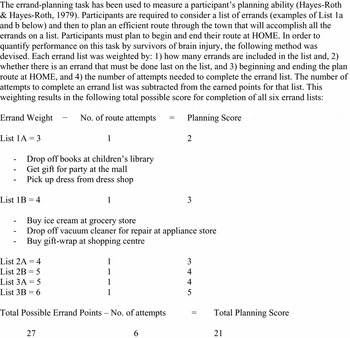
The task uses a map of a town printed on (11 × 8.5 inch) paper and labelled with locations such as a grocery store, library, middle school and home (Figure 1). It requires participants to plan a route through the town to carry out a series of errands on a list in one trip, as efficiently as possible, with each plan beginning and ending at the ‘Home’ location. Participants were presented with a total of six errand lists, broken down into two sets (Figure 2). Complexity was introduced by increasing the number of errands on a list and, for some lists, by some re-ordering of errands based on ‘logical necessity’ (Trabasso et al., Reference Trabasso, van den Broek and Suh1989). The first set of three lists (A lists), the simpler of the two sets, contained errands that could be done in any order, whereas the second set of three lists (B lists) had some errands that needed to be done in a specific order. For example, in List 1B, planning to ‘buy ice cream’ must be done last before returning home so that the ice cream does not melt.
Map of town.

Errand-planning lists and scoring.

Procedure
Participants were shown the map of the town and the experimenter pointed to and labelled the home location and several of the stores identified on the map. The errand lists were then introduced. All participants were told they would be planning several trips to accomplish various errands throughout the town. Participants were instructed to consider each errand on a list and to refer to the map in order to plan a route through the town that would accomplish all the errands on a list efficiently, in one trip. Instructions specified that participants should show their plan by numbering the errands on the map to indicate the order they planned to do each of the errands on a list. To complete each list, all errands, or the corresponding locations, had to be numbered, with each trip beginning and ending at the Home location.
Scoring
Planning performance was assigned a score value. There was one point awarded for having each of the errands accomplished on a list, as well as one point for additional considerations of the logical necessity factors (for the B list), resulting in a total of 27 possible points. Each attempt to develop a plan for an errand list was also recorded, with a total of 6 points representing the minimum number of route attempts possible (one attempt per list). The minimum number of route attempts was subtracted from the total number of errands to yield the planning score, with a maximum score of 21 (27 errands – 6 attempts = 21). If a participant was unable to complete a list, no points were awarded for that list. A planning score that was zero or a negative value indicated an inability to do the task.
Reading Comprehension Task
Materials
Based on norming criteria (Shears & Chiarello, Reference Shears and Chiarello2004), 80 two-sentence texts requiring an inference in two knowledge areas (40 physical causality and 40 planning) were selected. Control sentences were constructed from each of the inference sentences, such that each first sentence in a pair was altered to remove any causal relation to the second sentence, resulting in 80 two-sentence control texts (40 physical, 40 planning). Control sentences were read and edited by two independent reviewers with expertise in linguistics, to ensure that any causal relation between sentences in a pair had been eliminated, while maintaining content of knowledge area and sentence length similar to inference sentences (Appendix A). Then two stimulus lists were constructed; on one list 20 physical inference texts were paired with 20 physical control texts, and on the other list 20 planning inference texts were paired with 20 planning control texts. These two lists were then combined into a single list for the study, yielding one list of 80 sentence pairs (40 inference and 40 control).
For each sentence pair in the list, six probe words were selected (see Appendix A). Two words that were present in both the inference and control versions of the sentences were selected as text probes. Based on the explanatory statement from the norming process, two words were selected as the inference-related probes. Two other words unrelated to the sentences were selected as unrelated probes. These six probe words formed (1) the text, (2) the inference-related, and (3) the unrelated probe conditions for the inference and control versions of each sentence pair. All probe words were equivalent across conditions in mean word length (text probes = 6.1, inference probes and unrelated probes = 5.8) and mean Usenet log frequency (text probes = 4.64, inference probes = 4.73 and unrelated probes = 4.8; Chiarello, Shears, & Lund, Reference Chiarello, Shears and Lund1999). Finally, inferred knowledge was assessed with questions (40 with correct response of yes and 40 with correct response of no) pertaining to knowledge of planning and of physical causality. All questions were written to require access to one of these areas of inferred knowledge. The same two independent reviewers identified the questions as pertaining to either planning or physical causality knowledge. There was 100% agreement by reviewers as to the classification of the final probe words and questions included in this experiment.
Procedure
Data were collected in individual testing rooms on desktop computers. Data collection for all the ABI participants and some of the NI participants was at Coastline Community College. The remaining NI participants were tested at the University of California, Riverside. Psyscope software (Cohen, MacWhinney, Flatt, & Provost, Reference Cohen, MacWhinney, Flatt and Provost1993) was used to record the reaction time and accuracy for each key press. There were 480 total responses to probe words and 80 total responses to knowledge questions.
Instructions were given verbally and appeared simultaneously on the computer screen. The instructions informed participants that they would be reading brief texts for understanding and that their comprehension would be tested. To ensure that all ABI participants understood and could follow the instructions, the number of practice trials varied per individual. For ABI participants the number of practice trials was at least five and no more than 12. For NI participants there were five practice trials. Reading was self-paced by all participants. All stimuli were centrally presented, with normal capitalisation and punctuation, and remained on the screen until the participant responded.
All trials began with the central message ‘Get ready to read sentences’. All participants were instructed to keep their index and middle finger of the preferred hand resting lightly on the ‘0’ and ‘.’ keys in order to respond as quickly and accurately as possible. Keys were labelled ‘Yes’ and ‘No’ by a paper template that completely covered the numeric keypad except for the ‘0’ and ‘.’ keys. Participants were instructed to press the ‘Yes’ key to indicate they had read the first sentence and were ready for the second sentence. A central reminder followed the participant's key press to the second sentence. ‘Get ready to respond quickly and accurately to words. Press the YES key if the word was in the sentences and the NO key if the word was not in the sentences.’ The six probe words were centrally presented one at a time. A balanced Latin square controlled the presentation order of inference-related, unrelated and text probe words, ensuring that the presentation order of probes was rotated across all possible orderings equally. Probes remained on the screen until participants responded. There was a 50 ms delay following the participant's response to each probe word before the next presentation. The computer recorded response times and the correct (yes response to actual text words) and error rates (yes response to inference-related words or unrelated words) for probe recognition. Following the final probe word, the screen cleared for 500 ms.
The validating question was then presented centrally and remained on the screen until the participant responded by yes or no key press. The computer recorded the response time and accuracy of the response. Correct responses to validating questions was ‘yes’ for 40 questions and ‘no’ for the other 40 questions, balanced over knowledge area and sentence type. Following the key press response to the validation question, the screen cleared for 2000 ms. The message ‘Get ready to read sentences’ was presented centrally for 500 ms to begin the next trial. The procedure was repeated, with rest breaks in between blocks of 10 trials, for ABI participants, and blocks of 20 trials for NI participants. NI participants completed four blocks (20 trials each) of computer randomised sentences from both knowledge areas, for a total of 80 trials in approximately a 1-hour session. ABI participants completed four blocks (10 trials each) of computer randomised sentences from both knowledge areas, for a total of 40 trials in approximately one 45-minute session. This required two sessions conducted on consecutive days for ABI participants to complete the 80 total trials.
Plan of Analysis
Mean comparison tests will examine the first hypothesis that scores on the errand-planning task will discriminate between participants with brain injuries and non-injured participants. Mean comparison tests will also examine our prediction that planning knowledge is impaired relative to the comprehension of physical cause and effect following brain injury. We predicted that survivors of brain injury (ABI) with errand-planning scores of 15 or less would be impaired when making inferences related to planning knowledge, but not in making inferences related to physical knowledge. Non-injured participants (NI) and any survivors of brain injury that scored more than 15 points on the errand-planning task were predicted to show no differences in forming inferences from either knowledge domain.
A mixed factorial design employed the within-participant variables of two knowledge areas (physical versus planning) and two sentence types (inference versus control), and the between-participant variables of two groups (ABI versus NI) and two errand-planning scores (high versus low). Dependent variables were accuracy of responses to probe word recognitions and accuracy of answers to knowledge-validating questions. For the measures of probe word recognition, this design also included probe type (text versus unrelated versus inference-related) as a within-participant factor.
Results
Does Performance on the Errand-Planning Task Discriminate Between Participants with Brain Injuries and Non-injured Participants?
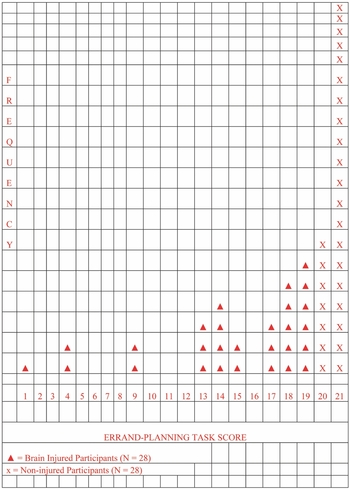
The errand-planning scores of ABI participants ranged from 1 to 21, out of a possible score of 21. All NI participants demonstrated a score of 20–21 on the errand-planning task (Figure 3). The mean errand-planning score for the NI group (20.66) was significantly different from the mean errand-planning score for the ABI group (14.93), t (55) = 4.42, p < .05. This result supports our first hypothesis, demonstrating that the errand-planning task discriminates between survivors of brain injury and non-injured participants.
Discriminant errand-planning scores for ABI and NI participants. The two ABI participants with scores of 20 and 21, whose data were not included because they were not impaired at planning, are not shown.

Of the 30 ABI participants who completed the errand-planning task, 14 had scores of 15 or less. This group is referred to as ABI Low Planners in the reading comprehension analyses. The remaining 16 ABI participants had scores of 17 and over, including two who had scores of 20 and 21, which were considered to be in the ‘normal’ planning range. These two higher-scoring participants were not included in the subsequent analysis because they clearly did not demonstrate impaired planning knowledge. The group that contained the remaining 14 participants with scores of 17 or over is referred to as ABI High Planners. Thus, there was a total of 28 ABI participants, divided into two planning knowledge groups based on their errand-planning scores, to compare to non-injured readers for the inferences drawn from planning versus physical knowledge.
Impaired Planning-task Scores and Impaired Planning Inferences
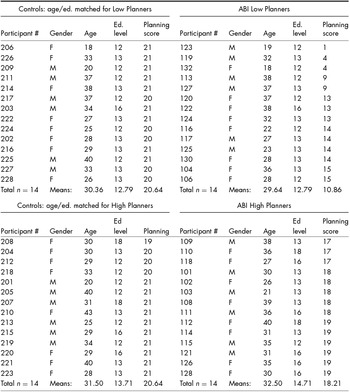
To compare inference formation across the two knowledge areas between survivors of brain injury and non-injured participants, a dichotomised score on the errand-planning task was employed. Non-injured participants were matched by gender, age and education level to brain-injured participants for planned comparisons with the High Planners and Low Planners in the survivors group. Examining the survivor groups separately indicated that the mean planning score for the ABI High Planners (18.21) was not significantly different from the matched NI group mean (20.64), t (27) = 0.024, p = .21, but there was a significant difference between the planning scores of ABI Low Planners (mean score = 10.86) and the matched 14 NI matched participants (mean score = 20.7), t (27) = 2.62, p < .05 . Table 1 gives the mean age, education levels and errand-planning scores for the ABI High versus Low Planners and matched NI participants. Given the different patterns across the two ABI planning groups when compared with the NI participants, the next set of analyses examined performance on the reading comprehension tasks for these groups separately.
ABI Participants by Low and High Planning Scores Matched to Age and Education Level Non-injured Participants

Probe Word Recognition Accuracy
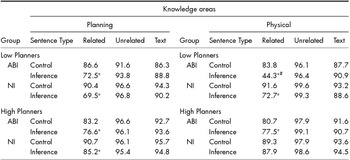
To examine our second hypothesis, we compared inference processes between ABI High and Low Planners matched to NI participants by gender, age and education levels. All ANOVA Fs and effect size rs are reported at significance level p = .05 or less. The mean square error (MSE) is reported for each significant outcome. Table 2 presents the mean accuracy data for each type of probe word recognition.
Mean Correct Recognition for Probe Words (Inference-related vs Unrelated vs Text) for Control vs Inference Sentence Types Across Planning vs Physical Knowledge Areas for ABI Low vs High Planners and Matched NI Participants

* = Inference fewer correct rejections than control.
# = Physical fewer correct rejections than planning.
ABI High Planners and matched NI participants
There were no between-group differences for probe recognitions, indicating that inference processing was similar across knowledge areas and sentence types for ABI High Planners and matched NI (see Figure 4 top panel). Specifically, there were no differences or interactions for text or unrelated probe recognitions. For inference-related probe recognitions there was a main effect of sentence type, F(1,26) = 13.04, MSE = 14.3, r = .578, with fewer correct rejections of inference-related probes following inference (81.8%) than control (85.9%) sentences. This indicates inferences were being made by ABI High Planners and matched NI regardless of knowledge area.
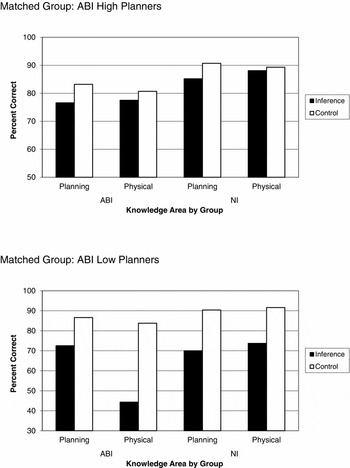
Mean per cent correct recognitions for inference-related probes by High and Low Planner ABI and matched NI controls.

ABI Low Planners and matched NI participants
There were no significant main effects for text probe recognitions, but an interaction between these two groups and knowledge area was significant, F(1,26) = 4.03, MSE = 68.4, r = .366. This interaction was the result of better accuracy for text probe recognition following planning knowledge sentences in NI (92.2%) than in ABI Low Planners (87.5), F(1,26) = 4.88, MSE = 64.2, r = .398. ABI Low Planners (89.3%) and matched NI participants (90.1%) did not differ in the recognition of text probes following physical knowledge text, F < 1.00. This finding demonstrates that only planning knowledge differed between these groups.
For unrelated probe recognition there was a significant main effect of group (ABI Low Planners versus NI), F(1,26) = 11.93, MSE = 30.7, r = .561, indicating that the NI group had more correct rejections of unrelated probes (98.1%) than the ABI Low Planners group (94.5%). There was also a significant main effect of knowledge area, F(1,26) = 59.96, MSE = 4.5, r = .835, indicating more correct rejections of unrelated probes followed physical text (97.9%) than planning text (94.7%). There were no interactions. These findings show that the NI group is more accurate overall than the ABI Low Planners group.
For the theoretically important inference-related probe recognitions, the ABI Low Planners and the matched NI participants had a significant main effect of knowledge area, F(1,26) = 11.23, MSE = 2210, r = .549, indicating fewer correct rejections of related probes followed physical (73.1%) as compared to planning (79.7%) texts. There was also a main effect of sentence type, F(1,26) = 41.98, MSE = 330.9, r = .786, indicating fewer correct rejections of related probes followed inference (64.7%) than control (88.1%) sentences. There was an interaction with knowledge area, F(1,26) = 20.03, MSE = 110.3, r = .660, based on a difference between groups (ABI Low Planners versus matched NI) for correct rejections following physical text (ABI = 64.0% versus NI = 82.1%), F(1,26) = 7.83 MSE = 587.6, r = .482, but not following planning text (ABI = 79.6% versus NI = 79.9%), F < 1.00, ns. This finding suggests that ABI Low Planners made physical inferences, but did not make planning inferences, while matched NI participants made inferences equally across both knowledge areas.
These effects were qualified by the anticipated three-way interaction between groups (ABI Low Planners versus matched NI), knowledge areas, (planning versus physical), and sentence types (inference versus control), F(1,26) = 10.02, MSE = 130.4, r = .527. Matched NI participants made fewer correct rejections of related probes to physical inference (72.7%) than physical control (91.6%) sentences, F(1,13) = 8.91, MSE = 281.6, r = .638. NI participants also did this for planning inference (69.5%) compared to planning control (90.4%) sentences, F(1,13) = 11.76, MSE = 260, r = .689, but this was not dependent on knowledge area, F = 3.00, ns (see Figure 4 bottom panel). Similarly, ABI Low Planners made fewer correct rejections of related probes to physical inference (44.3%) compared to physical control (83.8%) sentences, F(1,13) = 31.06, MSE = 351, r = .840. ABI Low Planners also made fewer correct rejections following planning inference (72.5%) relative to planning control (86.6%) sentences, F(1,13) = 14.59, MSE = 95.5, r = .727. However, there was a significant difference between correct rejection rates across knowledge areas for the ABI Low Planners, F(1,13) = 9.32, MSE = 242, r = .418. Figure 4 shows that the difference between inference and control sentences is greater for physical than for planning knowledge for ABI Low Planners.
In summary, these results suggest that physical knowledge supported the inference process more than planning knowledge for ABI participants who had low errand-planning scores, and that matched NI participants used both knowledge areas to support the inference process.
Knowledge Question Accuracy
A final set of analyses of variance was conducted separately for ABI High and Low Planners on mean per cent correct answers to knowledge validating questions for the within-participant factors of knowledge areas (physical versus planning) and sentence types (inference versus control), as well as for between-group comparisons (ABI versus NI). Mean per cent correct data are presented in Table 3. All ANOVA Fs and effect size rs were calculated at p = .05 or less.
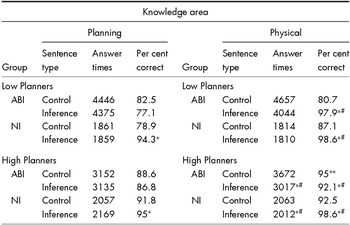
Mean Raw Answer Times (ms) and Per cent Correct for Knowledge Questions Following Control vs Inference Sentence Types Across Planning vs Physical Knowledge Areas for ABI Low vs High Planners and Matched NI Participants

* = Inference more accurate than control.
# = Physical faster and/or more accurate than planning.
ABI High Planners and matched NI participants
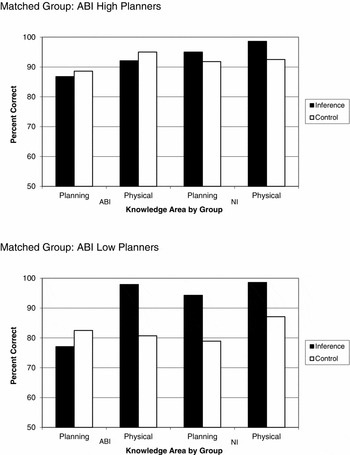
There were no group differences for sentence type (inference versus control), F = 1.01, ns. There was a main effect of knowledge area (physical versus planning), F(1,26) = 19.01, MSE = 98.4, r = .650, indicating answers following physical knowledge (94.6%) were more accurate than answers following planning knowledge (90.5%) texts. The groups did differ on the variable of knowledge area, F(1,26) = 4.14, MSE = 23.8, r = .371. Figure 5 (top panel) shows that ABI High Planners had more correct answers to physical knowledge (93.6%) as compared to planning knowledge (87.7%) questions, F(1,13) = 12.77, MSE = 38.1, r = .574. The difference between NI participant answers to physical knowledge (95.5%) as compared to planning knowledge (93.4%) questions, F(1,13) = 6.78, MSE = 9.48, r = .585, was less than the difference between knowledge areas for the ABI High Planners. Group also interacted with sentence type (inference versus control), F(1,26) = 9.13, MSE = 37.2, r = .510. Figure 5 (top panel) shows that this interaction was due to a difference between correct answers following inference (96.8%) compared to control (92.1%) sentences in the matched NI sample, F(1,13) = 8.52, MSE = 35.4, r = .629. This result was not found for ABI High Planners, with correct answers following inference (89.5%) compared to control (91.8%) sentences, F = 1.00, ns. Thus, NI participants had facilitated answers to knowledge questions following inference but not control sentences. Consistent with the hypothesis for the NI group, this facilitation did not depend on knowledge area. However, ABI High Planners did not demonstrate facilitated answers to knowledge questions. Thus, regardless of knowledge area, ABI High Planners were unable to use inference processes to answer knowledge questions correctly.
Mean per cent correct answers to knowledge questions by High and Low Planner ABI and matched NI controls.

ABI Low Planners and matched NI participants
There was no difference between these groups for correct answers to knowledge questions, F = 2.83, ns. There was a main effect of knowledge area, F(1,26) = 41.53, MSE = 71.5, r = .615, indicating answers following physical knowledge (91.1%) were more accurate than answers following planning knowledge (83.2%) texts. There was also a main effect of sentence type, F(1,26) = 9.89, MSE = 395.7, r = .525, indicating that correct answers followed inference (92.0%) more than control (82.3%) sentences. Sentence type and knowledge area interacted, F(1,26) = 8.50, MSE = 1225, r = .496. This interaction revealed that correct answers to physical inference (98.2%) compared to physical control (83.9%) sentences were significantly different, F(1,26) = 23.56, MSE = 114.3, r = .689, while correct answers to planning inference (85.7%) compared to planning control (80.6%) sentences did not differ, F = 1. 00, ns.
Again, this result was qualified by a significant three-way interaction between group, knowledge area and sentence type, F(1,26) = 17.33, MSE = 70.7, r = .632 (see Figure 5 bottom panel). This interaction revealed no group difference (F = 1.70) for answers to physical knowledge questions (ABI Low Planners = 89.3% versus NI = 92.9%). There was a simple main effect of sentence type, F(1,26) = 23.56, MSE = 114.3, r = .689 for physical inference (98.2%) relative to physical control (83.9%) sentences, but group and sentence type did not interact for physical knowledge, F < 1.00, ns. However, for answers to planning knowledge questions the difference between ABI Low Planners (79.8%) and matched NI participants (86.6%), F(1,26) = 3.19, MSE = 200.7, r = .331, indicates a trend in the data (p = .08). This group difference interacted with sentence type (inference versus control), F(1,26) = 7.07, MSE = 213.3, r = .462.
Figure 5 (bottom panel) shows that this interaction was the result of significant facilitation for correct answers following planning inference (94.3%) relative to control (78.9%) sentences, F(1,13) = 6.80, MSE = 370, r = .343 for matched NI participants. This facilitation was not seen for ABI Low Planners (planning inference sentences = 77.1% versus planning control sentences = 82.5%), F(1,13) = 3.09, p = .12.
This result indicates that only NI participants were able to use planning knowledge to facilitate correct answers to planning knowledge questions that followed an inference relative to the control sentences. This finding also demonstrates that there is no between-group difference for answers to questions relying on physical knowledge, as anticipated.
Discussion
This paper presents an errand-planning task as a potential measure of planning comprehension following acquired brain injury. This simple paper and pencil task accurately discriminated between survivors of brain injury, whose performance scores ranged from 1 to 19 out of a possible 21, and a group of gender, age and education-level matched non-injured participants, whose errand-planning scores ranged from 20 to 21 out of possible 21. This task measures an individual's ability to comprehend, rather than enact, the sequencing of goal-directed behaviours in order to accomplish a specified goal. Through the use of directive sentences, each participant read a list of errands, contemplated a map of a town, and accordingly made a mental plan to accomplish the errands in one efficient trip through the town. Non-injured participants (NI) routinely scored above 19 out of 21 on this task, while survivors of brain injury were generally unable to score above 18 out of 21; although two participants with brain injury did score above 18. These survivors’ data were not included in analyses, but is an important reminder that each individual incident of brain injury is unique and recovery is always possible.
This research concentrates on plan knowledge or comprehension because of its significance to everyday functioning and because current neuropsychological assessments of planning ability are unable to discriminate between enactment and comprehension of plans. The errand-planning task used in this study demonstrated a discriminative result indicating impaired planning knowledge following acquired brain injury relative to planning knowledge in non-impaired matched controls. The results indicate that those survivors who are able to score 15 or above out of the possible 21 points on the errand-planning task might be less impaired at utilising planning knowledge through the inference process, relative to matched controls, than those survivors whose errand-planning scores are less than 15 out of the 21 possible points. As predicted, survivors with high errand-planning scores demonstrated inference processes similar to those of matched controls, while survivors with low errand-planning scores were impaired relative to controls utilising these inference processes.
The errand-planning task, unlike other neuropsychological assessments of executive dysfunctions, may offer a method for clinicians and rehabilitation workers to assess a survivor's ability to assess directives, sequence actions and comprehend that planning can be used to achieve a goal. The data presented in this study indicate that the errand-planning task may offer an alternative form of distinguishing between planning enactment and comprehension, which may be the baseline for cognitive rehabilitation for this critical daily life skill.
In order to validate the errand-planning task as a measure of comprehension of planning knowledge, we utilised simple, two-sentence narratives to measure inference processes, which support comprehension of text. The evidence supported our second hypothesis – that a between-groups difference for inference processes would be found for planning knowledge, assessed by the errand-planning task, but not physical cause-and-effect knowledge. This result was affected by the degree of impairment in planning knowledge among the ABI participants, however. Inference processes for these two areas of knowledge were found to be differentially available to Coastline Community College Acquired Brain Injury (ABI) students who had scores of less than 15 out of 21 (Low Planners). Participants with brain injury, whose scores were above 15 (High Planners), predicting they would be relatively unimpaired at utilising planning knowledge, performed equally to participants with no history of brain injury.
For inference-related probe words, a three-way interaction between ABI Low Planners and matched controls, knowledge area (planning versus physical) and sentence type (inference versus control) demonstrated impaired comprehension of planning knowledge. That is, ABI High Planners and NI participants had fewer correct rejections of inference-related probes following inference relative to control sentences, regardless of knowledge areas, while Low Planners only made fewer correct rejections of inference-related probes for physical knowledge. Again, this result supports our hypothesis that the errand-planning scores indicate that these knowledge areas are differentially available to Low Planners.
Unexpectedly, ABI Low Planners also made fewer correct rejections of inference-related probes following inference relative to control sentences relying on planning knowledge. This surprising evidence of planning inferences may indicate that this area of knowledge is still available to ABI survivors, although at a significantly lower rate than physical knowledge. A replication study (Shears & Gauvain, this issue) examines whether a different ordering of these measures (questions first, then probes) has different results.
Significant interactions between groups were also reported for accuracy on the answers to knowledge questions. These interactions demonstrate that ABI survivors, regardless of their errand-planning score, have a robust ability to form and use inferred information drawn from knowledge of physical cause and effect, but are less able to use inferences that rely on planning knowledge to answer knowledge questions.
For Low Planners, a significant three-way interaction between ABI versus NI, knowledge areas and sentence types was found, similar to the probe data, and shows that low errand-planning scores were predictive of impaired comprehension of planning knowledge for Low Planners’ answers to questions.
Importantly, a difference between knowledge areas was demonstrated by a between-group difference in the availability of planning knowledge, as compared to the availability of physical cause-and-effect knowledge. This difference appears to reflect something about planning knowledge itself, rather than some deficit in the inference process. Sirigu et al. (Reference Sirigu, Cohen, Zalla, Vanechkout, Pillon, Dubois and Agid1998) and Zalla et al. (Reference Zalla, Plassiart, Pillon, Grafman and Sirigu2001) both provide evidence that planning knowledge is unique, and our current results indicate that the comprehension or mental preparation stage of planning is where survivors have challenges.
While those survivors whose scores were above 15 were able to form inferences from both knowledge areas similar to those of the matched controls, the High Planner ABI group did not show facilitation for knowledge validating questions for either knowledge area. This finding may mean that ABI High Planners were not utilising inference processes to answer knowledge questions and therefore they were less able to answer questions correctly. A plausible explanation is that knowledge questions are simply more difficult for survivors than probe word recognitions, or that inferences are not sustained long enough to support correct answers.
These collective results are encouraging for survivors of brain injury and cognitive rehabilitators, as the ability to form inferences, long held to be impaired following most brain injuries, is intact. Rather, it is the difference between knowledge domains and the accessibility of sequenced, goal-directed actions – planning knowledge—that should be the focus of rehabilitation efforts. We acknowledge that the students from Coastline Community College's Cognitive Retraining Program, who participated in this study, are an extraordinary group of brain injury survivors in that they meet strict criteria of reading abilities and functioning. It would be informative to utilise the errand-planning task in more diverse populations of brain injury survivors. Scoring on this task may result in a less dichotomous grouping and may predict a range of inference formation across planning knowledge. The use of simple, narrative texts used here as evidence of comprehension of the plans of others is also a plausible retraining tool. If survivors who demonstrate impairment at forming planning knowledge inferences are trained to ‘follow’ the logical, sequential, actions towards a character's goals in such narratives, they may strengthen their ability to comprehend plans.
In sum, the accuracy data from the ABI Low Planners for answers to knowledge questions and false recognitions of inference-related probes show that physical knowledge is available to the ABI participants, while planning knowledge is less available, as predicted by the errand-planning scores. Importantly, both ABI Low and High Planners were not different from matched NI participants in their ability to use inferred physical knowledge, suggesting that, however else their injuries have impacted their cognitive processes, the inference process and knowledge of physical cause and effect are functionally intact.
Acknowledgements
The first author thanks the students, faculty, and staff of Coastline Community College Acquired Brain Injury Cognitive Retraining Program for their generous time and support of this research.
Financial Support
This research received no specific grant from any funding agency, commercial or not-for-profit sectors.
Conflict of interest
None.
Ethical Standards
The authors assert that all procedures contributing to this work comply with the ethical standards of the relevant national and institutional committees on human experimentation and with the Helsinki Declaration of 1975, as revised in 2008.
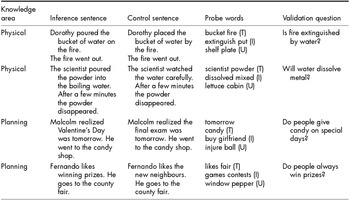
Examples of stimulus materials indicating two knowledge areas (physical versus planning), two sentence types (inference versus control), the probe word conditions (text (T) versus inference-related (I) versus unrelated (U), and knowledge validating questions (yes versus no).