In 2014 the World Health Organization declared the Ebola Virus disease outbreak in West Africa to be a public health emergency of international concern. The outbreak in the West African countries of Liberia, Sierra Leone, and Guinea has caused over 23,000 deaths and infected over 500 health workers. Ebola is highly contagious and spreads through contact with the body fluids of infected patients. The virus has caused devastating effects in the affected families and communities and produced serious economic consequences in the affected countries. In October 2014 a nurse in Spain and 2 nurses in the United States developed Ebola after caring for patients who had been transferred from West Africa. Media stories on Ebola increased, often providing information that was alarming and inaccurate.Reference Mira, Lorenzo and Gea 1
While no cases of Ebola occurred in New Zealand, the outbreak received intense coverage in mainstream and social media, which may have increased perceptions of risk. The public’s perception of risk, rather than actual risk, has been shown to be a major determinant of protective behavior following infectious disease outbreaks.Reference Weinstein 2 Evidence shows that the public are more likely to plan or to adopt protective behavior when they feel personally at risk, when the illness is seen as having severe consequences, when the infectious disease engenders high levels of anxiety, and when the health authorities are perceived as being unable to control the outbreak.Reference Rubin, Amlot and Page 3 - Reference Tang and Wong 6
Understanding how perceptions of risk about Ebola influence the adoption of protective behavior, such as using public transport, keeping children from school, and going to public events, may help health authorities understand the likely impact of an outbreak on a community. It may also help to target messages to the public to correct misperceptions about the efficacy of specific protective behaviors. This is of particular importance with regard to an Ebola vaccine, which may be available in the near future. 7 In this study we investigated public perceptions of risk from the Ebola outbreak, understanding of Ebola transmission, and the factors associated with anticipated protective behavior and vaccination in a cross-sectional telephone survey of the New Zealand general population.
METHODS
Participants
A representative sample of 750 members of the New Zealand population was recruited for the telephone survey by using random digit dialing by UMR Research. A nationally representative sample was achieved by using set quotas based on the age, gender, and regional distribution within New Zealand. Telephone interviews were conducted between February 12 and 19, 2015. From a total of 15,755 calls to residential landlines that were answered, 12,851 respondents declined to participate, 1603 stopped the interview or hung up partway through, 343 were excluded because of language difficulty, and 208 were excluded because the group to which they belonged was already sufficiently represented in the sample. This provided a final sample of 750 people that was representative of the population with regard to age, gender, and region of New Zealand.
Measures
Demographic Information
Information was collected on the participant’s gender, age group, region of residence within New Zealand, marital status, employment, education level, ethnicity, and household composition.
Views of Ebola
Participants were asked 5 questions about their knowledge of and concerns about the Ebola outbreak. First, How closely are you following news about the recent outbreak of Ebola in West Africa? Responses were on a 4-point scale from “not at all closely” (1) to “very closely” (4) or “I haven’t heard of Ebola.” Participants who gave the final response (n=6) were excluded from subsequent analyses. Second, participants were asked, How concerned are you that there will be a large outbreak inside New Zealand within the next 12 months? Responses were on a 4-point scale from “not at all concerned” (1) to “very concerned” (4) or “don’t know.”
Next participants were informed that “public health authorities have said that the risk of the Ebola virus spreading to New Zealand and causing an outbreak here is low” and were asked, How confident are you in this assessment? Response options were from “not at all confident” (1) to “very confident” (4) or “don’t know.” Participants were also asked, How confident are you that if the Ebola outbreak spread to New Zealand, that New Zealand hospitals and medical services could contain the outbreak and stop it spreading? Responses were from “not at all confident” (1) to “very confident” (4) or “don’t know.”
Finally, participants’ views of Ebola transmission were assessed by the following question, To the best of your knowledge, if a person is sick with Ebola and has symptoms, how easily is Ebola spread from that person to other people? Response options were “not very easily” (1), “somewhat easily” (2), “very easily” (3), or “don’t know.” For all of the above questions, participants who responded “don’t know” were not included in the regression analyses.
Understanding of Routes of Transmission
Participants’ understanding of the ways Ebola can be transmitted from one person to another was assessed by the question, To the best of your knowledge, which of the following methods can potentially spread the Ebola virus: by air, by water, by mosquitos, through contact with the sweat of a person infected with Ebola, through contact with urine or diarrhoea of a person infected with Ebola; through contact with the vomit of a person infected with Ebola; through contact with surfaces or material contaminated by a person infected with Ebola? Possible response options were “yes,” “no,” or “maybe.” Participants were classified as correctly identifying possible transmission routes if they answered “no” to the first three methods (air, water, and mosquitos) and if they correctly identified direct or indirect contact with the body fluids of a person infected with Ebola (sweat, urine or diarrhoea, vomit, and contaminated surfaces).
Protective Behavior
Participants were asked, If there was an Ebola outbreak in New Zealand, would this cause you to reduce any of the following activities: going to work; using public transport; flying domestically; flying internationally; going to public events such as movies, sporting events, or concert; going to hospitals or to the doctor; going into shops; sending my children to school or childcare? Response options were “yes,” “no,” or “maybe.”
Likelihood of Vaccination
Finally, participants were asked, If there was a safe and effective vaccination developed for the Ebola virus, how likely is it that you would choose to have this vaccine? Response options ranged from “not likely at all” (1) to “highly likely” (5), or “don’t know.” Participants who responded “don’t know” were not included in the regression analyses.
Statistical Analysis
Statistical analyses were conducted by using SPSS Statistics 22 (IBM Corp, Armonk, NY). Responses to questions about participants’ knowledge of and concerns about Ebola, knowledge of transmission routes, anticipated protective behaviors, and vaccination likelihood were assessed by frequency of each possible answer. Correct responses to questions about body fluid transmission and vector transmission were summed to give scores between 0 and 4, or 3, respectively. The affirmative responses to questions about protective behavior were summed to give a value between 0 and 8. Multiple regression analyses were then used to identify demographic variables and perceptions that were associated with reported intention to take protective actions during an outbreak and vaccination likelihood. Demographic predictor variables of age (four groups: 29 and under, 30 to 44, 45 to 59, and 60 and over), gender, and education (dichotomized to some or completed high school, and tertiary qualification) were entered into the model. Participants’ reported views of Ebola (following news, outbreak concern, confidence in health authorities’ assessment, confidence that health systems could stop spread, and ease of spread) were also entered. Finally, body fluid and vector transmission scores were entered. An alpha level of 0.05 was used for all statistical tests.
RESULTS
Sample Demographics
The sample comprised 750 participants: 359 male participants (48%) and 391 female participants (52%). A total of 14% were aged 29 years or less, 37% were aged 30 to 44 years, 19% were aged 45 to 59 years, and 30% were aged 60 and over. The participants’ first reported ethnicity was as follows: 72% New Zealand European, 10% Maori, 2% Pacific Island, 9% non-New Zealand European, 6% Asian, and 2% another ethnicity.
Knowledge of and Concerns About the Ebola Outbreak
The majority of participants reported that they had been following the news about the recent outbreak of Ebola in West Africa either very closely (21%) or somewhat closely (51%). Only 20% had not been following very closely, and 8% not at all closely. A small number of participants had never heard of Ebola (1%) and were excluded from further analyses. A large majority of participants reported that their primary source of information about Ebola was the news media (87%), followed by social media sources (5%). When a secondary source of information was reported, it was mostly social media (10%).
After establishing the level and type of information seeking, participants were asked about their level of concern that there would be a large Ebola outbreak in New Zealand within the next 12 months. The majority of respondents were not very concerned (41%) or were not at all concerned (30%). Just over one-fifth of participants (21%) reported being somewhat concerned, and 7% were very concerned. Three participants were unsure when asked about their level of concern about a potential Ebola outbreak.
Participants were also asked about their level of confidence in the assessment by public health authorities that the risk of an Ebola outbreak in New Zealand was low. The majority of participants had high levels of confidence in this assessment, reporting being very confident (48%) or somewhat confident (41%). A minority of respondents were not very confident (8%), not at all confident (2%), or unsure (1%). Levels of reported confidence that New Zealand hospitals and medical services could contain an Ebola outbreak were not as high, with 23% of participants reporting being very confident and 46% somewhat confident. However, a relatively large proportion reported being not very confident (23%); 6% were not at all confident, and 2% were unsure.
The majority of respondents (52.1%) reported that the Ebola virus could be spread very easily from person to person. One-third (33.3%) responded that the virus could be spread to others somewhat easily. Only 10.3% believed that it was not very easy for the Ebola virus to spread from person to person, whereas 3.5% were unsure.
Knowledge About Ebola Transmission
The majority of participants correctly identified contact with urine or diarrhea (84.8%) and vomit (87.2%) of an infected person as methods that can potentially spread the Ebola virus. A smaller proportion of respondents knew that Ebola can be spread by contact with the sweat (68.4%) or contact with surfaces or material contaminated by an infected person (69.2%). Participants had the least accurate knowledge about air (52.7%), water (42.4%), and mosquitos (50.7%) not being methods that can potentially spread Ebola.
These responses were summed to form 2 knowledge variables: (1) accurate knowledge of body fluid transmission (the number of correct “yes” answers provided to questions about the spread of Ebola via urine or diarrhea, vomit, sweat, and contaminated surfaces), and (2) accurate knowledge of vector transmission (the number of correct “no” answers provided to question about whether the Ebola virus can be spread via air, water, or mosquitos). For body fluid transmission, knowledge was relatively high; 46.9% of participants correctly answered all 4 questions, 30.3% identified 3, 13.2% identified 2, 4.9% identified 1, and only 4.3% of respondents were not able to correctly identify any sources of bodily fluid transmission of the Ebola virus.
Fewer participants held correct knowledge about vector (air, water, mosquitos) transmission of Ebola (ie, that the virus is not transmitted in these ways). Approximately one-quarter of participants correctly identified that none of these were routes of transmission (23.8%), 25.2% of participants correctly identified 2, 24.7% only correctly identified 1, and 26.1% responded that all 3 could spread the Ebola virus.
Protective Behaviors in the Event of an Outbreak
High numbers of the population reported that they would reduce their activities to potentially limit their exposure to the virus. As shown in Figure 1, almost one-quarter (23%) reported that they would reduce going to work, 49% would reduce their use of public transport, and 45% and 57% would reduce domestic and international flights, respectively. Around one-half of respondents (53%) said they would reduce their attendance at public events such as movies, sporting events, or concerts; 43% would avoid hospitals or going to the doctor; 36% would reduce going into shops; and 42% would try to avoid sending their children to school or childcare.
Percentage of Respondents Intending to Stop Activities to Avoid Potential Contact With Ebola Virus.

Predictors of Protective Behaviors
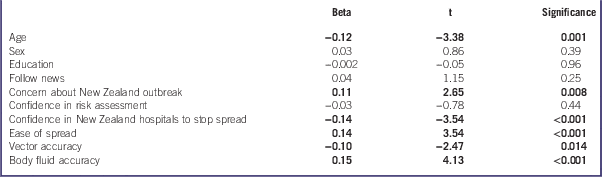
A multiple regression analysis was carried out to assess the influence of demographic variables, perceptions of Ebola, and accuracy of knowledge about transmission on the number of protective behaviors that participants reported they would engage in if there were an Ebola outbreak. The demographic variables of age, sex, and education alone predicted a significant amount of the variance in the number of protective behaviors reported, F(3, 692)=6.07, P<0.001, R2 adj=0.021. The addition of the participants’ perceptions of Ebola and knowledge of transmission predicted a significantly greater amount of variance than did demographics alone, Fchange(5, 687)=16.70, P<0.001, R2 change=0.11. The overall model predicted a significant amount of variance in the number of intended protective behaviors, F(8, 687)=12.97, P<0.001, R2 adj=0.121. Greater age was significantly associated with fewer protective behaviors. Greater concern about a New Zealand outbreak, lower confidence in New Zealand hospitals and medical services to contain the virus and stop it spreading, and beliefs that Ebola is easily spread from person to person were associated with higher numbers of intended protective behaviors. Greater knowledge about body fluid transmission of Ebola was associated with increased protective behaviors, whereas knowledge that Ebola is not spread by water, air, or mosquitos was associated with fewer protective behaviors (Table 1).
Results of Final Multiple Regression Model: Variables Predicting Total Number of Intended Protective BehaviorsFootnote a

a Significant values are in bold.
Vaccination Likelihood
A large proportion of the sample reported that it was highly likely (28.3%) or very likely (17.9%) that they would choose to have an Ebola vaccination if a safe and effective vaccine were developed. Another quarter of respondents (27.5%) reported it being somewhat likely that they would get vaccinated. However, the final quarter of respondents reported that it was not very likely (16.0%) or not at all likely (8.6%) that they would get an Ebola vaccine if it were available.
Predictors of Vaccination Likelihood
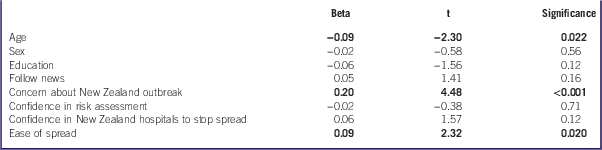
A multiple regression analysis was carried out to assess the influence of demographic variables and perceptions of Ebola on the reported likelihood that participants would get an Ebola vaccination. The demographic variables of age, sex, and education alone predicted a small but significant amount of the variance in reported vaccination likelihood, F(3, 682)=2.68, P=0.046, R2 adj=0.007. The addition of the participants’ perceptions of Ebola predicted a significantly greater amount of variance than did demographics alone, Fchange(5, 677)=7.52, P<0.001, R2 change=0.052. The overall model predicted a significant amount of variance in vaccination likelihood, F(8, 677)=5.80, P<0.001, R2 adj=0.05. Higher age was associated with lower vaccination likelihood. Greater concern about a New Zealand outbreak and beliefs that Ebola is easily spread from person to person were associated with greater reported vaccination likelihood (Table 2). Adding knowledge of transmission routes to this model did not result in a significant increase in predicted variance accounted for in vaccination likelihood, Fchange(2, 675)=1.26, P=0.28, R2 change=0.003; thus, it was not included in the final model.
Results of Final Multiple Regression Model: Variables Predicting Vaccination LikelihoodFootnote a

a Significant values are in bold.
DISCUSSION
This survey was conducted in February 2015, when approximately 23,250 cases of Ebola had occurred in Africa, causing approximately 9380 deaths. 8 We found that most New Zealanders had been closely following stories about Ebola in the news media. The majority of respondents were not concerned that there would be a large outbreak of Ebola in New Zealand and were confident that New Zealand medical services would be able to prevent the spread of disease. However, approximately 7% of the sample was very concerned that there would be a large outbreak inside New Zealand within the next 12 months, and 30% were not confident that New Zealand hospitals and medical services would be able to contain an outbreak and stop it spreading within New Zealand. A large amount of misinformation was held about the transmission of the virus. Less than half of all participants (46.9%) could correctly identify all 4 body-fluid-related methods by which Ebola can be transmitted, and only one-quarter (23.8%) correctly stated that Ebola cannot be spread via air, water, and mosquitos.
Almost half of respondents reported that if there were an Ebola outbreak in New Zealand, they would avoid using public transport, attending public events, and sending their children to school. A lesser proportion reported that they would avoid going to work and going into shops. In the event of an actual Ebola outbreak, people might not act as they have predicted. However, even if the proportion of New Zealanders who actually would have responded in these ways to a local outbreak was only one-tenth of those who indicated an intention to change their usual behavior, the impact on New Zealand communities and the economy would be extremely disruptive. We found that the total number of protective behaviors that respondents reported they would adopt in the event of an Ebola outbreak in New Zealand, and likelihood of vaccination, was significantly related to both their level of concern that there would be a large Ebola outbreak in New Zealand in the next 12 months and perceptions of the ease with which Ebola can be transmitted. Protective behaviors were also associated with greater knowledge of possible routes of body fluid transmission of the virus.
Our findings are consistent with previous studies looking at the relationship between perceptions of risk and the likelihood of engaging in protective behavior during a pandemic.Reference Rubin, Amlot and Page 3 - Reference Tang and Wong 6 , Reference Liao, Cowling and Lam 9 A recent study in Sweden investigated the self-reported intentions of Swedish adults with regard to social distancing in the event of an influenza outbreak.Reference Timpka, Spreco and Gursky 10 That study found that approximately 10% of subjects indicated they would stay home when not ill, and approximately 25% reported an intention not to use public transport during a future influenza outbreak. Subjects who reported an intention to engage in these social distancing behaviors were more likely to have higher levels of anxiety about catching influenza and about the severity of subsequent illness.
Similar patterns are seen when we compare the results of this survey with other studies of public perceptions about Ebola. The level of concern about an Ebola outbreak was comparable to a survey conducted in Israel (another unaffected country) around the same time.Reference Gesser-Edelsburg, Shir-Raz and Hayek 11 Our finding that knowledge that Ebola is not spread by water, air, or mosquitos was associated with fewer protective behaviors is consistent with a recent US study showing that individuals who were more knowledgeable about Ebola transmission had fewer concerns about contracting the virus.Reference Rolison and Hanoch 12 A recent German study of Ebola risk perceptions also found high rates of protective behaviors to avoid contact with the virus including cancelling flights and avoiding public transport.Reference Rübsamen, Castell and Horn 13 A recently published US survey found relatively high rates of protective behavior even without an Ebola outbreak in that country, with 22% saying they would avoid public transportation during the holiday season and 10% saying they would avoid public places.Reference Kelly, Squiers and Bann 14
Our findings have implications for public health communications in the event of similar future health threats, particularly concerning the ability and the public’s perception of the preparedness of medical services to contain the outbreak. Providing frequent, reliable estimates of the likelihood of a threat spreading may help to reassure those who become unduly fearful in response to news media reports from overseas. A priority for public health messages in relation to future health threats should be to provide frequent, realistic estimates of the likelihood of the threat occurring and to repeatedly emphasize the preparedness and ability of the national health system to contain and manage the health threat.
The other significant association with the total number of protective behaviors that respondents reported they would adopt in the event of an Ebola outbreak was with the age of the respondent. Special efforts to target public health messages at young people may reassure this population group and thus reduce the proportion who may consider adopting unnecessary protective behaviors. Increased use of social messaging and other innovative communication strategies may enhance the delivery of health messages to younger population groups.
The limitations of the study should be noted. Although collection of the telephone survey was based on a representative sample of the New Zealand population in terms of age, gender, and region, it was limited to those who had phone access and therefore may not be representative of the population as a whole. In addition, the current study was limited by a relatively low response rate. However, research shows that even in telephone surveys with low response rates, if the sample is representative of the population, the data collected are still likely to be accurate. 15 Furthermore, the study was conducted over a short period of time and attitudes and risk perceptions about the Ebola virus may have changed subsequently in response to recent information or media stories. Bearing those limitations in mind, our study suggests that protective behavior in response to an Ebola outbreak is likely to cause major disruption to public services and to have serious economic consequences. The results of this study suggest first that the efforts of health authorities should be directed toward reducing the level of misinformation and inaccuracy about the way the virus is transmitted. Second, providing frequent and realistic estimates of the likelihood of a virus outbreak or the threat of spreading would help to reduce public anxiety. Third, increased use of social media to provide information on the virus would help to reach younger members of the population who have higher levels of concern. Finally, greater attention to communication about the ability and preparedness of medical services to contain the outbreak is likely to mitigate at least some of the unnecessary protective behaviors planned by the public.
Funding
A+ Trust Research Fund.